
InspectAPedia® FREE Encyclopedia of Building & Environmental Construction, Diagnosis, Maintenance & Repair |
Question? Just ask us! InspectAPedia
|
 Heating Oil & Fuel Oil Properties Guide
A Description of Petroleum-based Fuels & Their Characteristics
- POST a QUESTION or COMMENT about different types of petroleum based fuels: kerosene, home heating oil, jet fuel, diesel fuel, etc.
Properties of heating oil & related petroleum-based fuels:
Types of heating fuels & other petroleum based fuels such as kerosene, diesel fuel, home heating oil: This article describes the different petroleum-based puels and their characteristics.
Are some of these petroleum based fuels interchangeable? We compare the specific gravity and pour point of various oil fuels, kerosene, heating oil. We explain how to use a hydrometer or the Friedman freeze test to distinguish kerosene from heating oil.
We also describe problems with heating system reliability when certain heating oil additives are used or when sediment is stirred as empty or very-low-level oil tanks are re-filled.
This article series answers most questions about all types of heating systems and gives important inspection, safety, and repair advice.
InspectAPedia tolerates no conflicts of interest. We have no relationship with advertisers, products, or services discussed at this website.
What are the Different Petroleum-based Fuels and What are their Characteristics?
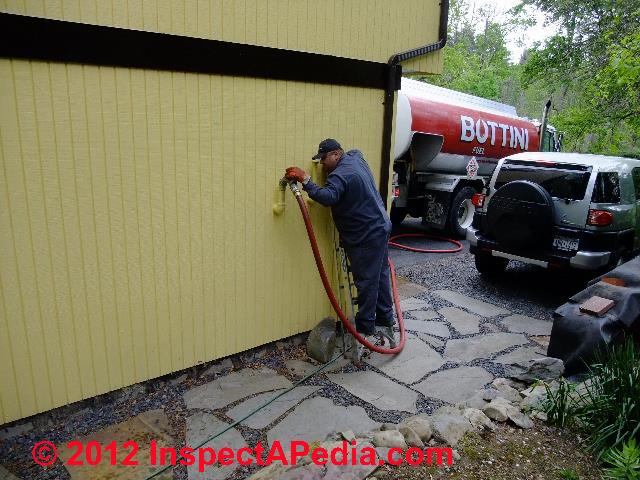 The article below describes the differences among these various diesel fuels, oil fuels & heating oil fuels, arranged in our list from "lightest" to "heaviest" are in the types of hydrocarbon chains that are distilled out of the crude oil during refining (and also that some of these fuels may contain other additives.
Article Contents
Definitions of Types of Fuel Oils
- Biodiesel: sold in percentage mixtures with No. 2 home heating oil as a heating fuel or bioheat, in mixtures with diesel fuel as a vehicle fuel, as well as in pure form B-100.
See BIODIESEL HEATING FUELS
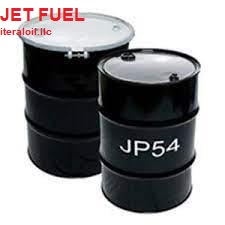
- Jet Fuel type A basically Kerosene, or filtered #1 oil cleaned up to higher specifications including very fine filtering (through diatomaceous earth) and a water removal step.
The kinematic viscosity of jet fuel at at -34.4°C is 7.9 cSt or 52 SSU. - Kerosene is #1 oil which has been filtered to clean it up. Sold at ridiculously higher prices in stores as "lamp oil" this material may have deodorants or fragrances added.
A traditional name widely used as a synonym for kerosene is "coal oil", though kerosene is in fact a petroleum product while original coal-oil is or was made from coal. True coal oil was a different product listed separately below.
The specific gravity of kerosene at 25°C = 0.8
The viscosity of kerosene at at 20°C is 2.71 cSt or 35 SSU.
The viscosity cP of kerosene at 40°C = 1.3 - 2.1 with an API gravity of 38-45.
Synonyms for Kerosene include: Kerosine; Coal Oil; Range Oil; Astral Oil; Mineral Seal; Mineral Colza; Range Oil JP-2; Jet Fuel JP-1; Navy Fuel JP-5; JP-5 Navy Fuel; JP-5; Kerosine petroleum; petroleum fuel; fuel oil, no.5; residual oil no.5; Marine Diesel Fuel and JP-5 Navy Fuel;
Jet A fuel; Deodorized base oil; Deodorized kerosene; Petroleum base oil; Kerosine Burner Fuel; Lamp oil; Sweetened kerosine (CAS91770159); Hydrodesulfurized kerosine (CAS64742810); Hydrocracked kerosine (CAS101316807)- Coal oil: Coal oil, or "original" coal oil was produced by the distillation of one of three raw materials: bituminous shale, cannel coal, or mineral wax.
Chemically coal oil is similar in properties to kerosene and the terms are often used synonymously, but at least in the early use of the term, "coal oil" fuel was not refined from crude oil distillation as is modern "kerosene".
Adding to the ambiguity of use of "coal oil" and "kerosene", "cannel coal" itself is described as both "bituminous coal" and as "oil shale".
The boiling point of coal oil is 175-325°C
Clean-burning coal oil competed with whale oil beginning in the 1850's and was produced first in Scotland but at nearly the same time in the U.S., Australia, and other countries.
The confusion of coal oil with "kerosene" is understandable thanks to Canadian A. Gesner whose coal-oil production process produced coal oil that was in fact marketed under the trade-name "Kerosene".
Following the development of the U.S. oil fields in Pennslvania beginning in 1859, in North America coal oil was largely replaced by more inexpensively-produced petroleum distillates including what is currently still called "kerosene". Thanks to reader J.G. who commented about coal oil:
In Australia in the 20th century, a LOT of kerosene was made from coal. Also, coal is not far removed from being a petroleum product. It's definitely a fossil fuel. Just in solid form, not black sludgy stuff. - J.G., 6/19/2015
- Coal oil: Coal oil, or "original" coal oil was produced by the distillation of one of three raw materials: bituminous shale, cannel coal, or mineral wax.
- Cannel Coal: or boghead or sapropelic coal is a comparatively clean-burning coal used both as a fuel and light source and as a source of coal oil.
... the higher-grade cannel coals yield a variable but always larger percentage of the coal gas, coal oil, and ammoniacal liquor - (Ashely 1918)
Cannel coal itself burned relatively cleanly (without smoke) which may explain its name as a variation of "candle" - (Arkell 1953)- Arkell, William Joscelyn, and Sergei Ivanovich Tomkeieff. English Rock Terms: chiefly as used by miners and quarrymen. Oxford University Press, 1953.
- Ashely, George H., "Cannel Coal in the United States", [PDF] Bulletin No. 659, US Geological Survey, 1918.
- Wilson, Graham, "Cannel Coal: Black Gold of the 19th Century", retrieved 10 Oct 2015 original source: http://www.turnstone.ca/cannel.htm
- Case Oil: beginning in the 1890's, early in the life of the oil refining industry, some refiners, including Standard Oil, sold kerosene shipped in five-gallon tins packed and "canned" in their own canneries.
The five-gallon tins of case oil were in turn packed for shipment into wooden crates. Packed and shipped in this fashion the kerosene was widely referred to as case oil. Case oil was sold in very large volumes in the Asian markets. - #1 fuel oil is more refined than #2 oil, has a lower pour point (or gel point or waxing point), is less viscous, has a higher septane rating and contains fewer BTU's per gallon than #2 heating oil. No. 1 fuel oil is quite similar to kerosene and is the fraction that boils off during oil, refining right after gasoline.
The viscosity of No. 1 Fuel oil at 21.1°C is 2.39 - 4.28 cSt or 34-40 SSU. - Diesel fuel used in diesel powered vehicles and some other engines, is basically #2 home heating oil.
But in the U.S. and other countries, home heating oil has dye added in order to distinguish it from un-taxed or lower-taxed fuels from un-dyed and higher-taxed diesel fuels used for over-the-road vehicles.
Use of dye in diesel fuels: Un-taxed diesel is "dyed" and taxed diesel (that is, by a vehicle fuel tax) is not-dyed. In an emergency if you're out of home heating oil you can drive to the "gas" station to purchase diesel fuel (but you'll pay more since it's taxed).
In the U.S. "red diesel" is used to identify high-sulfur diesel fuel for use in off-road equipment and machines.The I.R.S. requires a red dye in tax-exempt diesel fuel such as that used for home heating.
Also in the U.S. blue die is added to diesel fuel used by government vehicles. In the U.K. "red diesel" is agricultural and other off-road vehicles and machines.
In the E. U. a solvent yellow 124 dye is added to un-taxed fuels - it can be detected by an acid-test. Removing dye from diesel fuels is illegal.
Does diesel fuel dye affect its performance? There have been questions raised about whether or not the use of marker dyes in diesel fuel affect its performance.
To date we have not found analysis nor tests which confirm that there is a measurable effect on fuel atomization nor burn in home heating systems. In other words, apparently not. Diesel fuel dye does not affect the performance of the fuel. A question about the effect of dyes on jet engines was raised in a New York Times article in 1997.
Dyes used in petroleum fuels are described in detail later in this article. - Diesel fuel Winter Blend combines Diesel fuel with about 10% to 20% #1 oil to avoid waxing or gelling of the fuel. The septane rating of winter blend diesel fuel will usually be above regular diesel fuel when a septane-booster additive has been included.
A synonym for diesel fuel is No. 2 fuel oil.
Reader Herman Vogel points out that adding a higher septane #1 fuel (kerosene, for example) to a lower septane #2 fuel, makes the mixture higher in septane.
Also see Mr. Vogel's
COMPLETE COMBUSTION, Stoichiometric for an explanation of complete fuel combustion and boiler or furnace maximum efficiency.
If you are unable to obtain a winter mix of diesel fuel and are facing cold temperatures, additives are sold for consumer use, to be poured into diesel fuel to avoid waxing or cold-filter plugging, such as Diesel 9.1.1® sold by Power Service Products.
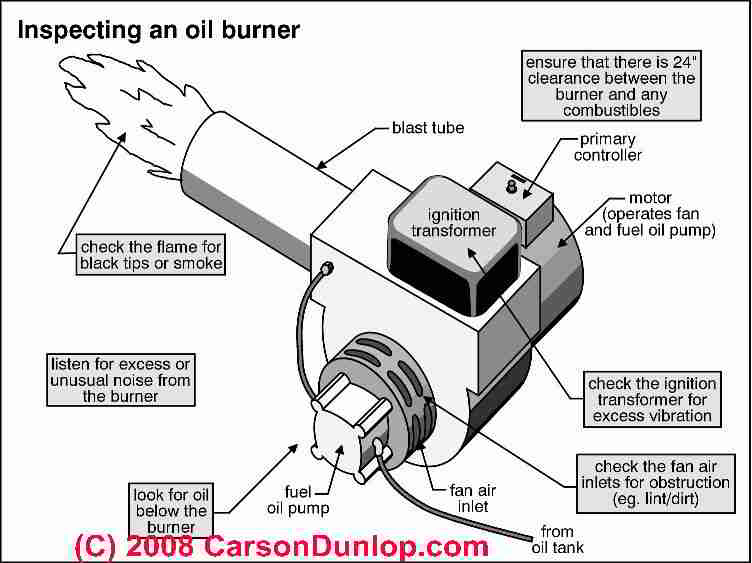
Note that some texts refer to the diesel fuel or home heating fuel waxing point as the Cold-Filter Plugging Point or CFPP. (The sketch of an oil burner (below) is courtesy of Carson Dunlop Associates, a Toronto home inspection, education & report writing tool company [ carsondunlop.com ]. )
For its Chinese trademark and brand Standard Oil adopted the name Mei Foo (Chinese: 美孚), (which translates to American Trust). Mei Foo also became the name of the tin lamp that Standard Oil produced and gave away or sold cheaply to Chinese farmers, encouraging them to switch from vegetable oil to kerosene.
Response was positive, sales boomed and China became Standard Oil's largest market in Asia. - "Standard Oil in China", Wikipedia, retrieved 2016/06/10, original source: https://en.wikipedia.org/wiki/Standard_Oil#Standard_Oil_In_China
A fictional account of that case oil market describes it as well, illustrating that case oil remains in contemprary literature as an important product and important era in the history of oil refining:
So-called case oil was kerosene shipped in gallon tins [sic] packed in wooden boxes. ... Chinese and Indians burned the oil in their lamps and used the wood and tin to built their huts [sic], shingle their roofs, make cooking pots and pitchers.
Sir Marcus Samuel, the all-powerful English distributor of case oil to India and China, had visited ... offices in great secrecy in 1901 to negotiate some sort of partnership. - Cussler, Clive, "The Assassin", Putnam Press 2015.
- Home Heating Oil Winter Blend combines #2 heating oil with #1 oil (often called a "kerosene mix" by the heating oil distributor) (Copyright violation protection insert:
this text is ©InspectAPedia.com) for use at homes with outdoor oil tanks in freezing climates. Kerosene mix is usually 10 - 20% #1 with #2 similar to the Winter Blend Diesel described above. - Home Heating Oil also referred to as #2 Fuel Oil or by some writers as Regular Fuel Oil.
Number of BTUs in a gallon of home heating oil: One gallon of No. 2 home heating oil will provide about 138,500 BTUs per gallon.
How flammable is home heating oil?: it's not that easy to set on fire. If you were to toss a match into a bucket of No.2 home heating oil the match will just go out. (DO NOT TRY THIS AT HOME.)
An oil burner uses a high voltage spark to ignite heating oil after the oil has been pressurized to 100 to 120 psi or more and then atomized by passing through the oil burner nozzle.
The kinematic viscosity of No. 2 fuel oil at 40°C= 1.9 - 3.4 mm2/s
The viscosity of No. 2 fuel oil at 21.1°C is also given as 3.0 - 7.4 cSt or 36-50 SSU. - #3 fuel oil is a distillate fuel oil that is not in wide use.
- #4 fuel oil (bunker oil) is used in large stationary engines, power plants, and very large commercial boilers.
No. 4 oil when burned as heating fuel may contain several contaminants including nickel and sulphur.
No. 4 fuel oil is typically produced by blending distillate along with residual fuel oils such as No. 2 and No. 5. Synonyms for No. 4 fuel oil include bunker oil, heavy distaillate, diesel ditillate, or residual fuel oil.
The kinematic viscosity of No. 4 light fuel oil at 40°C= 1.9 - 5.5 mm2/s
The kinematic viscosity of No. 4 fuel oil at 40°C= 5.5-24 mm2/s - RM oil is used as fuel by diesel locomotives and is a mix of #4 and #2 oils with some other refining differences
- #5 fuel oil is a mixture of 75-80% No. 6 fuel oil and 25-20% No. 2 fuel oil.
- #6 oil is used to make asphalt for paving and is burned in some large commercial boilers. No. 6 oil, like No. 4, when burned as heating fuel may contain several contaminants including nickel and sulphur.
Synonyms for No. 6 fuel oil include residual fuel oil or RFO, heavy fuel oil or HFO. No. 6 fuel oil is the remainder of a petroleum fuel distillation process after gasoline and the distillate fuel oils listed above have been boiled off or distilled.
No. 6 fuel oil may be used in electrical power generators and some heavy duty engines.
The viscosity of No. 6 Fuel oil at 50°C is 97.4 -660 cSt or 450-3M SSU.
Note: in April 2014 the New York Times reported that New York City is three years into a 4-year plan to phase out the use of No. 6 fuel oil from use in building heating systems but that by April 2014,
... three years into a four-year plan to phase out No. 6 [fuel oil] barely more than half of the buildings that were burning it have switched to cleaner oil, and of those that have stopped using No. 6, hundreds have switched to No. 4 [heating oil], which though permitted for another 16 years [until 2030] can br only slightly less noxious, depending on the supplier. - The New York Times (4/7/2014).
The Times article explained that in addition to the lack of natural gas supply to some buildings, expense in converting from No. 4 fuel oil or No. 6 oil to cleaner-burning No. 2 heating oil is a major obstacle for many building management companies.
Boiler conversion costs were reported costing between $5,000 and $17,000., and chimney relining needed at some fuel conversions can cost as much as $10,000. per floor. New York City created a fund to help building owners finance the required changes.
What this all means is that the heavier petroleum based fuels (higher numbers) have longer hydrocarbon chains than the lower number fuels, they have more BTUs per gallon, they will be more viscous (and often dirtier or will contain more contaminants including environment-polluting sulphur).
It is not helpful to order and burn Kerosene #1 over #2 fuel oil except in outdoor aboveground oil tanks in areas subject to temperatures below 16 °F.
Improved Properties of Modern Low-Sulphur Home Heating Oil
Now that home heating oil is required to be low in sulphur, heating service technicians report the following observations
- Oil fired heating equipment is running cleaner than ever, with fewer oil burner problems traced to "dirty" oil
- The oil company is seeing fewer no-heat calls
- The low sulphur oil resembles "kerosene" - it has an improved pour point property (as if a pour point depressant had been added) that in turn means fewer no heat calls traced to waxing or gelling heating oil. However building owners whose oil fired heating equipment is fueled by outdoor oil storage tanks still are buying a kerosene mix.
- There may be damage to the gaskets on certain brands or models of heating equipment (e.g. some Riello™ oil burner parts), but on most oil burner equipment gaskets and parts vulnerable to this change in heating oil properties had already been updated. - [Bottini to DF Oct 2013 personal communication - Bob]
Dyes used in oil fuels
- Europe, rebated fuels are dyed with Solvent Yellow 124 ("Euromarker")
- U.S. low-tax fuels, high-sulfur fuels (note the "high sulfur" regarding the stain discussion below) are dyed with Solvent Red 26 3.9lbs per 1000 barrels, or Solvent Red 164
- Worldwide, aviation gasoline is dyed according to its type: Aviation gasoline 80/87 has red dye while Aviation gasoline 82UL is coloured by a purple dye
Research on dyes in oil fuels and in biodiesel:
- RUST STAINS on ROOFS - includes in FAQs discussion of role of red dye in home heating oil
- Figueira, Ana Cecília B., Kleber T. De Oliveira, and Osvaldo A. Serra. "New porphyrins tailored as biodiesel fluorescent markers." Dyes and Pigments 91, no. 3 (2011): 383-388.
- Moses, C. A. The Evaluation of Red-Dye Contamination in Jet Fuel and the Identification of a Screening Method for Thermal Stability Issues.[PDF] FAA Report DOT/FAA/AR-10/15, 2010.
Abstract: An experimental study was conducted to quantify the effects of red-dye contamination on the thermal stability of jet fuel and subsequent fouling rates of critical fuel system components.
The effect of red-dye contamination on fouling rate is linear, but each nozzle has a different slope. A concentration of 0.55 mg/L caused a four-fold increase in the fouling rate of the most sensitive nozzle.
The effect of a concentration just above the visible level, 0.055 mg/L, was measurable. The results are to be used by the aircraft engine manufacturers to define the minimum acceptable level of red-dye contamination in jet fuel.
A methodology was developed based on the determination of the fouling rate of fuel nozzles, which can be used to evaluate the effect of additives and contaminants. - Suwanprasop, Somsaluay, Thumnoon Nhujak, Sophon Roengsumran, and Amorn Petsom. "Petroleum marker dyes synthesized from cardanol and aniline derivatives." Industrial & engineering chemistry research 43, no. 17 (2004): 4973-4978.
- Suwanprasop, Somsaluay, Sasitorn Suksorn, Thumnoon Nhujak, Sophon Roengsumran, and Amorn Petsom. "Petroleum markers synthesized from n-alkylbenzene and aniline derivatives." Industrial & engineering chemistry research 42, no. 21 (2003): 5054-5059.
- Trindade, Magno Aparecido Gonçalves, and Maria Valnice Boldrin Zanoni. "Voltammetric sensing of the fuel dye marker Solvent Blue 14 by screen-printed electrodes." Sensors and Actuators B: Chemical 138, no. 1 (2009): 257-263.
- Trindade, Magno Aparecido Gonçalves, Valdir Souza Ferreira, and Maria Valnice Boldrin Zanoni. "A square-wave voltammetric method for analysing the colour marker quinizarine in petrol and diesel fuels." Dyes and pigments 74, no. 3 (2007): 566-571.
Definitions of Octane and Septane
It is helpful to understand why we talk about septane ratings for diesel fuel rather than diesel fuel octane ratings. Octane ratings for fuels focus on how smoothly the fuel burns, not its energy content.
Octane ratings are important for high compression engines such as many modern gasoline engine-driven automobiles because under high compression a lower-octane fuel will not burn evenly, causing knocking (or detonation, knocking means that there is partial and uneven "premature-explosion" of parts of the fuel charge) that can actually damage an engine.
Common octane boosters include MTBE, ETBE, isooctane, toluene, and previously, lead.
Octane: eight carbon atoms in molecular structure
Septane: seven carbon atoms in molecular structure - see Heptane just below.
Heptane: is the zero point of the octane rating scale.
Heptane is "any one of several isometric hydrocarbons, C7H16, of the paraffin series (nine are possible, four are known); - so called because the molecule has seven carbon atoms. Specifically, a colorless liquid, found as a constituent of petroleum, in the tar oil of cannel coal, etc." - Websters Dictionary
Iso-Octane: is the 100 point on the octane rating scale
A simplified explanation of the difference in these measures is that octane rating describes how evenly a fuel burns, not how easily it ignites, or according to some sources (since a more even burning fuel may be harder to ignite), octane measures how hard it is to ignite a fuel while septane rating measures how easy it is to ignite a hydrocarbon fuel.
In other words, a higher octane fuel is harder to ignite, but burns more evenly than a fuel that is similar but lower in octane.
Note: measuring fuel oil viscosity is generally based on ASTM D396, measurement with SVM 3000
How to distinguish between K1 kerosene and #2 No2 home heating oil
Reader Question: I have a question I just can't find the answer to anywhere. I work for an oil company that delivers home heating oil. We usually haul K1 kerosene and #2 heating oil at the same time. And we run several trucks.
Both of these petroleum fuels are dyed red. And we are "often" in a situation where we don't know if a truck compartment has K1 or #2 oil in it. They look virtually the same. How can you tell one from the other? Please respond to this question. Thank you, L.M.
Reply: Identifying petroleum fuels by density or specific gravity or by their waxing point at cold temperatures: using a hydrometer
K1 (kerosene) and No.2 home heating oil look the same, and indeed a mix of K1 and No.2 is sold by some oil companies for use in outside home heating oil tanks to avoid waxing or jelling problems in cold weather.
These two fuels look the same to the naked eye, they smell about the same, and are from a very similar origin in the oil refining process (K1 is lighter and comes off before No. 2 heating oil during the refining process). And as we explain in the oil fuels article above, the I.R.S. requires a red dye in tax-exempt diesel fuel such as that used for home heating.
With that background, I can think of two ways that one can, without very sophisticated analysis, distinguish between kerosene and No. 2 home heating oil.
Fuel density or specific gravity: Kerosene vs. home heating oil
Density or specific gravity measurements are made on a scale that uses the density of water as a comparison point. Water has a density of 1 gram/cm3 at 4 °F. That's our yardstick. A suitable hydrometer can measure a liquid’s specific gravity.
A hydrometer is a hollow, sealed, calibrated glass tube, a float, and a scale.
An old hydrometer that was very common was one used to check the antifreeze in an automobile. The hydrometer had a rubber bulb on one end and intake on its open end. The bulb was squeezed to suck antifreeze mix into the tube where the float would rise to mark a point on a scale.
The scale in that hydrometer was printed to report common densities of the water-antifreeze mix that in turn would read out the lowest temperature at which the mix would remain unfrozen.
In sum, the depth to which the hydrometer sinks is inversely proportional to the liquid’s specific gravity. So all we need is help from an equipment supplier who can sell you a hydrometer with the proper weight and scale to read the specific gravity or density range of heating oils or kerosene.
A quick sample and a quick read on the scale and you'll know what you've got.
You can see from our table below that with only a very small chance of overlap, the specific gravity or density of kerosene averages about 0.81 while No. 2 heating oil will be around 0.90.
There are two types of hydrometers: the rubber bulb and suction tube type I described above (used for antifreeze testing in my example) and a simpler float with a graduated scale, or a "float hydrometer".
To use a bulb hydrometer you simply use the suction bulb to draw a liquid sample up into the tube sufficient to float the float and read the scale.
To use a float hydrometer you put your liquid sample into a clean glass container (such as a beaker) and place the floating hydrometer into the liquid with its scale rod pointing down and its weighted bulb "down".
Depending on the density of the liquid the hydrometer will sink to a particular depth. You will be able to read the specific gravity or density of your liquid sample right on the scale of the float hydrometer's rod.
Where to buy a hydrometer and what type of hydrometer to purchase
Hydrometers are not expensive: you'll find models under $10.00 U.S. You'll find them online from many suppliers as well as in stores such as WalMart and even some grocery stores. But see our warning just below.
Watch out: for testing petroleum products like kerosene or heating oil, when you buy a hydrometer you'll want one whose scale reads from one and below - since we are reading the density of liquids that will be less than water. (By the way, that's why water that leaks into an oil tank is found at the tanks' bottom - the water is heavier than the heating oil so sinks below it to rest on the tank bottom.)
You do not want a wine making hydrometer for oil product testing as the scale won't serve our purposes. A wine making hydrometer such as the nice Rite-Brew model has a scale of .990 - 1.160 - no good for our purposes. But some multi-scale hydrometers may indeed work fine for our needs.
For measuring oil products you will want to find a "Low-STK" lab-grade hydrometer that measures specific gravities less than 1, i.e. in the range of our chart below - noting that all of the measurements will be at numbers less than one and more than 0.6.
Suppliers of petroleum hydrometers useful for the petroleum industry include
- Brannon hydrometer for petroleum density ranges, Fisher Scientific, website: http://www.fishersci.com
- Stevenson Reeves, Ltd., a U.K. company, 40 Oxgangs Bank, Edinburgh, Scotland, EH13 9LH phone +44 (0)131 445-7151 website: http://www.stevenson-reeves.co.uk/hydrometers/LAOP.htm "BS 718 hydrometers in the SP series are available in ranges measuring from 0.600 to 1.100 g/ml at 15°C."
- Search the web for buy hydrometer for petroleum products - you'll find a stunning number of suppliers of hydrometers calibrated in the range needed for examining kerosene, home heating oil, diesel fuel, etc.
Table of Specific Gravity of Common Petroleum-Based Fuels
| Petroleum Product (or other) | Specific Gravity | Gravity API | Viscosity, SSU @ 100° F. | Cloud Point |
|---|---|---|---|---|
| Gasoline | 0.71 - 0.79 |
|||
| Kerosene | 0.78 - 0.81 [3] |
40 |
33 |
-40 F |
| Diesel Fuel Oil | 0.82 - 0.95 |
37 |
35 |
16 F to -15F |
| Home Heating Oil | 0.82 - 0.95 |
34 |
35 |
16 F to -15F |
| Heavy Fuel Oil | 0.92 - 0.99 |
|||
| Water | 1 |
Notes to the table above
If purchasing a hydrometer to test petroleum products be sure the unit you buy measures in the specific gravity ranges shown above.
Fuel waxing under cold conditions: kerosene vs. home heating oil identification by the friedman-freezer-test
The cloud point for a petroleum product or fuel is generally described as the temperature at which small solid crystals are first visually observed as the fuel cools. This is the point at which the flow of the fuel through piping and equipment begins to be affected.
"Cold filter plugging" is the point at which a fuel filter (or heating oil tubing or filter) will plug and fuel will cease to flow. This is a lower temperature than the cloud point. But here we just care about the visible cloud point in heating oil and kerosene.
Kerosene has a lower cloud point, waxing point or pour point than No. 2 home heating oil.
- No. 2 home heating oil or diesel fuel waxing or clouding or gelling begins to occur when the liquid heating oil reaches about - 9 °C or about 16 °F. (Clouding can occur typically between 8 °F above zero down to 15 °F. below.)
- Kerosene waxing, clouding, or gel point: (much lower thank No.2 home heating oil, as low as -40 ° F.) [8]
Laboratory testing to measure the cloud point for heating oil, diesel fuel, or kerosene typically uses very precise measurements of temperature and short-range infrared trans illumination. But we can take a more crude approach for distinguishing between kerosene and heating oil:
I'll bet that you could put a small container of kerosene and another of heating oil into a freezer and check them every fifteen minutes. The first one to become waxy and solid is the No. 2 home heating oil. I just made this up, so I've named it accordingly. [Experts' comments or suggestions are invited. CONTACT us.]
Details about waxing in home heating oil, the definition of pour point, and a discussion of oil waxing problems and solutions are found
at HEATING OIL CLOUD WAX GEL POINT
Watch out: don't forget about your test subjects in the freezer or there is some chance that a container may break therein and make a mess. Or use a clear plastic container to hold each sample. You want to be able to easily see the wax forming.
Problems With Heating System Reliability When Heating Oil Additives are Used or Low-Level Oil Tanks are Filled
When we serviced and installed heating equipment we often recommended use of heating oil additives to remove small amounts of water or sludge in oil storage tanks, or to act as a pour point depressant for outdoor aboveground oil storage tanks.
But while these are good products, things didn't always go well.
We discuss the problem of sludge in heating oil tanks, lines, filters, and oil burner nozzles in more detail
at HEATING OIL SLUDGE.
...
Continue reading at BIODIESEL HEATING FUELS or select a topic from the closely-related articles below, or see the complete ARTICLE INDEX.
Or see HEATING OIL FAQs - questions and answers posted originally on this page
Or see these
Recommended Articles
- HEATING OIL TYPES & PROPERTIES - home
- BIODIESEL HEATING FUELS
- CRUDE OIL & DISPERSANT EXPOSURE
- ENDOCRINE DISRUPTERS at BUILDINGS
- EXPOSURE to CRUDE OIL or HEATING OIL-CONTAMINATED FISH
- HEAT TAPES on OIL TANK PIPING
- HEATING OIL CLOUD WAX GEL POINT
- HEATING OIL EXPOSURE HAZARDS, LIMITS
- HEATING OIL - OLD, usable?
- HEATING OIL SHELF LIFE
- HEATING OIL SLUDGE
- HEATING OIL TANKS
- HEATING OIL USAGE RATE
- MSDS Sheet for HOME HEATING OIL
- MSDS Sheet for CRUDE OIL - PDF
- MSDS Sheets for OIL DISPERSANTS
Suggested citation for this web page
HEATING OIL TYPES & PROPERTIES at InspectApedia.com - online encyclopedia of building & environmental inspection, testing, diagnosis, repair, & problem prevention advice.
Or see this
INDEX to RELATED ARTICLES: ARTICLE INDEX to HEATING OIL, OIL BURNERS, OIL FIRED HEATERS, OIL TANKS
Or use the SEARCH BOX found below to Ask a Question or Search InspectApedia
Ask a Question or Search InspectApedia
Try the search box just below, or if you prefer, post a question or comment in the Comments box below and we will respond promptly.
Search the InspectApedia website
Note: appearance of your Comment below may be delayed: if your comment contains an image, photograph, web link, or text that looks to the software as if it might be a web link, your posting will appear after it has been approved by a moderator. Apologies for the delay.
Only one image can be added per comment but you can post as many comments, and therefore images, as you like.
You will not receive a notification when a response to your question has been posted.
Please bookmark this page to make it easy for you to check back for our response.
Our Comment Box is provided by Countable Web Productions countable.ca
Citations & References
In addition to any citations in the article above, a full list is available on request.
- Kia Gregory, "Cost Among Hurdles Slowing CIty's Plan to Phase Out Dirty Heating Oil", The New York Times, 7 April 2014, p. A17
- [1] From the following reference, edited: http://www.impalassforum.com/vBulletin/showthread.php?t=184909
- [2] Kerosene Blending, U.S. EPA, web search 12/2/2011, original source: http://www.epa.gov/diesel
/presentations/keroseneblding.pdf - [3] Kerosene properties, Wikipedia, web search 12/2/2011
- [4] Procedure for measuring the cloud point of petroleum products, Wikipedia, web search 12/2/2011 - Quoting:
The test oil is required to be transparent in layers 40mm in thickness (in accordance with ASTM D2500). The wax crystals typically first form at the lower circumferential wall with the appearance of a whitish or milky cloud. The cloud point is the temperature at which these crystals first appear.
The test sample is first poured into a test jar to a level approximately half full. A cork carrying the test thermometer is used to close the jar. The thermometer bulb is positioned to rest at the bottom of the jar. The entire test subject is then placed in a constant temperature cooling bath on top of a gasket to prevent excessive cooling.
At every 1°C, the sample is taken out and inspected for cloud then quickly replaced. Successively lower temperature cooling baths may be used depending on the cloud point. Lower temperature cooling bath must have temperature stability not less than 1.5 K for this test.
- [5] Kerosene effects on B20 Fuel & Cloud Point, Department of Transportation, Ohio, web search 12/2/2011, original source: http://www.dot.state.oh.us/Divisions/ConstructionMgt
/Materials/In%20House%20Research/Bio-Diesel-kerosene.pdf - [6] Cold-Flow, web search 12/2/2011, original source: http://www.biodiesel.org/
pdf_files/fuelfactsheets/Cold%20Flow.PDF - [7] “Survey of Diesel Fuels and Aviation Kerosene’s From U.S. Military Installations”, Steven R. Westbrook (SwRI) and Maurice E. LePera (US Army TARDEC), 6th International Conference on Stability and Handling of Liquid Fuels, October 13-17, 1997, Vancouver, B.C., Canada.
- [8] Fuel Gelling Challenges - Technology Solutions, Phase Technology, November 2003
Phase Technology, 11168 Hammersmith Gate, Richmond BC
V7A 5H8 Canada, website: www.phase-technology.com web search 12/2/2011, original source: http://www.promiles.com/PhaseTech/Fuel%20
Gelling%20Challenges%20Technology%20solutions%20v.1.pdf - “Low-Temperature Properties of Triglyceride-Based Diesel Fuels: Transesterified Methyl Esters and Petroleum Middle Distillate/Ester Blends”, Journal of the American Oil Chemists Society, JAOCS, Vol. 72, No. 8 (1995).
- “Cold Flow Properties of Biodiesel and Biodiesel Blends – A Review of Data”, Ken Bickell, University of Minnesota Center for Diesel Research
- Jet Fuel Characteristics, web search 12/2/2011, original source: http://www.smartcockpit.com/data/pdfs/flightops/
aerodynamics/Jet_Fuel_Characteristics.pdf - Studies of Jet Fuel Freezing by Differential Scanning Calorimetry and Cold-Stage Microscopy J. Eng. Gas Turbines Power -- January 2003 -- Volume 125, Issue 1, 34 (6 pages) doi:10.1115/1.1492836
- Thanks to irate reader, James Ferguson, who suggested we correct and clarify which diesel fuels are dyed and which are not - January 2009.
- Thanks to aerospace engineer Herman Vogel, July 2010,
(also see COMPLETE COMBUSTION, STOICHIOMETRIC) for suggesting that
Gents, under Oil Fuel Types & Characteristics; at #1 fuel oil you state:
“has a higher septane rating and contains fewer BTU’s per gallon than #2 heating oil.”
Yet under Diesel Fuel Winter Blend you state:
“combines Diesel fuel (#2 fuel oil) with about 10% to 20% #1 fuel oil … The septane rating of winter blend will usually be below [above] regular diesel fuel unless a septane booster additive is added”
You obviously meant to say “above” since adding a higher septane #1 fuel to a lower septane #2 fuel, makes the mixture higher in septane! - Also see Wikipedia definitions of use of dye in diesel fuels. Wikipedia lists the different colors of dye used in diesel fuels in various countries and applications.
- Kemp, Kenneth W.; Brown, Theodore; Nelson, John D. (2003). Chemistry: the central science. Englewood Cliffs, N.J: Prentice Hall. pp. 992. ISBN 0-13-066997-0.
- "Diesel Fuel Dye, Required by the I.R.S., Poses Risk to Jet Engines, Some Experts Say", Matthew L. Wald & Pamela K. Browne, New York Times, April 27, 1997 "The effects of the dye are not clear, but tests indicate that even minute amounts in engines can be heated into a tar like substance that clogs fuel nozzles in the engines. The contamination can be almost infinitesimal. Only 11 parts of dye per million parts of diesel fuel - the recipe required by the Internal Revenue Service - turn the fuel cherry red. But jet fuel is considered contaminated when it has even the slightest pinkish tinge instead of its normal color; somewhere between water and white wine" The article continues "The Boeing Company warned its customers in a letter last November that "the likelihood of a major airport shutdown because of red dye contamination in jet fuel is a serious concern for the aviation industry
- Power Service Products, P.O. Box 1089, Weatherford, Texas 76086, 1-800-643-9089, email: psp@powerservice.com, markets a diesel fuel additive to prevent waxing or cold filter plugging point, Diesel 9.1.1® web search 07/26/2010 original source http://www.powerservice.com/d911/default.asp?view=app
- Websters online dictionary, web search 07/26/2010 - original source: http://www.webster-dictionary.org/definition/heptane
- In addition to citations & references found in this article, see the research citations given at the end of the related articles found at our suggested
CONTINUE READING or RECOMMENDED ARTICLES.
- Carson, Dunlop & Associates Ltd., 120 Carlton Street Suite 407, Toronto ON M5A 4K2. Tel: (416) 964-9415 1-800-268-7070 Email: info@carsondunlop.com. Alan Carson is a past president of ASHI, the American Society of Home Inspectors.
Thanks to Alan Carson and Bob Dunlop, for permission for InspectAPedia to use text excerpts from The HOME REFERENCE BOOK - the Encyclopedia of Homes and to use illustrations from The ILLUSTRATED HOME .
Carson Dunlop Associates provides extensive home inspection education and report writing material. In gratitude we provide links to tsome Carson Dunlop Associates products and services.
 | HOME | ABOUT | ASK a QUESTION | CONTACT | CONTENT USE POLICY | DESCRIPTION | POLICIES | PRIVACY | |
| © 2024 - 1985 Publisher InspectApedia.com - Daniel Friedman | |||||||||