
InspectAPedia® FREE Encyclopedia of Building & Environmental Construction, Diagnosis, Maintenance & Repair |
Question? Just ask us! InspectAPedia
|
 Sooty Boilers, Furnaces, Water Heaters
Causes, Problems, Cures

- POST a QUESTION or COMMENT about sooty heating equipment: causes, problems, cures
Sooty oil fired heating equipment: this article explains the significance of soot on, around, or inside oil fired heating boilers, furnaces, and water heaters.
We explain how much oil burner soot is normal and when soot production is a problem. Thick soot build-up inside of a flue, the chimney, or inside of the boiler or furnace heat exchanger or inside of a domestic water heater is a problem that causes higher fuel bills, equipment operating problems, and potential fire and safety problems.
InspectAPedia tolerates no conflicts of interest. We have no relationship with advertisers, products, or services discussed at this website.
How Soot Causes Problems with Heating Boilers, Furnaces, Water Heaters
Watch out: Safety warning about soot: Sooting can occur with both gas fired and oil fired systems.
Soot coming from a gas fired heater is probably indicating a very dangerous condition risking fatal carbon monoxide poisoning
If a gas fired appliance is producing soot, it should be turned off and Immediate service is needed.
and GAS FIRED WATER HEATERS for safety warnings about soot at heating appliances.
Soot coming from an oil fired heater warns of improper operation and risks a destructive puffback.
See OIL BURNER SOOT & PUFFBACKS
Significance of Sooty Debris visible in the flue vent connector or on top of equipment around the heating boiler
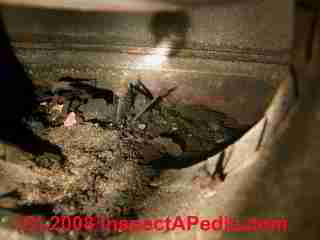
If you see soot, rust flakes, and debris in the flue vent connector (photo at page top) or chunks of black and brown sooty crud on top of horizontal surfaces near your oil fired heating equipment, this means that the heating system needs to be cleaned and serviced.
Our photo at page top shows what was probably several years of accumulated soot, rust flakes, and debris in the flue vent connector of an oil-fired horizontal furnace in a wet moldy crawlspace. The owner thought that his system, which was almost impossible to access, had "just been cleaned".
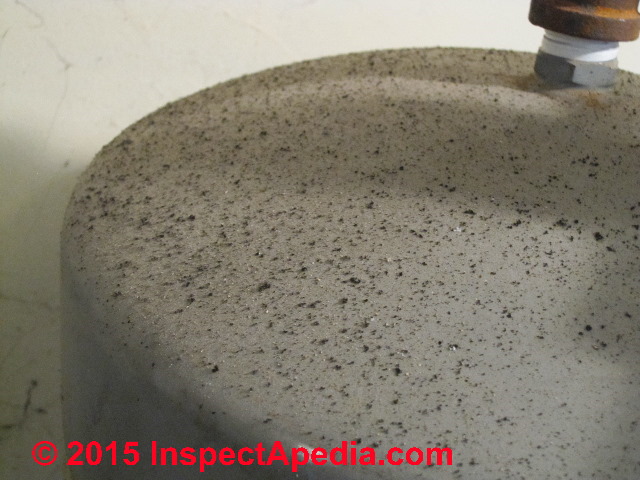
Our photo (left) shows soot and crud that has blown out of the boiler flue vent connector and sprinkled itself on every horizontal surface in the boiler room and in a nearby garage.
We wiped these surfaces clean and even vacuumed every thing in sight each time the boiler was serviced. That made it easier to convince our heating service tech that the system was running "dirty".
A little oil burner soot after service is normal: Because cleaning an oil fired heater disturbs soot and some of that leaks into the utility room, it's normal to see a very light coating of soot dust in the 24 hours or so after your heating system is cleaned and serviced.
But if you clean that stuff up it should not quickly reappear. If the heating system has "just been serviced" and you see soot and crud blowing around, especially if it's new soot production, this debris means that service was incomplete.
Watch out: don't use your household vacuum cleaner to vacuum oil burner soot unless you're willing to risk sacrificing that vacuum cleaner - it may become so dirty you won't want to use it in the home for general cleaning. Worse, if the vacuum cleaner is leaky you may end up blowing soot into the living area.
A proper service procedure for oil fired heating equipment includes removal of the flue vent connector and thorough cleaning of all debris from these components as well as a visual inspection of the condition of the chimney to which the flue vent connector joins to send combustion products outside.
Opening this damper and looking inside meant we literally "hit pay dirt". The dirt meant that the system needed to be cleaned, that the owner was paying for heat, but the heat was going up the chimney, not into the home -- as we explain a bit more below.
A hard to access heating system in a cramped nasty area rarely receives thorough cleaning and service. That was the case for this system.
Why is soot or crud in the oil fired boiler or furnace flue a problem?
A flue vent connector ((also called the "stack pipe" or "flue pipe") is the metal pipe that connects the oil fired heating appliance to a chimney in order to safely vent combustion gases outdoors.
That's a place where we can see some helpful clues about how the oil fired heating equipment is operating without disassembling the oil fired boiler, furnace, or oil burner itself.

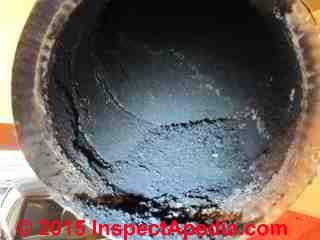
When we look in to the flue close to the heating boiler or furnace, such as at the barometric damper shown at above left, it's normal to see a thin coating of soot on the interior of the metal flue pipe.
Because soot acts like an insulating coating, too much soot in a heating system causes problems.
So we do not want to see soot accumulating in depth in the flue vent connector or chimney (above right) nor blowing around the boiler room, accumulating on top of the boiler, or blowing into and staining other areas of the building.
Technical note: the seasonal efficiency of oil fired heating equipment declines between service calls - that's the normal result of soot accumulation. If we run oil fired heating equipment too hot, to produce "zero" soot, we're sending too much heat (and money) up the chimney.
So a modest amount of soot accumulation in the boiler, furnace, or flue vent connector is normal between annual service calls.
More examples and photos of soot in and on oil burners and oil fired heaters are
at DRAFT REGULATOR SOOT INSPECTION
and
at CHIMNEY HEIGHT & CLEARANCE CODE
Watch out: if your oil fired heating equipment can't make it from one annual service call to the next one without blowing soot into the building, sooting up, clogging, and becoming noisy or smoky, something is wrong.
Just how much soot is ok? We answer that just below.
Soot layers too thick in boilers or furnaces means we spend more to heat the building:
Soot inside the furnace or boiler reduces the transfer of heat into the heating system's water (or air if it's a furnace).
Thus the transfer of heat into the building is reduced by soot in the heating equipment. As the soot layer gets thicker less heat is transferred and more of the heat simply continues to go up the chimney instead of into the building.
When a heating service technician measures the "efficiency" of a heating system, the number, say 85%, means that for each dollar you spend on heating oil, about 85 cents is coming into the building as heat, and the remaining 15 cents is going up the chimney as wasted energy.
Soot layers too thick in a boiler or furnace could be unsafe, even a fire hazard:
Soot layers in boilers or furnaces that are too thick means that the equipment is running "hot" and could even be unsafe.
Where a heating boiler was nearly blocked solid with soot, we've measured flue temperatures close to the boiler of over 1000 degrees F.!
Any combustibles too close to a hot metal flue or chimney could catch on fire at this temperature.
So how thick can the soot layer be before we have to clean the furnace or boiler?
1/8" of soot is the limit
So if the thickness of the soot you see in the flue vent connector, looking in at the barometric damper is 1/8" thick or more, the system should be cleaned and tuned.
Warning: even if the soot layer is thin and fine where you're looking, don't rule out other possible boiler, furnace, flue, or chimney problems. For example, debris could be blocking the chimney, or the flue pipe could be blocked with debris further on closer to the chimney.
But seeing that the flue looks clean where we can inspect is good news.
BOILER OPERATING PROBLEMS discusses the signs of improper oil fired hot water at operation.
Warm air furnaces are discussed
at FURNACES, HEATING,
and problems with loss of heat are discussed
at NO HEAT - BOILER / FURNACE DIAGNOSIS.
A discussion of our page top photo and those rusty sooty fragments in view is found
at HOW to INSPECT A BAROMETRIC DAMPER.
Separately, diagnosing black stains on indoor surfaces in the living space, possibly caused by oil fired equipment sooty operation or puffbacks, is discussed
at THERMAL TRACKING & HEAT LOSS.
This article series answers most questions about central heating system troubleshooting, inspection, diagnosis, and repairs. We describe how to inspect, troubleshoot and repair heating and air conditioning systems to inform home owners, buyers, and home inspectors of common heating system defects.
Troubles with Heat Scavengers & Passive Flue Gas Heat Recovery Devices on Oil or Wood Fired Heating Equipment
Reader Question: 11/29/2014 paul said: Oil Burner Filled House with Smoke
We just installed new oil burner last year in [our] house. We put [a] heat scavenger on pipe going to chimney side ways.
We didn't put a [draft regulator or barometric] damper on [flue] pipe.
We recently we had the furnace blow smoke out - [it] filled house bad[ly] with smoke and co2.
[We] took [the] furnace apart soot was a good half inch thick on top the nozzle, [though it] was clean the [combustion] chamber where it fires. [That area was] was clean as a whistle but the top of the furnace was sooty.
Question are them [sic] heat scavangers illegal in PA? Also do you need [a barometric] damper with them? Also can they be on their side? Also what went wrong?
Reply: flue gas heat recovery device cautions
Paul, various types of heat scavenging devices or passive flue gas heat recovery devices have been around for over 30 years:
- Konnerth III, Andrew. "Heat reclaimer." U.S. Patent 4,050,628, issued September 27, 1977.
- Seehausen, Jobst W. "Heat pipe recuperator." U.S. Patent 4,183,399, issued January 15, 1980.
- Moskal, John F. "Heat scavenger." U.S. Patent 4,392,610, issued July 12, 1983.
I understand the temptation to just use the space where a barometric damper would have fit for a heat scavenger - since you don't need to cut flue pipe nor make other adjustments. But I have two worries with that approach:
Draft regulation is needed on all fossil fuel fired appliances: gas, oil, wood
First, without a barometric damper it is absolutely impossible to set the oil burner for optimum performance - draft conditions vary in and outside of a building for a number of reasons. The service tech needs to set the proper draft in the breech or flue for best performance.
And bad draft as you'll hear me gripe next, can also speed oil burner clogging and malfunction.
Heat scavengers can become a source of clogged flues or chimneys, leading to trouble
Second, a heat scavenger on oil fired heating systems is asking for trouble in my OPINION because the multiple passages provide obstructions that invite soot accumulation, clogging, and subsequent oil burner back-pressure in the combustion chamber, overheating or incomplete, sootier-still combustion. Laws aside I personally don't like these devices on oil fired heating equipment.
You need to have an experienced heating service tech help you out with a thorough cleaning of the oil burner and flue, remove the scavenger, install a barometric damper, and inspect the chimney to decide if a more thorough chimney inspection and cleaning are needed.
If you give me the brand and model of your heat scavenger I will be glad to report more about the manufacturer's installation instructions. You might have mounted it improperly, but in my OPINION even a properly-mounted device may add risk fo clogging and venting and safety concerns.
Some state, provincial, or local codes may preclude the use of these heat miser or heat scavenger devices, either explicitly or implicitly by more general provisions. For example:
Chapter 9, Fire Prevention:
(e) Boilers and furnaces in which oil burners are installed shall be connected to flues having sufficient draft at all times to assure safe operation of the burner; a suitable draft regulating device shall be inst alled where necessary to prevent excessive draft.
Smoke pipe dampers, if any, shall be such that they cannot close off more than 80 percent of the internal cross section area of the smoke pipe. - Charter & Code, Townof Easton, Maryland, retrieved 11/29/2014 original source http://www.town-eastonmd.com/Charter%20and%20Code/THE%20CODE%20CHAPTER%209.pdf
I'd give your local fire inspector or building department a call to ask their opinion about the use of this device on wood stoves as well as on oil fired heating equipment. Let us know what you're told.
Additional references suggest that these devices may be more reliable on gas-fired heating appliances.
- " Are passive flue gas heat recovery devices savers?", SuperHomes, - retrieved 11/29/2014, original source http://www.superhomes.org.uk/resources/passive-flue-gas-heat-recovery-devices/ - Excerpt of product claim:
Passive Flue Gas Heat Recovery Devices can work on boilers whatever their fuel (depending on the model and flue size).
But not all boiler types are suitable. Exact savings depend on the type of boiler to which they are fitted.... Since 2005 virtually all gas boilers that have been fitted in the UK have been more efficient, condensing boilers.
... A full list of Passive Flue Gas Heat Recovery Devices is found on the Energy Saving Trust recommended products database [ http://www.energysavingtrust.org.uk/Take-action/Find-Energy-Saving-Trust-Recommended-products ] , with links to the suppliers’ or manufacturers’ websites.
[This document contains no safety caveats. However the text suggests that "all types"of heating boilers is focused on LP gas or natural gas-fired appliances where the flue clogging hazard should be less than with wood or oil fired heating equipment - ed. ] ] - "Flue gas heat recovery Capturing the waste heat" Centre for Sustainable Energy, Home Energy Advice, 3 St. Peter's Court, Bedminster Parade, Bristol BS3 4AQ, Website: www.cse.org, Tel: 0117 934 1400, Email: info@cse.org , - retrieved 11/29/2014, original source http://www.cse.org.uk/pdf/advice_leaflet_flue_gas_heat_recovery.pdf
...
Continue reading at OIL BURNER INSPECTION & REPAIR or select a topic from the closely-related articles below, or see the complete ARTICLE INDEX.
Or see SOOT on OIL FIRED HEATING EQUIPMENT FAQs - questions and answers posted originally on this page.
Or see these
Recommended Articles
- CEILING STAIN DIAGNOSIS
- CREOSOTE FIRE HAZARDS
- FIRE & SMOKE ODOR REMOVAL
- GAS BURNER FLAME & NOISE DEFECTS
- GAS BURNER SOOT CAUSE & CURE
- GAS BURNER PILOT LIGHT PROCEDURE
- GHOSTING DARK STREAKS or LINES: CAUSES to diagnose lines or rectangular areas of stains on walls or ceilings
- MOLD APPEARANCE - STUFF THAT IS NOT MOLD
- OIL BURNER INSPECTION & REPAIR
- OIL BURNER SOOT & PUFFBACKS
- SOOT HAZARDS in BUILDINGS
- SOOT on OIL FIRED HEATING EQUIPMENT
- STAINS on INDOOR SURFACES, PHOTO GUIDE
- STAINS CANDLES FIREPLACE WOODSTOVE
- THERMAL TRACKING BRIDGING GHOSTING
Suggested citation for this web page
SOOT on OIL FIRED HEATING EQUIPMENT at InspectApedia.com - online encyclopedia of building & environmental inspection, testing, diagnosis, repair, & problem prevention advice.
Or see this
INDEX to RELATED ARTICLES: ARTICLE INDEX to HEATING SYSTEMS
Or use the SEARCH BOX found below to Ask a Question or Search InspectApedia
Ask a Question or Search InspectApedia
Questions & answers or comments about sooty heating equipment: causes, problems, cures.
Try the search box just below, or if you prefer, post a question or comment in the Comments box below and we will respond promptly.
Search the InspectApedia website
Note: appearance of your Comment below may be delayed: if your comment contains an image, photograph, web link, or text that looks to the software as if it might be a web link, your posting will appear after it has been approved by a moderator. Apologies for the delay.
Only one image can be added per comment but you can post as many comments, and therefore images, as you like.
You will not receive a notification when a response to your question has been posted.
Please bookmark this page to make it easy for you to check back for our response.
Our Comment Box is provided by Countable Web Productions countable.ca
Citations & References
In addition to any citations in the article above, a full list is available on request.
- Dirk Faegre, Camden, Maine (207) 232-9494 is a certified BPI energy auditor and certified Envelope technician who kindly suggested draft regulator and flue vent connector inspection defect additions 6 Sept 09
- Our recommended books about building & mechanical systems design, inspection, problem diagnosis, and repair, and about indoor environment and IAQ testing, diagnosis, and cleanup are at the InspectAPedia Bookstore. Also see our Book Reviews - InspectAPedia.
- Fuel Oil & Oil Heating Magazine, 3621 Hill Rd., Parsippany, NJ 07054, 973-331-9545
- Domestic and Commercial Oil Burners, Charles H. Burkhardt, McGraw Hill Book Company, New York 3rd Ed 1969.
- National Fuel Gas Code (Z223.1) $16.00 and National Fuel Gas Code Handbook (Z223.2) $47.00 American Gas Association (A.G.A.), 1515 Wilson Boulevard, Arlington, VA 22209 also available from National Fire Protection Association, Batterymarch Park, Quincy, MA 02269. Fundamentals of Gas Appliance Venting and Ventilation, 1985, American Gas Association Laboratories, Engineering Services Department. American Gas Association, 1515 Wilson Boulevard, Arlington, VA 22209. Catalog #XHO585. Reprinted 1989.
- The Steam Book, 1984, Training and Education Department, Fluid Handling Division, ITT [probably out of print, possibly available from several home inspection supply companies] Fuel Oil and Oil Heat Magazine, October 1990, offers an update,
- Principles of Steam Heating, $13.25 includes postage. Fuel oil & Oil Heat Magazine, 389 Passaic Ave., Fairfield, NJ 07004.
- The Lost Art of Steam Heating, Dan Holohan, 516-579-3046 FAX
- Principles of Steam Heating, Dan Holohan, technical editor of Fuel Oil and Oil Heat magazine, 389 Passaic Ave., Fairfield, NJ 07004 ($12.+1.25 postage/handling).
- "Residential Steam Heating Systems", Instructional Technologies Institute, Inc., 145 "D" Grassy Plain St., Bethel, CT 06801 800/227-1663 [home inspection training material] 1987
- "Residential Hydronic (circulating hot water) Heating Systems", Instructional Technologies Institute, Inc., 145 "D" Grassy Plain St., Bethel, CT 06801 800/227-1663 [home inspection training material] 1987
- "Warm Air Heating Systems". Instructional Technologies Institute, Inc., 145 "D" Grassy Plain St., Bethel, CT 06801 800/227-1663 [home inspection training material] 1987
- Heating, Ventilating, and Air Conditioning Volume I, Heating Fundamentals,
- Boilers, Boiler Conversions, James E. Brumbaugh, ISBN 0-672-23389-4 (v. 1) Volume II, Oil, Gas, and Coal Burners, Controls, Ducts, Piping, Valves, James E. Brumbaugh, ISBN 0-672-23390-7 (v. 2) Volume III, Radiant Heating, Water Heaters, Ventilation, Air Conditioning, Heat Pumps, Air Cleaners, James E. Brumbaugh, ISBN 0-672-23383-5 (v. 3) or ISBN 0-672-23380-0 (set) Special Sales Director, Macmillan Publishing Co., 866 Third Ave., New York, NY 10022. Macmillan Publishing Co., NY
- Installation Guide for Residential Hydronic Heating Systems
- Installation Guide #200, The Hydronics Institute, 35 Russo Place, Berkeley Heights, NJ 07922
- The ABC's of Retention Head Oil Burners, National Association of Oil Heat Service Managers, TM 115, National Old Timers' Association of the Energy Industry, PO Box 168, Mineola, NY 11501. (Excellent tips on spotting problems on oil-fired heating equipment. Booklet.)
- In addition to citations & references found in this article, see the research citations given at the end of the related articles found at our suggested
CONTINUE READING or RECOMMENDED ARTICLES.
- Carson, Dunlop & Associates Ltd., 120 Carlton Street Suite 407, Toronto ON M5A 4K2. Tel: (416) 964-9415 1-800-268-7070 Email: info@carsondunlop.com. Alan Carson is a past president of ASHI, the American Society of Home Inspectors.
Thanks to Alan Carson and Bob Dunlop, for permission for InspectAPedia to use text excerpts from The HOME REFERENCE BOOK - the Encyclopedia of Homes and to use illustrations from The ILLUSTRATED HOME .
Carson Dunlop Associates provides extensive home inspection education and report writing material. In gratitude we provide links to tsome Carson Dunlop Associates products and services.
 | HOME | ABOUT | ASK a QUESTION | CONTACT | CONTENT USE POLICY | DESCRIPTION | POLICIES | PRIVACY | |
| © 2024 - 1985 Publisher InspectApedia.com - Daniel Friedman | |||||||||