
InspectAPedia® FREE Encyclopedia of Building & Environmental Construction, Diagnosis, Maintenance & Repair |
Question? Just ask us! InspectAPedia
|
 Corrosive Drywall Detection, Effects & Remedies
Chinese Drywall Rotten Egg Smells, Corrosive Sulfur Gases, Rotten Egg Smells, Building Damage & Health Hazards in buildings
- POST a QUESTION or COMMENT about the hazards of Chinese drywall: its recognition, effects on buildings, effects on people
Chinese drywall problems in buildings: outgassing, damage, remediation costs:
This article series discusses Chinese Drywall, odors, indoor air quality hazards, corrosive outgassing, health hazards, and damage to copper building components such as copper electrical wiring and plumbing that may be caused by outgassing from Chinese Drywall used in construction in the U.S. Health complaints related to Chinese drywall outgassing include individual sensitivity to odors varies substantially, making odor reports inconsistent, but complaints include headaches, runny noses, and difficulty breathing.
We report on the following: financial relief for people who have to pay for Chinese drywall removal and building repairs. Authoritative information sources on Chinese Drywall. Chinese Drywall indoor air quality concerns include corrosive hydrogen sulfide or other gases & chemicals.
Chinese Drywall outgassing damage to electrical wiring, plumbing, air conditioner or heat pump corrosion as well as some building contents.
Find here: a list of sources of sulphur odors and sewer smells in buildings. How to identify odors or gases by type, source, and toxicity.
Noxious odors or smells in buildings can be diagnosed and cured. Names of Chinese Drywall Manufacturers; reports on Chinese Drywall Lawsuits.
InspectAPedia tolerates no conflicts of interest. We have no relationship with advertisers, products, or services discussed at this website.
- Daniel Friedman, Editor/Publisher - See WHO ARE WE?
Corrosive Drywall & "Chinese Drywall" Hazards: sources, causes, detection, & cures for corrosive drywall in buildings
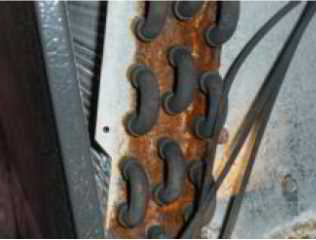
 The page top photo of blackened corrosion on an air conditioner cooling coil is from the U.S. CPSC warning to fire safety professionals.
[Click to enlarge any image]
Article Contents
Also
see ODORS, SMELLS, GASES IN BUILDINGS-DIAGNOSIS & CURE
and
see ODOR DIAGNOSIS CHECKLIST, PROCEDURE for a quick check that can help identify the source of smells in buildings
This article series discusses the diagnosis and cure of odors from a variety of sources including animals including pets, dogs, cats, or unwanted animals or dead animals, formaldehyde odors in buildings from building products or furnishings, plumbing drains, plastic or vinyl odors from building products, flue gases, oil tanks or oil spills, pesticides, septic odors, sewer gases, and even abandoned chemicals at properties.
Reader Question: What is causing oxidation and corrosion on copper pipes in my building?
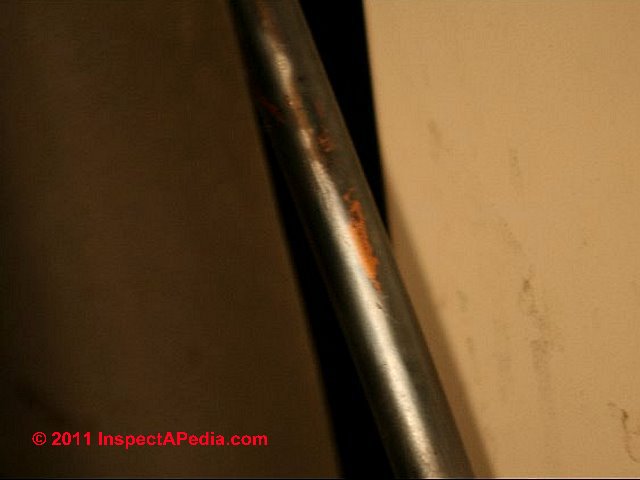
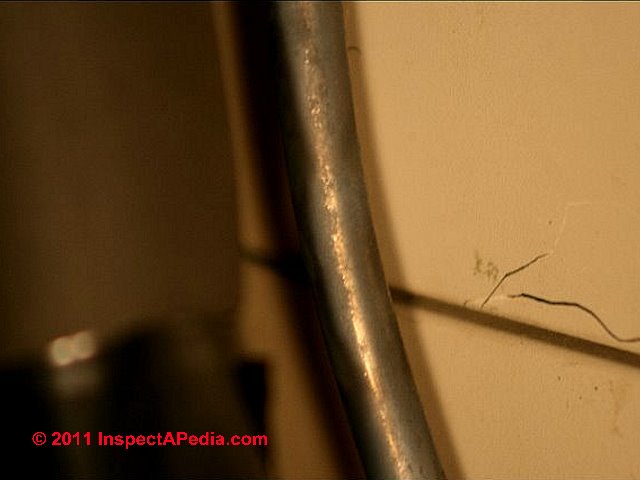 In this article we include a few pictures of my copper lines running to the condenser coils in an air conditioner. This is after only 3 1/2 years in our new home. I contacted the builders of our home, and the said they have never used drywall from china. I tested my water with a
water test kit for hydrogen sulfide, and the results were less than .3 ppm. And I can't find any reports of any cases like mine. - B.S.
In this article we include a few pictures of my copper lines running to the condenser coils in an air conditioner. This is after only 3 1/2 years in our new home. I contacted the builders of our home, and the said they have never used drywall from china. I tested my water with a
water test kit for hydrogen sulfide, and the results were less than .3 ppm. And I can't find any reports of any cases like mine. - B.S.
B.S. makes the point that not all blackened copper or corroded copper components in buildings is easily nor necessarily traced to the Chinese Drywall outgassing problem. Some of these other sources of corrosion include:
- simple aging of the copper piping
- exposure to frequent wet conditions from an external leak or from condensation on the copper surface - experienced building inspectors and plumbers use this trick to quickly identify cold water piping in an older building as distinct from hot water piping that will generally be less black, more shiny or copper colored.
- exposure to sulfide gases from other sources such as water
- exposure to chlorine, such as around an indoor swimming pool
Chinese Drywall Outgassing
Chinese drywall has received considerable attention in the U.S. as a source of odors, health hazards, and even corrosion of HVAC equipment, electrical wiring, and piping, found in North American homes renovated or built since 2001, and especially in homes built in 2006 and 2007.
The U.S. CPSC has received about 3,082 reports from residents in 37 states, the District of Columbia, American Samoa, and Puerto Rico who believe their health symptoms or the corrosion of certain metal components in their homes are related to problem drywall. State and local authorities have also received similar reports. - US CPSC.
As reported in the CPSC/CDC/EPA/HUD CPSC EXECUTIVE SUMMARY ON CHINESE DRYWALL, [paraphrasing and editing]
Testing by the Lawrence Berkeley National Laboratories (LBNL) demonstrated that certain Chinese samples had emission rates of hydrogen sulfide one hundred times greater than non-Chinese samples. CPSC staff modeling based on these results shows that estimated concentrations of the reactive sulfur chemicals in the indoor air of a home that are predicted to result from the presence of the drywall can be approximately a factor of ten times greater for certain Chinese samples than for the non-Chinese samples.
There were also tests made for possibly high levels of sulphur-reducing bacteria (SRB) in Chinese drywall, but as the summary continues:
... there appears to be no difference in the presence or absence of sulfur-reducing bacteria between the imported Chinese drywall and U.S. domestic drywall samples tested, including Chinese samples found by LBNL to have some of the highest reactive sulfur gas emissions.
As reported in the US CPSC PRELIMINARY EVALUATION OF DRYWALL CHAMBER TEST RESULTS,
The top ten reactive sulfur emitting drywall samples are from China. The patterns of reactive sulfur compounds emitted from drywall samples show a clear distinction between the Chinese drywall samples manufactured in 2005/2006 and NA drywall samples, with the exception of two Chinese samples C14 and C15, which have similarities to the NA emission profile.
The same study reports that by 2009 the Chinese drywall product corrosive sulphur gas and other emissions were substantially reduced:
The newer Chinese samples (manufacture date of 2009) demonstrate a marked decrease in sulfur emissions as compared to the 2005/2006 samples, and in some cases are similar to those of the NA [North American Manufacturer-produced drywall] samples.
Drywall outgassing, not bacteria, explain the sulphur smell
The March 26, 2010 US CPSC REPORT on CHINESE DRYWALL indicated that the odor source is not bacteria but outgassing of sulphur compounds. Quoting from that study (page 6),
While several organizations have hypothesized that SRB is responsible for production of reduced sulfur gases, only one peer-reviewed scientific paper was identified on this topic and it did not show a positive association between SRB and problem drywall. In the study published in 2010, subsequent to a poster in 2009, Hooper and colleagues describe the isolation of an iron oxidizing bacterium, Thiobacillus ferrooxidans, in Chinese drywall using a real-time polymerase chain reaction (RT-PCR) methodology (Hooper et al. 2010).
and from page 7.
Other groups, in non-peer reviewed literature, have also evaluated the role of SRB as a source of sulfur gases generated from problem drywall. In the October 2, 2009, issue of Builder Magazine, an interview with Sabre Technical Services advanced the position that the paper facing in problem drywall contains bacteria that are capable of producing reduced sulfur gases.
This position is contradicted by a limited study in which gamma irradiation was used to sterilize one piece of problem drywall and to examine the effects on corrosion potential. The study concluded that irradiation did not alter the corrosion potential of the drywall and, therefore, live bacteria did not play a role in copper corrosion (Cerro 2009).
In conclusion, there are conflicted studies of varying quality that have attempted to determine the role, if any, of microorganisms in the generation of sulfur-based corrosive gases emanating from problem drywall. This preliminary study demonstrates that SRB is culturable from a subset of both Chinese and U.S. manufactured drywall samples, but does not definitively determine if microorganisms are responsible (wholly or in part) for the generation of corrosive gases generated from problem drywall.
The effects of the outgassing of reactive sulfur compounds by Chinese drywall include
- Corrosion of copper electrical wiring
(probably specifically where insulation has been stripped back such as at electrical connections). In turn the effects of Chinese drywall outgassing on building electrical systems may include:- Flickering lights
- Light switches that do not work or do not work consistently
- Electrical receptacles ("electrical outlets" or "plugs" or "sockets") that do not work or do work only intermittently
- Overheating electrical connections
- Circuit breakers that may fail to operate properly, increasing the risk of an electrical fire
- Also see ELECTRIC POWER LOSS / FLICKERING LIGHTS- causes of flickering or dimming lights
- Corrosion of copper plumbing
in buildings can be caused by exposure to corrosive outgassing from Chinese drywall - Corrosion of aluminum or copper heat exchanger coils
in air conditioning and heat pump systems. Possible corrosion of metal ductwork. - Watch out: corrosion of key components in smoke alarms and carbon monoxide alarms -
risking loss of the function of these important home safety devices, thus increasing the risk of a loss from a building fire or life safety hazards from carbon monoxide poisoning. (see CARBON MONOXIDE - CO).
FHA-insured families experiencing problems associated with problem drywall may be eligible for assistance to help them rehabilitate their properties. HUD’s Community Development Block Grant (CDBG) Program may also be a resource to help local communities combat the problem.
Homeowners who believe they may have problem drywall should immediately report to CPSC by calling 800-638-2772 or logging on to www.cpsc.gov/cgibin/drywall.aspx. Hearing- or speech-challenged individuals may access the phone number through TTY by calling the toll-free Federal Relay Service at 800-877-8339.
Findings of Fact and Conclusions of Law Regarding Chinese Drywall - Germano Case
AN 10 APRIL 2008 COURT DOCUMENT reporting findings of fact and conclusions of law in GERMANO, ET AL. V. TAISHAN GYPSUM CO. LTD., ET AL., CASE NO. 09-6687 [108 page PDF] specifies general scientific findings on Chinese drywall which distinguish it from typical, benign drywall as the following: [Also see details and additional cases quoted at FINANCIAL AID: CHINESE DRYWALL LOSSES/REPAIRS]
- Chinese drywall has a significantly higher average concentration of strontium and significantly more detectable levels of elemental sulfur.
- Chinese drywall releases reduced sulfur gases.
- The sulfur gases released by Chinese drywall are irritating to the human body. Exposed individuals reported irritation of the eyes, respiratory system, and skin, among other things.
- The sulfur gases released by Chinese drywall cause offending odors in homes, making them hard if not impossible to live in.
- The sulfur gases released by Chinese drywall are corrosive to metals, particularly copper and silver.
- The corrosion on metals caused by the sulfur gases emitted by Chinese drywall causes premature failure of electrical & mechanical devices.
- The corrosion on metals caused by the sulfur gases emitted by Chinese drywall poses a fire risk
Names of Companies That Produced Outgassing Toxic Chinese Drywall
The Florida Sun Sentinel along with other news agencies such as the Los Angeles Times have reported (May 2010) that the U.S. CPSC has named five Chinese drywall Manufacturers, as the producers of corrosive H2S outgassing drywall and asked that these companies step up to their responsibilities to pay for repairs needed by U.S. homeowners who installed their products. Included among the five were the first five companies listed below in order of level of drywall outgassing:
- Knauf Plasterboard Tianjin Co. Ltd. [According to the Sun Sentinel, this manufacturer, Knauf Plasterboard Tianjin Co. Ltd., is settling cases with builders who have fixed homes containing the problem drywall.] The highest outgassing product was produced by this company in 2005. Drywall produced by this company in 2006 ranked in fifth highest outgassing position as well).
- Taian Taishan Plasterboard (drywall produced in China in 2006 and in 2009)
- Shandong Taihe Dongxin (drywall produced in China in 2005)
- Shandong Chenxiang GBM (C&K Gypsum Board): (drywall produced in China in 2006 and in 2009). Shandong Taihe Dongxin Co., Ltd. on September 10, 2007, changed its name to Taishan Gypsum Co., Ltd. [see GERMANO CHINESE DRYWALL CASE.]
- Beijing New Building Materials (BNBM): (drywall produced in China in 2009)
These companies are or were producers of drywall sold in the U.S. that has been tested and confirmed as emitting so much hydrogen sulfide it can cause pipes and wires to corrode and cause breathing or respiratory problems for home occupants.
Problem outgassing by drywall sold by these companies emits corrosive gans at as much as 100 times other brands. Typical home repair costs at 100 to 150 thousand dollars where this Chinese drywall was installed according to CPSC chairwoman. Inez Tenenbaum.
Alison Grant, a Boca Raton FL lawyer representing more than 500 homeowners affected by Chinese drywall says that the U.S. appeals to the manufacturers to stand behind their product won't help, and that litigation is required. The Sun Sentinel article added that seven homeowners in Virginia and one in Louisiana have been awarded damages, but that foreign companies may not be compelled by U.S. court rulings.
In September 2010 the New York Times reported that severe financial problems and health concerns continue to plague owners of homes where Chinese drywall was used in construction or remodeling, particularly in homes built after 2004 when Hurricane Andrew had caused U.S. made drywall to be in short supply. See"Drywall Flaws: Owners Gain Limited Relief", The New York Times. 18 Sept. 2010.
Names of Companies Producing Safe Drywall Reported Not to Have Outgassing Problems
The CPSC has listed the following companies whose drywall samples were tested to produce low or no detectable emission of sulfide outgassing.
Watch out: Notice that some of the same companies who produced problem drywall are also listed here - so just identifying the brand name of drywall does not necessarily indicate whether the specific product found in a particular home is a problem or not. That is why an expert inspection for signs of outgassing and corrosion as well as other identification steps are important.
- Knauf Plasterboard Tianjin: (Drywall test sample from 2009)
- China; Tiger ***ShiGao JianCai***liangpianzhuang: Drywall test sample from 2006)
- China; USG Corporation: Drywall test sample from 2009)
- U.S.; Guangdong Knauf New Building Material Products Co. Ltd.: Drywall test sample from 2009)
- China; 3/8" drywall manufacturer uncertain Drywall test sample from unknown date
- China; Knauf Plasterboard (Wuhu) Co. Ltd.: Drywall test sample from 2009)
- China; CertainTeed Corp.: (2009) U.S.; Georgia Pacific Corp.: Drywall test sample from 2009)
- U.S.; Dragon Brand, Beijing New Building Materials Co. Ltd.: Drywall test sample from 2006)
- China; CertainTeed Corp.: (2009) U.S.; Pingyi Baier Building Materials Co. Ltd.: Drywall test sample from 2009)
- China; Sample purchased in China, manufacturer unknown: Drywall test sample from 2009) China;
- Panel Rey S.A.: Drywall test sample from (2009) Mexico;
- Lafarge North America: Drywall test sample from 2009)
- U.S.; National Gypsum Company: Drywall test sample from 2009).
- U.S.; National Gypsum Company: Drywall test sample from 2009) U.S.; Georgia Pacific Corp.: (2009)
- U.S.; Pabco Gypsum: Drywall test sample from 2009)
- U.S.; Temple-Inland Inc.: Drywall test sample from 2009)
- U.S.; and USG Corporation Drywall test sample from 2009) [U.S. Gypsum reports that all of its drywall products, including its Sheetrock brand are free of the Chinese drywall outgassing defect. ]
U.S. Distributors of Outgassing Chinese Drywall
One U.S. drywall supplier, Banner Supply, was reported by Miami News Herald partner CBS4 as having been aware of the drywall outgassing problem without notifying its customers. Banner Supply switched to distributing U.S. made drywall and signed a confidentiality agreement with its Chinese supplier that obligated the distributor to remain silent about the problem. The Miami News Herald article (20 May 2010) reported that lawsuits against Banner Supply are expected to go to trial in June 2010 [in the Miami Dade Circuit Court].
Financial Aid to Pay for Chinese Drywall Repair/Replacement & Damages
Bank & Mortgage Relief for Homeowners Suffering Losses for Chinese Drywall Repairs
The U.S. government has encouraged lenders to suspend mortgage payments and to reduce property taxes on homes damaged by Chinese drywall. [Paraphrasing, The New York Times, 1 Oct. 2010]
Tax Relief for Chinese Drywall Losses in the U.S.
- IRS PERMITS CASUALTY LOSS DEDUCTION FOR CHINESE DRYWALL REPAIR COSTS: 30 September, 2010, announced in an IRS letter from George J. Blain (Assoc. Chief Counsel, IRS) to U.S. Senator Jim Webb [2 July 2010] (D-VA) and reported in various media sources including the New York Times On 1 October 2010. According to the Times article, "... taxpayers can deduct so-called casualty losses - generally the cost of repairs from a sudden or unusual event - in the year in which the loss occurs". Some limitations on this Chinese drywall repair cost loss deduction include
- the loss claimed was not compensated by an insurance company or other
- taxpayer has no pending insurance reimbursement claim and don't intend to ask for such
- taxpayers with pending insurance claims can deduct 75% of the unreimbursed loss
- taxpayer has to itemize their deductions
- amount must exceed $500 [no problem for most cases]
- amount of loss must exceed 10% of taxpayers adjusted gross income
- US CPSC-US IRS CASUALTY LOSS DEDUCTION DRYWALL GUIDANCE LETTER: 23 November 1999, Cheryl A. Falvey, director, US Consumer Product Safety Commission wrote to members of the U.S. Senate and House of Representatives providing information in support of an Internal Revenue Service IRS Revenue Code interpretation that could permit homeowners to take a casualty loss deduction on their income taxes for repairs necessary due to the presence of Chinese drywall in their homes. Web search 10/01/10, original source: www.cpsc.gov/info/drywall/irs.pdf
- IRS TOPIC 515 - CASUALTY, DISASATER, AND THEFT LOSSES, U.S. Internal Revenue Publication 515, available at http://www.irs.gov/taxtopics/tc515.html
Insurance Coverage for Chinese Drywall Losses in the U.S.
As of September 2010, we have found no reports of payouts by U.S. insurance companies to cover costs to homeowners of repairs associated with sulphur outgassing Chinese drywall, and other media outlets indicate that insurance companies have been universally denying claims
Check this: Reported in several media outlets including the New Orleans Times Picayune (26 March 2010), The Louisiana Court Orleans Parish Judge Lloyd Medley has issued a ruling striking certain homeowners insurance policy exclusions from being relied on by Audubon Insurance (owned by AIG), a home insurance company involved in denying a Chinese Drywall claim. Audubon had excluded Chinese Drywall claims under the terms of a "pollution or contamination" exclusion that Medley concluded applies to "environmental damage" and not to damage to a building from substandard building materials. [Think of losses caused by a building collapse due to inadequate sizing of framing member - Ed.]
Lawsuit, Litigation Results for Chinese Drywall Losses
There have been some "successful" class action and individual lawsuits involving claims for damages associated with the installation of Chinese-made drywall in U.S. homes, but actual settlements that addresses the losses of all homeowners in the U.S. may be very slow in coming.
The Wall Street Journal reported on 15 October 2010 that the New Orleans Judge Fallon who is handling these cases (see below) has agreed to a settlement under which Knauf Plasterboard Tianjin and related suppliers and insurers will remove and replace Knauf drywall, wiring, copper tubing, and appliances from 300 homes in four U.S. states (Alabama, Mississippi, Louisiana, and Florida), as well as covering the relocation expenses for those homeowners. Costs are estimated at $40. to $80. per square foot of home interior space.
Appointment of the United States District Court for the Eastern District of Louisiana for Chinese Drywall Litigation Consolidated Hearings
In recognition that there has been U.S. nationwide litigation involving several class actions and thousands of individual cases, including 10 "bellwether" cases in Virginia and Louisiana, On 15 June 2009, a Judicial Panel on Multidistrict Litigation transferred all federal actions alleging damages from defective Chinese Drywall to the United States District Court for the Eastern District of Louisiana, referred to as the MDL Court) for coordinated or consolidated pretrial proceedings pursuant to 28 U.S.C. p 1407.
See In re Chinese-Manufactured Drywall Prod. Liab. Litig., 626 F. Supp. 2d 1346 (J.P.M.L. 2009) (Rec. Doc. No. 1). Above paraphrased from and also see "Case 2:09-md-02047-EEF-JCW Document 5011-1, Plaintiff's Steering Committee's Memorandum of Law in Support of its Motion to Enjoin Conflicting State Court Proceedings in Muscogee County, Georgia that interfere with this court's continuing jurisdiction over this litigation."
Bellwether Chinese Drywall Case Conclusions
Owners of seven homes in Virginia where Chinese tainted drywall was installed were awarded 2.6 million by the federal judge overseeing the Chinese drywall multidistrict litigation underway (in 2010) in New Orleans, LA as we reference just below.
UNITED STATES DISTRICT COURT EASTERN DISTRICT OF LOUISIANA, IN RE: CHINESE MANUFACTURED DRYWALL PRODUCTS LIABILITY LITIGATION, MDL NO. 2047, [PDF] Section: L, Judge Fallon, Mag. Judge Wilkinson, Findings of Fact & Conclusions of Law, Case 2:09-md-02047-EEF-JCW Document 2380 Filed 04/08/2010 [108 page PDF document]. We quote from the conclusions of that case, just below:
III. CONCLUSION
In summary, based upon the Findings of Fact and Conclusions of Law, the Court finds that scientific, economic, and practicality concerns dictate that the proper remediation for the Plaintiff-intervenors is to remove all drywall in their homes, all items which have suffered corrosion as a result of the Chinese drywall, and all items which will be materially damaged in the process of removal. Accordingly, the Court further finds that the Plaintiff-intervenors are entitled to recover damages as follows:
a. Plaintiff intervenors William and Deborah Morgan have suffered property damages, personal property damages, and other forms of compensable damages in the amount of $381,613.29. In addition, the Court finds that Plaintiff intervenors William and Deborah Morgan have suffered loss of use and enjoyment damages in the amount of $100,000.00. The Court awards Plaintiff intervenors William and Deborah Morgan total damages, caused by Taishan, in the amount of $481,613.29.
b. Plaintiff intervenors Jerry and Inez Baldwin have suffered property damages, personal property damages, and other forms of compensable damages in the amount of $341,699.11. In addition, the Court finds that Plaintiff intervenors Jerry and Inez Baldwin have suffered loss of use and enjoyment damages in the amount of $100,000.00. The Court awards Plaintiff intervenors Jerry and Inez Baldwin total damages, caused by Taishan, in the amount of $441,699.11.
c. Plaintiff intervenors Joseph and Cathy Leach have suffered property damages, personal property damages, and other forms of compensable damages in the amount of $59,676.86. In addition, the Court finds that Plaintiff intervenors Joseph and Cathy Leach have suffered loss of use and enjoyment damages in the amount of $30,000.00. The Court awards Plaintiff intervenors Joseph and Cathy Leach total damages, caused by Taishan, in the amount of $89,676.86.
d. Plaintiff intervenors Bob and Lisa Orlando have suffered property damages, personal property damages, and other forms of compensable damages in the amount of $307,905.44. In addition, the Court finds that Plaintiff intervenors Bob and Lisa Orlando have suffered loss of use and enjoyment damages in the amount of $100,000.00. The Court awards Plaintiff intervenors Bob and Lisa Orlando total damages, caused by Taishan, in the amount of $407,905.44.
e. Plaintiff intervenors J. Frederick and Vannessa Michaux have suffered property damages, personal property damages, and other forms of compensable damages in the amount of $255,607.80. In addition, the Court finds that Plaintiff intervenors J. Frederick and Vannessa Michaux have suffered loss of use and enjoyment damages in the amount of $100,000.00. The Court awards Plaintiff intervenors J. Frederick and Vanessa Michaux total damages, caused by Taishan, in the amount of $355,607.80.
f. Plaintiff intervenors Preston and Rachel McKeller have suffered property damages, personal property damages, and other forms of compensable damages in the amount of $251,741.22. In addition, the Court finds that Plaintiff intervenors Preston and Rachel McKeller have suffered loss of use and enjoyment damages in the amount of $100,000.00. The Court awards Plaintiff-intervenors Preston and Rachel McKellar total caused by Taishan, in the amount of $351,741.22.
g. Plaintiff intervenors Steven and Elizabeth Heischober have suffered property damages, personal property damages, and other forms of compensable damages in the amount of $380,886.27. In addition, the Court finds that Plaintiff intervenors Steven and Elizabeth Heischober have suffered loss of use and enjoyment damages in the amount of $100,00.00. The Court awards Plaintiff intervenors Steven and Elizabeth Heischober's total damages, caused by Taishan, in the amount of $480,886.27. In sum, the Court awards all seven Plaintiff intervenor families monetary damages for their losses caused by the defendant Taishan in the total amount of $2,609,129.99. New Orleans, Louisiana, this 8th day of April 2010.
ELDON E. FALLON UNITED STATES DISTRICT JUDGE
Additional Court Documents in re Chinese Manufactured Drywall Litigation in the U.S.
A 10 April 2008 court document reporting findings of fact and conclusions of law in GERMANO, ET AL. V. TAISHAN GYPSUM CO. LTD., ET AL., CASE NO. 09-668 [108 page PDF] specifies general scientific findings on Chinese drywall which distinguish it from typical, benign drywall as the following:
Case 2:09-md-02047-EEF-JCW Document 5011-1, Filed 08/09/10, Plaintiff's Steering Committee's Memorandum of Law in Support of its Motion to Enjoin Conflicting State Court Proceedings in Muscogee County, Georgia that interfere with this court's continuing jurisdiction over this litigation.
Case 2:09-md-02047-EEF-JCW Document 1090 Filed 09/17/10 Daubert Order motions filed by the Plaintiffs' Steering Committee and Intervenor Knauf Plasterboard Tianjin Co., Ltd., ("Knauf") to exclude specific aspects of expert witness testimony.
See: U. S. District Court, Eastern District of Louisiana (New Orleans), CIVIL DOCKET FOR CASE #: 2:09-md-02047-EEF-JCW, -EEF-JCW In Re: Chinese-Manufactured Drywall Products Liability Litigation, that collects the pertinent court documents, hosted at http://www.freecourtdockets.com/
How is Chinese drywall (the problematic product) Recognized in Homes
The U.S. CPSC and the U.S. HUD in January 2010 issued recommended interim guidance for identifying problem Chinese drywall in buildings: PROCEDURES FOR IDENTIFICATION OF HOMES WITH CORROSION FROM PROBLEM [CHINESE] DRYWALL [PDF].
The CPSC-HUD recommendations involve two basic steps in identifying Chinese drywall that may be causing or contributing to a safety, mechanical, or air quality problem in homes: [From the Executive Summary of the CPSC HUD document cited above.]
Step 1: Threshold Inspection [for Outgassing Chinese Drywall]:
Visual inspection must show:
(a) Blackening of copper electrical wiring and/or air conditioning evaporator coils; and
(b) The installation of new drywall (for new construction or renovations) between 2001 and 2008.
A positive result for this step (including both criteria) is a prerequisite to any further consideration.\
Step 2: Corroborating Evidence[for Outgassing Chinese Drywall]:
Because it is possible that corrosion of metal in homes can occur for other reasons, it is important to obtain additional corroborating evidence of problem drywall. Homes with the characteristic metal corrosion problems must also have at least 2 of these corroborating conditions if the new drywall was installed between 2005 and 2008. For installations between 2001 and 2004, at least 4 of the following conditions must be met. Collecting evidence of these corroborating conditions will in some cases require professional assessors and/or testing by analytical laboratories.
(a) Corrosive conditions in the home, demonstrated by the formation of copper sulfide on copper coupons (test strips of metal) placed in the home for a period of 2 weeks to 30 days or confirmation of the presence of sulfur in the blackening of the grounding wires and/or air conditioning coils;
(b) Confirmed markings of Chinese3 origin for drywall in the home;
(c) Strontium levels in samples of drywall core found in the home (i.e. excluding the exterior paper
surfaces) exceeding 1200 parts per million (ppm);
(d) Elemental sulfur levels in samples of drywall core found in the home exceeding 10 ppm;
(e) Elevated levels of hydrogen sulfide, carbonyl sulfide and/or carbon disulfide emitted from
samples of drywall from the home when placed in test chambers using ASTM Standard Test Method
D5504-08 or similar chamber or headspace testing4;
(f) Corrosion of copper metal to form copper sulfide when copper is placed in test chambers with
drywall samples taken from the home.
Watch out: there are many other sulphur smell sources in buildings, and some of them may be quite dangerous. We provide a detailed list of sewer and sulphur gas odor sources later in this article at SOURCES OF SULPHUR ODORS IN BUILDINGS.
Additional information is in the document PROCEDURES FOR] IDENTIFICATION OF HOMES WITH CORROSION FROM PROBLEM [CHINESE] DRYWALL [PDF] from the CPSC and HUD.
The Florida Department of Health has also provided lists and photos of components in homes likely to be affected by sulphur and other outgassing products emitted by Chinese drywall in homes. That state's DOH also provides a case definition that "... enables the user to rank homes as a possible, probable, or confirmed case. Homes that exhibit the sentinel indicators of drywall associated corrosion are defined as possible cases. All three sentinel indicators of Criteria 1 must be met for the home to be considered as a possible case. Criteria that define a probable or confirmed case are described in later sections." - Florida DOH
The Florida DOH describes a similar three-criteria procedure for identifying problem Chinese drywall, summarized and commented-on just below:
Criteria 1 for Possible Chinese Drywall Case Identification
- The home was built or renovated with drywall since 2001
- Observed corrosion of air conditioner evaporator coil ...
Watch out: blackening and corrosion on copper HVAC components such as refrigerant tubing may be found in both homes with Chinese drywall and homes that did not use that material - DF.
- Observed metal corrosion, indicated by blackening of one or more of copper electrical wiring, exposed copper Corrosion of electrical components will presumably pertain to copper wiring and other copper electrical components exposed to air and to Chinese drywall outgassing, such as copper electrical wiring from which insulation has been stripped back - at electrical receptacles,switches, splices, and in an electrical panel; our OPINION is that depending on the level, location, and duration of corrosive gases in a building, there may be hidden damage as well, such as corrosion of internal copper parts in some circuit breakers or switches.
Corrosion on mirrors may be recognized by loss of reflective coating on mirrors, especially at the edges and corners
The Florida DOH Criteria 2 and 3 for confirming a Chinese drywall problem case are intended for use by trained building inspection experts. We summarize below material that is provided in detail at the FL DOH Chinese drywall information web article.
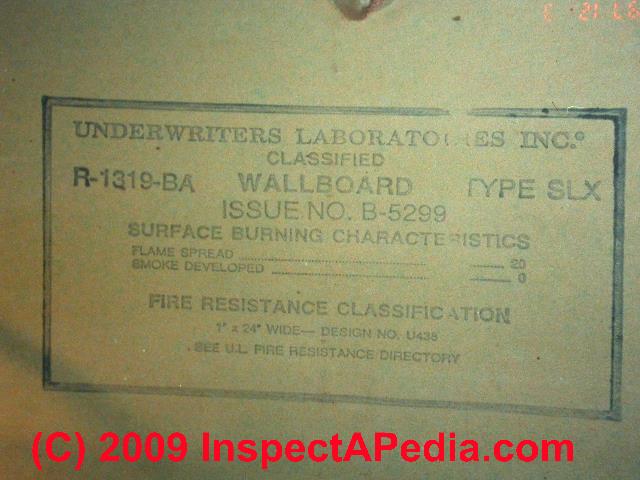
Examples of Drywall Identification Stamps that are NOT Chinese Drywall
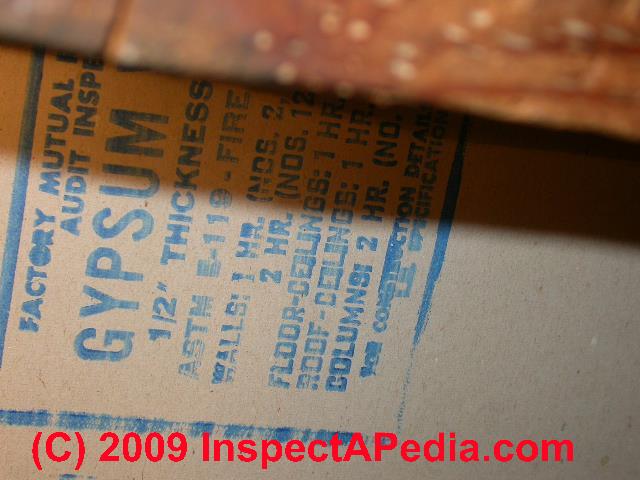
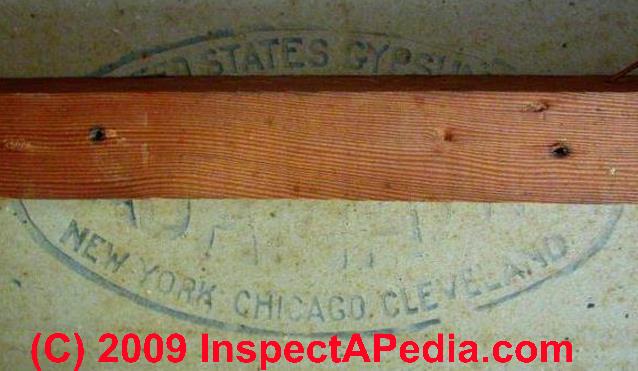
Our photos (above and below) show modern identification stamps or lables that may be found drywall products used for interior walls and ceilings. Also see additional drywall identifying number stamps found at DRYWALL GYPSUM BOARD USED FOR EXTERIOR WALL SHEATHING.

Criteria 2: for Probable Chinese Drywall Case Identification
- Observed markings on the back of drywall indicating the country of origin is China.
Watch out: not all drywall bears identification markings; if there are no stamps on the back of drywall, also look for possible remainders of drywall top or bottom edge tapes as often that paper contains the manufacturer's identification.
Watch out: don't assume that if you find U.S. marked drywall that no Chinese drywall is present. Some buildings were constructed or remodeled using drywall from both sources.
Demolition, or test cuts may be necessary to expose the back or hidden side of drywall.
- Objective analysis of drywall in home finds Strontium levels exceed 2,000 mg/kg (ppm)
[Details & references are provided by the Florida DOH]
If a home meets Criteria 1 for possible Chinese drywall presence, and significantly if you have ruled out other sources of hydrogen sulfide in the building, such as these sulphur or sewer gas odor sources ...
- Sewer gas leaks: see SEWER GAS ODORS and SEWER GAS ODORS in COLD / WET WEATHER especially the latter if your home is in a seasonally cold climate
- Sulphur gases and odors from well water: see DIAGNOSING AND CORRECTING SULPHUR ODORS, and WELL WATER CONTAMINANT SOURCES, and WATER ODORS)
- Soil gases
and where a number of items in Criteria 2 are confirmed, then the FL DOH considers the home a probable Chinese drywall case and investigation continues with Criteria No. 3 to attempt to identify the presence of Chinese drywall by product markings. We summarize the criteria just below:
Criteria 3: for Confirmed Chinese Drywall Case Identification
- Elemental sulfur presence confirmed by tests
- Laboratory analysis of suspect drywall headspace for reduced sulfur gas emissions
- Qualitative analysis of suspect drywall for its ability to cause corrosion/blackening of copper
If the results of a Chinese drywall investigation have met the criteria for “possible case”, ruled out other sources of hydrogen sulfide as significant contributors to copper corrosion in the home (we listed possible sulphur gas and odor sources just above), and receive positive results on a sufficient number of samples from one or more of the above evaluations in Criteria 3, then according to the Florida DOH, the home meets the criteria for a “confirmed case”.
Sources of Sulphur Odors in buildings Include Smells Associated with Chinese Drywall & Other Causes in buildings
Before blaming drywall for building odors, be sure that the smells are not from another detectable source such as sewer gases or a failing hot water tank anode - see ODORS, SMELLS, GASES IN BUILDINGS-DIAGNOSIS & CURE for details and see SMELL PATCH TEST to FIND ODOR SOURCE. The FL DOH suggests that reports of sulphur odors indoors are not a reliable indicator that Chinese drywall is present, because of a variety of reasons.
Below we list common sources of sulphur gases and odors in buildings as well as a few warnings about trying to confirm a Chinese drywall problem based on smell alone.
- Some buildings using Chinese drywall do not present a characteristic sulphur odor but may still have corrosion and outgassing problems
- There are multiple possible sources of sulphur gases and sulphur odors in buildings
- Individual sensitivity to odors varies substantially, making odor reports inconsistent
Common Sources of Sulphur Gases & Odors in buildings
- Sulphur odors from well water - see
- DIAGNOSING AND CORRECTING SULPHUR ODORS
- WELL WATER CONTAMINANT SOURCES
- More information about causes of and cures for hydrogen sulfide odors in water is at WATER ODORS.
- Sulphur gases and odors from a failing hot water tank sacrificial anode - see
- Sulphur gases and odors from a bacterial contamination of a hot water tank
- Sulphur odors from defects in the building drain waste or vent piping
- PLUMBING FIXTURE TRAPS - dry plumbing traps or leaky traps may be an odor source. Drain noises can be a clue to this problem. We discuss how to diagnose and cure drain sounds at Plumbing Drain Noises.
- Loose toilets or a faulty toilet base wax ring (discussed at SEWER GAS ODORS)
- SEWER GAS ODORS
- SEWER GAS ODORS in COLD / WET WEATHER
- SEWER GAS ODOR COLD / WET WEATHER FAQs
- SEWER GAS ODOR COLD / WET WEATHER FAQs-2
- Blocked or improperly installed plumbing vents: see PLUMBING VENT DEFECTS & NOISES for an explanation of sewer gas leaks from building drain vent piping. Transite pipe plumbing vents - an cement-asbestos material, can become delaminated and clogged with age, blocking the plumbing vent system.
See TRANSITE ASBESTOS CHIMNEYS, DUCTS, PIPES - See BUILDING DRAIN & SEWER LINE ODORS for the full discussion of odors from building drains & drain piping. Also see SEPTIC or SEWER PIPING LEAKS for odors from septic systems and sewer lines.
- Illustrations of a leaky cast iron sewer line that sent sewer gases into the building's transite (asbestos cement) heating duct system can be seen at TRANSITE PIPE AIR DUCTS and at CAST IRON DRAIN PIPING.
- Watch out: if the sulphur odors in a building are due to sewer gas backups, dangerous levels of possibly explosive methane gas could be present.
Also, at SEPTIC & CESSPOOL SAFETY we explain that gases produced in a septic tank are dangerous, as a potential source of explosion and as a cause of death by asphyxiation if someone falls into or deliberately enters a septic tank. - Sulphur odors or "septic odors" at a kitchen sink may actually be food odors from a garbage disposer that needs cleaning.
- Sulphur odors from a failing or backing-up septic system - see
- See SEPTIC SYSTEM ODOR CURES for the full detailed article on this topic.
- Also see OTHER CAUSES OF ODORS FROM A SEPTIC SYSTEM.
- SEPTIC SYSTEM ODORS
- Sulphur odors originating outdoors - see SITE, WEATHER, OR FAILING NEIGHBORS AS ODOR SOURCES
- Other odors mistaken for sulphur odors, such as a dead animal in building walls or crawl spaces. We also mention human flatulence which also can have a sulphur odor but will normally be episodic and brief in duration.
- Watch out: some people mistake LP gas or natural gas leak odors for sulphur gas or sewer odors. See GAS PIPING AND TANK DEFECTS.
In sum, before blaming drywall for building odors, be sure that the smells are not from another detectable source such as sewer gases or a failing hot water tank anode - see ODORS, SMELLS, GASES IN BUILDINGS-DIAGNOSIS & CURE for details and see SMELL PATCH TEST to FIND ODOR SOURCE. - DF
What Tests are Performed to Evaluate the Hazard from Chinese Drywall in buildings?
The following tests are commonly used to evaluate the level of indoor contamination from Chinese drywall:
- Strontium emission test for Chinese Drywall
- Iron/Fe2S and strontium/SrS (impurities) emission test for Chinese Drywall
- VOCs, especially organic sulfides emission test for Chinese Drywall
- Elemental sulphur and sulphur-based gases emission test for Chinese Drywall
- Analysis of copper surfaces (exposed electrical wiring, copper piping) for corrosion attributable to corrosive gases emitted by Chinese Drywall
- Accelerated corrosion test to evaluate the corrosivity of a specific sample of Chinese Drywall material.
EMS lab provides a range of tests for the level of outgassing and probable hazard or building damage from Chinese Drywall, as do some other U.S. environmental testing laboratories.
Remedies for Corrosive Hazardous Chinese Drywall in buildings
Unfortunately the effective remedies for the presence of problematic outgassing Chinese Drywall in buildings are likely to be extensive and costly:
- Remove the source of corrosion - the offending Chinese Drywall - has to be completely removed - this means removal of drywall ceilings and walls in homes where this material was installed.
- Identify and replace corroded, unsafe building components, such as the smoke alarms and CO alarms mentioned above. If electrical wiring is badly corroded, it may also be unsafe, or circuit breakers may be unsafe and may also need to be replaced. Gas piping and sprinkler system piping may also need replacement according to the CPSC INTERIM REMEDIATION GUIDANCE FOR HOMES WITH CORROSION FROM PROBLEM DRYWALL [PDF]
Advice from AIHA, the American Industrial Hygiene Association for Dealing with Corrosive Drywall, References & Citations
- American Industrial Hygiene Association®, "ASSESSMENT AND REMEDIATION OF CORROSIVE DRYWALL", [PDF] October 10, 2010, Sponsored by the AIHA® Biosafety and Environmental Microbiology Committee, Construction Committee, and Indoor Environmental Quality Committee, also available from AIHA. Excerpts from the Executive Summary of this document are quoted below:
Contaminated drywall imported from China has been f ound to emit sulfide vapors, impacting the air quality in tens of thousands of h omes as well as in larger buildings. In this White Paper, AIHA summarizes the available sci ence and identifies critical gaps in the current understanding of the problem that must be addressed.
The presence of corrosive drywall (CDW) can general ly be recognized based on visual inspection and the building’s construction h istory. Blackening of certain metal surfaces provides a consistent marker for the poten tial presence of CDW. Corrosion damage to electrical and mechanical systems has occ urred, and property values can be significantly diminished.
The one available medical study evaluating occupant s of homes with CDW identified short-term irritation effects possibly a ssociated with CDW emissions in subjects predisposed to irritation of the mucous me mbranes based on their medical history (e.g., asthma, dry eyes).
Federal and state response guidance and commercially available remediation services have proceeded ahead of a complete understanding of critical issues. Since emissions from CDW represent a complex, variable mix of sulfides in the parts per billion levels, setting chemical air quality standa rds is not feasible. Available air quality monitoring methods are generally not sufficiently s ensitive for either assessing exposure to CDW emissions or verifying remediation efforts.
CDW can be identified in a bulk sample analysis by a positive laboratory test for elemental sulfur. Elevated strontium content is als o a marker for potential emissions. Both elemental sulfur and strontium can be measured by laboratory analysis of drywall samples. A hand-held X-ray fluorescence meter (XRF) can be used as a field tool for identifying potential CDW locations within a struct ure.
Several attempts to control emissions while leaving CDW in place have not been successful. Air cleaning and moisture reduction, however, may reduce indoor air contaminants and corrosive effects pending removal of CDW.
To effectively control emissions from CDW, remediat ion should (a) remove all corrosive drywall; (b) eliminate visible demolition dust; (c) eliminate residual CDW odors from remaining surfaces; and (d) restore elec trical and mechanical systems to a safe, reliable, and code-compliant condition. Vario us remedial approaches have been attempted, ranging from removal of all drywall (bot h CDW and non-CDW) and all electrical and mechanical systems to selective remo val of only CDW and affected components. However, none of these strategies has b een demonstrated conclusively to eliminate emissions on a permanent basis.
Residual odors emitted by remaining surfaces have been addressed by airing the structure and its contents up to several months. Various treatments are in use to expedite this process, although none has been scientifically validated. Remediation strategies that ensure cost-effective restoration of CDW-impacted structures to pre-existing condition are needed. This is especially critical for homes where mitigation budgets are limited.
Competencies necessary for individuals assessing and remediating CDW are also discussed.
Additional work is needed to resolve CDW issues: (a ) research on underlying chemistry, emission dynamics, health risks and corr osion damage; (b) development of protocols for air quality monitoring, assessment, a nd remediation; and (c) issuance of guidance for worker protection. AIHA’s findings and recommendations will be updated as new information becomes available.
- Contact AIHA at http://www.aiha.org
- Find an AIHA consultant at http://www.aiha.org/about-ih/Pages/Find-an-Industrial-Hygienist.aspx
[Disclosure: the author, Daniel Friedman, is a professional member of AIHA. He does not offer field or laboratory services for CDW.]
Watch out for Bogus Chinese Drywall Remedies
Watch out: the indoor air "purifiers" and "deodorizers" sold by some vendors who specifically advertise regarding Chinese drywall odors are not the proper approach to dealing with this problem, treating the symptom rather than the cause, and ignoring corrosion and other damage caused by this product.
Also see FTC Consumer Alert, FTC NOTICE: Defective Imported Drywall: Don’t Get Nailed by Bogus Tests and Treatments December 2009.
Reporting Chinese Drywall Complaints or "Incidents" to the US CPSC
Consumers are encouraged to report problems with their drywall, especially apparent or confirmed damage from Chinese drywall outgassing to the U.S. Consumer Product Safety Commission.
From the US CPSC / HUD 28 January 2010 HUD AND CPSC ISSUE GUIDANCE ON IDENTIFYING PROBLEM DRYWALL IN HOMES
FHA-insured families experiencing problems associated with problem drywall may be eligible for assistance to help them rehabilitate their properties. HUD’S COMMUNITY DEVELOPMENT BLOCK GRANT (CDBG) Program may also be a resource to help local communities combat the problem.
Homeowners who believe they may have problem drywall should immediately report to CPSC by calling 800-638-2772 or logging on to www.cpsc.gov/cgibin/drywall.aspx. Hearing- or speech-challenged individuals may access the phone number through TTY by calling the toll-free Federal Relay Service at 800-877-8339.
The US CPSC also provides a FORM for registering information about a drywall incident.
Chinese Drywall Court Cases, Litigation, Court Rulings - List of
- GERMANO, ET AL. V. TAISHAN GYPSUM CO. LTD., ET AL., CASE NO. 09-6687 - [PDF] Findings of Fact and Conclusions of Law - Excerpts are quoted from this public document, just below. UNITED STATES DISTRICT COURT, EASTERN DISTRICT OF LOUISIANA: MDL NO. 2047 IN RE: CHINESE MANUFACTURED DRYWALL : PRODUCTS LIABILITY LITIGATION : SECTION: L :: JUDGE FALLON : MAG. JUDGE WILKINSON
*This Document Relates to Germano, et al. v. Taishan Gypsum Co. Ltd., et al., case no. 09-6687.*
From 2004 through 2006, the housing boom and rebuilding efforts necessitated by various hurricanes led to a shortage of construction materials, including drywall. As a result, drywall manufactured in China was brought into the United States and used in the construction and refurbishing of homes in coastal areas of the country, notably the Gulf Coast and East Coast.
Sometime after the installation of the Chinese drywall, homeowners began to complain of emissions of smelly gasses, the corrosion and blackening of metal wiring, surfaces, and objects, and the breaking down of appliances and electrical devices in their homes.
Many of these homeowners also began to complain of various physical afflictions believed to be caused by the Chinese drywall. Accordingly, these homeowners began to file suit in various state and federal courts against homebuilders, developers, installers, realtors, brokers, suppliers, importers, exporters, distributors, and manufacturers who were involved with the Chinese drywall. Because of the commonality of facts in the various cases, this litigation was designated as multidistrict litigation pursuant to 28 U.S.C. =A7 1407.
United States District Judge Fallon, of the Eastern District Court of Louisiana ruled on April 8, 2010 awarding all seven Plaintiff intervenor families monetary damages for their losses caused by the defendant Taishan in the total amount of $2,609,129.99.
Based upon the Findings of Fact and Conclusions of Law, the Court found that scientific, economic, and practicality concerns dictate that the proper remediation for the Plaintiff-intervenors is to remove all drywall in their homes, all items which have suffered corrosion as a result of the Chinese drywall, and all items which will be materially damaged in the process of removal.
The court document specifies general scientific findings on Chinese drywall which distinguish it from typical, benign drywall as the following:
- Chinese drywall has a significantly higher average concentration of strontium and significantly more detectable levels of elemental sulfur.
- Chinese drywall releases reduced sulfur gases.
- The sulfur gases released by Chinese drywall are irritating to the human body. Exposed individuals reported irritation of the eyes, respiratory system, and skin, among other things.
- The sulfur gases released by Chinese drywall cause offending odors in homes, making them hard if not impossible to live in.
- The sulfur gases released by Chinese drywall are corrosive to metals, particularly copper and silver.
- The corrosion on metals caused by the sulfur gases emitted by Chinese drywall causes premature failure of electrical & mechanical devices.
- The corrosion on metals caused by the sulfur gases emitted by Chinese drywall poses a fire risk
History & Properties of Gypsum & Drywall Wallboard
Drywall is a widely used construction material that is also known as gypsum board, wallboard, plasterboard, sheetrock, and gyproc. P2.0006-0003 (Cozen O’Connor, Chinese Drywall Litigation: Subrogation Whitepaper (2009)). A drywall panel is composed of a layer of hardened gypsum plaster sandwiched between two layers of paper liner. Id. Gypsum is a hydrated calcium sulfate, composed of two molecules of water (H2O) and one of calcium sulfate (CaSO4). Id.
The gypsum used to make drywall can be created both naturally and synthetically. Id. Naturally occurring gypsum is a deposit largely the result of the evaporation of water in ancient inland seas which contains large amounts of dissolved gypsum. P2.0051-001 (Treatment and Disposal of Gypsum Board Waste, Construction Dimension, February 1992 at 5).
Synthetic gypsum
is chemically identical to mineral gypsum, but the amount and types of trace materials and unreacted
sorbents found in the source material can vary among power plants and among mines from which
it originates.
P2.0006-0003 (Cozen O’Connor, Chinese Drywall Litigation: Subrogation Whitepaper
(2009)).
Synthetic gypsum is generally obtained in the final stage of industrial processes, where sulfuric acid is neutralized by a calcium salt; for example it is produced as a byproduct of coal combustion power plants. Id.; P2.0240.0014 (ASTM International report).
To make drywall from gypsum, first gypsum is crushed or ground up and heated to about 350 degrees Fahrenheit to remove approximately seventy-five percent (75%) of its water content in a process called calcining, thereafter becoming a fine white powder. P2.0006-0003 (Cozen O’Connor, Chinese Drywall Litigation: Subrogation Whitepaper (2009)); P2.0051-0001 (Treatment and Disposal of Gypsum Board Waste, Construction Dimensions, February 1992 at 5).
Second, the calcined gypsum is mixed with water, foam, and other additives to form a slurry which is fed between continuous sheets of paper on a continuous belt line. Id.
Third, as the board moves down the belt line, the calcined gypsum recrystalizes or rehydrates, reverting to its original gypsum state, and the paper sheets become firmly bonded to the rehydrated core. Id. Finally, the board is cut to length and conveyed through dryers to remove free moisture. Id.
Historically, gypsum was used as far back as 3700 B.C. by the Egyptians as a base to preserve the wall murals in the pyramids. P2.0051-0001(Treatment and Disposal of Gypsum Board Waste, Construction Dimension, February 1992 at 6); P2.0240-0022 to -0023 (ASTM International, Oct. 2009 at 9-10).
The Roman Empire used gypsum for interior purposes, such as the interior walls of Pompeii. Id.
There is little information of the use of gypsum plaster during the Middle Ages. Id. The modern science of gypsum began with the discoveries by Antoine Lavoisier outlined in his two papers on gypsum presented to the French Academy of Sciences in 1765 and 1766. P2.0240-0022 to -0023 (ASTM International, Oct. 2009 at 11). In the United States, the use of gypsum board started in the early 1950s and was driven by the following issues,
(1) avoiding the drying time of plaster which allowed earlier occupancy of buildings, and
(2) the lack of skilled plasterers in many locations. P2.0240-0026(ASTM International, Oct. 2009, pg. 13). Gypsum is fire resistant, thus making it a preferable material for drywall. P2.0051-0001 (Treatment and Disposal of Gypsum Board Waste, Construction Dimensions, February 1992 at 6).
Supporting Research on Chinese Drywall Hazards
- American Industrial Hygiene Association®, "ASSESSMENT AND REMEDIATION OF CORROSIVE DRYWALL", October 10, 2010, Sponsored by the AIHA® Biosafety and Environmental Microbiology Committee, Construction Committee, and Indoor Environmental Quality Committee, also available from AIHA
- ASTM E2600 - 08 Standard Practice for Assessment of Vapor Intrusion into Structures on Property Involved in Real Estate Transactions is available from the ASTM at astm.org/Standards/E2600.htm
"This practice is intended for use on a voluntary basis by parties who wish to conduct a VIAOn a parcel of real estate, or more specifically conduct a screening evaluation to determine whether or not there is potential for a VIC, and if so, identify alternatives for further investigation."
The standard goes on to emphasize the uncertainty in testing any site for gases and vapor intrusion. - "A Tax Break for Replacing Bad [Chinese] Drywall", Tara Siegel Bernard, The New York Times, 1 October 2010, p. B3
- IRS Letter to Virginia Senator Jim Webb on Chinese Drywall casualty loss deduction, web search 10/1/2010, original source: http://www.doh.state.fl.us/ENVIRONMENT/COMMUNITY/indoor-air/taxrelief.pdf
- "Chinese Drywall Maker, Others, to Fix U.S. Homes", M.P. McQueen, The Wall Street Journal, October 15, 2010, original source: http://online.wsj.com/article/ , Dow Jones & Company, Inc.
SB10001424052748704361504575552222399666154.html - “DEFECTIVE IMPORTED DRYWALL: DON’T GET NAILED BY BOGUS TESTS AND TREATMENTS,” (local copy) original source - www.ftc.gov/bcp/edu/pubs/consumer/alerts/alt164.pdf, December 2009.
- EMS Testing Laboratories (a nationwide chain in the U.S.) - see http://www.emsl.com
- "DRAFT REPORT ON PRELIMINARY MICROBIOLOGICAL ASSESSMENT OF CHINESE DRYWALL", U.S. CPSC, draft report 26 March 2010, - Web Search 08/03/2010, original Source: http://www.cpsc.gov/info/drywall/microbio.pdf
Lori Saltzman, M.S., Director, Division of Health Sciences, U.S. Consumer Product Safety Commission, 4330 East West Highway, Bethesda, MD 20814, Prepared By: Environmental Health & Engineering, Inc., 117 Fourth Avenue, Needham, MA 02494, EH&E Report #16512, March 26, 2010 - "Drywall Flaws: Owners Gain Limited Relief, Chinese Product Forces Many From Homes", Andrew Martin, The New York Times, p. 1, 18 September 2010
- Germano, et al. v. Taishan Gypsum Co. Ltd., et al., case no. 09-6687: Germano Chinese Drywall Lawsuit Case Court Ruling (PDF) - Web Search 06/13/2010 original source: http://www.chinesedrywallprotocol.org/uploads/Germano.pdf
- U.S. CPSC & HUD EXECUTIVE SUMMARY, CHINESE DRYWALL HAZARDS, published by the US Consumer Product Safety Commission, and supported by the US CDC (Centers for Disease Control), the U.S. EPA (Environmental Protection Agency), and HUD, the U.S. Department of Housing and Urban Development - original source: http://www.cpsc.gov/info/drywall/execsum0410.pdf
- Chinese Drywall information hosted by the US Consumer Product Safety Commission, and supported by the US CDC (Centers for Disease Control), the U.S. EPA (Environmental Protection Agency), and HUD, the U.S. Department of Housing and Urban Development - http://www.cpsc.gov/info/drywall/index.html
- HUD and CPSC Issue Guidance on Repairing Homes With Problem Drywall, U.S. Department of Housing and Urban Development, Shaun Donovan, Secretary, Office of Public Affairs, Washington, DC 20410 and U.S. Consumer Product Safety Commission, 4330 East West Highway, Bethesda, MD 20814, Friday April 2, 2010, HUD No. 10-068 HUD Contact: Shantae Goodloe, (202) 708-0685 http://www.hud.gov/news and CPSC Media Contact: Patty Davis, (301) 504-7908 http://www.cpsc.gov- see http://www.cpsc.gov/info/drywall/hud10068.html for details
- HUD and CPSC Issue Guidance on Identifying Problem Drywall in Homes, same source as op.cit., - original source: http://www.cpsc.gov/info/drywall/hud10020.html
- FHA-insured families experiencing problems associated with problem drywall may be eligible for assistance to help them rehabilitate their properties. HUD’s Community Development Block Grant (CDBG) Program may also be a resource to help local communities combat the problem.
- "Pay up, US tells drywall makers
Government names chinese firms that sold tainted products", William E Gibson, Paul Owers, Sun Sentinel, 26 May, 2010, Palm Beach County FL edition, p. S8. William E. Gibson wgibson@SunSentinel.com - 202-824-8256. Original source: print edition. Online source (less detail) see http://www.sun-sentinel.com/business/
fl-drywall-report-0526-20100525,0,7022672.story - "U.S. names Chinese drywall brands with worst emissions", Los Angeles Times, 27 May 2010 - Web Search 08/03/2010 Original Source: http://www.latimes.com/business/la-fi-drywall-20100527,0,3260498.story
- "Chinese Drywall Seller Reportedly Aware Of Problem", CBS4 News, May 20, 2010, Web-Seach 08/03/2010 http://cbs4.com/local/Chinese.Drywall.CPSC.2.1565689.html
- [PROCEDURES FOR] IDENTIFICATION OF HOMES WITH CORROSION FROM PROBLEM [CHINESE] DRYWALL, by the Consumer Product Safety Commission and the Department of Housing and Urban Development, January 28, 2010 - original source: http://www.cpsc.gov/info/drywall/InterimIDGuidance012810.pdf
- US CPSC FORM FOR REGISTERING INFORMATION ABOUT A DRYWALL INCIDENT You can also report a drywall complaint by calling toll-free at 1-800-638-2772 or by sending an e-mail to info@cpsc.gov
- U.S. CPSC INTERIM REMEDIATION GUIDANCE FOR HOMES WITH CORROSION FROM PROBLEM DRYWALL - original source: http://www.cpsc.gov/info/drywall/guidance0410.pdf
- U.S. CPSC, NOTICE of INQUIRY: IDENITFYING LABELS for DRYWALL [PDF] U.S Consumer Product Safety Commission, 24 November 2009, retrieved 2021/07/07 original source: https://www.cpsc.gov/s3fs-public/pdfs/foia_drywalllabels.pdf
- CPSC Alert to Fire Safety Professionals - ALERT! Report to CPSC any fires that you suspect are associated with problem drywall - see http://www.cpsc.gov/info/drywall/firesafetyprof.pdf Report problem drywall-related fires to: CPSC’s Rik Khanna at rkhanna@cpsc.gov or 301-504-7546 or Andrew Trotta at atrotta@cpsc.gov or 301-504-7578.
- CPSC Staff Preliminary Evaluation of Drywall Chamber Test Results, Reactive Sulfur Gases1, Michael Babich, Ph.D., Mary Ann Danello, Ph.D., Kristina Hatlelid, Ph.D., M.P.H., Joanna Matheson, Ph.D., Lori Saltzman, M.S., and Treye Thomas, Ph.D. March 2010 - see http://www.cpsc.gov/info/drywall/chamber0310.pdf
- US CPSC Status Update on Chinese Drywall - March 2010 - see http://www.cpsc.gov/info/drywall/mar2010status.pdf
- U.S. Federal Drywall Information Center website - www.drywallresponse.gov
- U.S. GYPSUM CORPORATION, - Web Search 08/03/2010 Quoting from the company's website
We are aware of complaints and lawsuits related to certain wallboard manufactured in China that was imported into Florida in the 2005-2006 timeframe. All of United States Gypsum Company’s wallboard is produced in North America and does not have the problems associated with Chinese made drywall.
U.S. Gypsum also provides information about its use of synethetic gypsum as follows:
Synthetic gypsum has been used to make wallboard in the U.S. for more than 20 years: Since 2000 alone, the U.S. gypsum wallboard manufacturing industry has produced the equivalent of 72,000,000,000 square feet of wallboard made with synthetic gypsum – enough to finish the interior of more than 7,000,000 American homes. Today, all USG SHEETROCK™ brand gypsum wallboard is manufactured using either synthetic gypsum, gypsum mined in North America, or a combination of both.
Synthetic gypsum is identical to mined gypsum: Synthetic gypsum is an environmentally‐friendly product made through a controlled process by which limestone and water are used to “scrub” the emissions from coal‐fired power plants to create the end product calcium sulfate. Calcium sulfate is a high purity mineral identical in chemical composition to mined gypsum. 1 This “scrubbing” process is also called “flue gas desulfurization” (FGD).
The U.S. Environmental Protection Agency encourages the use of synthetic gypsum in making wallboard: In 1993 and again in 2000, the EPA classified synthetic, or FGD, gypsum as a non‐hazardous waste. The EPA encouraged U.S industry to use FGD gypsum to make wallboard, stating that the use is beneficial to “conserve natural resources, reduce disposal costs, and reduce the total amount of waste destined for disposal.”2 The EPA stated, “[w]e support increases in these beneficial uses, such as . . . use in construction products such as wallboard.”3 As recently as 2008, the EPA highlighted on its website a new wallboard plant that was built near a coal‐fired power plant and would use synthetic gypsum made from scrubbing the power plant’s emissions. ...
- web search 08/03/2010, original source http://www.usg.com/documents/corpcom/synthetic-gyp.pdf
- Chinese Drywall information from the Florida state department of Environmental Protection -
http://www.doh.state.fl.us/environment/community/indoor-air/casedefinition.html#presence - help with visual identification of Chinese drywall products. - Chinese Drywall References (from the FL DOH article, these documents can be obtained at www.drywallsymposium.com)
- 1. Alessandroni, M. What's the (Elemental S)tory?). Poster Presentation at Technical Symposium on Corrosive Imported Drywall Nov 5-6, 2009.
- 2. Demott, R., Alessandroni, M., Hayes, H., Freeman, G., Gauthier, T. - Elemental Sulfur and Trace Metal Content in Chinese and Domestic Brands). Poster Presentation at Technical Symposium on Corrosive Imported Drywall Nov 5-6, 2009.
- 3. Salazar, R., Krause, D., Eldredge, C. - Comparison of Methods Utilized by Commercial Laboratories for Analyses of Bulk Drywall Samples. Poster Presentation at Technical Symposium on Corrosive Imported Drywall Nov 5-6, 2009.
- 4. Singhvi, R, Lin, Y., Admassu, G., Syslo, J. Field Analysis of Elemental Sulfur in Drywall by GC/ECD. Poster Presentation at Technical Symposium on Corrosive Imported Drywall Nov 5-6, 2009.
- 5. Spates, W., Rinicker, T., Toburen, T. - Evolution of Chinese Drywall Inspections and Findings Based on Laboratory Data and FDOH Guidelines and the Need to Incorporate New and Productive Inspection Techniques Poster Presentation at Technical Symposium on Corrosive Imported Drywall Nov 5-6, 2009.
- 6. Tuday, M., Chen, K, Cherazaie, H., Fortune, A., Henton, W., Parnell, C, Dangazyan, M., Cornett, C. Measurement of Corrosive, Odorous and Potentially Harmful Gases from Imported and Domestic Wallboard . Oral Presentation at Technical Symposium on Corrosive Imported Drywall Nov 5-6, 2009.
- 7. Tedder, R. Disposal Options for Imported Drywall. Oral Presentation at Technical Symposium on Corrosive Imported Drywall Nov 5-6, 2009.
- 8. Layne, A. EPA’s Activities on Chinese Drywall. Oral Presentation at Technical Symposium on Corrosive Imported Drywall Nov 5-6, 2009.
- Reference (Available at http://www.epa.gov/oswer/docs/chinesedrywall.pdf) (Back to top)
- References (Available at http://www.cpsc.gov/info/drywall) (Back to top)
- 10. Garland, S.E., and Greene, M.A. Statistical Analysis of the Chemical Screening of a Small Sample of Unused Chinese and non-Chinese Drywall – Tab A. Oct 28, 2009.
- 11. Interagency Task Force on Chinese Drywall October 29, 2009 Release of Initial Chinese Drywall Studies – Indoor Air Studies. Tab C. Oct 28, 2009
- 12. EH&E Report 16512 for the CPSC. Draft Final Report on an Indoor Environmental Quality Assessment of Residences Containing Chinese Drywall – 51 home study. Nov 18, 2009.
- CHINESE DRYWALL HAZARDS
- AIHA ASSESSMENT AND REMEDIATION OF CORROSIVE DRYWALL [PDF]
- CPSC EXECUTIVE SUMMARY ON CHINESE DRYWALL [PDF]
- CPSC-US IRS CASUALTY LOSS DEDUCTION DRYWALL GUIDANCE LETTER [PDF]
- FTC NOTICE: DEFECTIVE IMPORTED DRYWALL: DON’T GET NAILED BY BOGUS TESTS AND TREATMENTS [PDF]
- GERMANO, ET AL. V. TAISHAN GYPSUM CO. LTD., ET AL., CASE NO. 09-6687 [108 page PDF]
- HUD & CPSC PROCEDURES FOR] IDENTIFICATION OF HOMES WITH CORROSION FROM PROBLEM [CHINESE] DRYWALL [PDF]
- HUD AND CPSC ISSUE GUIDANCE ON REMEDIATING PROBLEM DRYWALL IN HOMES [PDF]
- IRS PERMITS CASUALTY LOSS DEDUCTION FOR CHINESE DRYWALL REPAIR COSTS [PDF]
- IRS TOPIC 515 - CASUALTY, DISASATER, AND THEFT LOSSES [PDF]
- Trotta, Andrew, & Mark Grill, REPORT ON STUDY OF ELECTRICAL COMPONENT CORROSION RELATED TO PROBLEM DRYWALL [PDF] U.S. CPSC, March 2011, retrieved 2018/08/09 original source: https://www.cpsc.gov/s3fs-public/pdfs/blk_media_electrical031811.pdf
Introduction excerpt:
Attached at Tab A is Sandia National Laboratories’ (Sandia or SNL) final report (Report on Accelerated Corrosion Studies of Electrical Components) on their analysis of corrosion of electrical components exposed to selected contaminant gasses at elevated temperature and humidity to simulate 40 years of exposure to the approximate conditions present in homes with problem drywall. This work was undertaken as part of the U.S. Consumer Product Safety Commission (CPSC) staff’s multitrack plan to assess the health and safety impacts of problem drywall.
Conclusion Excerpts:
While this study provides some level of reassurance that the installed electrical components are sufficiently robust to withstand both the actual in-situ exposure to drywall and simulated longer-term exposure to hydrogen sulfide emissions without a discernable safety risk, it is evident that the components have been degraded, however slightly, by the corrosive reaction with the gases.
Therefore, it is advisable, out of an abundance of caution, for remediation guidance to include replacement of affected electrical distribution system components, including receptacles, GFCI receptacles, switches, twist-on splicing connectors, and circuit breakers.
Corrosion to the exposed ends of Type NM cable assemblies did not reduce significantly the overall cross section of copper and thus, did not decrease the wire’s ability to carry its rated current. Thus, removal or cleaning of the exposed ends of the wiring to reveal a clean/uncorroded surface is recommended, and cables may remain in place unless damaged during drywall removal.
All alterations to, and installation of components in, the electrical system should be conducted by qualified personnel strictly in accordance with local code requirements with the express approval of authorities having jurisdiction.
...
Reader Comments, Questions & Answers About The Article Above
Below you will find questions and answers previously posted on this page at its page bottom reader comment box.
Reader Q&A - also see RECOMMENDED ARTICLES & FAQs
On 2019-01-14 - by (mod) -
Hi Paul, I didn't know that we shared another common interest in bikes.
D
On 2019-01-14 by Paul Probett - Incodo NZ
Hi Daniel
Hope this finds you well and like me, growing old disgracefully :) ( That's the motto of the Ulysses Motorcycle club in NZ)
We've finally run into a Chinese drywall problem on a large complex. Attached are a little collection of refs that might be of use
Regards
Paul Probett Incodo Forensic Building Pathology, New Zealand
On 2019-01-13 - by (mod) -
PCL
Ventilation with fresh air will indeed help reduce H2S levels in a building, and an air-to-air heat exchange ventilator would be a way to reduce the energy cost of the ventilation program.
However some warnings are worth keeping in mind:
1. The H2S offgassing of this drywall can cause costly, even dangerous, hidden damage to mechanical systems, such as corrosion on circuit boards or controls, as well as the better known corrosion on copper pipes etc.
2. While in an absolute sense I agree that "nothing outgasses forever" since nothing lasts literally forever, some offgassing products such as some formaldehyde flooring or wood products and some vinyl product off gassing has shown that it can continue for many years.
On 2019-01-13 by PCL
Nothing outgasses forever. For those who don't have settlement money, is it an option to simply ventilate the house enough to keep the levels of hydrogen sulfide down, and keep ventilating until they taper off? This might not be very pleasant for those in FL, but it might be more pleasant than living in a homeless shelter.
On 2016-11-19 - by (mod) -
Sewer gas, dead animal, spilled food, piping leaks. The two detectors you cite will not detect sewer gases nor other odors.
Please search InspectApedia.com for DRAIN ODORS or for SEWER GAS ODORS or for ODOR DIAGNOSIS to see how to track down and fix the trouble.
On 2016-11-19 by Barb
I am noticing a smell in my house especially under my bathroom sink but not just there. It smells almost like food? It is a somewhat heavy odor.
what could this be? We have a carbon monoxide detector and a radon gas eliminator.
On 2015-05-13 - by (mod) -
Interesting question, Rudy. I don't know an authoritative answer nor could I find one but here's an informed answer based on what we do know about Chinese Drywall hazards.
Electrical or other metallic components can be damaged by corrosive outgassing from Chinese Drywall. So electrical wiring, presumably covered with intact insulation, should not have had its copper wire cores exposed to gases and thus should be OK. But that might not be true for exposed copper wire components such as wire ends at splices or at connecting terminals of receptacles or light switches. It seems to me that an onsite inspection of such metal components is in order.
Effects of the Chinese drywall outgassing on non-metallic building components have not shown up in documents that we could find by researching the question.
On 2015-05-13 by Rudy Qualls
After removing all CDW and related dust should I remove all electrical wiring and junction and receptacle boxes, connectors? Same for ductwork for HVAC system? what about compressor setting outside and copper lead line from compressor to HVAC unit? Effects on plastic parts? Do I treat studs after pulling out CDW? Get rid of appliances? What about roof and insulation in walls and ceilings?
Question:
(Oct 16, 2012) William Tracy said:
Im a drywall installer I've been hanging sheetrock for 27 yrs I was working on Guam 90 to 95 there was this pabco sheet rock that glittered when you cut it and made us itch, and i get tiny blisters all over my right hand to mid forarm it dry's up all the skin peals off leaving raw spots on my hand it started when hanging this sheetrock and twenty yrs later it still does this once a month or so, ive asked hoards of doctors they dont know,in 97 had spots on lungs took meds for a year what was it?
doctors dont know, I know its the pabco drywall and shaftwall liner, I think it had Asbestos in it, thats just on Guam in the states I worked all over the country,and ive seen most of those id stamps you rember it because each brand of sheetrock acts differant,when you see one with a certain stamp it like not this love again,I've tryed to contact lawyers but I live in SAIPAN CNMI USA, Its hard to get things done on a tiny tiny Island in the pacific, so thats the first comment SMILE WORLD
I never knew what the smell was, never thought of if, but i know that smell as if it were cookie's baking in the oven, i had to start using a inhaler in 2001 and ive never had aszma ,ok i just checked the sheetrock i have in my house still had 8 sheets and its,Universal Gypsum Board Green Label Singapore, the reason im on this page is because of my septic tank and found this about drywall, i think this is a building code violation andwant to ck, have 2 nieghbors we all have septic tanks all 3 tanks are within 15 feet of each other know sewage comes up thru the ground,the building inspector had to pass that right?
Reply:
Thanks for the comments, Mr. Tracy.
...
Continue reading at HYDROGEN SULFIDE GAS or select a topic from the closely-related articles below, or see the complete ARTICLE INDEX.
Or see these
Recommended Articles
- CONCRETE CORROSION DUE TO HYDROGEN SULFIDE
- Drywall MSDS - separate article
- DRYWALL GREEN LOW TOXICITY MAGNESIUM OXIDE MgO
- DRYWALL TYPE IDENTIFICATION STAMPS
- ENVIRO-SCARE - PUBLIC FEAR CYCLES
- FORMALDEHYDE GAS SOURCES in BUILDINGS
- FORMALDEHYDE GAS SOURCES & HAZARDS RESEARCH
- GAS DETECTION INSTRUMENTS
- HYDROGEN SULFIDE GAS
Suggested citation for this web page
CHINESE DRYWALL HAZARDS at InspectApedia.com - online encyclopedia of building & environmental inspection, testing, diagnosis, repair, & problem prevention advice.
Or see this
INDEX to RELATED ARTICLES: ARTICLE INDEX to BUILDING ENVIRONMENT
Or use the SEARCH BOX found below to Ask a Question or Search InspectApedia
Ask a Question or Search InspectApedia
Try the search box just below, or if you prefer, post a question or comment in the Comments box below and we will respond promptly.
Search the InspectApedia website
Note: appearance of your Comment below may be delayed: if your comment contains an image, photograph, web link, or text that looks to the software as if it might be a web link, your posting will appear after it has been approved by a moderator. Apologies for the delay.
Only one image can be added per comment but you can post as many comments, and therefore images, as you like.
You will not receive a notification when a response to your question has been posted.
Please bookmark this page to make it easy for you to check back for our response.
Our Comment Box is provided by Countable Web Productions countable.ca
Citations & References
In addition to any citations in the article above, a full list is available on request.
- In addition to citations & references found in this article, see the research citations given at the end of the related articles found at our suggested
CONTINUE READING or RECOMMENDED ARTICLES.
- Carson, Dunlop & Associates Ltd., 120 Carlton Street Suite 407, Toronto ON M5A 4K2. Tel: (416) 964-9415 1-800-268-7070 Email: info@carsondunlop.com. Alan Carson is a past president of ASHI, the American Society of Home Inspectors.
Thanks to Alan Carson and Bob Dunlop, for permission for InspectAPedia to use text excerpts from The HOME REFERENCE BOOK - the Encyclopedia of Homes and to use illustrations from The ILLUSTRATED HOME .
Carson Dunlop Associates provides extensive home inspection education and report writing material. In gratitude we provide links to tsome Carson Dunlop Associates products and services.
 | HOME | ABOUT | ASK a QUESTION | CONTACT | CONTENT USE POLICY | DESCRIPTION | POLICIES | PRIVACY | |
| © 2024 - 1985 Publisher InspectApedia.com - Daniel Friedman | |||||||||