
InspectAPedia® FREE Encyclopedia of Building & Environmental Construction, Diagnosis, Maintenance & Repair |
Question? Just ask us! InspectAPedia
|
 Sources of Wet Basements or Crawl Areas
Identify & Fix Exterior Sources of Foundation Leaks & Basement Water Entry
- POST a QUESTION or COMMENT about troubleshooting wet basements: finding outside sources of water leakage
Common outdoor causes of wet basewments or crawl areas:
This article describes the common sources of foundation leaks and wet basement and how to find and fix them:
Sources of water outside and around buildings such as roof spillage, surface runoff, groundwater, mishandling of roof gutters and downspouts, and improper exterior foundation drains or footing drains.
InspectAPedia tolerates no conflicts of interest. We have no relationship with advertisers, products, or services discussed at this website.
Exterior Sources of Water that Cause Building Leaks, Water Entry, Flooding
 Before launching a costly repair or retrofit to dry out a wet basement or crawl space it makes sense to check the common sources of basement or crawl space leaks and water entry described on this page.
In areas where rain is common (much of North America, Europe, Asia, etc.) the most-common source of foundation leaks or water entry in basements and crawl spaces is rain spilling off of the roof and landing close to the foundation.
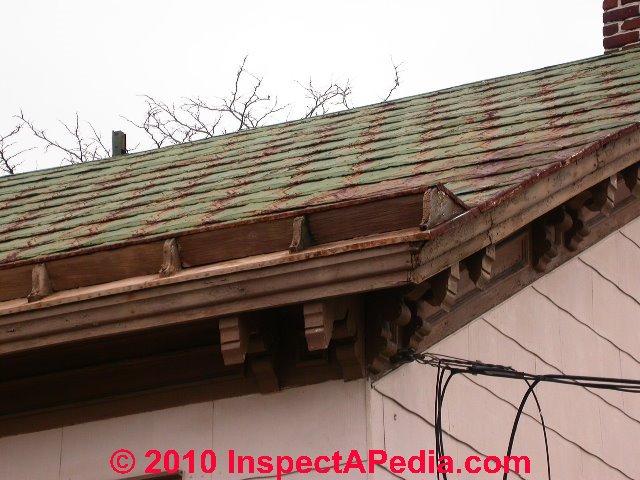
Make your life easier by taking a walk around your building during rainfall to see where water is going. Then look-up. You may see an obvious problem like the gutter falling off of the house in our photo.
[Click to enlarge any image]
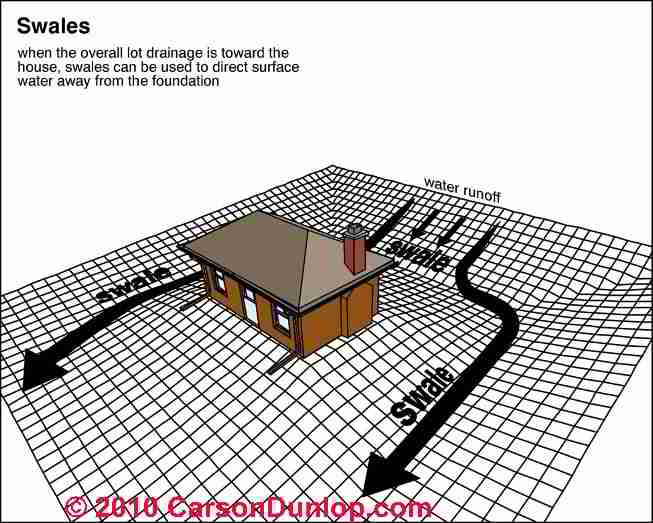
Our page top sketch of swale drainage construction is provided courtesy of Carson Dunlop Associates.
Roof Gutters, Downspouts, & Leaders are the most common source of foundation leaks and wet basements
Roof gutters and downspouts - check to see that roof runoff is effectively disposed of away from the building, and that it is actually working.
- See GUTTERS & DOWNSPOUTS for a guide to types of roof gutter systems.
- See GUTTER DEFECTS LIST
and DOWNSPOUT / LEADER DEFECTS for examples of common mistakes in handling roof runoff.
Most of the wet basements that we (DJF) have investigated were suffering from mishandling of roof drainage.
Between gutter defects that spill large volumes of water close to the foundation and improper site grading, we estimate that 80 percent or more of basement water entry problems can be explained.
Do not tie the downspouts into the footing drains - you will simply overload the footing drain system and risk future basement water entry.
We want to see gutters extended to release roof drainage no less than 10 feet from the home, more is better, and even more important, from the point at which water leaves the downspout end, it should continue to flow away from the building, not back towards it.
Add a splashblock to route surface runoff around a chimney whose side formed a water trap against the foundation wall
Improper Site Grading, In-Slope Grade May Send Roof Spillage or Surface Runoff into Building Basements or Crawl Areas
Site grading and control of surface runoff -
see GRADING, DRAINAGE & SITE WORK for details.
Keep water away from the foundation.
As we detail
at BASEMENT WATER ENTRY PREVENTION,
this means proper site drainage that assures that surface runoff and roof spillage are conducted away from the building.
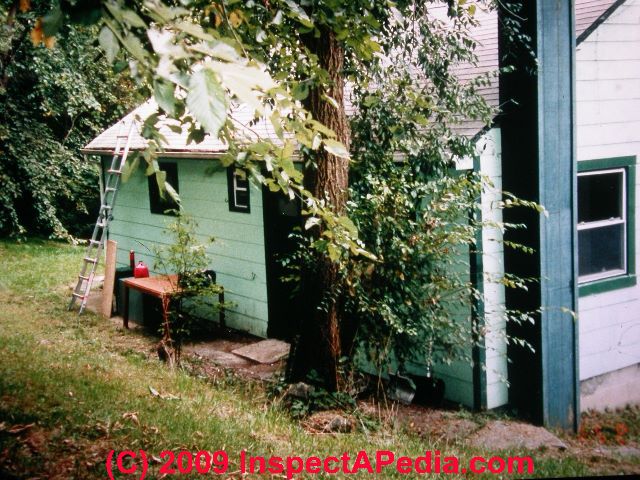
Our photo (above left) shows a home with an in-slope grade facing the house wall. It would have been relatively easy to install a swale draining hillside water and roof spillage around the left side of the home in this picture.
Instead the owners suffered decades of wet basements until the wet conditions made the home sills so attractive to termites that major
Guide to Finish Grading Details to Prevent Foundation Leaks & Water Entry
At grade,
the main object is to get water away from the foundation as quickly as possible. Finish grade should slope away from the building for at least 10 to 15 feet, and should not contain low spots that will make water ponds.
Swales:
if one or more sides of the building face an upwards sloping hill, slope the finish grade away from the building for at least 10-15 feet, and then shape the finish grade at that point into a swale that itself continues to carry water around to the downhill side of the building.
A swale, illustrated by Carson Dunlop Associates' sketch at left, is a nice word for a "gentle ditch" - it does not have to be deep.
Details about proper surface grading to control runoff are found
at SURFACE CONTOURING for DRAINAGE
Foundation ditches:
Do not do what we have found at some flooding basements: an in-slope grade problem that was trapping surface and roof runoff against the house was "fixed" by digging a ditch right against the foundation wall in an attempt to carry water away.
The ditch digger simply had built a water trap to guarantee that water would be sent against the foundation wall.
If a site absolutely has no room for a swale located 10-15 feet away from the foundation, you might make a workable drainage system by building a waterproof swale closer to the foundation wall by lining the swale or "ditch" with a heavy duty waterproof rubber or plastic membrane of the same material described at
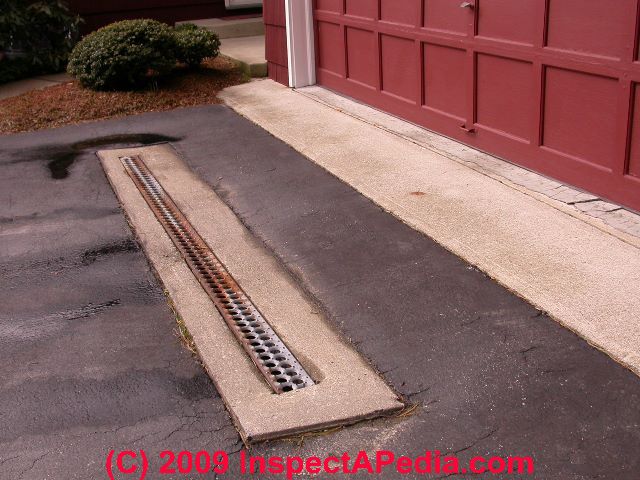
- Add an intercept drain at the entry of garages into which a paved driveway is sending water whenever it rains.
If you are planning to re-pave a driveway, that's a great time to go to the trouble of cutting in and installing a drain that prevents water from flowing into the garage.
Connect the intercept drain to a storm drain or to a new buried drain line that slopes to daylight well away from the building.
Don't connect the intercept drain to the building footing drain system - you may overload the footing drains and cause basement leaks.
Guide to Foundation Drainage Details to Avoid Foundation Leaks & Wet Basements
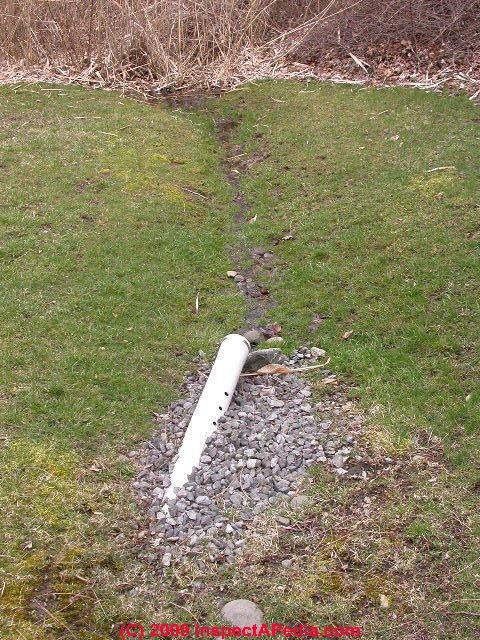
Footing drains / foundation drains
check for presence of and check that water is flowing out of footing drains if water is in the basement. If the basement is wet and the footing drains are dry, they are not working.
See FOUNDATION DRAINS & FRENCH DRAINS.
Our photo (left) illustrates a foundation drain that is "brought to daylight" at a property.
But this foundation drain (or "footing drain" extension) raises some questions: the use of perforated pipe far from the building may be ok.
And it's proper to use perforated pipes around the foundation footings themselves, so that water can enter the drainage system for disposal.
But if the pipes carrying this drainage "away" from the building are in fact perforated and are leaking it back into soils close to the structure, we may be simply recycling water rather than disposing of it.
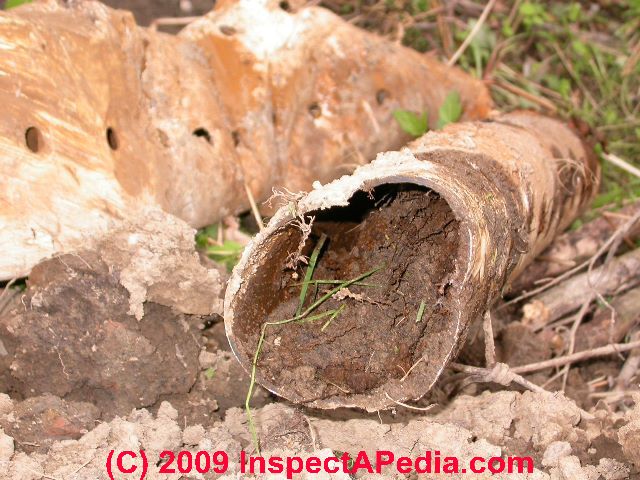
- Find the end of the footing drain
system that used to drain to daylight - it may have become buried with mud or covered by backfill.
Clear it open and check the end for water flow in wet weather. Our photo (above left) shows the footing drain that was excavated and removed at the home of a client whose house suffered recurrent flooding. The old footing drain was totally impacted with mud.
The photo below shows the ends of three new footing drains that were installed and carried to daylight.
We remained a little nervous about just what the builder used for backfill - notice that silty mud coming out of the new drains? They may not have a long life.
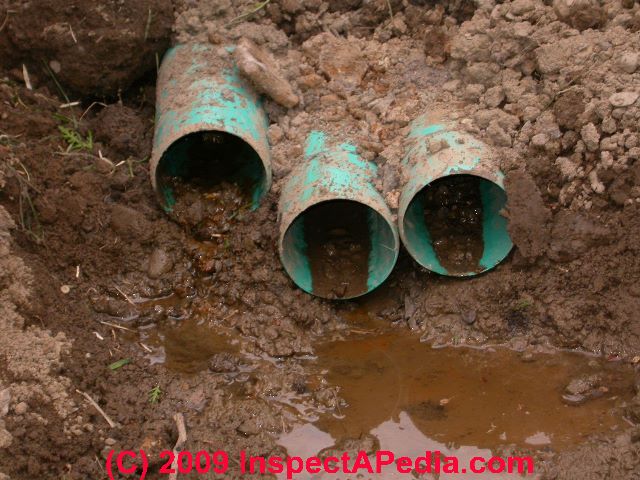
- Find and un-clog the footing drains:
excavate at a building corner, find the footing drains, cut open the drain to see how full it has become with silt, and have the drains cleaned using high pressure water or other methods. - Reroute a non-working footing drain
to a drywell if you can't get it to daylight - Add missing foundation footing drain sections that were omitted,
such as around a chimney or building addition
Other Outdoor Sources of Basement Leakage & Water Entry
- Buried components near the building foundation -
when roof spillage or surface runoff land near a building foundation wall, objects buried close to the structure, such as a buried oil tank or septic tank or even a large boulder or in-sloping solid rock all form a ready cavity or hole that helps catch and accumulate water that then can penetrate the foundation wall or leak up through the basement or crawl space floor.
If you see water stains along a crawl space or foundation wall that are in the same area as a buried outdoor object that is withing 10-15 feet of the foundation then that may be the route of water into the building.
See WATER ENTRY FROM BURIED TANKS for details - Repair foundation holes and cracks -
see SEAL CRACKS IN CONCRETE, HOW TO - Storm drains -
nearby storm drains should be un-blocked and not backing up onto the property. - Sump pumps -
also check that if they are installed, the sump pump(s) are working and that water is pumped to a location that does not drain back into the building. Some properties use an outdoor catch basin and sump pump to dispose of roof runoff or surface runoff.
See SUMP PUMPS GUIDE
This article series discusses methods for preventing wet basements by attention to multiple best construction practices, including the basics of foundation damp proof coating or waterproofing, poor site drainage, bentonite clay for basement waterproofing, foundation membranes to prevent leakage, foundation drain tiles, proper backfill, and proper finish grading.
...
Continue reading at GRADING, DRAINAGE & SITE WORK or select a topic from the closely-related articles below, or see the complete ARTICLE INDEX.
Or see these
Recommended Articles
- BASEMENT DE-WATERING SYSTEMS
- BASEMENT LEAKS, INSPECT FOR
- BASEMENT WATERPROOFING
- CRAWL SPACE DRYOUT
- FLOOD DAMAGE ASSESSMENT, SAFETY & CLEANUP
- FOUNDATION WATERPROOFING
- FOUNDATION WATERPROOFING: CRACK SEALANTS
- FOUNDATION WATERPROOFING SEALANTS
- GEOTEXTILES & DRAINAGE MATS
- GRADING, DRAINAGE & SITE WORK
- GUTTERS & DOWNSPOUTS
- WATER BARRIERS, EXTERIOR BUILDING
- WATER ENTRY FROM BURIED TANKS
- WET BASEMENT PREVENTION
- WATER ENTRY in BUILDINGS - home
Suggested citation for this web page
EXTERIOR WATER SOURCE ELIMINATION at InspectApedia.com - online encyclopedia of building & environmental inspection, testing, diagnosis, repair, & problem prevention advice.
Or see this
INDEX to RELATED ARTICLES: ARTICLE INDEX to BUILDING LEAKS & WATER ENTRY
Or use the SEARCH BOX found below to Ask a Question or Search InspectApedia
Ask a Question or Search InspectApedia
Questions & answers or comments about troubleshooting wet basements: finding outside sources of water leakage.
Try the search box just below, or if you prefer, post a question or comment in the Comments box below and we will respond promptly.
Search the InspectApedia website
Note: appearance of your Comment below may be delayed: if your comment contains an image, photograph, web link, or text that looks to the software as if it might be a web link, your posting will appear after it has been approved by a moderator. Apologies for the delay.
Only one image can be added per comment but you can post as many comments, and therefore images, as you like.
You will not receive a notification when a response to your question has been posted.
Please bookmark this page to make it easy for you to check back for our response.
Our Comment Box is provided by Countable Web Productions countable.ca
Citations & References
In addition to any citations in the article above, a full list is available on request.
- [1] Scott Anderson, The Journal of Light Construction, December 2005 [1]. Mr. Anderson is owner of Tri-State Basement Systems in Berlin VT
- Steven Bliss served as editorial director and co-publisher of The Journal of Light Construction for 16 years and previously as building technology editor for Progressive Builder and Solar Age magazines. He worked in the building trades as a carpenter and design/build contractor for more than ten years and holds a masters degree from the Harvard Graduate School of Education.
Excerpts from his recent book, Best Practices Guide to Residential Construction, Wiley (November 18, 2005) ISBN-10: 0471648361, ISBN-13: 978-0471648369, appear throughout this website, with permission and courtesy of Wiley & Sons. Best Practices Guide is available from the publisher, J. Wiley & Sons, and also at Amazon.com.
Excerpts with updates and annotations expanding the original Best Practices Guide text can be found in the online review and book summary at BEST CONSTRUCTION PRACTICES GUIDE and also at DECK & PORCH CONSTRUCTION, at INDOOR AIR QUALITY IMPROVEMENT GUIDE, and in other articles found at InspectAPedia.com such as HOUSEWRAP AIR & VAPOR BARRIERS, SOUND CONTROL in buildings, and other topics. - Mark Cramer Inspection Services Mark Cramer, Tampa Florida, Mr. Cramer is a past president of ASHI, the American Society of Home Inspectors and is a Florida home inspector and home inspection educator. Mr. Cramer serves on the ASHI Home Inspection Standards. Contact Mark Cramer at: 727-595-4211 mark@BestTampaInspector.com
- Our recommended books about building & mechanical systems design, inspection, problem diagnosis, and repair, and about indoor environment and IAQ testing, diagnosis, and cleanup are at the InspectAPedia Bookstore. Also see our Book Reviews - InspectAPedia.
- In addition to citations & references found in this article, see the research citations given at the end of the related articles found at our suggested
CONTINUE READING or RECOMMENDED ARTICLES.
- Carson, Dunlop & Associates Ltd., 120 Carlton Street Suite 407, Toronto ON M5A 4K2. Tel: (416) 964-9415 1-800-268-7070 Email: info@carsondunlop.com. Alan Carson is a past president of ASHI, the American Society of Home Inspectors.
Thanks to Alan Carson and Bob Dunlop, for permission for InspectAPedia to use text excerpts from The HOME REFERENCE BOOK - the Encyclopedia of Homes and to use illustrations from The ILLUSTRATED HOME .
Carson Dunlop Associates provides extensive home inspection education and report writing material. In gratitude we provide links to tsome Carson Dunlop Associates products and services.
 | HOME | ABOUT | ASK a QUESTION | CONTACT | CONTENT USE POLICY | DESCRIPTION | POLICIES | PRIVACY | |
| © 2024 - 1985 Publisher InspectApedia.com - Daniel Friedman | |||||||||