
InspectAPedia® FREE Encyclopedia of Building & Environmental Construction, Diagnosis, Maintenance & Repair |
Question? Just ask us! InspectAPedia
|
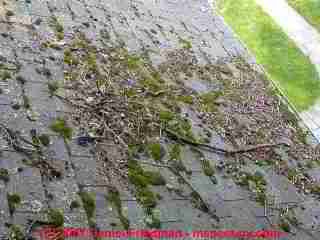 Photo-guide to Identification of Algae, Fungus, Lichens, Moss on, in or Related to Buildings
- POST a QUESTION or COMMENT about algae, lichens, and moss growth on buildings: cause, remedy, prevention
Algae, Lichens, Moss on buildings: What's the difference?
This article describes and provide photographs and microscopic photographs of algae, moss, lichens, or fungal growth that occurs on buildings and in nature.
We include links to references useful in the identification of algae, moss, lichens, and mold. Our photo at page top shows moss on an asphalt shingle roof.
InspectAPedia tolerates no conflicts of interest. We have no relationship with advertisers, products, or services discussed at this website.
- Daniel Friedman, Publisher/Editor/Author - See WHO ARE WE?
What does Algae look like on or around buildings & Algae under the microscope?

This article series tells readers how to identify, evaluate, remove or prevent stains on building surfaces.
Black stains due to algae
Algae often appears on organic and even inorganic surfaces of buildings and in nature such as on the asphalt roof shingles in this photo.
Black algae stains can also look a lot like extractive bleeding shown in this separate article on EXTRACTIVE BLEEDING on SHINGLES which can appear on asphalt roof shingles.We think that extractive bleeding on shingles is not common while dark algae-based stains on roof surfaces are very common.
While algae is the most common source of black or green roof stains on shingles, when the staining or bleeding appears to run down the roof from individual small points or "spots" this may be something other than a fungal growth or soot: it may b e extractive bleeding or "bleed through" on shingles.
The presence of algae on the roof is an indicator that this roof area is in a shaded spot where you may want to be alert for development of moss or other roof problems, but the level of damage from algae is probably low, even less than that caused by lichens. Avoid any aggressive cleaning methods that might damage the roof surface.
See ALGAE STAINS on ROOFS and also STAINS on ROOF SHINGLES for a more detailed discussion of bleed through or extractive bleeding as well as black algae stains on roof shingles.
Green stains due to algae
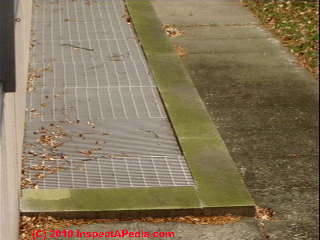
Green stains that are algal growth also appear on buildings including on shingles, siding, and even on masonry walls, sidewalks, planters, and retaining walls: stone, concrete block, and concrete. If you see flat green stain on a building exterior and that is not producing any plant-like raised growth it is likely to be an algae.
Watch out: on walks and decks algae makes for a dangerously slippery surface when it is wet. Details are at SLIPPERY STAIRS, WALKS, ROOFS.
Also see STONE, STUCCO & BRICK CLEANING METHODS for details about cleaning and prevention of algae or moss growth on outdoor and other surfaces.
Green algae contamination on cleaning fabrics used in a car wash is illustrated and discussed separately at ALGAE CONTAMINATION at CAR WASH
What does Algae Look Like Under the Microscope
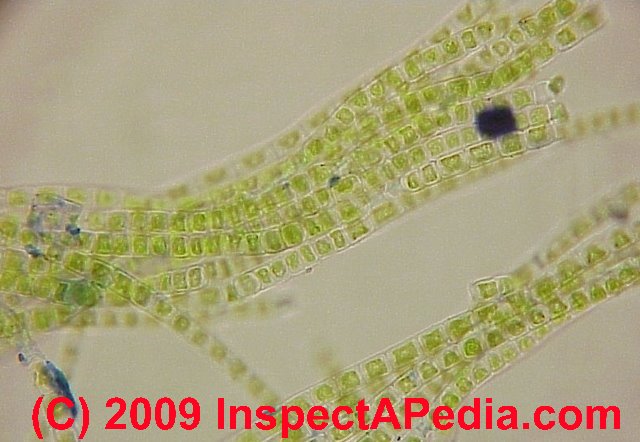
Examining a surface or tape lift sample of green "something" on a building surface by using an optical microscope can often quickly tell us if the green stain is biological and is algae, or if it's something else.
Algae under the microscope has a distinctive appearance that easily distinguishes it from moss, lichens, and mold, as we show here. This microphotograph of algae was made in our lab while examining a sample sent to us from our friend and mold lab expert Sue Flappan.
The original algae sample was collected from a concrete sidewalk using simple adhesive tape.
What does Lichens look like on buildings, in nature, and in the microscope?
Lichens, one of the most hardy growth organisms found in nature, can grow in harsh conditions. Lichens is often found growing on roof shingles, especially asphalt and wood shingles as we show here.
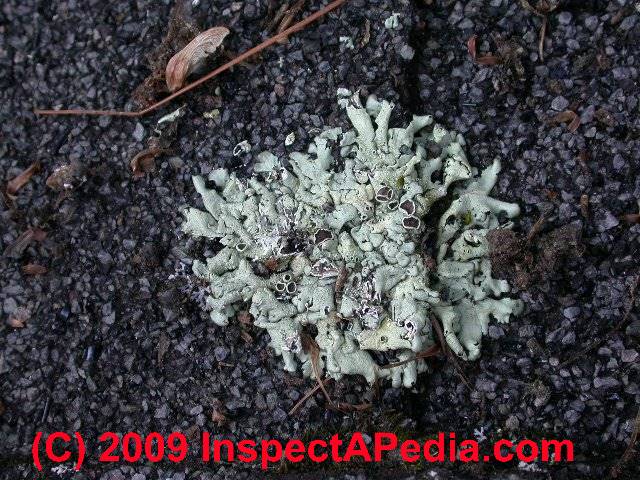

Our photographs (above) show lichens growing on an asphalt roof shingle in situ (above left). In the photo where our pen is inserted for scale (above right) we had "picked" the spot of lichens gently and flipped it over.
Our pen points to the hole left in the asphalt shingle as the lichens had such a good grip on the mineral granules that when removing the lichens it brought some of the roof protective coating along with itself.
If you click to enlarge the photo at above right you'll see the actual mineral granules from the shingle adhered in the "roots" of the lichens.
See LICHENS on ROOFS for details about the causes, effects, and prevention of lichens growth on roofing surfaces.
Also see LICHENS on STONE SURFACES.
Lichens on Painted Metal - Cars:
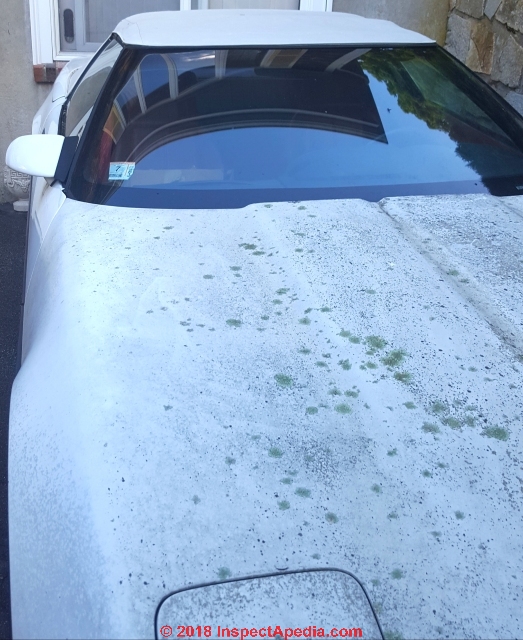
Above: this picture by an InspectApedia.com reader, shows a car that has an extensive lichens and mold growth on its hood.
Click to enlarge the image and you'll see the blue-green lichens colonies on the car's hood and headlights. The black spots could be an algae or a mold (fungus). We'd need to see a sample in our lab to know which.
What does Moss look like on buildings, in nature, and in the microscope?
Moss growing on any roof surface will be more severe on roof sections that area shaded and exposed to periodically damp cool weather conditions.
The presence or absence of much sunlight on a roof surface is often a determining factor in the amount of moss or lichens growth (more sun, less moss and lichens.
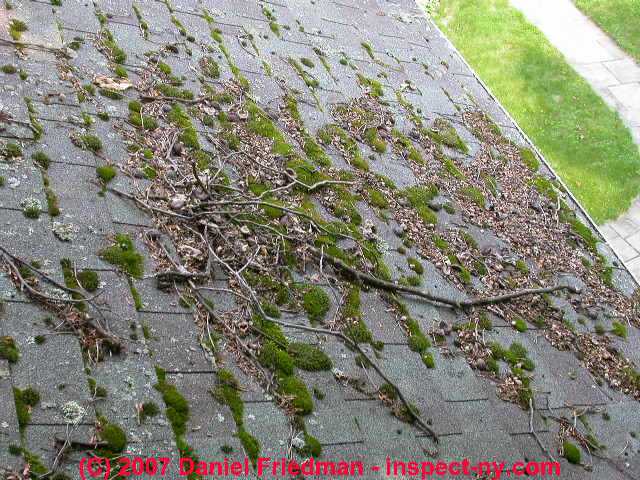
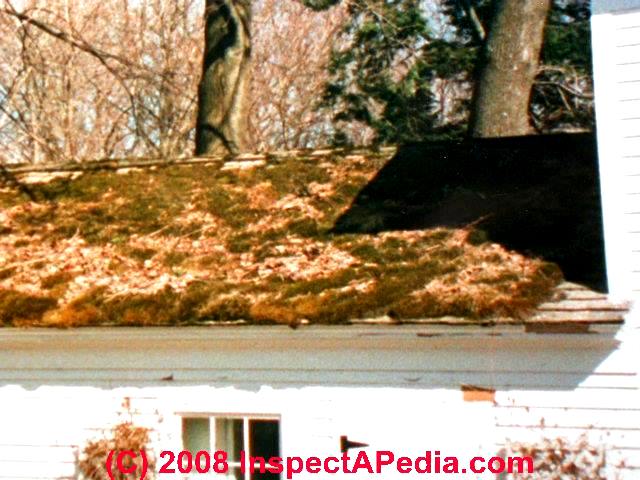
Moss and lichens are more than a cosmetic issue on many kinds of roofing materials - asphalt shingles, roll roofing, wood shingle roofs, wood shake roofs. By holding moisture against the roof surface lichens but more so moss speed the wear of the asphalt shingle surface in freezing climates by increasing frost damage to the mineral granule coating on the shingles.
See also TREES & SHRUBS, TRIM OFF BUILDING

What Moss Looks Like Under the Microscope - photos
It's easy to see the plant-like structure of moss fragments, as our photograph (left) demonstrates.
This moss sample was collected from a basement wall: we suspect that the damp conditions that produced this moss growth on the building wall also increased the risk of a mold problem in the same structure.
For an identification guide to mosses we include some resources below at Reviewers.
For an extensive catalog of methods for preventing algae, moss, or lichens growth on roofs see How to Prevent Moss, Lichens & Algae Growth on Roofs.
See Black Stain Removal & Prevention for advice on diagnosing, cleaning, and preventing algae stains on roofing.
Online Guides to Types of Stains on Building Surfaces:
At STAIN DIAGNOSIS on BUILDING EXTERIORS we list types of stains, contaminants or discoloration seen on building exterior surfaces by stain color & appearance, by building location or material, and by stain cause
. We distinguish among the following stuff that may stain or be found growing building roofs, walls, or other surfaces, with extra focus on asphalt shingle roofs as well as other roofing materials such as wood shingles, wood shakes, roll roofing, and even slate or tile roofs. Some of these types of roof stains or discoloration are only cosmetic in nature, while others may indicate growths that are likely to reduce the roof covering life.
At STAIN DIAGNOSIS on BUILDING INTERIORSwe list types of stains found on or in building interiors by stain color & appearance, by building location or material, and by stain cause.
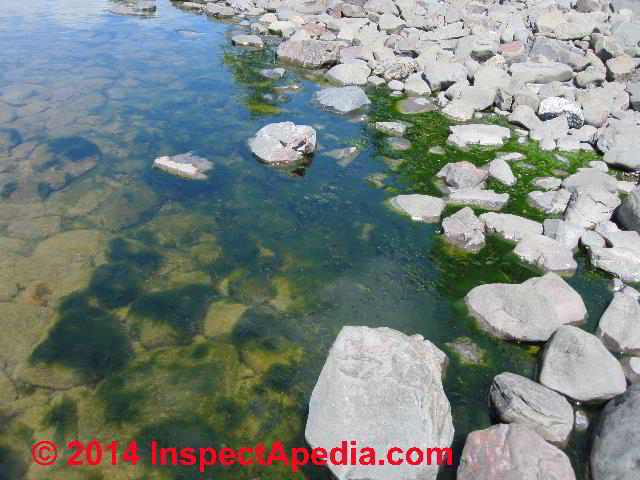
Our photo above shows algae formation in a fresh water lake near a failed septic drainfield.
See SEPTIC DRAINFIELD FAILURE DIAGNOSIS
and
see SEPTIC FAILURE SPOTS where we describe where effluent typically shows up when the disposal field is failing, including causing algae blooms in nearby waterways.
...
Continue reading at ALGAE STAIN TEST METHODS or select a topic from the closely-related articles below, or see the complete ARTICLE INDEX.
Or see these
Recommended Articles
- STAIN DIAGNOSIS on BUILDING EXTERIORS
- ALGAE & MOLD STAINS on EXTERIORS
- ALGAE STAINS on ROOFS
- BLACK STAIN REMOVAL & PREVENTION for advice on diagnosing, cleaning, and preventing algae stains on roofing.
- MOLD CLEANUP - WOOD FRAMING & PLYWOOD
- MOLD & FUNGUS on WOOD SIDING: CLEAN & PREVENT
- MOLD GROWTH on SURFACES, PHOTOS
- SLIPPERY STAIRS, WALKS, ROOFS - algae is one of the slipperiest materials known
- STAIN DIAGNOSIS on BUILDING EXTERIORS - home
- STONE, STUCCO & BRICK CLEANING METHODS for a discussion of the mechanical, chemical, lighting, heat and other methods used to remove algae, lichens, moss, and fungi from stone, masonry, roadways, and other exterior surfaces.
Suggested citation for this web page
ALGAE, FUNGUS, LICHENS, MOSS COMPARED at InspectApedia.com - online encyclopedia of building & environmental inspection, testing, diagnosis, repair, & problem prevention advice.
Or see this
INDEX to RELATED ARTICLES: ARTICLE INDEX to BUILDING STAINS
Or use the SEARCH BOX found below to Ask a Question or Search InspectApedia
Ask a Question or Search InspectApedia
Questions & answers or comments about algae, lichens, and moss growth on buildings: cause, remedy, prevention
Try the search box just below, or if you prefer, post a question or comment in the Comments box below and we will respond promptly.
Search the InspectApedia website
Note: appearance of your Comment below may be delayed: if your comment contains an image, photograph, web link, or text that looks to the software as if it might be a web link, your posting will appear after it has been approved by a moderator. Apologies for the delay.
Only one image can be added per comment but you can post as many comments, and therefore images, as you like.
You will not receive a notification when a response to your question has been posted.
Please bookmark this page to make it easy for you to check back for our response.
Comments


IF above you see "Comment Form is loading comments..." then COMMENT BOX - countable.ca / bawkbox.com IS NOT WORKING.
In any case you are welcome to send an email directly to us at InspectApedia.com at editor@inspectApedia.com
We'll reply to you directly. Please help us help you by noting, in your email, the URL of the InspectApedia page where you wanted to comment.
Citations & References
In addition to any citations in the article above, a full list is available on request.
- Guides to identifying mosses, lichens, algae
Graphic Guide Ontario Mosses (some of which appear widely dispersed by climate and geographic area, not just in Ontario) which offers a graphic guide to mosses. worldofmosses.com/ggom/index.html - Also see the sources listed at worldofmosses.com/ggom/ggomBibliography.html
- Also see the Journal Folia Geobotanica, Springer, Netherlands ISSN1211-9520 (Print) 1874-9348 (Online) IssueVolume 11, Number 2 / June, 1976 DOI10.1007/BF02854759 Pages217-22
- The Ecology of Algae, F.E. Round, Cambridge University Press, 1984 ISBN-10: 0521269067 ISBN-13: 978-0521269063
After an introduction outlining the chemical and physical characteristics of the environment, the book goes on to look at the actual habitats in which algae occur. The communities of the individual habitats such as open water, sediments, rocky shores, coral reefs, hot springs, sea ice, soil, etc., are then discussed with special phenomena highlighted, for example rhythmic activity, nitrogen fixation and buoyancy. There are also chapters on seasonal cycles of algal growth, energy flow, geographical dispersion, palaeo-ecology and contribution to sediments. The importance of algae in symbiotic relationships and their considerable significance to animal grazers in aquatic food chains are also discussed. The final chapter deals with the relationships of algae to eutrophication and pollution of water. This is an important aspect, which can only be understood through an appreciation of algal ecology. - Lichens of North America, Irwin M. Brodo, Yale University Press, 2001, ISBN-10: 0300082495, # ISBN-13: 978-0300082494
Quoting from Library Journal:
Lichens are a combination of a fungus and an alga but have a unique structure and appearance quite different from either. Existing worldwide and growing on a variety of surfaces, including rocks, soil, and trees, they may appear leafy, shrubby, mossy, crusty, or jellylike and are seen in a wide range of colors, from brilliant oranges, yellows, and reds to dull grays and browns. This huge new book, written by a world authority on lichens and emeritus research scientist at the Canadian Museum of Nature, Ottawa, provides information on about 1500 of the roughly 3600 recognized North American lichens. Part 1 introduces lichens in 14 clearly written chapters that discuss their biology, ecology, geography, environmental roles, and collection. Part 2, the heart of the book, is a guide that offers identification keys to groups, genera, and species and their descriptions, with accompanying photographs and North American distribution maps. The more than 900 truly beautiful, full-color photos were taken by the Sharnoffs, nature photographers whose work has been widely published in National Geographic, Smithsonian, and elsewhere. Of value to professionals and amateurs alike, this book is certain to be a classic reference for decades to come. Highly recommended for academic and research libraries and for public libraries where interest warrants; libraries needing only a brief yet informative introduction to lichens should consider William Purvis's inexpensive Lichens (Smithsonian Institution, 2000). William H. Wiese, Iowa State Univ. Lib., Ames - Our recommended books about building & mechanical systems design, inspection, problem diagnosis, and repair, and about indoor environment and IAQ testing, diagnosis, and cleanup are at the InspectAPedia Bookstore. Also see our Book Reviews - InspectAPedia.
- In addition to citations & references found in this article, see the research citations given at the end of the related articles found at our suggested
CONTINUE READING or RECOMMENDED ARTICLES.
- Carson, Dunlop & Associates Ltd., 120 Carlton Street Suite 407, Toronto ON M5A 4K2. Tel: (416) 964-9415 1-800-268-7070 Email: info@carsondunlop.com. Alan Carson is a past president of ASHI, the American Society of Home Inspectors.
Thanks to Alan Carson and Bob Dunlop, for permission for InspectAPedia to use text excerpts from The HOME REFERENCE BOOK - the Encyclopedia of Homes and to use illustrations from The ILLUSTRATED HOME .
Carson Dunlop Associates provides extensive home inspection education and report writing material. In gratitude we provide links to tsome Carson Dunlop Associates products and services.
 | HOME | ABOUT | ASK a QUESTION | CONTACT | CONTENT USE POLICY | DESCRIPTION | POLICIES | PRIVACY | |
| © 2025 - 1985 Publisher InspectApedia.com - Daniel Friedman | |||||||||