
InspectAPedia® FREE Encyclopedia of Building & Environmental Construction, Diagnosis, Maintenance & Repair |
Question? Just ask us! InspectAPedia
|
 Air Conditioner Condensing Coil Fins Damage
- POST a QUESTION or COMMENT about diagnosing and repairing damaged HVAC coil fins
This air conditioning repair article discusses the damaged air conditioner condensing coil fin damage & compressor, including bent or clogged fins which can interfere with effective system operation and improper support such as tipped or leaning A/C compressors.
InspectAPedia tolerates no conflicts of interest. We have no relationship with advertisers, products, or services discussed at this website.
Air Conditioner Condensing Coil Fins Damage & Repair
 Discussed here: Air conditioner condensing coil fin damage - Air conditioner compressor support pad defects. Corrosion on Heating & Air Conditioning Heat Exchanger Coils & Condenser Coils.
Types of Air Conditioner, Heat Pump, & Refrigeration System Condensers / Condenser Coils. Changing or replacing a bad condensing coil, advice for.
Which Cooling or Heat Pump "Coil" is Which: Condensing Coil & Cooling/Evaporator Coils Defined
Outdoors: the A/C or heat pump CONDENSING COIL discussed here is normally on the outdoor or compressor portion of your air conditioning system. The job of the condensing coil is to cool high temperature refrigerant gas to condense it back to a liquid refrigerant form.
Avoid confusion
Indoors: the COOLING COIL or EVAPORATOR COIL is the evaporator coil found inside the air handler, used to cool air blown across it and into the building occupied space.
If your concern is with If your equipment is a heat pump these terms can be a bit confusing because in heating mode, your heat pump system's indoor coil is warming, not cooling the air blown across it
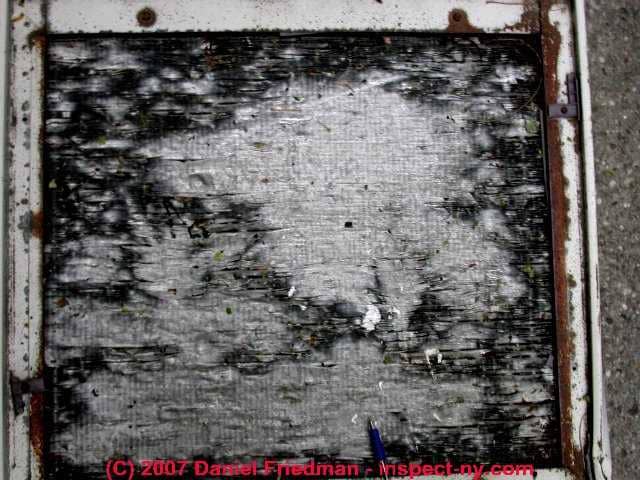
Shown at above-left: an outdoor condensing coil with badly damaged cooling fins: If the condensing coil fins are extensively bent and damage, airflow across the coil is impeded, causing the same failures and operating cost issues described above for the compressor too close to the building wall.
When coil fins are sufficiently damaged as to be mostly blocked, the coil is not usable and needs replacement. Minor A/C coil fin damage can be repaired using special "combs" sold for that purpose - ask your air conditioner service technician to look at, evaluate, and repair fin damage.
Nova-Tech International and other companies sell coil fin straightening combs, but if your coil is as horrible as this one it needs replacement.
Condensing coils may also become blocked by dirt and debris, interfering with system cooling operation. There is a big payoff in cleaning dust, debris, grass clippings off of a dirty refrigeration condensing coil (this includes outdoor condenser/compressor units for air conditioners and heat pumps and also the condensing coil on a home refrigerator or freezer).
A refrigeration system works by transferring heat from hot refrigeration gas/liquid to ambient air around the condensing coil. Remember that heat always flows from the warmer to the cooler substance.
A blocked condensing coil, regardless of the cause of blockage, can also cause the occurrence of refrigerant gas bubbles in the refrigerant piping system - a condition you might hear or see. See details
at BUBBLES seen or heard in the liquid REFRIGERANT LINE?
Overheating, Blocked Coils May Cause Air Conditioner or Heat Pump Noise
Because dirt and debris block airflow across the coil, increasing the cost of heating or cooling the building and perhaps even overheating the compressor motor, it is important to keep leaves and debris off of this component.
In severe cases cooling or condensing coils can become so blocked that air flow is seriously reduced, possibly also leading to an evaporator or cooling coil icing problem indoors or an overheated, damaged compressor outdoors, or simply loss of cooling capacity of the system.
We first mentioned
at NOISES, COMPRESSOR CONDENSER
that we had a field report from a reader who explained that a noisy outdoor compressor unit was, according to his HVAC service technician, traced to a blocked, clogged outdoor condensing coil. We speculate that perhaps the compressor was running hot and that correcting air flow across the condensing coil corrected that condition.
I have a National comfort Products CPO 2464-B unit which is an air conditioner and gas heating unit combined. The unit is about 5 years old.
The air conditioner had become increasingly noisy. I called the party that installed the unit. After spending $90.00 for a service call I was informed the the external coils were dirty, opening up the unit light was not visible thru the coils.
I was advised to use a garden hose and rinse the coils. I did not have that available so I turned the unit on and using a watering can, poured warm soapy water onto the coils. this was done several times.
The unit now seems to work properly. I did not see this particular problem described on your website. There may be other means of cleaning the coils but this was all I could think of. - C.A.P., Norristown PA
Corrosion on Heating & Air Conditioning Heat Exchanger Coils & Condenser Coils
Corrosion on heat exchanging coils in heat pumps, air conditioners, or water-to-air heating coils eventually leads to leaks and costly repairs that require replacement of the coil and re-charging of the HVAC system refrigerant
. Corrosion may occur as a function of age and use and failure to keep the coil clean, but there are some special sources of corrosion in HVAC systems that you should watch for:
- Corrosion of HVAC equipment coils due to their use at indoor swimming pools:
chlorine used in pools is very volatile and rapidly leaves the pool water as chlorine gas.
While the chlorine levels may be below a health hazard to humans at indoor pools, the operation of indoor HVAC systems that condition swimming pool room air exposes the coil to high volumes of possibly corrosive chlorine, reducing the equipment life. - Corrosion of HVAC equipment coils due to presence of Chinese Drywall
in the building.
See CHINESE DRYWALL HAZARDS for details.
Types of Air Conditioner, Heat Pump, & Refrigeration System Condensers / Condenser Coils
Above we have explained the purpose and function of condensing coils and condensers used in air conditioners, heat pumps, and other refrigeration equipment such as dehumidifiers, refrigerators, and freezers. Here is more detail about the types of condensers and condensing coils and where they are used.
Static condensers
rely on the natural movement of air across the condensing coil (such as in many residential refrigerators and freezers). For a static condenser to work you must leave air space on both sides and above the condensing coil to allow for airflow by natural convection (as no fans are used).
Oil cooler condensers are a type of static condenser that use two or three turns of tubing to cool oil that is then sent back into the compressor motor in a repeated cycle. These condenser (cooling) coils found on some compressors (commercial) also must have adequate airlfow.
Static condensers may also be found in a split in the compressor motor shell, between an inner and outer box shell - such as used in halo heaters - to reduce air condensation.
You can identify a split shell or box shell static condenser because the box is warmer on the outside sides and at the compressor motor top than at the bottom. These static condensers also require airspace for natural air convection.
Forced air condensers require a fan to move air across the condensers' cooling fins and coils. On an air conditioner or heat pump compressor/condenser unit the fan typically draws outdoor air through the coil and out an exhaust side of the condenser unit.
When used on a residential refrigerator or freezer the condenser coil may be at the bottom (or in some designs the top) of the unit where a fan blows air across the condensing coil and out of the box again.
Clean the refrigerator coils?
In an expert witness court case involving a matrimonial dispute we [DF] testified that a refrigerator had overheated, burning the vinyl flooring in the kitchen when the condensing coils had been left plugged with and dust.
One of the attorneys asked if it was our opinion that refusing to clean the coils had been a deliberate act of sabotage on the part of the building occupants. "Of course not," I answered, "most people never clean their refrigerator or freezer coils - they never think about it until the equipment fails."
Pets
like to lie close to a bottom-mounted condenser coil/fan unit at refrigerators and freezers, to enjoy that nice warm exhaust air in cool weather.
A result is a coil clogged with pet hair that needs more frequent cleaning. Even if it doesn't burn the floor under you refrigerator, a dirty condensing coil means a less efficient refrigerator or freezer operation and higher electrical bills.
Reinstall the airflow panels
that you might remove to clean a refrigerator or freezer condenser coil. Failing to do so means air will no longer pass properly over the condensing coil. The result, as with pets, is a higher electrical bill.
Changing Out or Replacing a Bad Condenser Coil on an Air Conditioner or Heat Pump
Reader Question: what is the cost will be to replace the A/C coil and refrigerant gas
3/26/14 chuck said: My condenser coil has failed and all Freon has leaked out. Any idea of what the cost will be to replace the coil and Freon?
Reply:
Chuck, in a companion article on refrigerant leaks
we comment on coil repair options.
The actual repair cost range is quite large, ranging from a DIY epoxy kit to a service call to a coil replacement to a complete HVAC system replacement, depending on the cause of the leak, the refrigerant type or age of the system, and thus the repair options.
To replace an AC condensing coil you could be looking at $1300 - $1500. U.S.D. vs. $2000 to $3000 to replace the whole unit.
See ADDING A/C: RETROFIT SIZING for an example of a mismatch that means poor heating or heat pump system operation.
See COOLING CAPACITY, RATED of air conditioning equipment if the system seems to be working but is inadequate to cool your building.
As we also cite in our information about
the COOLING COIL or EVAPORATOR COIL, a condensing coil can also need replacement due to damage, leaks, or corrosion. When replacing a condensing coil it is important to match the size of the original coil so that the air conditioner, heat pump, or other equipment remains properly balanced among compressor, condenser, and evaporator.
Condenser coil piping and tubing is smaller diameter than the suction lines, and are often made of steel. Keep in mind that when soldering steel to copper refrigerant piping you'll need to use silver solder or brazing.
See details about HVAC piping soldering discussed
at REFRIGERANT PIPING INSTALLATION
Reader Comments, Questions & Answers About The Article Above
Below you will find questions and answers previously posted on this page at its page bottom reader comment box.
Reader Q&A - also see RECOMMENDED ARTICLES & FAQs
Question: what will it cost to replace the condensing coil and Freon?
(Mar 27, 2014) chuck said:
My condenser coil has failed and all Freon has leaked out. Any idea of what the cost will be to replace the coil and Freon?
Reply:
Chuck, in a companion article on refrigerant leaks at REFRIGERANT LEAK REPAIR and in the FAQs section at the bottom of that article -
inspectapedia.com/aircond/Refrigerant_Leak_Repair.php#FAQ
we comment on coil repair options.
The actual repair cost range is quite large, ranging from a DIY epoxy kit to a service call to a coil replacement to a complete HVAC system replacement, depending on the cause of the leak, the refrigerant type or age of the system, and thus the repair options.
To replace an AC condensing coil you could be looking at $1300 - $1500. U.S.D. vs. $2000 to $3000 to replace the whole unit.
...
Continue reading at REFRIGERANT DRIERS & FILTERS or select a topic from the closely-related articles below, or see the complete ARTICLE INDEX.
Or see CONDENSING COIL REPAIR REPLACE FAQs - questions & answers about condenser coils posted originally at the end of this page.
Or see these
Recommended Articles
- COMPRESSOR / CONDENSER REPAIR - home
- COMPRESSOR / CONDENSER DIAGNOSTICS
- COMPRESSOR / CONDENSER INSPECTION CHECKLIST
- COMPRESSOR / CONDENSER INSTALLATION ERRORS
- COMPRESSOR / CONDENSER LEVELING REQUIREMENTS
- COMPRESSOR CONDENSER NOISES
- CONDENSING COIL REPAIR REPLACE
- FAN, COMPRESSOR / CONDENSER UNIT
- HEAT PUMP OUTDOOR UNIT DEFROST CYCLE
- LONG-ON CYCLING AC COMPRESSOR
- REFRIGERANT FLOODBACK, LIQUID SLUGGING
- REFRIGERANT LEAK REPAIR
- SHORT CYCLING AC COMPRESSOR
Suggested citation for this web page
CONDENSING COIL REPAIR REPLACE at InspectApedia.com - online encyclopedia of building & environmental inspection, testing, diagnosis, repair, & problem prevention advice.
Or see this
INDEX to RELATED ARTICLES: ARTICLE INDEX to AIR CONDITIONING & HEAT PUMPS
Or use the SEARCH BOX found below to Ask a Question or Search InspectApedia
Ask a Question or Search InspectApedia
Questions & answers or comments about diagnosing and repairing damaged HVAC coil fins or coil tubing damage & repair.
Try the search box just below, or if you prefer, post a question or comment in the Comments box below and we will respond promptly.
Search the InspectApedia website
Note: appearance of your Comment below may be delayed: if your comment contains an image, photograph, web link, or text that looks to the software as if it might be a web link, your posting will appear after it has been approved by a moderator. Apologies for the delay.
Only one image can be added per comment but you can post as many comments, and therefore images, as you like.
You will not receive a notification when a response to your question has been posted.
Please bookmark this page to make it easy for you to check back for our response.
Our Comment Box is provided by Countable Web Productions countable.ca
Citations & References
In addition to any citations in the article above, a full list is available on request.
- Thanks to Areader Charles A. Plinton, Norristown, PA, for discussing A/C compressor noise, coil cleaning, and system maintenance - August 2010
- Our recommended books about building & mechanical systems design, inspection, problem diagnosis, and repair, and about indoor environment and IAQ testing, diagnosis, and cleanup are at the InspectAPedia Bookstore. Also see our Book Reviews - InspectAPedia.
- Complete List of Air Conditioning & Heat Pump Design, Inspection, Repair Books at the InspectAPedia Bookstore.
- Modern Refrigeration and Air Conditioning, A. D. Althouse, C.H. Turnquist, A. Bracciano, Goodheart-Willcox Co., 1982
- Principles of Refrigeration, R. Warren Marsh, C. Thomas Olivo, Delmar Publishers, 1979
- Refrigeration and Air Conditioning Technology, 5th Ed., William C. Whitman, William M. Johnson, John Tomczyk, Cengage Learning, 2005, ISBN 1401837654, 9781401837655 1324 pages
- In addition to citations & references found in this article, see the research citations given at the end of the related articles found at our suggested
CONTINUE READING or RECOMMENDED ARTICLES.
- Carson, Dunlop & Associates Ltd., 120 Carlton Street Suite 407, Toronto ON M5A 4K2. Tel: (416) 964-9415 1-800-268-7070 Email: info@carsondunlop.com. Alan Carson is a past president of ASHI, the American Society of Home Inspectors.
Thanks to Alan Carson and Bob Dunlop, for permission for InspectAPedia to use text excerpts from The HOME REFERENCE BOOK - the Encyclopedia of Homes and to use illustrations from The ILLUSTRATED HOME .
Carson Dunlop Associates provides extensive home inspection education and report writing material. In gratitude we provide links to tsome Carson Dunlop Associates products and services.
 | HOME | ABOUT | ASK a QUESTION | CONTACT | CONTENT USE POLICY | DESCRIPTION | POLICIES | PRIVACY | |
| © 2024 - 1985 Publisher InspectApedia.com - Daniel Friedman | |||||||||