
InspectAPedia® FREE Encyclopedia of Building & Environmental Construction, Diagnosis, Maintenance & Repair |
Question? Just ask us! InspectAPedia
|
 Ceramic Tile Floor Properties: Kitchens & Bath
- POST a QUESTION or COMMENT about choosing & installing ceramic tile floors in kitchens & bathrooms
Kitchen & bath ceramic floor tile properties, choices, recommendations:
This article discusses ceramic floor tile choices & properties, and ceramic tile installation details for kitchens and bathrooms.
InspectAPedia tolerates no conflicts of interest. We have no relationship with advertisers, products, or services discussed at this website.
Ceramic & Stone Tile Selection & Installation Advice for Bathrooms & Kitchens
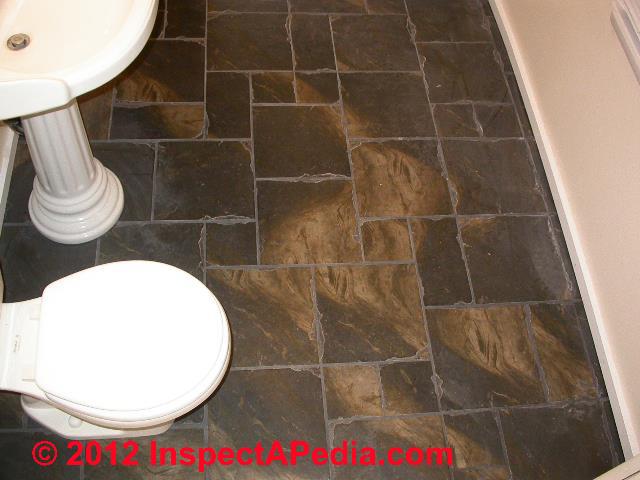 This article series discusses current best design practices for kitchens and bathrooms, including layout, clearances, work space, and accessible kitchen and bathroom layout, clearances, turning space, grab bars, controls, etc.
[Click to enlarge any image]
We include advice on choosing and installing kitchen countertops, cabinets, and kitchen or bathroom flooring, sinks, and other plumbing fixtures and fixture controls such as faucets. A list of kitchen and bath product manufactures and sources is included.
This article includes excerpts or adaptations from Best Practices Guide to Residential Construction (Steve Bliss, J Wiley & Sons) , by Steven Bliss, courtesy of Wiley & Sons.
As detailed in Chapter 6 of Best Practices Guide to Residential Construction (Steve Bliss, J Wiley & Sons) : A quality ceramic tile job starts with proper framing to support the tile and the selection of tile materials that are right for the application and compatible with each other.
If all these products are installed following the manufacturer’s instructions as well as the specifications of the Tile Council of America (TCA), the result should be an attractive and durable job.
 Finally, it is critical that
the installer leave the required expansion joints at the
room perimeter, tub lips, and other places the tile is
restrained—the source of many tile callbacks.
Finally, it is critical that
the installer leave the required expansion joints at the
room perimeter, tub lips, and other places the tile is
restrained—the source of many tile callbacks.
Selecting Tile for Kitchens & Baths
A wide array of tiles are readily available. In addition to aesthetic concerns, tiles vary in strength, water absorption, scratch resistance, ease of cleaning, and slip resistance.
In general, look for harder tiles for floor and counter applications, and tiles low in water absorption for wet applications. Beyond looking at the specifications, it is a good idea to test a sample of tile for scratch resistance, scuffing, and ease of cleaning, using real pots and pans, shoes, and household cleansers.
Strength and Water Absorption of Ceramic Tiles
The body of a ceramic tile, also called the bisque, is made by heating a mixture of clay and other additives in a kiln. In general, the longer the clay is fired and the higher the temperature, the denser and stronger the tile will be and the more impervious to water absorption.
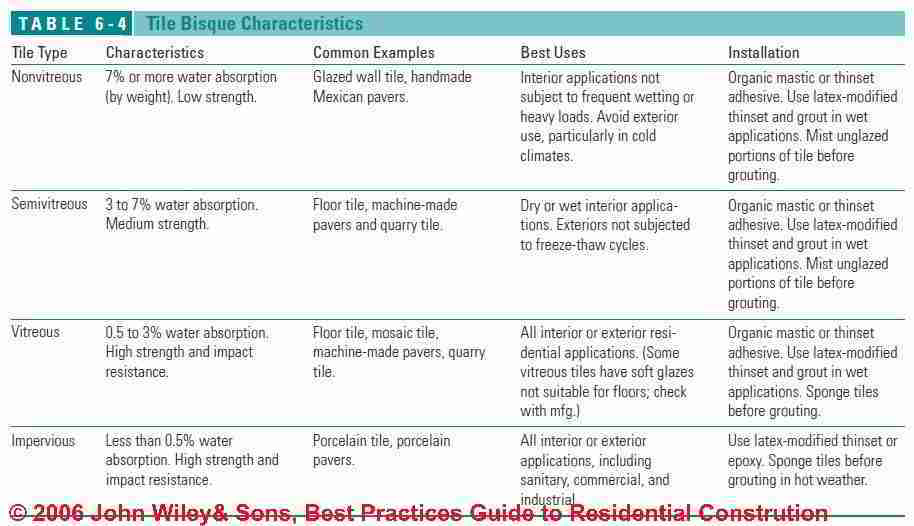
Nonporous tiles that absorb little water will perform better in wet applications than porous tiles. The tile bisques manufactured according to ANSI standards are rated from nonvitreous to impervious (see Table 6-4).
[Click any image or table to see an enlarged version with additional detail, commentary & source citation.]
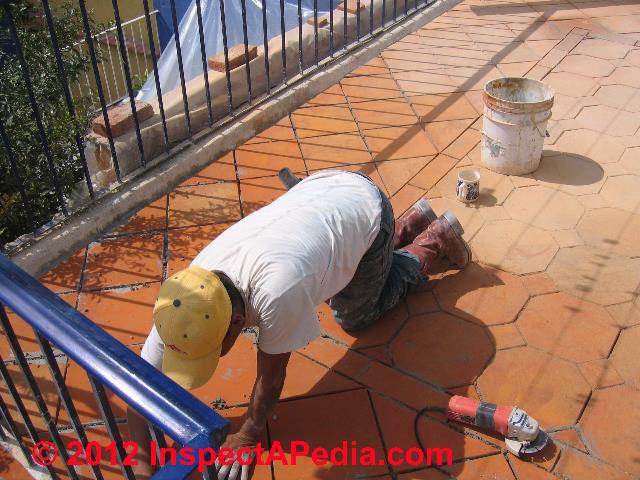
Comparison of the Properties of Glazed vs. Unglazed Ceramic Tile
 With the exception of
quarry tile, terra-cotta, and some porcelains and mosaics,
most tiles come glazed. The glaze consists of a mix of silica
and pigments that is fused to the surface of the tile at
high temperatures, creating a glasslike coating.
With the exception of
quarry tile, terra-cotta, and some porcelains and mosaics,
most tiles come glazed. The glaze consists of a mix of silica
and pigments that is fused to the surface of the tile at
high temperatures, creating a glasslike coating.
Glazes provide decorative color and protect the surface of porous tiles from absorbing water and stains. How well a glaze resists abrasion and shows scratches depends on several factors:
- Temperature: Glazes fired hotter and longer tend to be harder and more scratch-resistant.
- Color: Light-colored glazes tend to be harder than dark colors and conceal scratches better.
- Gloss level: Matte-finished glazes tend to be harder than high gloss and also conceal scratches better.
Unglazed tiles show the natural color of the clay, although some unglazed mosaics have pigment added to the clay.
Unglazed tiles may need to be sealed to prevent staining during grouting or in use on floors, counters, and other applications prone to staining. Sealing is generally done before grouting. If used on a counter, make sure the sealer is suitable for use around food.
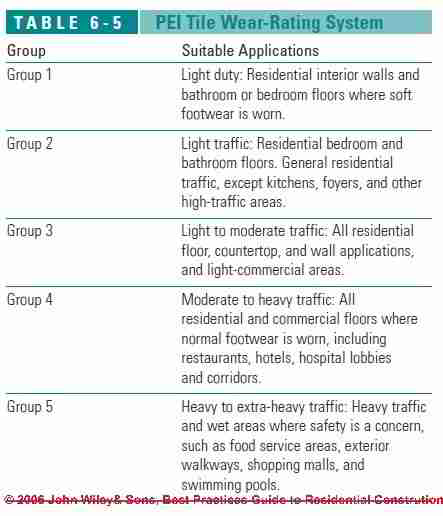
Many manufacturers now rate the abrasion resistance of their tile using the guidelines of the Porcelain Enamel Institute (PEI). The PEI system rates tiles from 1 to 5 as shown in Table 6-5.
Select Grade 3 or higher where scratching of the tile surface is a concern.
Slip Protection vs. Use of Glazed Tiles in Baths or Kitchens: Coefficient of Friction
Many glazed floor tiles become dangerously slippery when wet. This is a concern wherever floors are subject to wetting, but particularly on shower floors and bathroom floors near tubs and showers.
In general, unglazed tiles or textured patterns will be less slippery. Some tile has a special nonskid surface made by adding an abrasive grit to the tile face or glaze. The downside is that nonglossy surfaces are somewhat harder to keep clean.
Many tile manufacturers use a coefficient of friction (COF) to rate the traction a tile provides.
While there are no national standards that specify a required COF, the Americans with Disabilities Act (ADA) recommends a minimum COF of .60 on accessible walking routes.
Experts also recommend a minimum COF of .60 for shower stalls, wet bathroom floors, and other wet areas.
Also see flooring basics
at FLOOR DESIGNS: KITCHEN & BATH and
for alternatives to ceramic tile floors
see FLOOR, STONE, GRANITE, MARBLE, AGGLOMERATE and
also FLOOR, RESILIENT VINYL or CORK.
Ceramic Tile-Setting Material Manufacturer List
- Bonsal American www.bonsal.com Setting compounds, grouts, preformed shower pans, curbs, and niches. Also, distributor of backerboards, isolation membranes, and other tile-setting products
- Color Caulk, div. of Roanoke Companies Group www.colorcaulk.com Color-matched caulking
- Custom Building Products www.custombuildingproducts.com Elastomeric and liquid-applied membranes, self-leveling underlayments, setting compounds, and grouts
- Laticrete International www.laticrete.com Trowel-on membranes, self-leveling underlayments, setting compounds, grouts, and sealants
- Noble Company www.noblecompany.com CPE sheet membranes, trowel-on membranes, clamping ring drains, and preformed slopes, niches, and curbs
- Mapei www.mapei.com Trowel-on and sheet membranes, self-leveling underlayments, setting compounds, grouts, and color-matched sanded caulks
Ceramic Tile Backerboard Producers
- Custom Building Products www.custombuildingproducts.com Wonderboard cement backerboard, Easyboard cement and polystyrene lightweight backerboard, and Rhinoboard fiber-cement backerboard
- Georgia-Pacific Gypsum www.gp.com/build Denshield gypboard backer with glass-matt facing
- James Hardie Building Products www.jameshardie.com Fiber-cement backerboard
- National Gypsum www.nationalgypsum.com Permabase lightweight cement and polystyrene backerboard
- Schluter Systems www.schluter.com Kerdi tile membrane goes directly over drywall or other substrates
- T. Clear Corp./Fin Pan Inc. www.finpan.com Util-A-Crete lightweight concrete backerboard
- U.S. Gypsum www.usg.com Durock cement backerboard
- W. R. Bonsal www.bonsal.com Extruded polystyrene backerboard with fiberglassreinforced cement facing
Kitchen & Bath Industry Associations
- Association of Home Appliance Manufacturers(AHAM) www.aham.org
- National Kitchen and Bath Association (NKBA) www.nkba.org
- Ceramic Tile Institute of America www.ctioa.org
- Home Ventilation Institute (HVI) www.hvi.org
- Marble Institute of America www.marble-institute.com Porcelain Enamel Institute (PEI) www.porcelainenamel.com
- Tile Council of America (TCA) www.tileusa.com
- - Adapted with permission from Best Practices Guide to Residential Construction (Steve Bliss, J Wiley & Sons) .
For information about whether or not ceramic floor tile contains asbestos, see CERAMIC TILE, ASBESTOS / LEAD?.
...
Continue reading at FLOOR TILE SETTING COMPOUNDS or select a topic from the closely-related articles below, or see the complete ARTICLE INDEX.
Or see these
Recommended Articles
- BATH & KITCHEN DESIGN GUIDE - home
- CERAMIC TILE FLOOR, WALL
- CEMENT BACKERBOARD INSTALLATION
- FLOOR FRAMING & SUBFLOOR for TILE
- FLOOR TILE SEALERS, CERAMIC, STONE
- TILED WALKING SURFACE SLIP HAZARDS
- CERAMIC TILE, ASBESTOS / LEAD?
- CERAMIC TILE BACKSPLASH INSTALLATION
- CERAMIC TILE DAMAGE REPAIR
- CERAMIC TILE GROUT INSTALLATION
- CERAMIC TILE FLOOR & WALL
- CERAMIC TILE SETTING COMPOUNDS
- CERAMIC WALL TILE INSTALLATION
- FLOOR DAMAGE DIAGNOSIS
- FLOOR DESIGNS: KITCHEN & BATH
- FLOOR FRAMING & SUBFLOOR for TILE
- FLOOR, RESILIENT VINYL or CORK
- FLOOR, STONE, GRANITE, MARBLE, AGGLOMERATE
- FLOOR TILE INSTALL on CONCRETE
- TILED WALKING SURFACE SLIP HAZARDS
Suggested citation for this web page
CERAMIC TILE FLOOR & WALL at InspectApedia.com - online encyclopedia of building & environmental inspection, testing, diagnosis, repair, & problem prevention advice.
Or see this
INDEX to RELATED ARTICLES: ARTICLE INDEX to BATH & KITCHEN
Or use the SEARCH BOX found below to Ask a Question or Search InspectApedia
Ask a Question or Search InspectApedia
Try the search box just below, or if you prefer, post a question or comment in the Comments box below and we will respond promptly.
Search the InspectApedia website
Note: appearance of your Comment below may be delayed: if your comment contains an image, photograph, web link, or text that looks to the software as if it might be a web link, your posting will appear after it has been approved by a moderator. Apologies for the delay.
Only one image can be added per comment but you can post as many comments, and therefore images, as you like.
You will not receive a notification when a response to your question has been posted.
Please bookmark this page to make it easy for you to check back for our response.
Our Comment Box is provided by Countable Web Productions countable.ca
Citations & References
In addition to any citations in the article above, a full list is available on request.
- Best Practices Guide to Residential Construction, by Steven Bliss. John Wiley & Sons, 2006. ISBN-10: 0471648361, ISBN-13: 978-0471648369, Hardcover: 320 pages, available from Amazon.com and also Wiley.com. See our book review of this publication.
- In addition to citations & references found in this article, see the research citations given at the end of the related articles found at our suggested
CONTINUE READING or RECOMMENDED ARTICLES.
- Carson, Dunlop & Associates Ltd., 120 Carlton Street Suite 407, Toronto ON M5A 4K2. Tel: (416) 964-9415 1-800-268-7070 Email: info@carsondunlop.com. Alan Carson is a past president of ASHI, the American Society of Home Inspectors.
Thanks to Alan Carson and Bob Dunlop, for permission for InspectAPedia to use text excerpts from The HOME REFERENCE BOOK - the Encyclopedia of Homes and to use illustrations from The ILLUSTRATED HOME .
Carson Dunlop Associates provides extensive home inspection education and report writing material. In gratitude we provide links to tsome Carson Dunlop Associates products and services.
 | HOME | ABOUT | ASK a QUESTION | CONTACT | CONTENT USE POLICY | DESCRIPTION | POLICIES | PRIVACY | |
| © 2024 - 1985 Publisher InspectApedia.com - Daniel Friedman | |||||||||