 Well Pipe Grabber & Fishing Tool Designs
- POST a QUESTION or COMMENT about submersible well pump & pump controls, their properties, installation, troubleshooting & repair
Well retrieval tool designs & patents:
History, patents, sketches of devices for retrieving stuff dropped into a well. This article describes and illustrated tools people have invented for retrieving pipes, pumps, tools, or other stuff dropped into a well.
Our focus is on water wells, drilled bore holes, steel or plastic well casing designs but these tools also pertain to the oil and gas drilling industry.
This article series describes methods & tools bought or home-made that can be used to fish materials out of a water well if you've dropped the pipe, well pump, or tools down into the well casing. The poly rope shown in our page top photo can be used to pull the well piping from this drilled well - if the rope remains intact.
InspectAPedia tolerates no conflicts of interest. We have no relationship with advertisers, products, or services discussed at this website.
- Daniel Friedman, Publisher/Editor/Author - See WHO ARE WE?
Well Retrieval Tool Designs & Patents
Below in this article we describe and illustrate some of the classic patented tools and designs that over the last 100 years have typified inventions used to retrieve pipes or other stuff dropped into a well.
 At WELL PIPE RETRIEVAL TOOLS, our home page for this article series, we explain that there are just a few basic types of pipe or junk grabbers used to pull stuff out of oil or gas or water wells:
- Augers
are drill-type devices designed to retrieve drill components from a borehole by drilling into a verical (dropped) pipe or by wrapping around it. - Grappling hooks
are sometimes used to try to hook onto tools, or other non-pipe-shaped items that have fallen into a well. - Magnets
or junk magnets, are sometimes used to retrieve smaller metal objects that have fallen into a well; it's doubtful that a magnet could pull a steel well pipe however. In the oil and gas industry junk magnets are run into a well ahead of a diamond drilling tool in order to remove metal junk that can damage the drilling bit. - Overshoots or Overshots
are fishing devices that fit over the exterior of the well pipe and then grab onto the well pipe exterior to enable lifting the pipe. Logan Oil Tools calls these "external catch" devices. [12]
The overshot may be a metal mesh device, or a spiral device, one or more round or oval loops, or similar devices that grab on to the pipe exterior. The overshot was invented by Bowen in 1935. - Reamers:
are devices used to ream out collapsed well casings in the oil and gas industry; [11] and those clever folks also use an impression block to figure out the shape of whatever it is that has fallen into the well if they don't already know. [12] - Spears
or releasing spears for well fishing are fishing devices that are inserted into the interior bore of a well pipe and then grab onto the interior sides of the pipe. Logan Oil Tools calls devices of this sort "internal catch" devices.[12]
Releasing spears include design features that can when appropriate release the "caught" pipe or component. Spearing tools are used to retrieve piping from a well when it cannot be grasped with an external catch tool. - Taps or Taper Taps
are conical-shaped threaded devices used to retrieve pipes or tubing from a borehole by turning the tap into the open end of a pipe or tube dropped into the bore. - See WELL FISH TOOL & CAMERA SOURCES at the end of this article for manufacturers of well retrieval tools, well pipe retrievers, well pump retrievers, specialty well repair tools, and for patented designs that suggest home made well pipe retrieval tools.
- See WELL FISH TOOL DESIGNS & PATENTS for examples of patented well fishing tools and well pipe grabbers and their designs.
Any tool you make or buy to fish out something dropped into a water well is going to be of one of these classes.
- Aulenbacher, Merle W. "Method and apparatus for cutting and retrieving casing from a well bore." U.S. Patent 4,047,568, issued September 13, 1977.

- Axelstrom, Raymond E., "Well rod grab." U.S. Patent 2,590,487, issued March 25, 1952 (Shown above)
Abstract Excerpt:
The main objects of the invention are to provide an improved form of grab for fishing for and entering into lifting engagement with an article in the nature of a broken rod or the like that might be deep in the well; and to provide a grab structure of this kind that will pass over the top of a broken rod even when the same is leaning against the wall of the well or casing. - Burkepile, Ivan H., Burkepile, Jimmie J., "Well pipe retrieving device." U.S. Patent 3,902,751, issued September 2, 1975. (Shown below)
Abstract excerpt:
A device for retrieving plastic type well pipe out of a well shaft when such pipe becomes loose and falls into the well, the device including a washer shaped retrieving ring having an opening in its center with the ring adapted to be guided along a guide rod over the end of the pipe section to be pulled from the well,
the ring being secured to a pulling rope or chain which, upon tensioning, will cause the ring to wedge or bind against the pipe section with the loop of rope disposed therebeneath and engaging the ring with the ring preventing the rope from slipping off the pipe section so that the rope may then pull and retrieve the pipe section from the well shaft.

Above, Burkpile's well pipe retrieving device.
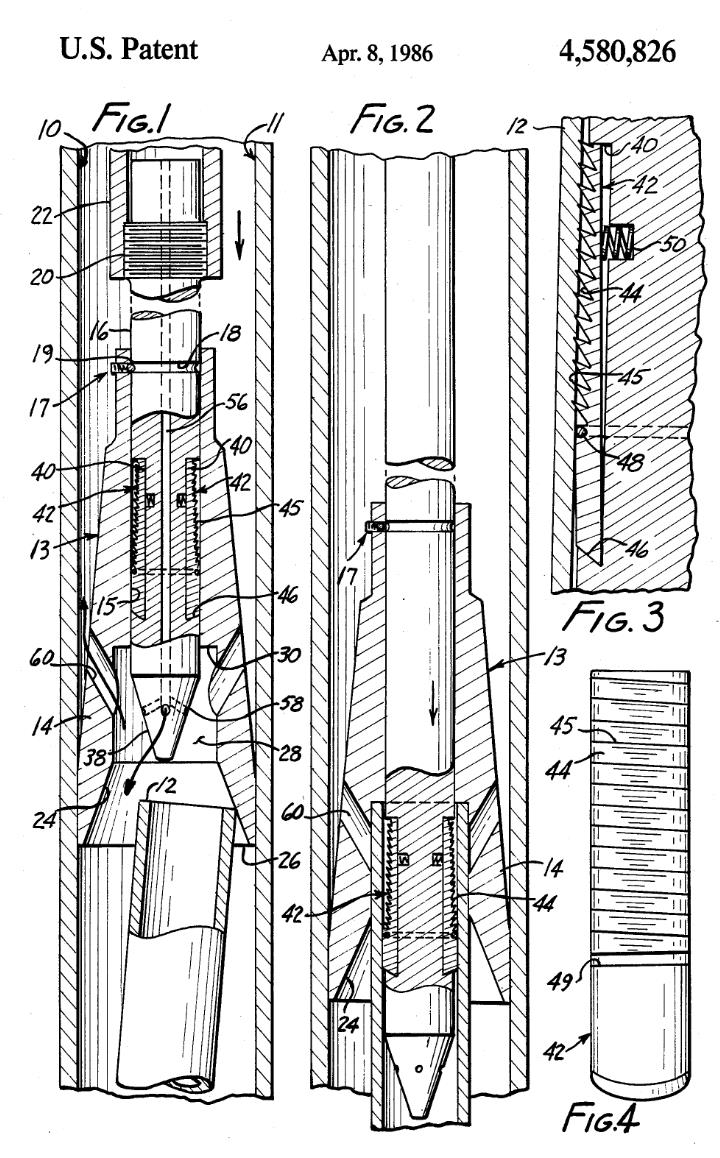
- Carver, Herman C., Michael R. Kent, and Bernie L. Chalmers. "Retrieval tool." U.S. Patent 4,580,826, issued April 8, 1986. (Illustrated below)
Abstract excerpt:
A retrieval tool to retrieve loose pipe and the like from a well. A bell-mouth centering device is sent down the hole to center the pipe, and a spear passes through the centering device into the pipe. Gripping devices carried by the spear engage the pipe so as to pull it to the surface. The gripping devices are able to cut a thread in the pipe so as to be releasable from the pipe if desired.
Above: Carver's patented well pipe retrieval tool.
- Griffin, Claud Champ. "Pipe-grip." U.S. Patent 827,011, issued July 24, 1906. (shown below)
Abstract excerpt:
... the present invention comprises two members 5 and 6, the former including an upper horizontal portion 7, having a horizontally-disposed eye 8 at its forward portion and having depending side pieces 9 at its rearward portion. The member 6 includes aforwardly disposed horizontal eye 10 and rearwardly-divergent legs 11, having laterally-turned trunnions 12 at their rearward ends, which are engaged in eyes 13 in the portions 9.
The member 6 is thus pivoted for vertical movement to bringits eye 10 into and out of exact registration with the eye 8.
When these eyes 8 and 10 are in registration with each other, they may be engaged with a pipe or other cylindrical body, and if the member 5 be then raised the rearward portion of the member 6 will also be raised, which will throw this member out of a horizontal plane and tend to draw its eye 10 out of registration with the eye 8, which will cause the eye 10 to bind against the pipe, thus holding the latter against movement with respect to the grip.
Lifting-cables 14 may be engaged with the upper horizontal portion 7 of the member 5, and, as shown in the drawing, the members 5 and 6 may be each formed of a single metallic rod bent into the desired shape.

Above: Griffin's elegantly simple pipe gripping tool can pull a pipe fallen into a well.
- Hoffman, Corey E., Richard Lee Giroux, Mike A. Luke, and Stephen J. Norris. "Sand removal and device retrieval tool." U.S. Patent 6,427,776, issued August 6, 2002.

- Lyons, John E., "Pipe grab." U.S. Patent 1,781,335, issued November 11, 1930. (Shown in 3 illustrations above and below)
Abstract except:

This invention relates to pipe grabs, and is particularly adapted for attachment to oil well towers for pulling pipe out of oil wells. One of the objects of the invention is to provide a pipe grab of the character referred to, that will grip the pipe so that the same maybe pulled in a straight line out of the oilwell and furthermore to provide a second clamp on the bottom of the tower that will not only cause the upper grab to pull in spaced alinement with the well, but will also prevent the pipe from slipping back into the well in event the pulling grab should slip or otherwise be displaced from the pipe.

Further objects of the invention are to provide, in a manner as hereinafter set forth, a device of the character referred to, which is strong, compact and durable, thoroughly reliable for its intended purpose, very simple in its method of assembly, and comparatively inexpensive to manufacture and operate.
- Morris, George HO, and Robert F. Mitchell. "Apparatus for retrieving pipe sections from a well bore." U.S. Patent 4,969,514, issued November 13, 1990.
- Newman, Kenneth R. "Deployment/retrieval method and apparatus for well tools used with coiled tubing." U.S. Patent 4,940,095, issued July 10, 1990.

- Robichaux, Sosthene. "Method of removing stuck pipe from wells." U.S. Patent 2,261,564, issued November 4, 1941. (Illustrated above)
Abstract excerpt:
At times pipe or screen becomes tightly stuck in well bores and is very difficult to remove when it becomes desirable to remove the same. In some cases the stuck pipe may be removed by means of a grappling tool but in many cases the pipe, or screen, must be cut, or unscrewed, and removed a section at a time.
In some cases, however, the stuck pipe cannot be pulled as a unit; neither can it be unscrewed and removed and in many cases it is so tightly stu'ck that it is not practical to cut the same into sections and pull the out of sections one'at a time.
The present method involves cutting the stuck pipe or screen into sections, then milling away and simultaneously vibrating the cut off section until it becomes loOse in the bore and can be easily withdrawn.
In removing screen by the method herein disclosed a washing fluid may be forced down into the bore and out through the screen whereby it may be washed loose or whereby the washing process in combination with the milling process will release the out of section so that it may be pulled out.

- Stewart, Leonard E., Winters, Marvin J., "Retrieving arrangement for well drilling operations." U.S. Patent 2,647,008, issued July 28, 1953.
...
Continue reading at WELL PIPE GRABBER FAQs where we answer reader questions about fishing dropped stuff back up out of a well, or select a topic from the closely-related articles below, or see the complete ARTICLE INDEX.
Or see these
Recommended Articles
Suggested citation for this web page
WELL FISH TOOL DESIGNS & PATENTS at InspectApedia.com - online encyclopedia of building & environmental inspection, testing, diagnosis, repair, & problem prevention advice.
Or see this
INDEX to RELATED ARTICLES: ARTICLE INDEX to WATER SUPPLY, PUMPS TANKS WELLS
Or use the SEARCH BOX found below to Ask a Question or Search InspectApedia
Ask a Question or Search InspectApedia
Share this article:Search the InspectApedia website
Need to make a private comment? Email editor@inspectApedia.com. We welcome email with your website content critique, corrections, suggestions or questions. Email is monitored daily but our workload may prevent an immediate reply. For immediate results, we hope you'll first try asking your question using the search box just above.
Citations & References
In addition to any citations in the article above, a full list is available on request.
- UN, "Small Diameter Wells", Natural Resources Management & Environment Department, Food and Agriculture Organization of the United Nations, FAO Corporate Document Repository - Self-Help Wells - see http://www.fao.org/docrep/X5567E/x5567e05.htm
- [11] Oil glossary.com, Overshot Definition (Website) OilGasGlossary.com. Oil & Gas Field Technical Terms Glossary, Web Search 04/21/2012, original source: http://oilgasglossary.com/overshot.html
- [12] Logan Oil Tools, Inc., 11006 Lucerne Street, Houston, Texas 77016-1920, Tel: 281.219.6613 | Fax 281.219.6638 Email: sales@loganoiltools.com, Website: http://www.loganoiltools.com/ (Obs. in 2026, Logan is now found at Innovex International Superior Hydraulic Fishing Jars, Overshots etc. (Website)
- In addition to citations & references found in this article, see the research citations given at the end of the related articles found at our suggested
CONTINUE READING or RECOMMENDED ARTICLES.
- Carson, Dunlop & Associates Ltd., 120 Carlton Street Suite 407, Toronto ON M5A 4K2. Tel: (416) 964-9415 1-800-268-7070 Email: info@carsondunlop.com. Alan Carson is a past president of ASHI, the American Society of Home Inspectors.
Thanks to Alan Carson and Bob Dunlop, for permission for InspectAPedia to use text excerpts from The HOME REFERENCE BOOK - the Encyclopedia of Homes and to use illustrations from The ILLUSTRATED HOME .
Carson Dunlop Associates provides extensive home inspection education and report writing material. In gratitude we provide links to tsome Carson Dunlop Associates products and services.
 |
HOME | ABOUT | ASK a QUESTION | CONTACT | CONTENT USE POLICY | DESCRIPTION | POLICIES | PRIVACY | |
| © 2026 - 1985 Publisher InspectApedia.com - Daniel Friedman | |||||||||