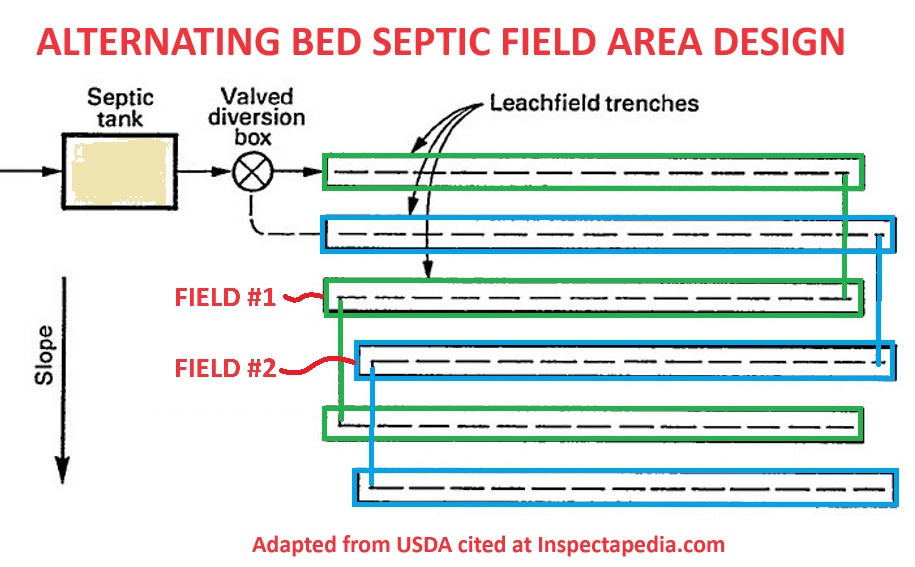
 Septic Drainfield Size & Piping FAQs
- POST a QUESTION or COMMENT about septic drainfield or soakaway bed size or capacity requirements & design
Septic drainfield design & size FAQs:
This article provides diagnostic and policy or code and design questions and answers about the required size of septic drainfields, soakbeds, leach fields, and similar onsite wastewater disposal systems.
This article series explains how we choose the size of a septic leachfield or soakaway bed or drainfield.
We discuss several different conventional soil absorption systems: absorption fields: conventional trench, deep trench, shallow trench, cut-and-fill, and gravelless septic systems. Then we discuss septic absorption beds, and seepage pits.
InspectAPedia tolerates no conflicts of interest. We have no relationship with advertisers, products, or services discussed at this website.
- Daniel Friedman, Publisher/Editor/Author - See WHO ARE WE?
Questions & Answers about Septic Drainfield Size, Piping, & Features
These questions and answers about determining the size of a leachfield or soakaway bed size were posted originally
at SEPTIC DRAINFIELD SIZE - be sure to read that article.
Article Index
- DRAINFIELD RE-SIZING & REPAIR BY OWNER? - can DIY septic repairs work? Is it safe?
- DRAINFIELD SIZE REQUIREMENTS - how big must my drainfield be?
- SEPTIC DRAINFIELD PIPE / TRENCH DEPTH FAQs - pipe depth, slope
- SEPTIC DRAINFIELD PIPE SIZE, SLOPE & TYPES FAQs
- SMALL SEPTIC TANK or DRAINFIELD SIZE FAQs - can tiny septic tanks and drainfields actually work?
...
Septic Drainfield Trench & Pipe Depth FAQs
What's the effectiveness of a "finger system" septic that's 4 ft. deep
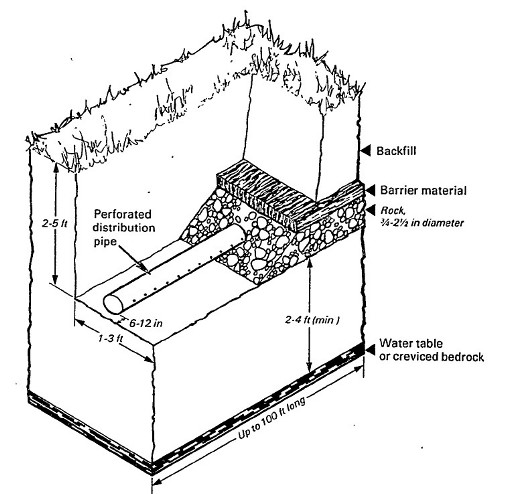 How effective is a finger system buried 4 feet deep On 2018-11-15 by Lori parsons -
by (mod) - What's the normal septic drainfield depth? Warning about deep septic soakbed trenches.
Lori
Watch out: while a deep drainfield is common in some areas (such as northern Minnesota), and while such a drainfield may successfuly dispose of septic effluent in the sense that it's "getting rid of the liquid" without it appearing at the ground surface, deep drainfields have no chance of successfully treating the septic effluent to improve its sanitation because there is simply not enough oxygen at depth for aerobic and possibly even anaerobic bacteria to be present.
At SEPTIC DRAINFIELD SIZE we quote septic design authorities:
Septic drainfield trench depth specifications:
A typical septic drainfield trench is 18 to 30 inches in depth, with a maximum soil cover over the disposal field of 36"; or per the USDA, 2 feet to 5 feet in depth.
At References or Citations we cite these sources.
In some climates, such as northern Minnesota, we have observed drainfield trenches placed much deeper - unfortunately meaning that while effluent disposal may be protected from freezing, effluent treatment may be marginal.Similarly, at SEPTIC DRAINFIELD DESIGN - CONVENTIONAL we quote:
(ii) Septic drainfield trench depth shall be as shallow as possible,
but not less than 18 inches. At least six inches of aggregate is placed below the distribution line and two inches above the line. The earth cover over the aggregate should not exceed 12 inches in order to enhance natural aeration and nitrogen uptake by plant life.In my OPINION any effluent dispersal system in soil that's more than about 24" down will be oxygen-starved and so may successfully dispose of effluent but may not treat it - thus releasing contaminants to the environment.
The effluent disposal effectiveness depends on much more than depth, including soil type, percolation rate, installation specification, trench design, and of course septic tank pumping frequency and condition. One missing baffle can quickly destroy a drainfield.See details at SEPTIC TRENCH DEPTH SPECIFICATIONS
And at SEPTIC DRAINFIELD DESIGN SPECIFICATIONS we give details on septic trench depth in sloped terrain
...
Small Septic System Size: trench and/or drainfield FAQs
Is my off-grid septic design using a 110 gallon septic tank and a 50 ft long rocky sandy drainfield line reasonable?
 I have a multilevel garage/shop approx 15 minutes from my home.
I have it in mind to put in a half bath for occasional use. 5 gal/day max.
Not zoned for residential, never will.
New construction now banned.
Off the grid. In the interests of not having to dig an outhouse, I am planning a DIY dual chamber 110gal septic tank, and 50-75’ perf pipe leach field in well drained sandy/rocky soil.
From a technical perspective only, is this a reasonable design? On 2020-11-22 by JohnC -
by (mod) - NO
Short answer, In my OPINION, no. Your details do not describe a feasible septic design.
About detailed engineering specifications for your off-grid design, from a brief two line e-text I can't suggest design details, but in general if you can design your system so that it works entirely by gravity, AND provided that your percolation test, site layout, slope, available space, and seasonal high ground-water levels permit, then a conventional septic drainfield can work.
Watch out: there is no possible conventional septic tank and drainfield system design that would work and be approved using a 110 gallon septic tank.
See SEPTIC DRAINFIELD SIZE
and SEPTIC TANK SIZE
Where you'll see basic septic system design guidelines.
I wouldn't do any site work beyond soil percolation test and I wouldn't buy anything before you've got an idea from your local septic or board of health officials just what kind of system they'll approve for your site.
Have you considered the alternative of an incinerating toilet? A gas fueled unit can handle your waste at a small fraction of the cost and trouble of the system you've outlined.by JohnC
Off the grid, no electricity. Incinerating takes too much power.
by (mod) - propane option for incinerating toilets - minimal electrical consumption
Right, you'd need 20A 120V or more or an electric incinerating toiilet, but not exactly true:
there are propane options like the Cinderella brand propane incinerating toilet. The only electrical use would be to power the exhaust vent fan of such a toilet.
If your site is going to have propane fuel availability, comparing cost and trouble and cold-weather reliability, you might want to consider a propane-fueled incinerator toilet, at least for deisgn and cost comparisons.
If you're not familiar with this type of toilet take a look at the description at
CINDERELLA INCINERATING TOILET USE GUIDE
by JohnC - not interested in an incinerating toilet
Thanks but I’m not interested in an incinerating toilet.
If you’re unable or unwilling to give me the benefit of your experience on the question as asked, then I’ll take my question to another forum. Have a nice day.
by (mod) - Your DIY septic designb must meet basic criteria or it's likely to fail, cause contamiantion, sewage backups, and violate local laws
My goodness! I have no axe to grind on this point, John, and we certainly don't sell toilets here. Nor do we sell anything else.
Bottom line: Watch out: a 110 gallon "septic tank" will quickly have so little net free area that there is no chance that it can produce clarified effluent to flow into your sandy rocky soil drainfield. The result will be a quickly clogged and failed drainfield and repeated expensive repairs.
In addition, rocky sandy soil may not be suitable for a conventional drainfield as it may not be able to adquately (using soil bacteria) treat the septic effluent. The result is discharge of pathogens into the environment, contaminating any nearby wells or waterways.
You might need to consider an above ground mound septic or a small residential propane or solar powered sewage treatment system.
I simply thought that comparing the cost to any proper septic system for an off-grid situation the alternative might be of interest to you before launching into the larger, more expensive design and installation of an onsite treatment system. Seems I've offended you despite the best of intentions.
Watch out:In my original reply I gave some links to basic septic system design guidelines and I warned you that I doubt that any design professional can accept your starting critera such as a 110 gallon "Septic tank" and come up with an owner-built conventional septic tank and drainfield system that would work much less be acceptable to local officials.I can't give you the septic system design specifications you want within your constraints. Frankly, as descibed it doesn't sound like a feasible design to me. Sorry that that truth offends you.
Watch out: also for the risk of contaminating your own local well water as well as nearby groundwater, lakes, streams when considering a DIY septic system that cannot handle the occasional sewage input load.
InspectAPedia.com provides building and environmental diagnostic and repair information. In order to absolutely assure our readers that we write and report without bias we do not sell any products nor services, nor do we have any business or financial relationships that could create such conflicts of interest.
...
Septic System Pipe Material, Size, Slopoe FAQs
Which are the best types of pipes to use in a conventional drainfield/leachfield?
I could not find which type of pipes are better to use for a drainfield/leachfield. I have seen 3 different types at lowes.
1. PVC pipe with 3 rows of holes on the bottom.
2. Black flexible corrugated pipe with 2 rows of holes on the bottom
3. Black flexible corrugated pipe that has small slits instead of holes and it is all the way around the circumference of the pipe.
I am not sure which to get and the price is about the same for all 3 of them. - D Smith 6/25/11
Reply:
All of these will work if you are using gravel-filled trenches, and will work longer and better if you install an effluent filter at the septic tank outlet so as to avoid pipe clogging. In gravelless systems the galleys may use more narrow slits (and in some designs also a covering of geotextile fabric) to avoid soils washing INTO the galley or piping.
In general I avoid installing piping with holes facing "UP" in conventional drainfield trenches.
Can I use smaller diameter septic effluent line where I'm pumping the effluent to the D-box?
Building a new house hooking up to existing drain field but I have to pump it to my first d-box can I run my 2”sewer pipe across the drain field to the first d-box On 2021-10-06 by Larry
Reply by Inspectapedia Com Moderator - Yes you can run 2-inch pumped effluent line to D-box
@Larry,
Yes, but take care of the installation sequence and equipment weight so as not to damage the drainfield, and depending on your climate, you could need to deal with freeze risk.
OK if piping to drainfield is routed under driveway?
Can I put the tank close to the house and run the drain field across from the house on the other side of a narrow (one car) driveway? (Apr 27, 2015) Anne
Reply: yes provided you use proper pipe type
Anne
Check your local codes on the required minimum distance between septic tank and building foundation. And watch out that some idiot doesn't damage your house foundation during excavation.
To run a septic line under a drive you'll need Schedule 80 PVC pipe as well as proper installation (depth, bedded in sand, no sharp rocks in backfill) . Keep in mind it's not just the weight of your car, it's the weight of other heavier vehicles that may pull into the drive over the life of the building.
What's the Minimum slope or "drop" in septic piping between septic tank and drainfield?
What's the minimum drop from septic tank to drain field? On 2020-01-02 by Tommy
by (mod) - minimum 1/8" per foot to avoid pipe clogging
Tommy typically you keep 1/8" to 1/4" per foot of horizontal distance run in piping.
If your septic piping anywhere in the system slopes less than 1/8" per foot, when waste is send down a building drain and into the septic tank or effluent is sent from septic tank to drainfield, the risk is clogging and thus failure of the system, even risking a sewage backup.
Can we cut off the tops of tall septic drainfield line access / inspection pipes?
We have a new septic system (less than two years old) and can see PVC pipes with caps glued tight extending 18 to 24 inches above our lawn.
Can these be cut shorter and recapped? Is there a minimum height required? On 2019-07-05 by Rock
Reply by (mod) -
Rock
If the pvc pipes and caps are access points for cleanout or for inspection, gluing them in place doesn't sound sensible to me.But I've found that sometimes those caps are a bit hard to pull off, which can fool you into thinking the cap is glued when it's not. Try grasping the cap on opposite sides of the pipe and wiggling it slightly as you pull upwards.
About cutting off these unsightly pipes sticking up out of your yard, yes, you can shorten those projecting pipes down to ground level or close to that, but
Watch out: in doing so you want to be sure that the caps and pipes are water tight so that running surface water doesn't flood and destroy the septic soakaway beds.
How will a flood easement affect my septic system ?
my septic and leach field have been in for 30 yrs. working great. the state of PA wnt to expand their flood easement over the leach field. Will this cause a problem if i need to replace it 5yrs down the road? Example getting permits etc. - Todd 3/3/1012
Reply: Watch out: warnings about septic fields in a flood zone
Todd I'm unsure what the flood easement means in your case but two conditions give us concern:
1. Any vehicle traffic passing over your leach field is likely to damage if not destroy it, leading to a need for costly repairs and perhaps relocation of the field
2. If the flood easement means that your leachfield is subject to actual flooding, you know that the fields will not function in any sanitary way when saturated.
Our septic alarm keeps going off if we use more than 400 gallons
I just moved to a brand new house and that has a septic. I have septic first time in my life. I have some guest due to family occasion.
Alarm goes off every other day. I am told that septic tank pumps 400 gallons a day. If we use more than 400, it sets off alarm.
We have 1250 gallon tank and other tank is 1000 gallons that pumps water to drainfield.
I have a big family so I will have guest several times a year. What should I do? Can I pump it manually e.g. total 800 gallons a day until guests are gone? or Should I buy a small pump e.g. 2 hp and pump water out on a small ditch? Can I do that? What is the solution? What is maximum gallons I can have pumped? My drain field is 6 ft deep and about 500 total length. - Jay 5/7/12
Reply: you may be exceeding the maximum daily wastewater flow allowed by your septic design
Jay, it sounds from your note as if the septic system was designed to handle a daily maximum wastewater volume of 400 gallons per day. I'd start by asking a local wastewater system engineer or installer who is familiar with yoru system design to assure that everything is currently working properly since if not, some repair action is needed.
Next, in my OPINION if your regular usage is exceeding the design capacity of the system, you'll need to address that problem by a combination of steps to minimize water usage to lighten the load on the system combined with an expansion of system capacity.
To do anything else might seem to "work" in the short run, but actually the result is discharging untreated or insufficiently treated wastewater into the environment - contaminating groundwater, potentially contaminating local wells etc., and risking a near term system failure.
Is it ok to add to existing leach lines to add capacity after tree roots clogged lines?
Can i add to my existing leach lines because i think a tree entered one of my lines i have not opened my ground up yet - (June 23, 2014) crystalcantua@yahoo.com
Reply:
Crystal
Certainly, provided your site has adequate space and the addition meets clearance or property setback requirements, adding additional drainfield capacity is generally a good move.
You might want first to try to diangose the trouble more accurately. If a tree is close to an existing drainfield line and the new line is not quite some distance away, the new line is likely to become invaded and blocked as well - unless you remove the tree and stump.
Can I switch between two septic soakbed lines?
I have two field lines. I can swich field lines. One is 330 ft the other 250 ft. one has gravel the other dont. both are 10 inc gravels pipe.
i think it may be to deep its 36-40 inch deep i don't have good ground seems like the ground doesn't soak the water quick enough grass doesn't grow there should i take off 8-10 inch of dirt off the topthen paint grass seed. i have to switch every three weeks. please advice. thanks (May 12, 2015) ken
Reply:
Ken it sounds as if you need two simultaneous drainfields.
You could go to an alternating bed septic design, but clogged soils may recover in years but not weeks.
Electrical Engineer Plans DIY septic design or repair
I am a first time user of your Q&A. I am very impressed already! I have some of these very same questions.
I am not going not going to pay some ? (fill in with your words) a huge amount of money for something I know I can fix myself.
Yeah, I might be an EE but have studied a lot about pipes, soils, etc. (Civil engineering) Can't be that difficult.
Again, thanks. JMP,PE (June 2, 2015) JAMES M. PESZKO
Reply:
Thanks for the note JMP. Some of my best friends are E.E.'s and some are stunningly sharp.
On the other hand, watch out for the "IBM Problem" - my coinage for people who are smart, know they're smart, but don't know that they don't know something. One of my buddies built a stunning deck - with very precise cuts and fasteners aligned to within a millimeter.
But she didn't know that drywall screws are not structural fasters.
So it's also smart to ask questions and find out who knows. (Which is not me, I'm only fourteen years old.)
And I agree also about asking questions of your "expert" - some are certified, licensed, but lack experience in residential construction.
The risk may be a "safe" design solution but one that's unnecessary. In Hyde Park a civil engineer specified a major excavation, house lift, and new foundation for a foundation problem that would normally be solved by a helical pier.
His design worked and was safe but it cost about 10X what was suggested later by a foundation engineer who knew about helical piers and residential foundations.
I also agree that often a smart, careful homeowner who will take the time to actually read the proper design or other reference materials for a home repair topic may do a more careful, more thorough job than a stranger who may be less motivated and who may be in more of a hurry.
Working together makes us smarter.
What's the best septic drainfield design for Clay Soils in North Dakota
We moved into our new house in Sept of 2014, by the first of March 2015 the toilets began gargling when flushing. I contacted my contractor and he suggested that the drain field may be frozen (I had covered it with 6" of straw) but whatever I pumped it a couple times to get through the winter.
Once spring was here, there was wet spots on the drain field and the toilets eventually gargled again.
The soil here is pretty much clay, they had put in 300' of drain field. We are planning on digging this up and replacing it. What is the best solution to this, as far a the soil material to haul in? I'm in North Dakota. thanks (June 4, 2015) Mike
Reply:
I've inspected septic system design and failures in similar clay soil conditions in northern Minnesota; old deep systems that "worked" for years often disposed-of but never actually treated septic effluent and I have even seen evidence (algae) suggesting that effluent was creeping down into Lake Superior. Currently (2026 and recently) septic authorities in those areas of difficult soils recommend using a septic mound or similar raised bed septic or raised peat mound septic design.
I'd look into a mound or raised bed septic system if your local health department will approve it.
Can we sue the health department for approving a soil percolation test now that our drainfields have failed?
Our field lines are seeping up through the ground and will need to be replaced. The home is 20 years old and the health department knowingly without our knowledge approved perk test in 1995 after all indicators was red.
Now we have issues and inspector mentioned it to my wife when he came out that he knew it would be bad. Should the health department be liable for currently replacement cost of $15,000 for their negligence? (June 5, 2015) Todd
Reply: Doubtful; you can sue city hall, but should you? Sometimes yes but be prepared to be exhausted and poor.
Todd,
I understand the frustration one would feel on thinking that a building official didn't do a proper job.
OPINION: But you'll have a tough time proving that twenty years ago someone approved a septic design plan that was improper.
The arguments can include change of soil conditions, failure of the property owners to properly maintain the system, normal aging and soil clogging, or who knows what. I'm no lawyer (I abandoned law school after learning the difference between law and justice back in 1966)
but I suspect your lawyer would tell you that unless you can obtain a clear written statement that places responsibility on someone you won't get further than enriching the attorneys involved.
You've heard perhaps the phrase
You can't fight city hall.
In fact, you can sue city hall, depending on where you live. For example in New York article 78 of the CIvil Practice Law and Rules gives you that right, but as other writers have pointed out, the law requires that you exhaust your administrative remedies first.
In turn that means you can expect to be exhausted and financially destitute before your local municipality is going to even consider paying damages for a opinion expressed by an official off the record two decades ago.
That's the case unless you can actually prove a violation of the law.
And I imagine there will be a group of active and mostly retired code officials, health department officials, a septic design engineer, original builder, septic contractor or excavator, all standing in a circle pointing to one another.
- Martin Kernan, "Legal: Who Says that You Can't Fight City Hall?", Utica Observer Dispatch, 15 July 2012, retrieved 16 Sept 2015 original source http://www.uticaod.com/article/20120715/Blogs/307159987
...
Thank you to our readers for their generous comments
On 2012-03-20 by GREAT INFO AND EASY TO UNDERSTAND
It's nice to finally find someone that puts things in layman's terms thanks, Bob.
...
...
Continue reading SEPTIC DRAINFIELD SIZE - topic home, or select a topic from the closely-related articles below, or see the complete ARTICLE INDEX.
Or see these
Recommended Articles
- NYS 75-A.8 Subsurface treatment of effluent, absorption field requirements, leach field design criteria for example regulations describing the construction of septic drainfields.
- SEPTIC DESIGN for FLOOD DAMAGE RESISTANCE
- SEPTIC DRAINFIELD INSPECTION & TEST - home
- SEPTIC DRAINFIELD LOCATION for help in finding an existing septic soakaway bed, leach field or drainfield
- SEPTIC DRAINFIELD SHAPE
- SEPTIC DRAWINGS
- SEPTIC SOIL & PERC TESTS
Suggested citation for this web page
SEPTIC DRAINFIELD SIZE FAQs at InspectApedia.com - online encyclopedia of building & environmental inspection, testing, diagnosis, repair, & problem prevention advice.
Or see this
INDEX to RELATED ARTICLES: ARTICLE INDEX to SEPTIC DRAINFIELDS & DBOXES
Or use the SEARCH BOX found below to Ask a Question or Search InspectApedia
Ask a Question or Search InspectApedia
Share this article:Questions & answers or comments about septic drainfield or soakaway bed size or capacity requirements & design.
Search the InspectApedia website
Need to make a private comment? Email editor@inspectApedia.com. We welcome email with your website content critique, corrections, suggestions or questions. Email is monitored daily but our workload may prevent an immediate reply. For immediate results, we hope you'll first try asking your question using the search box just above.
Citations & References
In addition to any citations in the article above, a full list is available on request.
- In addition to citations & references found in this article, see the research citations given at the end of the related articles found at our suggested
CONTINUE READING or RECOMMENDED ARTICLES.
- Carson, Dunlop & Associates Ltd., 120 Carlton Street Suite 407, Toronto ON M5A 4K2. Tel: (416) 964-9415 1-800-268-7070 Email: info@carsondunlop.com. Alan Carson is a past president of ASHI, the American Society of Home Inspectors.
Thanks to Alan Carson and Bob Dunlop, for permission for InspectAPedia to use text excerpts from The HOME REFERENCE BOOK - the Encyclopedia of Homes and to use illustrations from The ILLUSTRATED HOME .
Carson Dunlop Associates provides extensive home inspection education and report writing material. In gratitude we provide links to tsome Carson Dunlop Associates products and services.
 |
HOME | ABOUT | ASK a QUESTION | CONTACT | CONTENT USE POLICY | DESCRIPTION | POLICIES | PRIVACY | |
| © 2026 - 1985 Publisher InspectApedia.com - Daniel Friedman | |||||||||