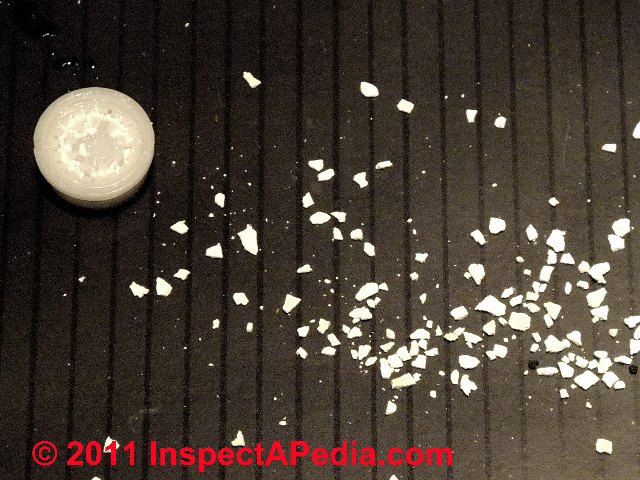
 FAQs on Particulate Debris in the Water Supply

- POST a QUESTION or COMMENT about flushing debris and dirt out of water heater tanks
Questions & answers about how to diagnose and fix debris in the water supply coming from the water heater: white plastic debris particles or other debris coming from water heater tank.
This is not the same in cause nor cure as black crud, sand, rust, or other particulate debris in the water building supply.
This article series explains how white and gray debris particles in the building water supply and clogging faucet strainers were traced to a bad water heater plastic dip tube.
InspectAPedia tolerates no conflicts of interest. We have no relationship with advertisers, products, or services discussed at this website.
- Daniel Friedman, Publisher/Editor/Author - See WHO ARE WE?
FAQs on Particulate Debris in the Building Water Supply & Piping
These questions & answers about debris in the building water hot water supply pipes, fixtures, faucets, or water heater were posted originally
at HOT WATER DEBRIS CAUSE & CURE - be sure to read the diagnosis and repair advice found there.
What caused this plastic fragment to clog the hot water valve in my shower?
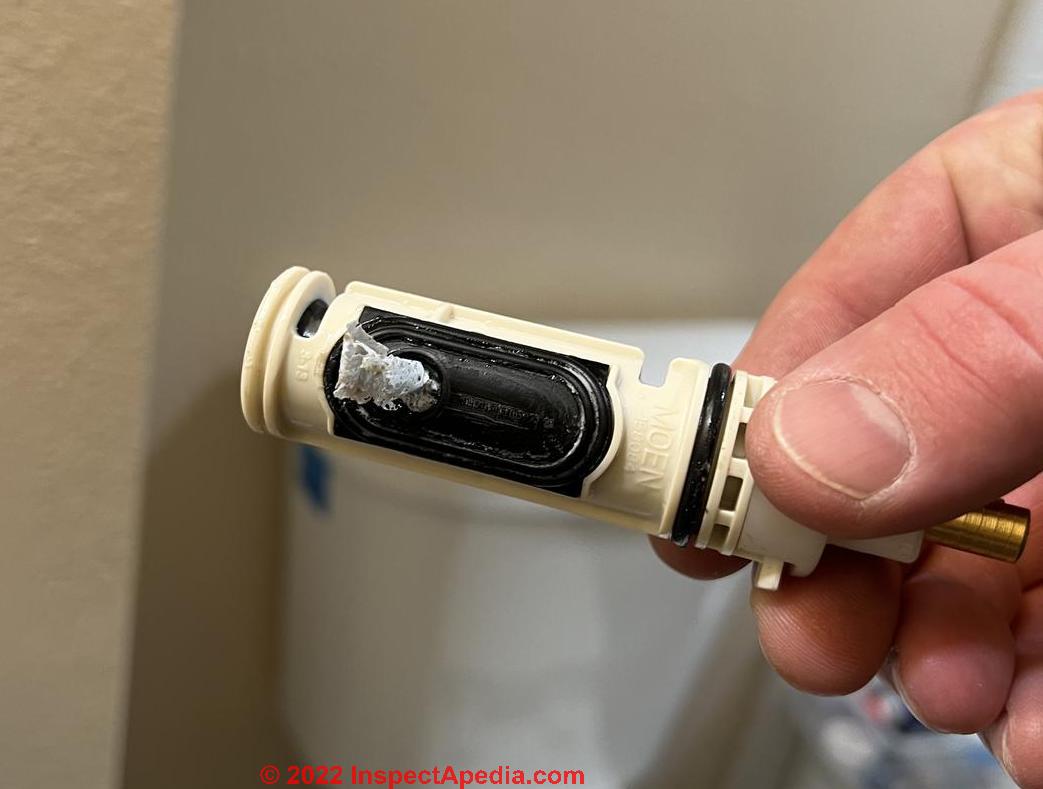
I found this in my shower valve. it looks like plastic. it's coming from the hot water line and is preventing me from completely shutting off my shower/tub faucet. On 2022-03-22 by Chris
by Inspectapedia Com Moderator (mod)
@Chris,
If that's not a plastic fragment from a disintegrated water heater dip tube it may be a chunk of mineral scale escaping from your water heater.Try soaking the part in vinegar for a day or two, then gentle cleaning with a toothbrush. If vinegar dissolves the particle then it's more likely scale.
In that case see WATER HEATER SCALE DE-LIMING PROCEDURE
by Al
@Chris, I have the same thing from my water taps, did you figure out what it is and what's causing it?
by InspectApedia-911 (mod) - Whitish deposits are often from minerals in the water
@Al,
Whitish deposits like that shown are usually from minerals in the water.
Have you measured the hardness of your water supply?
See details at
WATER HARDNESS: HOW TO MEASUREby Al
@InspectApedia-911, I think it's caused by the hot water tank; the dip tube disintegrating... water tank is 21 years old so that's probably explains why
by InspectApedia-911 (mod)
@Al,
OK that's entirely possible - in which case you'll find
- that on removing the tank top fitting for the dip tube the dip tube itself will be largely disintegrated
- there will be quite a lot of plastic debris bits, sometimes pretty soft, in the water heater bottom
- those particles will show up at various plumbing fixtures and even valves, clogging faucet strainers and shower heads
The article above shows that we went to a bit of trouble to flush the water heater tank itself.
We then cleaned all of the faucet strainers and shower heads, and flushed some clean water through the water heater and hot water piping to complete the job.To clean out the water heater you'll want to follow the procedure we give
at WATER HEATER FLUSH PROCEDURE
See our water heater debris diagnosis and cleanout details
at HOT WATER DEBRIS CAUSE & CURE
by Al
@InspectApedia-911, thank you so much for the insight I will be replacing my current hot water tank, and hopefully this will spare me the greaf of constantly having to clean the aerators
. Come to think of it... the washing machine hot water hose probably needs to be cleaned as well!
by InspectApedia-911 (mod)
@Al,
Usually washing machine hoses include a strainer at the washing-machine-end connection - that may need to be cleaned.
Shown below, Danco washing machine hose washers with screens.

How to identify and treat mineral debris found in water pipes
Help me identify this tan crumbly debris found in our plumbing system

Need help in identifying substance in plumbing system. The attached photo show the material that we have filtered out of our faucets throughout the house. Seems to be worse on the second floor.
Has a sandy feel to it so it could just be sand. But it could also be some calcium deposits.
Had plumber flush the entire system but still occurring. Anyone have any ideas as to what it is or recommend an expert to diagnose the problem?
Attached please find a magnified photo of the debris with a ruler showing the approximate size. Actually doesn't look like sand at all. More like chips. What do you think?
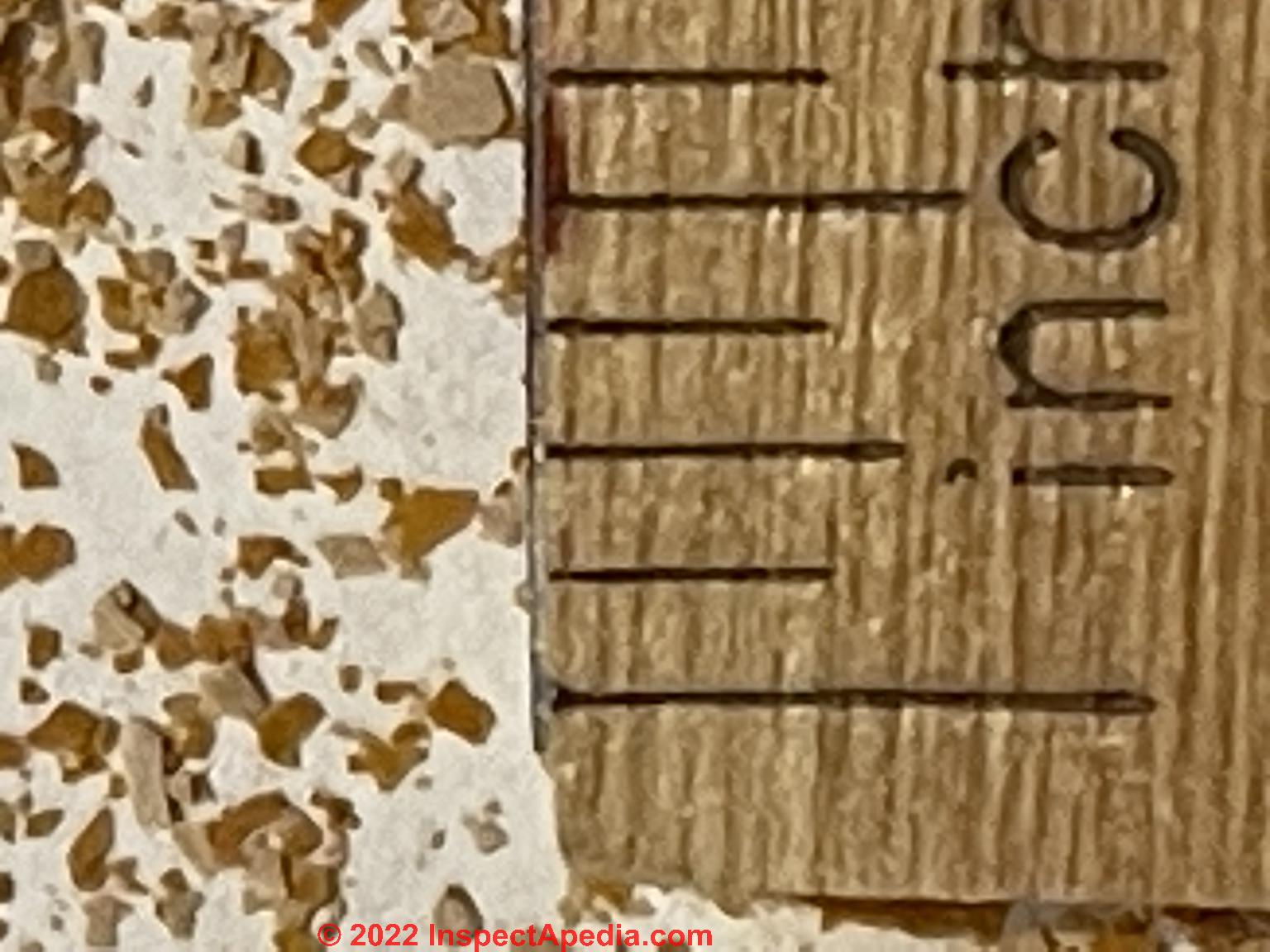
Our water comes from the city of Melourne water system. It is not well water.
We have both a water filtering system and a water softening system. They were both just inspected to make sure that there was do debris coming into water pipes from those systems.
We are located in Satellite Beach, FL (Brevard County) and the home is 15 years old. On 2022-01-25 by Rland0
by Inspectapedia Com Moderator - irregular non-spherical particles are not water softener resin
@Rland0,
Is there any water treatment equipment on your water supply system, such as a softener? Filters?
Is your water from a municipal supply or private well?
Country and city of location? Age of well?Debris found in our Rheem electric water heater is definitely not "resin" - what is it?
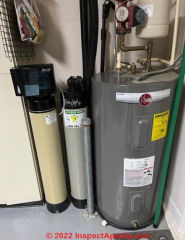
We had our water treatment person look at this system this morning. She looked at the debris and said it was definitely NOT resin. Attached is a photo of the system components.
On the left is the softner system, in the middle is the filtering system and on the right is the water heater. so the answer to your question is that the filtering system is ahead of the softner system. On 2022-01-25 by Rland0
Moderator reply: diagnostic questions about debris in the plumbing system
The reason I ask about the water treatment equipment is that the color of the debris looks a lot like water softener resin, though normally resin is in the form of spherical beads.
If the debris was coming in from the municipal supply you would expect to find it caught by your water filter system.
So we infer the source is downstream from the filters.
Are your filters ahead of the softener?Has there been work on a muncipal water supply line that released scale or debris? If so your neighbours would have this problem too.
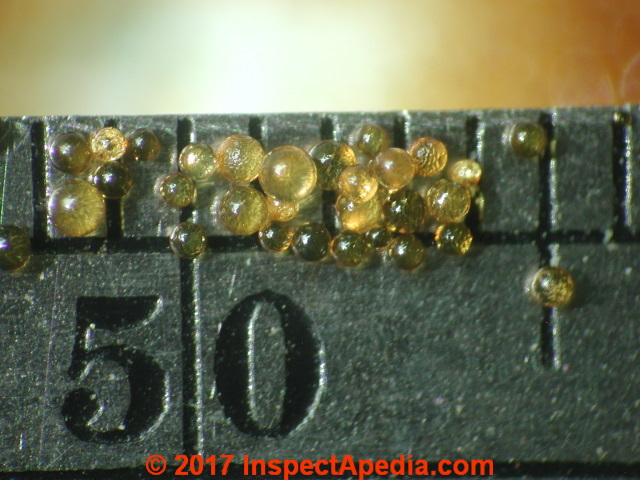
Above: water softener resin beads under my forensic lab microscope. Notice that while they vary a bit in size, they're all round spheres.
Your debris looks more like irregular flakes - perhaps mineral scale.
Interested readers can see more water softener resin photos at WATER SOFTENER RESIN REPLACEMENT
I also considered the gravel material used in softeners to keep the resin in place - photos of that are also at the link I give above. But that. too should be larger, smooth, and clean.
If you're confident that there is no obvious particulate source (as in the examples we've discussed) what's left has to be
- some sort of deteriorating plumbing material in water path or
- a type of mineral scale.
It would be instructive to feel the hardness or granularity of the material and perhaps you could post a sharper, enlarged view of the particles for us to take a closer look.
When did these particles first appear?
Are they found at every plumbing fixture?
What else has changed in the building's plumbing system?
Is it possible that those are plastic fragments from a disintegrated dip tube in a water heater?
You may need to flush the heater just as was done on this page. It can be a bear to get all of that junk out through the heater's bottom drain valve - we had to remove the valve and flush with a bit of pressure.
You could start by asking your plumber to pull both the dip tube and the sacrificial anode in the water heater (those might be two separate parts on some heaters) and to inspect their condition.
Let me know what you find.If it's not the dip tube it's probably mineral scale.
by Rland0 - water heater is only 1 year old - it's probably not a dip tube problem
Since our water heater is only one year old, I doubt that the debris is caused by plastic fragments from a disintegrated dip tube in the water heater.
My best guess at this time is that the mineral fragments are caused by the following scenario: In November 2020, we had a water purifying system installed. About six months after installation, we began to notice the fragmented debris.
We called our plumber and he flushed the system but he was also unable to identify the fragments.
My best guess is that these are mineral fragments that are slowly being chipped away by the water purifiers flowing through the pipes.
The minerals accumulated for ten 15 years inside the pipes before we installed the purifying system. What do you think?
by Inspectapedia Com Moderator
@Rland0,
That's a good guess, I missed the nearly new age of your water heater.
"being chipped away by the water purifiers flowing through the pipes"
I think you mean to say that sending treated water very low in mineral content may be loosening scale in the water piping.
You'd expect more scale in the hot water piping and devices than in the cold.
Have you tried having the piping acid-flushed?by Rland0
I like your description "sending treated water very low in mineral content may be loosening scale in the water piping".
I have had the plumber treat the system once trying to flush out the accumulation.
It appears as though it was not successful in getting it all. Is it dangerous to flush the system with an "acid", as you are recommending?
By the way, the debris is not magnetic.
by Inspectapedia Com Moderator - acid flushing of water pipes is dangerous so must be done by an expert
@Rland0,
Yes acid flushing of water pipes is dangerous: both risks to the worker in handling the acid and risk that some idiot leaves acid in the pipes or in other equipment.
I would want to isolate all tanks containing water, such as a water heater or water pressure tank, and I'd expect the plumber, one experienced in this process, to follow the acid cleaner manufacturer's instructions and to take care to thoroughly flush all acid from the system once the cleanout has been completed.
Decades ago we used acid flush to clean clogged tankless coil hot water systems; at the time my OPINION was that once we'd acid-flushed the piping, the acid had left the exposed copper surfaces etched - possibly picking up scale faster than before.That meant that flushing alone, without also installing and maintaining a water softener, may not give a lasting solution.
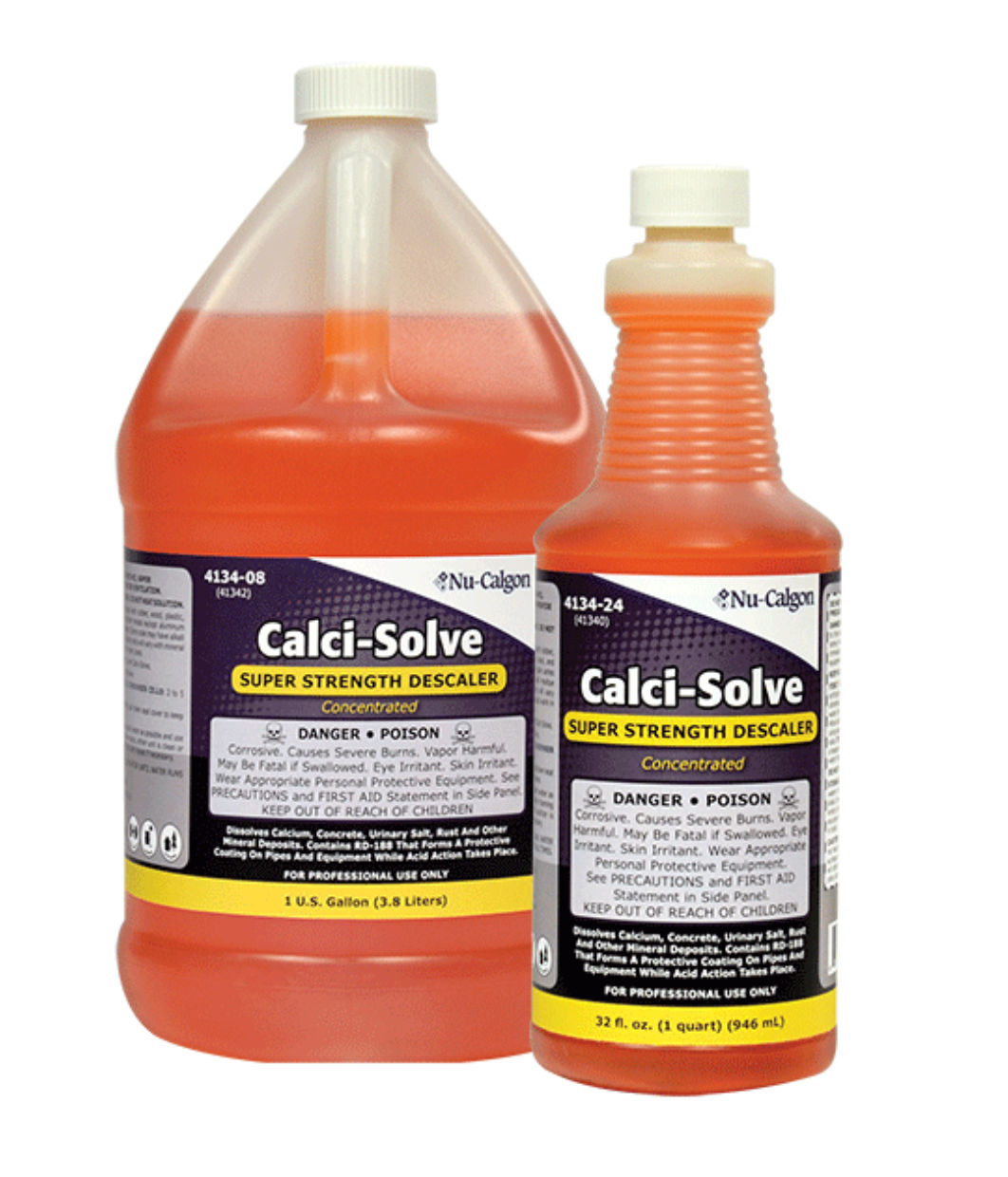
Watch out: as you surmise, pretty much all of these de-scalers are poisonous and can be dangerous to handle.
The manufacturers, to a man or woman, warn that the product must be used by a trained professional, usually a licensed plumber, and the user must follow the manufacturer's instructions.
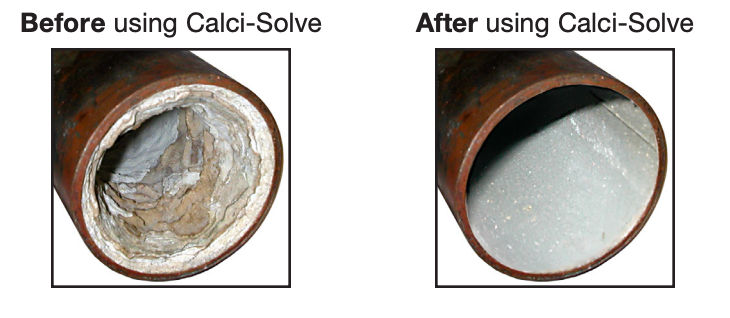
See these example from Nu-Calgon, 2611 Schuetz Rd. • St. Louis, MO 63043 USA, Tel: 800-554-5499 Web: www.nucalgon.com retrieved 2022/01/26
These products are used most-often as drain cleaners but some company literature also cites their use as plumbing pipe cleaners.The Nu-Calgon company's web page for Calci-Solve cites:
Use Calci-Solve to remove scale and rust from the following:
- Air Conditioning Equipment
- Air Compressor Jackets
- Pasteurizers and Tanks
- Dish Washing Machines
- Water Sealed Blowers
- Refrigerator Drains
- Calendar Machines
- Blue Print Drains
- Boilers
- Air Filters
- Condensers
- Siphon Pipes
- Water Piping
- Water Pumps
Calci_solve PRODUCT BULLETIN & INSTRUCTIONS [PDF] 3-93
Nu-Calgon PRODUCT BULLETIN & INSTRUCTIONS [PDF] 3-108
Quoting:
Read and understand the product’s label and Safety Data Sheet (“SDS”) for precautionary and first aid information.
The SDS is available on the Nu-Calgon website at www.nucalgon.com.
And yes, scale debris is principally calcium and magnesium mineral deposits, possibly in copper piping with a bit of dissolved copper, none of which is magnetic. Even in steel piping the iron content of the scale is likely to be so low as to not display magnetic attraction.
@Rland0,
Here is the Calci-Solve SDS [PDF] https://inspectapedia.com/plumbing/Nu-Calgon-Calci-Solve-SDS.pdf
Recommended reading re Hot Water Tank Debris - Scale problems (home page: HOT WATER DEBRIS CAUSE & CURE )
Besides the article WATER HEATER FLUSH PROCEDURE
be sure to see
WATER HEATER SCALE PREVENTION
CLOGGED TANKLESS COIL or PIPES, LIME SCALE
CLOGGED SUPPLY PIPES, REPAIR
Particulates are in all the faucet screens, just worse in shower.
Particulates are in all the faucet screens, just worse in shower.
Didn’t notice particulates when blowing dow the water heater. Put drain hose in floor drain.
Particles are fine and feel gritty when being removed from screen. Particle size is hard to define...they would easily pass through a window screen but not through the faucet screens.
Have a water softener that has been in place for several years.
Initially had a well person look at the solids (I was thinking it might be the well). He did not think it was anything from the well.
I’m thinking it must be some sort of a chemical reaction perhaps due to the anode.
Tried to comment on this couple times before but don’t know what happened. On 2020-11-17
by Kevin
Reply by (mod) -
Indeed when the anode begins to deteriorate that can produce debris (as shownat the top of this page) and clog shower heads and faucet strainers;
Besides flushing the water heater tank you may need to replace the sacrificial anode.
New Bradford White Water Heater Sending fine white particulates into shower fixture
New Bradford White water heater installed about four months ago.
Fine white particulate resulting in needing to clean screen in master shower about once a week. Previous water heaters were approximately 20 years old with no problem.
We are on well water if this matters.
Flushed heater through bottom drain valve on two occasions. Would like to understand prior to calling installer. On 2020-11-14 by Kevin
Reply by (mod) -
How irritating.
Are the particles appearing everywhere or just at the shower?
When you flushed the heater did any junk come out?
Is there a water softener installed?
and if so,
If you examine the white debris, is it salty?
Or
is it hard particulates that might be from some plastic source like a damaged pump impeller?Is the volume of white particulate great enough that you're sure it's not just excess white teflon pipe dope that came from assembling the new water heater?
Dirty hot water after installing a new water heater
Installed new water heater had rod removed. Am not getting dirty water on hot only. Have flushed several times but does not help I it is electric. Have softener and only hot is effected On 2020-06-16 by M renner
Reply by (mod) -
M
Are you saying that the dip tube was removed from the NEW water heater when it was installed? If so you need it put back.
You say you are "not getting dirty water" - I think there may be a typographical error. Let's be sure I understand the question.Did you flush the water pipes too, after installing the new heater?
After flushing my water heater there's no hot water into my washing machine
I drained and flushed my hot water heater and now there is no hot water coming into my laundry box hot water supply.
What can I do to fix that? I appreciate any help you can give. On 2019-01-27 by Glenda
Reply by (mod) -
Is it an electric water heater?
Did you turn it on while there was air inside the heater?
If so the elements were probably burned-up.Or possibly debris from the water heater as simply clogged the strainer at the hot water inlet at your washing machine.
Is there a Health hazard from a deteriorated CPVC water heater dip tube?
I just found out that our Weil McLain indirect hot water tank has a defective dip tube and has cause my entire home to have loss of water pressure and clogged plumbing fixtures and appliances. The problem became so bad that we lost use of our kitchen silk and shower.
After 2 years of investigation, I ended up contacting Weil McLain and they gave me a new water tank right away. Also, they have agreed to replace the damaged fixtures throughout the entire house.
I am contacting you now to ask if you are aware of any health issues that could arise due to ingesting these particles?
We have 4 small children ranging from 3 to 12 years of age which have been living with this problem (taking baths, drinking water and eating foods prepared with the contaminated water).
I realize this subject may be out of your zone of knowledge but thought best to at least ask, as your website seems very thorough on the subject of dip tub problems.
I thank you in advance for any information or resources you could share with us. - G.S. 3/29/2013
Reply:
I'm sure sorry it took so long to figure out the problem. Someone who knew what they were doing should have found it in five minutes by checking a faucet strainer and recognizing the white particulate debris.
There may be potential health hazards IF the dip tube you describe was made of PVC (which many are - or more likely CPVC) but a literature search I conducted for this reply could not find a reference to such events. I did find reference to testing for CPVC particles from dip tubes in water supplies.
Your first order of business is to find out what the tube was made-of. Or if you have samples of the debris, to have them analyzed.
You'd need something like a, FTIR spectrograph of dip tube plastic and polypropylene.
This test is discussed in Qualitative Procedures For Identifying Particles In Drinking Water, Stephen Booth, Blaise J. - Editors. American Water Works Association, 2005, ISBN 1583213740, 9781583213742
Also see Ruth Ricahrson & Marc dwards, "Vinyl Chloride and Organotin Stabilizers in Water Contacting New and Aged PVC Pipes", Web Report 2991, 2009, Water Research Foundation, 6666 West Quincy Avenue, Denver, CO 80235-3098. Their research included this finding "In all cases VC levels were below the MCL of 0.002 mg/L but above the MCLG (MCL Goal) of 0 mg/L."
Based on those sources I suspect that the actual health risk was low because of the comparatively low total volume of plastic material involved, and that the risk would also vary by water temperature, chemistry, and water volumes involved. But this is NOT my area of expertise.
Your second order of risk assessment business would be to ask an industry expert (see the article I've attached) for an opinion. Beware that there may be a very big gap between theory or opinion and demonstrable fact.
And of course, ask your doctor for an opinion.
Black chips come out of our hot water supply
Hey everyone we moved into a brand new apt unit in East Bay, CA. Built 5yrs ago, we've lives in for 4yrs, only 1 prior tenant which was the 1st year.
A few months ago, we noticed lil black "almost like" chips coming out of the bathroom tub faucet(s), obviously only when using not water & the hotter the worse.
Also when these black chips are present the water seems oily, looks oily & leaves a black ring around bathtub. We have called the office & told them what's going on but haven't heard anything from them since.
I went out yesterday & got a Brita filter to at least put on our kitchen faucet so were no longer drinking that love.
I mean the black pieces only come out when using not water but the water in general must not be all that healthy since it still has to flow thru the same pipes & originates from the same water heater, which is a Rheem by the way... Any help would be greatly appreciated On 2018-02-05 by Jimmy
Reply by (mod) -
I agree it sounds like water heater contamination, rust, debris. Flush the heater, check the dip tube and anode.
Description of water heater scale in an old water heater
Our water heater started leaking. I replaced it and the new one is working fine. The old one would not drain and appeared to be plugged at the drain valve
. While it was lying on the ground I picked up the base to let it drain out the two openings (cold water inlet and hot water outlet) at the top. As I lifted it I could hear sloshing around inside, like ice cubes in a cooler full of water. Out the top came many chunks of soft white crystals.
Looked like crushed ice, but were soft and mushy, almost soapy when squeezed, then disintigrates between the finger and thumb. What is this stuff?
Also, the next day the hot water connection to the dishwater started leaking.
This dishwasher is about 6 weeks old and the connection is snug. That was two days ago. Today there is a leak in one of the bathroom faucet connections. Is there a common thread here? On 2017-08-04 by Des
by (mod) - white debris may be mineral salts and scale from hard water
Des
The white stuff was probably mineral salts deposited in the bottom of the heater from years of use. Heat drives minerals out of the water. If your water is quite hard you might consider installing a water softener.
About the next day's leak, unless you were wiggling around pipes nearby it may be either bad luck, or perhaps an effect of higher water temperature or an effect of having accidentally sent some solder, paste, or crud through the piping when you replaced the water heater. It sounds unlikely but I suppose if crud clogs a dishwasher control or valve or motor that might contribute to a leak.
Try unscrewing faucet strainers and- see if they're blocked by crud and debris - a clue
- flush out the piping
Big recall of fill tube in water heaters: plastic fill tube pipe disintegrated.
About 20 or more years ago there was a massive recall of the fill tube in hot water heaters. This was a plastic pipe inside that the fill water goes into and is taken to the bottom of the heater so the cold water is not sucked out the top of the tank.
Got ours replace thru the recall, a plumber takes the intake tube loose and the fill tube inside can be replaced.
There was nothing left of the old one, it totally dis-intrigrated as shown by pictures in this article. I just yesterday replaced the hoses that go into and our of the top of water heater.
The old one were braided outside but with a black rubber tube inside. The black tube disintergrated and first stopped up a shower valve, then more small black pieces were come out of the hot water lines around the house.
I had them replaced with stainless steel flexible hoses, no liners, just a flexible steel hose. House is about 22 years old and the old line failed and disintergrated.
Builders put cheep junk into all parts of a house, saving a few dollars, and don't care about future problems of homeowners. On 2017-02-09 by LM
by (mod) - plastic dip tube deterioriation leaves particles that clog building pipes & faucets
LM,
Thank you for your comments. I agree the disintegrating plastic or rubber Parts LS problems with both water heaters and Plumbing Systems, including clogging.However you might want to have your water chemistry tested.
For example if the water is particularly aggressive or corrosive or acidic you may want to treat it in order to protect the rest of your plumbing system.
What is the Slimy substance in tap and shower filters on the hot water side?
Clear slime like substance found in the tap and shower filters in he hot water aspect only of an internal house. Water board found no contamination but this build up keeps occurring. Cylinder replaced 4/5 years ago. New bathroom installed 6 weeks ago.
This problem has only happened from the installation. What is this. On 2017-01-10 by totsin74
Reply by (mod) -
I suspect you may be seeing a bacterial contamination. Have you tried having a sample from your water or water heater or this gooey slime tested by a water test lab?
What is the white film in our hot water? It goes away after a minute!
I have a two week old A.O. Smith 40 gallon electric water heater. When I turn on the hot water, I get a white film that is in the water for about a minute and then it goes away. It also happened to a Bradford-White water heater that was in for a week.
Local plumbers can't solve the problem.
My neighbors had new water heaters installed without the problem and we all use the same water lines. I need help. Thank you. On 2015-05-09 by Jim Pilling
Reply by (mod) - air
Jim
Fill a large clear tumbler or pitcher with hot water and observe the cloudiness you describe.Let the water stand a few minutes. If the cloudiness disappears I suspect it's fine air bubbles entrained in the water, not debris.
...
Continue reading at HOT WATER DEBRIS CAUSE & CURE or select a topic from the closely-related articles below, or see the complete ARTICLE INDEX.
Or see these
Recommended Articles
- WATER HEATER SCALE DE-LIMING PROCEDURE
- WATER HEATER FLUSH PROCEDURE - how to clean out a hot water heater tank
- WATER HEATER DRAIN PROCEDURE
Suggested citation for this web page
WATER HEATER DEBRIS FAQs at InspectApedia.com - online encyclopedia of building & environmental inspection, testing, diagnosis, repair, & problem prevention advice.
Or see this
INDEX to RELATED ARTICLES: ARTICLE INDEX to WATER HEATERS
Or use the SEARCH BOX found below to Ask a Question or Search InspectApedia
Ask a Question or Search InspectApedia
Share this article:Search the InspectApedia website
Need to make a private comment? Email editor@inspectApedia.com. We welcome email with your website content critique, corrections, suggestions or questions. Email is monitored daily but our workload may prevent an immediate reply. For immediate results, we hope you'll first try asking your question using the search box just above.
Citations & References
In addition to any citations in the article above, a full list is available on request.
- In addition to citations & references found in this article, see the research citations given at the end of the related articles found at our suggested
CONTINUE READING or RECOMMENDED ARTICLES.
- Carson, Dunlop & Associates Ltd., 120 Carlton Street Suite 407, Toronto ON M5A 4K2. Tel: (416) 964-9415 1-800-268-7070 Email: info@carsondunlop.com. Alan Carson is a past president of ASHI, the American Society of Home Inspectors.
Thanks to Alan Carson and Bob Dunlop, for permission for InspectAPedia to use text excerpts from The HOME REFERENCE BOOK - the Encyclopedia of Homes and to use illustrations from The ILLUSTRATED HOME .
Carson Dunlop Associates provides extensive home inspection education and report writing material. In gratitude we provide links to tsome Carson Dunlop Associates products and services.
 |
HOME | ABOUT | ASK a QUESTION | CONTACT | CONTENT USE POLICY | DESCRIPTION | POLICIES | PRIVACY | |
| © 2026 - 1985 Publisher InspectApedia.com - Daniel Friedman | |||||||||