 Vinyl Siding Damaged by Building Movement
- POST a QUESTION or COMMENT about Vinyl Siding on Buildings, Installation, Inspection Methods, Defects, Diagnosis & Repair
Building movement or settlement causes of vinyl siding damage:
Siding damage on a building may indicate serious structrural damage such as settlement, rot, insect damage, even a developing foundation or wall collapse.
This article illustrates severely rippled buckled siding caused by movement in the underlying structure.
This article series discusses all of the known causes of buckled, loose, cracked or otherewise damaged vinyl siding. Rippled or loose vinyl siding may be more than just a cosmetic worry, and may indicate structural defects, building movement, leaks, or even heat or fire hazards.
InspectAPedia tolerates no conflicts of interest. We have no relationship with advertisers, products, or services discussed at this website.
- Daniel Friedman, Publisher/Editor/Author - See WHO ARE WE?
Vinyl Siding Buckled, Torn Due to Building Movement
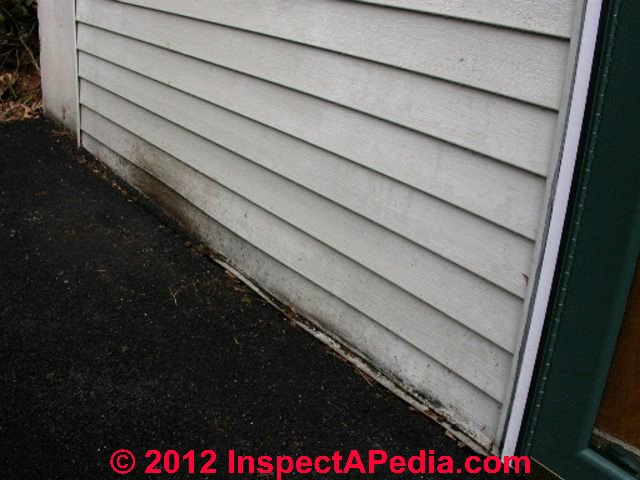
Above we illustrate a sure clue of hidden rot or insect damage: crushing buckled vinyl siding at or close to ground level.
Further investigation in this New York home disclosed a wood floor built actually on and below grade level and very extensive termite damage to the building's wood sills and floor structure.
Though there was no access below the floor without demolition, this visual clue launched an appropriate investigation and avoided a costly surprise.
Watch out: many building cladding materials such as vinyl siding and some aluminum siding may stay in place and look pretty good even though the structure to which they are attached is in trouble.
Our opinion is that by the time you see siding buckling at the point of ground contact or bending such as in our page top photo, the building has already suffered serious damage.

Above, this building in Northern Maine has settled and sagged enough to actually bend and tear the vinyl siding.
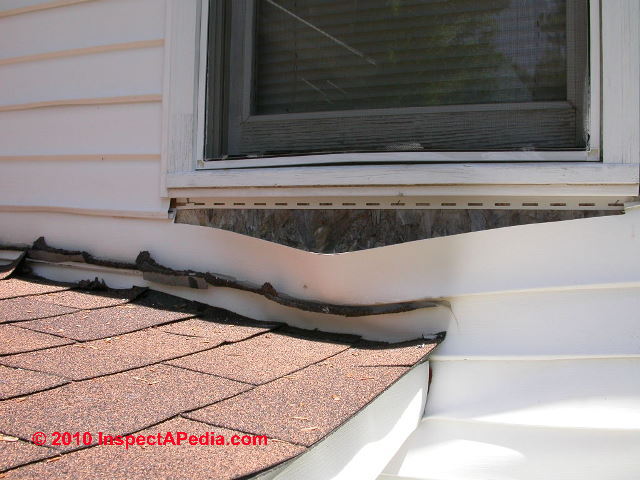
Finally, in our photo above you can see deformed vinyl siding that has pulled away from the building due to collapse of the lower roofed structure to which siding was attached by glued-on (and improper) roof-wall flashing.
The leak into this wall was a contributor to insect damage in the building and is discussed further at Loose Vinyl Siding: Blow-Offs, Fall-Offs & Nailing Defects.
Are there structural issues with wrinkled vinyl siding?
Our reader asked:
No where does it tell me if there are structural issues with wrinkled siding. Mine is in a place where it doesn't matter if it's wrinkled, but I don't wish to have the structure integrity compromised. - Carol Heitlinger 6/9/2012
Reply:
Quite So, Carol.
We don't expect to blame "wrinkled siding" such as the heat-damaged siding above, or buckled siding described in the article above as a structural integrity problem.
Since building siding is a skin that is "hung" on the structure, usually wrinkles in the siding are usually due to heat such as from a BBQ grille placed too close to vinyl siding, or more often wavy siding is due to improper fastening of the siding to the building (nailing too tightly) combined with the effects of heat from sun exposure - not a structural defect.
There is an exception: in cases of significant structural movement, or rotted crushing sills in an older wood-framed home, I've seen aluminum or vinyl siding that were bulged in locations where siding was down in contact with the ground.
That's not a wrinkled siding problem it's a bulged siding problem.
...
...
Continue reading at VINYL SIDING GAPS, HOLES, CRACKS or select a topic from the closely-related articles below, or see the complete ARTICLE INDEX.
Or see these
Recommended Articles
Suggested citation for this web page
VINYL SIDING MOVEMENT DAMAGE at InspectApedia.com - online encyclopedia of building & environmental inspection, testing, diagnosis, repair, & problem prevention advice.
Or see this
INDEX to RELATED ARTICLES: ARTICLE INDEX to BUILDING SIDING
Or use the SEARCH BOX found below to Ask a Question or Search InspectApedia
Ask a Question or Search InspectApedia
Share this article:Questions & answers or comments about Vinyl Siding on Buildings, Installation, Inspection Methods, Defects, Diagnosis & Repair.
Search the InspectApedia website
Need to make a private comment? Email editor@inspectApedia.com. We welcome email with your website content critique, corrections, suggestions or questions. Email is monitored daily but our workload may prevent an immediate reply. For immediate results, we hope you'll first try asking your question using the search box just above.
Citations & Reviewers
In addition to any citations in the article above, a full list is available on request.
- Bob Fankhauser <blueboxconst@hevanet.com>, 503 206 9824 Cell, a retired engineer / professional handyman and Habitat for Humanity volunteer who offered comments, suggestions, additions for vinyl CLTE (Coefficient of Linear Thermal Expansion), CPVC, PVC, cellular PVC, and vinyl (25 Feb 20-16) as well as helpful discussion concerning the wide variation in coefficients of expansion of materials given by various sources.
- Eric Galow, Galow Homes, Lagrangeville, NY. Mr. Galow can be reached by email: ericgalow@gmail.com or by telephone: 914-474-6613. Mr. Galow specializes in residential construction including both new homes and repairs, renovations, and additions. [ About Hurricane Katrina and building products, personal communication, 8/27/2013]
- Mark Cramer Inspection Services Mark Cramer, Tampa Florida, Mr. Cramer is a past president of ASHI, the American Society of Home Inspectors and is a Florida home inspector and home inspection educator. Contact Mark Cramer at: 727-595-4211 mark@BestTampaInspector.com 11/06
- John Cranor [Website: /www.house-whisperer.com ] is an ASHI member and a home inspector (The House Whisperer) is located in Glen Allen, VA 23060. He is also a contributor to InspectApedia.com in several technical areas such as plumbing and appliances (dryer vents). Contact Mr. Cranor at 804-873-8534 or by Email: johncranor@verizon.net
- In addition to citations & references found in this article, see the research citations given at the end of the related articles found at our suggested
CONTINUE READING or RECOMMENDED ARTICLES.
- Carson, Dunlop & Associates Ltd., 120 Carlton Street Suite 407, Toronto ON M5A 4K2. Tel: (416) 964-9415 1-800-268-7070 Email: info@carsondunlop.com. Alan Carson is a past president of ASHI, the American Society of Home Inspectors.
Thanks to Alan Carson and Bob Dunlop, for permission for InspectAPedia to use text excerpts from The HOME REFERENCE BOOK - the Encyclopedia of Homes and to use illustrations from The ILLUSTRATED HOME .
Carson Dunlop Associates provides extensive home inspection education and report writing material. In gratitude we provide links to tsome Carson Dunlop Associates products and services.
 |
HOME | ABOUT | ASK a QUESTION | CONTACT | CONTENT USE POLICY | DESCRIPTION | POLICIES | PRIVACY | |
| © 2026 - 1985 Publisher InspectApedia.com - Daniel Friedman | |||||||||