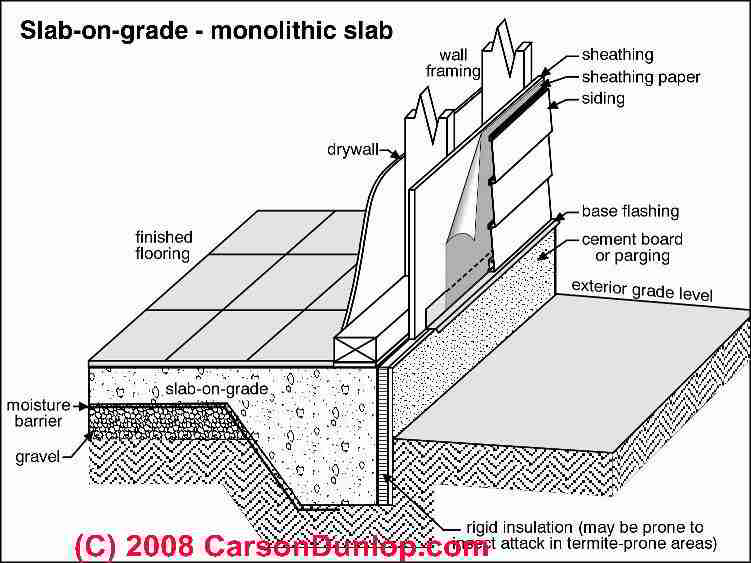
 Use of Polyisocyanurate Foam Insulation Below Concrete Slabs

- POST a QUESTION or COMMENT about insulating foam beneath concrete floors or slabs
Polyisocyanurate foam insulation properties:
This article discusses the use of polyisocyanurate foam board insulation below concrete slabs. We describe research on the effectiveness of polyisocyanurate foam boards under a concrete building floor slab, and we compare using Polyisocyanurate Sub Slab Insulation with Polystyrene Foam Insulation Below a Concrete Slab.
InspectAPedia tolerates no conflicts of interest. We have no relationship with advertisers, products, or services discussed at this website.
- Daniel Friedman, Publisher/Editor/Author - See WHO ARE WE?
Properties & uses of Polyisocyanurate Insulation & Using Polyisocyanurate Foam Insulation Underneath a Concrete Slab
The question-and-answer article below paraphrases, quotes-from, updates, and comments an original article from Solar Age Magazine and written by Steven Bliss.
Is Foil-Faced Polyisocyanurate Foam Insulating Board Good to Use Below a Concrete Floor Slab?
Question:
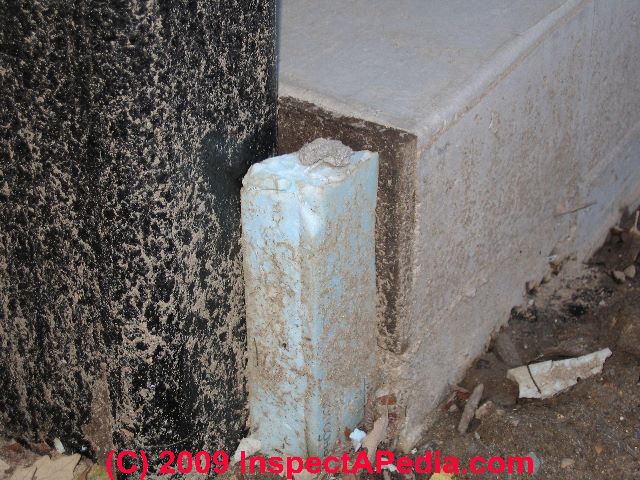
The articles I read concerning the insulation of concrete slabs refer to extruded polystyrene foam insulating board for use underneath the slab and for perimeter treatment. (See photo at left).
Except for Owens-Corning literature that recommends use of its Energy Shield sheathing, foil-faced polyisocyanurate foam insulation use below slabs seemed to be ignored in the 1980's - why? -- Steve Scheller, Falls Church VA
Answer:
In 1984 the only published research to date on underground applications of rigid foam insulation was a study by Dow Chemical, in which samples of insulation were buried for extended periods and later unearthed.
In those tests, foil-faced polyisocyanurate foam insulating board did not fare so well, absorbing on average 5 percent water by volume and losing 40 percent of its R-value.
Manufacturers of the foil-faced products argued that the tests were not valid because
- the 2-foot square samples used had proportionally far more edge area than full sheets (edges are torn cells that are open to moisture)
- the applications did not resemble a typical application, but a worst-case scenario.
The major manufacturers of foil-faced polyisocyanurate foam insulating board, Owens-Corning and Celotex, both recommend its use below grade for foundation wall and underslab applications, but in general they recommend taking extra care while backfilling so as not to puncture the foil facing.
[Additional foil facing punctures would be caused, for example, by a radiant heat floor contractor who installs the tubing by stapling it or nailing it to the foil-faced sub-slab insulation before the concrete is poured. See RADIANT HEAT FLOOR MISTAKES. --DF.]
They also recommend good drainage around the building foundation so the insulating polyisocyanurate foam board panels are never immersed in water.
Specifically, Celotex recommends that the insulating foam board panels be protected during backfilling with a rigid material such as fiberboard sheathing.
Owens-Corning recommends that all polyisocyanurate foam board joints and edges below grade be covered with aluminum tape.
Comparing Polyisocyanurate Sub Slab Insulation with Polystyrene Foam Insulation Below a Concrete Slab
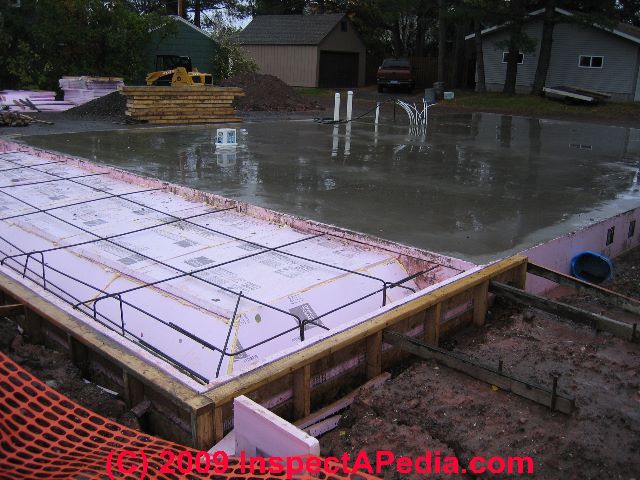
For comparison's sake, extruded polystyrene (see POLYSTYRENE FOAM INSULATION) has higher compressive strength than polyisocyanurate, but both have similar water absorption properties as measured by standard tests. Both are over 90-percent closed-cell foams.
Our photo (left) shows polystyrene foam insulating board below a concrete slab being poured in Two Harbors, MN.
In 1984 Owens Corning was currently monitoring samples buried over the summer and was expected to produce data results by 1985 when the samples were dug up. But in the mid 1980's builders had to rely on scanty published data and on manufacturer's recommendations.
Also remember that each foil-faced insulating board product has its own chemical makeup and facing material.
See INSULATION R-VALUES & PROPERTIES for details about specific insulating board properties.
Readers should also see POLYISOCYANURATE FOAM and IAQ,
The question-and-answer article about use of polyisocyanurate foam insulating board below concrete slabs, quotes-from, updates, and comments an original article from Solar Age Magazine and written by Steven Bliss.
Orignal article
The link to the original Q&A article in PDF form immediately below is preceded by an expanded/updated online version of this article.
- Q&A on Below-Grade Polyisocyanurate use of solid foam insulation below concrete slabs - PDF version, use your browser's back button to return to this page
...
Continue reading at FOAM INSULATION & INSECTS or select a topic from the closely-related articles below, or see the complete ARTICLE INDEX.
Or see these
Recommended Articles
- FOAM BOARD INSULATION TYPES
- FOAM SPRAY INSULATION TYPES
- INSULATION INSPECTION & IMPROVEMENT - home
- POLYSTYRENE FOAM INSULATION
Suggested citation for this web page
POLYISOCYANURATE FOAM BELOW SLABS at InspectApedia.com - online encyclopedia of building & environmental inspection, testing, diagnosis, repair, & problem prevention advice.
Or see this
INDEX to RELATED ARTICLES: ARTICLE INDEX to BUILDING INSULATION
Or use the SEARCH BOX found below to Ask a Question or Search InspectApedia
Ask a Question or Search InspectApedia
Share this article:Search the InspectApedia website
Need to make a private comment? Email editor@inspectApedia.com. We welcome email with your website content critique, corrections, suggestions or questions. Email is monitored daily but our workload may prevent an immediate reply. For immediate results, we hope you'll first try asking your question using the search box just above.
Citations & References
In addition to any citations in the article above, a full list is available on request.
- Solar Age Magazine was the official publication of the American Solar Energy Society. The contemporary solar energy magazine associated with the Society is Solar Today. "Established in 1954, the nonprofit American Solar Energy Society (ASES) is the nation's leading association of solar professionals & advocates. Our mission is to inspire an era of energy innovation and speed the transition to a sustainable energy economy. We advance education, research and policy. Leading for more than 50 years. ASES leads national efforts to increase the use of solar energy, energy efficiency and other sustainable technologies in the U.S. We publish the award-winning SOLAR TODAY magazine, organize and present the ASES National Solar Conference and lead the ASES National Solar Tour – the largest grassroots solar event in the world."
- Steve Bliss's Building Advisor at buildingadvisor.com helps homeowners & contractors plan & complete successful building & remodeling projects: buying land, site work, building design, cost estimating, materials & components, & project management through complete construction. Email: info@buildingadvisor.com
Steven Bliss served as editorial director and co-publisher of The Journal of Light Construction for 16 years and previously as building technology editor for Progressive Builder and Solar Age magazines. He worked in the building trades as a carpenter and design/build contractor for more than ten years and holds a masters degree from the Harvard Graduate School of Education. Excerpts from his recent book, Best Practices Guide to Residential Construction, Wiley (November 18, 2005) ISBN-10: 0471648361, ISBN-13: 978-0471648369, appear throughout this website, with permission and courtesy of Wiley & Sons. Best Practices Guide is available from the publisher, J. Wiley & Sons, and also at Amazon.com - In addition to citations & references found in this article, see the research citations given at the end of the related articles found at our suggested
CONTINUE READING or RECOMMENDED ARTICLES.
- Carson, Dunlop & Associates Ltd., 120 Carlton Street Suite 407, Toronto ON M5A 4K2. Tel: (416) 964-9415 1-800-268-7070 Email: info@carsondunlop.com. Alan Carson is a past president of ASHI, the American Society of Home Inspectors.
Thanks to Alan Carson and Bob Dunlop, for permission for InspectAPedia to use text excerpts from The HOME REFERENCE BOOK - the Encyclopedia of Homes and to use illustrations from The ILLUSTRATED HOME .
Carson Dunlop Associates provides extensive home inspection education and report writing material. In gratitude we provide links to tsome Carson Dunlop Associates products and services.
 |
HOME | ABOUT | ASK a QUESTION | CONTACT | CONTENT USE POLICY | DESCRIPTION | POLICIES | PRIVACY | |
| © 2026 - 1985 Publisher InspectApedia.com - Daniel Friedman | |||||||||