
InspectAPedia® FREE Encyclopedia of Building & Environmental Construction, Diagnosis, Maintenance & Repair |
Question? Just ask us! InspectAPedia
|
 Buyer's Guide to Waterless Toilets, No-water toilets & Low Water Usage or Water Conserving Toilets
- POST a QUESTION or COMMENT about water conserving toilet choices: no-water toilets, waterless toilets, low water-consuming toilets and low-flush toilets
This article provides information about waterless & low water septic systems, waterless toilets, chemical toilets, incinerating toilets, holding tanks, disinfection septic systems, & greywater systems.
This document also has links to septic design engineers, advanced septic system products and books. Guide to choices among chemical toilets, composting toilets, low water toilets, no-water toilets, electric toilets, & incinerating toilets as components of alternative septic systems - Toilet product sources & product comparisons
InspectAPedia tolerates no conflicts of interest. We have no relationship with advertisers, products, or services discussed at this website.
- Daniel Friedman, Publisher/Editor/Author - See WHO ARE WE?
Buyers' Guide to Waterless Toilets, No-water toilets, Low Water Toilets & Greywater Toilet Flush Systems
 Waterless toilets, low-water toilets, holding tanks, and graywater systems are
alternative designs for sites where a septic system can't be installed or where
water is in limited supply or not available at all.
Waterless toilets, low-water toilets, holding tanks, and graywater systems are
alternative designs for sites where a septic system can't be installed or where
water is in limited supply or not available at all.
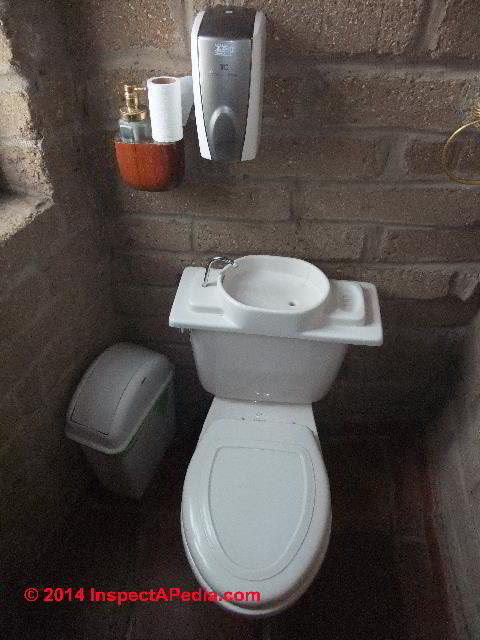
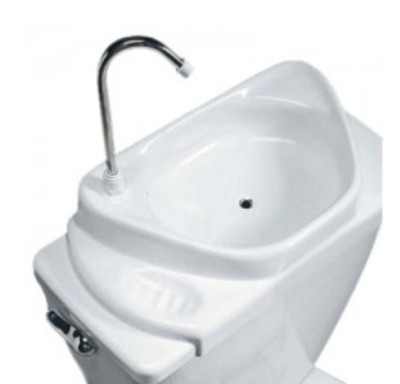
Photo at left: this water-reusing toilet shown above combines a sink for hand-washing with the toilet flush tank. Water used to wash one's hands is directly recycled into the toilet flush tank for the next toilet use. This Stilfor [citation needed] toilet uses 1.6 gallons of recycled water per flush.
A similar toilet lid conversion accessory from SinkPositive [image] can be used to convert any tank type toilet lid into a hand-washing sink.
[Click to enlarge any image]
Examples of advanced septic designs which may need to employ waterless or low-water usage toilets include aerobic septic systems, chemical, composting, incinerating & waterless toilets, evaporation-transpiration (ET) septic systems, septic media filters, greywater systems, holding tank septic systems, mound septics, raised bed septics, pressure dosing septic systems, sand bed filters, peat beds, constructed wetlands, and septic disinfection systems.
Alternative onsite wastewater disposal systems can reduce the soil absorption area or leach field size requirement substantially and can in fact in some cases reduce the needed area to zero. For problem sites where space or soil conditions make it difficult to install a conventional leach field these designs are very important alternatives.
Alternative Septic System Designs for wet sites, steep sites, rocky sites, limited space, and other difficult site conditions.
Consultants in this field can be listed at our alternative septic designers page at no charge by contacting me.
Also
see SEPTIC SYSTEM INSPECT DIAGNOSE REPAIR - home.
Massachusetts Title 5 Licensed Septic System Inspector, & New York State H.I. License # 16000005303 (inception to 2008). Technical reviewers welcomed and are listed at Reviewers.
Each of the links below presents an InspectAPedia article providing more in-depth information about each of these alternative toilet designs and wastewater disposal methods.
- CAMPING & EMERGENCY USE TOILETS - for camping, or for emergency home use we discuss a variety of temporary, portable and camping toilets. Camping toilets typically store wastewater in a reservoir for later dumping into an approved dumping station or septic system. Simple camping and emergency toilets typically use a plastic bag to contain solid waste for later pack-out and disposal.
- CHEMICAL TOILETS: use a
chemically treated reservoir located directly
below the toilet seat. The chemicals reduce odors and perform partial (incomplete) disinfection of the waste.
While RV chemical toilets may store large quantities of wastewater, portable chemical toilets have limited storage capacity and must be emptied manually or pumped and periodically cleaned by a septic
company.
Similar to simple chemical toilets but more sophisticated in design are recirculating toilets which separate the waste from the chemical and then re circulate the fluid through the toilet tank. Chemical treatments stabilize the waste both for safety (avoiding a methane gas explosion), sanitation, and odor control. There may be concerns with over-use of stabilizing chemical treatments if you are emptying larger RV chemical toilets into a private septic tank. - COMPOSTING TOILETS: may be used where the water supply is limited or not available at all, or where a building owner for other reasons wishes to conserve water use. Other wastewater treatment will still be required for handling graywater from sinks and showers. Composting toilets, properly maintained and used, can produce treated waste that can be used as fertilizer.
- DISABLED or ELDERLY-USE TOILETS discusses Use of Chemical or Composting Toilets by the elderly, disabled, sick, or injured
- DISASTER ZONE TOILET GUIDE
- DISINFECTION SEPTIC SYSTEMS: use chlorination or ultraviolet light (UV) to disinfect wastewater effluent before it is discharged to the environment.
- DRIP DISPERSAL SEPTIC EFFLUENT SYSTEMS - (Jantrania/Gross wastewater system type III or if treated to level 2 or better effluent, Jantrania/Gross wastewater system type VII). Drip dispersal systems may include pressure dosing or systems that dispose of effluent using only gravity.
- GREYWATER FLUSH TOILETS - using lav, sink, shower or tub water to flush toilets
- GREYWATER TOILETS & SEPTICS aka GREYWATER SYSTEMS: refer to systems which reduce the liquid effluent load on a septic system by separating greywater (or graywater) from sinks and showers from blackwater (black water) from toilets. When we inspect a home which uses a separate drywell to handle greywater we presume that the owners discovered that their septic system, or at least its leach field, was of limited capacity or life.
- HOLDING TANK SEPTIC SYSTEMS: use a sealed
tank to hold household waste and wastewater until the tank can be pumped out by a septic pumping company. Most
jurisdictions do not permit septic holding tanks as a permanent wastewater handling method for full-time occupied
residences, but holding tanks may be permitted during new home construction and in other special cases.
In New York State we've seen holding tank systems in use on small-lot properties located along the Hudson River. Generally such systems will not be acceptable for full time occupied residences as even a large tank of several thousand gallons will require frequent and costly pumping and disposal. - INCINERATOR TOILET SYSTEMS: incinerator
toilets use electricity or gas to burn the waste placed into these systems. Like chemical toilets and holding tanks they have
limited capacity, are used where water is not available or must be conserved, and they do not address the handling
of remaining graywater from sinks and showers.
My favorite of this type was the "Destroylet" incinerator toilet which was electric/propane fueled and which is no longer on the market. Each flush resulted in a more than 10-minute burn cycle which produced a pretty smelly exhaust. - MARINE TOILETS - toilets designed for use on boats, ships, similar vehicles
- US EPA, WATER EFFICIENCY TECHNOLOGY FACT SHEET: OIL RECIRCULATING TOILETS, [PDF] (2000) US EPA Article on Incinerating Toilets PDF file, retrieved 1/19/1999, 3/6/2014 and anew 2019/07/20
Excerpt:
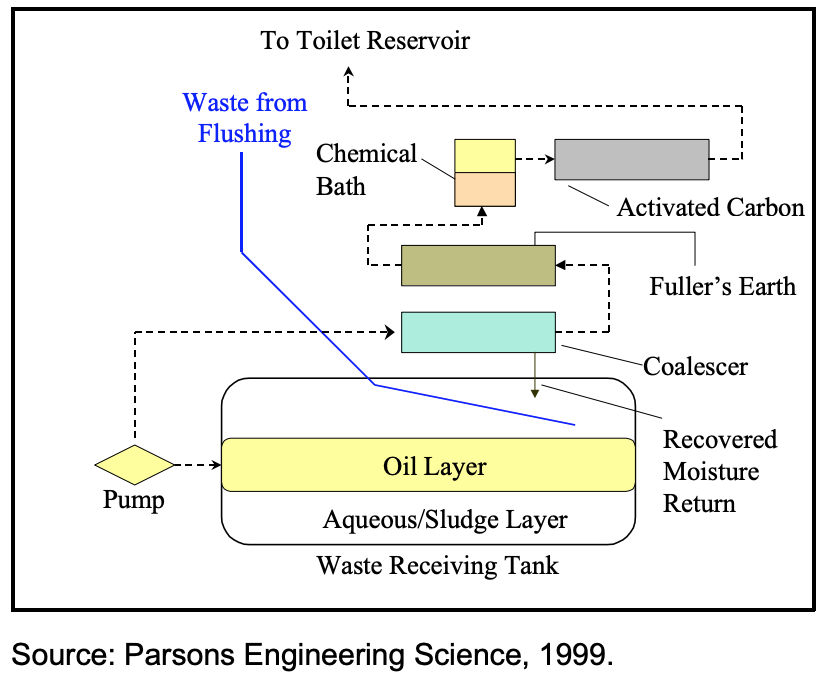
Oil recirculating toilets are “non-water carriage” toilets, meaning that they do not require water to operate. Instead, human wastes are deposited into mineral oil, or another similarly non-aqueous medium.
The water-based urine and the solid waste products are separated from the oil medium, which is then filtered and reused in the toilet. The waste is separated and contained in a holding tank until it can be disposed of at an approved facility. - OUTHOUSES & LATRINES - Outhouses, or latrines or simple trench systems, useful in remote and impoverished areas to improve sanitation and thus the quality of drinking water and other special, extremely low-cost waste handling, wastewater treatment systems are ignored by most modern texts on onsite wastewater treatment, excepting perhaps military manuals which address field toilets and sanitation for military operations. This topic needs considerably more attention as a step in assisting rural, poor areas in developing nations.
- TOILET TANK LID LAV-SINKS - combine the provision of a lav for hand washing, space-savings in small bathrooms, and direct re-use of hand-washing graywater in the toilet flush tank. Several companies produce a toilet top sink that replaces the conventional toilet tank lid; some are more accessible than others, all conserve both space and water.
- Toilet tank based hand washing sink shown at left: Stilfo, installed in Guanajuato, Mexico [citation needed]
- Caroma products, with offices worldwide including Caroma National, Tel: 1-300-227-662, Australia, include the Profile Smart 305 sink/toilet that includes a toilet top sink fixture, Website http://www.caromausa.com/ - contact information at the company's website does not clearly indicate a company or corporate address.
Canada tel: 800-460-7019 x2; Caroma USA Email: info@caromausa.com Phone + 1800 605 4218,
Australia Tel: 1300-CAROMA,
New Zealand: Caroma Auckland http://www.caroma.co.nz 17 Allens Road, East Tamaki, Phone 64 9 279 2700 Auckland,New Zealand 2013 Fax 0800 423 825 - Coroflot displays the Eco toilet designed by Jang Woo-seouk, incorporating a toilet top mounted sink that looks more easily accessible than the toilet tank sink we show in the little bathroom in our photo . Website: http://www.coroflot.com - contact information for the product is unclear
- SinkPositive, 4716 Hilltop Rd., Greensboro NC 27407, USA, Tel: Email: Deven@Sinkpositive.com ,
Website: sinkpositive.com
Quoting: SinkPositive is a retrofit for your toilet lid that turns it into a sink, delivering a clean, environmentally friendly, and touch-free hand wash with every flush - Smeg, an Italian company produces both sink top over a clothes washer and a sink top over a refrigerator! Smeg S.p.A Via Leonardo da Vinci, 4 42016 Guastalla (RE), ITALY Tel. +39 0522 821 1 Fax +39 0522 821 452 smeg@smeg.it, Website http://www.smeg.com
- RV TOILETS & RV HOLDING TANK DUMP INTO SEPTIC TANK?
- TOILETS, WATERLESS ALTERNATIVES (this article) and GREYWATER SYSTEMS: provides a detailed discussion of each toilet type,
see the various toilet types and greywater/graywater links shown above on this page and re-listed below.
(Jantrania/Gross consider this septic design option "Wastewater System Type IV").
- Envirolet Low Water Remote Composting Toilet System (120v Electric)
The Envirolet Low Water Remote (120VAC Electric) Composting System has the highest capacity of all the Low Water Remote Systems and allows for up to three toilets to be connected to the composting unit. Each Low Water Toilet flushes with as little as one pint. Included with system purchase:
1. Envirolet Low Water Remote (120VAC Electric) Composting Unit,
2. Premix Starter Kit,
3. Envirolet Compost Accelerator (8oz),
4. 4" Wind Turbine,
5. 2-Stage Pre-Sediment Filter Drain Kit (Filter Tray, 5' Nylon Drain Line Quick Connect Breather "T"),
6. Luxury Low Water Toilet (White),
7. Vent/ Drain Kit (3' x 3" Flex Drain Duct, 4' x 4" Flex Vent Duct, Gear Clamps, Water Supply, Floor Flange, Coupling, Silicone, and Rubber Roof Flashing) - Envirolet Waterless Toilet (Black Granite), This toilet is easy and sanitary to clean with its removable bowl.
Used with Envirolet Waterless Remote Composting Toilet Systems, but can also be used with existing outhouse or other composting toilets -- not that anyone would choose anything other than an Envirolet! This toilet is 16.5" W x 22.5" L x 20.5" H (15" height to seat). Waterless toilet (black granite), toilet seat (oak), rubber floor gasket and hardware included - Envirolet Waterless Toilet (Cream)
- Nature-Loo composting toilet is an Australian product includes ceramic and plastic models
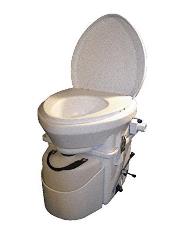
- Nature's Head is a U.S. made stainless-steel composting toilet, designed originally for the marine environment (use on boats). This is a portable, self contained, urine separating dry toilet that can be used where electricity is not available.
The liquid waste compartment can store 2.2 U.S. gal. which the manufacturer recommends disposing of in a public restroom. Liquid urine waste is automatically separated from the solids. Solid waste that has composted (decomposed) for 3 months or more can be used as plant fertilizer; solid waste that has not composted that long can be bagged and disposed-of in a dumpster. The base product cost is about $850.00 U.S.
The manufacturer notes that the toilet system does not produce the odors associated with holding tank toilet systems. It is suitable for cabins, cabanas, boat houses, hunting camps, RVs, basements, semi-trucks, and even pick-up trucks.
The unit is vented to outside a venting kit chosen depending on the installation requirements. A 12-V fan is used to operate the ventilation system, powered by battery or a solar vent with backup solar-charged battery pack.The composting system is primed with damp, crumbly peat moss. Telephone: 251-295-3043 email: Sales@NaturesHead.net
- Nature's Head is a U.S. made stainless-steel composting toilet, designed originally for the marine environment (use on boats). This is a portable, self contained, urine separating dry toilet that can be used where electricity is not available.
- Phoenix Composting Toilet from Advanced Composting Systems (Montana), requires 5 watts of electric power. Hand pump to remove excess liquid; rotating tines to move compost to the removal area. DC fan; can run on photovoltaics. Composting Toilet Prices: $4100. to $6100.
- * SunMar provides low water and no-water composting toilets, and stand alone toilets as well as equipment to provide central composting supporting multiple toilets. (Their website says there are 20 models of low water or no water toilets.)
SunMar uses a rotating drum to mix the compost. Sun-Mar is described by some vendors as not a true composting toilet but as a "dry toilet", smaller than true composting toilets, and using supplemental heat, air, and mixing to assure waste decomposition. Waste is kept on an outside compost pile for six months before spreading on soils.
More frequent emptying and smaller capacity than "true composters" this toilet may be a best fit for a low-use remote cabin.
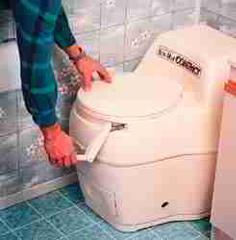
SunMar offers a variety of composting toilets including a self-contained composting marine toilet model, the SunMar Mobile, certified by the U.S. Coast Guard ($1,489.00). Shown here is the SunMar Excel ne composting toilet [Click image for larger photo]. SunMar composting toilets are described below. - Thetford Corporation 7101 Jackson Road, Ann Arbor, MI 48103, Phone: 1-800-543-1219, 734-769-6000, Fax: 734-769-2023; Thetford produces a wide range of permanent and portable alternative toilet designs. Quoting:
Our [toilet] products are easy to use at bedside and indispensable for the physically challenged, the aged, and small children.
Thetford's list of toilet products suitable for home or bedside health care are listed at
http://www.thetford.com/Thetford/HOME/ApplicationHome/BedsideApplications/tabid/94/Default.aspx -
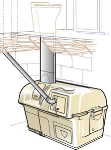
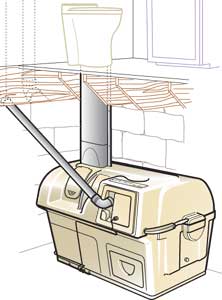
- LetsgoGreen is not a toilet manufacturer but rather a Canadian supplier of SunMar and other electric and non-electric versions of composting toilets (Ontario, Canada).
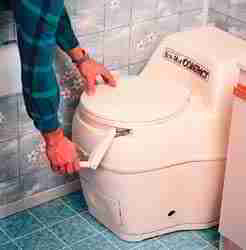
The toilet shown here is the Centrex 2000 A/F central-flush waterless air flow composting toilet which uses a below-floor composting drum (110V, Composting Capacity: 4-6 Residential, 6-8 Weekend/Vacation Use, cost $1,795.00).
Other self-contained composting toilet models are available.
- LetsgoGreen is not a toilet manufacturer but rather a Canadian supplier of SunMar and other electric and non-electric versions of composting toilets (Ontario, Canada).
- Envirolet Low Water Remote Composting Toilet System (120v Electric)

Product submissions are welcome Contact Us. to list your product or service here - if you are a manufacturer of waterless toilets, no-water toilets, low-water consuming toilets or other alternative wastewater treatment system equipment your product may be listed at no fee. Website content critique, additions, and suggestions are also invited. No conflicts of interest: We have no financial business relationship nor any other economic relationship with any product or service discussed at this website.
General Categories of Onsite Residential Wastewater Treatment Systems
Because various texts provide so many different views of categorizing wastewater systems, we have made this simple list which groups wastewater treatment systems into a few major categories:
(1) Conventional septic tank and drainfields using native soils for effluent absorption and treatment
(2) Raised bed and septic mound systems which take a similar approach but have to bring in fill to treat effluent
(3) Septic filter systems: various types of advanced material media filtration systems (sand beds, filter beds, synthetic
textile filters, foam media filters including above-ground self-contained systems)
(4) AEROBIC SEPTIC SYSTEMS which insert additional oxygen into and agitate sewage in the primary treatment tank
(5) Waterless and low-water and greywater-separation systems, which may not really treat effluent, may not
discharge anything into the environment, but which form another set of alternative designs where water supply or
land use restrictions mean that a conventional system is not permitted.
Adding to the complexity of what to call various septic systems, there are also categories of methods of septic effluent dispersal such as gravity-fed, trickle-down, pressure dispersal, sprinkler dispersal, and intermittent effluent dosing systems which use gravity or pressure.
In case this is not enough, there are also various levels of degree of treatment of septic effluent achieved by different versions of these systems. So you may read about more than one type of pressure-dosing filter bed system which look a lot alike but which achieve different degrees of effluent treatment.
Keeping these general categories in mind when reviewing various off-the-shelf packaged systems or wastewater treatment systems with interesting but non-descriptive names (like the "magic bullet treatment box") will help you to understand the general approach which has been taken.
Further reading will be needed to understand the installation cost, maintenance cost, and level of management required of each type of septic system.
...
Reader Comments, Questions & Answers About The Article Above
Below you will find questions and answers previously posted on this page at its page bottom reader comment box.
Reader Q&A - also see RECOMMENDED ARTICLES & FAQs
On 2016-04-22 by (mod) - occurrenced of explosion of methane gas in or around septic tanks or fields
Laxman
I'm doubtful that there is a common hazard from sewer gas explosion from waterless or chemical toilets, particularly because properly used the waste tank is treated with a chemical that regards the formation of methane gas.
Watch out: But such portable or makeshift toilet methane gas explosion hazards can occur and can be very dangerous.
At CAMPING & EMERGENCY USE TOILETS we describe a near-miss event.
We have had direct email reports from readers as well as a few posted comments of methane gas explosions in which the gas source was a septic tank or septic system or cesspool whose methane gas exploded as a result of a nearby flame, spark, or lit cigarette.
A septic contractor in New York told me personally that he was leaning over an open septic tank to look inside while smoking; his cigarette ignited methane gas enough to burn the beard off of one side of his face. When we talked he was freshl-shaved.
A reader wrote of a methane gas explosion when she and her husband burned a pile of leaves that had been raked up over the septic tank.
Also see these examples of
Scholarly Research on Septic Tank or Septic System Methane Gas Explosions
- Houser, Paul J. "Hazards and Safety Measures at Sewage Works." Sewage Works Journal (1938): 731-737.
- Hutter, Gary M. "Reference data sheet on sewer gas (es)." URL: http://www. meridianeng. com/Reference% 20Data% 20Sheet% 20on% 20Sewer% 20Gases. pdf (1993).
- Jenkins, Andrew, Les Gornall, and Harry Cripps. "Lessons for safe design and operation of anaerobic digesters." Loss Prevention Bulletin 229 (2013).
- Mi, L., Q. H. Peng, and X. Y. Peng. "Study on Early Warning Mode of Flammable Gases Concentration in Urban Sewers and Septic Tanks." China Water & Wastewater 28, no. 5 (2012): 16-19.
Abstract:
The establishment of gas safety monitoring system of sewers and septic tanks to achieve off-gauge early warning of flammable gases concentration is an effective way to prevent and reduce gas explosion accidents.This study addresses frequent alarm and false alarm phenomena in gas monitoring system by field investigation and data collection of gas explosions in metropolitan Chongqing.
Also,data from Nan'an District was collected for one year and the early warning modes of flammable gases concentration were established: stability mode,perturbation mode and accumulation mode.Discrimination standards were determined.
The discrimination standard was based on concentration trends of flammable gases.If the concentration at a subsequent moment is consistently three times higher than that at its preceding moment during a sampling period,an increasing trend of flammable gases concentration is marked.
According to this discrimination standard,the alarm frequency of the existing gas safety monitoring system can be reduced by at least half,improving the system reliability and validity. - Nava-Martinez, E. C., E. Garcia-Flores, and F. T. Wakida. "Surface methane emission in a former dumpsite in Tijuana, Mexico." International Journal of Environmental Research 5, no. 3 (2011): 621-626.
- Sayers, Royd Ray. "Gas hazards in sewers and sewage-treatment plants." Public Health Reports (1896-1970) (1934): 145-155.
- Vagholkar, K., and P. Vagholkar. "Sewer Gas Explosion In A Public Lavatory: An Unheard Cause Of Genital Burns." The Internet Journal of Surgery 31, no. 1 (2014).
- YANG, Jing, Wei-zhen LIANG, and Qing-qiang MENG. "Monitoring Method for the Combustible and Poisonous Gas from Urban Sewer [J]." China Water & Wastewater 1 (2005).
- XING, Juan-juan, Li YANG, and Xiu-hui JIANG. "Analysis of 122 occupational accident cases in confined space [J]." Journal of Safety Science and Technology 5 (2006).
...
Reader Comments, Questions & Answers About The Article Above
Below you will find questions and answers previously posted on this page at its page bottom reader comment box.
Reader Q&A - also see RECOMMENDED ARTICLES & FAQs
On 2017-02-21 by Laxman Apte
I want to know cases where explosion of accumulated gases occurred ,in spite of any flame or buring or welding spark nearby.
my email ID is
aptelaxman40@gmail.com
On 2016-04-22 by (mod) -
Rick, take a look at the chemical and composting and incinerating toilets in the list above. For temporary use and presuming that means most-economical solution, I'd look at a chemical toilet or a portable or camping toilet. All of those systems use a chemical additive that avoids odor problems.
On 2016-04-21 by Rick Lesco
Looking for detail on waterless toilets, also need for toilet temporary installation in a shed with electricity and bottled water of some sort and electrical disposal or chemical disposal and limits on odor.
Question: toilet using elevated rain barrell or water reservoir to flush
(Nov 10, 2014) Anonymous said:
Looking for toilet which uses an elevated rain barrel or water reservoir system to flush. No running water available. I do have electricity.
Reply:
Anon
Any flush toilet will work if its cistern or flush tank is filled, regardless of the source. You'd probably want a low-flush unit to make the most use of the limited water source you've got at hand.
The toilet tank can be filled by low pressure gravity water delivery - though depending on the fill valve choice some may fill more slowly than others.
Question: ok to turn off toilet vent fan?
(Mar 31, 2015) Lois M Hammel said:
Is it acceptable to not hook up the vent for 4 days on an electric chemical toilet?
Reply:
Lois
For a typical booster fan intended principally to avoid indoor odors that's ok.
The concern would be for a methane gas build-up indoors that could be explosive.
If the toilet is still vented to outdoors by natural convection then the safety hazard of a methane gas is of course reduced.
But if a toilet is in heavy use, not properly treated with chemicals, AND not vented at all, there could be trouble.
Take a look at solar powered toilet vent systems if you like.
...
Continue reading at CAMPING & EMERGENCY USE TOILETS or select a topic from the closely-related articles below, or see the complete ARTICLE INDEX.
Or see these
Alternative Toilet Type Articles
- ALTERNATIVE & WATERLESS TOILETS
- CAMPING & EMERGENCY USE TOILETS
- CHEMICAL TOILETS
- COMPOSTING TOILETS
- COMPOSTING TOILET SUPPLIES
- GREYWATER FLUSH TOILETS
- INCINERATOR TOILET SYSTEMS
- OUTHOUSES & LATRINES
- TOILET TYPES, CONTROLS, PARTS - home
- WATERLESS URINALS
Suggested citation for this web page
ALTERNATIVE & WATERLESS TOILETS at InspectApedia.com - online encyclopedia of building & environmental inspection, testing, diagnosis, repair, & problem prevention advice.
Or see this
INDEX to RELATED ARTICLES: ARTICLE INDEX to TOILET INFORMATION
Or use the SEARCH BOX found below to Ask a Question or Search InspectApedia
Ask a Question or Search InspectApedia
Try the search box just below, or if you prefer, post a question or comment in the Comments box below and we will respond promptly.
Search the InspectApedia website
Note: appearance of your Comment below may be delayed: if your comment contains an image, photograph, web link, or text that looks to the software as if it might be a web link, your posting will appear after it has been approved by a moderator. Apologies for the delay.
Only one image can be added per comment but you can post as many comments, and therefore images, as you like.
You will not receive a notification when a response to your question has been posted.
Please bookmark this page to make it easy for you to check back for our response.
IF above you see "Comment Form is loading comments..." then COMMENT BOX - countable.ca / bawkbox.com IS NOT WORKING.
In any case you are welcome to send an email directly to us at InspectApedia.com at editor@inspectApedia.com
We'll reply to you directly. Please help us help you by noting, in your email, the URL of the InspectApedia page where you wanted to comment.
Citations & References
In addition to any citations in the article above, a full list is available on request.
- New York State Department of Health, APPENDIX 75-A WASTEWATER TREATMENT STANDARDS - INDIVIDUAL HOUSEHOLD SYSTEMS , [PDF] New York State Department of Health, 3 February 2010, retrieved 3/1/2010, original source: https://www.health.ny.gov/regulations/nycrr/title_10/part_75/appendix_75-a.htm
- Advanced Onsite Wastewater Systems Technologies, Anish R. Jantrania, Mark A. Gross. Anish Jantrania, Ph.D., P.E., M.B.A., is a Consulting Engineer, in Mechanicsville VA, 804-550-0389 (2006). Outstanding technical reference especially on alternative septic system design alternatives. Written for designers and engineers, this book is not at all easy going for homeowners but is a text I recommend for professionals--DF.
- Composting Toilet System Book: A Practical Guide to Choosing, Planning and Maintaining Composting Toilet Systems, David Del Porto, Carol Steinfeld. Quoting an Amazon review: Del Porto's book is the definitive composting toilet book at this time. There is nothing even close. His book covers all aspects of composting toilet systems and touches on graywater issues as well. He treats the composting toilet as part of the home system. If a person is seriously interested in installing/having a composting toilet, this book can save him/her all of the mistakes people usually make. He even (carefully) explodes some of the advertising myths that the purveyors of composting toilets would have us believe. The book covers ready-made systems as well as home built systems. As trite as this sounds, the book truly is a must for someone considering installing composting toilet.
- Experiences with a composting toilet article from: Countryside & Small Stock Journal, available as HTML download.
Quoting Amazon review: This digital document is an article from Countryside & Small Stock Journal, published by Countryside Publications Ltd. on May 1, 1994. The length of the article is 1516 words. The page length shown above is based on a typical 300-word page. The article is delivered in HTML format and is available in your Amazon.com Digital Locker immediately after purchase. You can view it with any web browser.
From the supplier: A composting toilet is a good alternative to propane burning toilets, but it also has many problems. The worst part is emptying the waste and compost every 4-6 weeks. Other problems are the fan that must be kept running constantly and bug infestation. - In addition to citations & references found in this article, see the research citations given at the end of the related articles found at our suggested
CONTINUE READING or RECOMMENDED ARTICLES.
- Carson, Dunlop & Associates Ltd., 120 Carlton Street Suite 407, Toronto ON M5A 4K2. Tel: (416) 964-9415 1-800-268-7070 Email: info@carsondunlop.com. Alan Carson is a past president of ASHI, the American Society of Home Inspectors.
Thanks to Alan Carson and Bob Dunlop, for permission for InspectAPedia to use text excerpts from The HOME REFERENCE BOOK - the Encyclopedia of Homes and to use illustrations from The ILLUSTRATED HOME .
Carson Dunlop Associates provides extensive home inspection education and report writing material. In gratitude we provide links to tsome Carson Dunlop Associates products and services.
 | HOME | ABOUT | ASK a QUESTION | CONTACT | CONTENT USE POLICY | DESCRIPTION | POLICIES | PRIVACY | |
| © 2025 - 1985 Publisher InspectApedia.com - Daniel Friedman | |||||||||