
InspectAPedia® FREE Encyclopedia of Building & Environmental Construction, Diagnosis, Maintenance & Repair |
Question? Just ask us! InspectAPedia
|
 Septic Tank, Cesspool & Drywell Safety Warnings
Safety procedures for & warnings about inspecting, servicing, or working on septic tanks, drywells, cesspools
- POST a QUESTION or COMMENT about safety hazards around septic tanks & cesspools
This document provides important safety warnings for septic systems and cesspools, and provides some safety suggestions for septic system inspectors, septic system inspections, septic pumping contractors, and home owners.
InspectAPedia tolerates no conflicts of interest. We have no relationship with advertisers, products, or services discussed at this website.
Septic System, Septic Tank, & Cesspool Safety Warnings
 Fatalities involving falling into or deliberately entering septic tank occur world wide.
[Click to enlarge any image]
Providing inspection and diagnosis of on-site waste disposal systems is an extremely valuable public service which helps protect people from expensive unanticipated septic system repair costs and helps protect public health by assuring sanitary disposal of sewage and gray water waste from buildings.
More importantly though, septic system inspections may detect and warn about serious safety hazards at some properties.
The strong warnings issued below intend to reduce septic system safety hazards for inspectors and property owners/occupants, but it is not the author's intention to dissuade inspectors from providing this valuable service.
Watch out: Septic tanks, cesspools, and drywells present serious hazards including septic cave-in's or collapses, methane gas explosion hazards, and asphyxiation hazards. Simple precautions which we describe here can help avoid a dangerous or expensive septic problem.
Video shown here: a child died after falling into a septic tank in Delhi.
Citation of this article by reference to this website and brief quotation for the sole purpose of review are permitted. Use of this information at other websites, in books or pamphlets for sale is reserved to the author.
Examples & Case Reports of Fatal Hazards at Open or Insecure Septic Tank, Cesspool, Drywell Covers

Watch Out: there is a very high risk of fatal falls into septic tanks, cesspools, or drywells: danger lurks at cesspools, open covers, tanks or tank covers in poor condition, and from high levels of methane gas CH4 or hydrogen sulfide H2S.
These septic system dangers include the risk of collapse, falling, asphyxiation, explosion, and other potentially fatal hazards as well as risks of unsanitary conditions such as bacterial or viral infections.
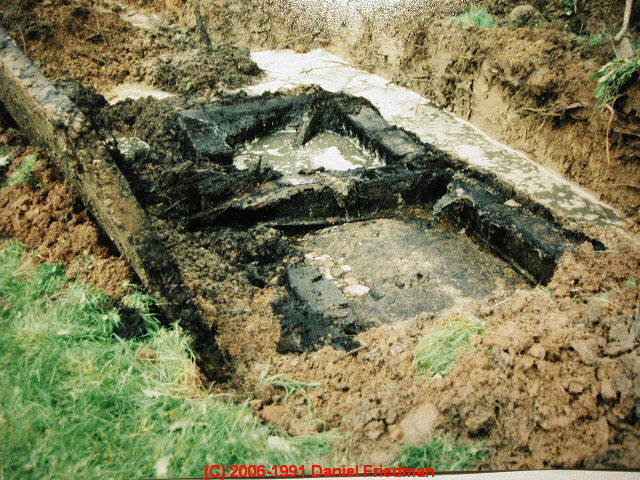
This hazard is more than theoretical. We have personally assisted in investigation of several septic or cesspool fall-in fatalities and are aware of others.
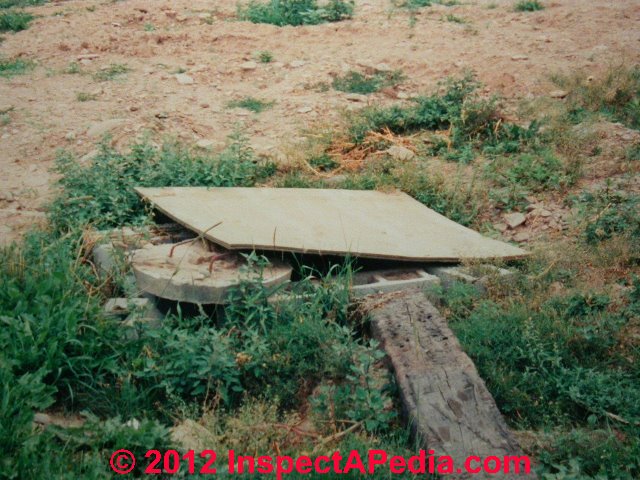
Inspecting a mobile park housing migrant workers at a New York farm that raises ducks to make pate; Steven Vemilye and Daniel Friedman documented various immediate and serious safety hazards at two open or semi-open septic tanks and cesspools.
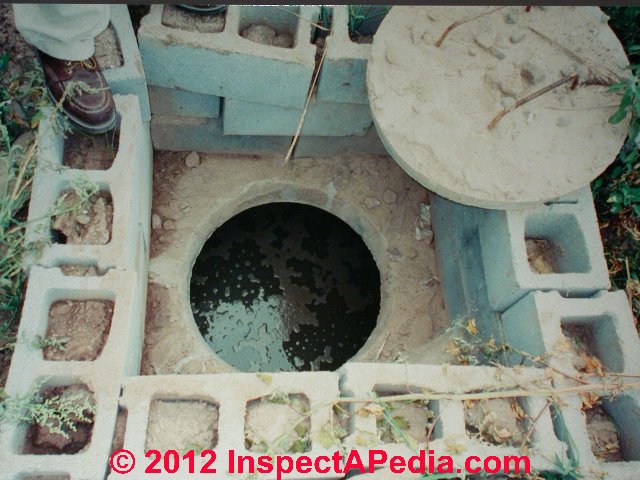
Shown above is a home-made dry-laid concrete block well (unstable) surrounding an open septic tank.
The property manager left the concrete septic tank cover off and just tossed a light section of plywood over the system in order to make frequent septic tank pumping easier.
This mobile home collection was occupied by many families including families with small children. An adult or child falling into an open septic tank is very likely to die quickly.
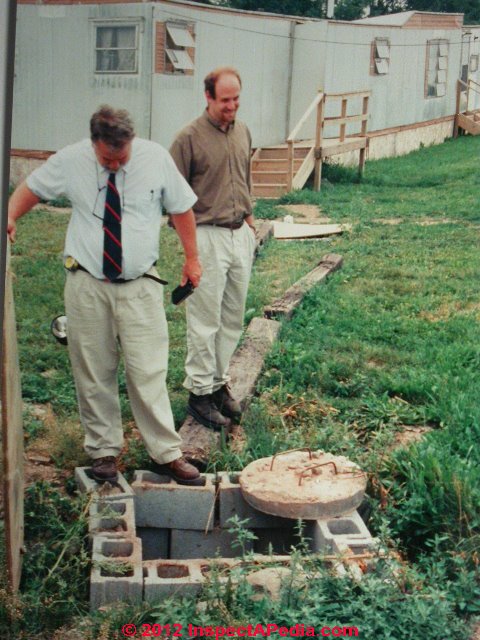
Above Mr. Vermilye, accompanied by the attorney who had asked us to perform a site inspection, was demonstrating the instability of the covers over septic facilities at this location. [As we document
at MOBILE HOMES, DOUBLEWIDES, TRAILERS, we report with regret that Mr. Vermilye passed away on 19 June 2001.]
Watch out: Readers trying to diagnose and deal with sudden soil subsidence or yard collapses should
see CESSPOOL SAFETY WARNINGS as those hazards can also apply to drywells and septic tanks, and
also see SINKHOLES, WARNING SIGNS.
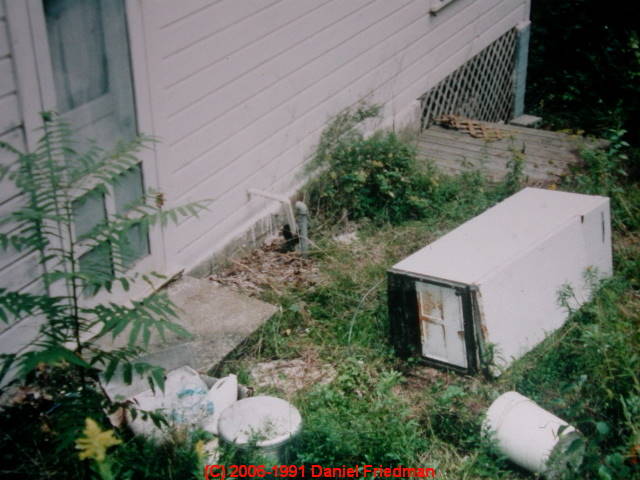
There can be other unexpected hazards when inspecting building sites and septic systems. In the photo series above, the author was inspecting the home shown from outside before looking in the crawl space to locate the main waste line exit point and thus before predicting the probable location of the septic tank.
Walking close to this house should have set off an alarm about possible unsafe conditions: poor maintenance, old home, of an age likely to have used a steel septic tank.
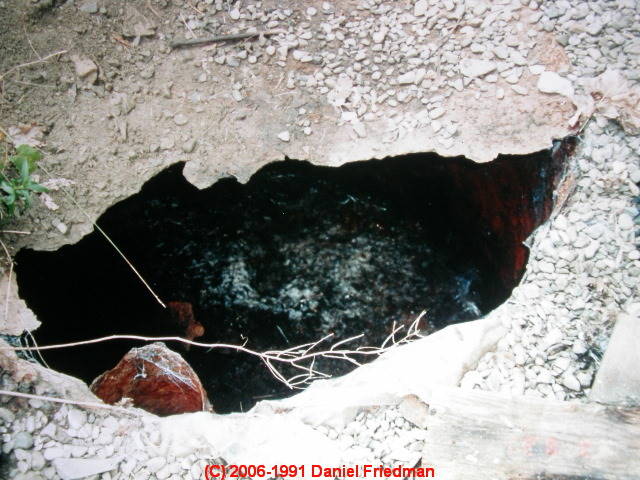
In fact the author found the tank very quickly by stepping through its cover, avoiding serious injury or even possible fatality mostly by luck. It was throw myself sideways into the briars and garbage at the site or fall completely into the septic tank.
Safety Guide for Septic System Inspection, Cleaning, Pumping, and Homeowner Care
 Providing inspection and diagnosis of on-site waste disposal systems is an extremely valuable public service which helps protect people from expensive unanticipated septic system repair costs and helps protect public health by assuring sanitary disposal of sewage and gray water waste from buildings.
More importantly though, such inspections may detect and warn about serious safety hazards at some properties.
Watch out: Before inspecting septic systems, cesspools, septic tanks, drainfields, etc., critical septic inspection safety issues must be understood.
Making a mistake can result in a fatality for the septic inspector, septic pumper, building occupants, or anyone who has the misfortune to walk over and fall into an unsafe or collapsing system.
Watch out: you or someone else could die working around or falling into a septic tank or cesspool.
The strong warnings issued below intend to reduce septic system safety hazards for inspectors and property owners/occupants, but it is not the author's intention to dissuade inspectors from providing this valuable service. But danger lurks at cesspools, open covers, tanks or tank covers in poor condition, and from high levels of methane gas. These risk collapse, falling, asphyxiation, and other potentially fatal hazards as well as risks of unsanitary conditions.
Photo: a rusted-through steel septic tank cover invites a quick ugly accident. The author [DF] discovered this tank cover, hidden under leaves at a New York home, by stepping through the cover.
- Don't work alone
at a septic tank, cesspool, or drywell: Falling into a septic tank or even leaning over a septic tank can be fatal. Do not work on or at septic tanks alone - workers can become suddenly overcome by methane gas. - Do not ever enter a septic tank
or cesspool unless you are specially trained and are wearing the special equipment and gear for that purpose, including self-contained breathing apparatus. - Do not go into a septic tank to retrieve someone
who has fallen in and was overcome by toxic gases unless you are equipped with a self-contained breathing apparatus (SCBA). If a SCBA is not available, call for emergency services and put one or more fans at the top of the septic tank to blow in fresh air. - Don't lean over a septic tank opening:
Do not lean over or stick your head into the septic tank to examine its interior - you could fall in to the tank or become overcome by gases and fall into the tank, an event which is likely to be fatal. - Don't ignite flames
Do not light a flame at or near the tank - methane gas is explosive.
At one tank pump out my client described the explosion and burns received by the pumping contractor when he stood by the tank and lit a cigarette.
A reader reported a stunning methane gas explosion that damaged nearby buildings when a brush fire was built over a septic tank. [There are safer ways to find the septic tank.] - Site must be ventilated:
Decomposing wastes in the septic tank produce toxic or otherwise dangerous gases (such as methane which is both explosive and in a septic tank methane gas is an asphyxiant) which can kill a human in a matter of minutes. When working on a tank be sure the area is well ventilated. - Rope off & Mark Dangerous Sites:
If your inspection discover that there are dangerous conditions, such as an unsafe tank cover, tank collapse, or a home-made septic tank or cesspool (which are at increased risk of sudden collapse) such areas should be roped off and clearly marked as dangerous to prevent access until proper evaluation and repairs can be made. - Safe cesspool, drywell, or septic tank covers are required:
be sure that the tank and its access ports have sound and secure covers that do not risk collapse and which cannot be removed by children. Note and take appropriate actions regarding unsafe tank covers, - Septic & Cesspool Collapse Hazards:
Old steel tanks, thin, rusting steel or rotting home-made wood tank covers, site-built tanks and cesspools, and recently-pumped cesspools are at particular risk of collapse.
Falling into a septic tank or cesspool is likely to lead to rapid asphyxiation from methane and in cases of collapse, there is risk of becoming buried.
Simply excavating by machine or by hand can lead to a septic collapse if the pre-existing tank or other components were improperly-constructed or are deteriorated or damaged.
The author has consulted in cases involving such fatalities (homeowner fell into a site-built cesspool), and at one site inspection, walking near an overgrown area the author himself stepped through a rusting steel septic tank top, surviving only by throwing himself into a nearby clump of brambles!
Beware of the following additional septic system inspection hazards: - Bad septic tank covers: flimsy, rusted, old-steel, home-made, or missing septic tank/drywell/cesspool covers
- Abandoned septic tanks: systems which may not have been filled-in
- Collapsed, or collapsing septic tanks or cesspools
- Additional unexpected septic components: possible presence of multiple components at a property, abandoned or in-use
- Un-stable soils: Cesspools and septic systems in areas of unstable soils or areas of commonly-found site-built systems - collapse risk
- Cesspool pumping or agitating: pumping, aerating, or agitating cesspools in an attempt to restore function can lead to sudden collapse of these systems, especially if the cesspool or septic tank was "site built" using stacked concrete blocks or stone
See also CESSPOOL SAFETY WARNINGS - Shock & Electrical Hazards:
when digging outdoors, watch out that you don't dig into and cut an electrical wire (or other buried mechanical line such as a gas or water line). Buried electrical wires can look a lot like tree roots.
Chopping through an electrical wire while digging to find a septic system can be dangerous. [Thanks to Donica Ben for reminding us of this septic safety problem.] - Sewage contaminants are a health hazard.
Be alert for unsanitary conditions such as surface effluent or sewage backups into buildings, events which risk serious viral and bacterial hazards and which indoors, may require professional cleaning.
Be alert for personal sanitation hazards when working around septic systems, such as open cuts or failure to wash properly after working on systems.
Do not bring sewage-contaminated clothing into your home.
Tetanus inoculations are needed if you are working in this field.
- Damage to Septic Components:
Avoid damaging septic system components or the building: Improper septic testing procedures, such as flooding a dosing-system, can damage the system.
Also, remember to check for leaks into or under the building being tested when running water into the building fixtures and drains. Don't leave water running unattended - at risk of flooding the building. - Document unsafe conditions that you observe during a septic system inspection.
Rope off and prevent access immediately if you detect a collapse risk or unsafe cover. Inform all appropriate parties.
Safety Warnings should be in writing and orally issued to - Septic and cesspool pumpers, workers, installers
- Homeowners or building occupants
Septic System Safety Warnings for Home Owners and Home Buyers
Septic system concerns for a building owner start with safety. Here are some red flags:
- Signs of collapse-possible fatal hazards:
include depressions or "soil subsidence" anywhere on or around the property. Any suspect area should be roped-off and absolutely no one should walk over or even close to such a spot until it has been investigated by a professional. - Old or abandoned septic systems:
such as site-built cesspools or drywells were often made with a thin steel or wood cover which with age can collapse.
If the history of the site or visual observation suggests that there are or were old systems at the property, professional investigation is warranted. Improper "abandonment" (failing to fill-in a pit) can lead to sudden collapses. Signs that there may be old systems at a property might come from anecdotal evidence (ask a neighbor, ask the local septic installing or service companies), or visual evidence such as seeing abandoned waste pipes at basement or crawl space walls or floors.
Don't assume that an old house which is now connected to the public sewer didn't previously have an on-site waste disposal system. - Septic service by untrained workers:
such as aerating, agitating, or pumping out an old site-built cesspool, can lead to sudden system collapse. Prevent access over or near any such systems. - Unsanitary conditions
such as discharge of sewage effluent to the yard surface, to a nearby well or stream, or previous septic backups into a building deserve professional attention. Indoors special cleaning may be needed to remove bacteria or other pathogens. - Septic testing by inexpert "inspectors"
who may not follow an adequate procedure increases the risk of a costly surprise. - Uninformed homeowners
may not notice a danger or malfunction .
Homeowners should review the SEPTIC TANK SAFETY
The information here is general in nature. S
ince conditions and requirements vary widely at individual sites, the you should obtain qualified expert advice pertaining to the specific system about which you have questions, and should not rely on this general text for costly diagnostic/repair/replacement decisions.
In other words, I'll try to give you some helpful information. In exchange, don't expect me to pay for your new septic system.
Do not drive over the septic tank or septic piping
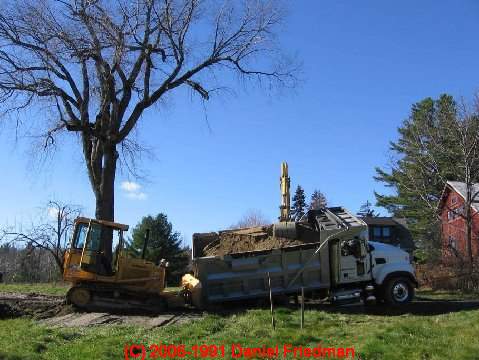
Unless special provisions have been made such as protection of sewer piping and septic tanks from damage, vehicle-rated septic tank covers, or similar steps, do not drive vehicles over the septic system.
Driving over septic tanks, septic piping, or drainfields risks costly damage to the septic system and may also be dangerous.
The bulldozer in our photo (left) was called to help remove a truck which drove over septic system components leading to a surprise collapse.
If a septic line must be run under a driveway,
for example to pass from a building to the septic tank, the line must be protected by choice of materials (schedule 40), or placed in a covered and protected trench at adequate depth (such as with concrete covers over the trench) to avoid damage.
If a septic tank is to be located below a drive or parking area,
it too must be properly designed and protected from collapse.
A septic drainfield cannot be located below a driveway or parking area.
Doing so will prevent proper drainfield operation due to soil compaction and also due to loss of proper evaporation of moisture through the surface, as well as almost certainly leading to crushed broken piping.
See DRIVING or PARKING OVER SEPTIC for details
Methane Gas Hazards around Septic Systems,
Methane Gas Toxicity vs. Methane Explosion & Asphyxiation Risks, How to Measure Methane Gas Levels
Exposure limits for methane gas are at METHANE GAS EXPOSURE LIMITS
Methane Gas Hazards are primarily of explosion or asphyxiation
We commented at the start of this page that methane gas which maybe encountered in septic system is both explosive and an asphyxiant.
A thoughtful reader, George Fielder, previously a salesperson for GfG Instrumentation, pointed out that these are the hazards. (We had inaccurately stated that methane gas was "toxic".)
Readers who need more details about the safety concerns regarding methane gas in and around septic systems should be sure to review the septic system methane gas hazards and measurement and references cited
at METHANE & SEWER GAS HAZARDS for those details.
(also see Septic Methane Gaslinks listed at the ARTICLE INDEX the bottom of this article in this article)
Guide to Proper Abandonment of Un-used Septic Tanks
It is important to properly abandon un-used septic tanks, cesspools, or drywells. If an old septic tank, cesspool, or drywell is simply "left alone" there may be very serious cave-in or fall-in safety hazards.
In addition to having been consulted in fatalities involving humans, we have learned that falling into septic tanks and cesspools is a risk for animals as well.
In 2008 Mark Cramer shared a report from an owner that that their horse fell into a septic tank and died tragically before it could be rescued.
The collapsing septic tank was not in the location which the owners thought it would be found, and clearly it had an unsafe cover.
Properly abandoning a septic tank, drywell, or cesspool which is no longer in use involves at least the following steps:
- Locate all of the un-used septic tanks, cesspools, drywells on the property
. At some properties there may be multiple systems and tanks, such as a chain of old cesspools or one or more septic tanks with a separate drywell. See these articles on finding hidden, lost, buried septic system components:- SEPTIC TANK, HOW TO FIND which offers detailed steps and multiple approaches, including our septic tank and drainfield location videos.
An experienced plumber or septic contractor can assist in these steps and may have special equipment that speeds the process. T - SPECIAL SEPTIC SAFETY WARNINGS for HOMEOWNERS
- SEPTIC TANK, HOW TO FIND which offers detailed steps and multiple approaches, including our septic tank and drainfield location videos.
- Pump out the septic tank, cesspool, or drywell - a septic pumping contractor performs this step.
- Break open the tank bottom -
so that it won't hold surface runoff, forming an un-wanted water or mud reservoir.
If the septic tank is steel, often the contractor will dig out the tank, crush it, and then bury it back in the original hole.
When we installed a new concrete septic tank the contractor buried the crushed steel one on edge alongside the new concrete tank. - Fill in the septic tank, cesspool, or drywell, or hole
where the tank was located (if you crushed an old steel tank) with stone, rubble, and soil so that there is on future collapse hazard. - Document the location
of the filled-in items so that future site work or building plans can avoid or at least anticipate these buried obstructions. - If newer septic tanks, cesspools, or drywells remain in use
at the property, be sure that their locations are documented
(see SEPTIC TANK LOCATION SKETCH ) and that each of these has an intact, secure cover that will not cave in nor be easily opened by a child
(see SEPTIC TANK COVERS )
We've written elsewhere about the importance of keeping livestock off of septic drainfields and septic tanks. - There may be an extra risk of livestock-caused septic tank collapse where old septic tank or cesspool covers or even new fiberglass septic tanks and covers are installed.
Septic Safety Research
- Ip, Ignatius, Craig Jowett, and Lloyd Laidman. IMPROVING SAFETY OF SEPTIC SYSTEMS THROUGH PROFESSIONAL OPERATIONS AND ‘MAINTENANCE IN MIND’ [PDF] Ontario, Canada,
- OMAF/MOE Staff, 2003. Construction and Siting Protocol: NSTS-04 Concrete, Steel or Equivalent Storage Facilities. www.gov.on.ca/omafra/english/nm/regs/conpro/conpro04.htm Ontario Ministry of Agriculture and Food, 2003
- Thomson, Graham. 2000. Corrosion and Rehabilitation of Concrete Access/Inspection Chambers. Water Industry Operators Association, Conference Proceedings. Available at: http://www.wioa.org.au/conf_papers/2000/paper4.htm
- US EPA. 2000. ‘Guidelines for Management of On-Site/Decentralized Wastewater Systems’, EPA 832-F-00-038.
- Also see articles listed inReferences or Citations at the end of this page
Reader Comments, Questions & Answers About The Article Above
Below you will find questions and answers previously posted on this page at its page bottom reader comment box.
Reader Q&A - also see RECOMMENDED ARTICLES & FAQs
On 2020-05-04 by (mod) whether or not it is safe to enter a dry well that's not containing sewage
Bob
Thanks for asking an important question which is whether or not it is safe to enter a dry well that's not containing sewage. I'm very reluctant to bet your life on a system that I hadn't seen and know nothing about it.
Watch out:
But the basic concern even if there is no sewage or methane gas would be a potential collapse that traps or buries someone in the drywall. That's reason number one.
It's also possible that there are bacterial hazards in gray water depending on where that water is coming from but I agree it's not the same concern as being asphyxiated by methane in a septic tank. That's concerned number two.
At least for those reasons one would never work alone and one would not enter a dry well or seepage pit without knowing that it is safe against collapse
On 2020-05-04 by Bob
My system has a one part for black water into a septic tank/field, then a second part for grey water on the other side fo the house. The grey water system has two tile wells, with an draining pipe (small holes drilled into it) for distribution of water into the soil.
The grey water drain pipe is clogged with roots that have grown in through the small holes. Here is my question: I am aware that black water septic tanks are dangerous because of Methane Gas and Hydrogen Sulfide, so I would never enter a black water septic tank.
However, is there the same danger for a grey water tile well? I need to enter the well to clean the roots out of the pipe, but do not want to do that, if I am risking my life.
On 2019-11-14 - by (mod) -
That doesn't sound like a methane gas hazard to me, Re.
On 2019-11-13 by reeniec215
can a small piece of septic pipe left in the ground cause a problem if left in landscaping bed? can it still release methane gas if its not attached to anything anymore. We found an old line coming into our 1929 house crawl space from what we think was an old septic line.
We believe there was a septic tank removed 10 years ago when our driveway was redone. We fear there may have been a short 2-3 ft stretch of pipe left in the landscaping bed between the driveway and the house when they removed the septic tank. How can we find out if it is there?
There seemed to be a large attraction to our driveway this year with midges and I'm fearing something may have been left behind. Can you provide any advice as to how I should investigate the existence of this possible septic pipe?
On 2019-08-03 - by (mod) -
if the tank and plumbing I'm not rated for being driven over then the system could collapse
On 2019-08-02 by haider
location of installation of fiberglass septic tank will be at entrance of vehicle garage, this will effect this type of tank
On 2019-05-11 by (mod) - report of falling into a septic tank
Stefanie
Thank you for posting this report of a septic-tank fall-in.
Watch out: falling into a septic tank more-often causes death than a furious 260 pound man.
Good advice for anyone buying a new home where septic tank condition is unknown is to STAY AWAY and have the tank excavated and investigated by a professional - to assure that there's a safe cover.
Also, for a jury-rigged jack-legged amateur idiot who left plywood as a septic tank cover your father ought to be asking - "What else did the same fellow do at this home?" as there may be other unsafe and improper work awaiting.
See SEPTIC TANK ACCIDENT REPORTS at https://inspectapedia.com/septic/Septic_Tank_Accident_Prevention.php
See also SEPTIC TANK SAFETY at https://inspectapedia.com/septic/Septic_Tank_Safety.php
On 2019-05-11 by Stefanie
My parents bought a home in St. Petersburg, FL Shortly they found they needed the tank pumped. My father tried to save some money by digging out the tank access. He soon found a piece of plywood but continued digging.
The previous owners had used the plywood to cover the access with the plywood; the cement block was too heavy apparently. The wood gave-way. Have you any idea what it takes to get a TOTALLY FURIOUS 260 pound man out of a septic tank?.
On 2017-12-01 - by (mod) -
Lynn,
If you smell methane the source could indeed be a septic tank or drainfield, or if you have a cesspool, from that source.
Watch out: old cesspools can be dangerous, particularly if the cover is not sound and secure. Falling-in can be fatal. Keep people away from the cesspool if you do not know absolutely that the system is properly and safely covered.
On 2017-12-01 by Lynn
Cess pool under back yard. Yard smells like gas or methane. The appliances do not seem
To be leaking in the house. House doesn’t smell but yard does. Sort of like gas smell but different. Not like sewer, more like gas but different. Could gat be from cess pool?
Question: safety & Health Procedures for Texas & other septic tank cleaning or pumping operators
2016/09/21 Jerry Herold said:
My son pumps out septic tanks in the Hill Country in Texas, for last 3 months. He has had pneumonia, and sicknesses, with days off. What type of protection is required to wear?
Should this be of no cost, given by the employer? should there be available showers, clean clothes, shoes, face shield, waterproof gloves, etc, at no cost to the employee? He comes home in his work shirt and pants, using his private vehicle. is that permissible?
must he shower and change before he leaves the work-site? Isn't he contaminating his vehicle, his house, his wife and his son, if does not shower and change at the work-site?
Reply: National & state workplace safety standards for septic tank pumping workers
Jerry,
OSHA publishes workplace safety standards for entering and cleaning septic tanks that address most of the questions you raise.
You can download a copy of OSHA's septic tank service operator safety procedures and suggestions for workers entering and cleaning vessel (as in ship) sewage tanks as a free PDF at the link just below.
You'll see that although the OSHA document focuses on marine sanitation systems, the suggestions in that document address most of your questions as well.
- OSHA, GUIDELINES FOR SAFELY ENTERING AND CLEANING VESSEL SEWAGE TANKS, [PDF] U.S. OSHA, U.S. Department of Labor, www.osha.gov, retrieved 2016/09/22, original source: https://www.osha.gov/Publications/OSHA_FS_3587.pdf
Abstract:
Sewage systems on vessels are known as Marine Sanitation Devices (MSDs) or Collection, Holding and Transfer Tanks (CHTs).
Cleaning these systems is required for operations such as routine surveys and , surface preservation, equipment modification, repairs and maintenance.
Watch out: Entering and cleaning tanks, piping and components present specific hazards to workers that put them at risk for injuries and illnesses if they are not properly protected (29 CFR 1915.13).
Emergency contact information for OSHA: For questions or to get information or advice, to report an emergency, fatality, inpatient hospitalization, amputation, or loss
of an eye, or to file a confidential complaint, contact your nearest OSHA office, visit www.osha.gov or call OSHA at 1-800-321-OSHA (6742), TTY 1-877-889-5627. - SEPTIC TANK ACCIDENT REPORTS [Web article] we describe septic tank accidents and fatalities, information of interest to your son as a septic tank cleaner as well as of interest to his employer.
- Texas septic operator licensing, education, regulation: In Texas septic service company operator licensing and also required training are described and regulated by the Texas Commission on Environmental Quality (TCEQ).
I could not find a document at TCEQ that specifically addresses safety and health procedures for septic tank cleaning operators but that agency is where you will find experts on Texas sanitary code and requirements.
Contact the TCEQ at: Website: https://www.tceq.texas.gov/ Email: ac@tceq.texas.gov (general) or tox@tceq.texas.gov (toxicology), or contact the agency at Tel: 512-239-1000, address: Mailing Address:
Contact NameTexas TCEQ licensing regulations for septic wastewater treatment facility operators are found in Texas Commission on Environmental Quality,
CHAPTER 30 - Occupational Licenses and Registrations, SUBCHAPTER J: WASTEWATER OPERATORS AND OPERATIONS COMPANIES, [PDF] pp 30.331, 30.337, 30.340, 30.342, 30.346, 30.348, 30.350, 30.355 Effective September 27, 2007 [PDF] - retrieved 2016/09/22, original source https://www.tceq.texas.gov/assets/public/legal/rules/rules/pdflib/30j.pdf
Take a look at this document's description of required education and training for operators as beyond simply qualifying for a license, the knowledge required is in my opinion essential for the safety and protection of both the septic tank cleaning operator employees and for the public. , Mail Code, TCEQ P.O. Box 13087 Austin, TX 78711-3087
Reader Question: My parents' septic tank caved in and the basement smells
26 August 2015 Anon said [by private email]
I was checking your site and couldn't seem to come across my particular situation. Basically i'm curious. so my parents have a septic tank system for their house, and a few days ago it caved in.
Right now the whole basement is absolutely putrid. There isn't actually sewage in the house, but I'm guessing the vapors or methane from a pipe are making it smell terrible, actually can't be downstairs b/c it smells so bad.
My question is about a sack of potatoes they have down there. They have been right next to the area that smells the worst, and I'm wondering if they are contaminated?
I won't eat them regardless, but my folks think they will be fine? I just feel like the fact that potatoes have a tendency to "soak" up things, I wonder if this isn't really bad for them? Could you please elaborate for me? Thanks!
Reply: watch out for methane gas explosion hazards and bacterial hazards and septic tank fall-in hazards
Watch out: septic odors are likely to include methane gas; methane is explosive. If there is sewer gas in the home a spark could blow the place up. Your folks need expert onsite help and need the explosion warning immediately.
Watch out: if someone falls into a septic tank or into a collapsed one, the result can be a quick but ugly death. Rope off the area and keep people away until an excavator or septic contractor has made the necessary repairs.
I'm not sure what the potatoes would absorb nor what's in the basement but I wouldn't eat them either. The possibility of bacterial hazards is there.
See
- ODORS, SEPTIC or SEWER
- METHANE & SEWER GAS HAZARDS
- SEPTIC SAFETY FOR HOME OWNERS
- SEWAGE CONTAMINATION in BUILDINGS
Reader Followup:
... that's already all been handled professionally. This is after the fact, I just wanted to know if they had or could have been contaminated somehow? If so, how?
Reply: research on the odor, gas & chemical absorption properties of potatoes
Jeff, if there is a smell there is a gas present. If the potatoes smell then they've absorbed VOCs, sewer gases, possibly also they've been affected by airborne pathogens.
If you want only to address the odor and chemical absorption properties of potatoes please see these articles that discuss odor absorption and other properties of potatoes.
- Laurila, Eira K., Eero U. Hurme, and Raija T. Ahvenainen. "Shelf life of sliced raw potatoes of various cultivar varieties—substitution of bisulfites." Journal of Food Protection® 61, no. 10 (1998): 1363-1371.
- Gerber, Nancy N. "Volatile substances from actinomycetes: their role in the odor pollution of water." CRC critical reviews in microbiology 7, no. 3 (1979): 191-214.
- "Process of treating peeled potatoes." U.S. Patent 2,241,436, issued May 13, 1941.
- Furuholmen, A. M., JAMES D. Winefordner, FREDERICK W. Knapp, and RAYMOND A. Dennison. "Potato sugars, quantitative analysis of glucose and fructose in potatoes." Journal of Agricultural and Food Chemistry 12, no. 2 (1964): 109-112.
...
Continue reading at CESSPOOL SAFETY WARNINGS or select a topic from the closely-related articles below, or see the complete ARTICLE INDEX.
Or see SEPTIC & CESSPOOL SAFETY FAQs - questions and answers posted originally on this page.
Or see these
Recommended Articles
- DRIVING or PARKING OVER SEPTIC
- SEPTIC & CESSPOOL SAFETY - home
- CESSPOOL SAFETY WARNINGS
- CISTERNS, WATER STORAGE
- DRIVING OVER SEPTIC SYSTEMS
- DRYWELL SAFETY CONCERNS
- METHANE & SEWER GAS HAZARDS
- METHANE GAS SOURCES
- SEEPAGE PITS
- SEPTIC SYSTEM & SEWER GAS ODORS
- SEPTIC TANK ABANDONMENT GUIDE
- SEPTIC TANK ACCIDENT REPORTS
- SEPTIC TANK COVERS
- SEPTIC SAFETY FOR HOME OWNERS
- SEPTIC METHANE GAS
- SINKHOLES, WARNING SIGNS
- SOIL PROPERTIES & BUILDING FAILURES
Suggested citation for this web page
SEPTIC & CESSPOOL SAFETY at InspectApedia.com - online encyclopedia of building & environmental inspection, testing, diagnosis, repair, & problem prevention advice.
Or see this
INDEX to RELATED ARTICLES: ARTICLE INDEX to SEPTIC SYSTEMS
Or use the SEARCH BOX found below to Ask a Question or Search InspectApedia
Ask a Question or Search InspectApedia
Try the search box just below, or if you prefer, post a question or comment in the Comments box below and we will respond promptly.
Search the InspectApedia website
Note: appearance of your Comment below may be delayed: if your comment contains an image, photograph, web link, or text that looks to the software as if it might be a web link, your posting will appear after it has been approved by a moderator. Apologies for the delay.
Only one image can be added per comment but you can post as many comments, and therefore images, as you like.
You will not receive a notification when a response to your question has been posted.
Please bookmark this page to make it easy for you to check back for our response.
Our Comment Box is provided by Countable Web Productions countable.ca
Citations & References
In addition to any citations in the article above, a full list is available on request.
- "Working in a Confined Space",[PDF] Occupational Safety & Health Servivce, Departmentof Labour, [copy on file as Confined_Space_Work_NZ_OSH.pdf] www.osh.dol.govt.nz/order/catalogue/pdf/ confined.pdf retrieved 4/4/13
- "Looking after your household sewerage system," New Plymouth District Council, Taranaki NZ, newplymouthnz.com, retrieved 4/4/13, [copy on file as Septic_Maintenance_Taranaki_NZ.pdf]
- Advanced Onsite Wastewater Systems Technologies, Anish R. Jantrania, Mark A. Gross. Anish Jantrania, Ph.D., P.E., M.B.A., is a Consulting Engineer, in Mechanicsville VA, 804-550-0389 (2006). Outstanding technical reference especially on alternative septic system design alternatives. Written for designers and engineers, this book is not at all easy going for homeowners but is a text I recommend for professionals--DF.
- In addition to citations & references found in this article, see the research citations given at the end of the related articles found at our suggested
CONTINUE READING or RECOMMENDED ARTICLES.
- Carson, Dunlop & Associates Ltd., 120 Carlton Street Suite 407, Toronto ON M5A 4K2. Tel: (416) 964-9415 1-800-268-7070 Email: info@carsondunlop.com. Alan Carson is a past president of ASHI, the American Society of Home Inspectors.
Thanks to Alan Carson and Bob Dunlop, for permission for InspectAPedia to use text excerpts from The HOME REFERENCE BOOK - the Encyclopedia of Homes and to use illustrations from The ILLUSTRATED HOME .
Carson Dunlop Associates provides extensive home inspection education and report writing material. In gratitude we provide links to tsome Carson Dunlop Associates products and services.
 | HOME | ABOUT | ASK a QUESTION | CONTACT | CONTENT USE POLICY | DESCRIPTION | POLICIES | PRIVACY | |
| © 2024 - 1985 Publisher InspectApedia.com - Daniel Friedman | |||||||||