
InspectAPedia® FREE Encyclopedia of Building & Environmental Construction, Diagnosis, Maintenance & Repair |
Question? Just ask us! InspectAPedia
|
 What Can or Cannot Be Flushed into a Septic Tank
Septic Tank Maintenance and Cleaning Advice
- POST a QUESTION or COMMENT about what things harm the septic system if flushed down toilets or other building drains
Toilet don't flush guide:
What items and chemicals are safe and what items are not safe to flush down the toilet and into a private septic system? What may damage the septic tank or leach fields? This document explains how to extend the life of the septic system by being careful about what goes into it.
We provide a list of articles giving exact details about items that should not be flushed down building drains either because of the probability of clogging the drain waste vent system or because of the risk of chemical harm to necessary septic tank and drainfield bacteria, or finally, because of the risk of chemical contamination of groundwaters, nearby leaks, ponds, streams, and the environment in general.
We also discuss & provide citations about chemical contaminants found in residential wastewater.
InspectAPedia tolerates no conflicts of interest. We have no relationship with advertisers, products, or services discussed at this website.
- Daniel Friedman, Publisher/Editor/Author - See WHO ARE WE?
What Solids, Liquids, Chemicals, Treatments & Other Stuff Should Not be Flushed Down Toilets or Other Building Drains?
 What Solids, Liquids, Chemicals, Treatments & Other Stuff Should Not be Flushed Down Toilets or Other Building Drains? - Complete guide to what is OK or NOT-OK to flush down the toilet and into your septic tank.
Article List for what is ok or not ok to flush down your drains. Chemical Contaminants Found in Residential Wastewater & Their Sources.
NO FLUSH SUMMARY LIST provides a free printer-friendly list of things to avoid flushing down the toilet.
This article is a section of our online book SEPTIC INSPECTION & TEST GUIDE whose chapters are shown at the end of this article.
Diapers, sanitary napkins, tampons, photo chemicals, cleaners, garbage and even toys which find their way into building toilets and drains risk clogging the drain piping, distribution piping, or the septic tank baffles.
In the photo at left, the inspector pointed to the bottle of acid and wondered how much photo chemical had gone into the septic system and worried about what that might mean for the health of the leach field.
Even if the septic drainfield field appeared to be "working" it might not be properly treating the septic effluent. It's best to keep diapers, sanitary napkins, chemicals, and the like out of your building drains and toilets. Garbage disposers also increase the solid waste load on septic tanks and may require that the tank be pumped more often.
Diapers, toys, garbage which find their way into building toilets and drains clog drain piping, distribution piping, or septic tank baffles and fields. Keep diapers, tampons, sanitary napkins, household chemicals, and the like out of building drains and toilets.
Garbage disposers also increase the solid waste load on septic tanks and may require that the tank be pumped more often.
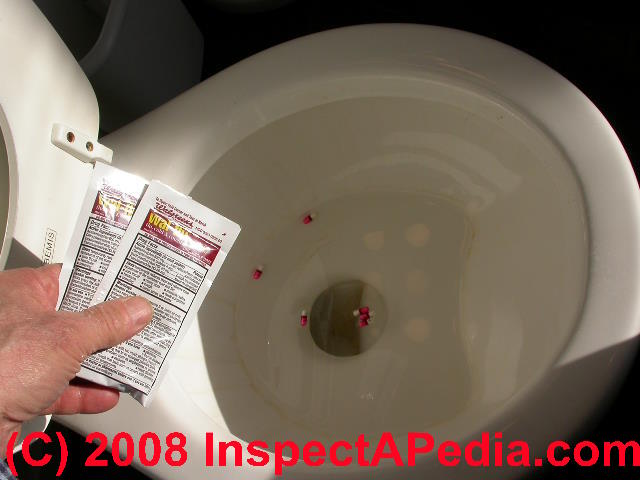
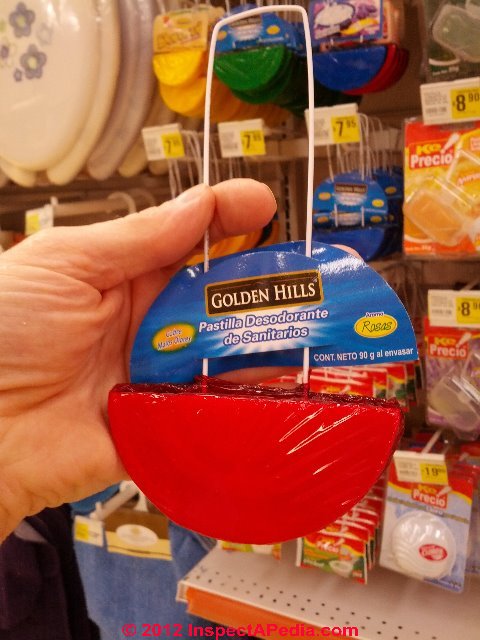
The tablet type toilet tank water deodorizer/flush-cleaner product such as the deodorizing hang-in-toilet-tank product shown in our photo above are discussed
at TOILET TABLETS: Are toilet tank cleaners that clean with every flush bad for the septic system?
Article List for what is ok or not ok to flush down your drains is given by the following detailed articles:
- TOILETS, DON'T FLUSH LIST
- NEVER FLUSH INTO SEPTICS - a list of the absolute "no-no's of things not to put down a drain or into a toilet.
- BETTER NOT TO FLUSH - things that you'd be better off not flushing down the drains
- CHEMICALS & CLEANERS into the SEPTIC TANK? - what household chemicals & cleaners are "ok" or "not OK" to put down drains
- CHEMICALS to KEEP OUT OF SEPTICS - other chemicals to keep out of septic systems
- CHLORINE IN DRINKING WATER - is this a problem for the septic system?
- CHLORINE IN SEPTIC WASTEWATER - where else does chlorine come from in a septic tank?
- DISHWASHERS vs SEPTICS - what is the effect on a septic system when we use a dishwasher
- DRUGS INTO the SEPTIC TANK? - what is the effect on the septic tank and drainfield if we dump unwanted drugs into the system?
- GARBAGE GRINDERS vs SEPTICS - is it OK to use a garbage disposal system at a house with a septic tank?
- REVERSE OSMOSIS CONCENTRATE WASTE DISPOSAL - what are the effects on the septic system of RO waste water concentrate
- SEPTIC TREATMENTS & CHEMICALS - are not required, not recommended, and in some jurisdictions are prohibited for conventional septic tank & soakaway bed systems and in some cases can cause damage to the system or can cause spread of contaminants in the environment.
Exceptions to the generally-true "use no septic treatments" can arise however for some advanced-design septic systems such as some aerobic or biologically-accelerated treatment (BAT) septic system designs.
See SEPTIC TANK BACTERIA BOOST - SEPTIC TREATMENT FAQs - questions & answers about the need for and usefulness of septic tank treatments, chemicals, enzymes, or drainfield/soakbed restorers
- SEWAGE PUMP DAMAGE & REPAIR - what things will clog or burn up a sewage pump - keep these out of your drains
- TOILET TISSUE CHOICES - is toilet paper a problem in septic tanks? Should we be using special bio-degradable toilet paper?
- WASHING MACHINES & SEPTIC SYSTEMS - what is the effect on the septic tank and drainfield if we use a washing machine?
- WATER SOFTENERS & CONDITIONERS - do water softeners harm the septic tank or drainfield? Is water softener salt a problem for the septic system?
- ** NO FLUSH SUMMARY LIST ** - printer friendly list of things that should not be flushed down the toilet
Chemical Contaminants Found in Residential Wastewater & Their Sources
 The focus of our "do not flush" advice provided in the article list above is practical: we list substances which are known to result in septic system blockage, clogging, failure, or contamination.
That more broad approach includes non-toxic materials such as coffee grounds and baby diapers or tampons, as our focus is on septic system maintenance and on preserving the proper functioning of the system piping as well as the health of the bacteria needed in the septic tank and in the absorption bed or soakaway bed to process various pathogens.
A very wide range of chemical contaminants can be found in residential wastewater, as a 1980 US EPA study documented in citing 129 contaminants that were targeted for survey.[3]
However the chief tables most often cited in that study don't address concentration levels nor drainfield effects, and the study pointed out the difficulties in surveying private homes and uses of products that can produce chemical contaminants in wastewater.
[Our photo (above left) illustrates a source of chemical contaminants: dumping photo-chemicals down the drain and into the septic system.]
Just below we provide some useful citations for further reading.
- [1] W.D. Robertson, "Chemical fate and transport in a domestic septic system: Site description and attenuation of dichlorobenzene", Environmental Toxicology and Chemistry, Volume 13, Issue 2, pages 183–191, February 1994 -
Abstract: The mobility and attenuation of dichlorobenzene (DCB) in a septic system groundwater contaminant plume with a very detailed monitoring network was evaluated by conducting a tracer experiment in which 450 ml of a plumbing line cleaner containing DCB and 1 kg NaBr were injected into the septic system.
DCB concentrations of up to 3,460 μg/L were observed in the septic tank effluent, up to 650 μg/L in the unsaturated zone 0.45 m below the tile bed, and up to 13 μg/L at the water table at 2 m depth.
Peak DCB concentrations arrived at the water table after 57 d at a source-normalized concentration of 0.02, whereas peak Br− concentrations arrived at the water table after only 10 d at a normalized concentration of 0.61, thus demonstrating DCB attenuation and retardation during migration through the aerobic unsaturated zone at this site.
Model simulations of DCB breakthrough at the water table provided an adequate fit with the field data when a retardation factor of 6.5 and decay half-life of 15 d were used.
Evidence for biodegradation of DCB was provided by the occurrence of a 7-d lag (biota acclimation period), after which increased attenuation of DCB was observed in the unsaturated zone and by the preferential attenuation of two of the three isomers of DCB.
Vigorous biodegradation of trace volatile organic compounds such as halogenated and substituted benzenes was indicated in the unsaturated zone below this septic system. - [2] William R. Walker, Carol J. Haley, Phyllis Bridgeman and Stephen H. Goldstein, "Effects of deodorants on treatment of boat holding-tank waste", Environmental Management, Volume 15, Number 3 (1991), 441-449, DOI: 10.1007/BF02393890
Abstract: A literature search and survey of Virginia, USA, campgrounds with RV pump-out stations were used to determine whether boat holding-tank deodorant chemicals would have deleterious effects on marina septic systems or package treatment plants.
Laboratory studies reported in the literature indicate that these chemical additives could affect septic system function in three ways:
(1) active ingredients in the additives can impair sewage degradation in septic tanks, causing sludge buildup and overflow of solids into the drainfield,
(2) additive chemicals might enter the drainfield and, in high enough concentrations, reduce the drainfield's ability to degrade waste, or
(3) toxic additive chemicals might migrate from the drainfield to ground or surface water.
Laboratory studies also show that some ingredients added to holding tanks interfere with functioning of activated sludge treatment process.
Experience in the field and in other laboratory studies suggests that factors such as dilution of treated waste with untreated waste and the characteristics of the sewage to be treated can reduce the possibility of damage to septic and activated sludge systems.
The campground owners surveyed indicated that they have few problems with their septic systems in spite of the presence of chemical additives in the RV waste.
However, most of them practice good septic system maintenance and have devised other means of ensuring that their systems function efficiently. In addition, the survey indicates that most Virginia campgrounds get only seasonal use (as would marinas in Virginia), allowing their systems to recover between peak seasons. - [3] U.S. EPA, "Sources of Toxic Compounds in Household Wastewater", EPA 600.2.80, August 1980 (Author: Steven W. Hathaway, Municipal Environmental Research Laboratory, Municipal Environmental Research Laboratory.
Wastewater Research Division) beginning on page 13 of that document (free from the EPA) lists 129 "target" toxic contaminants found in household wastewater along with their common sources. - Septic tank bacteria additives: exceptions to the generally-true "use no septic treatments" rule can arise however for some advanced-design septic systems such as some aerobic or biologically-accelerated treatment (BAT) septic system designs.
See SEPTIC TANK BACTERIA BOOST
...
Reader Comments, Questions & Answers About The Article Above
Below you will find questions and answers previously posted on this page at its page bottom reader comment box.
Reader Q&A - also see RECOMMENDED ARTICLES & FAQs
On 2021-04-27 by (mod) - don't dump commercial quantities of Castor Oil into the Septic Tank
 @Lorenzo,
That's a really interesting idea - pouring enough castor oil into a septic tank to repel Gophers digging in the drain field - but as you'll see below, when take a closer look you'll see that it's not a good idea.
Either you'll use too little castor oil to be effective or you'll use enough to be effective at an incredible cost and at the cost as well of ruining the septic fields.
Let's look at the soil-odorification idea in detail:
It seems to me that you would have to put so much castor oil into the septic tank in order two move to the leach field in any concentration that produces an odor that would repel animals that you'll be filling a good part of your septic tank with castor oil.
Using the retail price for castor oil you'll see typically $13. to $18. USD for a 16-ounce bottle. Calculations I illustrate below would require 8 bottles to make a gallon of castor oil, 2,000 bottles to make up 250 gallons, at a cost of about $30,000. USD.
Even buying castor oil in bulk (wholesale) you would be spending about $1,500 - $3500. on that speculative groundhog or gopher repellent soil-odor treatment
Watch out: There's also a high risk that you will clog the soil and put your septic field out of business. That in turn will be a costly repair.
I wouldn't do it.
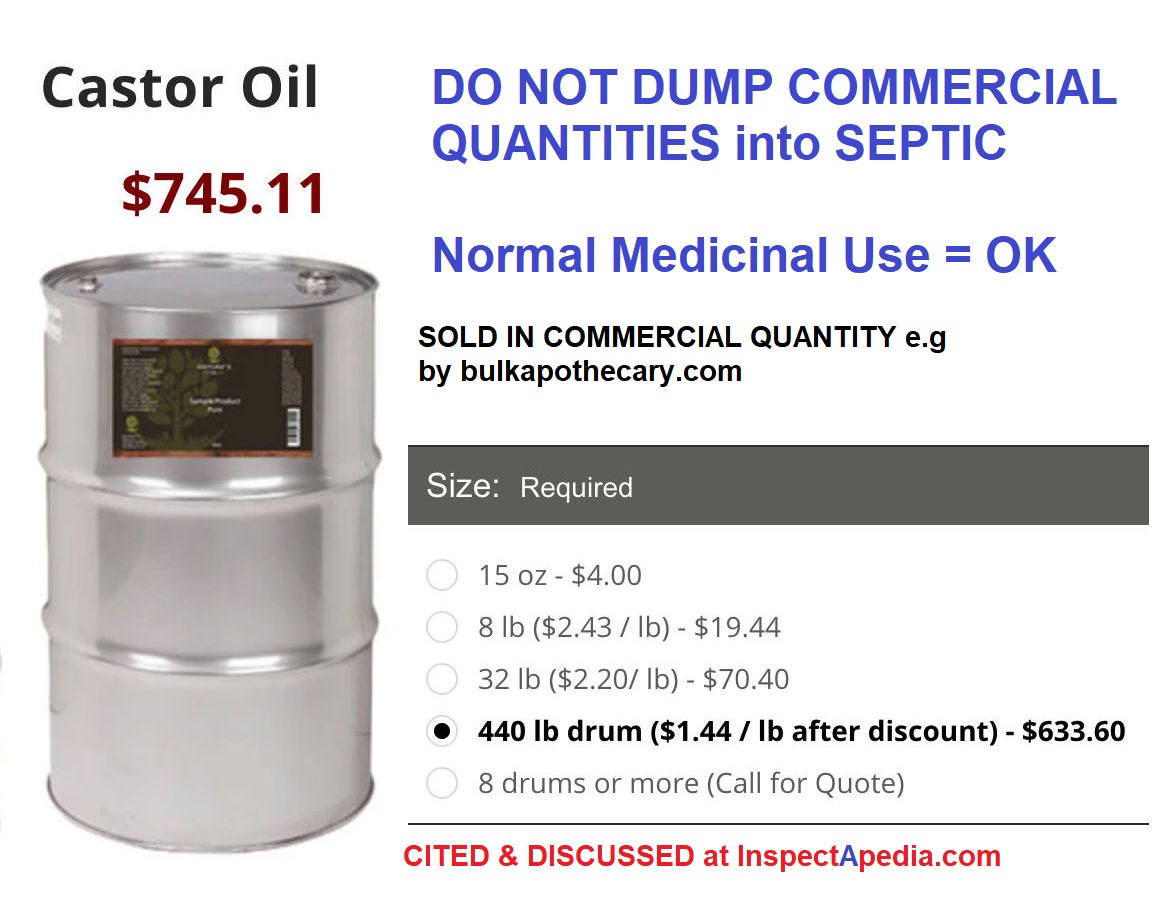
Continuing, here is an example of bulk purchase of large commercial volumes of castor oil, from Bulk Apothecary.
If we assume that your septic tank is a minimum of 1000 gallons and that you need to reach 25% concentration of castor oil to have a noticeable odor effect therein, you'd need 250 gallons of castor oil.
That's five 440 pound drums or 5 x $750 or about $3750. to buy that quantity at wholesale commercial rates.
Summarizing:
Do not dump commercial volumes of castor oil into your septic tank in an effort to repel groundhogs in nearby drainfield soils because
- you are likely to destroy the septic drainfield, requiring very expensive repairs, possibly tens of thousands of dollars
- the cost of the castor would in any event be prohibitive as a means of groundhog repellent, even if we could demonstrate that in the septic system its odor would effectively repel those pests
However it is perfectly acceptable to make **medicinal use ** of castor oil - that is, at the normal levels of human dosage, the amount of castor oil excreted in urine and feces and thus placed into the septic tank will be harmless to the septic system.
- Adults and children over 12 years of age - 1 to a maximum of 4 Tablespoons (15 to 60 mL) in a single daily dose. Source: U.S. NIH, "Castor Oil Liquid" https://dailymed.nlm.nih.gov/dailymed/drugInfo.cfm?setid=b29775df-8470-4fe3-bee3-f0490ea6903f
See details about controlling gopher and groundog pests at
On 2021-04-26 by Lorenzo - use castor bean oil to repel gophers & groundhogs?
I need to control gophers digging around my septic system. Use castor bean oil on the ground yo help control where they dig. I would like to put the castor oil in the septic so the oil can reach the leach lines and help keep the gophers from digging in and around the leach field. Want to know if the castor oil is septic safe. Folks that sold me the oil did not know.
On 2020-03-08 - by (mod) - dump wine in a septic?
Anon
The dose makes the poison. Emptying a single bottle of wine or even a couple of bottles into a residential septic tank would be harmless. On the other hand in a wine production facility entering any large volume of alcoholic liquid could kill the tank bacteria and therefore prevent the system from operating correctly.
On 2020-03-07 by Anonymous
Can you dump wine in a septic
On 2019-12-11 - by (mod) -
Tom
Sure, it's ok to dump a bottle or two of wine, home-made or otherwise, into a residential septic tank - typically down a sink drain or through a toilet.
However if you are a home-wine-maker with vats with many gallos of wine, do not empty that into a septic system. A too-high concentration of alcohol in the septic tank could cause at least temporary damage by killing off bacteria.
On 2019-12-11 by Tom
Can old homemade wine go into the septic system?
On 2019-10-10 by (mod) -
As long as you have working Inlet and Outlet baffles to prevent sending the sesame seeds out into the septic field it's not likely to be a problem. You'll simply remove those when the tank is pumped as the Seas will exit along with the floating grease and scum or solids that are removed during pumping
On 2019-10-09 by Kush
Hey guys, I own a property and a bagel shop moved in 3 months ago. We just inspected the tank and it has A LOT of sesame seeds. Would that negatively affect the tank? Hoe do you think I should solve this problem? Thanks!
On 2019-09-14 - by (mod) -
At normal household usage and wastage levels, coconut milk would be harmless and irrelevant to a septic system.
On 2019-09-13 by Kevin Barnes
Is coconut milk good or bad for the septic system ?
On 2019-08-27
- by (mod) -
Used in quantities of fractions of ounces no, an odorant won't harm the septic system in normal household use; however take care that some toilet bowl deodorizers and fresheners dispensed from the cistern or toilet tank can cause deterioration in rubber or plastic parts in the toilet flush and fill valve components.
On 2019-08-27 by Amanda
Will the essential oil based In-Bowl Toilet Fresheners used before going #2 be harmful to a septic system?
On 2019-03-23 by (mod) -
Yes - at normal household levels, expired soda or pop (carbonated soft drinks) won't harm a septic tank - but if you are a business or commercial establishment disposing of large volumes of expired sodapop I'd reconsider that advice.
On 2019-03-23 by Marc Rochefort
Can I flush expired pop into septic system?
...
Continue reading at NEVER FLUSH INTO SEPTICS or select a topic from the closely-related articles below, or see the complete ARTICLE INDEX.
Or see TOILET DONT FLUSH FAQs - questions & answers posted originally at the end of this article.
Or see these
Recommended Articles
- TOILET CLOG REPAIR, UN-BLOCK
- TOILETS, DON'T FLUSH LIST - home
- NEVER FLUSH INTO SEPTICS
- BETTER NOT TO FLUSH
- CHEMICALS & CLEANERS into the SEPTIC TANK?
- CHEMICALS to KEEP OUT OF SEPTICS
- CHLORINE IN SEPTIC WASTEWATER
- DISHWASHERS vs SEPTICS
- DRUGS INTO the SEPTIC TANK?
- GARBAGE GRINDERS vs SEPTICS
- GARBAGE GRINDERS on SEPTIC or SEWER
- * NO FLUSH SUMMARY LIST
- REVERSE OSMOSIS CONCENTRATE DISPOSAL
- RV HOLDING TANK DUMP INTO SEPTIC TANK?
- SEPTIC TREATMENTS & CHEMICALS
- SEWAGE PUMP DAMAGE & REPAIR
- TOILET TISSUE CHOICES
- WASHING MACHINES & SEPTIC SYSTEMS
- WATER SOFTENER IMPACT on SEPTIC
Suggested citation for this web page
TOILETS, DON'T FLUSH LIST at InspectApedia.com - online encyclopedia of building & environmental inspection, testing, diagnosis, repair, & problem prevention advice.
Or see this
INDEX to RELATED ARTICLES: ARTICLE INDEX to TOILET INFORMATION
Or use the SEARCH BOX found below to Ask a Question or Search InspectApedia
Ask a Question or Search InspectApedia
Questions & answers or comments about what things harm the septic system if flushed down toilets or other building drains
Try the search box just below, or if you prefer, post a question or comment in the Comments box below and we will respond promptly.
Search the InspectApedia website
Note: appearance of your Comment below may be delayed: if your comment contains an image, photograph, web link, or text that looks to the software as if it might be a web link, your posting will appear after it has been approved by a moderator. Apologies for the delay.
Only one image can be added per comment but you can post as many comments, and therefore images, as you like.
You will not receive a notification when a response to your question has been posted.
Please bookmark this page to make it easy for you to check back for our response.
IF above you see "Comment Form is loading comments..." then COMMENT BOX - countable.ca / bawkbox.com IS NOT WORKING.
In any case you are welcome to send an email directly to us at InspectApedia.com at editor@inspectApedia.com
We'll reply to you directly. Please help us help you by noting, in your email, the URL of the InspectApedia page where you wanted to comment.
Citations & References
In addition to any citations in the article above, a full list is available on request.
- New York State Department of Health, APPENDIX 75-A WASTEWATER TREATMENT STANDARDS - INDIVIDUAL HOUSEHOLD SYSTEMS , [PDF] New York State Department of Health, 3 February 2010, retrieved 3/1/2010, original source: https://www.health.ny.gov/regulations/nycrr/title_10/part_75/appendix_75-a.htm
- "Save the Septic System - Do Not Flush These Items Down the Toilet", Daniel Friedman, InspectAPedia.com - PDF document, printable reference card
- Watts Industries of North Andover, Mass., provides its ZRO-4 under counter system intended to target the independent water dealer market.
- In addition to citations & references found in this article, see the research citations given at the end of the related articles found at our suggested
CONTINUE READING or RECOMMENDED ARTICLES. - Percolation Testing Manual, CNMI Division of Environmental Quality, Gualo Rai, Saipan provides an excellent English Language manual guide for soil percolation testing. Original source: www.deq.gov.mp/artdoc/Sec6art108ID255.pdf
- Soil Test Pit Preparation, fact sheet, Oregon DEQ Department of Environmental Quality, original source www.deq.state.or.us/wq/pubs/factsheets/onsite/testpitprep.pdf The Oregon DEQ onsite water quality program can be contacted at 811 South Ave, Portland OR 97204, 800-452-4011 or see http://www.oregon.gov/DEQ/
- Thanks to reader Michael Roth for technical link editing 6/29/09.
- Septic Tank Pumping Guide: When, Why, How to pump the septic tank
- SEPTIC TANK/SOIL-ABSORPTION SYSTEMS: HOW TO OPERATE & MAINTAIN [PDF] - , Equipment Tips, U.S. Department of Agriculture, 8271 1302, 7100 Engineering, 2300 Recreation, September 1982, web search 08/28/2010, original source: http://www.fs.fed.us/t-d/pubs/pdfimage/82711302.pdf.
- Pennsylvania State Wastewater Treatment Fact Sheet SW-161, Septic System Failure: Diagnosis and Treatment
- Pennsylvania State Wastewater Treatment Fact Sheet SW-162, The Soil Media and the Percolation Test
- Pennsylvania State Wastewater Treatment Fact Sheet SW-l64, Mound Systems for Wastewater Treatment
- Pennsylvania State Wastewater Treatment Fact Sheet SW-165, Septic Tank-Soil Absorption Systems
- Document Sources used for this web page include but are not limited to: Agricultural Fact Sheet #SW-161 "Septic Tank Pumping," by Paul D. Robillard and Kelli S. Martin. Penn State College of Agriculture - Cooperative Extension, edited and annotated by Dan Friedman (Thanks: to Bob Mackey for proofreading the original source material.)
- In addition to citations & references found in this article, see the research citations given at the end of the related articles found at our suggested
CONTINUE READING or RECOMMENDED ARTICLES.
- Carson, Dunlop & Associates Ltd., 120 Carlton Street Suite 407, Toronto ON M5A 4K2. Tel: (416) 964-9415 1-800-268-7070 Email: info@carsondunlop.com. Alan Carson is a past president of ASHI, the American Society of Home Inspectors.
Thanks to Alan Carson and Bob Dunlop, for permission for InspectAPedia to use text excerpts from The HOME REFERENCE BOOK - the Encyclopedia of Homes and to use illustrations from The ILLUSTRATED HOME .
Carson Dunlop Associates provides extensive home inspection education and report writing material. In gratitude we provide links to tsome Carson Dunlop Associates products and services.
 | HOME | ABOUT | ASK a QUESTION | CONTACT | CONTENT USE POLICY | DESCRIPTION | POLICIES | PRIVACY | |
| © 2025 - 1985 Publisher InspectApedia.com - Daniel Friedman | |||||||||