
InspectAPedia® FREE Encyclopedia of Building & Environmental Construction, Diagnosis, Maintenance & Repair |
Question? Just ask us! InspectAPedia
|
 Using Septic Mounds as Components of Alternative Septic Systems for Difficult Sites

- POST a QUESTION or COMMENT about septic mound systems: design, installation, maintenance, diagnosis, repair
Mound septic system designs.
Mound Septic System design, install, maintain, repair: this document discusses the use of septic mound systems as an alternative septic system design. A septic mound is an engineered system involving fill to create a soil absorption system for the disposal of septic effluent.
Septic mound systems are used where local soils are not suitable for effluent disposal. In the sketch shown here, effluent is discharged to the septic mound by a pumping chamber. (Source: US EPA) Alternatively a septic mound, if suitably located, may be supplied effluent by gravity feed.
InspectAPedia tolerates no conflicts of interest. We have no relationship with advertisers, products, or services discussed at this website.
- Daniel Friedman, Publisher/Editor/Author - See WHO ARE WE?
What is a Septic Mound System?
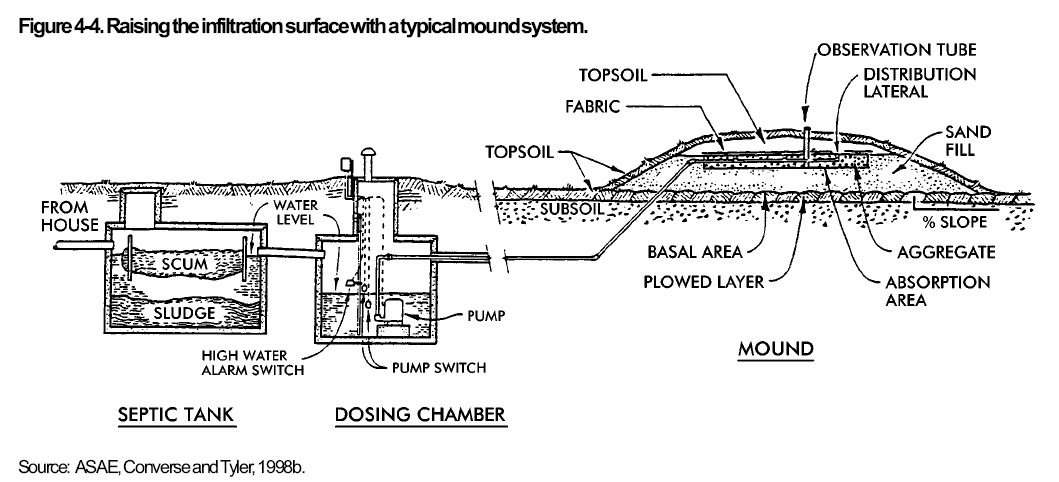 Mound Septic Systems are a wastewater absorption trench system which has been constructed using "suitable soil-fill material" which has been placed
on top of the natural soil on a building lot. Mound systems are often confused with "raised septic bed systems"
but have different design requirements, are generally smaller in total size, and depend on the fill material for successful wastewater treatment.
Mound Septic Systems are a wastewater absorption trench system which has been constructed using "suitable soil-fill material" which has been placed
on top of the natural soil on a building lot. Mound systems are often confused with "raised septic bed systems"
but have different design requirements, are generally smaller in total size, and depend on the fill material for successful wastewater treatment.
Raised bed septic systems are constructed in fill over soil which can accept septic effluent below the fill. Mound septic systems are constructed in fill over soil which does not acceptably treat septic effluent below the fill - all of treatment occurs in the mound.
Other requirements differ as well, as described, for example, in the New York standard for mound systems Appendix 75-A.9 reproduced below.
When are Septic Mound Systems Needed?
Site conditions such as sandy (permeable) soil with high groundwater levels, soils with poor percolation rate, and very rocky sites preclude installation of a conventional septic leach field as they lack adequate depth of proper soil in which effluent treatment could occur.
For these conditions, additional fill is brought to the site and installed in an area and depth sufficient that all of the effluent treatment occurs in the mound.
Effluent may enter the mound by gravity if site slopes permit, or effluent may have to be pumped up into the mound from a pumping station. In this latter case the pumping station would usually be in a second septic tank which receives clarified effluent from the primary tank.
Mound systems were developed by the North Dakota Agricultural College in the 1940's [Kahn, Allen, Jones cited at "More Information" below] with further studies of effective mound designs in the 1970's.
Common Septic Mound System Problems
Septic Mound Design Errors
Inspecting mound systems in New York State I have often seen improperly constructed mounds including efforts by the builder to save on fill cost by using the "mound" as a place to first pile up all of the trees and tree stumps which needed to be cleared from the site, covering this mess with a too-thin layer of fill soil in which the septic absorption trenches are installed.
The result is a mound system with a short life. If you see trees poking out from the perimeter of your mound further investigation may be in order. Also watch for effluent breakout around the bottom edges of the mound.
Improper mound siting is found at some properties where the builder fails to consider site runoff or natural groundwater paths.
One mound system was constructed using too little fill and placed over what had been a stream bed. My septic dye test very quickly produced red-dyed effluent at the low end of the mound where a seasonal stream continued to run under the mound in wet weather.
Placing a mound septic system on a steep slope, over a stream bed, over a natural drainage swale (photo of this defect), specifying an under-sized mound for the anticipated usage level, and poorly installed piping which does not slope properly or which becomes disconnected, and finally, use of improper soil which lacks the proper percolation rate all result in a costly installation with a too-short life.
What Will Cause Septic Mound or other Drain Field Damage
Traffic: As with any septic absorption system, heavy traffic over the mound can compress soil or break pipes, rendering the system inoperative and requiring costly repairs. At a recent inspection I found that the septic mound had been placed over a roadway connecting two properties owned by the same family.
Family members continued to drive back and forth between homes right over the septic mound. Its future life was rather doubtful. Driving vehicles over the septic mound or other drainfield, even for a single project such as construction of a nearby structure or performing other site work, is likely to damage the system and lead to need for costly repairs. Kahn et als. also advise keeping grazing animals, horses, cows, etc. off of mound systems.
Structures, Paving, Patios: Covering a septic mound, such as by installation of paving, a patio, or weed-blocking solid plastic, will damage the mound and prevent proper operation by blocking both oxygen intake into the soil and also evaporation of effluent from the soil top.
Blocking or sealing the ground surface will be a problem over just about any septic effluent absorption field. Don't build anything over a septic mound, no building, no fish pond, no patio, no tennis court, no parking area, no playground (compacts the soil).
Quick Guide to Planting Trees, Shrubs, and Ground Cover over Septic Mound Systems
Grasses, weeds, flower are OK: Many people have written to ask me what can be planted over a septic field.
The best answer is grass or native grasses and weeds. Flowers are ok so long as they are not varieties which send down deep roots. Basically, any shallow-rooting planting will be ok over the surface of a septic mound or over most other septic drainfields.
Stay away from trees or shrubs which are likely to put down deep roots. The roots will quickly invade and clog the buried effluent lines and may also cause them to move, break, or become disconnected.
Some experts (Kahn, Allen, Jones) also point out that if you're planting on the edges and lower toe of a septic mound, those plants need to be able to tolerate the higher moisture levels found in those parts of the mound system.
Trees are not OK: Kahn, Allen, Jones (book cited below) that trees such as bamboo, willow, eucalyptus, cypress, Monterey pine, pepper, and walnut have particularly aggressive and deep roots. Keep such trees at least 100 feet from the septic field.
Ivy, Pachysandra, Similar Ground Covers are not OK: because these plants will reduce effluent evaporation from the mound soils and because their roots often invade and clog effluent distribution piping.
Details are at PLANTS & TREES OVER SEPTIC SYSTEMS - home
Septic Mound System Installation Costs
In New York State a septic mound over rocky soil may cost double a conventional leach field even where a pumping station is not required. (Perhaps $15,000 to $20,000). Septic mounds require a larger area than leach fields in good soil.
If a pump station is required, some additional monitoring and maintenance is required, and of course if there is no electric power to run the pump, the size of the effluent holding tank will determine how many days of system operation are available in event of a power failure.
The following detailed specification for installation of a septic mound system is from: New York Appendix 75-A.9 Alternative Septic System Designs section 9.c Mound Septic Systems
Section 75-A.9 Alternative Septic Systems - © Mound Septic Systems Design Criteria

Photo above: Site work in preparation to construct a septic mound includes assuring good drainage of surface runoff away from the area where any type of septic effluent disposal system is to be constructed.
Title: Appendix 75-A.9 - Alternative Septic Systems [Regulation and System Design Criteria for Raised Septic Systems,
Septic Mound Systems, Intermittent Sand Filter Bed Systems, Evaporation-Transpiration Septic Systems,
Evaporation-Transpiration Absorption Septic Systems, and Other Alternative Septic Systems]
Effective Date: 12/01/1990
(1) General - Mound Septic Systems
A mound septic system (or septic mound system) is a soil absorption system that is elevated above the natural soil surface in a suitable fill material. It is a variation of the raised bed utilizing sandy fill material but not requiring a stabilization period prior to the construction of the absorption area.
On sites with permeable soils of insufficient depth to groundwater or creviced or porous bedrock, the fill material in the mound provides the necessary treatment of wastewater.
The overall size of the mound system will normally be substantially smaller than a raised bed.
[DF: Note: while they are similar in design "mound septic systems" discussed here are not identical to "raised septic systems" discussed at Raised Septics which have different site requirements.]
(2) Site Requirements for Mound Septic Systems
A mound system may be used where all the following conditions are found:
(i) The maximum high groundwater level must be at least one foot below the original ground surface.
(ii) Bedrock shall be at least two feet below the natural ground surface.
(iii) The percolation rate of the naturally occurring soil shall be faster than 120 minutes/inch.
(iv) The natural ground slopes shall not exceed 12%.
(v) All minimum horizontal separation distances can be maintained as described in Table 2.
(3) Design Criteria for Mound Septic Systems
(i) The designer shall consult with the health unit having jurisdiction regarding the method for detailing the hydraulic design.
(ii) The basal area of a mound system is defined differently than a raised bed. The basal area for a system on level ground includes all the area beneath the absorption trenches or bed and the area under the tapers.
Example Septic Mound Specifications & Site Limitations - Ohio OSU Fact Sheet Recommendations
Table 1-A* Comparison of site limitations for subsurface soil absorption systems and mound systems |
||
| Site Limitations on Drainfield or Soakaway Beds | Septic Mound System Specifications | Subsurface Soil Absorption System |
|---|---|---|
| Depth to limiting layer (inches) | At least 24" | At least 60" |
| Percolation rate (min/inch) | More than 3 min/in less than 120 min/in | More than 3 min/in, less than 60 min/in |
| Slope | Less than 15% grade | Less than 15% grade or slope |
|
||
Notes to the table above
* Table 1. is derived from Septic Tank - Mound System, AEX-744, [PDF] Karen Mancl, the Ohio State University Extgension Fact Sheet. We will add data to this table with examples of other septic mound system design specifications from other suggested sources.
CONTACT us with suggestions.
...
Table 1-B Septic Mound Effluent Disposal System Design Specifications |
||
| Septic Mound Site Characteristics | Slowly-Permeable Soils | Permeable Soils |
| Soil Percolation Rate 1 | 60 - 120 minutes per inch (mpi) | up to 60 mpi |
| Depth to bedrock or imperable soils | 60 inches | 60 inches |
| Slope or grade [original grade] | 6% or less | 12% or less |
| Depth to groundwater | over 24 inches | over 24 inches |
Notes to the table above
- Soil percolation test holes shall be 24" deep; if water is at 24 feet [below the mound bottom] percolation test holes shall be 16" deep.
- Also see SEPTIC SOIL & PERC TESTS Perc Tests or Deep Hole Testing for details about how to conduct soil percolation tests.
Sources:
- California septic system codes including this model: GLENN COUNTY CALIFORNIA SEWAGE DISPOSAL CODE [PDF] - 2.3MB PDF Table T-8, retrieved 2017/05/08, original source https://www.countyofglenn.net/sites/default/files/Environmental_Health/SewageDisposalRegulations.
Guide to Septic mound design notes for steep sloped sites
On a sloping site, the basal area includes only the area under the absorption trenches/bed and the lower or downhill taper. The basal area is designed upon the percolation of the naturally occurring soil. [Also see (iv) below for more steep slope design notes.]
Guide to Septic mound design notes for soils with too-fast percolation rates
Where the percolation rate is 60 min/in or faster, refer to TABLE 4B - SOIL APPLICATION RATES
- For soils of 61 to 120 min/in, a rate of 0.2 gpd/sq. ft. shall be used for determining the minimum basal area required.
- Also see SEPTIC TRENCH DEPTH SPECIFICATIONS where we give septic effluent disposal depths as a function of the slope or grade.
How soil percolation rates are tested for septic mound systems
(iii) Percolation tests for the [mound system] fill material shall be conducted at the borrow pit. Only soils with a percolation rate between five and 30 minutes per inch shall be used for the fill material. Sands with greater than 10% by weight finer than 0.05 mm material must be avoided.
At least 25% of the material by weight shall be in the range of 0.50 mm to 2.0 mm. Less than 15% of the material by weight shall be larger than a half-inch sieve. A sieve analysis may be necessary to verify this requirement. The required absorption area is based upon the percolation rate of the fill material as determined from Table 4B [link given above].
(iv) The [septic mound] system [effluent piping] shall be designed to run parallel with the contours of the site. The width of the system (up and down the slope) shall be kept to a minimum, but in no case shall the absorption area be wider than 20 feet. In a distribution network using a center pressure manifold, distribution lines shall have a maximum total length of 200 feet.
In a network septic system mound drainage bed using an end manifold, distribution lines shall have a maximum length of 100 feet.
(v) [Septic] Mound dimensions shall meet or exceed those required by the health unit having jurisdiction.
(vi) A [septic effluent] pressure distribution network shall be required.
(vii) A dual chamber septic tank or two tanks in series in addition to the dosing tank shall be provided [for network septic mound drainage bed or soakaway bed systems]
A gas baffle or other outlet modification that enhances solids retention is recommended [for septic mound pressure distribution systems]
(4) Construction Procedures for Mound Septic Systems

Above: a septic mound system under construction at a property in northern Minnesota. The contractor removed trees and fallen trees but left stumps in place (this helps keep the soil stable), and was bringing in suitable fill to construct the septic mound when these photos were taken.

(i) Heavy construction equipment shall not be allowed within the basal area and area downslope of the system which will act as the dispersal area for the mound.
(ii) The vegetation shall not be scraped away, roto-tilled, or compacted.
Excess vegetation shall be removed with trees cut at the ground surface but stumps left in place.
The area shall be plowed to a depth of seven or eight inches with a double bottomed blade/furrow plow and the furrow turned upslope.

(iii) The fill material is placed from the upslope side of the system to the full depth required in the design and shall extend to the edge of the basal area at a slope not to exceed one vertical to three horizontal.
(iv) The absorption area is then formed within the mound. A minimum of six inches of aggregate shall be placed beneath the distribution lines.
(v) The pressure distribution lines are placed parallel to the contours of the slope and a minimum of two inches of aggregate is placed above the lines.
(vi) A permeable geotextile is placed over the entire absorption area to prevent the infiltration of fines into the aggregate.
(vii) On sloping sites a diversion ditch or curtain drain shall be installed uphill to prevent surface water runoff from reaching the absorption area.
Curtain drains or intercept drains can protect septic drainfields in areas of wet soils or surface and subsurface groundwater
(viii) A minimum of six inches of finer materials such as clayey loam is placed over the top of the absorption area, and the entire mound including the tapers is then covered with six inches of top soil and seeded to grass.
Site Work: Integrating a Septic Mound Design onto an Existing Site: Getting Rid of the "Mound"
Question: How do I Get Rid of the Unsightly Mound in my Yard?
I built my home on low property which used to hold water. I had to have a mound system built per the local health department.
My question is now that I have this beautiful home, how can I get rid of the unsightly mound in my backyard? Are there any alternatives to the mound system? - Tim Murray
Answer: Bring in Fill to correct septic mound problems: warnings
There are many design alternative to septic mound systems, such as installing other advanced wastewater treatment systems, evaporation transpiration systems, and others. But these are costly and don't make sense if you already have a properly functioning, recently installed septic mound system.
In general, a "septic mound" is a raised septic bed intended to get septic effluent processing and disposal high enough above the local water table that you are not contaminating the environment.
In most septic mound designs nothing precludes bringing in still more fill so that the "mound" is more gracefully integrated into the rest of the site by adding fill around the mound perimeter, making the "mound" into a more gently sloped terrain feature.
Watch out: if you decide to add tons more soil to beautify the site around the mound, do not under any circumstances let the equipment operators drive over the septic mound, or it will almost certainly be destroyed. Also, don't add more soil on top of the mound - you may interfere with its proper operation.
Watch out:Furthermore you need to be sure that you have not interfered with surface runoff or surface drainage that needs to be directed away from the sepic mound, and you'll want to check with the original septic design engineer to be sure that your added fill doesn't interfere with the transpiration feature of the septic mound: by filling against the sides of a septic mound you may be reducing the original mound's ability to dispose of some effluent by evaporation.
Finally, while improving the contours of your home site, be sure that you make the final site grading design one that directs surface runoff and subsurface runoff away from the septic mound area. Directing groundwater onto the septic mound will prevent it from working and shorten its life.
Mound Septic Design Research & Specifications

Above: new septic mound is straw-covered; this amount of straw will help prevent erosion of the mound until grass has been established. But it is not enough straw to protect the new mound system from freezing.
- CURTAIN DRAINS or intercept drains can protect septic drainfields in areas of wet soils or surface and subsurface groundwater
- Gustafson, David M., James L. Anderson, Sara F. Heger, and Barbara W. Liukkonen. CHOOSING AN ALTERNATIVE SEPTIC SYSTEM FOR A HOMESITE WITH A HIGH WATER TABLE [PDF] (2000). University of Minnesota Extension, retrieved 2021/03/30 original source: https://conservancy.umn.edu/bitstream/handle/11299/94144/1/7571.pdf
This article discusses the use of a recirculating sand filter septic system.
See also SAND BED SEPTIC SYSTEMS - King County, WA, MOUND SEPTIC SYSTEM HOMEOWNERS MANUAL [PDF] King County/Seattle Washington, 14350 SE Eastgate Way, Bellevue WA 98007 USA, Tel: 206-477-8050, retrieved 2022/03/07
- King County, WA, SAND MOUND SEPTIC SYSTEM HOMEOWNERS MANUAL [PDF] King County/Seattle Washington, 14350 SE Eastgate Way, Bellevue WA 98007 USA, Tel: 206-477-8050, retrieved 2022/03/07
- Michigan - PRESSURE SEPTIC MOUND SYSTEMS [PDF] Technical Guidance for Site Suitability, Design, Construction and Operation and Maintenance, Michigan Department of Environmental Quality Water Division Land Division and Local Health Department Support Program
June 2003 retrieved 2019/08/27 original source: https://www.michigan.gov/documents/deq/deq-wb-dwehs-osw-mounds_240550_7.pdf
Excerpt: This technical guidance represents minimum standards for application of the described alternative method of sewage treatment and disposal for a development site less than one acre, subdivision lots, and site condominium units. - Ohio - SAND MOUND SEPTIC DESIGN SPECIFICATIONS [PDF] retrieved 2017/10/20, original source: http://www.odh.ohio.gov/
- Ohio - SEPTIC SEPARATION from SEASONAL HIGH WATER LEVEL [PDF] Drainage to manage the level of seasonal water in soils
Watch out: also see Bicki, T. J., and R. B. Brown. "ON-SITE SEWAGE DISPOSAL: THE IMPORTANCE OF THE WET SEASON WATER TABLE." [PDF] Journal of Environmental Health 52, no. 5 (1990): 277-279. - Simons, A. P., and F. R. Magdoff. Disposal of Septic Tank Effluent in Mound and Sand Filter‐Trench Systems on a Clay Soil. Vol. 8, no. 4. American Society of Agronomy, Crop Science Society of America, and Soil Science Society of America, 1979.
Abstract:
Small‐scale mound systems and conventional sand filter‐trench systems for disposal of septic tank effluent were established on a clay soil. During a wet year (1976), major differences in soil moisture patterns were observed between the two systems. Unsaturated flow of effluent occurred through the gravel/sand interface of the mound systems, although a slight pressure‐head buildup occurred at the bottom of the mound fill.
Conventional sand filter‐trench systems were under water throughout most of the 1976 monitoring season. However, when the dry conditions of 1977 allowed the water table to drop below 1.2 m, unsaturated conditions occurred below the gravel/sand interface of both the mound and sand filter systems.
Water tension patterns below the gravel/sand interface indicated development of the early stages of clogging (but not permanent ponding) in the mounds, while those within the sand filter‐trench system indicated the development of a restricting layer. Rejuvenation of the mound infiltrative surface occurred during the warm and dry 1977 spring and early summer.
Temperatures below the gravel/sand interface dropped to about −3°C during the winter in the mound systems, but stayed just above freezing in the sand filters.
A lack of snow accumulation on top of the mounds probably allowed the subzero temperatures.
...
Reader Comments, Questions & Answers About The Article Above
Below you will find questions and answers previously posted on this page at its page bottom reader comment box.
Reader Q&A - also see RECOMMENDED ARTICLES & FAQs
On 2021-07-29 by inspectapedia.com.moderator (mod) - clear tree falls off of septic mound - with care
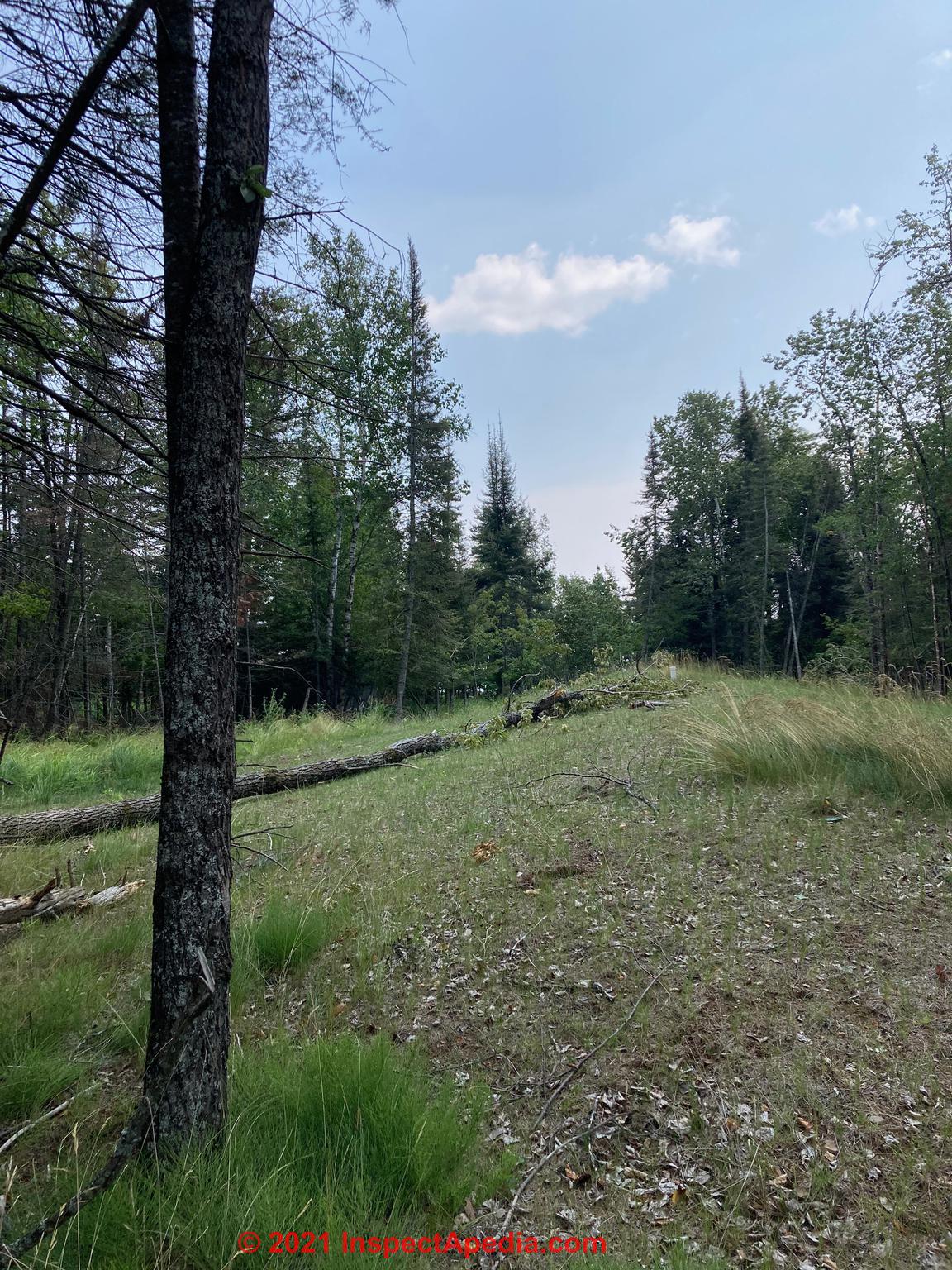 @Field Inspector K,
In my opinion, while it's not an emergency, you should clear fallen tree(s) from the septic mound for several reasons:
1. you can then inspect to be sure that no tree branch punctured and damaged one of the effluent lines - you'd want to repair that. Look for branches that speared into the soil, especially along the more-flat top of the mound area. Normally inspection ports will mark the location of each line.
2. you want to avoid further soil compression
3. you want to avoid the development of runoff channels that might over time erode the mound soil cover
but
Watch out: don't let some heavy handed bloke drive his backhoe or other heavy equipment over the mound for any reason, including tree removal, as doing so risks compressing the soil and damaging the mound.
Thanks for the helpful question and photo - we'll move this discussion to
MOUND SEPTIC SYSTEMS https://inspectapedia.com/septic/Septic_Mound_Design.php and welcome any further questions, comments, suggestions.
On 2021-07-29 by Field Inspector K
A medium-large tree fell on top of the septic mound system during a recent storm [photo above].
Should I worry about it lying there?
Would it damage the septic mound to just leave it there? It's too large for me to move by myself.
This Q&A appeared originally at TREES or SHRUBS OVER THE SEPTIC FIELD or TANK
On 2019-01-04 by (mod) - If the septic is backing up the cause may be:
If the septic is backing up the problem could be any of a number of issues such as
a failed drainfield that is clogged or saturated - not something that is ever fixed by pumping the septic tank
a blocked effluent line between tank and drainfield
damaged septic tank baffles or baffles that are missing - something that could be discovered during pumping
Ask your septic contractor to help diagnose the problem by inspecting the level of sewage in the tank, the condition of the baffles, and the occurrence of backflow of effluent into the septic tank during or after it was pumped out.
Also check the D-box effluent levels for signs of flooding.
On 2019-01-03 by yves
have a mound system .pumped out 6 months ago and told that we should have 2 yrs before next pump out but its already backing up in the house what do you think the problem is
On 2018-08-17 - by (mod) -
Anon the mound height can easily be 4 to six feet in height. Figure that the BOTTOM of the effluent trenches needs to be 24" or more above the seasonal high water table.
On 2018-08-17 by Anonymous
HOW high does a sand mountain on a septic
On 2017-08-24 - by (mod) -
Soil suitable for planting grass.
On 2017-08-24 by Bern
What type of soil would you use to topup mound
On 2017-05-23 - by (mod) -
Heather,
You may want to review the septic mound layout and site plan with your building or health department before raising an issue here. It might be that the size or area required to meet code for adequate capacity meant the mound wouldn't fit except diagonally.
On 2017-05-23 by Heather
We were shocked to find our septic mound placed diagonally across our back yard. The placement severely limits how we can use our yard. We were told that it HAS to be there. Before we were told that it was going to run along the side of the yard. Can this be true? It HAS to be in a particular spot? I thought we would have options. Our yard is ruined!
On 2016-08-09 by (mod) - Do you always need septic tanks pumped dry for septic repair work?
No, David, the requirement to pump out a septic tank completely for repair work depends on the repair needed. For example it MIGHT be possible to replace a damaged tank baffle by pumping the tank level down but not out completely.
The HAZARD is that simply leaning over a septic tank can be fatal: the worker can be overcome by methane fumes, faint, fall into the tank, and die. Those hazards are not reduced to zero even if a septic tank is pumped "dry" or "out" completely, as the gases remain.
That's why experts never work alone, wear protective equpment, and are not so stupid to do as one fellow I know who lit a cigarette while looking into the septic tank: he caused a methane gas explosion.
On 2016-08-09 by David
Do you always need tanks pumped dry for repair work?
Question: ok to flush toilet paper into a mound septic system?
(Mar 8, 2014) vswift said:
Very helpful information but I would like to know if there are any problems with flushing toilet paper.
Reply:
V.S. - if your septic tank is working properly and its baffles are intact it will keep any toilet paper in the septic tank and out of the drainfield. In that case flushing toilet paper is OK.
However often at older buildings with smaller-diameter or clog-prone building drains you may be requested to dispose of toilet tissue in a separate waste container rather than flushing it down the drain.
For a list of things that should not be flushed down building drains
Question: do mound septic systems need to be pumped?
(May 4, 2014) kay said:
Do mound systems need to be pumped same as conventional systems? Thank you
Reply:
Kay,
Thanks for the question. The answer is absolutely, yes. But let's be more clear. You don't pump the "mound" - the mound is a raised body of earth into which the septic tank's effluent is discharged for treatment and absorption into the soils.
What gets pumped or cleaned out periodically is the septic tank. Doing so extends the life of the septic mound by keeping the septic tank from becoming so full that it discharges solids along with the wastewater or under-treated wastewater into the mound.
See SEPTIC TANK PUMPING SCHEDULE
Question: our mound septic system is failing, what should we do next?
We just recently moved onto an acerage and over the winter we started having issues with our mound.. We had a blow out and at first the discharge was white and we called a septic guy and he gave us some active enzymes to add to out tank.. But now the discharge is black & white.. We have cut our water consumption in half (3 soon to be 4 people).. Is there anything at all be can do to fix this? - V.L. 6/16/2014
Reply:
V.L.:
No enzyme, no additive, no treatment that is legal is going to fix a failed septic mound. You would be better served giving that money to a charity rather than flushing it down the toilet.
See CHEMICALS & TREATMENTS for SEPTICS.
What's needed is a more careful diagnostic to discover just what's wrong: a broken or clogged pipe, or more costly, clogged soils and a failed absorption field.
At SEPTIC FIELD FAILURE CAUSES we list causes of field failures that may help you in diagnosis.
...
Continue reading at SEPTIC MOUND DESIGN SPECIFICATIONS or select a topic from the closely-related articles below, or see the complete ARTICLE INDEX.
Or see these
Recommended Articles
- RAISED BED SEPTIC SYSTEMS
- MOUND SEPTIC SYSTEMS
- SEPTIC MOUND DESIGN SPECIFICATIONS
- SEPTIC SYSTEM DESIGN ALTERNATIVES - home
- SEPTIC TANK & DRAINFIELD FREEZE PROTECTION
- TREES or SHRUBS OVER THE SEPTIC FIELD or TANK
Suggested citation for this web page
MOUND SEPTIC SYSTEMS at InspectApedia.com - online encyclopedia of building & environmental inspection, testing, diagnosis, repair, & problem prevention advice.
Or see this
INDEX to RELATED ARTICLES: ARTICLE INDEX to SEPTIC SYSTEMS
Or use the SEARCH BOX found below to Ask a Question or Search InspectApedia
Ask a Question or Search InspectApedia
Try the search box just below, or if you prefer, post a question or comment in the Comments box below and we will respond promptly.
Search the InspectApedia website
Note: appearance of your Comment below may be delayed: if your comment contains an image, photograph, web link, or text that looks to the software as if it might be a web link, your posting will appear after it has been approved by a moderator. Apologies for the delay.
Only one image can be added per comment but you can post as many comments, and therefore images, as you like.
You will not receive a notification when a response to your question has been posted.
Please bookmark this page to make it easy for you to check back for our response.
IF above you see "Comment Form is loading comments..." then COMMENT BOX - countable.ca / bawkbox.com IS NOT WORKING.
In any case you are welcome to send an email directly to us at InspectApedia.com at editor@inspectApedia.com
We'll reply to you directly. Please help us help you by noting, in your email, the URL of the InspectApedia page where you wanted to comment.
Citations & References
In addition to any citations in the article above, a full list is available on request.
- New York State Department of Health, APPENDIX 75-A WASTEWATER TREATMENT STANDARDS - INDIVIDUAL HOUSEHOLD SYSTEMS , [PDF] New York State Department of Health, 3 February 2010, retrieved 3/1/2010, original source: https://www.health.ny.gov/regulations/nycrr/title_10/part_75/appendix_75-a.htm
- Thanks to reader Tim Murray for discussing septic mound site improvement approaches - July 2010.
- Septic Tank - Mound System, AEX-744, Karen Mancl, the Ohio State University Extgension Fact Sheet, web search 09/10/2010, original source: http://ohioline.osu.edu/aex-fact/0744.html
- "International Private Sewage Disposal Code," 1995, BOCA-708-799-2300, ICBO-310-699-0541, SBCCI 205-591-1853, available from those code associations.
- "Manual of Policy, Procedures, and Guidelines for Onsite Sewage Systems," Ontario Reg. 374/81, Part VII of the Environmental Protection Act (Canada), ISBN 0-7743-7303-2, Ministry of the Environment,135 St. Clair Ave. West, Toronto Ontario M4V 1P5 Canada $24. CDN.
- Manual of Septic Tank Practice, US Public Health Service's 1959.
- Onsite Wastewater Treatment Systems, Bennette D. Burks, Mary Margaret Minnis, Hogarth House 1994 - one of the best septic system books around, suffering a bit from small fonts and a weak index. (DF volunteers to serve as indexer if Burks/Minnis re-publish this very useful volume.)While it contains some material more technical than needed by homeowners, Burks/Minnis book on onsite wastewater treatment systems a very useful reference for both property owners and septic system designers. We refer to it often.While Minnis says the best place to buy this book is at Amazon /A>
- Septic Tank/Soil-Absorption Systems: How to Operate & Maintain, Equipment Tips, U.S. Department of Agriculture, 8271 1302, 7100 Engineering, 2300 Recreation, September 1982, web search 08/28/2010, original source: http://www.fs.fed.us/t-d/pubs/pdfimage/82711302.pdf
- US EPA ONSITE WASTEWATER TREATMENT SYSTEMS MANUAL Top Reference: US EPA's Design Manual for Onsite Wastewater Treatment and Disposal, 1980, available from the US EPA, the US GPO Superintendent of Documents (Pueblo CO), and from the National Small Flows Clearinghouse. Original source http://www.epa.gov/ORD/NRMRL/Pubs/625R00008/625R00008.htm
- The NSFC Products List has an excellent list of design manuals/modules National Small Flows Clearinghouse (NSFC) now (2019/12/13) hosted at http://www.nesc.wvu.edu/ Tel: 304-293-4191 e-mail info@mail.nesc.wvu.edu.
he National Small Flows Clearinghouse (NSFC) was funded by the U.S. Environmental Protection Agency (EPA) to help America's small communities and individuals solve their wastewater problems through objective information about onsite wastewater collection and treatment systems. NSFC products and information are the only national resource of its type, dealing with small community wastewater infrastructure. or by telephone 800-624-8301 - In addition to citations & references found in this article, see the research citations given at the end of the related articles found at our suggested
CONTINUE READING or RECOMMENDED ARTICLES.
- Carson, Dunlop & Associates Ltd., 120 Carlton Street Suite 407, Toronto ON M5A 4K2. Tel: (416) 964-9415 1-800-268-7070 Email: info@carsondunlop.com. Alan Carson is a past president of ASHI, the American Society of Home Inspectors.
Thanks to Alan Carson and Bob Dunlop, for permission for InspectAPedia to use text excerpts from The HOME REFERENCE BOOK - the Encyclopedia of Homes and to use illustrations from The ILLUSTRATED HOME .
Carson Dunlop Associates provides extensive home inspection education and report writing material. In gratitude we provide links to tsome Carson Dunlop Associates products and services.
 | HOME | ABOUT | ASK a QUESTION | CONTACT | CONTENT USE POLICY | DESCRIPTION | POLICIES | PRIVACY | |
| © 2025 - 1985 Publisher InspectApedia.com - Daniel Friedman | |||||||||