
InspectAPedia® FREE Encyclopedia of Building & Environmental Construction, Diagnosis, Maintenance & Repair |
Question? Just ask us! InspectAPedia
|
 Cold or Wet Weather Sewage or Septic Odors
Find & Fix the Source of Sewer/Septic Smells
- POST a QUESTION or COMMENT about diagnosing the source of septic or sewer odors in cold weather
Cold-weather-related sewer or septic system odors:
This article describes how to diagnose and correct sewer gas or septic odors (and other building smells and odors with focus on diagnosing odor sources and causes in cold weather.
This article on diagnosing sewer gas or septic odors is a special cold-weather edition of our more general advice on finding and curing sewage odor problems.
Here we focus on sewage or septic odor problems that occur during cold weather or wet weather. We also discuss causes and cures for sewer gas odors related to wet or cold weather. We include questions & Answers on tracking down cool weather and night time sewer gas / septic tank smells.
InspectAPedia tolerates no conflicts of interest. We have no relationship with advertisers, products, or services discussed at this website.
- Daniel Friedman, Publisher/Editor/Author - See WHO ARE WE?
Sewer Gas Odor Tracking by Site Location and Season or Weather
 Article Series Contents
- SEWER GAS ODORS in COLD / WET WEATHER
- SEWER GAS ODOR COLD / WET WEATHER FAQs
- PLUMBING VENT BLOCKAGE ODORS
- TRACK DOWN COLD WEATHER SEWER ODORS
- SEWAGE ODOR SOURCE LOCATION
Where on the property are odors strongest?
you may be able to point to a waste line, building exit piping, leaks at a septic tank, drainfield failure, or even a neighbor's septic system problem.
- Downdrafts causing odors?
Cold weather can cause downdrafts from a building plumbing vent stack - if this is the case the odors would probably vary by wind conditions and would probably subside as the day warms up; look for nearby plumbing stacks above the area of odor. - Frozen septic systems causing odors?
If a septic system is backing up due to a failed (or frozen solid) drainfield, sewer gases may be pushed back into the home even before there is an actual sewage backup (this is unusual but possible. usually a sewage backup is not far off.)
If the system is clogged, such as a clogged waste line, blocked septic tank inlet or outlet line or baffle (in the tank), or failed drainfield, and if the system is in common daily use by one or more people, you'd expect that the system would soon backup, forcing drains to back up with sewage, starting at the lowest drain in the building - look there. - Long persistent odors?
If odors have persisted for some time, and no drains are backing up, it's unlikely that the septic system drain field is blocked. Still if the septic system is in failure, such as a failed drainfield, one common failure mode is that septic effluent is coming to the surface - which will mean outside smells.
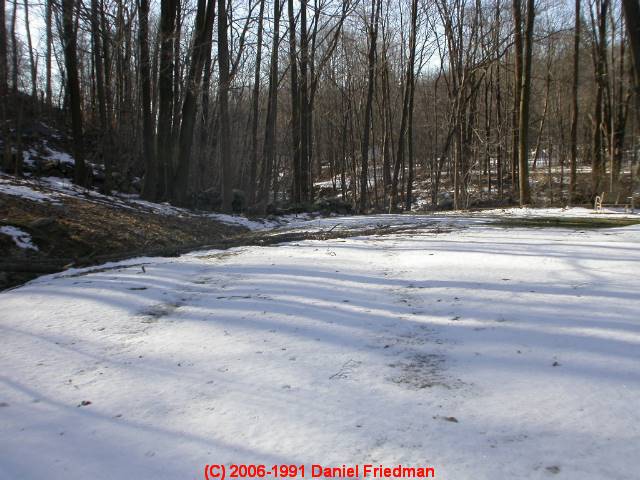
Look for a wet area, possibly covered by snow in northern climates - kick the snow aside in a grid pattern over the septic system components (don't' fall into a collapsing septic system - it can be fatal).
Look for areas where snow has melted to a thinner cover. This can occur in a normal system (bacterial action in the soil over the septic system and warm septic effluent carry heat out of the septic tank). But it can also be a clue of sewage effluent coming to the surface. Check such areas for effluent.
If a waste line is blocked or partly blocked and the odors are near the house,
such as at the house wall at the waste line exit point, effluent could be running along the buried pipe but outside it, having leaked from a damaged pipe at the wall, between the wall and the septic tank, or at the tank itself there could be an effluent leak where the line enters the tank, or at the tank cleanout top cover (which would indicate a blocked tank outlet or blocked drainfield).
Effluent will follow a buried pipe because it runs in a trench dug in the soil
the pipe and backfill in the trench are less solidly packed than in the surrounding soil - the trench acts as a conduit to bring sewage effluent to the house if the trench is filling with liquid.
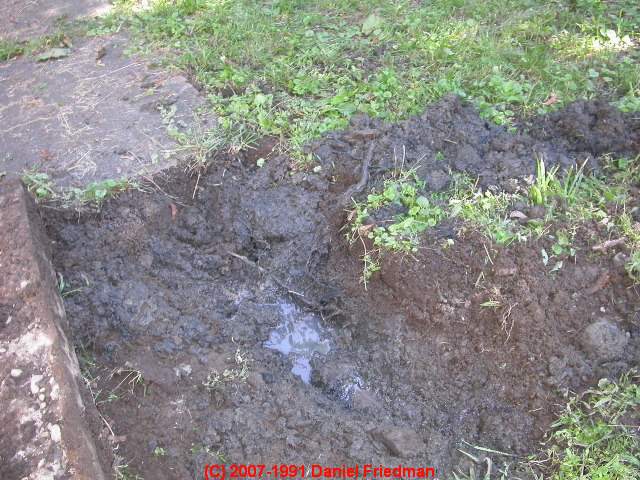 Broken pipe leaks may be mistaken for ground water leaks:
At left we show a broken sewer pipe found by lifting a section of sidewalk in a soft smelly area of the yard.
At a different property where basement paneling was removed following "a history of basement water entry from 'rising ground water' (according to the basement de-watering company)" a company had installed an expensive interior trench and drain system and sump pump to pump the "ground water" away.
We saw an inverted "vee" of leak stains on the basemen wall extending from below the main waste line where it exited the building.
It was obvious that the water entry had been not from rising ground water but from a broken leaking waste line outside the wall. Sure enough, our septic dye appeared in the new basement trench and drain system in just a few minutes.
The basement de-watering system had not been needed at this home, and the owner still needed to have the broken waste line excavated and repaired.
Look for leaks at a waste line,
perhaps first by having a plumber snake the line from inside the building to see if s/he feels evidence of a broken or collapsing or damaged pipe between the house and the septic tank.
See SEWER LINE REPLACEMENT (includes How to Find Distance to Drain Blockage)
If the drain field is saturated or blocked, expect to find abnormally high sewage level in the septic tank, possibly even backing up and flowing out when the tank is opened, and possibly also evident at the distribution box.
See SEPTIC TANK INSPECTION PROCEDURE
...
Reader Comments, Questions & Answers About The Article Above
Below you will find questions and answers previously posted on this page at its page bottom reader comment box.
Reader Q&A - also see RECOMMENDED ARTICLES & FAQs
How do I fix a winter sewer smell in my house
Every winter for the past 7 years I have a sewer smell in my house. I don’t know if it’s a coincidence but it started the winter after we remodeled the outside of our house.
We had a steeper pitch roof put on and I’m wondering if the smell is coming from a downdraft on the vent. The smell is strongest in an entrance closet closest to one of the bathrooms and to the outside part of the house.
My husband always fixed things, but he was diagnosed with cancer at the end of the remodel and passed away four years later.
I have no idea who to even call, but I’d love to fix this problem. I know it’s not an LP gas leak because the smell started to smell before I turned on my heat this year. Any help is greatly appreciated. - On 2022-10-16 by Debbie -
Reply by InspectApedia (Editor) - steps to diagnose sewer smell in my house in winter, but after remodelling
@Debbie,
Particularly in winter, when, if my surmise is accurate, your home's windows are closed, if you smell sewer gas indoors, the problem is not so likely to be due to roof pitch and outdoor wind conditions that might cause an outdoor down-draft of odors from the rooftop plumbing vent.
But as you'll read above on this page, the colder temperatures of winter can explain why some odors appear only in cold weather.For example, if there were a leaky plumbing vent connection in the walls of your home (in that entry closet wall?) it might be that only in winter when outdoor air is cold, might rising sewer gases in the vent system spill out of a leaky joint rather than rising by convection and exiting at the rooftop.
A clue in your question is that the odor started after a remodel job. So here are some specific diagnostic questions:
- Did the remodeling job add to or move or change any plumbing fixtures, drain piping or vent piping?
- Did the painter or drywall contractor flush paint or drywall debris down a drain when cleaning up after their work?
- What else changed in or at your home during the remodeling?
A plumber can pressure test your drain and vent system for leaks, but before going to that expense I'd first check the more-obvious sewer gas smell sources like a loose toilet, bad toilet wax ring (are odors strong if someone, on hands and knees, sniffs near the base of the toilet?), or from a dry plumbing trap in that nearby bathroom (does the odor dissipate if you run some water into each of the traps?).
Watch out: don't assume that there could be no fuel gas leak just because you have not yet turned on your heat.
Fuel gas leaks (LP or natural gas) can be present anywhere in the gas piping system, and might be noticeable only in cold weather when the building is less ventilated.
Bad smell in one bathroom after shower is used
We have a horrible smell like dirty diapers and almost hurts a bit to breathe that happens after the shower is used in one bathroom and only during cold weather.
The smell completely disappears during spring and summer and didn't start up again until we started needing to turn on the heat (like when it hit below 60 degrees outside but not freezing temps.)We can smell it coming from the shower drain but we also sometimes smell it in other areas likely the wall behind the toilets.
The master bathroom is on the other side of this bathroom and has a window that we have to keep open at all times during winter or smells back up in there too.
We've tried everything so far: septic pump, adding vents to plumbing in basement, putting hose down vent pipe on roof to wash out anything that might be in there (black water backed up in sinks, is that a clue?), adding sweet air filter to vent pipe (made it worse so we took it off), vinegar/baking soda down all the drains, draino in case of clogged pipes.
The house was built in 1967 and does not have PVC. We're on a septic and well. Looking for any possible solutions and I'm scared it may be a damaged vent pipe in the walls. - On 2021-11-29 by Melissa -
Reply by Inspectapedia Com Moderator - inspection of the sewer piping and vent piping using a sewer line camera
@Melissa,
I suspect that the drain or vent for that bathroom has been plugged or is leaking.
An inspection of the sewer piping and vent piping using a sewer line camera might be worthwhile and also a review of the buildings leak history to address the question of whether there could be mold contamination in a wall floor or ceiling cavity
On 2021-10-25 by Jeremy - Plumber can't figure out cause of intermittent sewage odors in bathrooms
Hello,
We just built a new house this year and we have had intermittent sewage smells in the bathrooms that our plumber has been unable to figure out. The plumbing passed inspection and the pressure test.
We run water in all the drains once a week to ensure traps have water. It started in our master toilet shortly after we moved in and was strong when it rained. They replaced a gasket on toilet and that seemed to fix it for a bit. It then moved to our half bath located on main floor.
They then replaced and reset every gasket in every toilet in the house. The smell then seemed to come in the morning time from about 7 am till noon. The plumbers then inspected our propane lines for any small leaks. Found small ones but that also did not fix the problem permanently.
Now the smell is on the 2nd floor bathroom and I have not been able to find anything that drives the smell (ie rain, cold etc). I am out of ideas as is the plumber. Thought maybe I'd give this forum a try since I am losing my mind lol. Thanks!
On 2021-10-25 by inspectapedia.com.moderator - moving around odor source - try a rooftop wind deflector on plumbing vent?
@Jeremy,
I agree that a moving around odor source is difficult to diagnose.
You might look for causes of building air currents and door transport in your home such as is air conditioning or heating duct system that can pick up an order from one place and transported to another.
That can account for a remote and undetected odor source.
You might also check to be sure that the odors are only indoors and not outdoors. Outdoors you might look at site conditions including wind direction and downdrafts from the rooftop plumbing vents.
If a pressure test on the Beltline found no leaks then it's probably not worth any invasive inspecting methods such as cutting up on a wall or ceiling to check the routing of the vent line.
You're on site people respond to look for other odor sources as well, ones that may have nothing to do with the plumbing system.
Sometimes a sensitive gas detection instrument can help pinpoint an order source.On 2021-10-25 by Jeremy
@inspectapedia.com.moderator, Thanks for the quick response! You mentioned a wind-operated elbow that keep vends open facing down wind in another response. We have lots of wind out here on the farm, so I was wondering if you could tell me what kind of fitting that was or where we could buy one? Thanks!
On 2021-10-25 by inspectapedia.com.moderator
@Anonymous,
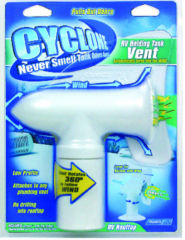
Look for a high-wind cap for plumbing vents or a plumbing vent wind diverter; an example is made by Camco, their "Camco Cyclone Plumbing Vent " often used on RV plumbing system vents and shown below.
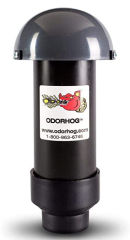
Also see products like the OdorHog sewer vent or plumbing vent cap claiming to prevent odorous downdrafts from rooftop plumbing vents;
You'll see that the manufacturers of ALL of these outdoor efforts to stop downdrafting sewer gas odors from an outdoor or rooftop plumbing vent take care to warn you that these products address outdoor sewer gas odors, not in door sewage or sewer gas odors.
On 2021-10-27 by Jeremy
@inspectapedia.com.moderator, we just purchased on amazon. I will let you know if we see improvement. Thanks!
On 2021-10-27 by inspectapedia.com.moderator
@Jeremy
Great, that will help other readers.
About tracking down indoor odors, the rooftop vent is not a likely source unless
- it is not properly plumbed, sealed, connected as it passes up through the building
or
- there are downdrafts of outdoor air containing sewer gas that also leak into the building interior
But a deflector or other plumbing vent device (such as an odor filter) can reduce outdoor odors of downdrafting sewer gases.
On 2021-10-04 by Michelle Dolloff - Bathroom closest to lagoon septic smells bad
We have a lagoon and our bathroom closest to it has sewer smell recently. Could it be because of the lagoon if so what do we need to do?
On 2021-10-04 by inspectapedia.com.moderator - is lagoon cause of sewer smell
@Michelle Dolloff,
First, be sure you've reviewed the lagoon septic system maintenance requirements found
since a failing lagoon septic OR a backup of wastewater from that septic system could cause odor problems.
It would be helpful to know what country, state, city you are in as weather and climate can make a difference. If the smell is a new problem and the lagoon has always been there, it may be from another source.
Also, if a sewer gas odor seems specific to just one area in the home one could suspect a clogged drain, inadequate vent piping, or a loose toilet or leaky vent line or leaky drain line.
We list several possible sources to review and rule out if possible at this page:
TRACK DOWN HARD-TO-FIND SEWER GAS ODORS IN BUILDINGS
Plumbing Vent Blockage Problems as a Source of Building Smells, Septic or Sewage Odors
This topic has moved to PLUMBING VENT BLOCKAGE ODORS - separate article
PlumbingTrap Siphonage, Dry Plumbing Traps, Sewer Gas Leaks & Freezing Weather-Related Plumbing Vent Problems
This discussion is now at TRAP SIPHONAGE & SEWER GAS
How to Find & Fix Sources of Septic Odors that Occur in Cold Weather
This topic moved to TRACK DOWN COLD WEATHER SEWER ODORS - separate article
Tips for Tracking Down Hard-to-Find Sewer Gas Odors in buildings
Please see SEWAGE ODOR SOURCE LOCATION - other Sources of Sewer Gas or Methane Gas Odors in buildings
...
Continue reading at SEWER GAS ODOR REMEDIES or select a topic from the closely-related articles below, or see the complete ARTICLE INDEX.
Or see SEWER GAS ODOR COLD / WET WEATHER FAQs - questions & answers posted originally at this page
Or see these
Recommended Articles
- SEWAGE PUMP ODORS
- SEWER GAS ODORS - home
Suggested citation for this web page
SEWER GAS ODORS in COLD / WET WEATHER at InspectApedia.com - online encyclopedia of building & environmental inspection, testing, diagnosis, repair, & problem prevention advice.
Or see this
INDEX to RELATED ARTICLES: ARTICLE INDEX to DRAIN SEPTIC SEWER PIPES
Or use the SEARCH BOX found below to Ask a Question or Search InspectApedia
Ask a Question or Search InspectApedia
Try the search box just below, or if you prefer, post a question or comment in the Comments box below and we will respond promptly.
Search the InspectApedia website
Note: appearance of your Comment below may be delayed: if your comment contains an image, photograph, web link, or text that looks to the software as if it might be a web link, your posting will appear after it has been approved by a moderator. Apologies for the delay.
Only one image can be added per comment but you can post as many comments, and therefore images, as you like.
You will not receive a notification when a response to your question has been posted.
Please bookmark this page to make it easy for you to check back for our response.
IF above you see "Comment Form is loading comments..." then COMMENT BOX - countable.ca / bawkbox.com IS NOT WORKING.
In any case you are welcome to send an email directly to us at InspectApedia.com at editor@inspectApedia.com
We'll reply to you directly. Please help us help you by noting, in your email, the URL of the InspectApedia page where you wanted to comment.
Citations & References
In addition to any citations in the article above, a full list is available on request.
- Herb Reed County Extension Director, Agricultural and Natural Resources Educator, Calvert County Maryland - private email to DF 9/5/2006 adding comments about odors and partial blockages.
- Onsite Wastewater Disposal, R. J. Perkins; Quoting from Amazon: This practical book, co-published with the National Environmental Health Association, describes the step-by-step procedures needed to avoid common pitfalls in septic system technology. Valuable in matching the septic system to the site-specific conditions, this useful book will help you install a reliable system in both suitable and difficult environments. Septic tank installers, planners, state and local regulators, civil and sanitary engineers, consulting engineers, architects, homeowners, academics, and land developers will find this publication valuable.
- Onsite Wastewater Treatment Systems, Bennette D. Burks, Mary Margaret Minnis, Hogarth House 1994 - one of the best septic system books around, suffering a bit from small fonts and a weak index. While it contains some material more technical than needed by homeowners, Burks/Minnis book on onsite wastewater treatment systems a very useful reference for both property owners and septic system designers.
- Advanced Onsite Wastewater Systems Technologies, Anish R. Jantrania, Mark A. Gross. Anish Jantrania, Ph.D., P.E., M.B.A., is a Consulting Engineer, in Mechanicsville VA, 804-550-0389 (2006). Outstanding technical reference especially on alternative septic system design alternatives. Written for designers and engineers, this book is not at all easy going for homeowners but is a text I recommend for professionals--DF.
- Country Plumbing: Living with a Septic System, Hartigan, Gerry: $ 9.95; ALAN C HOOD & TP; Quoting an Amazon reviewer's comment, with which we agree--DF
- Septic System Owner's Manual, Lloyd Kahn, Blair Allen, Julie Jones, Shelter Publications, 2000 $14.95 U.S. - easy to understand, well illustrated, one of the best practical references around on septic design basics including some advanced systems; a little short on safety and maintenance. Both new and used (low priced copies are available, and we think the authors are working on an updated edition--DF.
Quoting from one of several Amazon reviews:
The basics of septic systems, from underground systems and failures to what the owner can do to promote and maintain a healthy system, is revealed in an excellent guide essential for any who reside on a septic system. Rural residents receive a primer on not only the basics; but how to conduct period inspections and what to do when things go wrong. History also figures into the fine coverage. - Test Pit Preparation for Onsite Sewage Evaluations, State of Oregon Department of Environmental Quality, Portland OR, 800 452-4011. PDF document. We recommend this excellent document that offers detail about soil perc tests, deep hole tests, safety, and septic design. Readers should also see SEPTIC SOIL & PERC TESTS and for testing an existing septic system, also see Dye Tests
- US EPA ONSITE WASTEWATER TREATMENT SYSTEMS MANUAL Top Reference: US EPA's Design Manual for Onsite Wastewater Treatment and Disposal, 1980, available from the US EPA, the US GPO Superintendent of Documents (Pueblo CO), and from the National Small Flows Clearinghouse. Original source http://www.epa.gov/ORD/NRMRL/Pubs/625R00008/625R00008.htm
- Water Wells and Septic Systems Handbook, R. Dodge Woodson. This book is in the upper price range, but is worth the cost for serious septic installers and designers. Quoting Amazon: Each year, thousands upon thousands of Americans install water wells and septic systems on their properties. But with a maze of codes governing their use along with a host of design requirements that ensure their functionality where can someone turn for comprehensive, one-stop guidance? Enter the Water Wells and Septic Systems Handbook from McGraw-Hill.
Written in language any property owner can understand yet detailed enough for professionals and technical students this easy-to-use volume delivers the latest techniques and code requirements for designing, building, rehabilitating, and maintaining private water wells and septic systems. Bolstered by a wealth of informative charts, tables, and illustrations, this book delivers:
* Current construction, maintenance, and repair methods
* New International Private Sewage Disposal Code
* Up-to-date standards from the American Water Works Association
- Wells and Septic System, Alth, Max and Charlet, Rev. by S. Blackwell Duncan, $ 18.95; Tab Books 1992. We have found this text very useful for conventional well and septic systems design and maintenance --D>
- The NSFC Products List has an excellent list of design manuals/modules National Small Flows Clearinghouse (NSFC) now (2019/12/13) hosted at http://www.nesc.wvu.edu/ Tel: 304-293-4191 e-mail info@mail.nesc.wvu.edu.
telephone 800-624-8301 - In addition to citations & references found in this article, see the research citations given at the end of the related articles found at our suggested
CONTINUE READING or RECOMMENDED ARTICLES.
- Carson, Dunlop & Associates Ltd., 120 Carlton Street Suite 407, Toronto ON M5A 4K2. Tel: (416) 964-9415 1-800-268-7070 Email: info@carsondunlop.com. Alan Carson is a past president of ASHI, the American Society of Home Inspectors.
Thanks to Alan Carson and Bob Dunlop, for permission for InspectAPedia to use text excerpts from The HOME REFERENCE BOOK - the Encyclopedia of Homes and to use illustrations from The ILLUSTRATED HOME .
Carson Dunlop Associates provides extensive home inspection education and report writing material. In gratitude we provide links to tsome Carson Dunlop Associates products and services.
 | HOME | ABOUT | ASK a QUESTION | CONTACT | CONTENT USE POLICY | DESCRIPTION | POLICIES | PRIVACY | |
| © 2025 - 1985 Publisher InspectApedia.com - Daniel Friedman | |||||||||