
InspectAPedia® FREE Encyclopedia of Building & Environmental Construction, Diagnosis, Maintenance & Repair |
Question? Just ask us! InspectAPedia
|
 How to Measure Septic Tank Floating Top Scum Layer Thickness
- POST a QUESTION or COMMENT about how, when, where, & why to measure the scum layer thickness in a septic tank & what the thickness means about tank condition & the need for pumping.
Septic tank floating scum layer thickness measurement:
This document explains the tool and the procedure for measuring the thickness of the floating scum layer in a septic tank as an aid in determining septic tank condition and whether or not the septic tank needs to be pumped and cleaned. We include descriptions of how to make septic sludge and scum measuring tools.
Whether your septic system is a conventional septic tank and drain field or soakaway bed, an above ground septic system, or even a sewage holding tank, pumping and inspecting the septic tank is a critical septic tank maintenance and septic system maintenance chore.
InspectAPedia tolerates no conflicts of interest. We have no relationship with advertisers, products, or services discussed at this website.
- Daniel Friedman, Publisher/Editor/Author - See WHO ARE WE?
How to Measure the Scum layer thickness in a septic tank: How to measure the thickness of the floating scum layer in a septic tank

When the septic tank is pumped, measurements of the scum layer and sludge layer tell you the condition of the system. This procedure is modeled after the procedure described in classes for obtaining a Massachusetts Title 5 Septic Inspectors License.
However other states and authorities describe a similar procedure. Some septic contractors have built and bring to the pumpout job their versions of the equipment described below.
What is the floating scum layer in a septic tank
The floating scum layer in a septic tank includes oil and grease which, if pushed into the leach field, will clog that component of the septic system.
Oil and grease are particularly harmful to the aerobic portion of septic effluent treatment in the soil absorption system.
Therefore we want to clean the septic tank if the scum layer has thickened to the point of risking grease and oil being pushed out of the tank.
The septic tank needs to be pumped when the floating scum layer has accumulated to reach within 3 inches of the bottom of the outlet baffle or tee.
See SEPTIC TANK LEVELS of SEWAGE for details on normal and abnormal levels and what they mean.
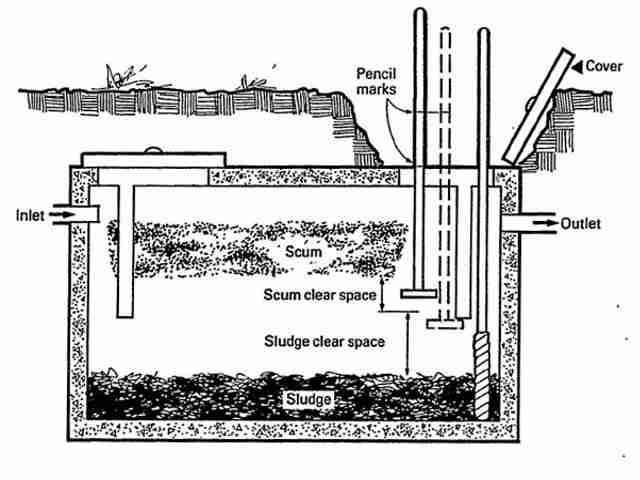
The septic tank scum layer probe shown above (courtesy USDA and US FPS) is also illustrated in a photograph just below.
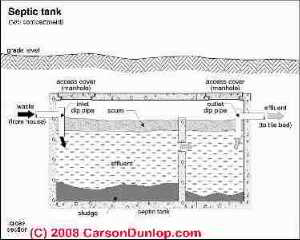
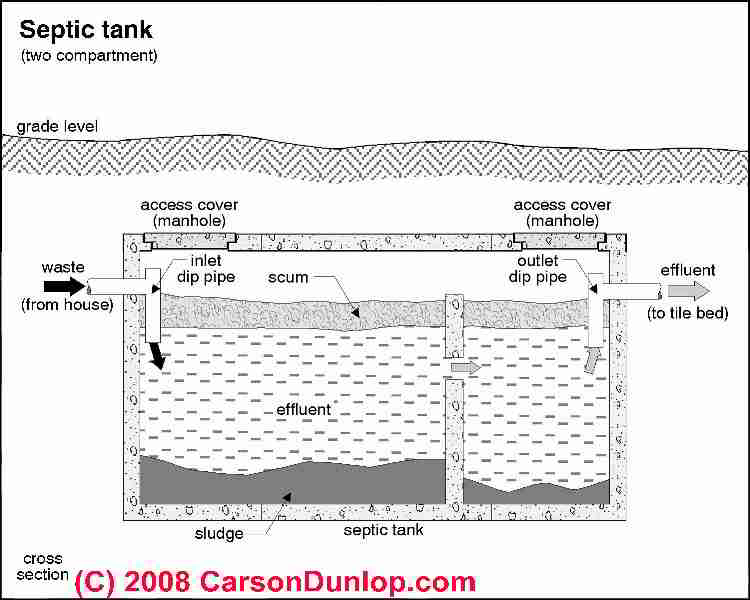
Page top septic tank sketch courtesy of Carson Dunlop Associates, a Toronto home inspection, education & report writing tool company [ carsondunlop.com ].
Septic tank top or floating scum layer thickness measurements are discussed on this page.
Separately, septic tank bottom sludge layer thickness measurements, discussed separately
at HOW TO MEASURE SEPTIC SLUDGE LAYER, made or at least roughly estimated by the septic pumping contractor at the time that a septic tank is pumped, provide key information that permits the home owner to know:
- Whether or not the septic tank is being pumped often enough
- Whether or not there is evidence that the septic fields have been damaged by having not pumped the tank soon enough
Watch Out: Safety concerns when measuring septic tank scum and sludge levels: The procedure described below involves opening a septic tank and probing to determine the thickness of settled sludge in a septic tank and to measure the thickness of the floating scum layer in the tank.
This procedure is dangerous, involving possible exposure to methane gas and possible risk of falling into a septic tank. The procedure should be performed by a qualified septic contractor. No one should open, inspect, or examine a septic tank while working alone.
Sanitary concerns when measuring septic tank scum and sludge levels:
Wear gloves when handling the septic probe and watch where you're swinging the pole around so as not to splash septage on your assistant (never work alone on septic systems). The equipment should be washed after use if it is to be retained for future use. Some septic contractors carry their poles in a long plastic-lined box which goes back on the truck.
How to Make the septic tank probe for measuring scum & sludge layer thickness
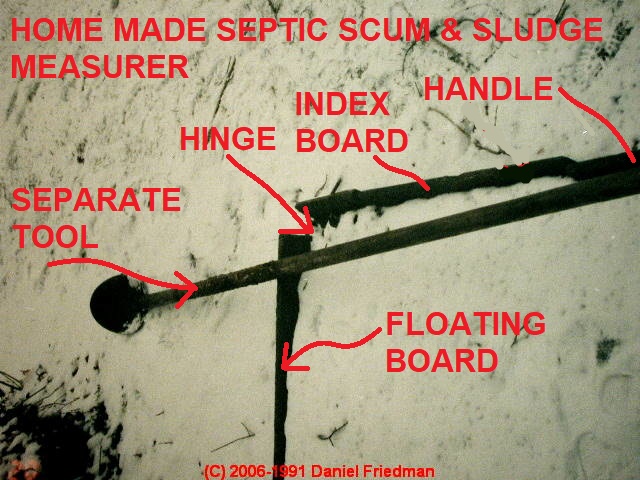
The septic tank scum and sludge measurement tool shown here is one used by a septic contractor to probe the thickness of the scum and sludge layers.
A floating feeler board board hinged is to a second index board that is in turn attached at the end of a (roughly) 8 ft. pole.
The floating feeler board is to feel the under-side of of the scum layer - the contractor says more floating board length makes that easier as the board floats better.
The handle-attached fixed index board allows the contractor to see where the top of the floating scum layer has left a line on the board - marking the thickness.
We recommend using 2" poly piping for this
purpose as it's easy to wash off. A simple door hinge is bolted to the end of the pipe and to the flapper board.
While some pumpers let the board float to feel the points described below, I've seen others who used a board which was fixed at a 90-deg. angle to the pole. (See illustration above).
Also see TUBE for MEASURING SCUM & SLUDGE for a tool that can make both scum and sludge thickness measurements with a single device.
- Open the septic tank access port.
If the tank is a single compartment septic tank (USDA sketch at left) ,this inspection is preferably at the tank outlet end as that's the point where risk of discharge into the absorption system is critical.
However some tanks provide a ready access port only at the inlet side - less desirable but you can look there, too.
Watch out: if your tank is a two compartment type, the solids, floating scum and settled sludge are accumulating at the inlet portion of the tank. Inspecting at the final septic tank outlet end will not discover sludge and scum early enough to prevent septic system damage.
Such tanks may have a center inspection port which admits tank access at the outlet of the sludge/scum containing compartment. That's where to test in two-compartment septic tanks. - Insert the septic tank measuring tool:
At the opened septic tank access port, probe with the flapper pole through the scum layer until you feel outlet baffle or sanitary tee. This means that the pole is turned so that the board will extend under and be able to feel the bottom of the baffle. - Mark the pole
(chalk or pencil will work) to indicate that point. We line up the mark with something easy to reach such as the top of the access port which serves as a uniform reference point for the later measurements. - Now lift up the flapper pole
to feel the resistance of the bottom of the floating scum layer. - Mark the pole again
using the same reference point as described above. - Scum distance to baffle bottom:
The distance between the two marks gives the distance from the bottom of the scum layer to the (lower) bottom of the outlet baffle. If the bottom of the scum layer is within 3 inches of the bottom of the baffle the tank needs to be pumped. - Scum distance to baffle top:
By visual inspection, if the top of the floating scum layer in the septic tank is within 1 inch of the top of the outlet baffle, the septic tank also needs to be pumped.
A similar sludge & scum measuring procedure is provided in Septic Tank/Soil-Absorption Systems: How to Operate & Maintain [ copy on file as /septic/Septic_Operation_USDA.pdf ] - , Equipment Tips, U.S. Department of Agriculture.
WHEN TO PUMP - 3 Rules on How thick can the septic tank sludge and scum layer be before septic tank cleaning is needed?
The following is an excerpt from WHAT SCUM SLUDGE THICKNESS = PUMP NEEDED.
"Generally at a two year interval for septic tank pumping service, the average septic tank in these size ranges will have a 400 mm scum layer with about a 200 mm sludge layer. With an average depth of 1600 mm, the solids content is about 600 mm thereby reducing the settling time by nearly 40%.
Similar rules of thumb offered by USDA on how much sludge or scum would mean the septic tank needs cleaning include:
- 1/3 of tank depth: Pump the septic tank when the total depth of scum plus sludge layers equals one-third of the depth of the tank
or
- Less than 3" between scum bottom & outlet baffle: Pump the septic tank when the bottom of the septic tank outlet baffle has less than three inches of clearance from the bottom of the scum layer (this may vary depending on the length of your outlet baffle or tee)
or
- Less than 6" from sludge top to outlet baffle bottom: Pump the septic tank when the bottom of the outlet baffle is less than 6 inches from the top of the sludge layer found on the septic tank bottom
Watch out: Don't wait too long before removing septic scum and sludge .People who wait until their septic system stops working due to a clogged or over-filled (with sludge and scum) septic tank have waited too long.
As the bottom sludge layer increases in thickness, and as the top septic scum layer increases as well, the remaining "net free area" or "effective septic tank volume" of effluent in the tank is reduced in volume.
When a septic tank is operating with a low volume of "net free area" of septic effluent, the system lacks adequate volume to provide adequate settlement time - time needed for sludge to settle to the tank bottom and scum to coagulate at the tank top.
Details are at EFFLUENT RETENTION TIME
In this circumstance, although drains in the building seem to be just fine, the septic tank effluent is remaining in a constant state of stirred agitation. In turn, that means that the system is pushing floating debris into the leach field or other absorption system.
Pushing grease, scum, and small solid debris out of the septic tank and into the leach field reduces the future life of that expensive component of a septic system.
Also see TUBE for MEASURING SCUM & SLUDGE for a tool that can make both scum and sludge thickness measurements with a single device.
For deep or hard to access or commercial septic tanks that may need close monitoring,
see ELECTRIC MONITOR for SCUM & SLUDGE and also take a look
at OTHER MEASURES of SCUM / SLUDGE.
Septic tank pumping pumping frequency guidance is provided in a table at our website (see links listed at the ARTICLE INDEX the bottom of this article.)
At SEPTIC TANK LEVELS of SEWAGE we explain how to interpret the meaning of high or low sewage levels in the septic tank as well as thick or thin scum or sludge levels.
...
Continue reading at HOW TO MEASURE SEPTIC SLUDGE LAYER or select a topic from the closely-related articles below, or see the complete ARTICLE INDEX.
Or see these
Recommended Articles
Suggested citation for this web page
HOW TO MEASURE SEPTIC SCUM LAYER at InspectApedia.com - online encyclopedia of building & environmental inspection, testing, diagnosis, repair, & problem prevention advice.
Or see this
INDEX to RELATED ARTICLES: ARTICLE INDEX to SEPTIC SYSTEMS
Or use the SEARCH BOX found below to Ask a Question or Search InspectApedia
Ask a Question or Search InspectApedia
Try the search box just below, or if you prefer, post a question or comment in the Comments box below and we will respond promptly.
Search the InspectApedia website
Note: appearance of your Comment below may be delayed: if your comment contains an image, photograph, web link, or text that looks to the software as if it might be a web link, your posting will appear after it has been approved by a moderator. Apologies for the delay.
Only one image can be added per comment but you can post as many comments, and therefore images, as you like.
You will not receive a notification when a response to your question has been posted.
Please bookmark this page to make it easy for you to check back for our response.
Our Comment Box is provided by Countable Web Productions countable.ca
Citations & References
In addition to any citations in the article above, a full list is available on request.
- New York State Department of Health, APPENDIX 75-A WASTEWATER TREATMENT STANDARDS - INDIVIDUAL HOUSEHOLD SYSTEMS , [PDF] New York State Department of Health, 3 February 2010, retrieved 3/1/2010, original source: https://www.health.ny.gov/regulations/nycrr/title_10/part_75/appendix_75-a.htm
- SEPTIC TANK/SOIL-ABSORPTION SYSTEMS: HOW TO OPERATE & MAINTAIN [PDF] - , Equipment Tips, U.S. Department of Agriculture, 8271 1302, 7100 Engineering, 2300 Recreation, September 1982, web search 08/28/2010, original source: http://www.fs.fed.us/t-d/pubs/pdfimage/82711302.pdf.
- Septic Contaminants, identifying - what are the contaminants produced by septic systems and what can be done about them if they escape initial treatment?
- Mark Cramer Inspection Services Mark Cramer, Tampa Florida, Mr. Cramer is a past president of ASHI, the American Society of Home Inspectors and is a Florida home inspector and home inspection educator. Mr. Cramer serves on the ASHI Home Inspection Standards. Contact Mark Cramer at: 727-595-4211 mark@BestTampaInspector.com
- John Cranor [Website: /www.house-whisperer.com ] is an ASHI member and a home inspector (The House Whisperer) is located in Glen Allen, VA 23060. He is also a contributor to InspectApedia.com in several technical areas such as plumbing and appliances (dryer vents). Contact Mr. Cranor at 804-873-8534 or by Email: johncranor@verizon.net
- Thanks to Richard at Effluent Services, Ltd., Cambridge 3434 NZ for the suggestions regarding the significance of the septic tank floating scum layer and settled sludge layer. New Zealand readers can contact this septic system service company at 07 827 0436 or Waikato Wide: 0800 EFFLUENT.
- Thanks to reader Robert Shirley, Calgary, for discussing alternative ways to measure septic tank sludge, including the relatively low cost electronic system on the market from Worldstone Inc. (SepticWatch) - a system to monitor sludge and scum and grease levels in grease traps or septic tanks - 04/20/2010
- Mark Cramer Inspection Services Mark Cramer, Tampa Florida, Mr. Cramer is a past president of ASHI, the American Society of Home Inspectors and is a Florida home inspector and home inspection educator. Mr. Cramer serves on the ASHI Home Inspection Standards. Contact Mark Cramer at: 727-595-4211 mark@BestTampaInspector.com
- John Cranor [Website: /www.house-whisperer.com ] is an ASHI member and a home inspector (The House Whisperer) is located in Glen Allen, VA 23060. He is also a contributor to InspectApedia.com in several technical areas such as plumbing and appliances (dryer vents). Contact Mr. Cranor at 804-873-8534 or by Email: johncranor@verizon.net
- Worldstone, http://www.worldstoneinc.com/ electronic monitors, including via internet, for grease traps, septic tanks, oil tanks - manufactured by F.O.G. Solutions,
1348 Delta Drive, Saginaw, MI 48638, 866 279-2824, 989-928-1806, Fax 480-247-4983. The Company also makes an oil tank level monitor.
"Worldstone Inc. is a Braintree Massachusetts based company that specializes in separation tank monitoring. Using established ultrasonic technologies, Worldstone’s GREASEwatch, SEPTICwatch and OILwatch monitors capture critical tank information and transfers data to city officials, end users or service providers creating a safer, cost effective solution to manual inspections. Data from monitors can help establish appropriate service intervals, and document maintenance for regulatory compliance. Alarm features can help detect abnormal conditions and prevent costly backups.
Worldstone monitors are currently assisting over 200 major restaurants, hospitals, prisons, casinos and city officials across the United States."
Septic Tank Monitoring:
"The SEPTICwatch monitor provides continuous monitoring of the sludge, scum, temperature and liquid levels [in a septic tank]. ... real-time information on actual changes as a percentage of permissible floating solids, bottom solids and total solids. It also provides the immediate status of the liquid level within the tank in inches. Using the monitor's programmable Control Unit, the tank's optimum level for pumping is set, so the tank can be pumped when it's actually needed. The [septic tank] monitor's Control Unit can also be programmed to warn of dangerously high solid levels and lower than normal/higher than normal liquid levels - emergency conditions that could indicate system failure."
Grease Trap Monitoring:
"...GREASEwatch monitor uses ultrasonic transducers and an embedded microprocessor to continuously monitor the sludge, scum, liquid levels and temperature in your grease trap. ... get real-time information on incremental changes in the levels of floating solids, bottom solids and total solids at the touch of a button. ... the immediate status of the liquid level in the trap in inches. The Control Unit can be programmed to indicate how full the tank should be before pumping, so there's no more guessing when it's time for service. The GREASEwatch monitor lets you plan a pumping level that meets your needs and protects your investment." - Inspecting Septic Systems: Online Book, Inspection, Test, Diagnosis, Repair, & Maintenance: our Online Septic Book: Septic Testing, Loading & Dye Tests, Septic Tank Pumping, Clearances, details of onsite waste disposal system inspection, testing, repair procedures.
- Advanced Onsite Wastewater Systems Technologies, Anish R. Jantrania, Mark A. Gross. Anish Jantrania, Ph.D., P.E., M.B.A., is a Consulting Engineer, in Mechanicsville VA, 804-550-0389 (2006). Outstanding technical reference especially on alternative septic system design alternatives. Written for designers and engineers, this book is not at all easy going for homeowners but is a text I recommend for professionals--DF.
- In addition to citations & references found in this article, see the research citations given at the end of the related articles found at our suggested
CONTINUE READING or RECOMMENDED ARTICLES.
- Carson, Dunlop & Associates Ltd., 120 Carlton Street Suite 407, Toronto ON M5A 4K2. Tel: (416) 964-9415 1-800-268-7070 Email: info@carsondunlop.com. Alan Carson is a past president of ASHI, the American Society of Home Inspectors.
Thanks to Alan Carson and Bob Dunlop, for permission for InspectAPedia to use text excerpts from The HOME REFERENCE BOOK - the Encyclopedia of Homes and to use illustrations from The ILLUSTRATED HOME .
Carson Dunlop Associates provides extensive home inspection education and report writing material. In gratitude we provide links to tsome Carson Dunlop Associates products and services.
 | HOME | ABOUT | ASK a QUESTION | CONTACT | CONTENT USE POLICY | DESCRIPTION | POLICIES | PRIVACY | |
| © 2024 - 1985 Publisher InspectApedia.com - Daniel Friedman | |||||||||