
InspectAPedia® FREE Encyclopedia of Building & Environmental Construction, Diagnosis, Maintenance & Repair |
Question? Just ask us! InspectAPedia
|
 Drywell & Seepage Pit Safety
- POST a QUESTION or COMMENT about septic system drywell or seepage pit or cesspool hazards
Safety warnings about drywells and seepage pits:
This wastewater drywell article discusses special safety, collapse, and fatality hazards special to drywells (or seepage pits) and gives safety and maintenance advice.
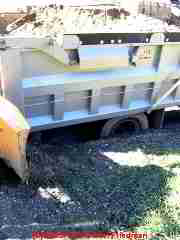
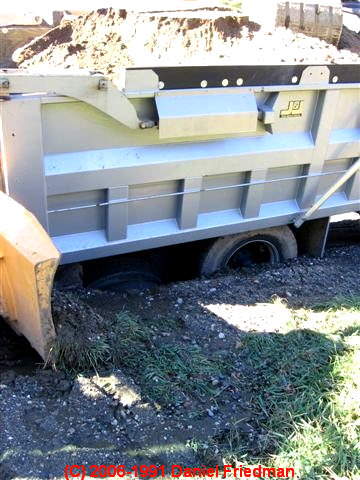
Watch out: Safety Warning: do not walk over the top of or close to the edges of a drywell or any other onsite pit or excavation because of the danger of fatal collapse. Keep pets and children away from such systems.
InspectAPedia tolerates no conflicts of interest. We have no relationship with advertisers, products, or services discussed at this website.
Drywell and Seepage Pit Safety and Septic System Capacity Warnings
 Drywell & Seepage Pit Safety
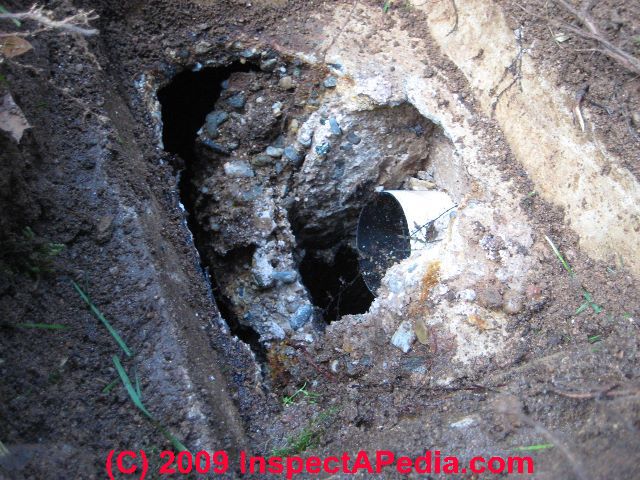
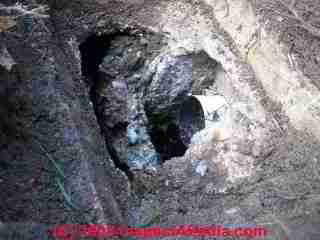
Photo at left: view into a filled seepage pit.
- Safety Warning: there is a risk of drywell collapse, risking injury and potential fatality if someone falls in to one of these
systems, particularly for older site-built systems that were often made of dry-stacked stone or concrete block,
and more-so if such systems are not protected by a very secure cover.
Believe it or not, simple wood board covers were often used on home-made drywells. Such covers rot and ultimately collapse.
Drywell & Seepage Pit Capacity and Testing Limitations
- Limited septic system capacity is implied by the presence of a drywell. Wet soil conditions or limited space
for a functioning drain field (for the septic system) often leads property owners to reduce the liquid load on
the septic system by routing gray water to a separate drywell.
Where such a system is installed owners/buyers should be alert for these conditions and should expect to face extra costs for system maintenance and repair as well as limited septic system capacity. - An exception to the septic system capacity warning above at a large building where a sink or laundry are added in an area distant from piping connected to the septic system, an owner may add a remote drywell as an alternative to inconvenient and costly routing of a drain line from the laundry to the existing septic system.
- Drywells can obscure or prevent effective septic loading and dye testing: If a drywell system is installed, running water at the fixtures draining into this system
(as may be done by some septic tests) are likely to fail to perform a loading test on the septic system even if such a test was attempted.
First, the fixtures where water was run in attempt to test the septic system (tank and leach field) may not even be delivering water to those components if instead the fixtures drain to a separate drywell.
It is critical to trace building drains as part of a septic test or to otherwise try to determine if the test water is actually entering the septic system. - Even if we're trying to "test the drywell", if the drywell is "working" at all, it is a large empty hole in the ground. After a period of disuse it may appear to be working during a test but fail in a day or two when the no-longer functioning hole is filled with wastewater.
- Where a drywell is installed at a property and a septic inspection was attempted, more testing may be in order: in cases where only toilets empty into the septic system, it may be possible to make a more effective septic loading and dye test:
put a test water load directly into the toilet by using a garden hose.
This is not a typical/normal septic test procedure and has its own concerns such as overloading a system of unknown design that did not anticipate such volumes and possible back-contamination of water supply via hose in toilet (a cross connection). Whether or not such an additional test is performed, our warning about a system of limited capacity for which the owner may face significant costs to repair or expand capacity remains in effect.
Watch out: Readers trying to diagnose and deal with sudden soil subsidence or yard collapses should see CESSPOOL SAFETY WARNINGS as those hazards can also apply to drywells and septic tanks
Also see SINKHOLES, WARNING SIGNS.
Important additional septic system safety warnings are at SEPTIC & CESSPOOL SAFETY.
Question:
(Jan 21, 2013) cameron carter said:
I would to know the law for waste water running from wash machine on top the ground
Reply:
Cameron, in most jurisdictions in the U.S., Canada, Europe, and parts of Asia, the discharge of graywater or any building plumbing drain water directly to the ground surface is prohibited. You don't say where you live so I'm left having to advise that you check directly with your local building department.
Interestingly, research on use of graywater shows that it can be beneficial to plants and dry soils.
See GREYWATER SYSTEMS for details.
...
Continue reading at DRYWELLS ARE THEY ACTUALLY DRY? or select a topic from the closely-related articles below, or see the complete ARTICLE INDEX.
Or see these
Recommended Articles
Suggested citation for this web page
DRYWELL SAFETY CONCERNS at InspectApedia.com - online encyclopedia of building & environmental inspection, testing, diagnosis, repair, & problem prevention advice.
Or see this
INDEX to RELATED ARTICLES: ARTICLE INDEX to SEPTIC SYSTEMS
Or use the SEARCH BOX found below to Ask a Question or Search InspectApedia
Ask a Question or Search InspectApedia
Try the search box just below, or if you prefer, post a question or comment in the Comments box below and we will respond promptly.
Search the InspectApedia website
Note: appearance of your Comment below may be delayed: if your comment contains an image, photograph, web link, or text that looks to the software as if it might be a web link, your posting will appear after it has been approved by a moderator. Apologies for the delay.
Only one image can be added per comment but you can post as many comments, and therefore images, as you like.
You will not receive a notification when a response to your question has been posted.
Please bookmark this page to make it easy for you to check back for our response.
Our Comment Box is provided by Countable Web Productions countable.ca
Citations & References
In addition to any citations in the article above, a full list is available on request.
- New York State Department of Health, APPENDIX 75-A WASTEWATER TREATMENT STANDARDS - INDIVIDUAL HOUSEHOLD SYSTEMS , [PDF] New York State Department of Health, 3 February 2010, retrieved 3/1/2010, original source: https://www.health.ny.gov/regulations/nycrr/title_10/part_75/appendix_75-a.htm
- In addition to citations & references found in this article, see the research citations given at the end of the related articles found at our suggested
CONTINUE READING or RECOMMENDED ARTICLES.
- Carson, Dunlop & Associates Ltd., 120 Carlton Street Suite 407, Toronto ON M5A 4K2. Tel: (416) 964-9415 1-800-268-7070 Email: info@carsondunlop.com. Alan Carson is a past president of ASHI, the American Society of Home Inspectors.
Thanks to Alan Carson and Bob Dunlop, for permission for InspectAPedia to use text excerpts from The HOME REFERENCE BOOK - the Encyclopedia of Homes and to use illustrations from The ILLUSTRATED HOME .
Carson Dunlop Associates provides extensive home inspection education and report writing material. In gratitude we provide links to tsome Carson Dunlop Associates products and services.
 | HOME | ABOUT | ASK a QUESTION | CONTACT | CONTENT USE POLICY | DESCRIPTION | POLICIES | PRIVACY | |
| © 2024 - 1985 Publisher InspectApedia.com - Daniel Friedman | |||||||||