
InspectAPedia® FREE Encyclopedia of Building & Environmental Construction, Diagnosis, Maintenance & Repair |
Question? Just ask us! InspectAPedia
|
 Camping or Portable Toilets for Camping or Emergency Home Use
- POST a QUESTION or COMMENT about using portable or emergency toilets
Portable toilets, emergency & camping toilets guide:
Tthis article provides information about using chemical or composting toilets for camping use, emergency home use, or for convenience (close access).
Most of these toilets are the simplest-to-use and are suitable for temporary or emergency toilets. Emergency toilets for home use; temporary toilets. We also describe EMERGENCY FIELD TOILETS - Using camping toilets along the Colorado River and we include warnings about methane explosion hazards and sealed home-made portable toilets.
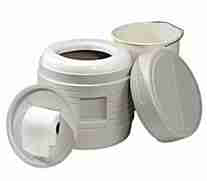
Our page top photo shows a typical bucket or canister type portable non-flushing camping toilet. Waste is collected in a reservoir, usually lined with a disposable plastic bag, for later disposal. A deodorant chemical may be used in the bag.
InspectAPedia tolerates no conflicts of interest. We have no relationship with advertisers, products, or services discussed at this website.
- Daniel Friedman, Publisher/Editor/Author - See WHO ARE WE?
Suggestions for Using Camping Toilets for Camping, or for Temporary or Emergency Home Use
Examples of situations that call for temporary, portable toilets for emergency home use include loss of use of normal house plumbing and toilets due to loss of water supply or due to a septic system or sewer system failure.
For those problems, also see SEPTIC BACKUP REPAIR
and see SEWER BACKUP PREVENTION
Waterless toilets, low-water toilets, and other alternative toilet designs may solve practical problems in providing convenient, sanitary facilities for temporary or even longer term care of elderly, disabled, sick, or injured people.
[Click to enlarge any image]
Camping Toilets: Portable no-flush toilet systems for camping or emergency use at home
 For short term use a camping toilet can be as easy as a chemical toilet to place close to bedside or in an otherwise accessible location for disabled, sick, or elderly person use.
Camping toilets are among the most simple, low-cost, and rudimentary facilities to provide and operate. Two types of portable camp toilets are produced:
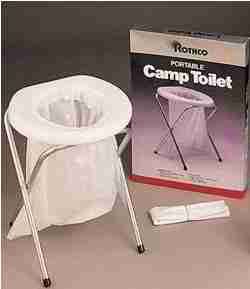
Toilet seat with legs: a folding frame supports a toilet seat that in turn holds a suspended plastic bag used to collect waste. After use the plastic bag is sealed for disposal.
Our photo (far left) shows a typical portable camping toilet.
This portable camp toilet, model 560, produced by Rothco, uses a folding steel frame to support a molded plastic toilet seat and plastic bag.
Plastic bucket type portable toilet: shown in our photo (close left) a pail and drum type portable toilet uses a plastic bucket that collects waste for later disposal.
These toilets are also quite inexpensive, often less than $40. U.S.
Two bucket type portable toilet producers are Coleman (non-flush portable toilet) and the Reliance Hassock Portable Toilet.
In an emergency, you can fabricate a bucket type portable toilet using a five-gallon joint compound bucket and heavy plastic bags to collect the waste.
Watch out: a free-standing portable toilet may be tippy or a bit short; you may need to provide grab rails or personal assistance to make using a portable toilet easy and safe for people who are disabled.
Thetford Corporation lists ten of their portable chemical toilet products as suitable for home or bedside use and for the physically challenged.
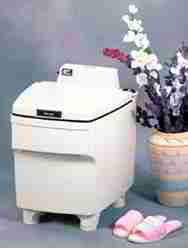
For some circumstances, a more sophisticated toilet may be suitable for home health care. Our photo (left) shows the Thetford ElectraMagic Model 80 RV recirculating 100% self-contained toilet that is intended for more permanent installation.
This toilet can be battery operated, and can be connected to an external tank for increased capacity. This toilet was designed for use in RVs and boats and uses very little water. It requires a 12V or 24V D.C. electrical hookup. (It can be powered by a car battery, for example.) Thetford's
Aqua-Kem liquid holding tank deodorant is used with these products. We discuss chemical toilet products and deodorants
at CHEMICAL TOILETS.
Unlike some of the chemical toilets we discuss here, the Thetford Electra Magic seat height is roughly 18" above the floor and may be easier to get on and off-of for the disabled.
Portable and emergency use toilets include these brands: Thetford Porta Potti, SeaLand’s SaniPottie, Coleman Portable Toilet, Fiamma Bi-Pots, Century Portable Toilet, Dometic Sani Porti, Visa Potty, Companion Eziloo and Primus Deluxe Portable Loo.
CONTACT us to add other portable or camping or alternative toilets and products.
Shown below, the Separett Camping Rescue Toilet that provides urine separation.
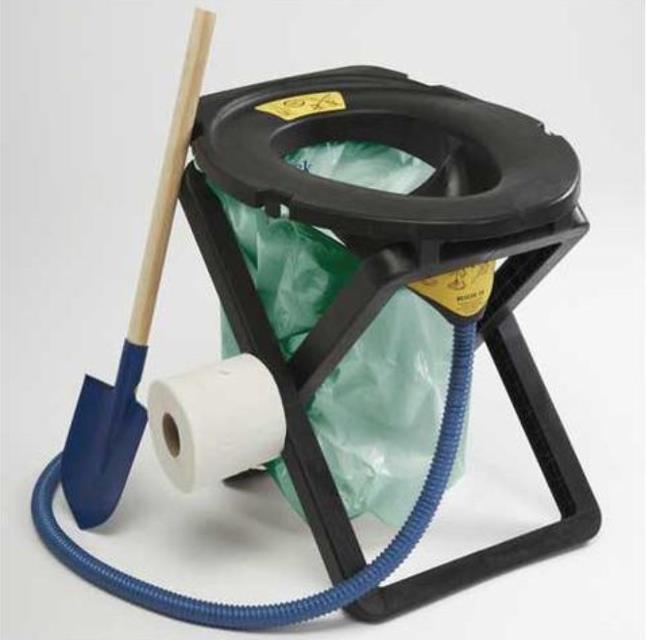
Contact information is at SEPARETT composting toilets, urine separating
Using a U.S. Army Surplus Ammo-Can as an Emergency Camping Toilet
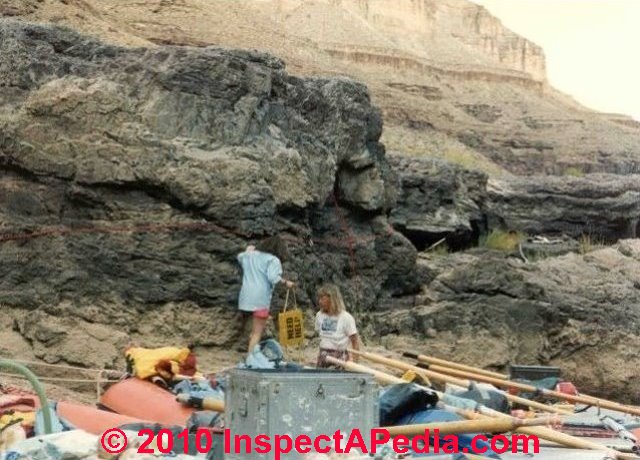 During a multi-week camping trip down the Color ard River in 1991 we learned that while it was ok to pee into the river (dilution was the solution), handling solid human waste was a different problem altogether.
Because the riparian grounds on either side of the Colorado river are small, fragile, and often very dry and very hot, rafters and other visitors are expected to follow an un compromised "leave only your footprints" policy.
Any waste left behind could be there literally for decades, contaminating the space for everyone else, human and other animals alike.
For this reason, at our nightly campsites we used a portable camping toilet like the Rothco unit shown above.
This toilet collected human waste in a plastic bag. A chemical deodorant/preservative, sometimes simply bleach, was added to prevent both explosion and bacterial hazards as this waste was saved and packed out for disposal in an acceptable dump at the end of the camping trip.
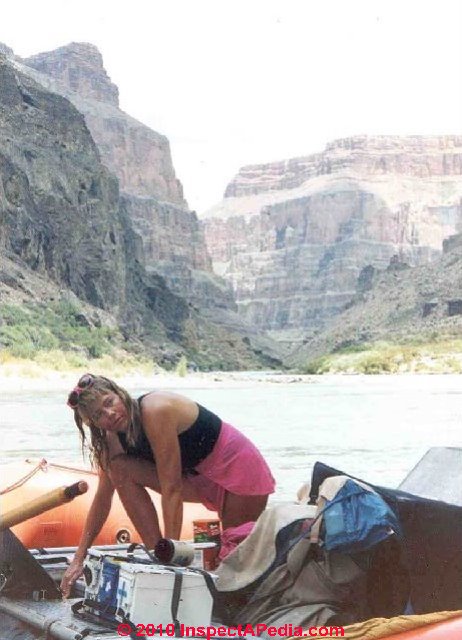
Camp toilet privacy: In a large group of strangers, initially privacy in using the camp toilet was a concern to some. The solution was the yellow "need help" cushion being carried by Mara and shown in our photo (above left).
If the cushion was not at the campsite, someone had taken it and gone to the nearby toilet (around the rock). If the cushion was in sight at the campsite, the toilet was free.
The Ammo-Box Toilet: Description of an Emergency Use, Absolute Minimum, Day Toilet for Excretion
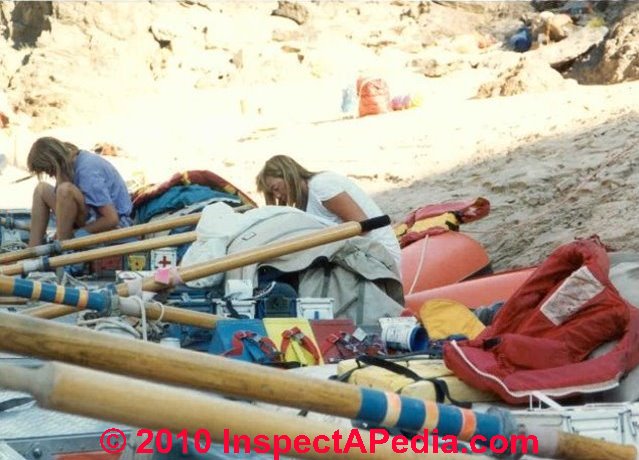 During the day we were either on rafts on the water, or on side-hikes up canyons feeding into the Grand Canyon itself. The portable camping toilet was packed away on one of our rafts.
But what about a little quickly-accessible "day toilet" for emergency use when the camping toilet was packed away?
OK so the typical portable camping toilet works rather well, but it's too big to fit into a backpack.
What do we do if we need a very small, but fully functional, tiny "pack-out-your-waste" emergency toilet for situations where digging a cat hole latrine is just not possible or not permitted?
As you can see in our photo (left), every raft carried several color-coded re-painted ammo-cans for various uses.
These were kept strapped close at hand for emergency use including first aid, and the "day toilet". See the blue, yellow, and red ammunition boxes in our photo?
Our guides told us that there was a "day toilet" available for emergency use if one of us had to "do number two" (defecate) during the day.
But few rafter-campers had a need or an opportunity to practice using this absolute-minimum emergency day toilet.
U.S. and other military ammunition cans have long been a popular military surplus product that was sold for a wide range of uses. These cans were made of heavy steel and usually contained a latching cover that was airtight and water tight.
Uses included not only safe transportation of ammunition, but tools, perishables, and even ... poop.
Ammo-boxes or "ammo cans" were produced in a range of sizes, of which the .30 Cal. (photo) and .50 Cal. U.S. Army Ammo boxes [image] were perhaps the most widely produced and distributed. These and at least seven other models of ammo boxes are still available from military surplus sources.
On the day the author needed to use the "day toilet" we were at a break where the Little Colorado River brings its opaque stream into the Colorado River itself.
This popular raft trip stop was busy with visitors, and our rafts were tied to the shore, and packed to continue our trip downstream in a few hours.
Contents of the Ammo-Box Toilet
By the time it became obvious that I needed to ask for the "day toilet", and the time I found someone who knew where our little emergency toilet had been stowed on one of the rafts, nature's call was urgent.
So urgent that when our guide Alan asked if I knew how to use the toilet, I just answered "yes" - which was a lie brought on by the realization that I really did not have much time for a pedantic explanation from a biologist.
Grabbing the emergency day toilet - a repainted, but originally olive green .30 Cal. U.S. Army surplus ammo box, I dashed into the rocks to find a bit of privacy and opened the ammo-box to see what was inside. Here were the contents of our tiny day toilet:
- A bit of folded toilet paper - the use was obvious
- A handful of quart-sized heavy-duty freezer-type plastic Zip-Loc plastic bags. The use was, on reflection obvious, if tricky.
- A cluster of a few unidentified items went unnoticed at the bottom of the ammo-can, including a bar of soap, some paper towels, and a small bottle of liquid that I ignored.
Actually if you are backpacking in area where you have to pack-out your waste, these components can be easily carried inside of a larger or doubled resealable plastic bag without the heavy ammo-box.
On a raft trip where weight was not the issue, the ammo box was convenient to keep these materials separated and quickly available.
Twelve Step Program for Using the Ammo-Box Toilet
Using the Ammo-Box toilet was really a lesson in aim. Readers will understand that no photos are included. I was busy.
- Select your location to do your business.
- Open the ammo-can toilet and set it aside, after selecting a clean quart-sized plastic bag. It's the plastic bag that forms the actual toilet or fecal waste container.
- Pull down your pants and squat.
- Open the bag and hold it where you can defecate into the bag. This is where aim comes in. The bag is only intended for fecal waste, not urine.
- Go.
- Wipe.
- Put the used toilet tissue into the bag with your feces.
- Watch out: see the explosion warning just below. To avoid methane gas production and possibly an exploding toilet bag, the fecal waste needs to be kept cold or treated with a suitable chemical or preservative.
- Remember the bar of soap and paper towels (and provided you have a water source). Used paper towels can also be disposed-of in the plastic baggie.
- Push out the excess air from the plastic waste bag and seal it.
- Return the bag and unused toilet tissue to the Ammo-Can
- Latch the ammo can shut and return it to storage.
Well, that's what I did. No one was around, so I just returned the ammo-can to our raft and stowed it.
How Does the Tiny Emergency Ammo-Box Toilet "Work"?
Later that afternoon, back on the Colorado River we oared past Geoff who asked how I'd enjoyed using the day toilet.
"How was the day toilet - any difficulties?"
"It was fine," I replied. "Aiming into a quart bag requires some care but it was ok."
Geoff, our trip leader, looked at me for a moment, thoughtfully.
"You remembered the bleach, right?"
"Bleach?"
"Yeah. You were supposed to put some bleach into the bag - you did that, right?"
"What bleach?"
The tranquil stretch of Colorado River burst into noisy action.
"ASHORE IMMEDIATELY - EMERGENCY!!!" Geoff screamed to Alan, the oarsman who was guiding the raft where our day toilet was stored.
" HE FORGOT THE BLEACH!!!"
Ravens burst from the brush, several snakes slithered aside, coyotes dashed, a beaver flapped its tail, two deer bounded into a side canyon, and perhaps the ghosts of the Anasazi took note from high on the canyon walls.
There was a huge flurry of human activity too as things thrown helter skelter and the ammo-can toilet was un-strapped from the raft and opened. Sapping the strong latch and flipping up the airtight lid, a guide found my zip-loc bag of feces and also the small bottle of liquid that I had ignored.
Opening the used waste bag took only a moment, but we could see that it was already blown-up like a balloon. Bleach was poured in, and the bag compacted and re-sealed.
Now, as Paul Harvey said, for the rest of the story.
On a previous Colorado River raft trip an inexperienced toilet user had also forgotten the chemical treatment.
In the Arizona sun at the bottom of the Grand Canyon, even a light-color painted steel ammo box can quickly reach well over 100 degrees F. Human waste packed inside of a very strong steel, airtight, latched-shut Ammunition Storage Box - an ammo-can - will rapidly decompose, producing plenty of high pressure, explosive methane gas.
On a previous Colorado River raft trip one of these ammo box toilets actually exploded. No one was injured, but it was a close call. The shrapnel from a sealed, exploding ammunition box could have seriously injured or even killed someone nearby. Or sunk a raft in the middle of the Colorado River.
Watch out: methane gas is highly explosive. Exploding or even simply expanding gas at high temperature in a tightly-sealed container such as a .30 Cal. Ammo Box or ammunition can can lead to a dangerous explosion.
See SEPTIC METHANE GAS for more information about septic and other methane gas hazards.
Emergency / Camping Toilet Research & Systems
- Americans with Disabilities Act, ADA, Website: access-board.gov/adaag/html/adaag.htm - web search 07/08/210 - original source http://www.access-board.gov/adaag/html/adaag.htm#4.16
- Ammo cans or military surplus ammunition boxes are widely available including for sale online
.30 Cal USED Metal Ammo Can - Used, Fair Condition. Original US Military Surplus. 200 Cartridges. 7.62 MM, M13, Overhead Fire, 1 M62 .4 m80 lc-87J601l368 Printed On Front Of Ammo Can. Dimensions: 10.25" x 6.5" x 3.5". GSA Compliant. - Century 6205 2.6-Gallon Portable Toilet by Century Tool shown in the photograph at page top was purchased at Amazon.com and costs less than $100. Other Century Tool camping products can be seen at centurycamping.com/
- Coleman Corporation, 3600 North Hydrauli, Wichita, KS 67219, USA Web: coleman.com Tel: 1-800-835-3278, is a producer of camping equipment and gear, including chemical and portable toilets including both non-flush portable toilets and a large portable flush-toilet. Coleman has offices in many countries.
- Reliance Products, 1093 Sherwin Road, Winnipeg, MB, Canada R3H 1A4, Web: relianceproducts.com Toll Free: 1-800-665-0258, Telephone: (204) 633-4403, produces the Reliance Hassock Portable Toilet #00984421. Quoting from the company's website:
Whether you’re on the road, in a campground, out on the water, or at the cabin, the Hassock is one of best portable toilets around. This lightweight, self-contained toilet has a comfortable contoured seat, a removable inner bucket for easy waste disposal and clean-up, an inner splash cover, and toilet paper holder.
In addition, the Hassock is compatible with our standard Double Doodie bag, which means virtually no clean-up and waste disposal is a snap when used together. - Rothco Corporation, 3015 Veterans Memorial Highway, Ronkonkoma, New York 11779-0512, USA Web: rothco.com Tel: 631-585-9446, Toll Free: 800-645-5195 Email: info@rothco.comTel. 800-645-5195;
Rothco, founded in 1953, is a wholesale supplier of military and outdoor products including camping toilets. Quoting:
ROTHCO is America’s foremost wholesale supplier of military and outdoor products. We carry an extensive line of apparel and gear available for domestic and overseas sale to resellers of all types: retail, wholesale, military, police, security, outdoor products, screen printers, uniform dealers, fashion retailers, and sportswear shops.
For nearly 50 years we’ve primarily serviced independently-owned Army/Navy surplus stores across America, but in recent years ROTHCO has expanded our customer and product range to include new lines of sportswear and over 25% of our sales are now to overseas customers. - Thetford Corporation, 7101 Jackson Road, Ann Arbor, MI 48103, USA Web: thetford.com Phone: 1-800-543-1219, 734-769-6000, Fax: 734-769-2023; Thetford produces a wide range of permanent and portable alternative toilet designs. Quoting:
Our [toilet] products are easy to use at bedside and indispensable for the physically challenged, the aged, and small children.
Thetford's list of toilet products suitable for home or bedside health care are listed at http://www.thetford.com/Thetford/HOME/ApplicationHome/BedsideApplications/tabid/94/Default.aspx
...
Reader Comments, Questions & Answers About The Article Above
Below you will find questions and answers previously posted on this page at its page bottom reader comment box.
Reader Q&A - also see RECOMMENDED ARTICLES & FAQs
On 2019-07-20 by (mod) - deodorant for emergency bucket toilet for the elderly / disabled
Margureite
You can use the same chemical treatment that is used in chemical toilets.
See details at HOW TO ADD CHEMICAL DEODORANT / DISINFECTANT to a chemical toilet
Watch out: just using a bucket as an emergency toilet can make sense in a true emergency, but for an elderly person or anyone who may have trouble getting up and down from a bucket or for whom there is extra risk of falling, I suggest using a chemical toilet that is higher from the floor, if necessary raised by a secure platform that also provides arms and a backrest. I describe how to make such a chemical toilet or porta potty support at the CHEMICAL TOILETS article cited below.
More toilet options that would be suitable for an elderly person who can't get to the bathroom are at CHEMICAL TOILETS
Yes you could perhaps put wipes and a bit of bleach into a freezer type "ziplok" bag for disposal in household garbage. I'm uncertain if where you live local regulations would prohibit such disposal.
On 2017-05-27 by Marguerite
Pls assist... My 80 year old mother broke her ankle. We now use a comode. But dealing with the faeces & urine is a problem.
The bucket in the comode is shallow. What chemicals can I use that will destroy the wet wipes and toilet paper? What can I leave in the bucket to leave it smelling better.
Can I for instance buy a larger zip lock bag, put a bit of bleach in and seal it, then throw it in the trash as our normal toilet systems cannot deal with us flushing wet wipes?
blinkgedagte@gmail.com .....Please help me. It's the first day and the did 3 number 2's bedides the urinating!
On 2016-05-11 by (mod) -
Pedro's link pointed to Campingtoilette Toilette Portable Toilet und Nachfüller at Amazon (in Germany?). This is a simple stand and seat over a plastic bag.
This toilet is described in the article above on this page as follows:
Plastic bucket type portable toilet: shown in our photo (close above on this page) a pail and drum type portable toilet uses a plastic bucket that collects waste for later disposal.
These toilets are also quite inexpensive, often less than $40. U.S.
Only when the bag has been sealed shut would there be a risk of methane gas, bag puffing up and ultimately bursting. A thin bag of waste excrement and urine would not burst with strength to cause a damaging explosion but it would create a heck of a nasty mess.
Leaving the bag un-sealed would eliminate the explosion risk. I'd suggest carrying a bottle of RV or Camping or Chemical Toilet disinfectant/deodorant.
You'll see that a few ounces can treat many gallons of waste, so only a small dose would be needed in the toilet bag you describe.
On 2016-05-11 by (mod) - bucket toilet on a small boat?
RE-posting without live link
Pedro said:
Thanks a lot for the help.
I intend on using a portable "toilet" in a small boat, so I was worried the bag would build up gas as you mentioned.
It will likely be hot when we're at the boat, so I am now planning that in any emergency use I will add bleach or a specific disinfectant, whatever small bottle I can find...
Thanks again.
On 2016-05-10 by (mod) - why we put bleach into the ammo-can emergency toilet
Pedro, I have not done long term tests but in my experience, adding a camping toilet disinfectant works better than bleach in that it includes deodorants, and the waste remains stable indefinitely. On a raft trip where we were not carrying fancy treatments, bleach was effective, concentrated, required less additive.
On a raft trip in hot sunny climates where an air-tight ammo-can was being used to contain the day toilet, the risk of exploding methane gas was real.
Buried, a plastic bag of human excrement will eventually decompose; as the plastic does not remain intact, the issue of exploding gases does not occur.
On 2016-05-09 by Pedro
Thanks.
Just so I can wrap my head around this... So it delays the decomposition of the feces, is that it?
Eventually it will decompose and produce the methane gas, right? Should we puncture the bag when throwing in the normal trash, then?
To avoid it exploding somewhere else... or is it already predicted that trash bags will eventually blow up in a dump/landfill, so no worries?
Thanks again
On 2016-05-08 by (mod) - why bleach was needed in the Ammo-Can emergency toilet on our raft trip
Pedro:
Why the bleach? Let me tell you my friend that omitting the bleach from a portable toilet on a raft trip down the Colorado nearly blew up the toilet and raft along with it. Happily our guide caught the mistake on time. Without a disinfectant the bacterial action in feces and sewage causes rapid production of explosive methane gas.
On 2016-05-08 by (mod) -
Sue:
it up in a plastic bag the same as you'd do with your dog's waste. Use a shovel if necessary. Throw that mess away and wash off the shovel.
On 2016-05-06 by Pedro
Hi
I am thinking of using a similar "system" for my small boat, so I would like to understand why the bleach, what is the expected reaction.
Thanks
On 2016-05-02 by mod
Sue give your dog a bath.
Scrape up the feces and bag them in plastic; pour in a bit of household bleach; dispose in garbage just as you would dog waste.
On 2016-05-02 by Sue
Someone took a dump in my back yard and my dog rolled in it. How do I treat the waste?
Question:
(Mar 18, 2015) Eurika said:
Good day, are these porta potties in caravans only suitable for the use of urine? It's needed for an elderly person. Thank you
Reply:
No Eurika the portapotties discussed in this article series accept all body waste - feces and urine.
However you will want to be sure that the portapotty or camping toilet is raised to a suitable height, secured against tipping over, and has grab rails if it's to be used by an elderly person or anyone else of limited mobility
...
Continue reading at CHEMICAL TOILETS or select a topic from the closely-related articles below, or see the complete ARTICLE INDEX.
Or see these
Alternative Toilet Type Articles
- ALTERNATIVE & WATERLESS TOILETS
- CAMPING & EMERGENCY USE TOILETS
- CHEMICAL TOILETS
- COMPOSTING TOILETS
- COMPOSTING TOILET SUPPLIES
- GREYWATER FLUSH TOILETS
- INCINERATOR TOILET SYSTEMS
- OUTHOUSES & LATRINES
- TOILET TYPES, CONTROLS, PARTS - home
- WATERLESS URINALS
Suggested citation for this web page
CAMPING & EMERGENCY USE TOILETS at InspectApedia.com - online encyclopedia of building & environmental inspection, testing, diagnosis, repair, & problem prevention advice.
Or see this
INDEX to RELATED ARTICLES: ARTICLE INDEX to TOILET INFORMATION
Or use the SEARCH BOX found below to Ask a Question or Search InspectApedia
Ask a Question or Search InspectApedia
Try the search box just below, or if you prefer, post a question or comment in the Comments box below and we will respond promptly.
Search the InspectApedia website
Note: appearance of your Comment below may be delayed: if your comment contains an image, photograph, web link, or text that looks to the software as if it might be a web link, your posting will appear after it has been approved by a moderator. Apologies for the delay.
Only one image can be added per comment but you can post as many comments, and therefore images, as you like.
You will not receive a notification when a response to your question has been posted.
Please bookmark this page to make it easy for you to check back for our response.
IF above you see "Comment Form is loading comments..." then COMMENT BOX - countable.ca / bawkbox.com IS NOT WORKING.
In any case you are welcome to send an email directly to us at InspectApedia.com at editor@inspectApedia.com
We'll reply to you directly. Please help us help you by noting, in your email, the URL of the InspectApedia page where you wanted to comment.
Citations & References
In addition to any citations in the article above, a full list is available on request.
- Thanks to reader K.H. for discussing the question of antibiotics emptied into a septic tank and chemical toilet alternatives for the elderly - July 2010
- In addition to citations & references found in this article, see the research citations given at the end of the related articles found at our suggested
CONTINUE READING or RECOMMENDED ARTICLES.
- Carson, Dunlop & Associates Ltd., 120 Carlton Street Suite 407, Toronto ON M5A 4K2. Tel: (416) 964-9415 1-800-268-7070 Email: info@carsondunlop.com. Alan Carson is a past president of ASHI, the American Society of Home Inspectors.
Thanks to Alan Carson and Bob Dunlop, for permission for InspectAPedia to use text excerpts from The HOME REFERENCE BOOK - the Encyclopedia of Homes and to use illustrations from The ILLUSTRATED HOME .
Carson Dunlop Associates provides extensive home inspection education and report writing material. In gratitude we provide links to tsome Carson Dunlop Associates products and services.
 | HOME | ABOUT | ASK a QUESTION | CONTACT | CONTENT USE POLICY | DESCRIPTION | POLICIES | PRIVACY | |
| © 2025 - 1985 Publisher InspectApedia.com - Daniel Friedman | |||||||||