
InspectAPedia® FREE Encyclopedia of Building & Environmental Construction, Diagnosis, Maintenance & Repair |
Question? Just ask us! InspectAPedia
|
 Lead Plumbing Pipe Hazards
How to Identify Lead
Drain & Water Supply Piping in Buildings
Lead water supply health concerns
Lead drain pipe leak risks
- POST a QUESTION or COMMENT about lead supply or drain piping in buildings: hazards, lead poisoning, leaks, repair, replacement
Lead pipes in buildings:
This article explains how to reliablhy identify water supply or drain piping in buildnigs.
We discuss lead piping health worries, durability, and leak risks.
We give a brief history of the use of lead supply & drain pipes, we illustrate where you will find and how to recognize lead pipes, and we discuss the question of which lead pipes need replacement and what the health and leak issues really are with lead plumbing.
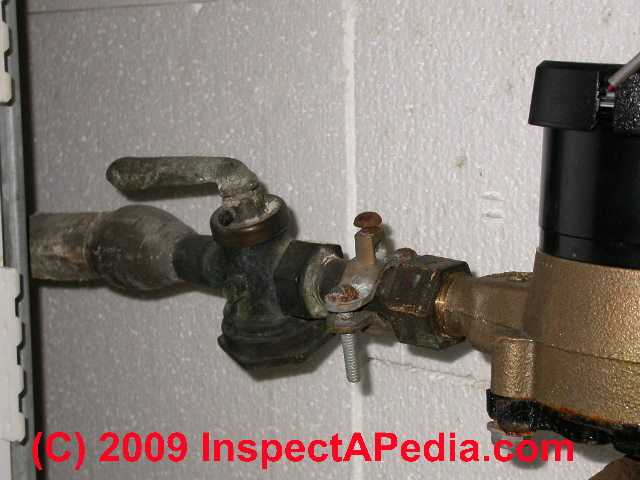
Our page top photo illustrates an easy-to-spot lead water supply pipe: that wipe joint is used only on lead pipes. Notice that the left hand water pipe under this sink is another material, probably copper or brass.
InspectAPedia tolerates no conflicts of interest. We have no relationship with advertisers, products, or services discussed at this website.
- Daniel Friedman, Publisher/Editor/Author - See WHO ARE WE?
Lead Water Supply & Drain Piping in buildings
How to spot lead water pipes in buildings
Watch Out: Lead Hazard Warning: consumption or absorption of lead into the human body is hazardous, particularly for children but in fact for anyone. [1] & [3-23].
And at least one correspondent, an EPA employee, has expressed his view that there is no level of lead exposure for which they have not found an adverse effect. [23]
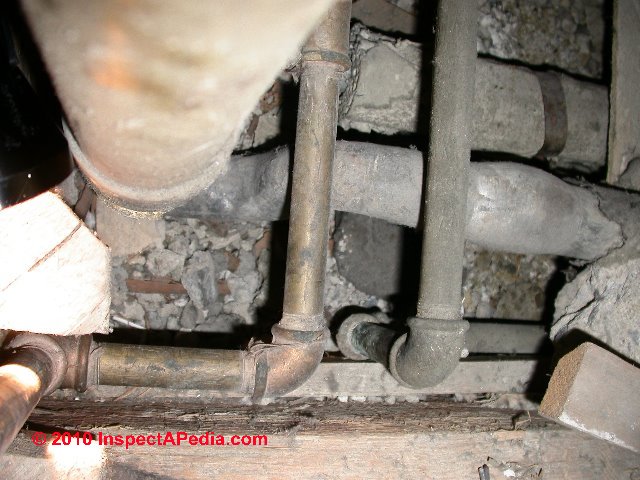
Our lead water pipe photo at left illustrates one of quite a few places to look for hidden lead pipes in older buildings: in the plumbing access behind a bath tub or shower.
Wipe joints help identify lead pipes: Notice that bulge in the lead drain line? That's a lead pipe wipe joint, or wiped joint, a key identifying characteristic in lead pipe connections.
The UPC UPC 890.320 Types of Joints, as adopted by Illinois, actually specifies how wipe joints are to be made and explain why a wiped joint will always be larger in diameter than the surrounding pipe.
c) Wiped Joints.
Joints in lead pipe or fittings, or between lead pipe fittings and brass or copper pipe ferrules, solder nipples, or traps shall be full-wiped joints.
Wiped joints shall have exposed surface on each side of the joint at least 3/4 inch and at least as thick as the material being joined. Wall or floor flange lead-wiped joints shall be made by using a lead ring or flange placed behind the joints at the wall or floor. Joints between lead pipe and cast iron, steel or wrought iron shall be made by means of a caulking ferrule, soldering nipple or bushing.
Wiped joints are made only in lead piping.
Portions of the following summary are from Carson Dunlop Associates' Home Reference Book, adapted & used with permission:
Lead piping was used between the street main and the house up until the 1950s.
A good deal of lead supply line is still in use, and the health authorities indicate that as long as it is used regularly, there is no functional [that is flow] difficulty with it.
Watch out: some assert that one can avoid the hazards of lead in water when the water has not been run for some time, by running water several minutes before using it.[2]
In fact our own tests conducted in concert with City authorities in Poughkeepsie NY at homes with lead water entry mains confirmed that if the city flushed out nearby water mains and the homeowner flushed out the home's water piping until the water ran cold - that is, was fresh water from the mains - immediately before collecting a water sample to check for lead, the resultant lead levels were very low and were often below the city's minimum acceptable lead levels.[22]
However as we point out in a companion
article LEAD IN DRINKING WATER, HOW to REDUCE
In November 2010 the New York Times reported that in 2009 only 5.4% of samples had elevated lead, but in 2010 tests of 222 water samples found lead from 16-30 ppb in 14% of the samples.
Although at these low levels the city did not consider the lead a clear health hazard, the city advised residents to run water for "at least 30 seconds" before drinking or cooking with it. A similar advisory was issued in 2005.
Watch out: the length of time needed to run water to flush out high-lead-level water that has been sitting in piping overnight depends on the total length of pipe between your tap and the street as well as use by other building occupants.
If you run water at a tap until it is cold you have most likely successfully flushed the lines. This same principle applies to private residences.
EPA Lead limit:
Although most homes have very low levels of lead in their drinking water, some homes in some communities have lead levels above the EPA action level of 15 parts per billion (ppb), or 0.015 milligrams of lead per liter of water (mgL).
Under Federal Law
water suppliers are required to have a program in place to minimize lead in drinking water by January 1, 1996.
This program includes corrosion control treatment, source water treatment, and public education.
We are also required to replace each lead service line that we control if the line contributes to lead concentrations of 15 ppb or more after we have completed the comprehensive treatment program.
If you have any questions about how the requirements of the lead regulations are being carried out, call your local water department or health department.
Lead Water Supply & Lead Drain Pipes in Buildings
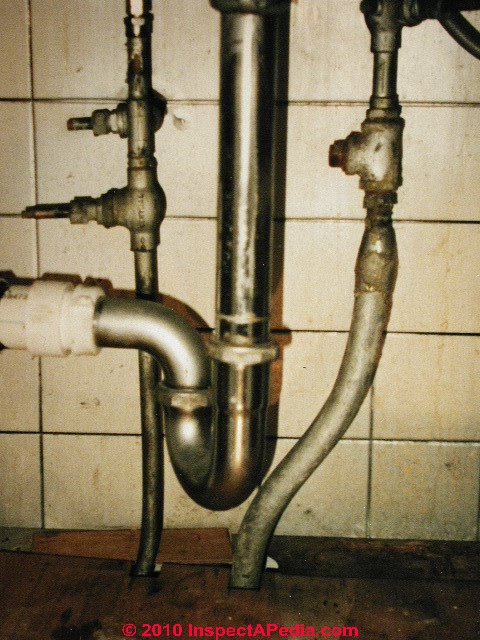
Above: a lead water supply pipe under this sink tells us that water distribution piping in this building, or at least some of it, is lead pipe.
Watch out for lead supply piping in a building even if the incoming water main that was lead has been replaced.
Conversely, also
Watch out for an entering lead water main at a building even if the building's own water distribution piping through the rest of the building is of another material - not lead.
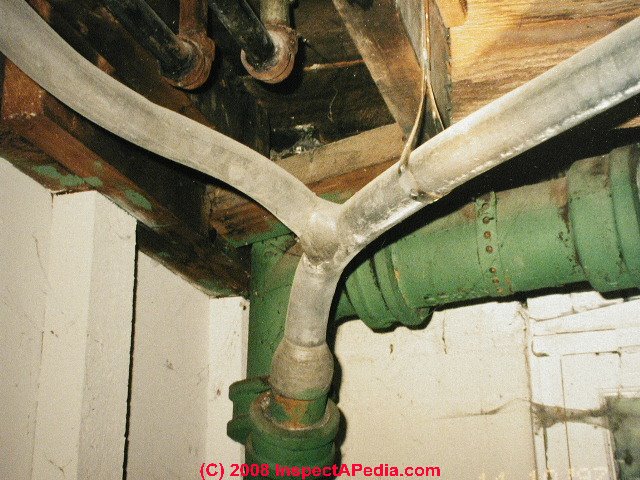
Above lead piping is used to drain plumbing fixtures.
The Tee joint between the two lead pipes as well as the connection of the lead line to what looks like a brass or copper adapter into the cast iron buildnig drain are both wiped lead pipe joints.
In our OPINION both lead water supply piping and lead drain piping are potentially hazardous sources of lead in drinking water.
The lead supply pipe risks are obvious and are discussed in this article. The hazard of lead drain piping are a bit more subtle and rest in the possible discharge of lead containing water into private sewer systems and thus into local aquifers.
The life expectancy of lead water supply piping i
s indefinite in some soils and in more corrosive soils we have plumbers' opinions that the service life of buried lead water supply piping is 40 to 50 years.
The life expectancy of lead drain piping
may be 50 years or longer, but varies by water corrosivity and amount of use as well as mechanical disturbance. Below we include a photograph and text of corroded leaky lead drain piping below a toilet.
Should We Replace Lead Water Supply Pipes?
Lead water supply piping may be a source of lead contamination of drinking water in some buildings.
Our own tests confirmed that where water is aggressive (leaching out lead from the pipes) and or where water that has been sitting in lead piping over night lead levels can be considerably higher than the US EPA standard cited above.
Our photo (left) shows a lead water supply pipe delivering water below a bathroom sink.
The right-hand pipe from the floor to the galvanized iron tee is lead, which you can recognize by the pipe diameter, by the lead wipe joint at the connection, and if necessary by gently scraping the pipe or using a magnet (lead is not magnetic but then niether is brass). Notice that the left hand water supply riser has already been replaced.
Watch out: our tests have found that running the water until cold water from the street is felt at the tap will reduce the levels of lead in building water and in some tests that lead level was below the current EPA standard.
However in our OPINION and that of at least one writer from the US EPA, because of numerous variables this is not a safe reliable way to avoid ingesting lead.
There may be other reasons besides leaks to replace lead water supply piping, including possible health concerns (arguable), or poor water pressure or flow.
Lead Water Pipes & Poor Water Pressure:
Up until World War II, most of the service pipes in built-up areas were lead. While these generally provide good service, they are small in diameter and may have to be replaced.
Long runs of relatively small (1/2-inch diameter) pipe result in considerable pressure drop, especially with more than one fixture flowing. Solutions include replacement with larger pipe or shortening the runs.
Also, lead is relatively soft, and if building settlement occurs, there is a chance of leakage or crimping the pipe. Leaks can also occur at connections as a result of long-term deterioration.
Another source of water entry main piping leaks is a little more subtle:
Many of the old lead service lines were connected to a galvanized nipple – a short piece of steel
that was often in contact with the soil. This pipe rusts on the outside and inside, and may be close to the end of its life. It is often wise to replace this as a precautionary measure.
When Do We Need to Replace Lead Drain Piping?
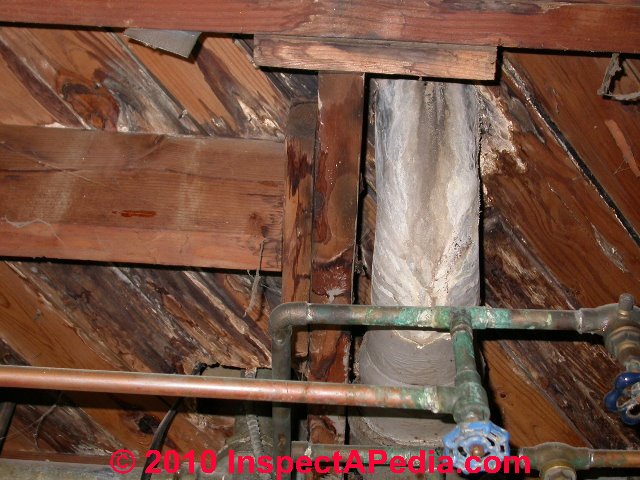
Leaky lead drain piping:
Lead drain pipes in buildings are often leaky and need replacement. If there is no visible corrosion on the piping and no evidence of leakage, the lead drain pipe may be quite serviceable.
Don't assume that because visible building drain piping in an old house is cast iron that no lead pipe bends were used.
As our lead toilet bend photograph (left) shows, often the toilet in older homes was mounted using a lead drain line.
- Home Reference Book, used with permission.
Extra Costs for Renovation or Repair of Lead Drain Piping
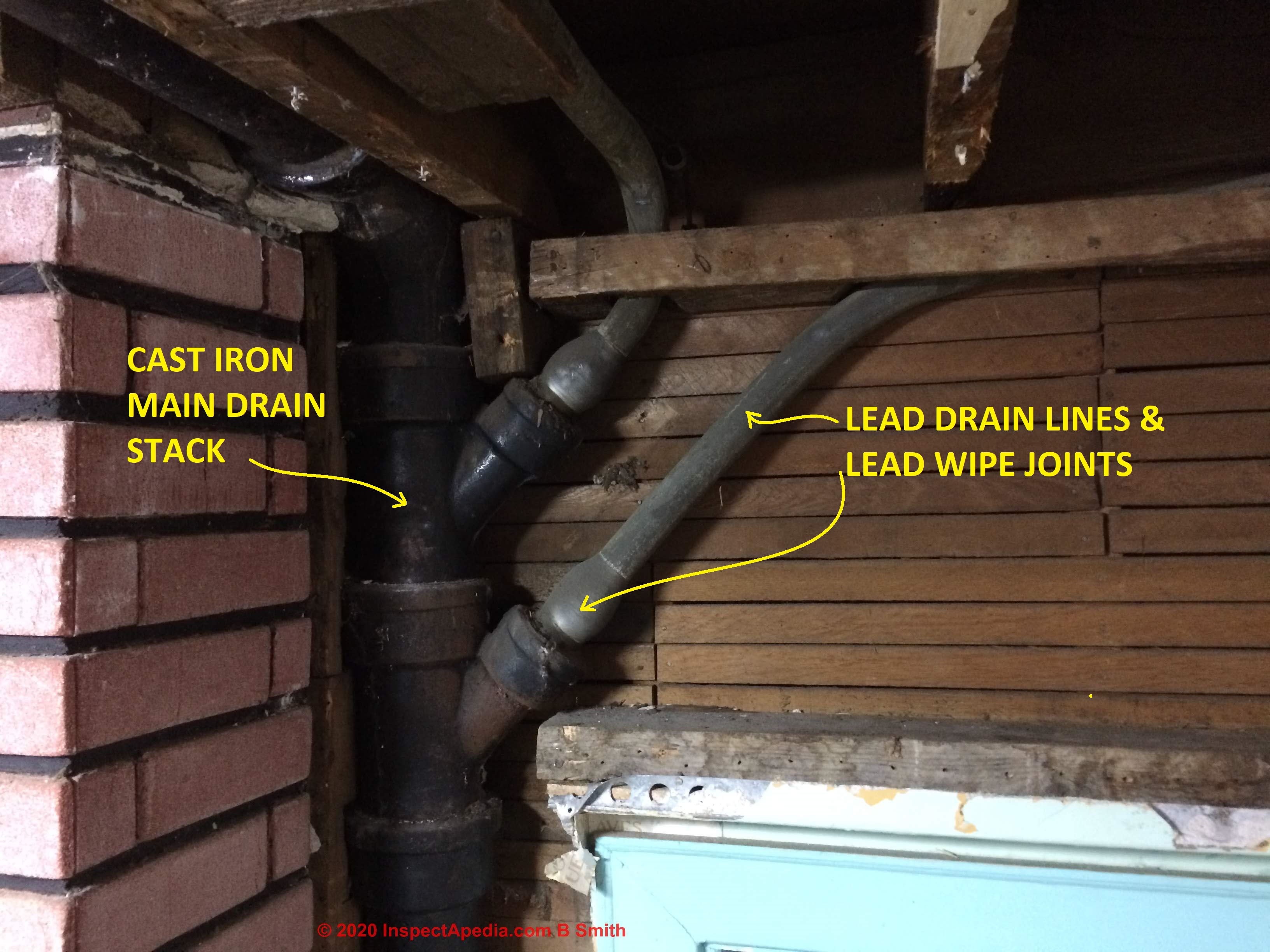
Above: wipe lead joints and lead drains connecting to the cast-iron main plumbing drain stack in an Aladdin Kit home located in New Hampshire. Photo courtesy of reader Brian Smith (October 2020).
More of the history of this home is
Also, because older brass fittings included lead in their composition,
Quick Tests to Determine if Building Piping is Made of Brass, Copper, Galvanized Iron, or Lead
Watch out: a lead drain line below a bath tub was identified in our photo at left - found by viewing the floor piping seen at a plumbing access opening in a 1935-built home in Poughkeepsie, NY - with age, becomes an increasting risk of a hidden plumbing leak.
We did not see any signs that the lead drain (the silver-gray colored, bulged horizontal pipe in our photo (left) was leaking.
But because this second-floor bathroom was constructed using a poured concrete floor, and because asbestos pipe insulation was present on the brass hot water supply pipe (parallel to and above the lead drain line shown at left ), when this drain leaks and needs repairs, extra costs will be involved, both to access the concrete encased piping, and to properly handle the asbestos insulation.
Until there is a leak, this piping and the asbestos insulation should be left undisturbed.
- Lead pipes
(red arrow in our photo above): scraping a lead pipe will reveal a shiny silver-white color and soft material.
A lead pipe will not attract a magnet .
Lead pipes terminate in a wider-diameter lead wipe joint that in turn may marry to a threaded nipple or adapter. - Brass water pipes
(orange arrow in our photo): scraping brass will reveal a shiny yellow color. Brass pipe will not attract a magnet.
Brass pipe fittings are mostly threaded but may on occasion be soldered.
Watch out: some brass water piping contains lead in the brass alloy. - Copper pipes
may range in color from shiny copper color to black depending on age, location, hot or cold water use, and other conditions.
See COPPER PIPING in BUILDINGS for details. Copper pipe will not attract a magnet. - Galvanized iron pipes
(blue arrow in our photo): scraping a galvanized iron pipe will also reveal a shiny silver-white color but the pipe will attract a magnet and most likely you can find threaded pipe fittings.
Are These Examples of a Lead Water Main?
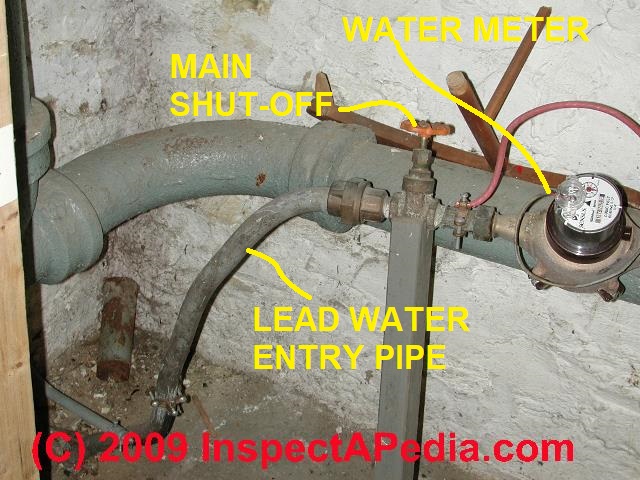
Above: The gray color and sharp bend near the floor make that entering water pipe look as if it could be lead, but the fitting connecting the pipe to the shutoff valve is not a wiped joint. Scratch the pipe to better identify the metal as copper (hard material, can't scratch deeply, bright red-orange where scratched) or lead (much softer metal, more-easily scratched, and silver where scratched).
Below: this water main entering the building is bent in a smooth wide-radius arc, and is "gray" in color, so an inspector might ask: is this a lead water line?
You may need to scrape a bit at the pipe surface to distinguish between brass and copper, or use a magnet to identify steel.
The answer is no, as we explain just below the photo.

Our yellow arrow points to a flare fitting connecting the incoming water line to an adapter that in turn connects to a larger diameter galvanized iron water pipe. Flare fittings are used on copper tubing or pipe, not on lead, so we are confident that this is a copper water line, not lead.
Photo above courtesy of Dov Ber Kahn, a home inspector in Rockland County, NY has contributed photographs of various building features to InspectApedia. Mr. Kahn is a licensed home inspector in New York and New Jersey, and can be reached at Website: Kahnbhomeinspectors, Tel: 845-445-8234, Email: kdovber@googlemail.com
Reader comment: Ace DuraFlow Epoxy Liner ePipe® Restoration Services for deteriorated or clogged piping
2016/03/21 Bill said:
Have you become familiar with Ace Duraflo's EPipe solution? I encourage you to check it out as it is a much more cost effective way of dealing with both residential lead issues and pin hole leaks. You will also discover they are doing considerable relining of lead service pipes in the UK.
Reply:
Ace DuraFlow EPipe is a procedure using a combination of heating, drying and cleaning (sanding) the interior of deteriorated piping followed by installation of an epoxy liner inside the pipe.
The system is used in the North America, U.K., and other countries. The company's website does not (that I could find) provide much detail, cost comparisons, research or much technical information but the procedure indeed may be suitable for some piping problems depending on the pipe condition. The company notes that their process is suitable for domestic water systems (galvanized, copper, and PEX piping) and non-potable systems.
Please see details at TRENCHLESS PIPE REPAIRS
Lead Pipe Replacement Safety
- Lee S, Lunney K [2021]. Biden takes moonshot approach to replacing lead water pipes. Bloomberg Law, March 31. news.bloomberglaw.com/environment-andenergy/biden-takes-moonshot-approach-to-replacing-u-slead-water-pipes
- NIOSH [1997b]. Protect your family: reduce contamination at home. Cincinnati, OH: U.S. Department of Health and Human Services, Centers for Disease Control and Prevention, National Institute for Occupational Safety and Health, DHHS (NIOSH) Publication No. 97-125. cdc.gov/niosh/docs/97-125/default.html
- NIOSH [2021c].EXPOSURE TO LEAD DURING RESIDENTIAL WATER LINE REPLACEMENT ACTIVITIES [PDF] Methner MM, de Perio MA. Cincinnati, OH: U.S. Department of Health and Human Services, Centers for Disease Control and Prevention, National Institute for Occupational Safety and Health, Health Hazard Evaluation Report No. 2019–0192–3377. - retrieved 2023/12/15, original source: cdc.gov/niosh/hhe/reports/ pdfs/2019-0192-3377.pdf
Excerpt from: Key Findings
Some employees had high blood lead levels
Lead was present on employee hands and work gloves
Lead was found on surfaces inside trucks and in the locker room
- The White House [2021]. Fact sheet: The Biden-Harris lead pipe and paint action plan. Statements and Releases, December 16. Washington, DC: The White House. https://www.whitehouse.gov/briefing-room/statementsreleases/2021/12/16/fact-sheet-the-biden-harris-leadpipe-and-paint-action-plan/
- US CDC, REDUCING WORKERS’ LEAD EXPOSURE DURING WATER SERVICE LINE REMOVAL AND REPLACEMENT [PDF] NIOSH & US CDC, retrieved 2023/12/15, original source: cdc.gov/niosh/docs/wp-solutions/2023-141/pdfs/2023-141.pdf?id=10.26616/NIOSHPUB2023141
Excerpt:
Workers who replace lead water service lines may be exposed to lead pipes and lead-contaminated soil while removing the old water lines and replacing them with lead-free lines.
The United States Environmental Protection Agency (EPA) estimates that there are between 6 and 10 million lead water service lines in the United States [EPA 2019]. Lead water service lines may be in the walls of structures or underground [EPA 2022; Lee and Lunney 2021] and may supply water to businesses, schools, childcare facilities, and residential homes.
Infrastructure legislation has made funding available to improve municipal water systems and protect public health by replacing lead pipes [White House 2021]. Increased efforts to replace these lines may result in an increased risk of worker exposure to lead-contaminated pipes and soil.
This document provides information about occupational lead exposure and recommendations for protecting workers’ health during lead pipe replacement.
...
Reader Comments, Questions & Answers About The Article Above
Below you will find questions and answers previously posted on this page at its page bottom reader comment box.
Reader Q&A - also see RECOMMENDED ARTICLES & FAQs
What is the percentage of tin and antimony in lead piping?
does any one know what all is in lead pipes like percentage of tin and or antimony On 2017-11-16 by Happy -
Reply by (mod) Composition of lead pipes used in plumbing: manufacture of lead piping
Hap
See this article from Scientific American:
MANUFACTURE of IRON and LEAD PIPES [PDF] Scentific American Magazine, original source: https://www.scientificamerican.com/article/manufacture-of-iron-and-lead-pipes/
Can I open up old corroded lead water pipes to increase flow?
Is there any way to clean out an old lead pipe water main to increase the pressure in the 3/4 inch main from the street - On 2017-10-16 by ken -
Reply by mod: no don't try it - you risk increasing the level of lead in yoiur water supply
Watch out: in my OPINION, no absolutely not. You should not attempt to rout out or clean and continue to use the old lead water main between street and house.
Here's why I say that: in normal use and varying by water chemistry, a coating of white lead oxide forms on the inside of lead water pipes. That coating actually reduces the transfer of lead Pb into the water as it passes through from the street, through the lead water main, and on to the point of use.
If you even could, say by chemical or mechanical means, remove that oxide to increase the inner diameter of the lead water main you will at the same time increase the level of lead in your water supply, thus inviting lead poisoning health issues. It might be that you'd also increase the risk of leaks.
In fact the flow rate of water through the lead water service line also affects the lead transfer into the building's water supply (Cartier 2012).
Here is some pertinent research:

- Cartier, Clément, Roger B. Arnold Jr, Simoni Triantafyllidou, Michèle Prévost, and Marc Edwards. "Effect of flow rate and lead/copper pipe sequence on lead release from service lines." Water Research 46, no. 13 (2012): 4142-4152.
Abstract
A pilot experiment examined lead leaching from four representative configurations of service lines including: (1) 100% lead (Pb), (2) 100% copper (Cu), (3) 50% Pb upstream of 50% Cu, and (4) 50% Pb-downstream of 50% Cu using a range of flow rates.
The cumulative mass of lead release indicated that a typical partial replacement configuration (50% lead downstream of copper) did not provide a net reduction in lead when compared to 100% lead pipe (85 mg for 50% Pb-downstream versus 83 mg for 100%-Pb) due to galvanic and deposition corrosion.
The partially replaced service line configuration also had a much greater likelihood of producing water with "spikes" of lead particulates at higher flow rates, while tending to produce lower levels of lead at very low flow rates.
After the first 214 days the galvanic current between copper and lead was only reduced by 34%, proving that galvanic impacts can be highly persistent even in water with optimized corrosion control by dosing of zinc orthophosphate.
Finally, this experiment raises concern about the low flow rates used during some prior home sampling events, which may underestimate exposure to lead during normal water use, especially when galvanic Pb:Cu connections are present. - Xie, Yanjiao, and Daniel E. Giammar. "Effects of flow and water chemistry on lead release rates from pipe scales." Water research 45, no. 19 (2011): 6525-6534.
Abstract
Lead release from pipe scales was investigated under different water compositions, stagnation times, and flow regimes.
Pipe scales containing PbO2 and hydrocerussite (Pb3(OH)2(CO3)2) were developed on lead pipes by conditioning the pipes with water containing free chlorine for eight months.
Water chemistry and the composition of the pipe scales are two key factors affecting lead release from pipe scales.
The water rarely reached equilibrium with pipe scales within one day, which makes solid-water contact time and corrosion product dissolution rates the controlling factors of lead concentrations for the conditions tested.
Among five water compositions studied, a solution with orthophosphate had the lowest dissolved lead release rate and highest particulate lead release rate. Free chlorine also decreased the dissolved lead release rate at stagnant conditions.
Water flow increased rates of release of both dissolved and particulate lead by accelerating the mass transfer of lead out of the porous pipe scales and by physically destabilizing pipe scales.
Dissolved lead comprised the majority of the lead released at both stagnant and laminar flow conditions.
Who manufactured lead solder used on cast iron pipes - Caulking Lead Ingots
Does anyone know who was the lead pipe manufacturer and also who manufactured the lead solder used on cast iron fittings? On 2017-03-24 by Melissa Sims -
Reply by (mod) -
Melissa there was surely not "the" lead pipe nor lead-based solder manufacturer - there will have been quite a few across a number of countries. At least dozens.
Some current suppliers of lead ingots used in cast iron pipe caulking include Braxton Harris, Jones Stephens, and Wal-Rich Corporation
Good luck with your lawsuite case.
Are lead pipes prohibited?
Are lead pipes ilegal - 2016-08-22 by Carol Davison -
Reply by (mod) - Are lead pipes illegal? It depends.
Carol:
An answer to whether or not lead pipes are "illegal" depends on the country in which you live. In the U.S.:
Quoting:Section 1417 of the Safe Drinking Water Act
Prohibition on Use of Lead Pipes, Solder, and Flux
Drinking water fountains
Section 1417 of the Safe Drinking Water Act (SDWA) establishes the definition for “lead free” as a weighted average of 0.25% lead calculated across the wetted surfaces of a pipe, pipe fitting, plumbing fitting, and fixture and 0.2% lead for solder and flux. The Act also provides a methodology for calculating the weighted average of wetted surfaces.
The Act prohibits the “use of any pipe, any pipe or plumbing fitting or fixture, any solder, or any flux, after June 1986, in the installation or repair of (i) any public water system; or (ii) any plumbing in a residential or non-residential facility providing water for human consumption, that is not lead free.”
Additionally there is a prohibition on introducing a pipe, any pipe or plumbing fitting or fixture, any solder, or any flux that is not lead free into commerce; unless the use is for manufacturing or industrial purposes.
The SDWA includes several exemptions from the lead free requirements, specifically for plumbing devices that are used exclusively for nonpotable services, as well as a list of specific products: toilets, bidets, urinals, fill valves, flushometer valves, fire hydrants, tub fillers, shower valves, service saddles, or water distribution main gate valves that are 2 inches in diameter or larger.
Currently EPA is conducting a rulemaking to clarify issues related to the lead prohibition.
Source: U.S. EPA, retrieved 2016/08/23, original source: www.epa.gov/dwstandardsregulations/section-1417-safe-drinking-water-act-prohibition-use-lead-pipes-solder-and
I do not read in that text a federal requirement that building owners remove existing lead water supply pipes.
How much lead is in older buildings?
Hi, Is there a resourse for the amount/source of possible lead in residential rental (older) buildings? On 2016-04-12 by Lisa -
Reply by (mod) -
Sure LIsa,
Take a look at the lead hazards article list just above and you'll see an extensive list of guides to lead sources in homes.
Ace Duraflo's EPipe solution for lead water pipes
Have you become familiar with Ace Duraflo's EPipe solution?
I encourage you to check it out as it is a much more cost effective way of dealing with both residential lead issues and pin hole leaks.
You will also discover they are doing considerable relining of lead service pipes in the UK. - On 2016-03-21 by Bill
Reply by (mod) -
Thanks so much, Bill, for the suggestion.
For other readers, the Ace DuraFlo Company suggests an alternative to replacing lead pipe.
- The existing lead water pipes are connected to an air hose and are then cleaned and dried.
- The dry pipes are further cleaned using a sand-blasting procedure
- The cleaned lead pipes are then lined with an epoxy coating.
- The epoxy coated lead pipes are reassembled [sic], flushed, and pressure-tested.
Related research on process for cleaning and lining lead water pipes
- Gillanders, Larry, Steve Williams, and John LaBorde. "Methods and systems for coating and sealing inside piping systems." U.S. Patent 9,724,730, issued August 8, 2017.
Abstract
Methods and systems for cleaning, coating and sealing leaks in existing pipes, in a single operation.
A piping system can be cleaned in one pass by dry particulates forced and pulled by air throughout the piping system by a generator and a vacuum.
Pipes can be protected from water corrosion, erosion and electrolysis, extending the life of pipes such as copper, steel, lead, brass, cast iron piping and composite materials.
Coatings can be applied to pipes having diameters up to approximately 6″.
Leak sealants of at least approximately 4 mils thick can cover insides of pipes, and can include novel mixtures of fillers and epoxy materials, and viscosity levels.
A positive pressure can be maintained within the pipes during applications.
Piping systems can be returned to service within approximately 96 hours. - Gillanders, Larry L., and Steven A. Williams. "Process for coating the interior surface of water service lines." U.S. Patent 9,273,815, issued March 1, 2016.
- Gillanders, Larry, Steve Williiams, and John LaBorde. "Methods and systems for coating and sealing inside of piping systems." U.S. Patent 8,343,579, issued January 1, 2013.
...
Continue reading at LEAD IN DRINKING WATER, HOW to REDUCE - Lead water supply piping as a possible health concern? Leak concern? or select a topic from the closely-related articles below, or see the complete ARTICLE INDEX.
Or see these
Recommended Articles
- LEAD CONTAMINATION HAZARDS in the HOME - home
- LEAD CONTAMINATION in WATER, HOW to TEST
- LEAD IN DRINKING WATER, HOW to REDUCE
- LEAD EXPOSURE HAZARDS INDOORS
- LEAD HAZARDS & FEAR: ENVIRO-SCARE
- LEAD IN DRINKING WATER, HOW to REDUCE
- LEAD PIPES in BUILDINGS
- LEAD POISONING HAZARDS GUIDE
- LEAD TEST KIT for HOME USE
- LEAD in WATER, ACTION LEVELS
- LEAD WATER PIPING
- SUPPLY PIPING - home
Suggested citation for this web page
LEAD PIPES in BUILDINGS at InspectApedia.com - online encyclopedia of building & environmental inspection, testing, diagnosis, repair, & problem prevention advice.
Or see this
INDEX to RELATED ARTICLES: ARTICLE I NDEX to PLUMBING SYSTEMS
Or use the SEARCH BOX found below to Ask a Question or Search InspectApedia
...
Ask a Question or Search InspectApedia
Questions & answers or comments about lead supply or drain piping in buildings: hazards, lead poisoning, leaks, repair, replacement.
Try the search box just below, or if you prefer, post a question or comment in the Comments box below and we will respond promptly.
Search the InspectApedia website
Note: appearance of your Comment below may be delayed: if your comment contains an image, photograph, web link, or text that looks to the software as if it might be a web link, your posting will appear after it has been approved by a moderator. Apologies for the delay.
Only one image can be added per comment but you can post as many comments, and therefore images, as you like.
You will not receive a notification when a response to your question has been posted.
Please bookmark this page to make it easy for you to check back for our response.
IF above you see "Comment Form is loading comments..." then COMMENT BOX - countable.ca / bawkbox.com IS NOT WORKING.
In any case you are welcome to send an email directly to us at InspectApedia.com at editor@inspectApedia.com
We'll reply to you directly. Please help us help you by noting, in your email, the URL of the InspectApedia page where you wanted to comment.
Citations & References
In addition to any citations in the article above, a full list is available on request.
- [1] Drinking Water from Household Wells - PDF, U.S. EPA, Original source last retrieved 2/13/2013, original source: http://www.epa.gov/privatewells/pdfs/household_wells.pdf
- [1a] Safe Drinking Water Act (SDWA), U.S. EPA, web search 11/7/2010, original source: http://water.epa.gov/lawsregs/rulesregs/sdwa/index.cfm
- [1b] Understanding the Safe Drinking Water Act, U.S. EPA, EPA 816-F-04-030 June 2004, web search 11/7/2010, original source: http://water.epa.gov/lawsregs/guidance/sdwa/upload/
2009_08_28_sdwa_fs_30ann_sdwa_web.pdf - [1c] Drinking Water Standards & Health Effects, U.S. EPA, web search 11/7/2010, original source:
http://water.epa.gov/lawsregs/guidance/sdwa/upload/
2009_08_28_sdwa_fs_30ann_standards_web.pdf - [1d] Drinking Water Treatment, U.S. EPA, web search 11/7/2010, original source:
http://water.epa.gov/lawsregs/guidance/sdwa/upload/
2009_08_28_sdwa_fs_30ann_treatment_web.pdf [Warning: this file is difficult or impossible to download from the EPA website - 11/2010] - [1e] Text of the U.S Safe Drinking Water Act: 42 USC CHAPTER 6A - PUBLIC HEALTH SERVICE [large PDF file]02/01/2010 web search 11/7/2010, original source: http://uscode.house.gov/download/pls/42C6A.txt
- [1f] Text of the U.S Safe Drinking Water Act: 42 USC CHAPTER 6A - PUBLIC HEALTH SERVICE [large text file - 15MB] 02/01/2010 (large text file), web search 11/7/2010, original source: http://uscode.house.gov/download/pls/42C6A.txt
- [1g] US CPSC Document #426 "How to Protect Your Family from Lead in the Home" with additional information and annotations
- [1h] "Displaced Gypsies at Risk from Lead in Kosovo Camps," Nicholas Wood, New York Times, 5 February 2006 p5.
- [1i] "Nigeria: Lead Poisoning Spreads", Reuters, The New York Times, 8 June 2010 p. A6 - web search 06/08/2010
- [1j] "Higher Levels of Lead Seen in City Tap WaterTh", Mireya Navarro, The New York Times, 4 Nov 20120.
- [3] US CPSC Document #426 "How to Protect Your Family from Lead in the Home" with additional information and annotations
- [5] "Displaced Gypsies at Risk from Lead in Kosovo Camps," Nicholas Wood, New York Times, 5 February 2006 p5.
- [9] How to Protect Your Family from Lead in Your Home U.S. CPSC publication with additional links and resource references
- [13] "Dally No Longer, Get the Lead Out," Jane Brody, The New York Times," 17 January 2006 p. F6. This is a good article for summarizing the lead issue.
- [14] SOP for Determining Lead (Pb) and And Its Availability in Children's Jewelry
- [21] Sample XRF Lead Survey Report, "Lead Paint Inspection and Visual Assessment Single Family Dwelling, Murdock & Assoc., Mattoon, IL. - original source [Dead Link Dec 2023 - ED.] hud2.towerauction.net/e17/document/132-151212_lbp [DOT] pdf
- [22] Dutchess County New York, Health Department: an original source whose contents were paraphrased, adapted, and expanded for this article include public information document provided by the City of Poughkeepsie New York (Dutchess County) to residents served by city water supply system, December 1995.
- [23] M.D.T., private correspondence, 2/13/2013 [on file]. M.D.T. is an EPA employee and among comments included this remark for which we express thanks, though the following does not reflect the EPA's current action level for lead hazards in water:
Lead is neuro-toxic even in very low doses. It causes permanent (irreversible) damage to children’s brain cells.
- [23] Steven G. Gilbert & Bernard Weiss, "A rationale for lowering the blood lead action level from 10 to 2 μg/dL", NeuroToxicology, Volume 27, Issue 5, September 2006, Pages 693–701, Environment and Neurodevelopmental Disorders, 22nd International Neurotoxicology Conference
- In addition to citations & references found in this article, see the research citations given at the end of the related articles found at our suggested
CONTINUE READING or RECOMMENDED ARTICLES.
- Carson, Dunlop & Associates Ltd., 120 Carlton Street Suite 407, Toronto ON M5A 4K2. Tel: (416) 964-9415 1-800-268-7070 Email: info@carsondunlop.com. Alan Carson is a past president of ASHI, the American Society of Home Inspectors.
Thanks to Alan Carson and Bob Dunlop, for permission for InspectAPedia to use text excerpts from The HOME REFERENCE BOOK - the Encyclopedia of Homes and to use illustrations from The ILLUSTRATED HOME .
Carson Dunlop Associates provides extensive home inspection education and report writing material. In gratitude we provide links to tsome Carson Dunlop Associates products and services.
 | HOME | ABOUT | ASK a QUESTION | CONTACT | CONTENT USE POLICY | DESCRIPTION | POLICIES | PRIVACY | |
| © 2025 - 1985 Publisher InspectApedia.com - Daniel Friedman | |||||||||