
InspectAPedia® FREE Encyclopedia of Building & Environmental Construction, Diagnosis, Maintenance & Repair |
Question? Just ask us! InspectAPedia
|
 How to Measure & Correct Unwanted Building Heat Losses
or unwanted Building Heat Gains
- POST a QUESTION or COMMENT about building heat loss: causes, detection, cures
Measure building heat loss: This article explains how to insulate a building and how much insulation is needed including how to measure or calculate heat loss in a building.
We define heating, coolilng and thermal terms like BTU and calorie, and we provide measures of heat transmission in or through materials, We give desired building insulation design data, and shows how to calculate the heat loss in a building with R values or U values.
Discussed here: How to Measure or Calculate & Stop Building Heat Loss. Find Drafts, Measure Insulation Values & Find Heating Cost Savings.
How to measure heat movement through a wall. How to measure building insulation.
How leaky is the building. Building design temperatures & how to use a home energy audit or heat loss analysis. What insulation "R" values should be used in a building insulation?
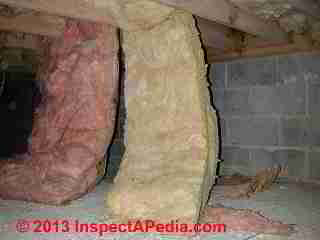
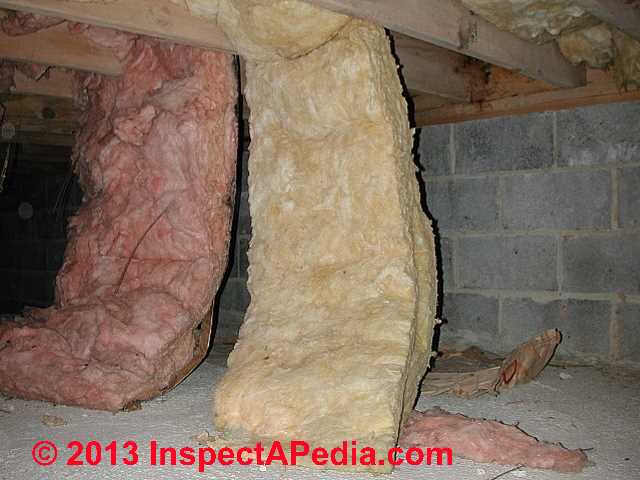
Our page top photo illustrates the importance of a visual inspection of all building areas: voids where insulation has fallen out of a cold crawl space floor can make a significant differnece in building energy costs as well as comfort.
InspectAPedia tolerates no conflicts of interest. We have no relationship with advertisers, products, or services discussed at this website.
- Daniel Friedman, Publisher/Editor/Author - See WHO ARE WE?
What is a BTU or BTUH? A Definition of BTUs
 A detailed presentation of heat loss and R-value
Formula-R™ and Owens Corning™ which may be visible in this photograph of pink Styrofoam™ insulation boards are registered trademarks of Owens Corning® and were photographed at a Home Depot® building supply center.
When we are evaluating the quality and effectiveness of insulation in a building or the adequacy of a building heating or cooling system, we need to use measurements that permit us to describe the rate at which a building loses heat under various conditions (such as outdoor temperature, wind velocity, how leaky the building is, the area of its windows and perhaps doors, and the amount of insulation in the building walls, floors, and ceilings.
A few of these critical definitions for heat loss and insulation values are given just below, followed by some simple formulas used to calculate the heat loss in a building and formulas for calculating R-values.
Definitions of BTUs, BTUH, and Calories
Definition of BTUs and BTUH: a BTU is one "British Thermal Unit" which is defined as the quantity of heat that would be required to increase the temperature of one pound of water by one degree Fahrenheit.
A BTUH is defined as the number of BTU's lost (if we're talking about heat loss or air conditioning), or provided (if we're talking about providing heat for a building) in one hour. You'll often see BTUH as a number on data plates on air conditioners and on heating systems.
One BTU is also equal to 252 calories. So what's a calorie?
Definition of Calorie or Calories: a calorie is defined as the quantity of heat needed to raise the temperature of one gram of water by one degree Centigrade.
How do we measure heat transmission or movement through a building wall, insulation, or any other material?
How do we measure and express how well a building is insulated? or How much heat loss is occurring at a specific building?
Many people have heard of using "R" values to describe "how good" a building's insulation is. This article explains three measures of the flow of heat out of or into a building: R-values, K-values, and U-values. Each of these is defined below. But before moving on to these basic concepts of building heat loss (or gain) theory, it is essential that this still more basic point be considered:
How leaky is the building with respect to heat loss (in a heating climate) (or gain in a cooling climate)?
It doesn't matter much how wonderful the building insulation is, how thick it is, or what the insulating material's "R" value is (see R defined below) if the building is leaky.
If, for example, we're considering an older home with leaky windows or doors, or if we're considering a tall building with poorly controlled heat in winter, such that occupants of the upper floors are leaving windows open in winter then the heat flow out of these openings will be so terrific that the amount of insulation won't matter much.
For details about actual heat loss calculations see HEAT LOSS R U & K VALUE CALCULATION. Continue reading this article series with the links shown just below.
What are the priorities when working to make a building energy efficient, warm, or cool?
Details about this topic are at ENERGY SAVINGS PRIORITIES. Excerpts are just below.
Therefore when the object is to make a building more energy efficient, and before any more sophisticated analyses are performed using thermography, insulation evaluations, or even calculations of areas, "R" values, "K" values, or "U" values (defined below), remember this order of concerns when working for building efficiency. The order of magnitude of sources of un-wanted heat loss in a building are pretty much in this order:
- Close open windows or doors when a building is being heated or cooled by other than "natural means" (like using fans, summer breezes or evaporative coolers in windows). Where older windows are leaking air but are otherwise in good condition, it may be most-economical to install a high quality, well-installed, storm window.
- Investigate and cure leaky windows or doors that are producing drafts; also check for drafty wall or ceiling vent fan openings such as kitchen fans and whole house ceiling exhaust fans that have been left un-covered during the heating season.
- Investigate and make sure that the top floor ceiling or attic floor (or cathedral ceilings) have been insulated, with no insulation voids or areas where insulation was removed or omitted
- Investigate and consider installing or adding wall insulation.
- Investigate and insulate any other un-insulated building perimeter areas such as the building rim joist or band joist accessed from a basement or crawl space.
- Insulate under floors over uninsulated crawl spaces (we prefer to make the whole crawl space an enclosed and conditioned space).
- Insulate building foundation walls below grade in basements or in conditioned-space crawlspaces.
- Investigate the efficiency and state of tune of the building's heating or cooling equipment, including boiler or furnace and the condition of the heating or cooling delivery system (baseboards or ductwork, for example). (Warning: have heating systems cleaned and tuned by an expert before accepting a measurement of the system's efficiency.)
How to Really Foul Up a Radiant Heat Concrete Floor Installation - Mistakes to Avoid
This article has been relocated to RADIANT HEAT FLOOR MISTAKES where we describe installation specifications for radiant heat flooring in a poured concrete slab along with a detailed report of just how bad a radiant heat floor slab installation can be. The article's conclusions include this insulation advice:
- Insulate below the floor slab
- Insulate the slab perimeter, making sure that the insulation design does not rely on foam placed against the slab perimeter and extending above grade up to siding where it will invite termites or carpenter ants into the structure
- Place the radiant heat tubing at the industry-recommended depth down from the surface of the slab. Typically the maximum depth that tubing should be placed in a concrete floor slab is 2" down from the finished floor surface.
- If you cannot be present at the job site at critical stages in construction, find someone knowledgeable who can inspect for you before the work continues.
- If your contractor is an opinionated bully, find someone else as soon as possible, even if his or her other work was good.
Formulas to Calculate the Rate of Heat Loss Per Hour for a Building Using it's "R" Values or "U" Values
Luckily, after having already discussed "K" values, "U" values, and "R" values as measures of heat loss just above, calculating a building's actual rate of heat loss is pretty simple - it's a "cookbook" process that uses the following formula:
Calculating the Building Heat Loss Rate using "R" values:
(Building Heat Loss in BTU's per hour) =
[(Building Total Surface Area in sq.ft.) / (Surface Area "R" value)] x (Temperature Difference)
Temperature Difference = the difference in temperature in deg F. on the two sides of the building surface, typically indoors and outdoors
Surface Area "R" value = the "R" value of the surface area being evaluated (say an insulated wall).
Calculating the Building Heat Loss Rate using "U" values:
(Building Heat Loss in BTU's per hour) U = 1/R, - or in other words -
(Building Total Surface Area in sq.ft.) x (Surface Area "U" value) x (Temperature Difference)
Thanks to Steven Muscato for correcting this formula.
More considerations when measuring home energy use or heat loss
But there's more work to do for a complete answer to building heat loss. We need to make up a simple table which will contain the total surface area of each type of material (since each will have it's own "R" value) and then plug in the area's "R" value and the temperature difference.
Usually we assume the same temperature difference for all of the areas of the building though this might be a simplification since that may not be exactly true.
Include the effect of wind on home energy use or heat loss - wind chill factor?
 We're also missing, from this simple calculation, the effects of wind on a building's heat loss, though a more sophisticated version of this approach might simply adjust the temperature difference to include
the wind factor. For example, you could use a wind/temperature chart to derive the effective outdoor temperature when it's also windy.
We're also missing, from this simple calculation, the effects of wind on a building's heat loss, though a more sophisticated version of this approach might simply adjust the temperature difference to include
the wind factor. For example, you could use a wind/temperature chart to derive the effective outdoor temperature when it's also windy.
[Click to enlarge any image] Shown here: a minus 30°F wind chill report for Two Harbors Minnesota in early February 2018.
In cold conditions, adding a wind velocity might increase the temperature difference across the building wall at least for the sides of the building against which there is significant wind-driven air movement.
Really? Well not necessarily. The effects of wind on the rate of building heat loss might be complex. For example if wind is pressurizing the air around all or part of a building that pressure might counteract the heat loss from air leakage from the building due to convection or buoyance or the stack effect that is usually described by warm air rising through the structure to pressurize and escape from air leaks present in pper building areas.
While you cannot directly use wind chill as a measure of heat loss from a building surface, you can find current wind speeds in local weather and wind data.
More sophistication of measures of heat loss are possible by adding the [wind chill] effects of moisture on heat loss from a surface, but while this is important for a (sweaty) human in cold conditions it is generally ignored when considering building heat loss.
Special thanks to reader Mike Kerry for discussing this topic, 2018/02/15. See details at HEAT LOSS in BUILDINGS, WIND EFFECTS below.
Using a spreadsheet to accurately calculate building heat loss or heat gain
This is a perfect application for an Excel or similar spread sheet, listing each building surface type (wall, window, door), it's R, K, or U value, and its total area. Adding temperature difference across these surfaces permits a calculation of the heat loss (or gain) through each surface type. These are simply added together to represent the entire building's heat loss or gain.
Heat loss vs. heat gain in buildings: applying the simple laws of thermodynamics
You may have noticed we keep talking about heat loss and then we add "or heat gain" in the same sentences or headings.
That's because heat loss analysis works just fine for both building heating and building cooling.
The only differences between looking at heat loss and heat gain for a building are the direction of heat flow and the fact that we may be using different equipment with different equipment efficiencies (a heating furnace or boiler versus an air conditioner).
If we're in a heating climate and are in the heating season, heat will flow from the building interior to the outdoors.
If we're in a cooling climate and are in the cooling season, heat will flow from the outdoors to the building interior. Just remember that (according to the laws of thermodynamics), heat (or energy) always flows from the warmer (or more exited state) into the cooler (or less excited state) area of a building.
How to make use of a home energy audit or free home energy use survey
A less precise and less computerized method for calculating building heat loss (or gain) is used by people who perform an "energy survey" or energy audit for a building. Home energy audit services may be free from your local utility company. The energy survey technician uses a pre-printed form whereon s/he records the areas of the building's walls, top floor ceilings, foundation walls, floors, and the number and type of windows and doors.
An "R" value is assigned to these and the sheet is used to manually calculate the building's rate of heat loss. We had one of these "free" surveys performed on a home built in 1900 when we were renovating it years ago. Regrettably the surveyor was not very observant. He rated our walls at a very high rate of heat loss by assuming that they were not insulated whatsoever (and then proceeded to try to sell us an insulation service).
What that particular home energy audit surveyor failed to notice was that the building walls had been insulated (with blown-in foam) - a condition that was quite easy to see since we had removed the building's exterior siding and wall sheathing. He just didn't look.
So while home energy audits are a great idea, make sure your auditor is awake before you believe the results of the home energy survey. And remember that some "home energy auditors" are really trying to sell you replacement windows (very long payback time) or building insulation. (Remember the urban legend about the home energy auditor who was using a camera light meter as an "energy loss" indicator to convince home owners that they needed new windows?)
Using infra-red or thermography to screen buildings for un-wanted heat loss, leaks, or heat gain points
Home energy loss surveys using thermography or simple infra-red thermometers are a great way to pinpoint individual points of heat loss (or unwanted heat gain) in a building. In the hands of a properly-trained expert (not a window salesman) this equipment can help find unexpected building air leaks or heat loss points even when you think that the building has already been insulated.
Having a "high-R" insulated wall or ceiling is not going to be enough to make a building energy efficient if there are many unidentified air leaks or insulation voids in the building's walls, ceilings, or floors.
What is the Typical Design Temperature for buildings and Building Insulation?
The "indoor design temperature" for a building refers to the assumed target indoor temperature that the building owner or occupants want. Typically 70 deg.F. is used unless the owner specifies something different.
The "outdoor design temperature" for a building is (for heating purposes) assumed to be the average lowest recorded temperature for each month between October and March (the heating season in most climates). If we are specifying a "design temperature" for cooling climates we'd use the average outdoor highest recorded temperature during the heating season, perhaps April through September.
What is a heating or cooling Degree Day?
Some building insulation designers and architects look at the number of "degree days" as an easy way to get at the average outdoor temperatures for an area and a season. A Degree Day is the daily average number of degrees Fahrenheit that the outdoor temperature is below 65 deg.F.
The number of "degree days" during a heating season is easy to obtain: call your local oil delivery company or utility company. These energy providers keep close tabs on degree days for their area since this number is used in planning for the automatic delivery of energy.
It's the number of "degree days" that have occurred in a given period, combined with a building's historic rate of heating oil use, for example, that tells an oil company when to schedule that building for an automatic delivery of heating oil.
Definition of Tons of cooling capacity
"One ton" of cooling capacity, historically, referred to the cooling capacity of a ton of ice. One ton of cooling capacity is the same as 12,000 BTU's/hour of cooling capacity.
Tons of ice does not, however, explain an important factor in the comfort produced by air conditioning systems, reduction of indoor humidity - that is, removing water from indoor air. Cool air holds less water (in the form of water molecules or gaseous form of H2O) than warm air.
Think of the warmer air as having more space between the gas molecules for the water molecules to remain suspended. When we cool the air, we in effect are squeezing the water molecules out of the air. When an air conditioner blows warm humid building air across an evaporator coil in the air handler unit, it is not only cooling the air, it is removing water from that air.
Both of these effects, cooler air and drier air, increase the comfort for building occupants. One ton of cooling capacity equals 12,000 BTU's/hour of cooling capacity.
BASEMENT CEILING VAPOR BARRIER
ENERGY AUDIT - How to Use a Free One
ENERGY SAVINGS MAXIMIZE RETURNS ON
U-value, K-value calculations are at HEAT LOSS R U & K VALUE CALCULATION.
And if you are not sure of the definitions of R, U, & K Values see DEFINITION of HEATING, COOLING & INSULATION TERMS. Also see INSULATION R-VALUES & PROPERTIES where we present a table of different insulating materials and their R-values and properties.
Because no amount of insulation can keep a drafty building warm, also review ENERGY SAVINGS PRIORITIES.
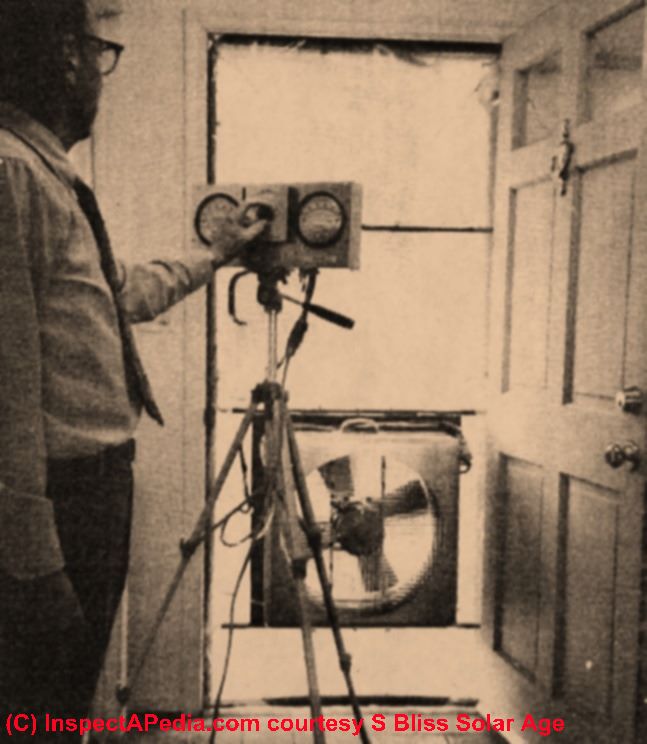
The blower door test shown at left is discussed in detail at HEAT LOSS DETECTION TOOLS.
Research on the Effects of Wind on Building Heat Loss
Comment: do not use "wind chill" to measure wind effect on building heat loss
2018/02/15 Mike Kerry said:
The article states "Use any 'wind chill factor' chart for this data." This is incorrect. Most published WCF formulae and tables are applicable to human skin, not buildings.
Reply:
Thank you Mike, that's a very important point that I will clarify in the article above.
I would very much appreciate any research citations you can offer to improve our discussion of this point.
Below I include what I've learned.
I agree that wind-chill as an effect on humans takes other factors such as relative humidity (RH) into consideration, while RH may have a different effect on the rate of heat loss increase as windspeeds increase around a building.
Research confirms that wind effect on the rate of heat loss at buildings is important, but I agree that using a human-skin "wind chill" number is not directly useful. Experts like Palyvos (2008) do suggest, however, that one can extrapolate usefully from common and widely-available measurements of winds.
Sharples points out that you need to look at wind speeds as measured close to the actual building's surfaces. To which I'd add that for a given overall wide-area wind speed, those data will be very different at different building sides and in different terrains.
It may also be important to consider the effects of wind pressure on a building's heat loss due to the stack effect. (Li 2001).
- Arens, Edward A., and Philip B. Williams. "The effect of wind on energy consumption in buildings." Energy and Buildings 1, no. 1 (1977): 77-84.
- Balaras, C. A., and A. A. Argiriou. "Infrared thermography for building diagnostics." Energy and buildings 34, no. 2 (2002): 171-183.
[Warns against depending on IR scans of buildings during windy conditions] - Defraeye, Thijs, Bert Blocken, and Jan Carmeliet. "Convective heat transfer coefficients for exterior building surfaces: Existing correlations and CFD modelling." Energy Conversion and Management 52, no. 1 (2011): 512-522.
Abstract
Convective heat transfer at exterior building surfaces has an impact on the design and performance of building components such as double-skin facades, solar collectors, solar chimneys and ventilated photovoltaic arrays, and also affects the thermal climate and cooling load in urban areas.
In this study, an overview is given of existing correlations of the exterior convective heat transfer coefficient (CHTC) with the wind speed, indicating significant differences between these correlations. As an alternative to using existing correlations, the applicability of CFD to obtain forced CHTC correlations is evaluated, by considering a cubic building in an atmospheric boundary layer.
Steady Reynolds-averaged Navier–Stokes simulations are performed and, instead of the commonly used wall functions, low-Reynolds number modelling (LRNM) is used to model the boundary-layer region for reasons of improved accuracy.
The flow field is found to become quasi independent of the Reynolds number at Reynolds numbers of about 105. This allows limiting the wind speed at which the CHTC is evaluated and thus the grid resolution in the near-wall region, which significantly reduces the computational expense.
The distribution of the power-law CHTC-U10 correlation over the windward and leeward surfaces is presented (U10 = reference wind speed at 10 m height).
It is shown that these correlations can be accurately determined by simulations with relatively low wind speed values, which avoids the use of excessively fine grids for LRNM, and by using only two or three discrete wind speed values, which limits the required number of CFD simulations. - Li, Yuguo, and Angelo Delsante. "Natural ventilation induced by combined wind and thermal forces." Building and Environment 36, no. 1 (2001): 59-71.
[The effects of buoyancy force, wind force and heat conduction loss are identified]
Abstract
Analytical solutions are derived for calculating natural ventilation flow rates and air temperatures in a single-zone building with two openings when no thermal mass is present. In these solutions, the independent variables are the heat source strength and wind speed, rather than given indoor air temperatures.
Three air change rate parameters α, β and γ are introduced to characterise, respectively, the effects of the thermal buoyancy force, the envelope heat loss and the wind force. Non-dimensional graphs are presented for calculating ventilation flow rates and air temperatures, and for sizing ventilation openings.
The wind can either assist the buoyancy force or oppose the airflow. For assisting winds, the flow is always upwards and the solutions are straightforward.
For opposing winds, the flow can be either upwards or downwards depending on the relative strengths of the two forces. In this case, the solution for the flow rate as a function of the heat source strength presents some complex features. A simple dynamical analysis is carried out to identify the stable solutions. - Loveday, D. L., and A. H. Taki. "Convective heat transfer coefficients at a plane surface on a full-scale building facade." International Journal of Heat and Mass Transfer 39, no. 8 (1996): 1729-1742.
Abstract
Accurate knowledge of the heat transfer processes at the external surfaces of buildings is necessary for design purposes.
Using an experimental arrangement designed to provide measurements of good quality and accuracy, correlations are obtained for the external convection heat transfer coefficient hc as a function of wind speed for a plane, smooth test surface on the facade of an eight-storey building.
Values for hc were correlated with wind speeds measured 1 m from the test surface and at 11 m above the roof. The correlations presented may be used for the prediction of hc values for the central region of smooth, multi-storey building facades between fourth and eighth storey levels inclusive. - Palyvos, J. A. "A survey of wind convection coefficient correlations for building envelope energy systems’ modeling." Applied Thermal Engineering 28, no. 8-9 (2008): 801-808.
Abstract:
The thermal losses to the ambient from a building surface or a roof mounted solar collector represent an important portion of the overall energy balance and depend heavily on the wind induced convection.
In an effort to help designers make better use of the available correlations in the literature for the external convection coefficients due to the wind, a critical discussion and a suitable tabulation is presented, on the basis of algebraic form of the coefficients and their dependence upon characteristic length and wind direction, in addition to wind speed.
Finally, simple average correlations are produced from the existing ones, useful for quick, gross estimates. - Sharples, Steve. "Full-scale measurements of convective energy losses from exterior building surfaces." Building and Environment 19, no. 1 (1984): 31-39.
Abstract:
An experiment is described which measured the forced convective heat transfer coefficients at several positions on the facade of a 78 m high slab-type building. The coefficients are correlated with wind speeds recorded 1 m from the building's surface, 6 m above the roof and a local weather station.
The effect of wind direction and facade location are discussed. Existing designvalues of forced convective coefficients are found to be of correct magnitude, even though the source of these values are physically unrelated to actual buildings. - Wiren, B. G. "Effects of surrounding buildings on wind pressure distributions and ventilative heat losses for a single-family house." In Wind Engineering 1983, Part 3C, pp. 15-26. 1984.
...
Continue reading at HEAT LOSS DETECTION TOOLS or select a topic from the closely-related articles below, or see the complete ARTICLE INDEX.
Or see these
Recommended Articles
- HEAT LOSS in BUILDINGS - home
- BASEMENT HEAT LOSS
- HEAT LOSS DETECTION TOOLS
- HEAT LOSS in BUILDINGS, WIND EFFECTS
- HEAT LOSS INDICATORS
- HEAT LOSS PREVENTION PRIORITIES
- HEAT LOSS R U & K VALUE CALCULATION
- HEAT LOSS RATE CALCULATIONS - R, U, & K VALUES
- HEATING COST SAVINGS METHODS
- SMOKE GUNS for AIR LEAK DETECTION
- SMOKE PENCIL / SMOKE GUN SOURCES
- THERMAL IMAGING, THERMOGRAPHY
- THERMOGRAPHY IR Infra Red & Thermal Scanners
- ENERGY SAVINGS in BUILDINGS - home
Suggested citation for this web page
HEAT LOSS in BUILDINGS at InspectApedia.com - online encyclopedia of building & environmental inspection, testing, diagnosis, repair, & problem prevention advice.
Or see this
INDEX to RELATED ARTICLES: ARTICLE INDEX to BUILDING ENERGY SAVINGS
Or use the SEARCH BOX found below to Ask a Question or Search InspectApedia
Ask a Question or Search InspectApedia
Questions & answers or comments about building heat loss: causes, detection, cures.
Try the search box just below, or if you prefer, post a question or comment in the Comments box below and we will respond promptly.
Search the InspectApedia website
Note: appearance of your Comment below may be delayed: if your comment contains an image, photograph, web link, or text that looks to the software as if it might be a web link, your posting will appear after it has been approved by a moderator. Apologies for the delay.
Only one image can be added per comment but you can post as many comments, and therefore images, as you like.
You will not receive a notification when a response to your question has been posted.
Please bookmark this page to make it easy for you to check back for our response.
IF above you see "Comment Form is loading comments..." then COMMENT BOX - countable.ca / bawkbox.com IS NOT WORKING.
In any case you are welcome to send an email directly to us at InspectApedia.com at editor@inspectApedia.com
We'll reply to you directly. Please help us help you by noting, in your email, the URL of the InspectApedia page where you wanted to comment.
Citations & References
In addition to any citations in the article above, a full list is available on request.
- "Energy Savers: Detecting Air Leaks [copy on file as /interiors/Energy_Savers_Detect_Air_Leaks.pdf ] - ", U.S. Department of Energy
- "Energy Savers: Air Sealing [copy on file as /interiors/Energy_Savers_Air_Sealing_1.pdf ] - ", U.S. Department of Energy
- In addition to citations & references found in this article, see the research citations given at the end of the related articles found at our suggested
CONTINUE READING or RECOMMENDED ARTICLES.
- Carson, Dunlop & Associates Ltd., 120 Carlton Street Suite 407, Toronto ON M5A 4K2. Tel: (416) 964-9415 1-800-268-7070 Email: info@carsondunlop.com. Alan Carson is a past president of ASHI, the American Society of Home Inspectors.
Thanks to Alan Carson and Bob Dunlop, for permission for InspectAPedia to use text excerpts from The HOME REFERENCE BOOK - the Encyclopedia of Homes and to use illustrations from The ILLUSTRATED HOME .
Carson Dunlop Associates provides extensive home inspection education and report writing material. In gratitude we provide links to tsome Carson Dunlop Associates products and services.
 | HOME | ABOUT | ASK a QUESTION | CONTACT | CONTENT USE POLICY | DESCRIPTION | POLICIES | PRIVACY | |
| © 2025 - 1985 Publisher InspectApedia.com - Daniel Friedman | |||||||||