
InspectAPedia® FREE Encyclopedia of Building & Environmental Construction, Diagnosis, Maintenance & Repair |
Question? Just ask us! InspectAPedia
|
 Chimney Safety Alert
US Consumer Product Safety Commission CPSC Document #5017, Expanded
- POST a QUESTION or COMMENT about the fire safety clearances required for woodstoves and other wood-fired heaters
Wood stove & chimney clearance safety:
This article provides woodstove chimney and flue safety advice from the U.S. CPSC in an expanded, illustrated version.
Because most wood stove-related house fires are traced to unsafe wood stove chimney or flue installations, these safety warnings, installation and chimney installation and inspection advice are important to anyone using a woodstove (or coal stove) in their home.
InspectAPedia tolerates no conflicts of interest. We have no relationship with advertisers, products, or services discussed at this website.
- Daniel Friedman, Publisher/Editor/Author - See WHO ARE WE?
Wood Heat Safety Alert: Check Chimney Clearances and Chimney Condition
"In 1982, wood-burning appliances accounted for more fires, more fire deaths, and greater property damage than any other kind of heating fuel -- about 140,000 fires, 250 deaths and $257 million in property damage.
These losses represented 20 percent of all residential fires in the U.S., 5 percent of all fire deaths, and 8 percent of estimated property damage." -- CPSC Chimney Safety Document #5017.
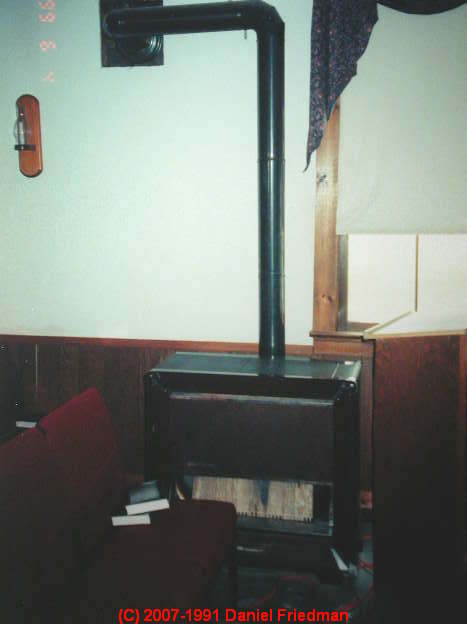
Whether your heater is a woodstove, coal stove, or even a gas fired free-standing stove or heater such as shown in the photo above showing a church heater, a fire-safe installation includes respecting the necessary clearances from combustibles and other measures too.
CPSC research indicates that most wood heating fires involve the chimney and not the appliance itself. The majority of these fires are contained within the chimney and cause no damage to the house.
The Commission
is concerned, however, not only about the chimney fires that did ignite other
parts of the house, but also about the potential future hazard from the
continued use of chimneys whose structural integrity has been compromised by a
chimney fire. This is especially true in light of the fact that many contained
chimney fires are not reported to the fire services; in fact, consumers may not
even be aware that a chimney fire has occurred.
Therefore, the Consumer Product Safety Commission is issuing a special safety
alert concerning chimneys used with wood burning
stoves, fireplaces, and fireplace inserts. The Commission urgently warns
consumers to be aware of the potential fire hazards associated with these
chimneys.
Now that the nation has entered the heating season, the Commission strongly
urges you, if you have a stove or fireplace, to check the chimney for any
damage that may have occurred in the past heating season. If it is difficult to
examine the chimney, a local chimney repairman, chimney "sweep," or
dealer can help. Have any damage repaired NOW.
Most fires involving either masonry or prefabricated metal chimneys occur
because of improper installation, use or maintenance. The Commission staff has
identified the following common causes of fires:
- Improper chimney installation too close to wood framing.
- Installation of thermal insulation too close to the chimney.
- Improperly passing the stovepipe or chimney through a ceiling or wall, causing ignition of wood framing.
- Structural damage to the chimney caused by the ignition of creosote (a black tar-like substance that builds up inside the chimney in normal use).
Structural damage to metal prefabricated chimneys that results in wood framing being exposed to excessive temperatures or leakage of potentially toxic gases to the interior of the home can take the following forms:
- Corrosion or rusting of the inner liners of metal chimneys.
- Buckling, separation of the seam, or collapsing of the inner liner of metal chimneys. (This can result from too hot a fire, especially in high-efficiency stoves and in fireplace inserts, or from a creosote fire.)
Structural damage also occurs
in masonry chimneys, often associated with deterioration or improper
installation of the chimney. The tile inner liner and the surrounding brick or
block structure may crack and separate, perhaps as a result of the ignition of creosote
that has built up in the chimney. Many old chimneys do not have a tile liner.
If your chimney does not have a liner, the addition of a properly installed
liner is advisable. Also, a clay liner should be sealed with refractory cement.
Even when the heating appliance is properly installed, people with either metal
or masonry chimney systems should frequently check the chimney for creosote
deposits, soot build-up, or physical damage.
This involves only a simple visual
examination, but it should be done as often as twice a month during heavy use.
If you see heavy creosote buildup, suspect a problem, or have had a chimney
fire, a qualified chimney repairman or chimney "sweep" should perform
a complete safety inspection. They can arrange for any necessary repairs or
creosote removal, which must be done before the heating appliance is used
again.
There are products now available which, according to recent tests conducted by
independent laboratories, show promise for reducing the production of creosote
and harmful pollutant emissions.
Advance wood stove designs appear to provide more complete combustion of the fuel. Catalytic combustors appear to achieve similar results, and are available with new stoves or as separate components which can be installed between the flue gas exit and the chimney connector of existing stoves.
The Commission advises owners of all chimneys to:
- Be sure that the chimney and stovepipe were installed correctly in accordance with the manufacturer's recommendations and local codes. If there is any doubt, a building inspector or fire official can determine whether the system is properly installed.
- Minimize creosote formation by using proper stove size and avoiding using low damper settings for
extended periods of time.
[and burn dry low-sap firewood, not green firewood; some woodstove manufacturers recommend burring the stove with a hot fire for some period of time at least once daily during the heating season. Also, don't buy a woodstove that is too big for the area to be heated - the result will be running the stove too long at low damper settings which increases the risk of creosote formation in the chimney] - Have the chimney checked and
cleaned routinely by a chimney "sweep" at least once a year. Inspect it frequently, as often as twice a month if necessary, and clean
when a creosote buildup is noted.
[See Chimney Cleaning Advice, Procedures for details and additional advice] - Always operate your appliance
within the manufacturer's recommended temperature limits. Too low a temperature increases creosote buildup, and too high a temperature may
eventually cause damage to the chimney and result in a fire.
[Inexpensive magnetic stovepipe thermometers for woodstoves can indicate when your chimney is dangerously hot] - Frequently look for signs of structural failure
[The CPSC means to perform a visual inspection of the chimney for damage.
See CHIMNEY INSPECTION DIAGNOSIS REPAIR ]
If you have had a fire or other safety problem with your chimney, or would like additional information, call the Commission's toll-free Hotline 800-638-CPSC.
DF: additional safety advice for people heating with wood stoves or coal stoves can be found
at WOOD, COAL STOVES & FIREPLACES
...
Continue reading at CHIMNEY INSPECTION CHECKLIST or select a topic from the closely-related articles below, or see the complete ARTICLE INDEX.
Or see these
Recommended Articles
Suggested citation for this web page
CHIMNEY CLEARANCE & CONDITION SAFETY at InspectApedia.com - online encyclopedia of building & environmental inspection, testing, diagnosis, repair, & problem prevention advice.
Or see this
INDEX to RELATED ARTICLES: ARTICLE INDEX to CHIMNEYS & FLUES
Or use the SEARCH BOX found below to Ask a Question or Search InspectApedia
Ask a Question or Search InspectApedia
Try the search box just below, or if you prefer, post a question or comment in the Comments box below and we will respond promptly.
Search the InspectApedia website
Note: appearance of your Comment below may be delayed: if your comment contains an image, photograph, web link, or text that looks to the software as if it might be a web link, your posting will appear after it has been approved by a moderator. Apologies for the delay.
Only one image can be added per comment but you can post as many comments, and therefore images, as you like.
You will not receive a notification when a response to your question has been posted.
Please bookmark this page to make it easy for you to check back for our response.
IF above you see "Comment Form is loading comments..." then COMMENT BOX - countable.ca / bawkbox.com IS NOT WORKING.
In any case you are welcome to send an email directly to us at InspectApedia.com at editor@inspectApedia.com
We'll reply to you directly. Please help us help you by noting, in your email, the URL of the InspectApedia page where you wanted to comment.
Citations & References
In addition to any citations in the article above, a full list is available on request.
- In addition to citations & references found in this article, see the research citations given at the end of the related articles found at our suggested
CONTINUE READING or RECOMMENDED ARTICLES.
- Carson, Dunlop & Associates Ltd., 120 Carlton Street Suite 407, Toronto ON M5A 4K2. Tel: (416) 964-9415 1-800-268-7070 Email: info@carsondunlop.com. Alan Carson is a past president of ASHI, the American Society of Home Inspectors.
Thanks to Alan Carson and Bob Dunlop, for permission for InspectAPedia to use text excerpts from The HOME REFERENCE BOOK - the Encyclopedia of Homes and to use illustrations from The ILLUSTRATED HOME .
Carson Dunlop Associates provides extensive home inspection education and report writing material. In gratitude we provide links to tsome Carson Dunlop Associates products and services.
 | HOME | ABOUT | ASK a QUESTION | CONTACT | CONTENT USE POLICY | DESCRIPTION | POLICIES | PRIVACY | |
| © 2024 - 1985 Publisher InspectApedia.com - Daniel Friedman | |||||||||