
InspectAPedia® FREE Encyclopedia of Building & Environmental Construction, Diagnosis, Maintenance & Repair |
Question? Just ask us! InspectAPedia
|
 Twist-On Connectors for Aluminum Wire - US CPSC Staff Concerns
- POST a QUESTION or COMMENT about copper pigtailing for aluminum wiring repairs: which connectors fail and why
Aluminum wiring repair:
Concerns about using twist on connectors. This document has been scanned verbatim from the CPSC document and is straight ASCII text.
InspectAPedia tolerates no conflicts of interest. We have no relationship with advertisers, products, or services discussed at this website.
- Daniel Friedman, Publisher/Editor/Author - See WHO ARE WE?
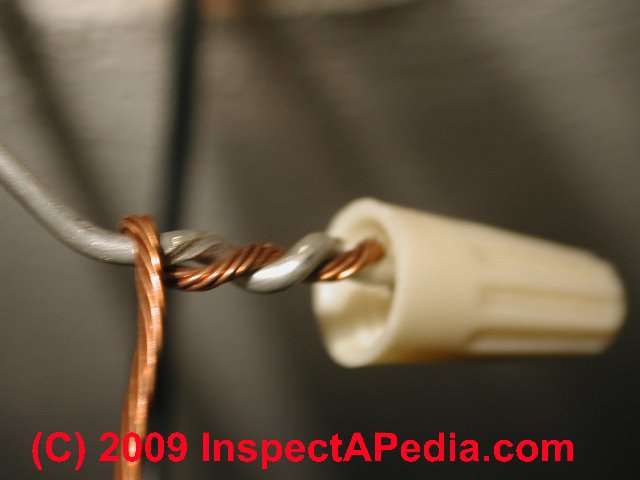
Twist on connectors for aluminum wiring repair? 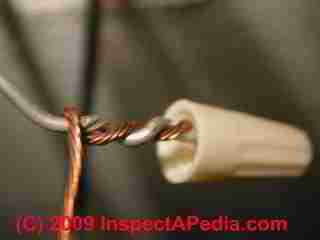 Verbatim scan of US CPSC documents obrained under FOIA.
U.S. CONSUMER PRODUCT SAFETY COMMISSION
WASHINGTON, D.C. 20207
May 1, 1995

Mr. James Beyreis
Vice President and Chief Engineer
Underwriters Laboratories Inc.
333 Pfingsten Road
Northbrook, IL 60062-2096

Subject: CPSC Staff Concerns Regarding Recently Listed Aluminum Wire Twist-On Connectors
Dear Jim:
As you are aware, the CPSC has worked cooperatively with Underwriters Laboratories
(UL) over the past two decades. I hope to continue and improve this cooperation to ensure
public safety is adequately protected, maintained, and where necessary, improved. I briefly
discussed the subject of this letter with Mr. David Dini of UL on April 20, 1995. I suggested
we arrange an open meeting to discuss this issue further.

To aid in the discussion, attached are CPSC staff concerns regarding the subject
connectors. Members of The CPSC staff are concerned wit this product and its applications in
homes with aluminum wiring. I propose that The topics in the attachment be the agenda for our
technical discussions. Mr. Dini indicated he would discuss this matter wit you, and someone
would be in contact wit me to arrange a date for these discussions.

I look forward to meeting with you and discussing this product safety issue in the near
future. If you have any questions regarding this matter, please feel free to call me at 301-504-
0504, extension 1290.

Sincerely,

Andrew G. Stadnik, P.E.
Associate Executive Director
Engineering Sciences

Attachment as noted.
D.  Haataja, UL-Washington, D.C.
T.  Castino, UL-Northbrook, IL

CPSC Staff Concerns with the Application of Twist-on AL/CU Wire Connectors

The principal application for a listed, twist-on, AL/CU connector is homes wired with aluminum
wiring during the mid-I 960's to early 1970's before safety concerns resulted in aluminum wiring
no longer being used. Many consumers living in these homes will believe that such a connector
is a safe, permanent repair for aluminum wiring connections at outlet terminals and splices. The
CPSC staff has the following concerns with the application of these connectors:

1. Wiring Used to Test the Connectors Differs From Wiring Installed in Many Homes -
Many of the estimated 2 million homes with aluminum wiring have a hard-drawn grade of
aluminum wiring (ECHi9 and other grades) that is not adequately represented by the aluminum
alloy currently used to qualify connectors for use with aluminum conductors. Testing is also
conducted using fresh samples and not with contaminated and distorted conductors representative
of wires in the field that have been previously used

2. UL Standard for Twist-on Connectors Lacks Environmental Testing - UL testing does
not appear to include testing under appropriate conditions of ambient temperature, humidity or
household contaminants.

3. Connectors Likely to be Mis-Applied by Consumers - The availability of a manually
applied, twist-on connector for use with aluminum wire will result in many consumers attempting
to repair and service their aluminum-wired homes themselves. Prior to that time, consumers
would not have available to them the proper special crimping tools needed to follow the CPSC-
recommended repair procedure. These crimping tools are made available to trained electrical
contractors on a lease arrangement to assure proper correction of this recognized fire hazard.
It does not appear that a UL evaluation for twist-on AL/CU wire connectors takes into account
that untrained, do-it-yourself consumers will likely undertake using such a connector with
aluminum wiring. Even if a connector performed satisfactorily when installed in accordance with
the installation instructions, the likelihood for improper installation is very high especially if
inordinate and unique special instructions when using aluminum wiring are included for this
rather common-looking connector.

4. Anti-Oxidant Compound Flammability - Compounds that are used with AL/CU wire
connectors are often petroleum-based greases that are flammable. With such materials, excessive
heat and direct exposure to flame should be avoided. However, excessive heat is the
consequence when a connector fails and the twist-on connector when used with aluminum wiring
has a propensity to fail.

5. Connector Body Flammability - Connector bodies often consist of non-flame-retardant
grades of thermoplastic materials. Once ignited, they will continue to burn with a flaming drip.
In the presence of a failing connection, this represents a serious fire hazard.

6. Connector Violates Principle of Safe Wire-to-Wire Electrical Splices - A twist-on
connector is intended to join two or more wire conductors within its cap. The purpose of the
cap is to hold the wires together, Electricity is intended to flow from wire-to-wire. In the case
of two solid wire conductors joined by a twist-on connector without pre-twisting the wires, the
two wires connect with each other along a longitudinal line of contact. This results in poor
performing contact surfaces when the conductor material is aluminum because the aluminum
oxide that exists on the surfaces of aluminum wires is nonconductive. While initially a connector
may appear to perform in a satisfactory manner, the conduction may be related more to the
wiping action of the steel spring commonly used in such connectors. The steel spring gouges
the outer surfaces of the aluminum wires, penetrates the aluminum oxide, and provides a
principal path for the electric current. The steel spring becomes part of the electric circuit, and
not simply as a means to apply pressure between the two wires to hold them in contact with each
other. Using steel as a circuit bridge between an aluminum wire and another wire violates
design practices for connecting aluminum wire, and violates provisions of UL's own standards.

7. Aluminum Wires Installed in Homes Are Weak in Resisting Shear Fracture - The
twisting action that takes place when applying a twist-on connector to aluminum 'wires, given the
physical properties of aluminum wires used in homes, results in forces that can readily sever the
aluminum wires where they enter the cap of a connector.

8. Field Failures Involve Twist-on Connectors With Aluminum Wire - CPSC has received
many reports of failures of twist-on connectors. In response, UL proposed and adopted revised
requirements for these connectors when rated for use with aluminum wiring. CPSC staff on
several occasions expressed reservations to UL in writing regarding the adequacy of the revised
requirements. These CPSC concerns were never addressed to CPSC staff's satisfaction.
Meanwhile, the reports of field failures involving twist-on connectors and aluminum wire
continue, including reports of disappointing performance of a special service twist-on connector
made with a copper alloy spring and used in Canada for a time.

9. Mechanical Integrity With No. 10 and 12 American Wire Gage (AWG) Solid Aluminum
Conductors - Experience with using twist-on type connectors and the relatively stiff wires
characteristic of aluminum wiring used in homes indicates poor performance because the
resulting connection often lacks mechanical integrity. When such splices were positioned into
the limited volume provided in outlet boxes installed in homes, the connections would readily
come apart.

10. Limited Technical Data to Support Twist-on Connector For Aluminum Wire - No
scientific rationale or engineering design analysis that addresses the long term safety of a twist-on
AL/CU connector product has been presented. Such documentation is appropriate since the
experience with previous forms of this product resulted in unsafe and unsatisfactory performance
in the field.
...
Continue reading at ALUMINUM WIRING REPAIRS NOT-RECOMMENDED or select a topic from the closely-related articles below, or see the complete ARTICLE INDEX.
Or see these
Recommended Articles
- ALUMINUM WIRING HAZARDS & REPAIRS - home
- ALUMINUM WIRING REPAIR METHODS
- ALUMINUM WIRING REPAIR ELECTRICIANS
- ALUMINUM WIRING REPAIR METHODS - CPSC Meeting 9/28/95
- ALUMINUM WIRING REPAIRS NOT-RECOMMENDED
- CPSC, UL, Ideal Corp, Meeting Log 6/1/95 about this twist on connector use with aluminum wiring
- IDEAL-65™ TWISTER
- IDEAL 65 TWISTER HISTORY
- REDUCE THE AL WIRE RISK: DETAILS
Suggested citation for this web page
CPSC CONCERNS RE: ALUMINUM WIRING CONNECTORS at InspectApedia.com - online encyclopedia of building & environmental inspection, testing, diagnosis, repair, & problem prevention advice.
Or see this
INDEX to RELATED ARTICLES: ARTICLE INDEX to ELECTRICAL INSPECTION & TESTING
Or use the SEARCH BOX found below to Ask a Question or Search InspectApedia
Ask a Question or Search InspectApedia
Try the search box just below, or if you prefer, post a question or comment in the Comments box below and we will respond promptly.
Search the InspectApedia website
Note: appearance of your Comment below may be delayed: if your comment contains an image, photograph, web link, or text that looks to the software as if it might be a web link, your posting will appear after it has been approved by a moderator. Apologies for the delay.
Only one image can be added per comment but you can post as many comments, and therefore images, as you like.
You will not receive a notification when a response to your question has been posted.
Please bookmark this page to make it easy for you to check back for our response.
IF above you see "Comment Form is loading comments..." then COMMENT BOX - countable.ca / bawkbox.com IS NOT WORKING.
In any case you are welcome to send an email directly to us at InspectApedia.com at editor@inspectApedia.com
We'll reply to you directly. Please help us help you by noting, in your email, the URL of the InspectApedia page where you wanted to comment.
Citations & References
In addition to any citations in the article above, a full list is available on request.
- In addition to citations & references found in this article, see the research citations given at the end of the related articles found at our suggested
CONTINUE READING or RECOMMENDED ARTICLES.
- Carson, Dunlop & Associates Ltd., 120 Carlton Street Suite 407, Toronto ON M5A 4K2. Tel: (416) 964-9415 1-800-268-7070 Email: info@carsondunlop.com. Alan Carson is a past president of ASHI, the American Society of Home Inspectors.
Thanks to Alan Carson and Bob Dunlop, for permission for InspectAPedia to use text excerpts from The HOME REFERENCE BOOK - the Encyclopedia of Homes and to use illustrations from The ILLUSTRATED HOME .
Carson Dunlop Associates provides extensive home inspection education and report writing material. In gratitude we provide links to tsome Carson Dunlop Associates products and services.
 | HOME | ABOUT | ASK a QUESTION | CONTACT | CONTENT USE POLICY | DESCRIPTION | POLICIES | PRIVACY | |
| © 2025 - 1985 Publisher InspectApedia.com - Daniel Friedman | |||||||||