
InspectAPedia® FREE Encyclopedia of Building & Environmental Construction, Diagnosis, Maintenance & Repair |
Question? Just ask us! InspectAPedia
|
 Thermal Conductivity of Metal Studs - Metal Stud Wall R-Values
Energy efficiency of steel studs
- POST a QUESTION or COMMENT about the effects of metal stud framing on building heating or cooling costs & energy efficiency
- Solar Age Magazine Articles on Renewable Energy, Energy Savings, Construction Practices
Metal framing studs & building energy efficiency:
This article discusses the thermal properties and heat loss characteristics of metal stud framed walls, including metal stud wall R-values. We include test data giving effective R-values for nominal 2x4 and 2x6 metal stud walls.
What are the R-values of metal stud insulated walls. Heat flow through walls built using metal studs. Metal stud thermal short-circuiting studies and heat loss data. How to save on building energy costs: heating, cooling, electricity usage & cost reductions where metal stud framing is used. Test data giving effective R-values for nominal 2x4 and 2x6 metal stud walls.
Steven Bliss served as editorial director and co-publisher of The Journal of Light Construction for 16 years and previously as building technology editor for Progressive Builder and Solar Age magazines. He worked in the building trades as a carpenter and design/build contractor for more than ten years and holds a masters degree from the Harvard Graduate School of Education.
Photos by Daniel Friedman.
InspectAPedia tolerates no conflicts of interest. We have no relationship with advertisers, products, or services discussed at this website.
- Daniel Friedman, Publisher/Editor/Author - See WHO ARE WE?
Metal Stud Thermal Performance & Thermal Conduction Data
The question-and-answer article below paraphrases, quotes-from, updates, and comments an original article from Solar Age Magazine and written by Steven Bliss.
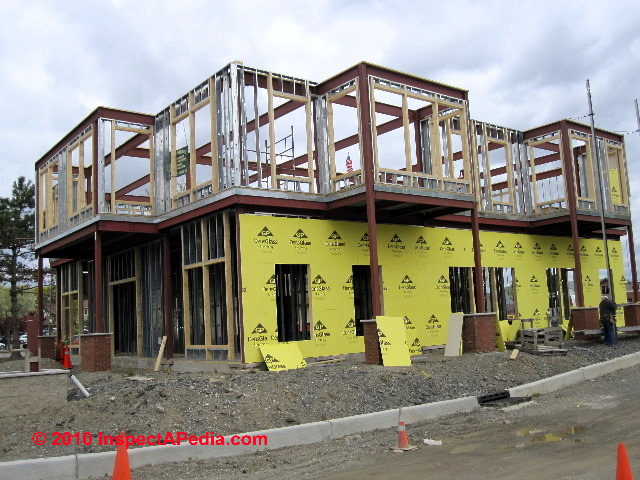
Our page top photo shows a metal stud-wall framed building (Dunkin Donuts) being constructed in Freedom Plains, NY.
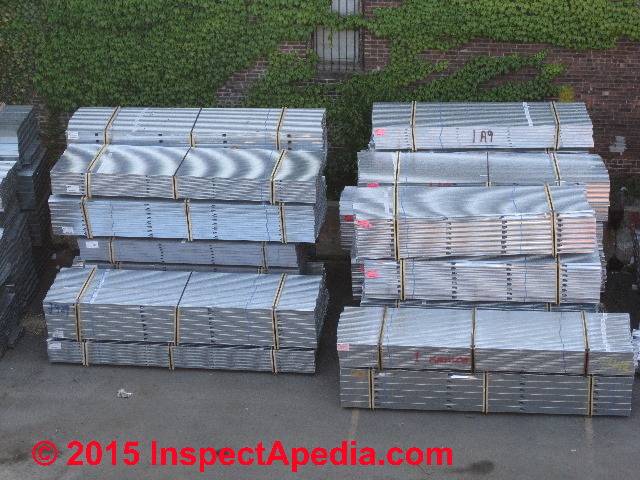
In the steel stud photo just above metal studs remain banded and on pallets waiting for use at a New York City High Line jobsite.
Thermal Properties of Metal Stud-Framed Walls
Question:
Commercial buildings are often required by code to be constructed using metal studs. I have been unable to find accurate thermal conduction values for metal studs in exterior building walls.
Do you know of any test data giving effective R-values for nominal 2x4 and 2x6 metal stud walls framed on 16- and 24-inch centers with fiberglass batts in the wall cavities?
- Thomas Anderson, IKM SGE, Inc., Architects, Engineers, and Interior Designers, Pittsburgh, PA.
Answer: Two Studies Report on Thermal Properties and Heat Loss Characteristics of Metal Stud Walls
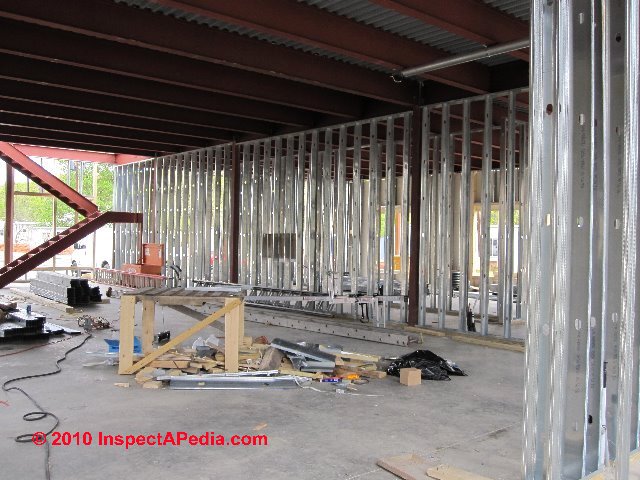
We found what we think are the only two papers on thermal properties of metal stud framed walls. They draw different conclusions.
In the first, written in 1972, J.R. Sasaki of the International Research Council of Canada concluded that metal stud wall R-values were 9 to 13 percent less than the R-value as calculated by the ASHRAE Zone Method. The ASHRAE Zone Method uses a weighted average of the U-Values.
See INSULATION R-VALUES & PROPERTIES and
see HEAT LOSS R U & K VALUE CALCULATION) of individual elements to calculate the thermal resistance of a multi-component system such as a stud wall.
Sasaki attributed the differences to convective heat transfer in the stud space or convective air exchange through the insulation. The walls in his test, however, were unlike more recent insulated building walls: they had only 2 inches of fiberglass insulation in a 3 1/2" stud cavity.
That design leaves an open air space that invites in-wall-cavity convection currents.
The very large heat losses that can occur with in-wall convection currents is discussed
at ENERGY SAVINGS RETROFIT CASE STUDY and "solved"
at ENERGY SAVINGS RETROFIT LEAK SEALING GUIDE - Ed.]
The second study of metal framed stud wall thermal properties was completed in the 1980's and used modern materials. Donald Larson and Bakhtier Farouk at Drexel University in Philadelphia measured heat flow through a wall built of foil-faced R-11 fiberglass, 1/2-inch drywall, and 0.02-inch-thick steel studs spaced at 16-inches on center.
Using a portable 4-foot-square test plate, they found the wall R-value to be 43-percent lower than that determined by a simple one-dimensional calculation.
The discrepancy, they speculate, was due to increased lateral heat flow through the flanges of the metal stud.
Thermal short-circuit ng was made worse by the foil facing on the insulation.
Larson and Farouk concluded with a note of caution, saying that the test method needed further assessment.
Standard design booklets for metal-stud buildings list R-values for the insulation only - they ignore the metal studs altogether. -- S Bliss.
The question-and-answer article about the thermal properties of metal stud-framed walls, quotes-from, updates, and comments an original article from Solar Age Magazine and written by Steven Bliss.
The link to the original Q&A article in PDF form immediately below is preceded by an expanded/updated online version of this article.
- Q&A on Metal-Stud Performance - PDF version, use your browser's back button to return to this page. Original article, Solar Age Magazine, September 1985, adapted and updated for InspectAPedia.com November 2010.
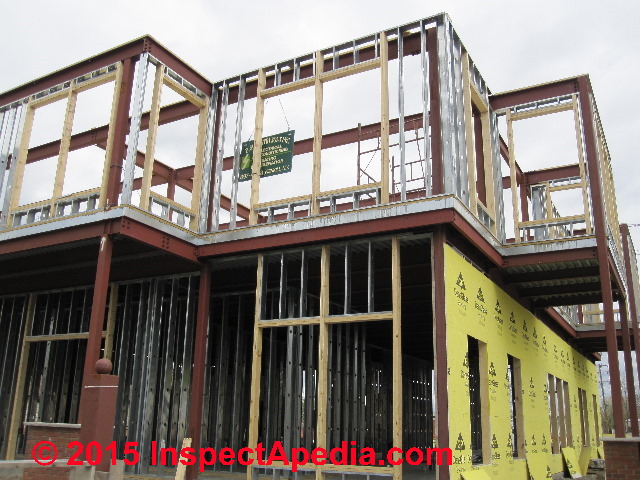
The steel stud-framed building underway above is shown after completion below.
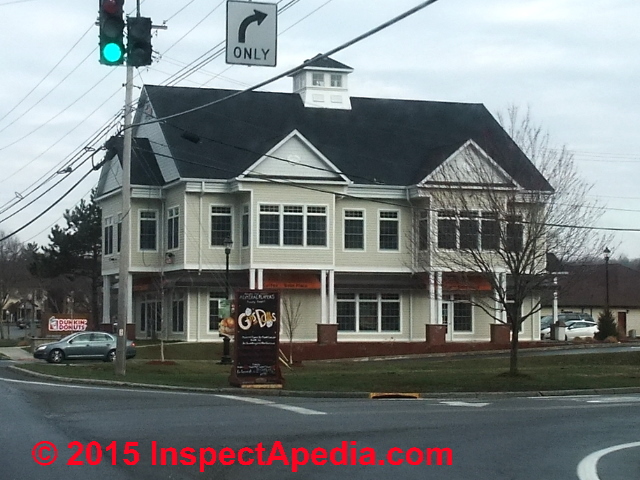
This EIFS-Steel-Stud-framed building is located in Freedom Plains (Dutchess County) NY.
Metal_Stud_Energy_Efficiency.php
...
Continue reading at ENERGY SAVINGS in BUILDINGS - topic home, or select a topic from the closely-related articles below, or see the complete ARTICLE INDEX.
Or see these
Recommended Articles
Suggested citation for this web page
FRAMING METAL STUD PERFORMANCE at InspectApedia.com - online encyclopedia of building & environmental inspection, testing, diagnosis, repair, & problem prevention advice.
Or see this
INDEX to RELATED ARTICLES: ARTICLE INDEX to BUILDING ENERGY SAVINGS
Or use the SEARCH BOX found below to Ask a Question or Search InspectApedia
Ask a Question or Search InspectApedia
Try the search box just below, or if you prefer, post a question or comment in the Comments box below and we will respond promptly.
Search the InspectApedia website
Note: appearance of your Comment below may be delayed: if your comment contains an image, photograph, web link, or text that looks to the software as if it might be a web link, your posting will appear after it has been approved by a moderator. Apologies for the delay.
Only one image can be added per comment but you can post as many comments, and therefore images, as you like.
You will not receive a notification when a response to your question has been posted.
Please bookmark this page to make it easy for you to check back for our response.
IF above you see "Comment Form is loading comments..." then COMMENT BOX - countable.ca / bawkbox.com IS NOT WORKING.
In any case you are welcome to send an email directly to us at InspectApedia.com at editor@inspectApedia.com
We'll reply to you directly. Please help us help you by noting, in your email, the URL of the InspectApedia page where you wanted to comment.
Citations & References
In addition to any citations in the article above, a full list is available on request.
- Solar Age Magazine was the official publication of the American Solar Energy Society. The contemporary solar energy magazine associated with the Society is Solar Today. "Established in 1954, the nonprofit American Solar Energy Society (ASES) is the nation's leading association of solar professionals & advocates. Our mission is to inspire an era of energy innovation and speed the transition to a sustainable energy economy. We advance education, research and policy. Leading for more than 50 years. ASES leads national efforts to increase the use of solar energy, energy efficiency and other sustainable technologies in the U.S. We publish the award-winning SOLAR TODAY magazine, organize and present the ASES National Solar Conference and lead the ASES National Solar Tour – the largest grassroots solar event in the world."
- Steve Bliss's Building Advisor at buildingadvisor.com helps homeowners & contractors plan & complete successful building & remodeling projects: buying land, site work, building design, cost estimating, materials & components, & project management through complete construction. Email: info@buildingadvisor.com
Steven Bliss served as editorial director and co-publisher of The Journal of Light Construction for 16 years and previously as building technology editor for Progressive Builder and Solar Age magazines. He worked in the building trades as a carpenter and design/build contractor for more than ten years and holds a masters degree from the Harvard Graduate School of Education. Excerpts from his recent book, Best Practices Guide to Residential Construction, Wiley (November 18, 2005) ISBN-10: 0471648361, ISBN-13: 978-0471648369, appear throughout this website, with permission and courtesy of Wiley & Sons. Best Practices Guide is available from the publisher, J. Wiley & Sons, and also at Amazon.com - Advanced Energy Design Guides for Commercial buildings, developed by ASHRAE, DOE, AIA, IESNA, USGBC
- The ASHRAE Advanced Energy Design Guide for Small Office buildings—Office buildings up to 20,000 sq.ft.2
- The ASHRAE Advanced Energy Design Guide for Small Retail buildings—Retail Spaces up to 20,000 sq.ft.2
- ASHRAE Design Guide, Advanced Energy Design Guide for K-12 School buildings, 6/11/2008, This is an ASHRAE Design Guide. Design Guides are developed under ASHRAE’s Special Publication procedures and are not consensus documents. This document is an application manual that provides voluntary recommendations
for consideration in achieving greater levels of energy savings relative to minimum standards. American Society of Heating, Refrigerating and Air-Conditioning Engineers, The American Institute of Architects, Illuminating Engineering Society of North America, U.S. Green Building Council, U.S. Department of Energy - The ASHRAE 30% Advanced Energy Design Guide for Small Warehouses and Self-Storage buildings—Warehouses up to 50,000 ft.2 and self-storage buildings that use unitary heating and air-conditioning.
- Technical Support Document: Development of the Advanced Energy Design Guide for Medium Box Retail—50% Energy Savings - original source: http://www.nrel.gov/docs/fy08osti/42828.pdf
- Technical Support Document: Development of the Advanced Energy Design Guide for Grocery Stores—50% Energy Savings, E.T. Hale, D.L. Macumber, N.L. Long, B.T. Griffith, K.S. Benne, S.D. Pless, and P.A. Torcellini, NREL Technical Report TP-550-42820 September 2008 - original source http://www.nrel.gov/docs/fy08osti/42829.pdf
- ASHRAE: "Indoor Air Quality (IAQ) ASHRAE Standard", Ranish Joshi, Arctic India Sales, reviews the basics of IAQ, emphasizes the importance of both source control and removal of contaminants when improving indoor air quality, warns about bringing inside contaminants from outdoors, and reviews the pertinent ASHRAE IAQ standards for buildings.
- "ASHRAE Fresh Air Ventilation System", Jie Chen et als, describes a fresh air ventilation system designed to meet ASHRAE 62.2P Standard.
- "Updated ASHRAE 90.1 Energy Code May Help
Maximize The Benefits Of Energy Efficient
Technologies", Lindsay Audin, Building Operating Management, May 2005, discusses ASHRAE Standard ASHRAE 90.1-2004, the latest version of ASHRAE's energy code, encompassing updates to the ASHRAE 90.1-2001 standard.
"Written to allow easy incorporation into specifications for new buildings and renovations, 90.1-2004 lays out minimum requirements for a building’s envelope, electrical power systems and equipment, lighting, heating, Ventilation and air conditioning, service, water heating, and energy management. Under the 1992 federal Energy Policy Act (EPAct), ASHRAE 90.1 was mandated as the basis for all state building codes as they affect energy use, starting with ASHRAE 90.1-1989.
Under EPAct, the 1999 version became law in July 2004, but has yet to be adopted by all states. Since the 1999 version was somewhat dated by the time it became a requirement, some states, especially those having high energy prices, have already updated their building codes to the 2001 version. Some states and cities, such as Phoenix, are now going further by leapfrogging the 2001 edition and enacting part or all of the 2004 edition instead." - Desmex Solar, Blvd. José Ma. Morelos 3649, Col. Purísima de Jerez, León, Gto. C.P.37290 Tel. +52 (477) 788 06 00, Fax. +52 (477) 771 10 02, e-mail: leon@desmexsolar.com: website http://www.desmexsolar.com/ Additional offices in San Miguel de Allende, Guanajuato, Mexico - Carretera a Celaya Km. 1, Plaza Alhóndiga Local 14 (1M), Frente a Mega Comercial Mexicana, San Miguel de Allende, Gto. Tel: +52 (415) 150 73 12 e-mail: sanmiguel@desmexsolar.com, Guadalajara, Mexico - +52 (33) 3165-2454 e-mail: guadalajara@desmexsolar.com, Monterrey Mexico - Tel. +52 (818) 356 43 30 e-mail: monterrey@desmexsolar.com, and Mexico City - Tel. +52 (55) 2643 26 29, Fax. +52 (477) 771 10 02 e-mail: mexico@desmexsolar.com
- "Energy Efficient Lab Design", Nicolas Lemire, Eng., Member ASHRAE, and Roland Charneux, Eng., Fellow ASHRAE, American Society of Heating, Refrigerating and Air-Conditioning Engineers, Inc. (www.ashrae.org). Reprinted by permission
from ASHRAE Journal, (Vol. 47, No. 5, May 2005). ©ASHRAE - Christmas in April program - see Rebuilding Together at their website, rebuildingtogether.org or contact Rebuilding Together National Headquarters, 1899 L Street NW, Suite 1000, Washington DC 20036 - 800-473-4229,
- Energy Star Program - see the Energy Star website at energystar.gov/index.cfm?c=bldrs_lenders_raters.energy_efficient_mortgage
- Habitat for Humanity, for the U.S. and Canada: http://www.habitat.org/ also has offices in other countries including supporting Latin America.
- Renewable Energy Sources, US EPA List: original source - see "Onsite Renewable Technologies", U.S. EPA at http://www.epa.gov/greeningepa/energy/renewtech.htm
- In addition to citations & references found in this article, see the research citations given at the end of the related articles found at our suggested
CONTINUE READING or RECOMMENDED ARTICLES.
- Carson, Dunlop & Associates Ltd., 120 Carlton Street Suite 407, Toronto ON M5A 4K2. Tel: (416) 964-9415 1-800-268-7070 Email: info@carsondunlop.com. Alan Carson is a past president of ASHI, the American Society of Home Inspectors.
Thanks to Alan Carson and Bob Dunlop, for permission for InspectAPedia to use text excerpts from The HOME REFERENCE BOOK - the Encyclopedia of Homes and to use illustrations from The ILLUSTRATED HOME .
Carson Dunlop Associates provides extensive home inspection education and report writing material. In gratitude we provide links to tsome Carson Dunlop Associates products and services.
 | HOME | ABOUT | ASK a QUESTION | CONTACT | CONTENT USE POLICY | DESCRIPTION | POLICIES | PRIVACY | |
| © 2025 - 1985 Publisher InspectApedia.com - Daniel Friedman | |||||||||