
InspectAPedia® FREE Encyclopedia of Building & Environmental Construction, Diagnosis, Maintenance & Repair |
Question? Just ask us! InspectAPedia
|
 Window Efficiency Features
Window Efficiency Rating Guide
- POST a QUESTION or COMMENT about window efficiency ratings - how to translate the numbers on building window stickers and labels into efficiency or energy performance
Window efficiency ratings: this article explains window efficiency and efficiency ratings, as well as specific features in window selection and installation that affect the window's energy efficiency.
InspectAPedia tolerates no conflicts of interest. We have no relationship with advertisers, products, or services discussed at this website.
Guide to Window Efficiency Features & Ratings
 In this article series we discuss the selection and installation of windows and doors, following best construction and design practices for building lighting and ventilation, with attention to the impact on building heating and cooling costs, indoor air quality, and comfort of occupants.
[Click to enlarge any image, photo, or table]
We review the proper installation details for windows and doors, and we compare the durability of different window and door materials and types. This article includes excerpts or adaptations from Best Practices Guide to Residential Construction (Steve Bliss, J Wiley & Sons) , by Steven Bliss, courtesy of Wiley & Sons.
Windows have a large impact on a home’s energy consumption, accounting for up to 25% of a typical home’s heating bills in cold climates and up to 50% of cooling bills in hot climates, according to the Environmental Protection Agency’s (EPA) Energy Star program. Even the best windows, with an R-value of 3 to 4, are thermal holes compared to today’s average R-19 wall. In addition to conductive heat losses, older windows add substantially to a home’s air leakage.
Beyond fuel bills, windows can also have a dramatic effect on occupant comfort. Sitting next to a leaky single glazed window in winter will make an occupant feel cold regardless of the thermostat setting, due to both cold drafts and to radiant heat losses from his or her body to the window surface.
Cold window surfaces also cause condensation, potentially leading to mold, peeling paint, and wood decay of window components. (Also see CONDENSATION or SWEATING PIPES, TANKS and DEW POINT TABLE - CONDENSATION POINT GUIDE as well as HUMIDITY LEVEL TARGET.)
Energy Certification for Windows
Evaluating a window’s energy performance is a complex task that has been made a lot simpler by two programs developed in a collaborative effort between government and industry. The groups have developed standardized testing procedures and ratings, and provide simple recommendations based on climate zone.
The NFRC Label for Windows
The National Fenestration Rating Council (NFRC), with support from the U.S. Department of Energy, created test procedures and rating systems for the energy performance of windows, glazed doors, and skylights. Any window making energy claims without an NFRC label should be avoided.
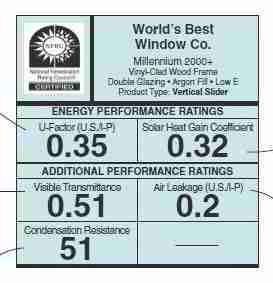
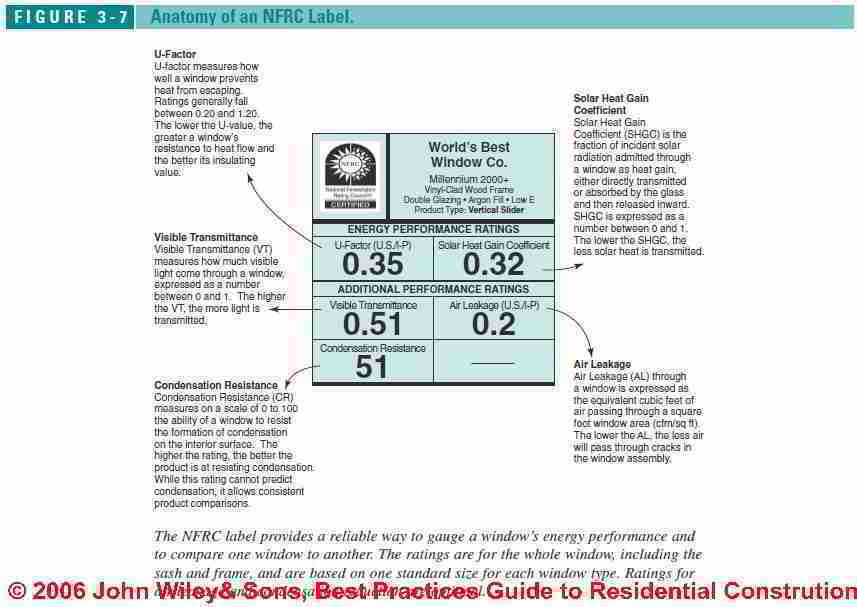
For every window, the NFRC label rates the U-factor, Solar-Heat-Gain Coefficient (SHGC), and Visible Transmittance (VT). Air Leakage (AL) and Condensation Resistance (CR) are optional ratings. The ratings are explained briefly in Figure 3-7 and in more detail in the following sections. Ratings should appear on the window label when delivered but can also be found on the NFRC website at www.nfrc.org.
Whole Window Energy Ratings
It is important to note that NFRC ratings apply to the entire window, including the sash and the frame. NFRC uses a single standard size to simplify testing and to make it easier for consumers to make apples-to-apples comparisons between windows.
The actual energy performance of windows significantly larger or smaller than the standard test size will vary somewhat from the label since the relative effect of the glass edge and frame is greater on smaller windows.
Glass-Only Ratings on Window Energy
Where glass-only ratings are needed, for example, for passive solar design, these can usually be obtained from the window manufacturer or the manufacturer of the insulated glass unit (IGU) installed in the window or door.
Energy Star Label for Windows
Launched by the U.S. EPA to promote the use of energy-efficient appliances and equipment, the Energy Star label was added to doors, windows, and skylights in 1998. An Energy Star Label certifies that the window or skylight meets the U.S. Department of Energy’s (DOE) energy guidelines for the climate zones listed on the label (see Table 3-3 below).
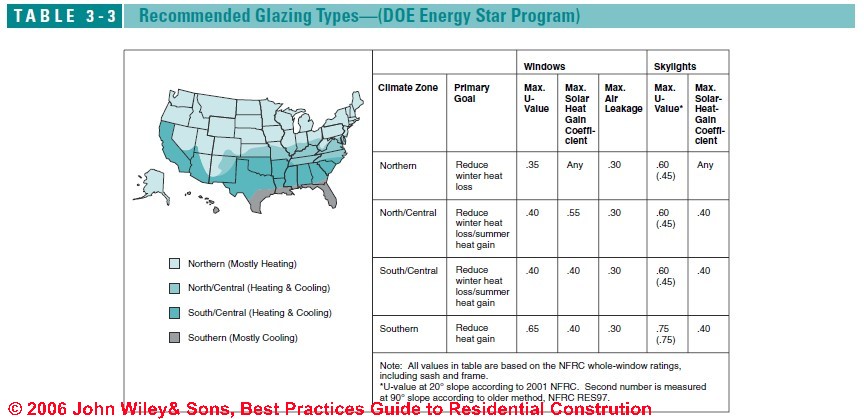
For windows without the label, you can still use the Energy Star guidelines in Table 3-3 (above) as a selection guide. Remember that these guidelines are based on NFRC whole-window ratings, not just the glass. For cold-climate buildings designed to use passive-solar heating, look for a whole-window SHGC of .55 or above.
Window U-Factor
A window’s ability to conduct heat (not including solar effects) is usually given as a U-factor or U-value. The lower the U-value, the more insulation value a window provides. Low U-values have the biggest impact in heating dominated climates but help reduce cooling loads as well. For climates with substantial heating or cooling loads, choose a total window U-value of .35 or less. The U-value is the inverse of the more familiar R-value.
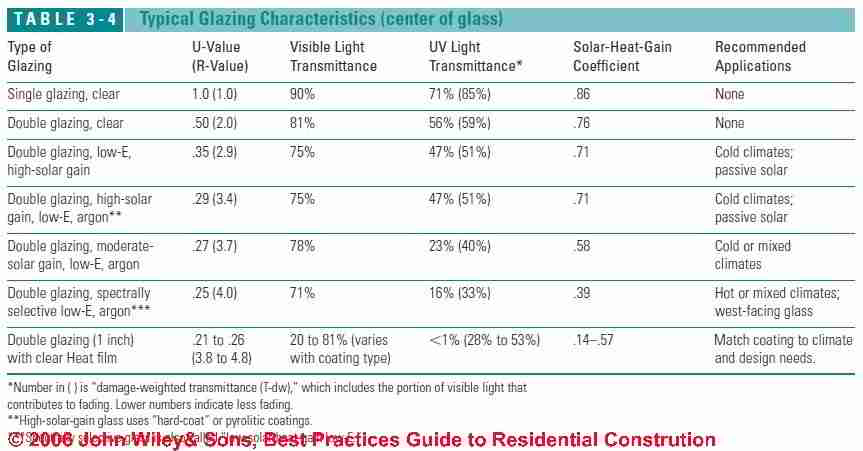
For example, standard double glazing has a center- of-glass U-value of about .5, which equals an R-value of 2 (1/0.5). Typical glazing U-values are shown in Table 3-4 (below). U-values for the entire window, however, must take into account the edge spacers, sash, and frame, as discussed below.
The NFRC (National Fenestration Council) in discussing solar heat gain at windows, describes the U-Factor (U) as follows:
U-Factor measures how well a product prevents heat from escaping a home or building. U-Factor ratings generally fall between 0.20 and 1.20. The lower the U-Factor, the better a product is at keeping heat in. U-Factor is particularly important during the winter heating season. This label displays U-Factor in U.S. units. Labels on products sold in markets outside the United States may display U-Factor in metric units.
Also see DEFINITION of HEATING, COOLING & INSULATION TERMS for discussion and definitions of R, U, and K Factors in building heat loss, heat loss resistance, and insulation values.
Gas Filled Window Glazings
Filling low-E coated glass with the inert gas argon or krypton will reduce heat loss through the glass by 10 to 15%. Krypton outperforms argon somewhat, but it is usually not enough to justify the higher cost.
Since argon fill is now available on most low-E windows for little or no cost, getting the boost in R-value is always a good idea. In addition to reducing heat loss, it increases the temperature of the inside surface of the window, improving comfort and reducing condensation.
Studies indicate that about 10% of the gas will leak out of a well-built sealed glass unit in about 20 years.
Also see SUNGAIN, FILMS, LOW-E GLASS.
Also see CONDENSATION or SWEATING PIPES, TANKS
and DEW POINT TABLE - CONDENSATION POINT GUIDE
as well as HUMIDITY LEVEL TARGET
Sash and Frame Effects on Window Energy Ratings & U-Value
The U-value of the entire window, as reported on NFRC labels, includes the effects of the glass edge, sash, and frame.With high-R glass, standard edge and frame materials often lower than the overall R-value compared to the center-of-glass measure.
Aluminum sash and frames without thermal breaks are the worst, contributing to both thermal losses and condensation in cold climates.
Thermally broken metal frames are better but should still be avoided in cold climates.Wood and hollow vinyl or fiberglass components all have moderately good thermal properties. Insulated vinyl and fiberglass frames offer the best thermal performance (Table 3-5).
Warm-Edge Spacers Effect on Window Energy Ratings

[Click to enlarge any image, photo, or table]
Because of their high thermal conductivity, standard aluminum edge spacers lower the insulating value of insulated glass units (IGUs) and often cause condensation along the bottom of the window. The loss of insulation value is more pronounced in very high R-value windows and small windows where the window edge accounts for a larger proportion of the window area.
Starting in the mid-1980s, manufacturers have responded with a variety of innovative solutions that are now used in about half of all new IGUs.
Solutions include using less conductive metals with an improved shape (PPG’s Intercept Spacer) or switching to a plastic or synthetic rubber spacer with little or no metal content (TruSeal’s Swiggle Seal or EdgeTech’s Super Spacer). Warm-edge windows can raise the glass temperature at the perimeter of the window by 6°F to 8°F, significantly reducing the condensation potential.
The biggest risk in using a new edge technology is that the seal will fail prematurely, resulting in a fogged unit. To guard against this, it is best to stick with a technology that has proven itself in the marketplace and is backed by a good warranty and a reliable window manufacturer.
(Also see CONDENSATION or SWEATING PIPES, TANKS
and DEW POINT TABLE - CONDENSATION POINT GUIDE
as well as HUMIDITY LEVEL TARGET.)
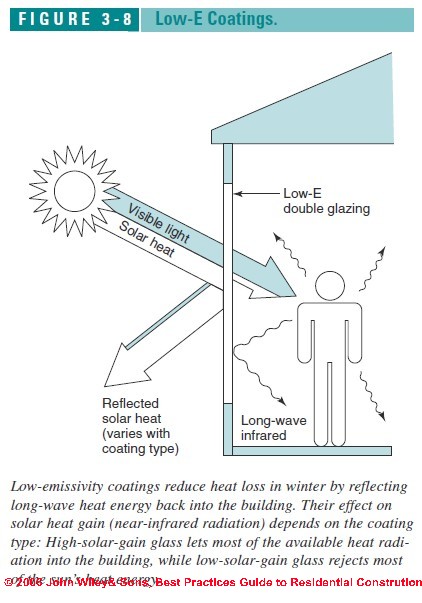
Low-emissivity, or “low-E,” coatings are microscopically thin metallic coatings applied to a glass surface, which reflect back radiant heat.
Different low-E coatings transmit different amounts of visible light, short-wave and longwave infrared, and ultraviolet radiation (Figure 3-8 at left).
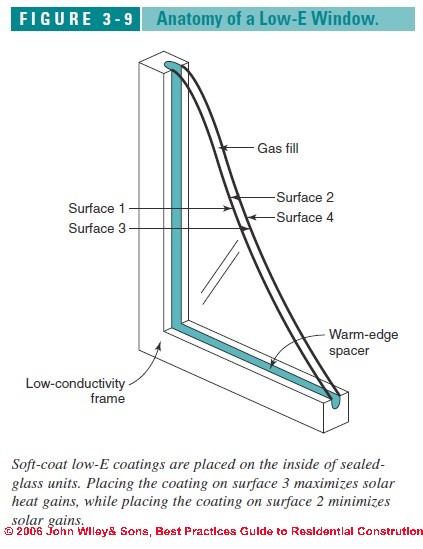
The most common type, called “soft coat” low-E, is applied to one of the inner surfaces of sealed insulated glass units (Figure 3-9 at left).
Hard-coat, or “pyrolitic,” low-E, which has a slightly lower R-value, is used in high-solar-gain glass and can also be used on storm windows and other removable glass panels exposed to the air.
Low-E window glass coatings can also be applied to a clear polyester film, called Heat Mirror, which is suspended between two panes of sealed glass, yielding insulation values as high as R-5 with one layer of film or R-8 with two layers.
Also see SUNGAIN, FILMS, LOW-E GLASS.
Spectrally Selective Low-E Windows
The newest generation of low-E glazing, often referred to as “spectrally selective,” provides an ideal combination of high R-values, low heat gain, and high-visible-light transmittance.
Spectrally selective windows generally outperform all other window types in mixed and hot climates, but they reap the greatest benefit in homes with significant cooling loads.
Because of their high insulation value, spectrally selective windows even perform well in cold climates, particularly in homes with significant air-conditioning loads or large amounts of west facing glass (see Window Orientation).
One exception is a house designed to use passive solar gain in winter, which would perform better with high-solar-gain glass.
See SUNGAIN, FILMS, LOW-E GLASS.
- American Architectural Manufacturers Association (AAMA) www.aamanet.org
- Efficient Windows Collaborative www.efficientwindows.org
- National Fenestration Rating Council (NFRC) www.nfrc.org Sustainable by Design www.susdesign.com
- Shareware calculators for sun angles, solar heat gain, and shading
- Window and Door Manufacturers Association (WDMA) www.wdma.com
-- Adapted and paraphrased, edited, and supplemented, with permission from Best Practices Guide to Residential Construction (Steve Bliss, J Wiley & Sons) .
Reader Question: our Low-E Argon-Filled Bonneville™ windows & doors seem to be gaining too much heat - can you help us figure out what's going on?
We started construction on a new home in Riva, MD near Annapolis in 2011. This is a second home so we are generally there only on the weekends. We purchased our Low-e windows and doors from Architectural Window Supply (AWS) in Annapolis
. On the recommendation of the owner of AWS we purchased low-e, argon gas filled Bonneville windows and doors - and paid cash up front. Bonneville ceased operations and eventually filed for bankruptcy after we ordered our windows and doors. Fortunately, with the help of the owner of Architectural Window Supply we were able to get most of our windows and doors. The house was completed in June 2012.
Our question concerns the efficiency – or more accurately the ‘inefficiency’ – of the windows. here is a quick summary:
- We have a ‘great room’ that faces southeast and gets direct sun from sunrise until about 1PM.
- We noticed the great room is extremely hot in the morning – during all seasons. Our cooling bill (geothermal) was huge last summer.
- On Saturday, March 9, 2013 we put a thermometer by one of the inside windows in the great room. It was mostly overcast but there was occasional sun and the high temperature outside for the day was 51 degrees.
- At 11AM the thermometer in the great room by the window glass read 102.
- The following day at 11AM the thermometer read 104. The high temperature outside for the day was 57 degrees.
So we are looking to understand why it gets so hot inside our great room. Can you help us understand this issue – or recommend someone we can pose this question to?
Reply from Steven Bliss (www.buildingadvisor.com)
A few comments & suggestions:
It would be useful to know the energy specifications of the windows used. Most windows come with an NFRC label showing the U-factor, solar-heat-gain coefficient (SHGC), and other data.
The typical low-e window with argon has a U-factor of around .32 – equivalent to an R-value of about 3. An average wall today, by comparison, has an R-value of 19 or more, so the best window offers much less insulation than an average wall. The argon increases the insulation value by about 10%, and has only a negligible effect on solar heat gain. Unless these are high-solar-gain windows, it is unlikely that the type of windows are responsible for the overheating, since typical low-e windows let in a lot less solar heat gain than double clear glass (if you can even buy those nowadays).
The problem is more likely due to the amount of glass, size of room, and level of insulation. New homes with tight construction and high levels of insulation are easy to overheat when too much solar gain enters the building.
A window’s solar gain is measured by the Solar Heat Gain Coefficient (SHGC). The higher the number, the greater to solar gain into the house. Low-e glass can be engineered for low, medium, or high solar gain. In southern and central states, the US DOE (in its Energy Star program) recommends that glass have a SHGC of .30 or less. In hot climates, or in houses with lots of east-facing and west-facing glass, heat-reflecting glass with a SHGC of under .25 is often the best choice.
The problem with too much east- and west-facing glass is that in spring, summer, and fall, the sun strikes this glass at a low angle, increasing the solar gain and making it difficult to shade. I don’t know how much southeast glass this house has, but apparently it has too much for thermal comfort. Short of removing windows or replacing them with low solar-gain glass, some options are:
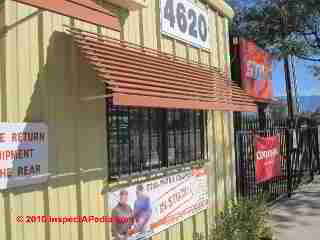
- Install shades or awnings, preferable with a heat-reflective surface facing the exterior.
The most effective location for shades is outside of the window, like awnings or old-fashioned shutters. To be effective on east or west glass, awnings “drop” must extend down to 65 to 75 % of the window (vs 45 to 60 % for south windows).
See any or all of these articles for more details
- PASSIVE SOLAR Roof & Window Overhangs
- SOLAR SHADES, LOW-E EFFECTIVENESS
- WINDOW SHADING, SCREENING
Our photo (above left) illustrates an effective awning installed in Tucson, AZ.
- Install solar screens, which block solar gain but still allow views. Like other shades, these are more effective on the exterior side of the window.
See SOLAR SHADES & SUNSCREENS for details - Install heat-blocking window films directly to the glass. Most of these have a tint.
- Install low-e storm windows, which use a special “hard-coat” low-e that can be exposed to moisture. Low-e windows will block solar heat gain better than standard storm windows.
- Not to mention, open the windows -- assuming they are operable!
Which solution is right for you depends on your budget and design preferences. A designer or architect experienced in passive solar design can help you select the right product and calculate how much benefit each product will provide.
As for the temperature readings you are getting, if the thermometer is in direct sunlight, you are not getting an accurate measure of the air temperature in the room.
Steven Bliss
Burlington, VT 05401
...
Continue reading at WINDOW GLAZING BASED on CLIMATE or select a topic from the closely-related articles below, or see the complete ARTICLE INDEX.
Or see these
Recommended Articles
- WINDOWS & DOORS, AGE, TYPES - home
- SKYLIGHT ENERGY EFFICIENCY
- WINDOWS & DOORS, AGE, TYPES
- WINDOW / DOOR AIR LEAK SEALING HOW TO
- WINDOW / DOOR ENERGY EFFICIENT, DOE
- WINDOW EFFICIENCY FEATURES & RATINGS
- WINDOW GLAZING BASED on CLIMATE
- WINDOW SHADING, SCREENING
- WINDOW TYPES - Photo Guide
Suggested citation for this web page
WINDOW EFFICIENCY FEATURES & RATINGS at InspectApedia.com - online encyclopedia of building & environmental inspection, testing, diagnosis, repair, & problem prevention advice.
Or see this
INDEX to RELATED ARTICLES: ARTICLE INDEX to DOORS & WINDOWS
Or use the SEARCH BOX found below to Ask a Question or Search InspectApedia
Ask a Question or Search InspectApedia
Questions & answers or comments about window efficiency ratings - how to translate the numbers on building window stickers and labels into efficiency or energy performance.
Try the search box just below, or if you prefer, post a question or comment in the Comments box below and we will respond promptly.
Search the InspectApedia website
Note: appearance of your Comment below may be delayed: if your comment contains an image, photograph, web link, or text that looks to the software as if it might be a web link, your posting will appear after it has been approved by a moderator. Apologies for the delay.
Only one image can be added per comment but you can post as many comments, and therefore images, as you like.
You will not receive a notification when a response to your question has been posted.
Please bookmark this page to make it easy for you to check back for our response.
Our Comment Box is provided by Countable Web Productions countable.ca
Citations & References
In addition to any citations in the article above, a full list is available on request.
- Basic Housing Inspection, US DHEW, S 352.75 U48, p.144, out of print, but is available in most state libraries; New York State version, ca 1955, source of our window parts and window repair sketches.
- Best Practices Guide to Residential Construction, by Steven Bliss. John Wiley & Sons, 2006. ISBN-10: 0471648361, ISBN-13: 978-0471648369, Hardcover: 320 pages, available from Amazon.com and also Wiley.com. See our book review of this publication.
- "Solar Heat Gain & Windows, the facts about", NFRC, National Fenestration Rating Council, January 2005, NFRC website: www.nfrc.org retrieved 12/4/2010, original source: http://www.nfrc.org/documents/SolarHeatGain.pdf.
- Our recommended books about building & mechanical systems design, inspection, problem diagnosis, and repair, and about indoor environment and IAQ testing, diagnosis, and cleanup are at the InspectAPedia Bookstore. Also see our Book Reviews - InspectAPedia.
- Decks and Porches, the JLC Guide to, Best Practices for Outdoor Spaces, Steve Bliss (Editor), The Journal of Light Construction, Williston VT, 2010 ISBN 10: 1-928580-42-4, ISBN 13: 978-1-928580-42-3, available from Amazon.com
- The Journal of Light Construction has generously given reprint permission to InspectAPedia.com for adaptations, quotations, or reproductions used at this website. All rights and contents of the JLC material are ©Journal of Light Construction and may not be reproduced in any form.
- In addition to citations & references found in this article, see the research citations given at the end of the related articles found at our suggested
CONTINUE READING or RECOMMENDED ARTICLES.
- Carson, Dunlop & Associates Ltd., 120 Carlton Street Suite 407, Toronto ON M5A 4K2. Tel: (416) 964-9415 1-800-268-7070 Email: info@carsondunlop.com. Alan Carson is a past president of ASHI, the American Society of Home Inspectors.
Thanks to Alan Carson and Bob Dunlop, for permission for InspectAPedia to use text excerpts from The HOME REFERENCE BOOK - the Encyclopedia of Homes and to use illustrations from The ILLUSTRATED HOME .
Carson Dunlop Associates provides extensive home inspection education and report writing material. In gratitude we provide links to tsome Carson Dunlop Associates products and services.
 | HOME | ABOUT | ASK a QUESTION | CONTACT | CONTENT USE POLICY | DESCRIPTION | POLICIES | PRIVACY | |
| © 2024 - 1985 Publisher InspectApedia.com - Daniel Friedman | |||||||||