
InspectAPedia® FREE Encyclopedia of Building & Environmental Construction, Diagnosis, Maintenance & Repair |
Question? Just ask us! InspectAPedia
|
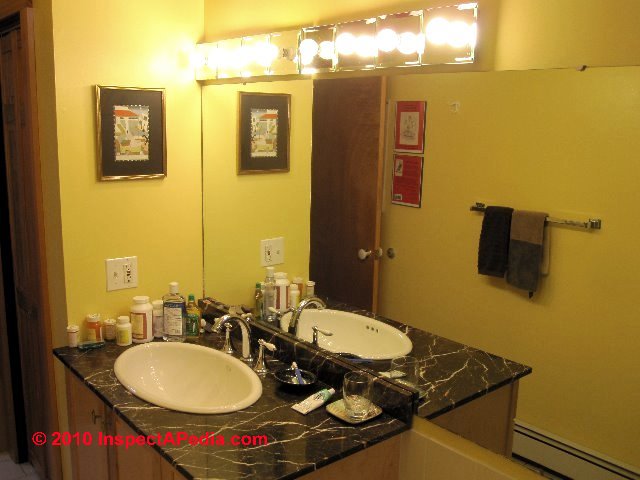 Guide to Bathroom Lighting Locations, Levels, Types
- POST a QUESTION or COMMENT about lighting specifications for bathrooms
Bathroom lighting design specifications:
This article gives guidelines for lighting location, strength, and safety for bathrooms. This article series details guidelines for selecting and installing interior lighting to meet the requirements for different building areas.
InspectAPedia tolerates no conflicts of interest. We have no relationship with advertisers, products, or services discussed at this website.
- Daniel Friedman, Publisher/Editor/Author - See WHO ARE WE?
Bathroom Lighting Guidelines
 This article includes excerpts or adaptations from Best Practices Guide to Residential Construction (Steve Bliss, J Wiley & Sons) , by Steven Bliss, courtesy of Wiley & Sons.
Also see LIGHTING, INTERIOR GUIDE our home page for information about all lighting topics relating to building interiors.
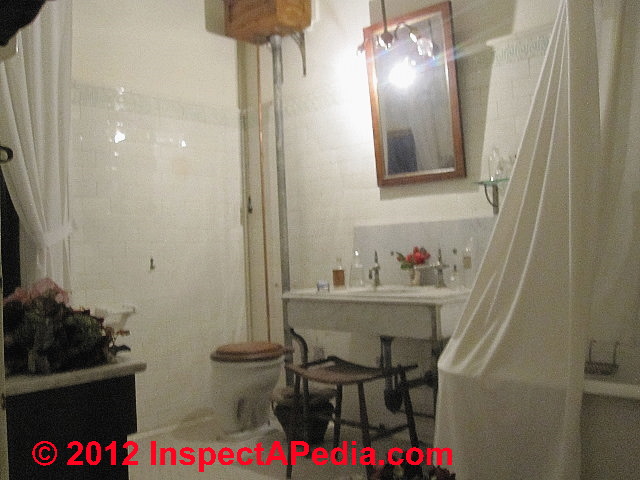
Photo above: bathroom lighting in the historic Samuel Morse home in Poughkeepsie, New York.
Bathroom Mirror Lighting Recommendations
Good lighting is critical at the bathroom mirror for shaving, makeup, and other tasks of personal hygiene.
For optimal lighting, place strip lights or globe type light bars at least 16 inches long on each side of the mirror centered at 61 to 64 inches (about the average eye height).
Wall sconces on either side are also an option for smaller mirrors.
These provide even cross lighting without shadows or glare (see Figure 5-23).
Notice in our photo above from Locust Grove,
the Morse home that the placement of a bulb suspended in front of the mirror generates plenty of glare.
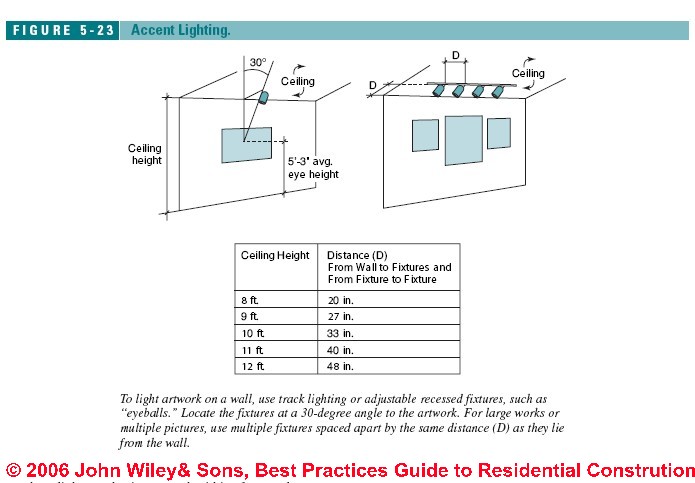
For small mirrors under 30 inches wide, use about 75 watts of incandescent lighting or 20 watts of warm-white fluorescent on each side. For larger mirrors, use up to 150 watts of incandescent or 40 watts of fluorescent on each side. Additional lights across the top of larger mirrors are also helpful.
If using fluorescents, select lamps with high CRIs and warm color temperatures in the 2700K to 3000K range.
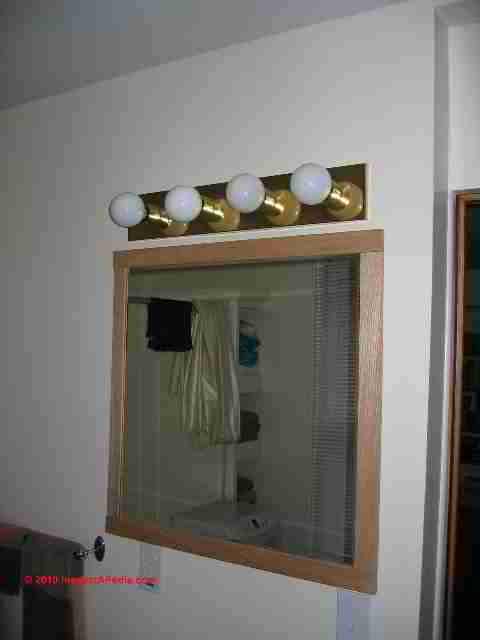
Lighting from above the mirror only using globe-type light bars, a pair of recessed downlights, or a lighting soffit is acceptable as long as the vanity top is a light color.
Otherwise, areas under the eyes, nose, and chin will be in shadow. If recessed fixtures are used, choose an A lamp, flood, or compact fluorescent for a diffused beam.
General Lighting Rules for Bathrooms
As a rule of thumb, provide one watt of incandescent or 1/3 to 1/2 watt of fluorescent light per square foot of floor space. Increase this by 50 to 100% for recessed lights, indirect lighting, or a room with dark surfaces. In a small bathroom, the mirror lights can also provide the ambient light.
For larger baths, a separate ceiling fixture mounted near the tub and toilet can be useful for ambient light and reading.
Finally, in a room with a high ceiling, indirect lighting with coves or uplights can create a feeling of spaciousness in a bathroom, along with a pleasing, soft glow.
Guidelines for Lighting Over Tub and Shower
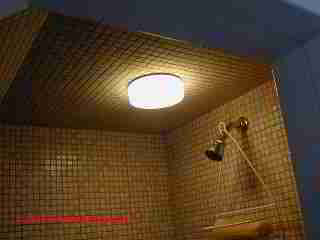 A recessed light with
a white diffuser mounted over the tub or shower will be appreciated
by bathers.
A recessed light with
a white diffuser mounted over the tub or shower will be appreciated
by bathers.
Watch out: Electrical codes require that these fixtures be totally enclosed and rated for use in a damp location (tub area) or wet location (shower). Most bathroom shower light fixture manufacturers require GFCI protection for their UL rating.
In our opinion the shower light fixture installed in the bathroom shown at left is unsafe, using an improper fixture type and lacking ground fault circuit interrupt protection - a shock and fatality risk. It's just too easy for someone to stand on a wet shower floor or touch conductive metal controls or piping (like that shower head) while fooling around trying to change a light bulb.
In addition, fixtures must be at least 6 feet above the water line and switches must be a minimum of 5 feet from the edge of the bathtub or shower.
Really? I [Jim Simmons] could not remember a GFCI requirement for shower recessed cans [recessed light fixtures or "pot lights" - Ed.].
Because there is not one. Code (NEC) says the only time you have to GFCI protect the can is if the manufacturer requires it. Otherwise as long as it is a recessed can (metal or standard trim) it can be over a tub or shower.
Surface fixtures (including track lights or paddle fans) are only allowed if they are at least 8' above the maximum water level or at least 3' away from the tub or shower rim NEC 410.10(D).
Interestingly the requirement does not address wall mounted fixtures!
I still don't understand why you can install a wall mount light in a tub or shower enclosure!- Jim P. Simmons Mr. Electric, Email: mrelectricwa@gmail.com, Website: olympia.mrelectric.com - 3/19/2014
Watch out: Check with local code officials in your own jurisdiction for specific lighting and electrical safety requirements.
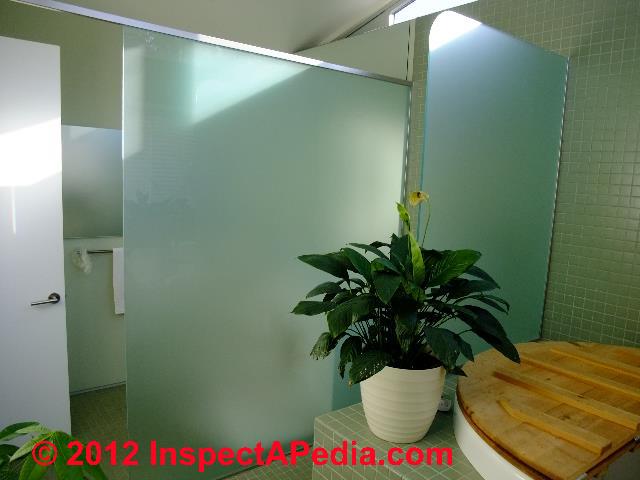
Our photo above illustrates nice use of indirect and rooftop skylight lighting over a walk-in shower in a Minnesota home.
Industry & Trade Associations for Lighting and Other Interior Components in buildings
American Lighting Association www.americanlightingassoc.com
- - Adapted with permission from Best Practices Guide to Residential Construction (Steve Bliss, J Wiley & Sons) .
...
Continue reading at LIGHTING, INTERIOR GUIDE or select a topic from the closely-related articles below, or see the complete ARTICLE INDEX.
Or see these
Recommended Articles
- LIGHTING, INTERIOR GUIDE - home
- BATHROOM LIGHTING GUIDELINES
- BAYONET BASE BULB TYPES
- BULB & LAMP ABBREVIATIONS & CODES
- BULB & LAMP TYPES GUIDE - home
- BULB COLOR TEMPERATURE COMPRARISONS
- BULB & FIXTURE TYPES for SOFFIT
- CLOSET LIGHTING FIRE SAFETY
- ELECTRIC POWER LOSS / FLICKERING LIGHTS
- FLUORESCENT LIGHT REPAIRS
- KITCHEN LIGHTING REQUIREMENTS
- LED BULB & LIGHTING TYPES
- LIGHTING LEVELS INDOORS, RECOMMENDED
- LUMENS DEFINITION COMPARISON
- RECESSED LIGHT CLEARANCES
- RECESSED LIGHT HOUSINGS GUIDE
- RECESSED & TRACK LIGHT USES
- RECESSED & TRACK LIGHT BULB GUIDE
- RECESSED LIGHT FIXTURE TRIM
- RECESSED SOFFIT or ROOF OVERHANG
- SPACING GUIDE for LIGHT FIXTURES
- TABLE TOP LIGHTING
- TASK LIGHTING
- LIGHTING OVER STAIRS & AT EXITS
- PRYNE RECESSED LIGHTS CATALOG 1950 [PDF]
Suggested citation for this web page
BATHROOM LIGHTING GUIDELINES at InspectApedia.com - online encyclopedia of building & environmental inspection, testing, diagnosis, repair, & problem prevention advice.
Or see this
INDEX to RELATED ARTICLES: ARTICLE INDEX to BUILDING LIGHTING
Or use the SEARCH BOX found below to Ask a Question or Search InspectApedia
Ask a Question or Search InspectApedia
Try the search box just below, or if you prefer, post a question or comment in the Comments box below and we will respond promptly.
Search the InspectApedia website
Note: appearance of your Comment below may be delayed: if your comment contains an image, photograph, web link, or text that looks to the software as if it might be a web link, your posting will appear after it has been approved by a moderator. Apologies for the delay.
Only one image can be added per comment but you can post as many comments, and therefore images, as you like.
You will not receive a notification when a response to your question has been posted.
Please bookmark this page to make it easy for you to check back for our response.
IF above you see "Comment Form is loading comments..." then COMMENT BOX - countable.ca / bawkbox.com IS NOT WORKING.
In any case you are welcome to send an email directly to us at InspectApedia.com at editor@inspectApedia.com
We'll reply to you directly. Please help us help you by noting, in your email, the URL of the InspectApedia page where you wanted to comment.
Citations & References
In addition to any citations in the article above, a full list is available on request.
- Steve Bliss's Building Advisor at buildingadvisor.com helps homeowners & contractors plan & complete successful building & remodeling projects: buying land, site work, building design, cost estimating, materials & components, & project management through complete construction. Email: info@buildingadvisor.com
Steven Bliss served as editorial director and co-publisher of The Journal of Light Construction for 16 years and previously as building technology editor for Progressive Builder and Solar Age magazines. He worked in the building trades as a carpenter and design/build contractor for more than ten years and holds a masters degree from the Harvard Graduate School of Education. Excerpts from his recent book, Best Practices Guide to Residential Construction, Wiley (November 18, 2005) ISBN-10: 0471648361, ISBN-13: 978-0471648369, appear throughout this website, with permission and courtesy of Wiley & Sons. Best Practices Guide is available from the publisher, J. Wiley & Sons, and also at Amazon.com - Our recommended books about building & mechanical systems design, inspection, problem diagnosis, and repair, and about indoor environment and IAQ testing, diagnosis, and cleanup are at the InspectAPedia Bookstore. Also see our Book Reviews - InspectAPedia.
- Best Practices Guide to Residential Construction, by Steven Bliss. John Wiley & Sons, 2006. ISBN-10: 0471648361, ISBN-13: 978-0471648369, Hardcover: 320 pages, available from Amazon.com and also Wiley.com. See our book review of this publication.
- In addition to citations & references found in this article, see the research citations given at the end of the related articles found at our suggested
CONTINUE READING or RECOMMENDED ARTICLES.
- Carson, Dunlop & Associates Ltd., 120 Carlton Street Suite 407, Toronto ON M5A 4K2. Tel: (416) 964-9415 1-800-268-7070 Email: info@carsondunlop.com. Alan Carson is a past president of ASHI, the American Society of Home Inspectors.
Thanks to Alan Carson and Bob Dunlop, for permission for InspectAPedia to use text excerpts from The HOME REFERENCE BOOK - the Encyclopedia of Homes and to use illustrations from The ILLUSTRATED HOME .
Carson Dunlop Associates provides extensive home inspection education and report writing material. In gratitude we provide links to tsome Carson Dunlop Associates products and services.
 | HOME | ABOUT | ASK a QUESTION | CONTACT | CONTENT USE POLICY | DESCRIPTION | POLICIES | PRIVACY | |
| © 2025 - 1985 Publisher InspectApedia.com - Daniel Friedman | |||||||||