
InspectAPedia® FREE Encyclopedia of Building & Environmental Construction, Diagnosis, Maintenance & Repair |
Question? Just ask us! InspectAPedia
|
 Table of Common Indoor Air Hazards, Sources, Effects, Remedies
- POST a QUESTION or COMMENT about common indoor air hazards, both biological and non-biological: cause, detection, cure
List of indoor air contaminants & hazards frequently found in buildings:
Here we provide a table listing common indoor air quality contaminants, their sources, effects, typical levels, and steps to reduce exposure.
InspectAPedia tolerates no conflicts of interest. We have no relationship with advertisers, products, or services discussed at this website.
Guide to Finding & Reducing Common Indoor Air Pollutants & Contamination Sources
This article series includes excerpts from Best Practices Guide to Residential Construction (Steve Bliss, J Wiley & Sons) , by Steven Bliss, courtesy of Wiley & Sons. According to Best Practices Guide to Residential Construction (Steve Bliss, J Wiley & Sons) :
Public health officials have focused their efforts on outside air pollution for decades, establishing laws and guidelines for what is acceptable air to breath. As it turns out, however, people spend a lot more time indoors than out and, on average, the air is far dirtier indoors. Pollutants range from the merely unpleasant to the potentially deadly. The health effects of low exposures to many of these substances over long time periods is not well understood.
Yet, it seems prudent to have a working knowledge of what’s in the air you’re breathing and to take commonsense steps to eliminate or minimize materials that, in larger doses, make most people sick.
A summary of common indoor pollutants is shown in
- Table 7-5, Table of Common Indoor Air Hazards is at INDOOR AIR HAZARDS TABLE provided just below in this document
- Table 7-9, Table of Combustion Products and Indoor Air Quality is at INDOOR COMBUSTION PRODUCTS & IAQ
For a full discussion of these indoor air hazards see pages 282 and 294 in Best Practices Guide to Residential Construction (Steve Bliss, J Wiley & Sons) , by Steven Bliss, Wiley & Sons.
Table of Common Indoor Air Hazards, Contaminants, Pollutants
The following table, issued in three sections, lists common indoor air hazards and contaminants, providing for each contaminant the name, description, primary household sources, health effects, typical exposure levels, and steps to reduce exposure.
Below on this page we add corrosive sulphur outgassing from Chinese drywall and a link to odor detection help in buildings.
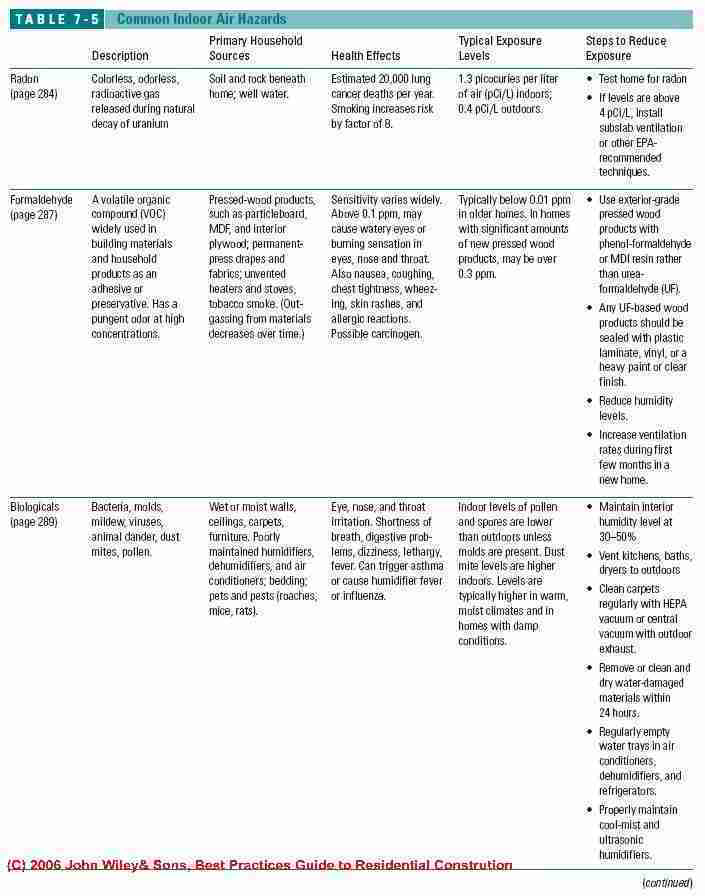
-- Adapted with permission from Best Practices Guide to Residential Construction (Steve Bliss, J Wiley & Sons) .
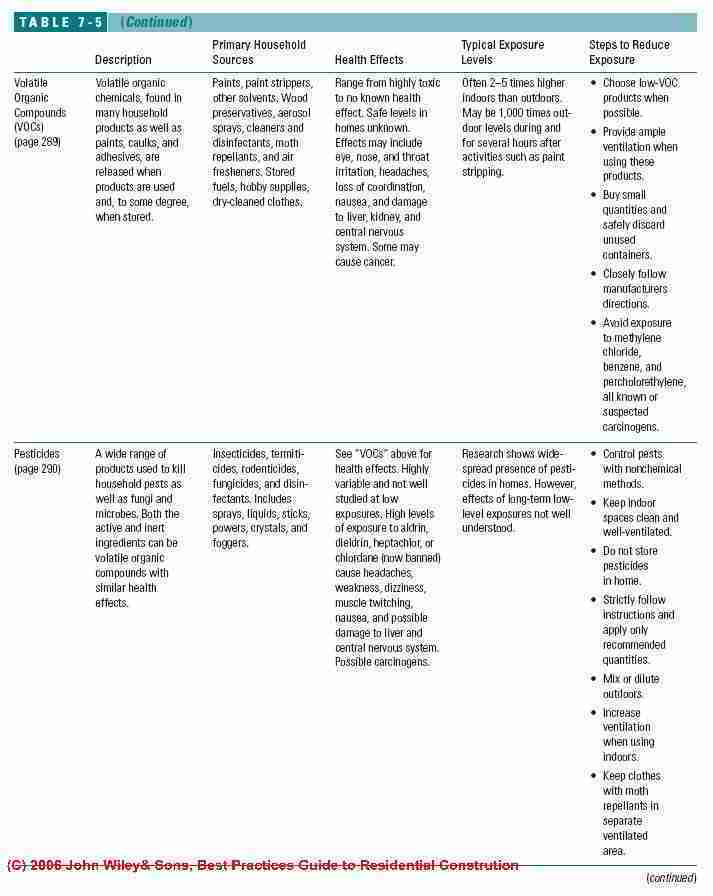
-- Adapted with permission from Best Practices Guide to Residential Construction (Steve Bliss, J Wiley & Sons) .
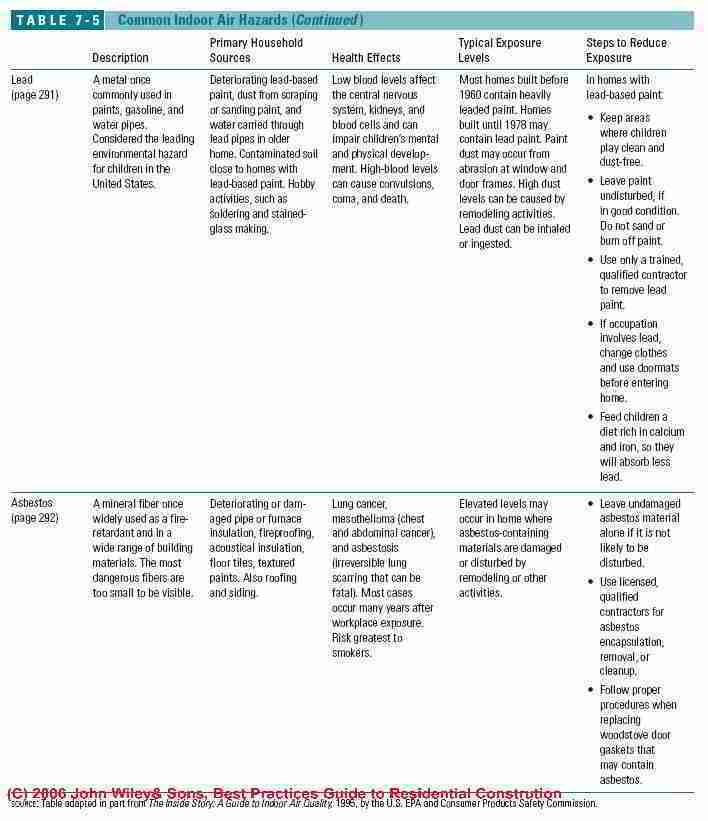
-- Adapted with permission from Best Practices Guide to Residential Construction (Steve Bliss, J Wiley & Sons) .
Update: to the indoor air quality hazards listed in these tables we add
- CHINESE DRYWALL HAZARDS discusses Chinese drywall odors, sulphur smells, and corrosive outgassing hazards in buildings. Major costs to remove this product, repair or replace electrical wiring, plumbing, and HVAC components may be involved, and there may be immediate safety hazards due to damaged smoke detectors or carbon monoxide detectors in buildings where Chinese drywall outgassing has caused damage.
- ODORS GASES SMELLS, DIAGNOSIS & CURE - how to identify and remove all kinds of odors in buildings
...
Continue reading at INDOOR COMBUSTION PRODUCTS & IAQ or select a topic from the closely-related articles below, or see the complete ARTICLE INDEX.
Or see
INDOOR AIR QUALITY IMPROVEMENT, KEY STEPS
Suggested citation for this web page
INDOOR AIR HAZARDS TABLE at InspectApedia.com - online encyclopedia of building & environmental inspection, testing, diagnosis, repair, & problem prevention advice.
Or see this
INDEX to RELATED ARTICLES: ARTICLE INDEX to BUILDING INDOOR AIR QUALITY IAQ
Or use the SEARCH BOX found below to Ask a Question or Search InspectApedia
Ask a Question or Search InspectApedia
Questions & answers or comments about common indoor air hazards, both biological and non-biological: cause, detection, cure
Try the search box just below, or if you prefer, post a question or comment in the Comments box below and we will respond promptly.
Search the InspectApedia website
Note: appearance of your Comment below may be delayed: if your comment contains an image, photograph, web link, or text that looks to the software as if it might be a web link, your posting will appear after it has been approved by a moderator. Apologies for the delay.
Only one image can be added per comment but you can post as many comments, and therefore images, as you like.
You will not receive a notification when a response to your question has been posted.
Please bookmark this page to make it easy for you to check back for our response.
Our Comment Box is provided by Countable Web Productions countable.ca
Citations & References
In addition to any citations in the article above, a full list is available on request.
- Steve Bliss's Building Advisor at buildingadvisor.com helps homeowners & contractors plan & complete successful building & remodeling projects: buying land, site work, building design, cost estimating, materials & components, & project management through complete construction. Email: info@buildingadvisor.com
Steven Bliss served as editorial director and co-publisher of The Journal of Light Construction for 16 years and previously as building technology editor for Progressive Builder and Solar Age magazines. He worked in the building trades as a carpenter and design/build contractor for more than ten years and holds a masters degree from the Harvard Graduate School of Education. Excerpts from his recent book, Best Practices Guide to Residential Construction, Wiley (November 18, 2005) ISBN-10: 0471648361, ISBN-13: 978-0471648369, appear throughout this website, with permission and courtesy of Wiley & Sons. Best Practices Guide is available from the publisher, J. Wiley & Sons, and also at Amazon.com - Our recommended books about building & mechanical systems design, inspection, problem diagnosis, and repair, and about indoor environment and IAQ testing, diagnosis, and cleanup are at the InspectAPedia Bookstore. Also see our Book Reviews - InspectAPedia.
- Decks and Porches, the JLC Guide to, Best Practices for Outdoor Spaces, Steve Bliss (Editor), The Journal of Light Construction, Williston VT, 2010 ISBN 10: 1-928580-42-4, ISBN 13: 978-1-928580-42-3, available from Amazon.com
- Carbon Monoxide Gas Toxicity, exposure limits, poisoning symptoms, and inspecting buildings for CO hazards
- DUST, HVAC CONTAMINATION STUDY An Investigation of Indoor Dust Debris Blamed on a Heating/Cooling System Reveals Carpet Dust
- Goodman Furnace High Temperature Plastic Vent HTPV safety recall US CPSC notice
- Home Heating System Should Be Checked[for proper venting and for CO Carbon Monoxide Hazards - DJF]
- Inspection Procedures for Oil-Fired Heating Systems Detailed step by step approaches for inspecting complex systems]
- Lennox Pulse Furnace Safety Inspection/Warranty Program: Carbon Monoxide Warning
- Oil Tanks - The Oil Storage Tank Information Website: Buried or Above Ground Oil Tank Inspection, Testing, Cleanup, Abandonment of Oil Tanks
- Oil Tanks Above Ground, UL Standards, guidance for home owners, buyers, and inspectors
- Plastic Heating Vent Pipe & Other Heating Safety Recall Notices
- Weil McLain Model GV Gas Boiler/gas valve CPSC recall/repair
- In addition to citations & references found in this article, see the research citations given at the end of the related articles found at our suggested
CONTINUE READING or RECOMMENDED ARTICLES.
- Carson, Dunlop & Associates Ltd., 120 Carlton Street Suite 407, Toronto ON M5A 4K2. Tel: (416) 964-9415 1-800-268-7070 Email: info@carsondunlop.com. Alan Carson is a past president of ASHI, the American Society of Home Inspectors.
Thanks to Alan Carson and Bob Dunlop, for permission for InspectAPedia to use text excerpts from The HOME REFERENCE BOOK - the Encyclopedia of Homes and to use illustrations from The ILLUSTRATED HOME .
Carson Dunlop Associates provides extensive home inspection education and report writing material. In gratitude we provide links to tsome Carson Dunlop Associates products and services.
 | HOME | ABOUT | ASK a QUESTION | CONTACT | CONTENT USE POLICY | DESCRIPTION | POLICIES | PRIVACY | |
| © 2024 - 1985 Publisher InspectApedia.com - Daniel Friedman | |||||||||