
InspectAPedia® FREE Encyclopedia of Building & Environmental Construction, Diagnosis, Maintenance & Repair |
Question? Just ask us! InspectAPedia
|
 Tile Roof Connections for High Wind & Seismic Areas

- POST a QUESTION or COMMENT about clay tile roof connections for high wind or earthquake areas
Roof tile connectors & fasteners for high wind or seismic areas:
This article describes the special connection methods used to secure clay tiles to roofs in high wind, hurricane, or seismic areas.
This article series explains clay tile roofing types, clay roofing tile inspection, tile roofing diagnosis, & tile roof repair.
InspectAPedia tolerates no conflicts of interest. We have no relationship with advertisers, products, or services discussed at this website.
High-Wind and Seismic Installation Requirements for Tile Roofs
 This article series discusses best practices in the selection and installation of residential roofing. This article includes excerpts or adaptations from Best Practices Guide to Residential Construction (Steve Bliss, J Wiley & Sons) , by Steven Bliss, courtesy of Wiley & Sons.
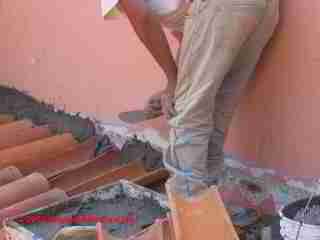
Our page top photo shows a very simple roof installation detail in area where high winds are not much of a concern, San Miguel de Allende, Mexico. Notice that except at the vertical wall abutment these soft clay tiles are simply placed by gravity with no fasteners whatsoever. This roof would be both destroyed and dangerous in high wind or seismic area.
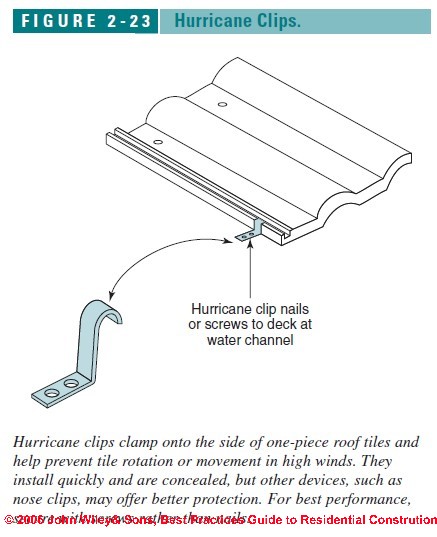
At left (and discussed below) is are details about hurricane clip fasteners used with clay tile roofs in areas of extra risk.
In areas prone to high winds, such as Florida, setting the tiles in mortar was once considered the strongest system.
However, newer anchoring systems using wires, special clips, and, in some cases, specialized adhesives have proven more reliable and have replaced mortar-set systems as the preferred approach.
Wire and clip systems also perform better than rigid attachment systems in seismic zones, as the flexible systems tend to absorb the shockwaves of an earthquake and protect the tiles from cracking.
Building codes vary in their requirements for high-wind and seismic areas but most permit one or more of the anchoring systems described below.
Model specifications for high-wind installations are available in the Concrete and Clay Roof Tile Installation Manual, jointly published by the Florida Roofing, Sheet Metal and Air Conditioning Contractors Association and the Tile Roofing Institute. General guidelines for high-wind installations or roofs over 40 feet above grade include:
- Fasten the head of every roof tile.
- Fasten the nose of every roof tile with clips or other approved methods.
- Secure all roof rake tiles with two fasteners.
- Set the noses of all roof ridge, roof hip, and roof rake tiles in a bead of approved roofer’s mastic.
Twisted Wire Requirements for Tile Roof Installations

This approach is used on roofs ranging from 2:12 to 24:12 in seismic zones and areas with moderate winds. Rather than nail the tiles to the roof, each tile is wired to a length of twisted 12-gauge wire (galvanized, copper, or stainless steel) running from eaves to ridge under each vertical course of tiles.
[Click to enlarge any image]
The twisted wire has a loop to tie into every 6 inches and is attached every 10 feet with special anchors, making relatively few holes in the underlayment (see Figure 2-22).
Because wire systems allow some movement, seismic forces do not tend to break the tiles.
Also, damaged tiles are easy to replace by snipping the tie wire and wiring in a new tile. Installation is labor-intensive, however, compared to nailing.
Hurricane Clip Requirements for Tile Roof Installations
A hurricane clip, also known as a storm clip or side clip, is a concealed L-shaped metal strap designed to lock down the water-channel side of a roofing tile near the nose (Figure 2-23).
Hurricane clips for roofing materials are well-suited to concrete tile and are used in conjunction with nails, screws, or other systems that secure the head of the tile.
Watch out: Hurricane clips for clay roofing tiles are approved for use in some hurricane areas, but they should be combined with a nose clip or similar device for maximum protection. Used alone, they may deform or loosen after several storms.
Nose Clips or Nose Hooks: Requirements for Tile Roof Installations
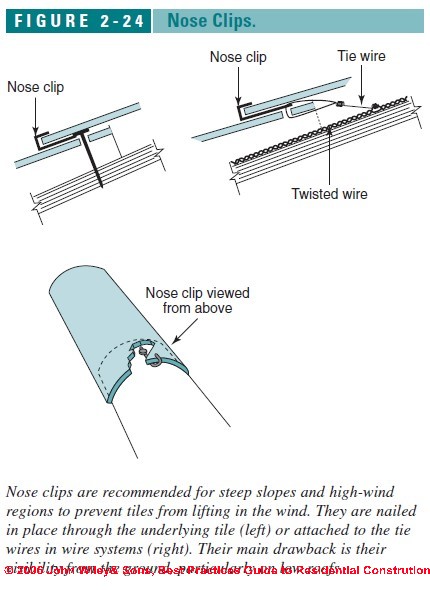
Also known as nose hooks, butt hooks, or wind locks, these simple metal clips hold down the bottom (nose) end of a roofing tile to prevent strong winds from lifting and breaking the tiles (Figure 2-24).
Nose clips are nailed in place through the underlying tile or attached to the tie wires in wire systems.
Nose hooks or nose clips on clay tile roofs are compatible with all methods of tile attachment and are recommended for high-wind areas and slopes greater than 7:12.
The main drawback to nose clips is that they are visible at the nose of each tile, which some homeowners find objectionable.
Tile Nail Option for Tile Roof Installations in Seismic or High Wind Areas
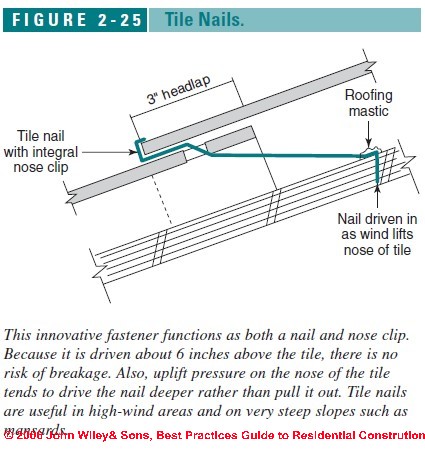
This innovative fastener, used mostly with S-tile or two-piece Mission tile, functions as both a nail and a nose clip. Because the nail is driven about 6 inches above the tile, there is no risk of breakage and the nail hole can be easily sealed with mastic (Figure 2-25).
Tile nails are approved for all slopes and are especially useful in high-wind areas and on very steep pitches such as mansards.
Hurricane or seismic tile nails are also useful for securing the first course of two-piece Mission tile.
Examples include the Tyle Tye® tile nail from Newport Tool & Fastener Co. and the Hook Nail from Wire Works, Inc.
Using Tile Adhesives for Clay or Concrete Tile Roof Installations
Another way to prevent uplift in windy conditions and to keep tiles from rattling on steep slopes is to set the butt edge of each tile in a dab of roofing cement. Over time, however, roofing cement may become brittle and fail. New proprietary tile adhesives promise to last longer and stay flexible over time.
In hurricane-prone areas, some contractors are applying adhesive to every tile—in some cases combined with other fastening methods, such as twisted wires.
While long-term performance has not been well-established, testing by manufacturers has demonstrated that adhesives can outperform mortar systems in hurricane-force winds.
- - Adapted with permission from Best Practices Guide to Residential Construction (Steve Bliss, J Wiley & Sons) .
Resources: Roofing Materials & Equipment Suppliers
Manufacturers
Concrete Roof Tiles
- Bartile Roofs www.bartile.com
- Eagle Roofing Products www.eagleroofing.com
- Entegra Roof Tile www.entegra.com MonierLifetile www.monierlifetile.com
- Vande Hey-Raleigh www.vhr-roof-tile.com
- Westile www.westile.com
Clay Roof Tiles
- Altusa, Clay Forever LLC www.altusa.com
- Ludowici Roof Tile www.ludowici.com
- MCA Clay Tile www.mca-tile.com
- U.S. Tile Co. www.ustile.com
Tile Fasteners and Adhesives
- Dow Building Products www.dow.com/buildingproducts Tile Bond polyurethane foam tile adhesive
- Fomo Products www.fomo.com Handi-Stick polyurethane foam tile adhesive
- Newport Fastener www.newportfastener.com Twisted wire systems, hurricane clips, nose clips, and the Tyle-Tye TileNail
- OSI Sealants www.osisealants.com RT 600 synthetic rubber tile adhesive
- Polyfoam Products www.polyfoam.cc Polyset and Polyset One polyurethane foam tile adhesives
- Wire works, Inc. www.wireworks-inc.com Tile hooks, hook nails, copper and stainless-steel nails
More Information about Roofing Materials, Methods, Standards
- Asphalt Roofing Manufacturers Association (ARMA) www.asphaltroofing.org
- Cedar Shake and Shingle Bureau www.cedarbureau.org
- Metal Roofing Alliance www.metalroofing.com
- Tile Roofing Institute www.tileroofing.org
- - Adapted with permission from Best Practices Guide to Residential Construction (Steve Bliss, J Wiley & Sons) .
Reader Comments, Questions & Answers About The Article Above
Below you will find questions and answers previously posted on this page at its page bottom reader comment box.
Reader Q&A - also see RECOMMENDED ARTICLES & FAQs
Question: where are clay or concrete root tile clips required?
(Apr 30, 2015) Adam said:
Does each and every tile receive the clips or just the bottom course?
Reply:
Adam in storm or high wind areas every course and tile should be tied down. In other areas that may not be required. For example in central Mexico where we are away from high winds and hurricanes clay roof tiles are simply held in place by gravity.
...
Continue reading at CLAY, CONCRETE, FIBER CEMENT ROOF TILE CHOICES or select a topic from the closely-related articles below, or see the complete ARTICLE INDEX.
Or see these
Recommended Articles
- CLAY TILE ROOFING - home
- CLAY TILE ROOF BATTENS & STACKING
- CLAY TILE ROOF CONNECTIONS
- CLAY TILE ROOF DAMAGE & WEAR
- CLAY TILE EAVES, HIP & RAKE DETAILS
- CLAY TILE ROOF FLASHING
- CLAY TILE ROOF FLASHING LEAKS
- CLAY TILE ROOF SLOPE, DECK & UNDERLAY
- CLAY TILE ROOF SPECIFICATIONS
- CLAY TILE ROOF SUPPLIERS
- CLAY TILE ROOF STYLES, DESIGNS
- CLAY TILE WIND & SEISMIC CONNECTORS
- CLAY, CONCRETE, FIBER CEMENT ROOF TILE CHOICES
- DURALITA & METAL TILE ROOFS
- ROOF SEALANTS & MASTICS
Suggested citation for this web page
CLAY TILE WIND & SEISMIC CONNECTORS at InspectApedia.com - online encyclopedia of building & environmental inspection, testing, diagnosis, repair, & problem prevention advice.
Or see this
INDEX to RELATED ARTICLES: ARTICLE INDEX to BUILDING ROOFING
Or use the SEARCH BOX found below to Ask a Question or Search InspectApedia
Ask a Question or Search InspectApedia
Try the search box just below, or if you prefer, post a question or comment in the Comments box below and we will respond promptly.
Search the InspectApedia website
Note: appearance of your Comment below may be delayed: if your comment contains an image, photograph, web link, or text that looks to the software as if it might be a web link, your posting will appear after it has been approved by a moderator. Apologies for the delay.
Only one image can be added per comment but you can post as many comments, and therefore images, as you like.
You will not receive a notification when a response to your question has been posted.
Please bookmark this page to make it easy for you to check back for our response.
Our Comment Box is provided by Countable Web Productions countable.ca
Citations & References
In addition to any citations in the article above, a full list is available on request.
- ARMA - Asphalt Roofing Manufacturer's Association - Asphalt Roofing Manufacturer's Association - https://www.asphaltroofing.org/
750 National Press Building, 529 14th Street, NW, Washington, DC 20045, Tel: 202 / 207-0917 - ASTM International, 100 Barr Harbor Drive, PO Box C700, West Conshohocken, PA, 19428-2959 USA The ASTM standards listed below can be purchased in fulltext directly from http://www.astm.org/
- NRCA - National Roofing Contractors Association - Website: www.nrca.net 10255 W. Higgins Road, Suite 600, Rosemont, IL 60018-5607, Tel: (847) 299-9070 Fax: (847) 299-1183
- UL - Underwriters Laboratories - https://www.ul.com/
2600 N.W. Lake Rd.
Camas, WA 98607-8542
Tel: 1.877.854.3577 / Fax: 1.360.817.6278 E-mail: cec.us@us.ul.com - Our recommended books about building & mechanical systems design, inspection, problem diagnosis, and repair, and about indoor environment and IAQ testing, diagnosis, and cleanup are at the InspectAPedia Bookstore. Also see our Book Reviews - InspectAPedia.
- Best Practices Guide to Residential Construction, by Steven Bliss. John Wiley & Sons, 2006. ISBN-10: 0471648361, ISBN-13: 978-0471648369, Hardcover: 320 pages, available from Amazon.com and also Wiley.com. See our book review of this publication.
- The Journal of Light Construction has generously given reprint permission to InspectAPedia.com for this article. All rights and contents are ©Journal of Light Construction and may not be reproduced in any form.
- Architectural elements: the technological revolution: Galvanized iron roof plates and corrugated sheets; cast iron facades, columns, door and window caps, ... (American historical catalog collection), Diana S Waite, available used out of Amazon.
- Building Pathology, Deterioration, Diagnostics, and Intervention, Samuel Y. Harris, P.E., AIA, Esq., ISBN 0-471-33172-4, John Wiley & Sons, 2001 [General building science-DF] ISBN-10: 0471331724 ISBN-13: 978-0471331728
- Problems in Roofing Design, B. Harrison McCampbell, Butterworth Heineman, 1991 ISBN 0-7506-9162-X (available used)
- Roofing The Right Way, Steven Bolt, McGraw-Hill Professional; 3rd Ed (1996), ISBN-10: 0070066507, ISBN-13: 978-0070066502
- Smart Guide: Roofing: Step-by-Step Projects, Creative Homeowner (Ed), 2004, ISBN-10: 1580111491, ISBN-13: 978-1580111492
- Tile Roofs of Alfred: A Clay Tradition in Alfred NY
- WEATHER RESISTIVE BARRIERS [PDF] U.S. Department of Energy, ", how to select and install housewrap and other types of weather resistive barriers
- In addition to citations & references found in this article, see the research citations given at the end of the related articles found at our suggested
CONTINUE READING or RECOMMENDED ARTICLES.
- Carson, Dunlop & Associates Ltd., 120 Carlton Street Suite 407, Toronto ON M5A 4K2. Tel: (416) 964-9415 1-800-268-7070 Email: info@carsondunlop.com. Alan Carson is a past president of ASHI, the American Society of Home Inspectors.
Thanks to Alan Carson and Bob Dunlop, for permission for InspectAPedia to use text excerpts from The HOME REFERENCE BOOK - the Encyclopedia of Homes and to use illustrations from The ILLUSTRATED HOME .
Carson Dunlop Associates provides extensive home inspection education and report writing material. In gratitude we provide links to tsome Carson Dunlop Associates products and services.
 | HOME | ABOUT | ASK a QUESTION | CONTACT | CONTENT USE POLICY | DESCRIPTION | POLICIES | PRIVACY | |
| © 2024 - 1985 Publisher InspectApedia.com - Daniel Friedman | |||||||||