 Septic Tank Back-Flooding FAQs
- POST a QUESTION or COMMENT about how to diagnose & repair septic tanks that are back-flooded or at abnormal sewage levels
Septic tank flooding or back flooding questions & answers:
Questions & answers on the causes and cures for flooded or back-flooded septic tanks.
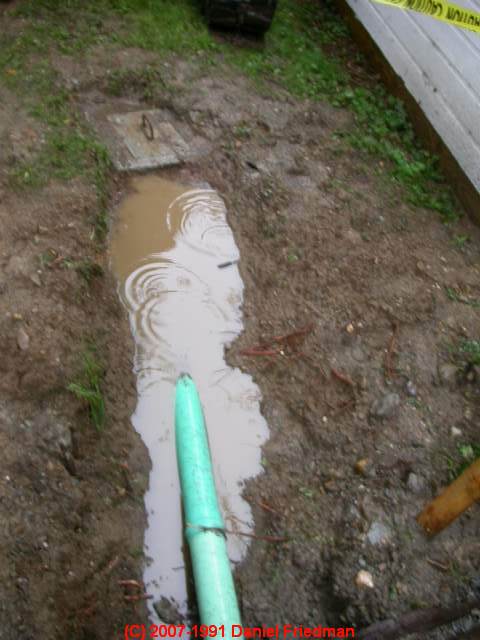
Backflooding means that water or wastewater is flowing backwards into the septic tank from a soakbed or drainfield or from surface runoff.
InspectAPedia tolerates no conflicts of interest. We have no relationship with advertisers, products, or services discussed at this website.
- Daniel Friedman, Publisher/Editor/Author - See WHO ARE WE?
Septic Tank Flooding & Back-Flooding
These questions & answers about flooded or back-flooded septic tanks were posted originally
at SEPTIC TANK BACK FLOODING - be sure to see that article.
Also, see FLOODED SEPTIC SYSTEMS, REPAIR where we explain how to fix a problem with septic tank or soakbed or drainfield flooding.
Article Index
...
Septic Tank Floods In Wet Rainy Weather FAQS
Tip: Also see SEPTIC TANK BACK FLOODING
Our septic tank fails when it rains: toilets won't flush and there's a septic odor indoors
We have a septic tank that is fairly new but every time it rains, no matter how lightly, our toilet won't flush correctly and when it rains all day we have the septic odor in our house but not outside and the toilet fills to the rim when you try to flush it. (Mar 16, 2014) debbie
Reply: see our explanation of septic tank back-flooding
Debbie it's a troubling question - it sounds as if rain runoff, perhaps from groundwater, surface runoff, or roof runoff is entering and flooding the septic tank, or worse, the drainfield. Even if the tank is new a failed older drainfield couild be at fault;
I'd ask your septic contractor to excavate and open the septic tank access ports to see if the tank level is flooding from surface runoff; And if you pump the tank and water runs back into the tank from the drainfield that'd diagnose a flooded drainfield. Either can back up into the house.
If the problem is really controlling surface runoff then you'll fix it by directing water away from the tank and drainfield.
See SEPTIC TANK BACK FLOODING or for drainfield flooding to read details.
When it rains water from the septic lines runs back into the septic tank, flooding it
I have flat ground. When it rains for days the ground get socked and the water from the lines runs back into the tank. Is there anything that can be done?
Bud4auburn@yahoo.com On 2018-02-28 by Buddy Cromer
Reply by (mod) -
Buddy
I am genuinely sorry to be the bearer of bad and expensive news, but a septic drainfield that floods from ground-water in a level area is probably improperly designed and needs significant revision.The bottom of the drainfield trenches needs to be at least 24 inches above the seasonal high water table - that can mean a raised bed septic or mound septic design (search InspectApedia.com for those phrases to read details).
Sometimes an intercept drain around the fields can carry off ground-water and leave fields working but that works best where there is some slope and some hope.I'm doubtful that it'd work in an entirely level area as water may just come up under the intercept drain and into the septic area.
When rain floods our septic drainfield we can't flush toilets and the tank floods; can we change to an effluent sprayer system?
We have a septic tank system with a drain field. In times when the ground is saturated and there is too much rain, the drain field water goes back into the septic tank and will not allow us to flush our toilets. Forget washing clothes.
I wondered if we could rely on a septic effluent sprayer system that would not back up. I also wanted to know if the system could be attached to the septic tank and replace the drain field permanently. On 2011-10-03 by Mary
Answer by (mod) - not without more changes to your septic system design
Mary, effluent dispersal by spray is used to dispose of effluent produced by aerobic or other wastewater treatment systems that perform a very high level of treatment inside the septic tank before the effluent leaves the system.
But I doubt you'd obtain permission to spray septic effluent from a system that was designed to work with a drainfield because you'd be spraying into the air and onto the ground surface effluent that was not sufficiently treated.
In a septic tank and drainfield system the tank performs just about 40% of the treatment, the remaining 60% being accomplished in the soil. By contrast, an aerobic system may perform up to 95% of the effluent treatment before it's released to a surface spray system.
When the ground is saturated our septic tank floods and our toilets won't flush - can we just add an effluent sprayer?
We have a septic tank system with a drain field. In times when the ground is saturated and there is too much rain, the drain field water goes back into the septic tank and will not allow us to flush our toilets. Forget washing clothes.
I wondered if we could rely on a septic effluent sprayer system that would not back up. I also wanted to know if the system could be attached to the septic tank and replace the drain field permanently. On 2011-10-03 by Mary
by (mod) - effluent dispersal by spray is used to dispose of effluent produced by aerobic or other - wet soils still mean septic system failure
Mary, effluent dispersal by spray is used to dispose of effluent produced by aerobic or other wastewater treatment systems that perform a very high level of treatment inside the septic tank before the effluent leaves the system.
But I doubt you'd obtain permission to spray septic effluent from a system that was designed to work with a drainfield because you'd be spraying into the air and onto the ground surface effluent that was not sufficiently treated.
In a septic tank and drainfield system the tank performs just about 40% of the treatment, the remaining 60% being accomplished in the soil. By contrast, an aerobic system may perform up to 95% of the effluent treatment before it's released to a surface spray system.Be sure to read the detailed diagnosis and repair advice
at SEPTIC DRAINFIELD REPAIR BY CORRECTING SURFACE WATER RUNOFF OR DRAINAGE - if the drainfield floods in wet weather
Septic failure after it rained cats and dogs - told not to pump the tank
Hi, I just had my septic tank pumped, and I failed to properly seal the lid, with a tarp then dirt. So I noticed a pool of water, and I saw more dollar signs in my future. But when I googled it, it said you must not pump out water from the tank as it will damage it.
I cannot ask my tenants to stop using water, as they are to used to wasting water with lots of laundry.
So I may be forced to pump it out if it will not damage the tank. I myself cut back severely no dish washing for a month, a rare shower twice a month, beginning to feel real ripe, and not much toilet flushing. And lastly if I do not pump it out how long on average would it take to drain into the leach fields, its 2500 gallons. Thank you.
Sorry forgot to mention; it rained cats and dogs, and that is how it filled up with California rain. Thanks again. On 2019-04-11 by ella seneres -
by (mod) - pumping the flooded septic tank won't fix it - we need a proper diagnosis
Ella
I think someone has given you confusing information. Pumping a conventional septic tank does not ruin it damage you can or harm it. However it doesn't need to be pumped over and over again. The pumping frequency is given in the septic tank pumping schedule article in this series and depends on the size of the tank and the Wastewater volume or number of bedrooms or number of building occupants.
However if surface water is leaking into your septic tank it will flood the tank and flood the drain fields and possibly ruin them. That's a question to have answered by your septic contractor.Watch out: if a septic tank or cesspool is home-made out of stacked stone or concrete block, indeed it can collapse if it's pumped out. Such systems are unsafe; keep people away and have it inspected by an experienced septic system contractor.
How do I diagnose septic field issues in our new home - can't flush toilets if the soil is wet or in rainy weather
We recently started having septic/drain field issues. We have been on our property for 20 years and never had a problem. We have a new home there now with a new foundation.
When the ground is saturated due to rain or sprinklers we can't flush the toilets and the washing machine will back up into the tub.
The toilets gurgle as well. We had the tank pumped (second time in 5 months) and it lookes like there is another smaller tank between the house and main tank.
There is no access to this but we saw sludge coming from it. The water from the drain field was also pouring into the tank. And suggestions on how to diagnose this properly as I don't want to just throw money at it? On 2021-06-29 by jhaug76 -
by inspectapedia.com.moderator (mod) - recently started having septic/drain field issues
@jhaug76,
1. Your septic system is either blocked or in total failure; wet weather saturation makes the failure show up but it's there regardless: a septic system as to work in all kinds of weather not just the dry season.
2. Pumping the septic tank prolongs field life but will never fix a failed drainfield nor remove a blockage there.
Scope the lines.
Alarm keeps going off on new septic system every time it rains
We have a new septic system in a new house. Everytime there is a hard rain the interior alarm goes off followed shortly by the exterior alarm.
I have to manually pump to get the alarm light to go off but it sounds again 2-3 hours later for up to 24 hours after it stops raining. When this happens we basically stop using water in the house. Is it possible for that much ground water to leak in or infiltrate the tanks? On 2017-05-14 by fernbri
by (mod) - septic pumping chamber is being flooded, alarm keeps going off
Fern,
From what you describe, it sounds as if a septic pumping chamber is being flooded.
In a new septic system installation that suggests to me that something is wrong with the installation.
Groundwater or roof runoff need to be kept away from septic tanks and drain Fields precisely to avoid this problem.
So you need your septic contractor to open and inspect the septic tank and the distribution box for signs of flooding in wet weather.
If that's happening, the water source is going to need to be identified and kept away from the septic components.
If water is leaking directly into the septic tank but not the drainfield it may be possible to repair the problem with a combination of sealing the septic tank pipe connections and cover and redirecting surface runoff.
Let me know what you're told as what you learned will help her other readers.by fernbri - contractor added risers but septic tank still floods
thanks for the quick response. Contractor will be getting an irate caller first thing Monday morning. First time it happened they put another layer of risers on the two tanks but clearly groundwater is working its way to the tanks.
Thinking of putting a swale in to divert the runoff water down and around the septic tanks. I will pump it down for 10 minutes in a few to hopefully last the night. Need some sleep after being up every 2 hours last night!
by (mod) - septic pumping chamber is being flooded.
Fern
Best if you can get the contractor on your side of this matter. Keep us posted. Daniel
After heavy rain bathroom & garden tub is overflowing onto the floor.
Will bypassing water conditioner help or do we just have to wait for things to dry up?
The past 2 nights our master bathroom & garden tub is overflowing onto the floor. The only thing that is different @ night is our water softener runs. The stool flushes normally during the day. We've had like 2.5" of rain the past week which is way above normal. Anybody know why this has started all of a sudden? On 2019-02-10 by skashon
by (mod) - waiting for the ground to dry after rain won't fix a failed, flooded septic system
SK
When the septic system has failed - from flooding combined with perhaps inadequate original design or soil clogging - waiting for the soil to dry out will, sadly, not fix the problem - it's going to recur until the field is re-built above the high water table.
But I agree that it makes sense to stop the water softener regen cycle - that adds more water to the septic tank and increases the chance of sewage backup into the buiding.
There is of course also the risk of scale clogged hot water pipes, tankless coil, water heater, etc. when the water softener is out of service for much time.
...
Septic Tank Flooded Again After it Was Pumped FAQs
Why is my septic backing up into the basement even though we had the tank pumped?
How can I fix septic issues all the sudden it’s backing up in my basement I had it pumped 13 months ago what do I do ? On 2018-11-23 by April Roberts
by (mod) - pumping the septic tank will never fix a failed septic system
April,
Unfortunately pumping the septic tank will never ever fix anything.Pump in the tank protects the field and extends the drainfield life but it won't fix a blocked sewage or septic line or will they fix a clogged drain field.
So if your septic drainfield is blocked or saturated and thus no longer accepting effluent flowing out of the septic tank, OR if there is a blocked line between septic tank and the drainfield, then you can expect the septic system to back up again after the tank is pumped - it just takes a few days to a week for your normal household plumbing fixture use to re-fill the septic tank.
What you need is some on-site diagnosis. That might involve looking at the sewers levels in the septic tank and looking at the waste water level in the distribution box or D box.
Septic tank "Back-Flooded" and Overflowed; the Pumpers didn't do a great job
I had not clue I was being robbed and not only that, but oh the thought I have 40 years of sludge that should have been sucked out,
I just spend the last hour reading your site. First I am a photojournalist; and you write so well. I was laughing most the time, as you are funny.
Second I had no clue all these decades, and its worth repeating this for others as they may not be as diligent as myself in exploring your site.
The Septic tank service has to use a pole to stir up the sludge so it can be pumped up.
That has NEVER happened, they just stick it in and look around. I had not clue I was being robbed and not only that, but oh the thought I have 40 years of sludge that should have been sucked out, my last septic sucker cost me 650 for 2000 gallons. He used a hose a little, but on one else ever did anything but suck.
I want to re re thank you for your site; its very informative and funny. From now on I almost feel I know more then these crooks because of your depth sharing and educating us.
Thanks for the learning curb on nothing I choose to learn about but had to. Bravo, oh and that you used s/he. Lord that almost made me weep. Hardly no one does that. Brava.
I am so sorry to bother you again. I am so relieved you are here. So I wrote before about the overflowing septic tank. It was backing up into my studio, the stench blablabla.
Had it pump, then snake thru the outdrain, and then did not cover manholes good enough, rained, flooded.
So no one could help me 4 months later! Finally one guy came up who put a measuring tape into a pipe that vents? the drain field, and said it was bone dry, and said if the septic tank is overflowing from the manholes but the leach fields are bone dry, possibly a clog.
I had someone finally come up today and I scrambled to come back and ask you, HELP. He ignored or did not want to hear about the dry fields and said pump the tank again and dig the leach fields.
I have no business owing a house, I inherited it, and I am on severe limited income, and to fork out 12,000 plus may put me under.
Now if I need it, I am gladly willing to bite my lip and pay up as I will pay for work rendered. But once again we come to those dry fields. And yes the system is 40 years old, but I never use nasty chemicals, I do not abuse water.
Thank you again for, us lost souls who do not know what is up and can easily be fooled and ripped off. On 2019-05-29 by ella seneres -
Reply by (mod) -
Ella,
My guess is that the tape down the vent opening finding no water could be a useful diagnostic if we were sure that the vet were actually near the end of one of the lines in the drain field.I don't think that just pumping the tank again is going to fix anything, and it's not appropriate if the type of recently pumped anyway. I also don't think digging up the entire drain field is appropriate without more diagnosis.
You need a plumber on site who has a sewer camera and who can run that through the lines to find the distribution box and through the distribution box the drainfield lines that can then be examined directly.Proper or best practices when pumping a septic tank
Yes, in addition to experience in the field and septic systems inspection, I've researched and written about the details of a thorough septic tank cleaning, as demonstrated to me by a Jimmy Herring, a Poughkeepsie septic pumping contractor.
And yes I agree that most pumpers are rushing the job.
There is no statute regulating what the pumping company must do - not in any jurisdiction I know-of.About the claim that septic pumpers need to pump water back into the septic tank
In my OPINION the worst offense that you described is a septic pumping contractor not being thorough by failing to stir up the sludge on the tank bottom, and more: it's those people who get paid for "pumping" the septic tank, then they empty most of the pumped volume BACK into the septic tank, claiming that "the water is needed" which
1. Is Not true at all :
The water (septic effluent) is not needed and does not need to be pumped back into the septic tank; The septic tank fills up and begins treating sewage within a few days of normal use.
2. Misrepresents what they're doing and is likely to shorten the drainfield life:
Unless the return-effluent is very thoroughly-filtered to remove small fine floating solids, the septic pump chops up the sewage and disperses solids into the truck during pumping - putting that back into the tank clogs up the drainfield....
I'm indeed happy that you found our (as in editorial "we") information useful - we work hard on it and are grateful when a reader finds the effort useful.
I too am a photojournalist - card carrying member of the US Press Association - ok so I don't usually carry my card. I didn't know I was a journalist until a lawyer representing an electrical manufacturer told me so during a meeting with the US CPSC on aluminum wiring connectors.The lawyer told some of the meeting attendees that he and his client would not continue the meeting with "that journalist" in the room.
I looked all around wondering if the NY Times had somebody hiding under the table.
Then he pointed at me.
I should have been upset, or insulated that he'd impugn my integrity but hell, the truth was I was really excited. Geez I told my friend as we took a break: After all these years, writing and scribbling since the 1950s, finally oh finally I'm a real journalist - I had no idea.Followup by ella seneres - rain filled our septic tank back up
Sorry forgot to mention; it rained cats and dogs, and that is how it filled up with California rain. Thanks again.
Hi, I just had my septic tank pumped, and I failed to properly seal the lid, with a tarp then dirt. So I noticed a pool of water, and I saw more dollar signs in my future.
But when I googled it, it said you must not pump out water from the tank as it will damage it. I cannot ask my tenants to stop using water, as they are to used to wasting water with lots of laundry.
So I may be forced to pump it out if it will not damage the tank.
I myself cut back severely no dish washing for a month, a rare shower twice a month, beginning to feel real ripe, and not much toilet flushing. And lastly if I do not pump it out how long on average would it take to drain into the leach fields, its 2500 gallons. Thank you.
Answer by (mod) -
Elua
I think someone has given you confusing information. Pumping a conventional septic tank does not ruin it nor cause damage except by accident such as breaking a lid or cover or driving over the septic tank.And when a tank is pumped out it should not need to be pumped over and over again right away.
The pumping frequency is given in the septic tank pumping schedule article in this series and depends on the size of the tank and the Wastewater volume or number of bedrooms or number of building occupants.
However if surface water is leaking into your septic tank it will flood the tank and flood the drain fields and possibly ruin them. That's a question to have answered by your septic contractor.If that is happening see
Otherwise see
FLOODED SEPTIC SYSTEMS, REPAIR to read suggestions for repairing a flooding septic tank or soakbed system that floats full of water when it rains
...
Septic tank filled up to the top and toilets bubbled: Do I have a clogged drain or a failing septic drainfield?
I had a lot of people to my cottage over the last month, toilet was bubbling up after a flush, exposed septic was full, within a couple days of reduced usage, toilet returned to normal operation and septic level dropped to intake / outtake pipes. Do I have a clog or just a slow draining field.
We also had 1 full day of heavy rain after discovery of full tank. Pls advise, thx On 2018-08-09 by terry
Answer by (mod) -
You probably have a failing septic field. Possibly rain floods the field and also back flows into the septic tank
Our septic pump went out. There's standing water in and over the septic tank;
The tank full alarm did not go off The alarm warning light is almost always on
We have a 2 tank septic system. About 2 months ago, our pump went out. The tank full alarm did not go off and we called somebody as soon as we saw standing water above the tank. They came out the next day, pumped the tank, replaced the broken pump w/ a more powerful pump, & fixed the alarm.
Ever since then, it seems like the system is struggling to keep up with our usage (which has not changed). The pump is always running. I can hear & feel it when standing above the tank. Maybe the old pump was always running too and I just couldn't hear the less powerful pump.
The alarm warning light is almost always on too. We even had the audible alarm go off when we happened to be using a lot of water at once. This was never an issue before.
When I called the same guy that installed the pump, he said it sounded like an issue in the septic field. It sounded like the next step in solving our problem, at least according to him, would be expensive. He said something about hydrostatic testing that could cost several thousand dollars depending on how many branches and how deep they are. Before agreeing, I wanted to do a little research (which is why I am here).
I've done some reading on this site and others and from what I can gather, it does sound likely that it is a drainfield issue. It just seems odd that we did not have any problems before the new pump; however, after the new (more powerful) pump, our system suddenly has problems keeping up. It seems unlikely that our septic field would suddenly get clogged.
This especially seems true since it has two sides and it seems to me like any issue caused from the overflow would have only affected the one side, but we are now having problems regardless of side.
I'd like to think that I can trust the technician, but I am a bad judge of that sort of thing and I hate the idea of wrongly doubting an honest guy.
Questions:
1. Could the initial tank overflow issue cause issues in the septic field? In case it matters, the tank had been emptied a year prior.
2. Could anything the technician have done when replacing the pump cause this kind of issue?
3. What is the proper next step to diagnose the root issue and how much should I expect to pay?
4. I'm reasonably handy and not afraid to get dirty. Is there anything I can do to diagnose/fix/etc?
5. If I need to call somebody, should I call the same guy or have a new guy that could also verify his previous work?
6. What should I be asking but I'm not? On 2019-04-09 by erics
Reply by (mod) -
Eric
I think you're on a reasonable diagnostic track by looking into the drainfield condition.
Yes a septic tank failure can damage a drainfield, in particular if a baffle is broken or overflowed such that solids are pushed out into the drainfield piping and leach lines.
Take a look in the D-box to see if there is flooding there.
Then you may need to have someone with a sewer camera check your leach lines for obvious damage, flooding, or sewage solids - as a step that might be worth doing before exploratory digging.
Will a flooded septic tank cause my drain field to leak into my yard ?
What would cause my drain field to leak into my yard the leak is located about 20 ft from tank, I was thinking a broken line On 2018-04-12 by scott
Reply by (mod) -
Scott, a blocked or broken or flooded septic drainfield line, or a backup leaking at an inspection port, or (worst news) a clogged, failed drainfield.
Watch out: When a septic drainfield is flooded or blocked it can no longer accept wastewater from the septic tank, so you risk a sewage backup into the building.
I would dig at the wet spot, with care, to find the conditions there in the actual drain field piping - that'll be diagnostic.
Use the picture frame icon next to the Comment button to attach photos of what you find and we can comment further.
Do septic tanks have a backflow preventer valve? High floodwaters keep filling the septic tank
Does the tank have s back flow valve?
High waters recently septic tank keeps filling with water? On 2018-02-24 by Terry
by (mod) - no
No, Terry septic tanks don't use a backflow valve.
You need some on-site help to see if the fields are saturated or blocked - start by checking in the D-box.
Also look for surface or ground water leaking into the septic tank.Watch out: if your drainfield is under water or flooded, it cannot accept effluent from the septic tank and the system is not usable. The risk is a sewa\ge backup into the building.
Drainfield backflows into and floods the septic tank; we know not to add more soil, so what's the fix?
We have a two concrete box septic system for a very large house. last spring and recently our drain field (back yard) has been back flowing into the tank which holds the gray water. This tank subsequently backs into the primary tank causing it to become full.
During pumping of these tanks we can witness water flowing back into the outlet hole. Our backyard during heavy rains in the spring becomes wet and soggy. To remediate the problem we put in a curtain drain last spring. It helps and we can see water flowing out of curtain drain but hasn't solved the problem.
What to do next? Any suggestions would be appreciated.
Back yard is flat and I'm told adding soil to it puts your leach field lower than ideal and makes it harder to incorporate evaporation, wind sun to dry leach field. On 2018-02-12 by tbv
by (mod) -
TBV
Back-flowing into the septic tank, if it stops quickly - minutes or less - could be a simple blocked line.But if it continues longer the fields are most-likely saturated - which your description suggests is the case.
Given that the curtain drain hasn't fixed the trouble I suspect
1. the curtain drain doesn't go deep enough or lacks capacity to keep extraneous groundwater out of the septic fields
or
2. the fields are basically in failure regardless (or both)
You may need to go to a raised bed or mound septic. That does not mean just adding soil over the existing fields. That won't work and will block oxygen. Instead it'd be a new elevated pipe network in a mound.
What caused a septic backup soon after tank pumped
We just had our tank cleaned out in Jan. and our septic tank has started backing up again, it is a 1k gal. tank with a curtain drain. Hubby seems to think the water isn't going out of the tank. Any suggestions? On 2017-03-28 by Sharon Powell
by (mod) - key diagnostic steps
Sharon
Watch out: warning that leaning over an open septic tank inspection cover can expose the observer to methane gas, fainting, falling into the septic tank, or other hazards
with that arm-waving stuff out of the way: with help from your plumber or septic contractor,
Find the septic tankOpen the inspection cover over the tank outlet
Look at the level of sewage in the tank:
- if waste is at the top of or flowing over the top of the outlet baffle or tee then yes, waste is not leaving the tank
That can be traced to a blocked waste line out of the tank, a flooded D-box, or a flooded or failed drainfield
Water is pooling around the pipe entering the septic tank; what do we do?
We are having water pooling around the pipe entering the tank starting at three feet from the house.
The pipe takes a sharp turn downwards to about three feet than veers to the left than into the tank. Since some of this pipe has been covered by a concrete patio (done before we bought the house) we haven't exposed the whole pipe.
We've gotten all kinds of possibilities including the tank needs pumping, the pipe is broken going to the tank, to the lid could be crushed.
There is not wetness in our drain field or anywhere else except around the pipe. Can this be fixed if it is the pipe? Of course the township wants us to hook up to the city sewer but that would cost was thousands. What do u suggest On 2016-10-25 by Beth
Reply by (mod) -
Darn.
Some excavating is needed to explore the problem.
First you want to find the septic tank cleanout lid and have your septic company open the tank to inspect the sewage level in the tank. If the tank is back-flooding then I suspect a blockage or failure at the tank outlet or drainfield.
The tech will perhaps next have you run water or flush toilets to see how waste flows into the septic tank and to inspect for leakage around the tank inlet.We don't want sewage leaking OUT of the septic tank and we do not want ground water leaking INTO the septic tank either as that'll flood the system and drainfield and means septic system failure too.
If the problem is simply ground water around the tank and if the septic system is working, you can defer the cost of connecting to sewer by directing groundwater away from the tank and sealing the tank inlet and outlet piping at the tank wall if they are leaky.
Need information on back pumping a drain field line
Hello,
I searched high and low on your website and the internet in general and can not find any info specifically on back pumping a drain field line. Here is my situation:
We have had above average rain here in GA, second wettest on record. I had a septic tank company come JUST to do a normal pumping and I was told that the drain field was not draining properly (never mind that we had had no problems).
He put the camera inside the drain field pipe to show me all the fluid in the line, and therefore the “urgent need” to treat the line. I wasn't thinking at the time, that it might be water from all of the heavy rains.
He made me think it was urgent to do something about it immediately (a tactic I have since learned that this company got into trouble with GA state for).
He back pumped (sucked) the drain field system for 30 minutes, jetted the drain field and then applied the bio chemical stuff.
Could this process, especially the back pumping have damaged my drain field, especially since the ground was thoroughly saturated?
Could mud have been sucked into the drain filed line, and how would I know it, by what kind of inspection?
Thanks! On 2019-01-20 by Anonymous
by (mod) - back pumping a drain field line
Thanks for asking, Anonymous.
YOu didn't find any material on "back-pumping a drainfield line" because that is not a term that I have come across.
Worse, there is no magic bullet, no "back pumping", no chemical treatment, that fixes the problem of a flooded (and thus failed) septic drainfield or soakaway bed.
Furthermore, there is even less benefit (except to the contractor's pocket book) from paying someone to try to pump effluent back out of the drainfield through the drainfield leach lines. When a drainfield is flooded and thus back-flowing into the septic tank, water in soils around the drainfield run into the drainfield trenches and ultimately back into the septic tank.
Pumping out some volume of water from the trenches themselves simply makes new room for more surface or subsurface runoff water to flow back into the trenches. It's not fixing anything.
"Jetting drainfields" is an old, popular magic bullet for which I have found essentially not one authoritative, unbiased, credible study showing any lasting benefit.
"Back pumping" meaning pumping drainfield trench effluent back out (perhaps through a D-box or through a septic tank) would not be expected to particularly damage the drainfield though I can think of some subtle ways in which damage might occur - depending on just how pumping was done.
For example I've seen cases of pumping out water from beneath a building (in an effort to stop basement water entry) actually make the problem worse. That happens when the pump-out removes soil fines, thus enlarging underground passageways through which water flowed right back into the pumped-out area. The effect was to actually increase the water flow into the area.
You need an on-site, credible, septic design engineer to assess the design of the present system, the seasonal high water table, the direction of surface and subsurface runoff, and to help you decide on a proper fix that ranges from improving surface runoff control, through subsurface intercept drains, to a new raised bed or mound drainfield.
Water bubbles up in the drainfield and rain floods my septic tank. Do I need new septic tanks?
My septic system has 2 tanks, the second tank is a holding tank [sic - he means a pumping chamber - Ed.] that gets pumped to the back yard drain field. I have water bubbling so I know my drain field is done and needs to be replaced.
I also know it's only 20 years old. And more, I know that when it rains a lot, my tank pumps way more than we use water.
I do not have leaky toilets. I have done some repair to the inlet pipe from the house where ground water could have seeped through. I have re grouted with hydraulic cement around the neck of the view lid
I still have excessive pumping after heavy rain. I do not want to replace drain field without repairing what I think is the heart of the problem. My drain field is saturated and stays saturated due to rain water seeping into my tank or tanks.
Has anyone ever had this problem. I am thinking about digging down beside both tanks, cleaning off the side walls, inspect for cracks or possible places it can leak from. Then install a cementisous product such as "thoroseal". Then roll with foundation sealer (tar).
Back fill and wait till the next big rain. Does this sound like a reasonable plan? I will do the work myself with some labor help.
If I still have excessive pumping after rain storms, is it reasonable to say I need a new tank(s) On 2016-03-22 by Joe P
by (mod) - more likely you need site grading, a new drainfield, and to seal leaks into the septic tanks
Joe
If the drainfield is saturated from groundwater you need to redirect the ground water; also seal leaks into the septic tanks and direct water away from the tanks.
If you can't get a couple of feet between drainfield trench bottom and top of the seasonal high water table your drainfield will not work. It won't treat the effluent that it discharges.
...
...
Continue reading at SEPTIC TANK BACK FLOODING or select a topic from the closely-related articles below, or see the complete ARTICLE INDEX.
Or see these
Septic System Flooding Diagnosis & Repair Articles
- FLOODED SEPTIC SYSTEMS, REPAIR
- PUMPER TRUCK OPERATION PROCEDURE where we explain how to spot backflooding during septic tank pumping
- PUMPING the SEPTIC TANK to continue with the septic tank cleaning & inspection procedure
- SEPTIC D-BOX FLOODING
- SEPTIC BACKUP PREVENTION for tips to avoid a septic problem during times of anticipated heavy septic system usage.
- SEPTIC DESIGN for FLOOD DAMAGE RESISTANCE
- SEPTIC DRAINFIELD FAILURE DIAGNOSIS
- SEPTIC DRAINFIELD REPAIR BY CORRECTING SURFACE WATER RUNOFF OR DRAINAGE - if the drainfield floods in wet weather
- SEPTIC SYSTEM BACK-PUMPING
- SEPTIC TANK BACK FLOODING
- SEPTIC TANK PUMPING MISTAKES
- SEPTIC SYSTEM BACK-PUMPING - pumping out the drainfield is not useful
Suggested citation for this web page
SEPTIC TANK BACK FLOODING FAQs at InspectApedia.com - online encyclopedia of building & environmental inspection, testing, diagnosis, repair, & problem prevention advice.
Or see this
INDEX to RELATED ARTICLES: ARTICLE INDEX to SEPTIC SYSTEMS
Or use the SEARCH BOX found below to Ask a Question or Search InspectApedia
Ask a Question or Search InspectApedia
Share this article:Search the InspectApedia website
Need to make a private comment? Email editor@inspectApedia.com. We welcome email with your website content critique, corrections, suggestions or questions. Email is monitored daily but our workload may prevent an immediate reply. For immediate results, we hope you'll first try asking your question using the search box just above.
Citations & References
In addition to any citations in the article above, a full list is available on request.
- In addition to citations & references found in this article, see the research citations given at the end of the related articles found at our suggested
CONTINUE READING or RECOMMENDED ARTICLES.
- Carson, Dunlop & Associates Ltd., 120 Carlton Street Suite 407, Toronto ON M5A 4K2. Tel: (416) 964-9415 1-800-268-7070 Email: info@carsondunlop.com. Alan Carson is a past president of ASHI, the American Society of Home Inspectors.
Thanks to Alan Carson and Bob Dunlop, for permission for InspectAPedia to use text excerpts from The HOME REFERENCE BOOK - the Encyclopedia of Homes and to use illustrations from The ILLUSTRATED HOME .
Carson Dunlop Associates provides extensive home inspection education and report writing material. In gratitude we provide links to tsome Carson Dunlop Associates products and services.
 |
HOME | ABOUT | ASK a QUESTION | CONTACT | CONTENT USE POLICY | DESCRIPTION | POLICIES | PRIVACY | |
| © 2026 - 1985 Publisher InspectApedia.com - Daniel Friedman | |||||||||