 Septic Tank & Drainfield Care FAQs

- POST a QUESTION or COMMENT about septic tanks and drainfields or soakaway beds: care and maintenance
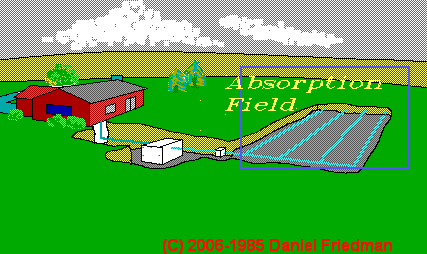
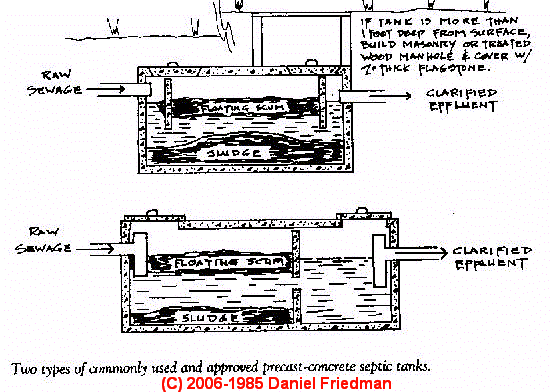
What is a private septic system: tank, drainfield, absorption bed, soakbed?
How should I take care of the septic system and tank?
This septic system care article offers an easy-to-understand explanation of what septic systems are, how they work, and why they fail. We give basic information about how to maintain a septic tank and drainfield.
Septic care is important for health, safety, and to avoid unnecessary and large expenses that occur when a poorly-cared-for septic system fails. We include links to companion articles which provide details of septic system care such as septic tank pumping, what not to flush down a toilet, and what you can and cannot plant over a septic leach field.
InspectAPedia tolerates no conflicts of interest. We have no relationship with advertisers, products, or services discussed at this website.
- Daniel Friedman, Publisher/Editor/Author - See WHO ARE WE?
FAQs on What is a Septic System & How does It Work?
 These FAQs about septic system basic care and operation were posted originally
at SEPTIC TANK & SYSTEM CARE BASICS - you'll be glad if you take a look at that advice.
Is it OK to cover drainfield with mulch?
Is is OK to cover the surface of a conventional conventional septic drain field with shredded bark mulch, instead of turf grass? On 2018-02-22 by Jennifer
Opinion by (mod) - thin layer is ok
I think that'd be fine if it's just a thin surface layer that doesn't block transpiration or evaporation from the drainfield. Take care to spread by hand, don't drive heavy equipment over the fields.
We're having repeated sewer backups, landlord blames me
(Sept 7, 2014) Deborrah Robertson dhaldonrob@yahoo.com said:
I live in a duplex on septic.
There has not been anyone living in the other unit for about 8 months. In the almost five years I've lived here the toilets, or shower, tub have backed up 4 times pouring water all over floor and carpet. Three times there was someone living in the unit next door when the toilets, shower backed up .
I am a very neat and clean person.
The Septic was pumped out about 10 months ago. My brother lives with me and he has no children nor do I. There was NOTHING put down the two
toilets except for: pee, poop and toilet paper and maybe a few hairs that went down the drain.
The Manager is in an uproar, he says it is all my fault, he is very abusive. I don't believe it is my fault. Aren't there other things to take into consideration when plumbing is backed up on a septic tank? I am desperate for you to answer my question.
Reply:
Deborrah
From your description it sounds as if there is either a sewer line blockage or a failed septic system. It's of course less expensive to blame you than to face what might be expensive to repair. Your building manager would be wise to bring in a qualified, experienced septic engineer or plumber or contractor to make a more accurate diagnosis of the trouble.
The first steps are trivially easy: inspect the condition of the septic tank and inspect the site surfaces for evidence of drainfield failure.
Owner pumped the septic tank before our inspection, tanks were full = backup evident
(Jan 12, 2015) karen marrow said:
We are looking to buy a property which has a septic tank. We will be new to this. We arranged a surveyor to view the tank and give us a report on it.
The tank in question was emptied 2 days prior to survey.
The property has been left empty. The survey could not be completed thoroughly as the tanks was full and the water was backed up to the man hole cover in the garden.
What could be the causes of this. We have been told that it is a cesspool/ septic tank that has a pump to pump out the water every night. We have concerns about this and are unsure whether we need to walk away from this property. Can you please give me some advise
Reply:
Sounds like some contradictory information or strong evidence of a failed, possibly dangerous septic system.
Karen unless I've misunderstood there's already plenty of important information here.
1. if the tank was "emptied" 2 days prior to the survey then someone knew perfectly well that there was a problem and took steps to subvert your septic inspection and test - in my opinion an improper if not unethical act that is highly questionable.
2. As the tank was nonetheless "full of water" at your inspection and considering that the building is unoccupied, then the system is in total failure and the tank is back-filling with ground-water or effluent from a saturated, failed drainfield (if it's a septic tank with a drainfield) (Or someone left water running in the building for days)
3. Being told that it is a cesspool is incoherent. A septic tank is not a cesspool.
To understand what a cesspool is, how they work (or don't) and why they are not permitted in many jurisdictions and why they don't adequately treat septic effluent even if they dispose of it, see inspectapedia.com/septic/Cesspool_Guide.htm
Having to pump the water out of a septic tank or cesspool every night sounds odd to me - though there are some septic dosing system designs in which septic effluent from a water-tight tank (not from a cesspool) is indeed sent only at intervals into a drainfield. If that were the case a failed pump or a pump left off could explain what you saw.
In sum, you are being given (or at least are reporting) illogical and inconistent data but there are serious warning signs. You need first to get an accurate definition of what type of system is installed, where its components are located, how they are supposed to work, and what has been their maintenance and repair history.
After that further inspection and testing might be in order, or might be throwing good money after bad. I don't know.
Garden watering line was filling my septic tank and drainfield
Hi,
I recently had my septic tank pumped out. - 2 weeks ago. They had to pump it out 2 times because the "initial" thought was failing leach field(s) because there was water coming out of the ground near the septic tank.
Turns out I had a leak in my water pipe in my garden for 2 months causing the ground to saturate....
short story...leak fixed 2 days after the septic pumping and both leach fields drained back into the septic tank...both sides of the septic tank are full again.
Do I need to have my tank pumped out again?
Also when they pump out the tank do they fill it up again with fresh water? Thanks, Catt On 2013-03-19 by Catt
by (mod) - septic tank fills in a few days after pumping
Catt,
No when a septic tank is pumped out it is left empty. One to three days of normal use will fill it up again quickly enough.
BEWARE of septic "pumping" companies who dump stuff back into the septic tank. You are paying them for next to nothing - they empty the tank, then pump much of the waste and wastewater back into the tank, in fact in WORSE CONDITION than BEFORE because the now agitated solids flow into and destroy the drainfield.
Your water pipe leak, if it was draining into the septic system, was flooding it.
Can I use septic drainfield treatments instead of replacing a failed system?
 Your articles were very informative. You do not recommend using the chemical additives or devises to restore a drainfield.
My drainfield is 50 years old. It no longer drains as well as it did due to the clogged biomat. Other than the $10,000 replacement, what can be done to restore the field to working order? On 2013-03-16 by MARILYN
by (mod) - when to replace or rebuild a septic leachfield
Marylin,
To be clear, it's not simply "my" recommendation to stay away from septic additives, rather it's that of experts in the field as well as various government agencies.
The "fix" is usually to reconstruct new drainfields on the property - a costly proposition.Be sure to read SEPTIC TREATMENTS & CHEMICALS
Sometimes it is possible to let a portion of a drainfield rest for several years or more and to somewhat recover.This is accomplished by using a diverter in the D-box to route septic effluent to (for example) one set of leach lines while the others rest.
In addition, direct surface and subsurface water away from the fields, and of course pump the septic tank on regular schedule.But once the biomat has clogged your drainfield, generally it needs to be replaced.
A septic "restoration" company drilled holes in the drainfield; now there are sinkholes in the yard
I am renting a home that has had many septic problems. We first had to have the septic emptied, then a new septic pump, then the field started leakeing, the landlord had someone come in and drill holes in the septic lines going to the field, it has caused sink holes in our yard, very frusterated. On 2011-09-27 by Brittany
by (mod) - renting a home that has had many septic problems
Brittany,
because a proper repair - which probably involves replacing a failed drainfield - is expensive, it's understandable that the property owner might have tried other approaches, but none of what you describe sounds effective, reasonable, nor sanitary. And sinkholes can be dangerous.
...
Continue reading at SEPTIC TANK & SYSTEM CARE BASICS - topic home, or select a topic from closely-related articles below, or see our complete INDEX to RELATED ARTICLES below.
Recommended Articles
- SEPTIC TANK & SYSTEM CARE BASICS
- SEPTIC DRAINFIELD LIFE
- SEPTIC LIFE EXPECTANCY
- SEPTIC LIFE MAXIMIZING STEPS
- SEPTIC SYSTEM INSPECT DIAGNOSE REPAIR - home
- SEPTIC SYSTEM TROUBLE: WHAT GOES WRONG
- SEPTIC TANKS - home
Suggested citation for this web page
SEPTIC TANK & SYSTEM CARE BASICS FAQs at InspectApedia.com - online encyclopedia of building & environmental inspection, testing, diagnosis, repair, & problem prevention advice.
Or see this
INDEX to RELATED ARTICLES: ARTICLE INDEX to SEPTIC SYSTEMS
Or use the SEARCH BOX found below to Ask a Question or Search InspectApedia
Ask a Question or Search InspectApedia
Share this article:Search the InspectApedia website
Need to make a private comment? Email editor@inspectApedia.com. We welcome email with your website content critique, corrections, suggestions or questions. Email is monitored daily but our workload may prevent an immediate reply. For immediate results, we hope you'll first try asking your question using the search box just above.
Citations & Reviewers
In addition to any citations in the article above, a full list is available on request.
- New York State Department of Health, APPENDIX 75-A WASTEWATER TREATMENT STANDARDS - INDIVIDUAL HOUSEHOLD SYSTEMS , [PDF] New York State Department of Health, 3 February 2010, retrieved 3/1/2010, original source: https://www.health.ny.gov/regulations/nycrr/title_10/part_75/appendix_75-a.htm
- [1] Lockwood, Dietershagen Associates Licensed Professional Engineers 1 Earl M. Court Clifton Park, New York 12065 (518) 371-2027
- The Plumbers's Handbook, Howard C. Massey, Craftsman Book Company; Rev Sub edition (April 1998), ISBN-13: 978-1572180567 includes septic system design basic sketches and specifications.
- Thanks to reader Michael Roth for technical link editing 6/29/09.
- SEPTIC TANK CAPACITY VS USAGE in Daily Gallons of Wastewater Flow, calculating required septic tank size, calculating septic tank volume from size measurements
- Table of Required Septic & Well Clearances: Distances Between Septic System & Wells, Streams, Trees, etc.
- Pennsylvania State Wastewater Treatment Fact Sheet SW-161, Septic System Failure: Diagnosis and Treatment
- Pennsylvania State Wastewater Treatment Fact Sheet SW-162, The Soil Media and the Percolation Test
- Pennsylvania State Wastewater Treatment Fact Sheet SW-l64, Mound Systems for Wastewater Treatment
- Pennsylvania State Wastewater Treatment Fact Sheet SW-165, Septic Tank-Soil Absorption Systems
- Document Sources used for this web page include but are not limited to: Agricultural Fact Sheet #SW-161 "Septic Tank Pumping," by Paul D. Robillard and Kelli S. Martin. Penn State College of Agriculture - Cooperative Extension, edited and annotated by Dan Friedman (Thanks: to Bob Mackey for proofreading the original source material.)
- In addition to citations & references found in this article, see the research citations given at the end of the related articles found at our suggested
CONTINUE READING or RECOMMENDED ARTICLES.
- Carson, Dunlop & Associates Ltd., 120 Carlton Street Suite 407, Toronto ON M5A 4K2. Tel: (416) 964-9415 1-800-268-7070 Email: info@carsondunlop.com. Alan Carson is a past president of ASHI, the American Society of Home Inspectors.
Thanks to Alan Carson and Bob Dunlop, for permission for InspectAPedia to use text excerpts from The HOME REFERENCE BOOK - the Encyclopedia of Homes and to use illustrations from The ILLUSTRATED HOME .
Carson Dunlop Associates provides extensive home inspection education and report writing material. In gratitude we provide links to tsome Carson Dunlop Associates products and services.
 |
HOME | ABOUT | ASK a QUESTION | CONTACT | CONTENT USE POLICY | DESCRIPTION | POLICIES | PRIVACY | |
| © 2026 - 1985 Publisher InspectApedia.com - Daniel Friedman | |||||||||