 Aerobic Septic System Pump FAQs

- POST a QUESTION or COMMENT about troubleshooting problems with building septic systems
Q&A Aerobic (ATU) Septic system pumps used for septic tank aeration or as effluent dispersal.
These septic system articles explain how to buy, inspect, install, test, diagnose maintain and repair septic tanks, drainfields, and all other components of all types of septic systems. Page top: a peat mound septic system in Two Harbors, MN.
InspectAPedia tolerates no conflicts of interest. We have no relationship with advertisers, products, or services discussed at this website.
- Daniel Friedman, Publisher/Editor/Author - See WHO ARE WE?
ATU Septic System Pump Q&A
These questions & answers about aerobic septic system pumps were posted originally at AEROBIC SEPTIC AERATOR PUMPS - be sure to read the detailed advice found there.
Also see our INDEX to ALL Aerobic Septic System (ATU) FAQs
Article Index
- AEROBIC SEPTIC SYSTEM AERATOR PUMP Q&A - aerates to provide oxygen in the treatment tank; noise, run-gime, diffuser placement
- AEROBIC SEPTIC SYSTEM ALARM FAQs - high sewage level alarm
- AEROBIC SEPTIC SYSTEM DISINFECTANTS FAQS
- AEROBIC SEPTIC SYSTEM EFFLUENT PUMP FAQs - moves liquid to the dispersal field
- AEROBIC SEPTIC SYSTEM LIFE Q&A
- AEROBIC SEPTIC SYSTEM SERVICE / MAINTENANCE Q&A
- AEROBIC SEPTIC SYSTEM ODOR FAQs
- AEROBIC SEPTIC TANK Q&A
...
Aerobic Septic System Aerator Pump FAQs
 Is my Noisy Septic System Air Pump Normal?
In in my new to me house I have a system with a Blue Diamond ET 80 A air pump. According to the previous owner the pump is about 2 years old.
The pump noise is driving me crazy! Using an Iphone app I measured the sound level at 85DB.
Is this normal? If the pump need to be replaced can you recommend an ultra quiet pump ? On 2016-10-13 by Howard
Reply by (mod)
If you need a new aerobic pump
see AEROBIC SEPTIC AERATOR PUMP SOURCES
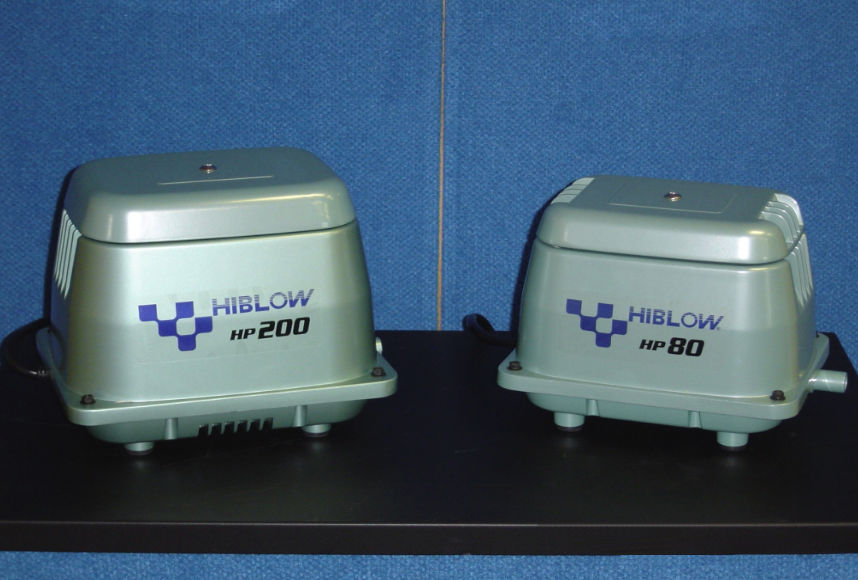
Photo: HiBLow septic aerator pump models used in aerobic septic systems.
Noisy septic aerator pump, worn bearings
I have a noisy aerator. My septic company says that the bearings are wearing out, but they recommend deferring repair/replacement until they stop functioning. Is that good advice? I am concerned about stinking up my yard and neighborhood. (Oct 28, 2015) Mike
Reply:
What we don't know is how long a screaming pump with bad bearings will continue to shriek before it stops. I'd replace it.
But if you want to squeeze out all the life you can from the pump, If you check regularly that the aerator pump is still working you should be ok
If my septic aerator pump runs all the time is my aerobic septic system failing?
Should my aeration system rotation motor run always or stop and go On by linda benoit
Answer by (mod) no but be sure we're talking about the right pump.
Linda
I'm guessing that by "areation system rotatino motor" you are referring to the aerator pump that pumps air down through a bubbler that then sends those air bubbles up through the aerobic septic system treatment tank - the "aerator pump" or "aeration pump".
Usually the aerobic system aeration pump runs continuously but you might have a different design. We'd need to know what your system is to find the specifications.Bottom line: if it's an aerator, it's normal to run continuously.
But a second pump, one designed to periodically move effluent out of the septic tank pumping chamber and into a drainfield or mound or other effluent dispersal system would normally run only intermittently.
Should the ATU / Aerobic pump be running all the time?
Is an aqua-safe as-500 atu motor supposed to run continually?
We have a new system and we can hear the motor hum continually. On 2018-05-08 by Vickie
Answer by (mod) -
Vickie (and for other readers)
In these aerobic treatment unit septic systems, you may find two different pumps:
a dosing pump operated by a timer sends effluent to the disposal or dispersal system - a dosing pump will not run continuously.
an aerator pump provides air (oxygen) for proper bacterial action in the treatment tank. An aerator pump usually is designed to run continuously.
To understand the aerator pump on an Aqua Safe 500 ATU system we excerpt from the system manual:
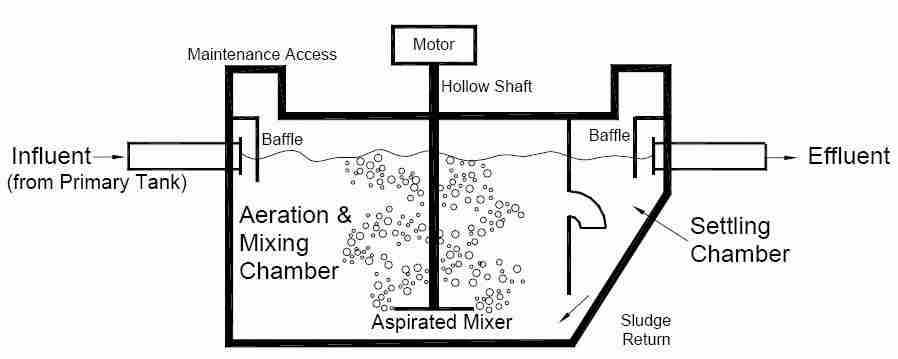
Aqua Safe series models of wastewater treatment plants are made with an outer mixing compartment and a center settling or clarifier compartment. They are in many ways similar to large township or municipality sewage treatment plants. They employ an extended aeration, activated sludge process.This type of treatment depends primarily upon the use of air that is introduced by air passing from the aerator compressor to four air lines located around the perimeter of the aeration mixing compartment.
As wastewater enters the aeration mixing compartment, simple hydraulic displacement is accomplished by the introduction of air which promotes the growth of aerobic organisms in much larger quantities than would occur naturally.
These bacteria break down the organic solids in the wastewater. From the aeration mixing compartment, mixed liquid enters the cone-shaped settling or clarifier compartment from the bottom.
No mixing occurs in this quiet zone where solids separate from liquid and settle to the bottom of the clarifier and re-enter the mixing compartment.
The liquid that separates from the solids in the clarifier continue to flow upward to the discharge pipe.
To start addressing an aerator pump noise complaint let's look first at how the system was actually installed at your property. Here is what Ecological Tanks Inc. says:
The aerator compressor must be installed in a well ventilated, relatively clean and dry location. Install the aerator compressor on the treatment plant's tank top or at a remote location no more than one hundred (100) feet from the treatment plant.The aerator compressor is supplied complete with all discharge fittings. Install 3/4" Sch. 40 PVC piping (supplied by others) between the aerator and treatment plant. A minimum of twelve (12) inches ground cover is recommended over the 3/4" Sch. 40 PVC air piping.
Details about the company ECOLOGICAL TANKS INC and access to the manual for your system are at AEROBIC SEPTIC SYSTEM ATU SUPPLIERS & MANUALS
Do I really need the aerator pump running on my septic system?
Is it necessary to have this system. Can i just turm it off? On 2016-02-19 by Cindy
by (mod) - If you turn off the aerator on an aerobic septic system
If you turn off the aerator on an aerobic septic system you will destroy your drainfield, risk sewage backup into the home, and probably violate local regulations.
IF the system is not working as designed it is not treating the sewage and thus is contaminating the environment, starting at your own property. Best to leave it on.
Where does the diffuser go in my Clearstream Aerobic Tank
When installing the difusser in an aerobic system (in my case Clearstream), does the difusser float on top of the water or does it stay submirged towards the bottom.
If it is designed to stay towards the botton, and for instance the pump is not on, what keeps the filter and line filling up with water? Thanks On 2020-07-13 by Bull Sitter
Reply by danjoefriedman (mod) - close to the bottom of the septic ta nk
If I understand the situation correctly the air diffuser will normally be near the bottom of the tank as the design wants air bubbles to create the volume of wastewater in the tank
In most systems the air is running all of the time.
If your design is one in which air pump only runs in cycles (operated by a timer) the pump will need to be of sufficient capacity to simply push the water out of the diffuser and the vertical pipe.
So don't worry about water getting into the diffuser or bubbler.
...
Aerobic Septic System Alarm Q&A
Yellow air pump warning light on for aerobic septic system.
Yellow air pump warning light on for aerobic septic system. The pump is pumping air.
How do you check/clean (unclog) the diffuser aeration line and diffuser? (3 tank system, with above ground aeration pump) (May 30, 2015) Jay Rennie
Moderator reply: How to respond to aerobic system alarm lights or sounds
Jay
The yellow light on your aerobic septic system control means that there is a problem with the aeration system - just as you suspect.
A red light on the aerobic septic system is a high-water alarm that's critical since it means that either an outlet is blocked or an effluent pump is failing, leading to a sewage backup.
You may also hear an audible alarm on your aerobic controlbox, usually a shrieking whistle or a buzz.
Details of just what to do to fix the problem causing the aerobic septic alarm to sound are found
at AEROBIC SEPTIC ALARM SYSTEMS
Please look there and don't hesitate to ask follow-up questions. - Daniel Friedman
...
ATU Disinfectants FAQs
Will chlorine tablets used in "self-cleaning" toilets damage our septic system?
I have installed a Self-Cleaning Toilet System on our 3 toilets which consists of a small water tight container which sits inline with the water line that fills the bowl (not the tank).
You put a 1" chlorine tablet inside the container and each time you flush a small amount of the slowly dissolved tablet is placed in the toilet bowl, effectively keeping you bowl clean.
We are on a septic system, should I be concerned about this small amount of chlorine going into the septic system with each flush? Would bromine tablets be better for a septic system? Thank You. On 2016-08-31 by Loren
by (mod) - self cleaning toilet cakes or products
Loren:
Modern self cleaning toilets like the Kohler example I cite below often use a combination of a deodorizing / disinfecting additive and some toilets may also use water jets to try to clean the toilet interior enough that you can put off using a toilet scrub brush.
I tried those "self-cleaning" products a few years back - leading to the following opinion:
1. "self-deodorizing" is a more accurate term that "self-cleaning" since the bleach won't scrub off fecal markings in the toilet bowl2. depending on the frequency of toilet use and thus the concentration of bleach in the flush water, high bleach concentrate in the toilet tank damaged the flapper valves on some low-use toilets
3. at normal usage levels the amount of chlorine discharged into the septic tank ought to make no difference to its operation
- KOHLER CONTINUOUS CLEAN TOILET INSTRUCTIONS [Website]
Excerpts: ContinuousClean is Kohler’s innovative self-cleaning technology that automatically dispenses cleaning solution with every flush to help keep your toilet clean longer*.
Yes, when used as directed, the cleaning solution that the ContinuousClean system delivers with each flush is safe for septic system use.
A much more aggressive and thorough self-cleaning toilet system is used in some public restrooms, like the Sanitronic that actually rotates into and out of a cleaning station.
- SANITRONIC SELF-CLEANING TOILET SYSTEM [Website]
Excerpt: A revolutionary, self-cleaning, toilet system. With a quick turn around time, every visitor will be able to experience a toilet that will be clean on the inside and out.
...
Aerobic Septic System Service & Maintenance FAQs
They told my mom the septic system would not need service for 15 years or more
We are selling our home with a septic tank & just discovered it is 4ft from the spa & buried under 4ft of cement with no access.
We took the home over from my mom & she says it was acceded & she was told it wouldn't need to be serviced for 15 years.
That was in 2004. I'm guessing it was serviced prior to the cement being poured. Everything was permitted by the city. Who is responsible for such a negligent mistake? Nicole (no email) On 2016-08-12 by Nicole -
Reply by (mod) - Really? permitted (getting a building permit to install a septic system) absolutely does NOT mean no-septic maintenance required
Your mom did not, from what I can read in your note, receive accurate, useful information.
Furthermore, burying a septic tank under concrete is improper, rendering it inaccessible;
The result increases the chance of an early drainfield failure as it's pumping the tank on schhedule (Search InspectApedia.com for SEPTIC TANK PUMPING SCHEDULE) that extends drainfield life.
"Permitted by the city" doesnt tell me enough; IMO no permit should have been issued for what you describe. But "you can't sue city hall". And I'm doubtful about collecting from a contractor who did something 12 years ago.
You might consider having the septic tank abandoned and installing a new one, or giving an allowance for that purpose rather than aggravating yourselves with litigation and fouling up the sale of your home. A related concern is the remaining life of the drainfield.
Why is our toilet still gurgling even though we had the septic tank pumped?
Wwe have a septic system. We just had it pumped out because of gurgling sounds from the bath tub drain, after flushing the toilet. Still gurgling!
Also, when several loads of laundry are done, there is suds in the toilet bowl! This bathroom is sharing the laundry room drain system. Could a vent pipe be clogged on this side of the house? On 2016-05-29 by Dann Makins
by (mod) - there is a clogged drain or plumbing vent or possibly a failing drainfield / leachfield
Dann
Unfortunately, pumping out a septic tank will **never ever** fix a clogged drain nor a failing drainfield. But yes it makes good sense to check first for a clogged vent line. Sometimes insects build a nest that blocks the line and on occasion I've found frogs, birds, even mice in vent pipes.
...
Aerobic Septic System Odor FAQs
Is there any reason I should be smelling sewage at the site of tank
I purchased a home and the county required a bigger tank size
(1250 gallons) the seller was required to do this before closing
the 1250 gallon was not available for 2 months and seller did not want to wait
so with no disclosure to ANYONE (county, realty agents or purchaser seller ordered 1500 gallon tank
septic co. was unable put it in where the smaller tank had been so AGAIN with no disclosure to anyone had septic co. install larger tank about 15'to the right and 3' down on the other side of a retaining wall
since the ground at the original site of tank was disturbed we were none the wiser
UNTIL we began working outside in the yard about 2 weeks after closing and could smell a strong sewage odor
3 months later the smell is still with us septic co. has sealed large lid at top of tank with caulk (3 weeks ago) it did not help and they have not been back in contact
No one has been able to tell me any reason why this isn't a major problem
the old tank was pumped collapsed and buried the odor is not present at this site
the leach field were not replaced at time of new tank install but found to be in working order by county inspector
a septic certificate was issued
Here is the question
Do you know of any valid reason I should be smelling sewage at the site of tank install at this point? On 2016-07-07 by monica
Answer by (mod) -
Monica it sounds as if I'm stepping in sewage with this question, as "valid reason" is a confusing label.
If you mean does sewage odor mean something is wrong and needs to be fixed, of course.by monica
thank you Dan
yes of course it does
any companies you could recommend..?Answer by (mod) -
You will want to hire a local plumber or septic company who have experience with tracking down plumbing vent problems and septic system problems.
...
Aerobic Septic System Tank FAQs
Why doesn't our septic tank ever develop a scum layer?
Why doesn't our septic tank ever develop a scum layer? At least, not visible at outlet side of tank.
It is a 1000 gal tank, just two people in the house, 4 years old, never yet been pumped out with little sludge developing in the bottom of the tank.
We have extremely hard water and the softener recharges every 3 to 4 days, hence a lot of salt in the system.
The screen at outlet becomes clogged with heavy black stuff and has to be cleaned every 6 months; at 8 to 10 months it would otherwise be completely clogged.
We do not allow any oil or grease down the drains and do not use the garbage disposal.
Any thoughts? On 2016-07-06 by rsd
by (mod) - it probably does: you may be looking in the wrong spot
RS
If you are looking into the interior of an outlet baffle from above you won't see the scum layer because it's being blocked - kept away from the outlet pipe opening by the baffle.
If you inspect the tank through a center cleanout you will most likely see a scum layer. With just two people in a home with careful use of septic system as you describe you are at a 5.9 year tank pumping interval - all else being equal;When the tank is pumped, be on-hand and with help from your pumping company -and with care as leaning over or falling into a septic tank is usually fatal - take another look at the scum layer.
I would be worried about backwashing a lot of salt into a septic system. Gayman and probably others have written about the deletrious effect salt on septic soakbed life.
Good going on keeping oils out of the septic tank - that increases its performance and perhaps field life. Same with garbage disposer.
It sounds as if your water softening system may be straining on your water supply; it might be worth a review with an onsite expert: hardness and daily usage volumes would determine the type and size of water system needed.
...
Aerobic SepticSeptic System Life FAQs
Experience with Aerator Systems aerobic septic systems: drainfield failure & replacement
 We have lived in 3 homes with Aerator Systems, and are getting ready to build a new home where we will install an Aerator system.
Note1: We’ve always had a service contract and done normal maintenance (with one instance of a motor rebuild), with overall good results. However, we just had a major failure — this week — and this is how it played out.
Initially, the alarm on our tank went off.
After resetting, it came right back on every time. We turned it off and called for system maintenance. He arrived and after evaluation, said the system wasn’t draining/we had a blockage in the drain field.
He made a recommendation that we get the (concrete) aerator tank pumped, and then get someone out to find the problem.
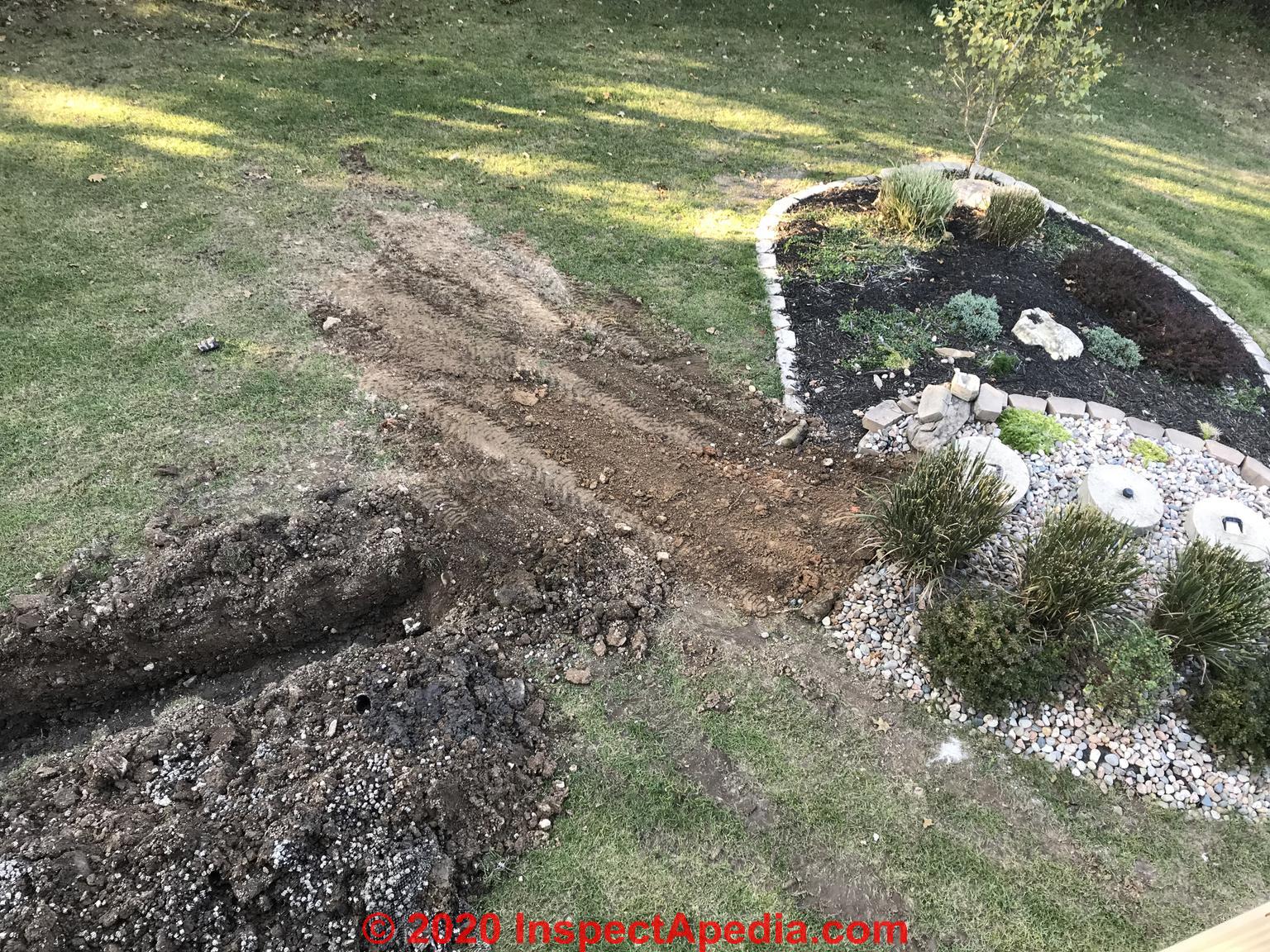
We got the tank pumped, and then called a plumbing service that had a camera they could use to find the blockage. They went as far as they could with the camera, then pinpointed this location above ground so we knew where to start digging.
We dug this area, and found that the “pipe” had collapsed. We couldn’t get anyone out to excavate for at least a week, so rented a small excavator. Bottom line, the remaining line was silted in, so total leach field failure.
The leach field piping used was FRENCH DRAIN PIPE! Inside a poly rock sock (taking the place of gravel and geo textile cloth). Epic failure!
We researched the proper specs for installing a septic leach field, and replaced the entire leach field accordingly, with proper fall, and installing the proper layers - gravel/triple wall leach field pipe/more gravel/geo textile cloth/dirt back fill.
I’m commenting here because I want to make it known that the leach field is just as important as the aerator system. I have no idea how many installers use leach field shortcuts, so be aware. Note2: digging up a leach field can be nasty, but considering this was an aerator system leach field, it wasn’t bad. On 2019-10-18 by PTators
Reply by (mod) -
Thank you for that detailed posting, it will be helpful to other readers.
...
...
Continue reading at AEROBIC SEPTIC AERATOR PUMPS - topic home, or select a topic from the closely-related articles below, or see the complete ARTICLE INDEX.
Or see these
Recommended Articles
- AEROBIC SEPTIC SYSTEMS, ATUs - home
- AEROBIC ATU SEPTIC MAINTENANCE PROCEDURES
- AEROBIC SEPTIC ALARM SYSTEMS
- AEROBIC ATU SEPTIC MAINTENANCE PROCEDURES
- AEROBIC ATU SEPTIC FAILURE RATES, COSTS
- AEROBIC ATU SEPTIC OPERATING COSTS
- AEROBIC ATU SEPTIC PROBLEMS
- AEROBIC SEPTIC AERATOR PUMP SOURCES
- AEROBIC SEPTIC FILTER CLOGGING
- AEROBIC SEPTIC SYSTEM ATU SUPPLIERS & MANUALS
- AEROBIC SEPTIC SYSTEM MAINTENANCE COSTS
- AEROBIC SEPTIC SYSTEM MAINTENANCE: Clearstream ATUs
- ALTERNATIVE DESIGN SEPTIC SYSTEM SUPPLIERS
- HOOT AEROBIC SEPTIC TROUBLESHOOTING
- SEPTIC SYSTEM & PRODUCT SUPPLIERS - home - basic septic system parts, supplies, tanks
Suggested citation for this web page
AEROBIC SEPTIC SYSTEM PUMP FAQs at InspectApedia.com - online encyclopedia of building & environmental inspection, testing, diagnosis, repair, & problem prevention advice.
Or see this
INDEX to RELATED ARTICLES: ARTICLE INDEX to SEPTIC SYSTEMS
Or use the SEARCH BOX found below to Ask a Question or Search InspectApedia
Ask a Question or Search InspectApedia
Share this article:Search the InspectApedia website
Need to make a private comment? Email editor@inspectApedia.com. We welcome email with your website content critique, corrections, suggestions or questions. Email is monitored daily but our workload may prevent an immediate reply. For immediate results, we hope you'll first try asking your question using the search box just above.
Citations & References
In addition to any citations in the article above, a full list is available on request.
- In addition to citations & references found in this article, see the research citations given at the end of the related articles found at our suggested
CONTINUE READING or RECOMMENDED ARTICLES.
- Carson, Dunlop & Associates Ltd., 120 Carlton Street Suite 407, Toronto ON M5A 4K2. Tel: (416) 964-9415 1-800-268-7070 Email: info@carsondunlop.com. Alan Carson is a past president of ASHI, the American Society of Home Inspectors.
Thanks to Alan Carson and Bob Dunlop, for permission for InspectAPedia to use text excerpts from The HOME REFERENCE BOOK - the Encyclopedia of Homes and to use illustrations from The ILLUSTRATED HOME .
Carson Dunlop Associates provides extensive home inspection education and report writing material. In gratitude we provide links to tsome Carson Dunlop Associates products and services.
 |
HOME | ABOUT | ASK a QUESTION | CONTACT | CONTENT USE POLICY | DESCRIPTION | POLICIES | PRIVACY | |
| © 2026 - 1985 Publisher InspectApedia.com - Daniel Friedman | |||||||||