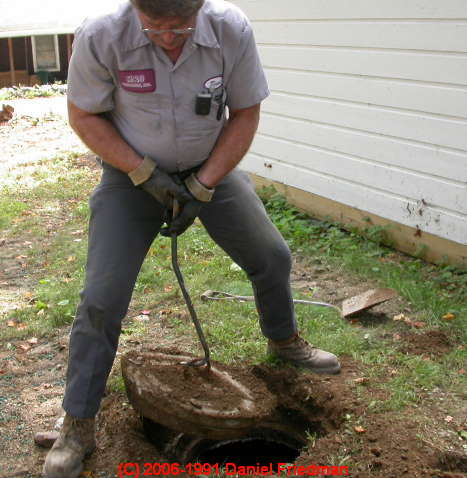
 Septic System Inspection FAQs

- POST a QUESTION or COMMENT about the curriculum for a thorough course in septic systems and onsite waste disposal systems inspection & troubleshooting - diagnosis & repair
Septic system inspection & test procedure questions and answers.
In this article series we explain in complete detail how to buy, inspect, test, diagnose maintain and repair septic tanks and all other components of septic systems.
InspectAPedia tolerates no conflicts of interest. We have no relationship with advertisers, products, or services discussed at this website.
- Daniel Friedman, Publisher/Editor/Author - See WHO ARE WE?
Septic System Inspection & Testing FAQs
hese questions & answers about inspecting and testing septic systems were posted originally
at SEPTIC SYSTEM INSPECTION & TEST GUIDE - be sure to also check that information.
Septic system failed after the inspector ran water and flushed toilets
Hello. We had a septic inspection done to sell the house. The inspector ran the water and flushed and flushed the toilets for about an hour. We never had a problem before but after he left we did have a problem , the septic failel, the yard was full of water
Besides that my well is giving us problems On 2019-10-14 by Jane D -
Reply by (mod) -
Jane:
I'm sorry that you've had septic and well troubles after a home inspection. I have comments that point out two different situations:
1. If the inspector's test was within normal recommended limits- such as a minimum water flow of 50 gallons per bedroom) then the inspection has disclosed upsetting but nonetheless genuine failures in the septic (and perhaps a well flow rate limitation) that are important for both seller and buyer to know now - before someone buys the house, finds these problems the day after they move in with 5 kids and 9 loads of laundry and give their lawyer a furious phone call about having been bamboozled by a home seller and their real estate agent.
2. If the inspector did something that was inappropriately aggressivelike running more a thousand gallons of water into the septic system - then they nevertheless have probably disclosed a failing septic system but the results are more difficult to defend.
In fact for some septic systems such as dosing systems and some aerobic septics, running such a huge volume of water into the system during a pre purchase septic system inspection may have exceeded the design parameters of the septic system being tested. In such a case the test was improper.
So you want a credible estimate of just how much water was run, not just how long it was run. (Running water for 1 hour at 2 gpm is insufficient: 120 gallons, while running water at 1 hour at 20 gpm: 1200 gallons - is more aggressive than normal because it probably exceeds the design parameters of the septic system.
In my experience, in every case - over 40 years of inspections and tests - whenever a septic test sent water to the surface, no matter how questionable the test itself - we discovered a failiure of the septic system; a look into the D-box or in the tank can usually tell us more information about the history of the system and its condition, such as seeing signs of baffle overflow or abnormally high levels in the tank or in the D-box; and we may see historic seepage evidence around the drainfield - or not.
I'm sorry to say that you'd be in an ugly position if you try to prove that your septic system is flawless and try to warrant that to the seller.So some further diagnosis of just what's wrong with the septic will be valuable. That along with some history: the age of the system, its design, size, soil conditions, maintenance history, tank and D-box condition all give a more-full idea of what's there and what repairs may be needed: ranging from fixing a clogged or broken line to budgeting for a field replacement or more.
About the well: if a well has a marginal recovery rate AND someone ran a lot of water they may have run the well dry or nearly dry. Usually in that case, let rest for a few hours to overnight the well will recover.
So how long has it been since you saw well trouble? That'll tell is if we need to be looking further for a problem (such as debris clogging, silt, sand, or an equipment issue to be fixed.)
Please interpret the discovery that pipes leaving D-box that are not perforated
If a camera inspection of pipes leaving a d-box shows that those lines are solid/un-perforated, would that indicate?
What type of system would typically have un-perforated pipes leaving the d-box? On 2018-10-26 by Mari -
by (mod) - it may be perfectly normal depending on what pipes are needed to get effluent to the perforated pipe drainfield sections
Mari,
Thanks, that's an interesting question.
It's not the case that solid lines leaving the d-box tell you anything about the ultimate destination of the effluent that they are carrying except that there is probably some distance between the D-box and the actual effluent Disposal system.That's system could be a conventional drain field with perforated pipes in gravel trenches or it could be something else.
For example it could indicate that that those lines run to a seepage pit, a septic tank, or an effluent pumping chamber of some sort as opposed to a typical leach field or leach area >
Do you get your septic tank or drainfield inspected before selling a home?
Before selling a home do you get your septic tank inspected or your drain field, I get my two cement tanks pumped out faithfully and no problem there . On 2018-08-02 Stella Briggs -
Answer by (mod) -
Stella
Please see our advice at HOME SELLERS GUIDE TO SEPTIC SYSTEMS https://inspectapedia.com/septic/Home_Sellers_Guide_to_Septic_Inspections.php
and after looking that over, do not hesitate to ask further question.
Danielby Stella Briggs - our drainfield was replaced years ago at a depth of 18 feet!
Thank you I have one more question, looks like I need to have the pipes repaired about 6 foot from the tanks there is a hole in the ground no water above it but there might be a broken pipe,
I know my tanks are in good condition they are concrete and the company that pumps them out said they look fine, also in 1979 when the drain field was built it was engineered dug down 18 foot and back filled according to township strict rules and no sign of problem there, no problems with any drainage.
Can the pipes be repaired without having to replace tanks and or drain field. I am totally ingnorant in all of this .
by (mod) - Normally one can excavate to and repair a broken/damaged sewer line or pipe.
Normally one can excavate to and repair a broken/damaged sewer line or pipe.
However I would certainly not assume that a drainfield dating from 1979 has any predictable future life.
And if the excavation means someone is going to drive heavy equipment over the drainfield that's likely to end its life right there.
Finally, a drainfield that was really built 18 feet below the surface of the ground cannot possibly work properly. It might "dispose" of sewage effluent but it's so deep in the soil that oxygen levels will be so low that it cannot support the bacteria necessary for effective processing of the pathogens in the effluent.In short the effluent may be disposed-of but it won't be treated, and it's instead ultimately contaminating the environment, ground-water, and potentially drinking water wells, lakes, rivers, streams.
by Stella
Even though we had to dig down it was back filled with sand, gravel and pipes. It cost us back then $18000.00
Reply by (mod)
Watch out: putting septic drainfield trenches down to a depth of 18 ft means the system will "work" to dispose of effluent. It will not and cannot "work" to treat the effluent effectively. That system may be contaminating nearby water sources or the general environment.
We can't get a price on septic expansion cost
We need to expand our leachfield for a small 1bedroom we are adding to our 49 acres.
Can’t seem to get answers as to price for our testing or contact an engineer that would come out to test and okay for the permit. I’m lost On 2018-07-23 by Carol mock -
by (mod) -
Carol,
Indeed there are so many special fields of engineering that one can get lost - so can engineers including some who practice out of their actual expertise.
Talk to the following and ask for suggestions for local experts who actually have experience and expertise with residential septic design. Surely with 49 acres you'll have space for the field extension but probably need a drawing and perc tests to get approval.
1. your local board of health or building department who approve permits
2. local septic installation contractors
3. engineering firms advertising they do septic design in your area
Septic pumper man said our septic tank lid is deteriorating
I just had tank pumped the man doing the jop said my lid was deteriorating and so was the concrete around the outlet pipe the rest of the tank seems ok.
Can i fix the concrete around the outlet pipe and what is is supposed to look like to me it looked like a box protruding from the side of the tank with the pvc baffle going into it On 2017-06-03 by Dave
Reply by (mod) - important safety warning
Dave,
Keep in mind that depending on just how much deterioration there is in the septic tank lid, the system could be quite unsafe.Watch out: If someone falls into a septic tank the result is usually fatal. If it's the case that your tank needs a new lid comma and having the contractor who replaces the lid make other small repairs at the same time would perhaps be easiest.
I really can't describe exactly what repair is needed since I don't understand the actual conditions at your septic tank. However if there's simply a small area of spalling concrete or a crack those things can be repaired with concrete patching compound or for smaller cracks or leaks, butt or silicone sealant.When repairing an area of spalled concrete, we clean loose material and make sure they repair area is dry. We then coat that area with a bonding agent and then apply a concrete patching compound.
Here's my suggested septic tank inspection checklist for plumbers
I am wanting to create a Septic Tank Inspection checklist for Journeymen Plumbers. Here is what I have so far, can you suggest anything I am missing?
-Perform an effluent quality inspection visually and an odour examination.
-Remove and clean effluent filter.
-Clean or replace air filters in the lift station or compressor.
-Test run sewage pumps and floats and perform a load test on all pumps.
-Determine if the tanks or other components require pumping.
-Visually inspect the drain field or pressure bed.
-Check alarm and panel function, and read history from data logger if equipped.
-Run water through distribution box
-Camera tank
- On 2015-04-22 by Samantha -
Reply by (mod) - see our more complete septic inspection and testing guide
...
Continue reading at SEPTIC SYSTEM INSPECTION & TEST GUIDE or select a topic from the closely-related articles below, or see the complete ARTICLE INDEX.
Or see these
Recommended Articles
- SEPTIC SYSTEM INSPECT DIAGNOSE REPAIR - home
- SEPTIC SYSTEM INSPECTION & TEST GUIDE - home
- SEPTIC INSPECTION LEVELS
- SEPTIC D-BOX INSTALL, LOCATE, REPAIR
- SEPTIC DRAINFIELD INSPECTION & TEST - home
- SEPTIC FAILURE CAUSES / SIGNS
- SEPTIC INSPECTION LEVELS
- SEPTIC LOADING & DYE TEST PROCEDURE - home
- SEPTIC SYSTEM INSPECTION CLASS
- SEPTIC SYSTEM INSPECTION WORK SHEETS
- SEPTIC SYSTEM INSPECTION LEVELS
- SEPTIC TANK INSPECTION PROCEDURE - home
Suggested citation for this web page
SEPTIC SYSTEM INSPECTION & TEST GUIDE FAQs at InspectApedia.com - online encyclopedia of building & environmental inspection, testing, diagnosis, repair, & problem prevention advice.
Or see this
INDEX to RELATED ARTICLES: ARTICLE INDEX to SEPTIC SYSTEMS
Or use the SEARCH BOX found below to Ask a Question or Search InspectApedia
Ask a Question or Search InspectApedia
Share this article:Search the InspectApedia website
Need to make a private comment? Email editor@inspectApedia.com. We welcome email with your website content critique, corrections, suggestions or questions. Email is monitored daily but our workload may prevent an immediate reply. For immediate results, we hope you'll first try asking your question using the search box just above.
Citations & References
In addition to any citations in the article above, a full list is available on request.
- In addition to citations & references found in this article, see the research citations given at the end of the related articles found at our suggested
CONTINUE READING or RECOMMENDED ARTICLES.
- Carson, Dunlop & Associates Ltd., 120 Carlton Street Suite 407, Toronto ON M5A 4K2. Tel: (416) 964-9415 1-800-268-7070 Email: info@carsondunlop.com. Alan Carson is a past president of ASHI, the American Society of Home Inspectors.
Thanks to Alan Carson and Bob Dunlop, for permission for InspectAPedia to use text excerpts from The HOME REFERENCE BOOK - the Encyclopedia of Homes and to use illustrations from The ILLUSTRATED HOME .
Carson Dunlop Associates provides extensive home inspection education and report writing material. In gratitude we provide links to tsome Carson Dunlop Associates products and services.
 |
HOME | ABOUT | ASK a QUESTION | CONTACT | CONTENT USE POLICY | DESCRIPTION | POLICIES | PRIVACY | |
| © 2026 - 1985 Publisher InspectApedia.com - Daniel Friedman | |||||||||