 Residential Oil Tank Leak Reporting Requirements
- POST a QUESTION or COMMENT about reporting the present of oil storage tanks at a property
Oil tank leak reporting laws & laws requiring reporting the presence of an oil storage tank:
Home heating oil bulk storage - petroleum oil storage tanks, regulations, issues, requirements for reporting the presence of an oil storage tank at a property.
InspectAPedia tolerates no conflicts of interest. We have no relationship with advertisers, products, or services discussed at this website.
- Daniel Friedman, Publisher/Editor/Author - See WHO ARE WE?
Reporting Requirements on the Discovery of Leaking Residential and Other Oil Storage Tanks
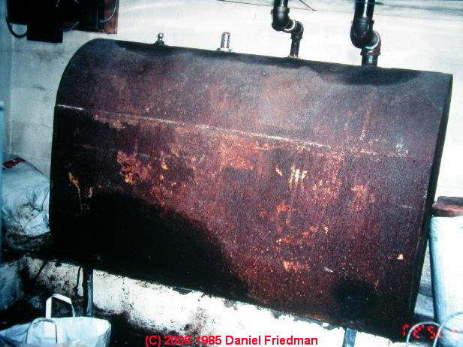 In this document, the NYS Department of Environmental Conservation informs home inspectors of their reporting requirements when
an oil tank is observed to be leaking. T
his information was presented to the New York Metro ASHI Chapter Seminar (American Society of Home Inspectors) in May, 1993 by Jacqueline Sibblies, a chemical engineer with the NYS DEC Offered a slide presentation on "Petroleum Bulk Storage" at the April NY Metro ASHI Educational session. Edits and illustrations by InspectAPedia.com.
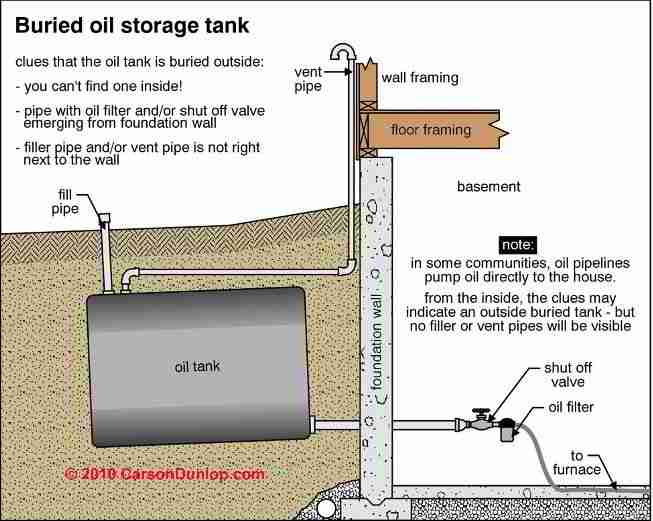
Sketch at page top courtesy of Carson Dunlop Associates, a Toronto home inspection, education & report writing tool company [ carsondunlop.com ].
[Click to enlarge any image]
This article deals primarily with bulk fuel storage tanks that are larger than 1,100 gallons. Such tanks fall under the NYS Petroleum Bulk Storage Law. However, much of what was covered had implications for home inspectors.
According to Ms. Sibblies, leaking petroleum storage tanks are a major source of groundwater contamination. Fuel leaking from damaged tanks can seep through the ground, get into an aquifer, and contaminate a water supply, causing wells to be shut down.
The DEC estimates that there may be as many as 160,000 tanks in New York State storing petroleum and subject to DEC regulations. Many of these tanks were installed underground in the 1950's and 1960's, and are bare steel. DEC authorities and other experts believe that many have become weakened by rust and have a 50% chance of developing leaks.
When inspecting a house, if the tank is larger than 1,100 gallons, the buyer should be advised that the DEC requires registration and periodic testing of such tanks and their piping. Inspectors should advise their clients that tank testing should be performed by the present owner and results be made available to the buyers.
It is prudent to advise buyers to have even smaller tanks tested, even though it is not a requirement. If there is room in the basement or garage, it would be wise to recommend that the existing tank be deactivated and a new tank be installed indoors.
If leakage is detected during a home inspection, it should be reported
within two hours to the DEC. The toll-free,
Free publications dealing with this topic are available from the DEC. For a list of such publications call the NYS DEC help line at 800-242-4351.
...
Continue reading at OIL TANK LEGAL ISSUES or select a topic from the closely-related articles below, or see the complete ARTICLE INDEX.
If your oil tank is leaking see OIL TANK LEAK & ODOR ADVICE.
Suggested citation for this web page
OIL TANK LEAK & SIZE REPORTING at InspectApedia.com - online encyclopedia of building & environmental inspection, testing, diagnosis, repair, & problem prevention advice.
Or see this
INDEX to RELATED ARTICLES: ARTICLE INDEX to HEATING OIL, OIL BURNERS, OIL FIRED HEATERS, OIL TANKS
Or use the SEARCH BOX found below to Ask a Question or Search InspectApedia
Ask a Question or Search InspectApedia
Share this article:Search the InspectApedia website
Need to make a private comment? Email editor@inspectApedia.com. We welcome email with your website content critique, corrections, suggestions or questions. Email is monitored daily but our workload may prevent an immediate reply. For immediate results, we hope you'll first try asking your question using the search box just above.
Citations & References
In addition to any citations in the article above, a full list is available on request.
- Mark Cramer Inspection Services Mark Cramer, Tampa Florida, Mr. Cramer is a past president of ASHI, the American Society of Home Inspectors and is a Florida home inspector and home inspection educator. Mr. Cramer serves on the ASHI Home Inspection Standards. Contact Mark Cramer at: 727-595-4211 mark@BestTampaInspector.com
- John Cranor [Website: /www.house-whisperer.com ] is an ASHI member and a home inspector (The House Whisperer) is located in Glen Allen, VA 23060. He is also a contributor to InspectApedia.com in several technical areas such as plumbing and appliances (dryer vents). Contact Mr. Cranor at 804-873-8534 or by Email: johncranor@verizon.net
- NFPA - the National Fire Protection Association can be found online at www.nfpa.org
- Our recommended books about building & mechanical systems design, inspection, problem diagnosis, and repair, and about indoor environment and IAQ testing, diagnosis, and cleanup are at the InspectAPedia Bookstore. Also see our Book Reviews - InspectAPedia.
- In addition to citations & references found in this article, see the research citations given at the end of the related articles found at our suggested
CONTINUE READING or RECOMMENDED ARTICLES.
- Carson, Dunlop & Associates Ltd., 120 Carlton Street Suite 407, Toronto ON M5A 4K2. Tel: (416) 964-9415 1-800-268-7070 Email: info@carsondunlop.com. Alan Carson is a past president of ASHI, the American Society of Home Inspectors.
Thanks to Alan Carson and Bob Dunlop, for permission for InspectAPedia to use text excerpts from The HOME REFERENCE BOOK - the Encyclopedia of Homes and to use illustrations from The ILLUSTRATED HOME .
Carson Dunlop Associates provides extensive home inspection education and report writing material. In gratitude we provide links to tsome Carson Dunlop Associates products and services.
 |
HOME | ABOUT | ASK a QUESTION | CONTACT | CONTENT USE POLICY | DESCRIPTION | POLICIES | PRIVACY | |
| © 2026 - 1985 Publisher InspectApedia.com - Daniel Friedman | |||||||||