 Mold in Attics: Media Blasting & Mold Encapsulants
- POST a QUESTION or COMMENT about choices of cleaning methods for mold-contaminated attics and about the use of sprays, disinfectants, biocides, and mold encapsulants in building attics after a mold cleanup project
How to get rid of attic mold and prevent it's re-growth: this article gives advice on how to find and deal with mold in building attics and roof cavities.
This procedure helps identify the presence of or locate the probable sources of mold reservoirs in buildings, and helps decide which of these need more invasive, exhaustive inspection and testing.
InspectAPedia tolerates no conflicts of interest. We have no relationship with advertisers, products, or services discussed at this website.
- Daniel Friedman, Publisher/Editor/Author - See WHO ARE WE?
ATTIC MOLD When to Media Blast and Use Encapsulants in Attics
 Is there ever a time when the fungicide, blasting, encapsulation method should not be used?
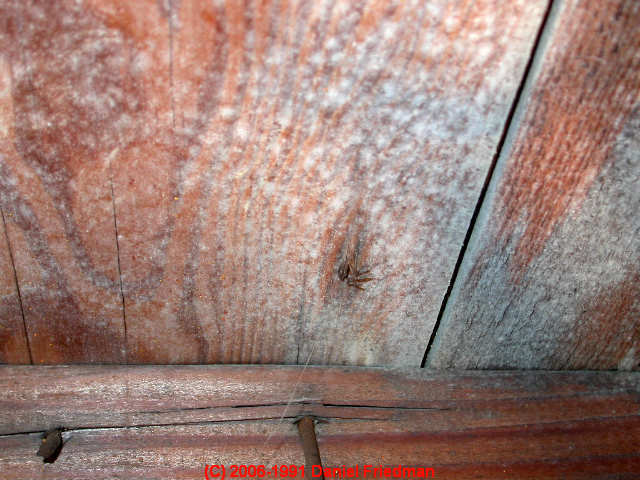
Toxic attic mold: The photo at the left was identified as a toxic mold that probably should be removed, although the ease of movement of mold spores from an attic down into a living area varies widely from building to building.
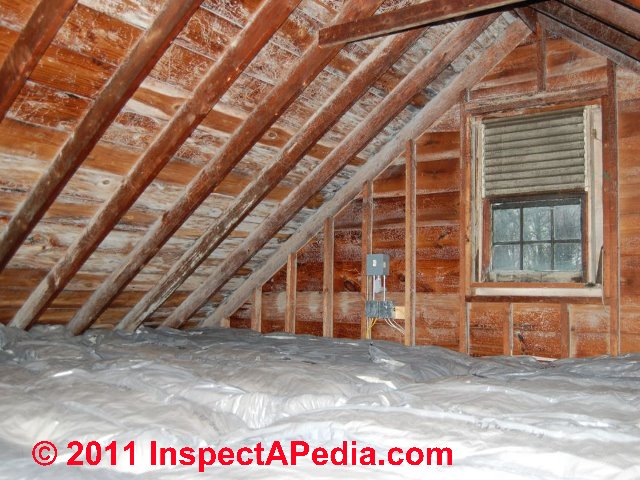
Uncertain attic mold: The photo at the very top of this page shows where you may find mold growing on the attic side of ceiling drywall, particularly below roof leaks or in areas of ice dam leaks at a building eaves.
In addition to testing to see what this material is (presuming there is a large area of it), we'd also evaluate the chances of particle movement between the attic and the living space before deciding on an appropriate approach to this moldy attic.
Using media blasting and encapsulants to remove mold in an attic are mold remediation methods which are probably inappropriate for small areas, say less than 30 sq.ft. of contiguous mold, and would otherwise certainly not be used without very good particle and dust containment measures.
If we had a moldy attic area where containment were impossible or impractical, other measures may be needed such as careful piece-meal demolition using negative air conditions in the attic and without passing moldy demolition materials unprotected through other building areas (double bagging, exit through a containment door, or disposal through an opening in a roof or attic gable end wall for example).
If a large area of toxic or allergenic attic mold is found on attic surfaces such as roof sheathing and or rafters, or on the surfaces of the attic floor or floor joists, media blasting may be a rapid and economical cleaning method to remove problem mold provided:
- Proper particle and dust containment can be set up to protect the rest of the building from cross contamination during the media blasting cleaning process
- Insulation that has been exposed to mold or which would be exposed to dust from media blasting has been removed.
- Be sure to review INSULATION MOLD CONTAMINATION TEST.
This article is part of our series: MOLD in BUILDINGS which describes how to find mold and test for mold in buildings including building attics or other building roof cavities.
...
Continue reading at ATTIC MOLD or select a topic from the closely-related articles below, or see the complete ARTICLE INDEX.
Or see these
Recommended Articles
- ATTIC MOLD - home
- ATTIC MOLD CAUSES
- ATTIC MOLD IS A PROBLEM ?
- ATTIC MOLD - IS IT TOXIC?
- ATTIC MOLD, WHERE TO LOOK
- ATTIC MOLD, WHAT IT LOOKS LIKE
- ATTIC MOLD, HARMLESS COSMETIC?
- ATTIC MOLD ROOF TEAROFF
- ATTIC MOLD ENCAPSULANTS
- MOLD CLEANUP GUIDE- HOW TO GET RID OF MOLD
Suggested citation for this web page
ATTIC MOLD ENCAPSULANTS at InspectApedia.com - online encyclopedia of building & environmental inspection, testing, diagnosis, repair, & problem prevention advice.
Or see this
INDEX to RELATED ARTICLES: ARTICLE INDEX to MOLD CONTAMINATION & REMEDIATION
Or use the SEARCH BOX found below to Ask a Question or Search InspectApedia
Ask a Question or Search InspectApedia
Share this article:Search the InspectApedia website
Need to make a private comment? Email editor@inspectApedia.com. We welcome email with your website content critique, corrections, suggestions or questions. Email is monitored daily but our workload may prevent an immediate reply. For immediate results, we hope you'll first try asking your question using the search box just above.
Citations & References
In addition to any citations in the article above, a full list is available on request.
- Atlas of Clinical Fungi, 2nd Ed., GS deHoog, J Guarro, J Gene, & MJ Figueras, Centraalbureau voor Schimmelcultures, Universitat Rovira I Virgili, 2000, ISBN 90-70351-43-9
- "Disease Prevention Program for Certain Vegetable Crops," David B. Langston, Jr., Extension Plant Pathologist - Vegetables, University of Georgia (PDF document) original source: www.reeis.usda.gov/web/crisprojectpages/209797.html
- Disease Prevention in Home Vegetable Gardens [PDF], Patricia Donald,Department of Plant Microbiology and Pathology,
Lewis Jett
Department of Horticulture, University of Missouri Extension - extension.missouri.edu/publications/DisplayPub.aspx?P=G6202 - "Management of Powdery Mildew, Leveillula taurica, in Greenhouse Peppers," Ministry of Agriculture and Lands, British Columbia - Original source: www.agf.gov.bc.ca/cropprot/peppermildew.htm
- Fifth Kingdom, Bryce Kendrick, ISBN13: 9781585100224, - we recommend the CD-ROM version of this book. This 3rd/edition is a compact but comprehensive encyclopedia of all things mycological. Every aspect of the fungi, from aflatoxin to zppspores, with an accessible blend of verve and wit. The 24 chapters are filled with up-to-date information of classification, yeast, lichens, spore dispersal, allergies, ecology, genetics, plant pathology, predatory fungi, biological control, mutualistic symbioses with animals and plants, fungi as food, food spoilage and mycotoxins.
- Fungi, Identifying Filamentous, A Clinical Laboratory Handbook, Guy St-Germain, Richard Summerbell, Star Publishing, 1996, ISBN 0-89863-177-7 (English)
- US EPA: Mold Remediation in Schools and Commercial Building [Copy on file at /sickhouse/EPA_Mold_Remediation_in_Schools.pdf ] - US EPA
- Mycology, Fundamentals of Diagnostic, Fran Fisher, Norma B. Cook, W.B. Saunders Co. 1998, ISBN 0-7216-5006-6
- US EPA: Una Breva Guia a Moho - Hongo [Copy on file as /sickhouse/EPA_Moho_Guia_sp.pdf - en Espanol
- Rodents, Mice, Squirrel Control - I find high levels of mouse and rodent dander, fecal dust, and urine-contaminated dust in some buildings, and high levels of these materials in building insulation in those locations. If you have a mouse problem, particularly if mice and their waste (fecals or urine) are contaminating the building HVAC or building insulation, may need both steps to clean up or remove infected materials and steps to stop an ongoing rodent problem. If squirrels are a problem, the cleanup needs to include closing off entry openings into the building. Get some help from a licensed pest control expert.
- In addition to citations & references found in this article, see the research citations given at the end of the related articles found at our suggested
CONTINUE READING or RECOMMENDED ARTICLES.
- Carson, Dunlop & Associates Ltd., 120 Carlton Street Suite 407, Toronto ON M5A 4K2. Tel: (416) 964-9415 1-800-268-7070 Email: info@carsondunlop.com. Alan Carson is a past president of ASHI, the American Society of Home Inspectors.
Thanks to Alan Carson and Bob Dunlop, for permission for InspectAPedia to use text excerpts from The HOME REFERENCE BOOK - the Encyclopedia of Homes and to use illustrations from The ILLUSTRATED HOME .
Carson Dunlop Associates provides extensive home inspection education and report writing material. In gratitude we provide links to tsome Carson Dunlop Associates products and services.
 |
HOME | ABOUT | ASK a QUESTION | CONTACT | CONTENT USE POLICY | DESCRIPTION | POLICIES | PRIVACY | |
| © 2026 - 1985 Publisher InspectApedia.com - Daniel Friedman | |||||||||