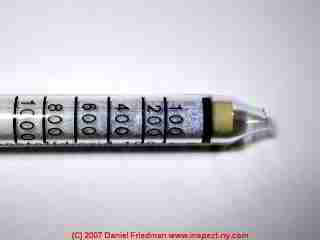
 Effects of Sulphur Dioxide Gas Exposure SO2
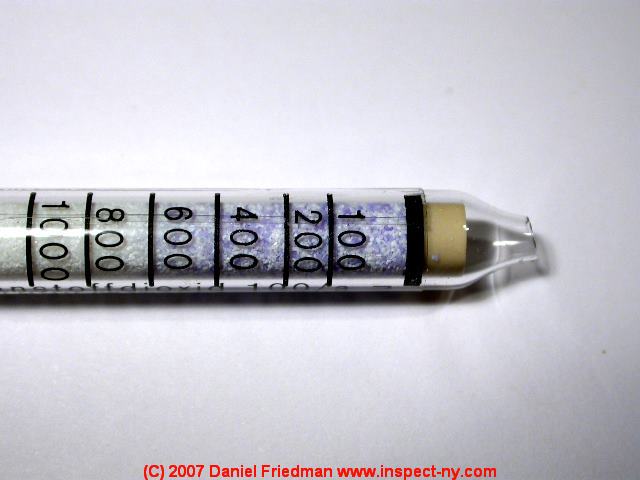
- POST a QUESTION or COMMENT about the toxicity of various gases found in buildings
What are the effects on humans of exposure to SO2 sulphur dioxide gas?
SO2 toxicity, exposure limits, sources, effects.
This article series gives basic information about exposure to and potential health hazards from a number of common toxic gases that may be found indoors or in or around buildings. We describe symptoms of exposure to these gases, industry recommendations for gas exposure limits, how gases may be measured, and how to track down and cure the sources of gas leaks in buildings.
InspectAPedia tolerates no conflicts of interest. We have no relationship with advertisers, products, or services discussed at this website.
- Daniel Friedman, Publisher/Editor/Author - See WHO ARE WE?
Sulfur Dioxide Gas Exposure Hazards & Effects
For sulfur dioxide (SO2 )the TLV had been 5.0 ppm for many years, but in 1978 ACGIH announced its intention to reduce that TLV to 2.0 ppm; that was done in 1980. The reason for this was recent information indicating that chronic (long term, repeated) exposure to sulfur dioxide concentrations near 5.0 ppm was found to have some minimal effects on working populations.
Sulfur dioxide is an upper respiratory tract irritant and acute (single or short-term) exposures cause
nothing but irritation of the nose and throat. Long term exposures to sulfur dioxide concentrations in excess of 2.0 ppm
can be expected in some cases to cause minor lung changes.
Potential Symptoms of sulfur dioxide gas exposure: Eye, nose, throat irritation; rhinorrhea, nosebleeds; choking, coughing, shortness of breath, chest pain, pulmonary edema, cyanosis; reflex bronchoconstriction; eye, skin burns; frostbite (on contact with liquid); asthma; chronic bronchitis. [12]
Affected organs: eyes, skin, respiratory system.
Health Effects of sulfur dioxide gas exposure: Irritation-Eye, Nose, Throat, Skin---Marked (HE14) Mutagen (HE2); Respiratory effects--- Bronchoconstriction, pulmonary edema, reactive airways dysfunction syndrome (HE9 and HE11); Suspect reproductive effects (HE5)
Affected Organs: Eyes, skin, respiratory system
OSHA Note:
Sulfur dioxide is listed by the FDA as generally recognized as safe when used in accordance with good manufacturing practice as a preservative of fruits or vegetables (21 CFR 182.3862). [12]
Sulfur Oxides Toxicity and Exposure Limits References:
Sulphur dioxide Sulfur dioxide SO2 exposure limits (PELS typically are at 5 ppm or less by some standards) are at
- SULFUR DIOXIDE GAS in our article titled: GAS EXPOSURE LIMITS & STANDARDS
Watch out: NIOSH Immediately Dangerous To Life or Health Concentration (IDLH): 100 ppm
Sulfur dioxide & other Oxides: Air Quality Criteria for Particulate Matter and Sulfur Oxides, Vol. III, US EPA, Environmental Criteria and Assessment Office, Research Triangle Park NC 27711, Dec. 1982, EPA-600/8/2-029c. Web search 08/26/2010, original source: http://nepis.epa.gov [large PDF]
OSHA citations for sulphur dioxide hazards & effects:[12]
- NIOSH Pocket Guide to Chemical Hazards: Sulfur dioxide.
- International Chemical Safety Cards (WHO/IPCS/ILO): Sulphur dioxide.
- Koksal, N., Hasanoglu, H.C., Gokirmak, M., Yildirim, Z. and Gultek, A.: Apricot sulfurization: an occupation that induces an asthma-like syndrome in agricultural environments. Am. J. Ind. Med. 43(4): 447-453, 2003.
- Piirilä, P.L., Nordman, H., Korhonen, O.S. and Winblad, I.: A thirteen-year follow-up of respiratory effects of acute exposure to sulfur dioxide. Scand. J. Work Environ. Health 22(3): 191-196, 1996.
- Pohanish, R.P. (editor): Sulfur Dioxide. In, Sittig's Handbook of Toxic and Hazardous Chemicals and Carcinogens, Fourth Ed., Vol. 2. Norwich, NY: Noyes Publications, William Andrew Publishing, 2002, pp. 2116-2119.
At VOCs VOLATILE ORGANIC COMPOUNDS we discuss several chemicals and gases found indoors and offer advice for reducing indoor exposure.
Question: Sulphur dioxide SO2 exposure limits?
[This question originally appeared in reader comments at CARBON DIOXIDE - CO2] - Ed.]
This article is interesting. I think I understand the concept but I have an application that use an analyzer.
To calibrate this instrument, I need to use an 8% SO2 compress gas cylinder (cylinder capacity 5m3). This is located in a sealed 10x10x10 room, so my room is 1000m3 and unventilated.
Worst case scenario, the cylinder empties in this room. Is this an accute risk knowing that 3000 ppm is the LC50 (1/2hour) limit and the bottle contains 80000ppm? I have a bit of difficulties to put some math around this. Could you please explain?
I think 8% concentration x 5m3 cylinder = 0.4m3 of SO2 release in the room.
The gas will occupy 0.4m3/1000m3 = 0.04% of the room volume which is 400ppm.
400ppm < LC50 3000ppm = Low Risk?
- Syl
Reply:
Syl, your question was a bit unclear and makes me worry that you are messing with gases without proper education or preparation. You are asking about Sulphur dioxide (SO2) in an article about Carbon dioxide (CO2) - in any event, if you are asking about recommended exposure limits for Sulphur dioxide SO2,
Sulphur dioxide exposure limits: OSHA PELs for SO2 and other recommended exposure limits are given at Sulfur Dioxide Gas in our article titled: GAS EXPOSURE LIMITS & STANDARDS. Depending on the standard, SO2 PELs range among 0.25 ppm, 2 ppm, or 5 ppm. - all significantly less than your 400 ppm.
Watch out: NIOSH Immediately Dangerous To Life or Health Concentration (IDLH): 100 ppm
...
Continue reading at GAS EXPOSURE EFFECTS, TOXIC - topic home, or select a topic from the closely-related articles below, or see the complete ARTICLE INDEX.
Or see these
Recommended Articles
- DEFINITION of PEL TLV STEL
- GAS EXPOSURE EFFECTS, TOXIC - topic home,
- GAS EXPOSURE LIMITS & STANDARDS - includes definitions of various exposure limits & limits for specific gases & chemicals
- GAS EXPOSURE SCREENING TEST
- SULPHUR DIOXIDE GAS TOXICITY
- SULPHUR & SEWER GAS SMELL SOURCES
Suggested citation for this web page
SULPHUR DIOXIDE GAS TOXICITY at InspectApedia.com - online encyclopedia of building & environmental inspection, testing, diagnosis, repair, & problem prevention advice.
Or see this
INDEX to RELATED ARTICLES: ARTICLE INDEX to GAS HAZARDS in BUILDINGS
Or use the SEARCH BOX found below to Ask a Question or Search InspectApedia
Ask a Question or Search InspectApedia
Share this article:Search the InspectApedia website
Need to make a private comment? Email editor@inspectApedia.com. We welcome email with your website content critique, corrections, suggestions or questions. Email is monitored daily but our workload may prevent an immediate reply. For immediate results, we hope you'll first try asking your question using the search box just above.
Citations & References
In addition to any citations in the article above, a full list is available on request.
- Sulfur dioxide & other Oxides: Air Quality Criteria for Particulate Matter and Sulfur Oxides, Vol. III, US EPA, Environmental Criteria and Assessment Office, Research Triangle Park NC 27711, Dec. 1982, EPA-600/8/2-029c. Web search 08/26/2010, original source: http://nepis.epa.gov [large PDF]
- "Hydrogen Sulfide", United States Department of Labor, OSHA, reference, retrieved 2/2/2014, original source https://www.osha.gov/dts/chemicalsampling/data/CH_246800.html
- U.S. Army Field Manual FM-8-285-Noxious_Chemicals discusses Ammonia, Carbon Monoxide, Hydrogen Sulfide, Oxides of Nitrogen, Hazards caused by fire,
- [1] CADAC, Commercial And Domestic Appliance Company, produces a range of gas and camping products. we are guessing that typically they'd be marketing LP - liquid propane. Web search 07/22/2010 - original source: http://www.cadac.co.za/index.php?page=company describes Cadac products. their tel: support line on 0860 22 3 22 0
- [2] Canadian Centre for Occupational Health and Safety, web search 07/22/2010, original source: http://www.ccohs.ca/oshanswers/chemicals/chem_profiles/propane/health_pro.html
- [3] "Residential Electric Water Heater Installation Instructions and Use & Care Guide", American Water Heater Co., October 2001, American Water Heater Co., Johnson City, TN, [manufacturer of residential & commercial water heaters, also manufacturer of Polaris/Commercial water heaters], Tel: 800-999-9515, web search 1/12/2012, original source: americanwaterheater.com/support/manuals/res-elect.pdf [copy on file]
- [4] Portions of this data were extract5ed from CompuServe's SAFETYNET forum 1989 and from the following articles:
- [5] [73766,1245] GASES.TOX 08-May-87 17240 53 Title: Toxicity & hazards discussion of various gases
- [6] Keywords: Discussion of the toxicity and hazards of various gases, ammonia, arsine, bromine, carbon dioxide, carbon monoxide, ozone, nitric oxide, nitrogen dioxide, propylene, and sulfur dioxide.
- [7] [74756,40] CO 20-Dec-86 7050 40 Title: Carbon Monoxide discussion by Jack Peterson
- This is a discussion of carbon monoxide from lift trucks, by Jack Peterson, in response to a query on the message board. Excellent information from one of the leading experts on the topic. ASCII file - Uploaded by Len Wilcox, 74756,40 [an old Compuserve address].
- [8] [76701,115] COALAR.TXT 19-Aug-88 12814 17 Title: Message thread on Carbon Monoxide Alarms
- [9] Keywords: CO CARBON MONOXIDE ALARM ALARMS MONITOR MONITORING TESTING
- [10] [Portions of this file was excerpted and edited from contents of a 1986 Compuserve message board discussion on Carbon Monoxide alarms, featuring comments by one of the leading authorities on CO, Jack Peterson.-- DJF]
- [12] Sulfur dioxide, Exposure Limits, U.S. Department of Labor, OSHA, web search 4/12/12, original source:
http://www.osha.gov/dts/chemicalsampling/data/CH_268500.html - Our recommended books about building & mechanical systems design, inspection, problem diagnosis, and repair, and about indoor environment and IAQ testing, diagnosis, and cleanup are at the InspectAPedia Bookstore. Also see our Book Reviews - InspectAPedia.
- CCSP, 2008: Analyses of the effects of global change on human health and welfare and human systems. A Report by the U.S. Climate Change Science Program and the Subcommittee on Global Change Research. [Gamble, J.L. (ed.), K.L. Ebi, F.G. Sussman, T.J. Wilbanks, (Authors)]. U.S. Environmental Protection Agency, Washington, DC, USA. Web search 08/28/2010, original source: http://nepis.epa.gov/
- GTSP, 2006: Carbon Dioxide Capture and Geologic Storage: A Core Element of a A Global
Energy Technology Strategy to Address Climate Change (PDF, 37 pp., 6.05 MB, About PDF).
April 2006, JJ Dooley et al. Global Energy Technology Strategy Program (GSTP) - IPCC, 2005: Special Report on Carbon Dioxide Capture and Storage, Special Report of the
Intergovernmental Panel on Climate Change [Metz, Bert, Davidson, Ogunlade,
de Coninck, Heleen, Loos, Manuela, and Meyer, Leo (Eds.)]. Cambridge University Press, The
Edinburgh Building Shaftesbury Road, Cambridge CB2 2RU England - TABLE Z-1 LIMITS FOR AIR CONTAMINANTS, 1910.1000 TABLE Z-1 [PDF] OSHA standard for air contaminant limits (http://www.osha.gov/pls/oshaweb/owadisp.show_document?p_table=STANDARDS&p_id=9992) - includes for CO2, Carbon dioxide.........| CAS No. 124-38-9 | 5000 ppm | 9000 mg/m3 limits for carbon dioxide as an air contaminant.
- In addition to citations & references found in this article, see the research citations given at the end of the related articles found at our suggested
CONTINUE READING or RECOMMENDED ARTICLES.
- Carson, Dunlop & Associates Ltd., 120 Carlton Street Suite 407, Toronto ON M5A 4K2. Tel: (416) 964-9415 1-800-268-7070 Email: info@carsondunlop.com. Alan Carson is a past president of ASHI, the American Society of Home Inspectors.
Thanks to Alan Carson and Bob Dunlop, for permission for InspectAPedia to use text excerpts from The HOME REFERENCE BOOK - the Encyclopedia of Homes and to use illustrations from The ILLUSTRATED HOME .
Carson Dunlop Associates provides extensive home inspection education and report writing material. In gratitude we provide links to tsome Carson Dunlop Associates products and services.
 |
HOME | ABOUT | ASK a QUESTION | CONTACT | CONTENT USE POLICY | DESCRIPTION | POLICIES | PRIVACY | |
| © 2026 - 1985 Publisher InspectApedia.com - Daniel Friedman | |||||||||