 Heating Baseboard Repair FAQs#4
- POST a QUESTION or COMMENT about baseboard heat and heating baseboard installations
Hot water baseboard heat repair tips & troubleshooting FAQs Set#2:
Frequently-asked "cold heating baseboard" questions and answers help diagnose and fix hot water heating baseboard troubles in your building.
This article series provides common hot water heating baseboard questions and answers that will help diagnose & repair most common heating baseboard troubles including no-heat or leaks or other problems.
InspectAPedia tolerates no conflicts of interest. We have no relationship with advertisers, products, or services discussed at this website.
- Daniel Friedman, Publisher/Editor/Author - See WHO ARE WE?
Baseboard Heat Diagnosis & Repair Questions & Answers #2

These questions & answers about troubleshooting and fixing problems with forced hot water baseboard heat were posted originally
at BASEBOARD HEAT REPAIR. Be sure to review the diagnosis and repair suggestions you'll find there.
Below is our index to questions and answers about troubleshooting or installing baseboard heat.
Article Contents
- BASEBOARD HEAT ADJUSTMENT - using the louvers, cleaning dust, fixing damaged fins, balancing heat delivery
- BASEBOARD HEAT BLOCKAGE - damage, dust, missing covers
- BASEBOARD HEAT CIRCULATOR PUMP - is it air blockage of a bad circulator?
- BASEBOARD HEATER is COLD - airbound? air blockage in heating pipes, other causes of cold baseboards
- BASEBOARD HEAT COVER PARTS - Covers, end caps, louvers
- BASEBOARD HEATER is HOT WHEN TURNED OFF
- BASEBOARD HEAT FREEZE UP
- BASEBOARD HEAT INSTALLATION & PLUMBING - new work or repairs, baseboards not hot, shut off
- BASEBOARD HEAT LEAKS
- BASEBOARD HEAT NOISES
- BASEBOARD HEAT ODORS
- BASEBOARD HEAT STAINS or SOOT - on walls above baseboard
- BASEBOARD HEAT is TOO HOT
- UNWANTED BASEBOARD HEAT - baseboard gets hot but thermostat is not calling for heat
Baseboard Heat Output Blocked
Baseboard heat efficiency when baseboard bottoms blocked
I recently bought a house in new England with cast iron baseboard heat throughout.
I like how well it works but I'm concerned about the efficiency as in many rooms the floor has been redone so the bottom of the radiator basically touches the floor now, the original feet sit in pockets in the new floor.
Clearly this means much less air is getting under and around the radiator than should. They do heat the rooms fine, but my super low ceilings are really making the life easy there.
My question is would it be worth the hassle of somehow raising them up?
I'd have to cut the plumbing and extend it an inch on each end some how to get to the normal installed height, but if that saves me a few hundred in oil each winter it would be very worth it. Or am I just making a mountain out of a molehill - On 2020-05-14 by Dave -
Reply by (mod)
In my OPINION, Dave, over the life of a home or even over just a few years, raising the baseboard runs so that you've got 3/4" to 1" of clearance to the floor surface, if the baseboards were basically blocked before - as is your case - should make a big difference in both the cost of heating your home and the speed at which it warms up.
So it's worth doing. - Daniel Friedman
How much does dust block baseboard heat output
I can't find any published data on how much dust and dirt reduces the efficiency of radiant fin tube. Dirty coils have a significant effect on forced air systems.
I would expect the the negative effect would not be as much, but who knows for sure. Does anyone know the approximate percent reduction in efficiency form dirty and dusty fin tube? On 2016-05-20 John:
Reply:
I have myself performed quantitative analysis, but take a look at the thick dust blocking the heating baseboard fins in my photo shown above.
When the baseboard is dust clogged like shown you're probably blocking at least 50% of the air flow through the heater.
See our own work on this topic found
at BASEBOARD HEAT DAMAGE REPAIR
Here's some research that approaches the question but I have not found a seminal research paper on the quatitative measurement of the effect of dust blockage of finned copper tubing baseboard.
- Bagheri, N., A. Moosavi, and M. B. Shafii. "Thermal enhancement of baseboard heaters using novel fin-tube arrays: experiment and simulation." International Journal of Thermal Sciences 151 (2020): 106285.
- Biele, Jens, Ekkehard Kührt, Hiroki Senshu, Naoya Sakatani, Kazunori Ogawa, Maximilian Hamm, Matthias Grott, Tatsuaki Okada, and Takehiko Arai. "Effects of dust layers on thermal emission from airless bodies." Progress in Earth and Planetary Science 6, no. 1 (2019): 1-11.
- Caselman, Marilyn W. "Heating system maintenance (1989)." (1989).
- Harris, Warren Skinner, and Alonzo Plumsted Kratz. A study of radiant baseboard heating in the IBR research home [PDF] (1945) University of Illinois. Engineering Experiment Station. Bulletin; no. 358 (1945). - Local copy saved as Radiant-BB-Heat-Harris.pdf
Excerpt: ... The tests were undertaken to determine the effect of introducing heat into the rooms by means of long, low panels, heated by means of hot water. These panels were placed near the floor and extended along the exposed walls of the rooms. A second object was to compare the operating characteristics of the panels with the operating characteristics of conventional, small-tube radiators. - Ploskić, Adnan, and Sture Holmberg. "Heat emission from thermal skirting boards." Building and Environment 45, no. 5 (2010): 1123-1133.
- Whitaker, Jerry C. "Preventing RF System Failures." In The RF Transmission Systems Handbook, pp. 18-1. CRC Press, 2017.
Search result excerpt:
Visually check the tube anode to see if dirt is clogging any of the heatradiating fins. … night should be equipped with electric room heaters (baseboard types, for example) to keep the room …
How do I clean hot water heating baseboard finned tubing
I moved into an apartment with baseboard heating registers similar to ones on the website. I need to clean them. Then are really dirty. I would like to disassemble the cover and clean the fins. Then reassemble the covers properly. Please send me detailed information on how to complete this task. (July 15, 2014) Karen
Reply:
Karen most hot water heating baseboards are comprised of
- an inverted "L" back that is screwed to the building walls and that provides carrying supports along which the finned copper tubing is supported,
- a vertical front face or cover that clamps onto steel supports that are themselves welded to and project out from the back
- a horizontal movable top enclosure that is hinged to allow the occupants to open or close the top heat outlet to adjust heat delivery
- The front face (and if needed the movable top enclosure) can be removed with care by noticing how they clamp onto their supports.
The steel front face is basically a flattened "U" shaped component whose top edge hangs over a vertical support inside the baseboard assembly and whose bottom edge "clips" onto the bottom edge of the same support.
Carfully pulling the bottom edge down and outwards will remove the front face to expose the finned copper tubing.
TAKE CARE: not to damage the fins by aggressive cleaning or vacuuming. Use a soft brush not a hard crevice tool, or if you're using a crevice tool, hold it near but not scraping along the fins themselves or you'll damage them - reducing future heat output.
Remember to vacuum along the floor under the baseboard as well.
How often do we need to clean basboard heaters and how do we do it?
I have baseboard heating using oil for fuel, how often do the baseboards need to be cleaned and how can it be done.
They have not been cleaner for quite a while and I would like to improve t he quality of the air and the efficiency of the heating system.
Who would I contact to clean baseboards in the entire house, which is ten rooms. On 2021-06-12 by Beverly
by inspectapedia.com.moderator - heating baseboard cleaning and maintenance
@Beverly,
The article BASEBOARD HEAT REPAIR includes cleaning and other advice about heating baseboard maintenance,
Watch out: be gentle or use a special brush attachment when vacuuming heating baseboard tubing and fins, or remove the baseboard covers if necessary.
If you are heavy-handed with the vacuum cleaner you may bend and damage the fins covering the baseboard tubing, resulting in reduced heat output.
Baseboard heat lacks adequate clearance from the floor, blocking cool air inlet - how do we fix it?
I have inadequate clearance between the baseboard bottom and the floor surface - which blocks entry of cool air into the baseboard.
What can I do to improve air flow without removing and raising the entire baseboard heater? - Dave
Reply: lack of air inlet at baseboard bottom cuts heat output and raises heating cost. Here's the cure:
Dave,
I agree that if you block air inlet at the bottom of baseboards you are significantly cutting off the heat output of the system and thus increasing heating system operating cost.Increasing floor clearance without having to remove and reinstall heating baseboard covers
If the blockage is due to wall-to-wall carpeting, you can try pulling back the carpet (with care to avoid tearing it) and cutting the carpet padding away for about 3-4 inches from and parallel to the wall where the heating baseboards are installed. Or remove the carpeting entirely up to an inch in front of the lower baseboard edge.
If there is no carpeting, and if air entry to the baseboard is blocked by wood flooring, I have to guess that someone added a layer of wood flooring atop the original - as it would be otherwise almost impossible to install the baseboard too low.
It might be possible to remove and replace the baseboard front cover with one whose total width gives adequate clearance from the floor- be sure that the bottom edge of the baseboard front cover protects the baseboard tubing fins from view and damage.Too-low heating baseboard "fixes" to avoid
I would NOT "fix" this problem by leaving the baseboard covers off entirely. That mistake is ulgy, exposes the baseboard heat to damage, loses the convection effect of air movement up through the bottom and out at the top of the baseboard as designed, and risks occupants having cut bare toes that stub against the baseboard fins.
Similarly drilling holes in the baseboard cover loses the convection effects and prevents proper baseboard operation.
How to improve heat output & cut heating costs by raising heating baseboards that are too low
If the whole baseboard installation was made too close to the floor (check this by seeing if the bottom edge of the fins on the baseboard tubing is less than 3 inches from the floor surface (less than 3" is too close), then you have little choice but to relocate the baseboard installation higher on the wall.
The fix is an ugly one: one would have to
- shut down, cool off and drain the heating system
- cut the baseboard heating pipes at the inlet and outlet ends of the baseboard runs
- remove the remaining baseboard covers
- with CARE to avoid bending pipes, damaging fins, or causing a leak, pull the screws that fasten the baseboard to the building walls and then
- raise the baseboard high enough to give the OEM clearance distance from bottom of the baseboard front cover to the floor surface - typically that's 2" between the floor surface and the bottom of the front baseboard cover.
(That's the distance you'll get if the baseboard was installed so that its back or wall-mount surface was installed just about touching the floor surface. I install the baseboard with about 1/8" clearance off of the floor surface itself just to reduce the chances of noises during heating component expansion and contraction.) - restore the baseboard backer support screws
- re-plumb the copper connections in the baseboard tubing (you will need to need to gently lift the runs of baseboard up off of the baseboard back-mounts in order to prep and assemble the copper unions or couplings)
- restore the heating system water in the line and bleed out excess air
- turn heat back on and when the system is up to full temperature and pressure, check for leaks in the newly soldered joint
Our new floor covering blocks baseboard bottom air inlet - is that OK?
I had New hardwood floors installed. The cast iron baseboard was already in place.
They cut the hardwood to fit under the legs and the baseboard is almost flush with the floors.
Now there is no air gap in between the baseboard bottom and the surfavce of the floor.
Is this OK? Will the heat of the baseboard damage that section of the wood due to constant high temperatures? (Dec 31, 2015) Sal said:
Reply: your baseboard heat output will be reduced; there are some fixes
If you close off the space between the bottom of the heating baseboard and the top of the floor you will reduce the heat output from the baseboard as you interrupt convection air currents that are a basic part of baseboard design and operation.
The result may be a room that's too cool, longer time to heat the room, or higher heating bills.
Unfortunately, none of the solutions are easy nor cheap. You'd have to either raise the baseboards (costly plumbing job) or remove a few inches of flooring to permit air to pass under the baseboard so that air will move up across the baseboard heater fins by convection.
Or you can first try living with the heating system as it is, perhaps focusing on making the home warmer by sealing drafts, adding storm windows, adding insulation.
Baseboard fins in "wrong direction" ?
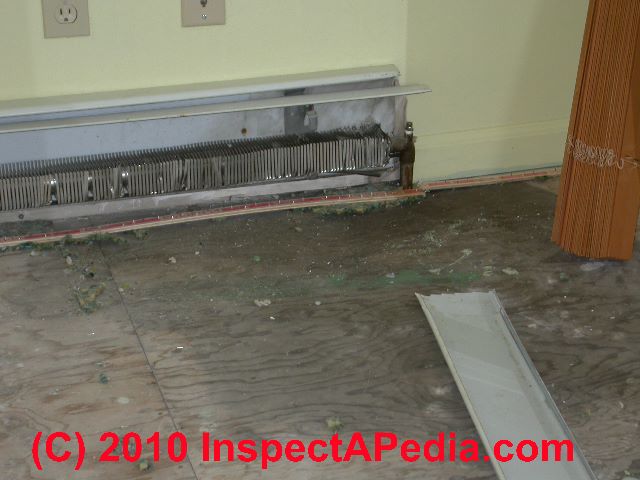
Photo above: aluminum fins are positioned vertically along the copper baseboard heat tubing. In our photo some of the fins have been bent; if there is a lot of denting, indeed air flow may be reduced through that baseboard section.
Re: Honeywell Aquastat Control Replacement
I know this is an old question, but just wanted to add that it is possible that the baseboard FINS (not the baseboards themselves) were installed in the wrong direction.
This would definitely impede heat flow from the pipes but usually shouldn’t be too difficult to fix. - On 2021-01-23 by xsie -
Reply by (mod): Really?
This opinion from Xsie needs clarification. Baseboard heating piping fins are not directional as long as the tubing is running horizontally.
Air flow moves up from floor level, between the fins and over their warmed surfaces as well as over the copper baseboard heat tubing itself, thus becoming warmer and then exiting at the top of the baseboard.
Can I install missing fins on my baseboard heat tubing?
Recently purchased a house with baseboard heating. One of the rooms is not heating satisfactorily. Half of the baseboards in this room are missing the fins entirely.
Question, if I installed fins on the baseboard pipe would the room heat better? Are fins needed to radiate more heat?
Thanks, On 2018-01-25 by Katie
by (mod) - You cannot easily add fins to the existing baseboard tubing without disassembly
Yes, Katie, replacing solid copper piping with finned copper tubing will increase the heat output of the baseboard.
You cannot easily add fins to the existing tubing. Rather that section is cut out and replaced with finned copper tubing of the proper type (thin-walled copper) that has the fins already in place.
What's the repair for calcium build-up clogging our heating pipes?
What can be done if your copper pipes are clogged, probably calcium buildup. What is the recommended procedure for cleaning out the pipes. There are 4 different zones in the system. I can isolate each zone if I need to. I have purchased a water softener so once everything is clean, hopefully it will stay that way. (Oct 19, 2015) Kevin
Reply: very unusual to find scale in hot water heating pipes
Kevin it's possible to acid-wash scaled copper piping,
but finding a scale formation problem in hydronic heating pipes would be very odd as the heating system does not normally keep taking in new mineral-containing water.
Scaling may not be the problem.
If you are asking about water supply piping (not heating piping) see BUILDING HOT WATER PIPE DE-SCALING
...
Cold Heating Baseboard - Air Removal Trouble
One heating baseboard section is cold
Small baseboard heater is bathroom not getting hot. - On 2015-02-16 by Anonymous -
Reply by (mod)
It's probably airbound. See AIR-BOUND HEATING SYSTEMS
Diagnosing cold baseboard: which sections of pipe should feel warm?
Some of my baseboards are cold even during a call for heat. I felt the pipes and I think that the warm piping was on the "outlet" or downstream end of baseboards from my boiler and circulator pump. Is that possible? - Anon On 2015-01-07
Reply by (mod) - Piping baseboard heat in series versus in parallel
Anon
Indeed this is a surprise: when a heating system is air-bound we expect the warm pipes and baseboards to be on the incoming side of the air-bound location - that is, hot water flows from the boiler as far as it can get before it is blocked by air (or more rarely by something else). But your heating system baseboard piping is an unknown.If the baseboards were piped in parallel rather than in series, the problem could be air within individual baseboard sections.
If there are no air bleeders on those baseboards I'd ask the heating service tech to add them as part of a project to properly purge the system from air.
Please review the diagnosis and repair steps given
Step by Step Review of Fixing a Cold Baseboard Heating Zone
I have a hydronic system with 4 zones. One zone in the basement, the shortest run and closest to the boiler, is a baseboard zone with two baseboards.
These stopped making heat and I diagnosed and found the Taco circulating pump to be dead. I replaced that, confirmed that it was working, and bled the entire system.
I bled the zone in question for quite a while. It is a short zone run with almost all of its ~30' total send and return run of copper exposed and visible.
With system up and running again and the new motor definitely working, the zone is still not heating up. On the zone in question, the inlet to the new pump and the pump body get hot when thermostat is on. The drain valve just above on the riser coming out of pump lets out hot water when opened.
HOWEVER, just beyond this valve and on the continued run the pipes remain cold. How is this possible?
With the zone so exposed I can see no leaks nor imagine how air could be again "settling" in this the lowest run of the house. What could be going on here? On 2020-01-27 by fprice
by (mod) - cold basement heating zone repair details
FP
First let's look to make sure there isn't a balancing valve or service valve that's closed.
Second, even though you've tried to bleed the air out of the zone, it may still be are bound.
It can be difficult to push air up and then down then around and then out to a bleeder depending on where your bleeders are located.
Start at AIR-BOUND HEATING SYSTEMS
Where we refer to using a a pony pump to force air out of an air bound hydronic heating system - I might try that next.by fprice - approach to bleeding air out of baseboards
Thanks! Forgot to mention; there are no bleeder valves on the zone in question, and they are baseboard heaters below the level of the boiler by just that much.
Actually, only one of the four zones (the largest and most complex) has bleeder valves and that only on half of the radiators.
My process (correct me if this is misguided) then is to close off the send and return valves of the other three zones (all thermostats off and burner off) at the boiler, leaving only the zone I am bleeding open. I then open the drain valve of that zone (into hose) and up the incoming water pressure at the regulator valve.
This is all of course at the boiler. I let that run for a while keeping an eye on the hose end for signs of air.
When satisfied, I cut the water pressure back down and immediately close the drain valve, adjusting pressure if needed and then open all back up, turn on burner, and call for heat.
Should I not be closing off the other zones?
Also, should I have the zone's impeller ON when bleeding?
Reply by (mod) -
FP
Let's start with a look at the air bleeding procedures at AIR-BOUND HEATING SYSTEMS - the live link I gave just above.
There are a couple of ways to force water through the zone using a pony pump vs adding bleeders, though ultimately you may want to add some air bleeder valves.by fprice
@danjoefriedman,
Rest assured I indeed started with and have followed the procedures at AIR-BOUND HEATING SYSTEMS, and this is what brought me here. The questions I have still don't seem to be addressed there (or I am missing them, perhaps).Namely: 1) Should all other zones be closed off when bleeding one zone ?, and 2) Should the impeller of the zone being bled be on when bleeding?
Reply & Suggestions by (mod) -
FP
Dagnostic Questions for Getting the Hot Water Heat Air Bleed Procedure Right
Q 1) Should all other zones be closed off when bleeding one zone ?
It's not usually necessary when bleeding from air bleeder valves on the "one zone" piping.
But if you're trying to force air out using a pony pump then shutting off other zones will make that job quicker, easier, and the results less ambiguous.
Q 2) Should the impeller of the zone being bled be on when bleeding ?
If you're trying to bleed air using air bleeder valves anywhere on the zone's piping, then you want
1. the boiler up to full operating temperature
2. the zone circulator running
In fact those conditions can help diagnose the location of the air blockage by feeling along the heating pipes. E.g. in our home recently our kitchen seemed too cool; The first place I went was to the boiler where I felt the output end of the pipe for that heating zone (it was damn hot) and then I felt the return line at the circulator for that zone (it was tepid).After allowing a reasonable time (5 minutes or more) for the boiler-hot water to make the loop back to the circulator, when that circ's input wasn't getting hot I knew I had at least a partial air-trap somewhere.
I felt along the heating piping and found that the second kitchen convector was cool at its output end. I replaced that float vent and the system got hot like a champ.
Similarly if I'd been using a pony pump to force water through the airbound zone, IMO having the circulator running has two advantages:1. It helps push water around the loop
2. I don't worry that the circ impeller itself is obstructing water flow (as it might if off)
BUT also take a close look at the circulator itself; a common leak point is at those mounting flanges; if you see leaks and corrosion there you might guess that while water leaks out when hot, air might be leaking in there when cold.by fprice - Success!
@danjoefriedman, Thanks so much for the continued advice! Lacking a pony pump at the moment and not having any bleeder valves on the zones in question, my only bleeding option has been using the drain valves (hose bibb style) near the impellers at the boiler.
Not ideal, I know. I should just get a pony pump. But I have managed to finally get the "bad" zone working again.
Can't get air (and water) to bleed ot of my baseboard
I live on the third floor of a condominium complex that has a large boiler on the first floor. I bleed the valve on my unit regularly. Occasionally there will be an air trap and it sputters quite a bit before the water flows out, but it's always corrected the problem if the register is not heating well.
But yesterday I opened the valve (which is large and actually a faucet) and first air came out, then nothing.
No water. If I leave it open I'll hear some gurgling and eventually a little water will come out (maybe a cup) then it stops again.
My valve motor is fine. I'm wondering if this could happen if the boiler is getting low on water.
It's supposed to have an automatic bleed system and a float that maintains the water at a certain level. I hesitate to call the plumbing service if It's something I can check or remedy myself. On 2022-01-28 by Janet
by Inspectapedia Com Moderator - hot water heating system may have a bad circulator pump
@Janet,
Hot water (hydronic) heating systems should always be "full" of water - to fill the boiler and all of the distribution piping.
But a bad circulator pump or relay could be failing to send pressure up to your floor, or the system could be air-bound and unable to lift water to your condominium from lower down in the system, or the boiler could be off and the system therefore lacking in pressure.
The Recommended Articles at the end of the article on this page suggest some additional diagnostics, but I suspect that those are beyond your scope of control - your building heating system probably needs repair by its maintenance staff or contractor.It could be that boiler pressure is low, that the circulator pump isn't working, or that there is a significant water out or air leak into the system, or it's airbound well ahead of the point where you're trying to bleed air.
Baseboards get cold again after we drain the system to remove air
I drained my hot water heating system to remove all air, and all the base board got hot. But once we stop draining, again within 5 minutes the baseborard heaters got cold. On 2020-10-12 by Mateen
by danjoefriedman (mod)
Mateen
We may just be tripping up over language here, but when removing air from a hydronic heating system, we do not "drain" the system. Draining means removing water. It's air that we're getting rid of to get hot water flowing through the piping system.
So if you're trying to fix an air-bound heating system by draining the water out and refilling the system it's likely that during the refill you're not pushing all of the air out of the system.
Also, It's possible that air from elsewhere in the heating system found its way back to the now-cold baseboards; try bleeding air again and let me know if air emerges.See the proper procedure at
AIR-BOUND HEATING SYSTEMS - home
I keep getting air in the lines of my baseboard heating.
I keep getting air in the lines of my baseboard heating. The guy who installed my boiler told me he believes it's a cracked or multiple cracks in the pipes. Very small though. Basically I have seen no water damage so I can't figure out where the leaks are.
I had pipes freeze years ago and that's when I had this problem start. We found the main leaks but still have this problem.
We've tried adding chemicals to seal the leak and we are still having problems. So my question is after all we tried it seems the only option is to literally tear apart every wall to find the leak/leaks.
Is there a way to find the leak's without destroying my house? On 2018-01-08 by Richard
by (mod) - three suggestions for finding how air is getting into a hot water heating system
Richard
From your note I infer that you've already tried to look for a manual or automatic air vent that is leaking in reverse: when the heating system cools air can be drawn into the heating piping.
Before tearing open walls to look for leaky heating pipes I would
1. be darn sure that all air has really been removed from the system
2. one by one check each air vent or even temporarily seal it off
3. snoop around with a moisture meter along the base of walls if you have heating pipes running in those walls; also snoop for moisture at the ceiling wall juncture below such areas if that's accessible; Infrared or thermographic scanning can also sometimes spot leaky hot water even when it's not showing up as a stain or wet spot.
My baseboard heat delivery is irregular
Hot water baseboard heating of 1973 has 2 zone valves (one on main floor and one in the finished basement).
I have an on-going problem that the tech/plumber doesn't acknowledge and is dismissive about. Both zone valves open/close properly. Both thermostats were recently replaced to see if that is the problem.
It wasn't. Problem: If main floor thermostat is set at say 70F and basement one is set at 65F, all seems good.
But if main floor thermostat is set low, say 60F and the basement thermostat is set at 70F, the main floor rads will still heat up even though the actual room temp may be 75F due to sunlight or cooking.
The main floor rads (as well as the basement rads) seem to be affected by the basement thermostat.
The reverse doesn't happen. IE, the upstairs thermostat set at a higher temp rightly doesn't cause the basement to call for heat.
Any idea? (By the way, the plumber didn't even bother to feel the upstairs rads for heat; simply said "Everything is working as it should". It isn't. ) - On 2020-05-12 by Ann -
Reply by (mod): when to ask for a more-expert heating service technician
Indeed there are problems such as a stuck or manually-opened check valve on a hot water heating boiler that can cause heat to flow through one or more heating zones even when there is no call for heat. That might be the problem in your case.
In my OPINION you need a more-expert and conscientious heating service technician. Call your plumbing or heating contractor, speak politely to the service manager, and explain that after having several unsuccessful service calls, it's time for them to send a more-experienced, expert technician to sort out this trouble.
Daniel
Landlord never bleeds air from the heating pipes
Hi, My apt suite was built in 1963 with the old baseboard heater (boiler).
My question is:
Every winter does the Landlord (have to bleed the pipes) cause you constantly hear water running, splashing, etc & we quite often have no heat.
Landlord never comes into our suites to bleed it, he has it running all year.
Thank You Carolyn - On 2020-03-16
Reply by (mod)
If your apartment is getting enough heat in winter then your heating pipes are not air-bound and the landlord doesn't need to bleed them.
Also, there are automatic air bleeders that can be installed at various points on the heat system piping, often eliminating the need for manual air bleeding of the system.
But if your heating system is also heating your apartment during the summer, then certainly there is a heating system valve or control that needs to be fixed.
You might point out that to your landlord - if that's the case - because sending out heat during the summer is not only wasteful, it's an unnecessary cost for everyone. In that case, take a look
Baseboard no longer hot after all water pipes were drained
Water company drained all water pipes in order to change meter. once water was restored I bleed radiator at highest point, I turned the heat back on. radiators got hot but the hot water baseboard heaters did not get hot. - On 2015-02-16 by val B
Reply by (mod) - Draining building water supply pipes affected baseboard heat? Air is blocking hot water flow.
Val it would be quite odd odd for draining the building water supply piping to have an impact on the heating system piping - UNLESS - there were a failed or missing check valve or backflow preventer between the boiler and its water supply piping.
If that were the case you'd think that if the building were drained entirely the boiler would have been completely emptied.
Try the diagnosis and repair steps shown at RECOMMENDED ARTICLES list at the bottom of the article titled
AIRBOUND HEAT SYSTEM REPAIR by WATER FEED VALVEBut
Watch out: have your heating service tech make double sure that there is a one-way check valve at the water inlet supply of your water system that provides water to the heating boiler (and its baseboard or radiator piping loops).
Otherwise we risk back-contamination of your potable or drinking water piping with rather nasty water from the heating zones.
Cold Baseboard Heat Room on a Single Zone - do I need to replace the aquastat?
 Hi Just wondering if I'm about to get ripped off or should i tell this person not to do the work.
I have a 1800 sq foot 2 story house and the farthest bedroom on first floor (2 outside walls) away from the furnace in the basement (consistently freezing cold outside) has been much colder than the rest of the house (tenants keep heat at 75 and this room hovers around 64-68)
It's a gas furnace - He told me its a Peerless Boiler and he is factory authorized dealer and the date on the boiler is May 2012. I have hot water radiator heat.
This new heating guy says the one year old Aquastat Control needs to be replaced - that it is a part failure unrelated to the workmanship of the previous contractor who did the work last year (i switched from Oil to Gas).
That if he repalces the control that there is a 70% chance that this will solve the coldness problem in the back bedroom will get warm. If the whole rest of the house has been warm without any problem - is this really the problem, wouldn't the rest of the house be cold too?
He wants to charge me $535 for the control 4 hours of labor at $65 an hour.
Now - its 2 days later, the room is still cold and now he's saying the baseboard heaters were installed wrong and need to be 'reworked' for $450.
That they are upside down and this is why the room isn't warm (same original contractor who put in the new furnace put in these baseboards in last year).
I called the original contractor (wish i brought him over this time to begin with) but I'm working with a property manager now).
He says that what this guy is saying is not true - that they were put in correctly. It was me who decided to use a 4' shorter length on one of the walls and this could be the issue, but why then did this new guy have to replace the control for $795.
Do they really cost $535 or is that way high? Thank you for any help or advice anyone can provide. -Paula 2/13/2014
Reply:
Really? I can't make sense out of the explanation given by your service tech.
The aquastat turns the boiler on and off, and may control one circulator. I can't see how it knows one room of the home from another. The tech may be honest but a lousy communicator, but from just the information in your note, I don't get it.
In the article above you'll see more photos of normal baseboard installations. I've never seen heating baseboard installed upside down - I wouldn't even know how to do that.
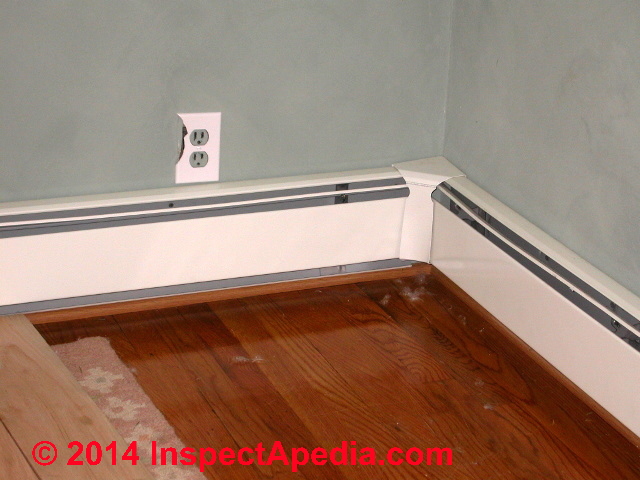
At left I have inserted a photograph of a normal hot water heating baseboard installation with the baseboards "right side up" and with decent clearance between the baseboard bottom and the floor surface. [We'll ignore for now that broken electrical receptacle cover hazard.]
Use the CONTACT link to send me some photos of your baseboards and we can comment further.If you don't know what kind of heat your building uses, we explain how to figure out the answer
at HEATING SYSTEM TYPES.If your heating system is not working properly,
see NO HEAT - BOILER
...
Turned up the thermostat but my room doesn't get warm and the battery light flashes
My thermostat is set at 20 degrees, but the room is at 14 and won’t heat up. The battery light is flashing, but display is still lit. Any tips? On 2018-01-30 by Matt
Reply by (mod) -
Matt
If the battery light is flashing you probably need new batteries in your thermostat
OR
the main power source - the low voltage transformer - is OFF - that in turn could mean that power to your heating system is off as well.
A good place to start troubleshooting is at
NO HEAT - BOILER where we give a sequence of steps to follow and things to check.
When we turn on the shower it is hot briefly then gets cold - is it our boiler?
We have hot water heat but our shower when we turn the shower on it gets hot and then it gets cold. What could be the problem ? On 2018-01-26 by Cheryl
by (mod) - check the aquastat settings
Cheryl,
I cannot tell from your question how your hot water is made. If your hot water is made by the heating boiler that also Heats your home, it is possible that your aquastat control is is not correctly adjusted.
...
...
Continue reading at AIR-BOUND HEATING SYSTEMS or select a topic from the closely-related articles below, or see the complete ARTICLE INDEX.
Or see these
Baseboard heat repair articles
- AIR BLEEDER VALVES for how to find and operate those cute little controls on baseboards (or radiators)
- BASEBOARD HEAT REPAIR - home
- AIR-BOUND HEATING SYSTEMS
- BASEBOARD HEAT DAMAGE REPAIR
- COLD HEATING RADIATOR REPAIR (hot water / hydronic heat)
- LEAKS at BASEBOARD, CONVECTOR, RADIATOR
Suggested citation for this web page
BASEBOARD HEAT DIAGNOSTIC FAQs4 at InspectApedia.com - online encyclopedia of building & environmental inspection, testing, diagnosis, repair, & problem prevention advice.
Or see this
INDEX to RELATED ARTICLES: ARTICLE INDEX to HEATING BOILERS
Or use the SEARCH BOX found below to Ask a Question or Search InspectApedia
Ask a Question or Search InspectApedia
Share this article:Search the InspectApedia website
Need to make a private comment? Email editor@inspectApedia.com. We welcome email with your website content critique, corrections, suggestions or questions. Email is monitored daily but our workload may prevent an immediate reply. For immediate results, we hope you'll first try asking your question using the search box just above.
Citations & References
In addition to any citations in the article above, a full list is available on request.
- Our recommended books about building & mechanical systems design, inspection, problem diagnosis, and repair, and about indoor environment and IAQ testing, diagnosis, and cleanup are at the InspectAPedia Bookstore. Also see our Book Reviews - InspectAPedia.
- In addition to citations & references found in this article, see the research citations given at the end of the related articles found at our suggested
CONTINUE READING or RECOMMENDED ARTICLES.
- Carson, Dunlop & Associates Ltd., 120 Carlton Street Suite 407, Toronto ON M5A 4K2. Tel: (416) 964-9415 1-800-268-7070 Email: info@carsondunlop.com. Alan Carson is a past president of ASHI, the American Society of Home Inspectors.
Thanks to Alan Carson and Bob Dunlop, for permission for InspectAPedia to use text excerpts from The HOME REFERENCE BOOK - the Encyclopedia of Homes and to use illustrations from The ILLUSTRATED HOME .
Carson Dunlop Associates provides extensive home inspection education and report writing material. In gratitude we provide links to tsome Carson Dunlop Associates products and services.
 |
HOME | ABOUT | ASK a QUESTION | CONTACT | CONTENT USE POLICY | DESCRIPTION | POLICIES | PRIVACY | |
| © 2026 - 1985 Publisher InspectApedia.com - Daniel Friedman | |||||||||