 Choosing a Caulk or Adhesive Gun: Models, Types, Advice
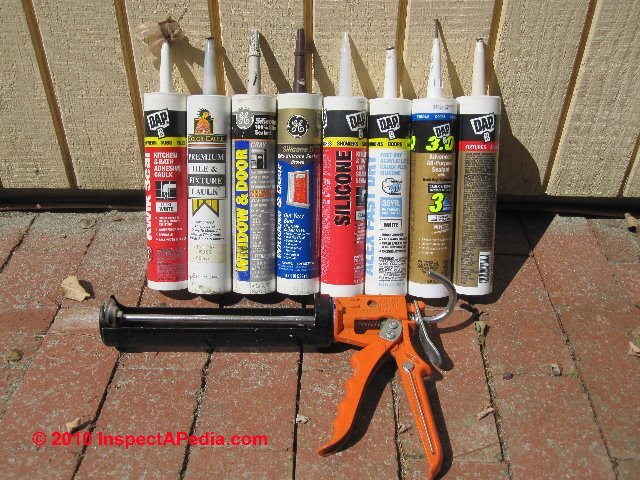
Comparison test of 7 popular caulking guns

- POST a QUESTION or COMMENT about types of caulk or adhesive or sealant guns or applicators - manual or powered caulk guns
Choices of caulking guns - a buyer's guide:
This article describes different types of caulk guns, caulk gun features, and caulk gun models, giving some opinion and advice about choosing a caulk gun that fits your needs.
InspectAPedia tolerates no conflicts of interest. We have no relationship with advertisers, products, or services discussed at this website.
- Daniel Friedman, Publisher/Editor/Author - See WHO ARE WE?
Best Caulkings Gun for Easy Fast Caulking & Good Results
This article series discusses best practices construction details for building exteriors, including water and air barriers, building flashing products & installation, wood siding material choices & installation, vinyl siding, stucco exteriors, building trim, exterior caulks and sealants, exterior building adhesives, and choices and application of exterior finishes on buildings: paints, stains.
Readers should see CAULKS & SEALANTS, EXTERIOR and also see GLUES ADHESIVES, EXTERIOR CONSTRUCTION. Some caulks and sealants also act as glues or adhesives.
There is a stunning, actually an overwhelming array of types and qualities of caulk guns available.
3M, Albion, Apex-Cooper Hand Tools, GE, Newborn, Rigid, Z-Pro, and other companies produce or distribute hundreds of caulk guns and other items of caulking equipment.
Contact information for these companies is listed at Resources for Building Exterior Caulks and Sealants. Here are some observations and opinions from DJF who, like many, has spent a lot of caulking time on construction projects:
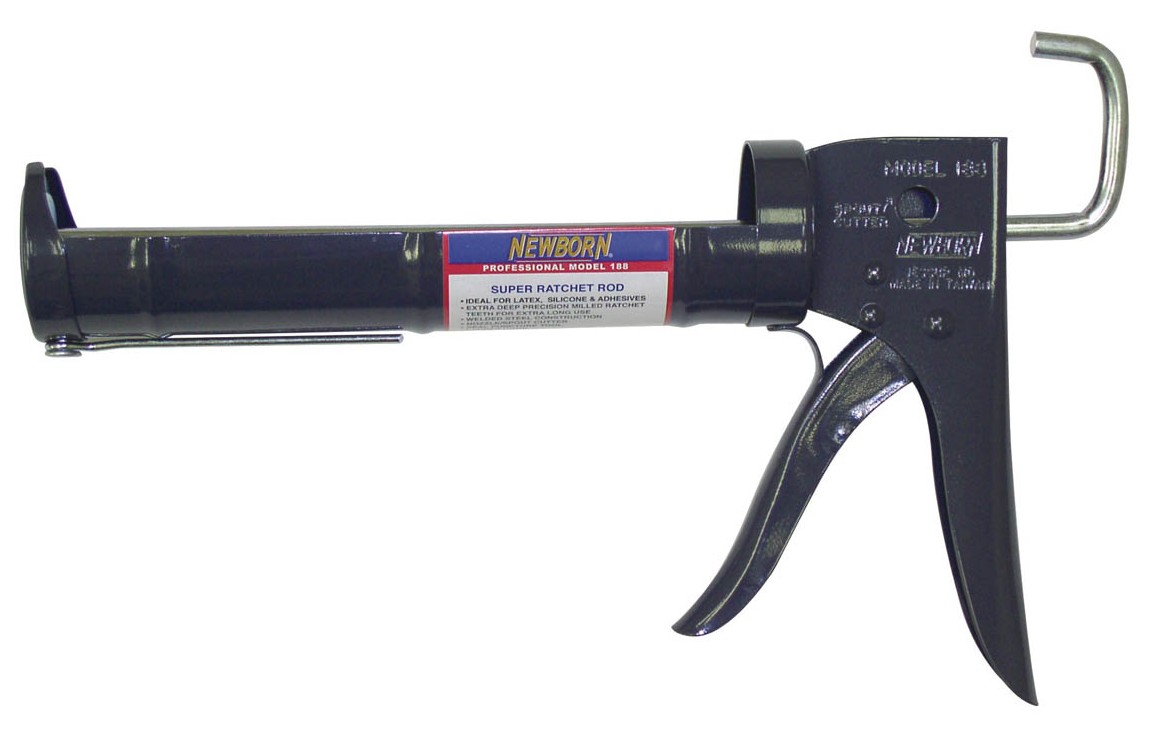
- Stamped-steel caulk guns (first caulk gun below)
Watch out Most caulk gun producers offer durable heavy duty and good performing caulk guns, but for the "quick and dirty one-off job" also offer homeowner-grade caulk guns made of stamped metal that we find, at least in some cases, do not last long. We call these "disposable" caulk guns.
With the least-costly grades of these caulk guns we find that very quickly the gun goes in the trash after a strong squeeze has bent the trigger handle, or the plunger mechanism keeps slipping rather than forcing caulk out of the cartridge or tube. - Manual caulk guns, heavy duty models
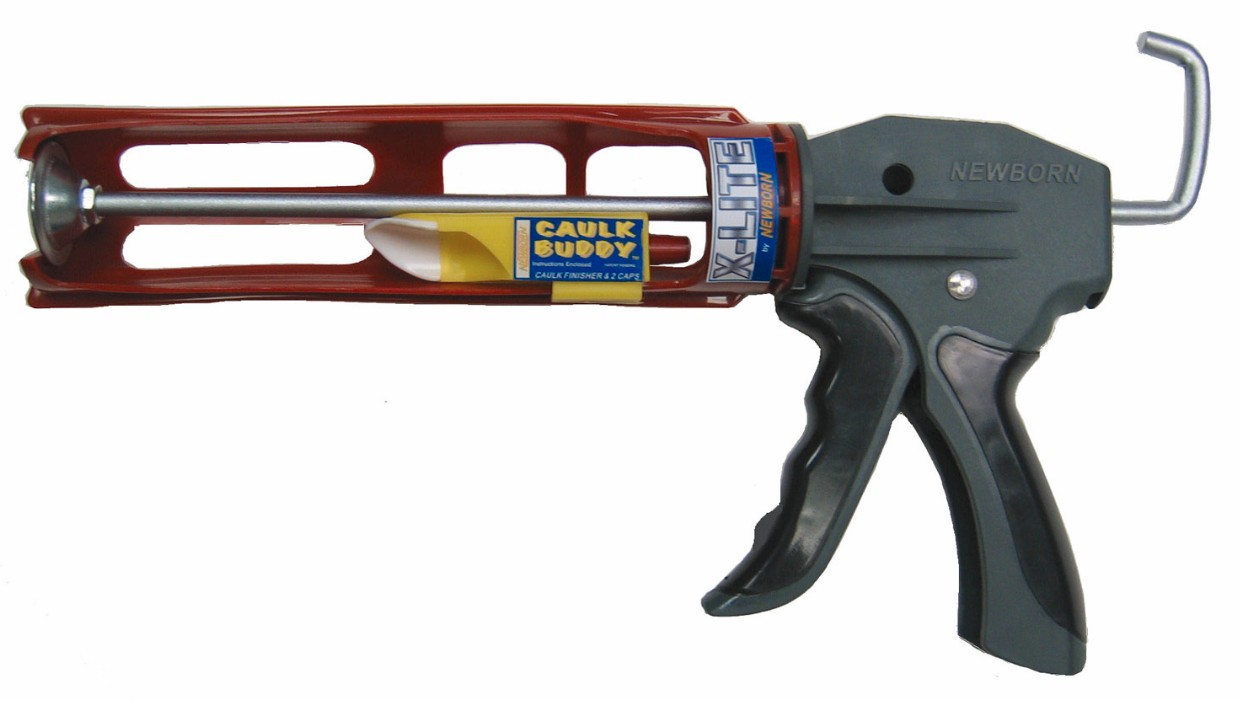
for homeowner and moderate construction use (second from left below): we much prefer the caulk cartridge type caulk gun shown in our photographs bellow, first and second.
This type of caulking gun has a strong steel body, cast iron handle, and a plunger mechanism that does not slip when pushing against a recalcitrant tube of caulk.
Like many models this caulk gun includes a wire to open the foil seal found in the tops of some caulk tubes and of course a cutter to snip off the caulk tube tip.
The hooked caulk pushrod end forms a convenient ladder hook for the tool. Newborn produces a heavy duty professional NBC250 caulk gun of this type.
Below; the Caulk buddy caulking gun.
A lighter version with an open cartridge body (below), the Newborn U-Lite caulking gun also performed acceptably but not as well as our preferred 3M caulk gun shown later on this page.

- Bulk caulk guns, cartridge and sausage caulk guns
are fast, and are designed to accept caulk bought in bulk, often in a collapsible plastic wrap or "sausage" (above right). - Air powered caulk guns
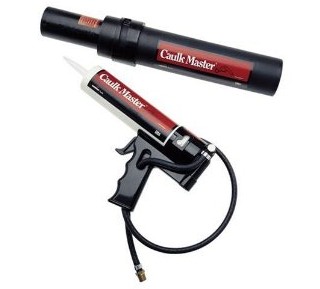
can pump very viscous caulks or adhesives at high speed and in large volumes. Models accept both cartridges and bulk or sausage packs of caulk. Our friend Mike Skok (Re Bath) uses a battery-operated air-powered caulk gun to dispense adhesive when installing plastic bath surrounds.
Apex-Cooper Hand Tools' PG 100 Caulk Master (below ) is a professional-grade air-powered caulk and adhesive gun that is driven by an air compressor - Apex-Cooper's air powered caulk gun.
- Cordless Battery-powered caulk guns
are really fast and low-effort, and with some practice, you can make very smooth caulk applications by learning to keep the caulk gun tip moving.
Rigid makes an 18-volt cordless gun used for both caulks and adhesives and shown below - Rigid's battery operated power caulking gun.

Below: a caulk gun with extension rod for reaching up or across to hard to get-to locations.

Finally, below, our standard (and favorite) manually-operated 3-M caulk gun. This is a durable and simple, reliable caulking gun suitable for all but the largest caulking jobs where I might consider the battery operated caulk gun by Rigid or for commercial work, the air powered caulk/sealant gun above on this page.

Definitions of Caulking, Chalking, Spackling
What's the Difference between caulking, chalking, and spackling?:
Definition of Spackling:
Spackling refers to use of joint compound to seal tape joints between sections of drywall or to smooth other irregularities in drywall before the wall or ceiling is painted. Spackling is also used on occasion as a superficial repair on plaster although repairing plaster with actual plaster may be preferred.
See DRYWALL, FIBERBOARD, PLASTER INTERIORS for help in identifying these materials and a bit about their history. Also see
Watch out: don't rely on joint compound or spackling compound to seal building leaks where temperature changes, vibration, or anything else will cause movement of the building materials.
Unlike flexible caulks that are designed to adhere to various types of surfaces and to tolerate small amounts of movement between the sealed surfaces, joint compound or spackling compound is designed for cosmetic repairs only, and it is likely to crack if installed where a flexible caulk should have been used indoors, and to weather and fail if used on an outdoor surface.
Definition of caulking:
Caulks are sealants used to close gaps or cracks against leaks. The leak may be an air leak or a water leak in a building, or historically, in other structures such as a boat where in addition to hull leaks a boat often leaked at the connection of hull to boat deck. Caulk types and uses are discussed in more detail
at CAULKS & SEALANTS, EXTERIOR.
Types of caulk guns used to apply caulk are discussed above
Before modern silicon, latex, or polyurethane caulks were invented boat leaks were sealed by hammering oakum, hemp or even cotton into the open gaps using a loggerhead.
Watch out: while it is often convenient to use caulk for cosmetic sealing of gaps and cracks indoors, such as along baseboard trim installed along uneven wall surfaces, be sure to use paintable caulk if the surfaces are intended to be painted.
For example, some silicone caulks that perform very well as sealants also form a surface to which paint will not adhere.
Definition of chalking:
Chalking is usually used to refer to the white oxidization that appears on some painted surfaces as they wear or weather, it's not something you'd do to drywall or plaster. Paint chalking is discussed
at PAINT FAILURE DICTIONARY and
at PAINT FALURE, DIAGNOSIS, CURE, PREVENTION.
Chalking is sometimes used in some parts of the world to refer to steps to make surface more "white", and it is also used to refer to plowing chalk into soil as part of applying manure - a step that has nothing to do with building maintenance.
If you live in a country where any of these words are used with a different meaning please CONTACT us to let us know about it.
Types & Sources of Exterior Caulks & Sealants
Construction Sealant (Caulks) Suppliers & Products
- Albion, 1250 North Church Street, Moorestown, New Jersey 08057-1102 http://www.albioneng.com/, 856-235-6688
- Chemrex www.chemrex.com
- Newborn caulking guns, distributed by Jamestown JD Distributors - http://www.jamestowndistributors.com
Polyurethanes and other high-performance sealants
- 3M - 800-234-8068
- Bostik - Chem-Calk urethane caulk - 414-774-2250
- DAP www.dap.com - 800-543-3840
- Tremco - Velcum urethane caulk - 800-321-7906
- Macklanburg-Duncan - Sika and Sikaflex caulks - 800-654-8454 (widely used in sealing concrete wall and floor slab cracks in the radon mitigation industry)
- OSI Sealants
These sompanies produce urethane caulks used widely on masonry surfaces and in the automotive industry.
Acrylic latex caulks
- Dow Corning Sealants www.dowcorningsealants.com
- Silicone sealants
- GE Silicones www.gesilicones.com Silicone sealant
- Geocel Corp www.geocelusa.com Acrylic latex, tripolymer, copolymer, Kraton, and clear sealants
- Macklanburg-Duncan www.mdteam.com Acrylic latex sealants
- OSI Sealants Inc www.osisealants.com Polyseamseal PVA-based caulk. Pro Series includes latex, polyurethane, and Kraton sealants.
- www.phenoseal.com Phenoseal vinyl adhesive caulk
- Red Devil www.reddevil.com Acrylic, silicone, and butyl sealants
- Sashco Sealants www.sashco.com Big Stretch and Mor-Flexx water-based sealants, Lexel Kraton sealant
- Sika Corp www.sikaconstruction.com Complete line of Sikaflex polyurethane-based sealants, butyl sealant
- Tremco Inc. www.tremcosealants.com High-performance, architectural-grade sealants,
- UGL www.ugl.com Acrylic latex caulks
- White Lightning www.wlcaulk.com Tripolymer, butyl, polyurethane, silicone, elastomeric, and other high-performance sealants
Exterior Adhesives
- Abatron www.abatron.com Epoxy, BestBond polyurethane glue
- Ambel www.excelglue.com Excel polyurethane glue
- Elmer’s Products www.elmers.com Yellow glues, ProBond polyurethane glue
- Custom-Pak Adhesives www.custompak.com Resorcinol and yellow glues
- DAP Inc. www.dap.com Weldwood contact cement, resorcinol, and construction adhesives Resources 49
- Franklin International www.titebond.com Titebond yellow glue, Liquid Hide Glue, and construction adhesives
- Gloucester Co. Inc. www.phenoseal.com Phenoseal adhesive caulk
- Gougeon Brothers www.westsystem.com West System epoxy
- Gorilla Group www.gorillaglue.com Gorilla polyurethane glue
- MACCO Adhesives www.liquidnails.com Liquid Nails construction adhesive
- SI Sealants www.osisealants.com PL400 construction adhesive
- System Three Resins www.systemthree.com Quick Cure epoxy
- - Adapted with permission from Best Practices Guide to Residential Construction (Steve Bliss, J Wiley & Sons) .
...
Reader Comments, Questions & Answers About The Article Above
Below you will find questions and answers previously posted on this page at its page bottom reader comment box.
Reader Q&A - also see RECOMMENDED ARTICLES & FAQs
Grease gun not working properly
I used a grease gun to do high pressure injection and it feels like it is pumping but it's still full what can I use to inject. On 2022-08-17 by Michael
Grease Gun Repair suggestions by InspectApedia-911 (mod) -
@Michael,
In my experience it's very easy to diagnose the grease gun problem that you describe.
First with the grease gun not pushed over the grease fitting but simply in open air do a little pumping. If grease flows freely from the grease gun orifice then the grease gun is working correctly.
If you establish that the grease gun is working correctly but no grease is flowing when you try to pump grease into the fitting then it's time to Simply replace that grease fitting by unscrewing it and screwing in a replacement.I have found that sometimes the grease fitting itself becomes clogged and won't accept lubricant.
Sometimes you can try to unplug it with a pin but I don't like the idea of forcing grit or dirt into the actual fitting that's being lubricated.
...
Continue reading at CAULKS & SEALANTS, EXTERIOR or select a topic from the closely-related articles below, or see the complete ARTICLE INDEX.
Suggested citation for this web page
CAULK GUN TYPES, CHOICES at InspectApedia.com - online encyclopedia of building & environmental inspection, testing, diagnosis, repair, & problem prevention advice.
Or see this
INDEX to RELATED ARTICLES: ARTICLE INDEX to EXTERIORS of BUILDINGS
Or use the SEARCH BOX found below to Ask a Question or Search InspectApedia
Ask a Question or Search InspectApedia
Share this article:Try the search box just below, or if you prefer, post a question or comment in the Comments box below and we will respond promptly.
Search the InspectApedia website
Note: appearance of your Comment below may be delayed: if your comment contains an image, photograph, web link, or text that looks to the software as if it might be a web link, your posting will appear after it has been approved by a moderator. Apologies for the delay.
Only one image can be added per comment but you can post as many comments, and therefore images, as you like.
You will not receive a notification when a response to your question has been posted.
Please bookmark this page to make it easy for you to check back for our response.
IF above you see "Comment Form is loading comments..." then COMMENT BOX - countable.ca / bawkbox.com IS NOT WORKING.
In any case you are welcome to send an email directly to us at InspectApedia.com at editor@inspectApedia.com
We'll reply to you directly. Please help us help you by noting, in your email, the URL of the InspectApedia page where you wanted to comment.
Citations & Reviewers
In addition to any citations in the article above, a full list is available on request.
- Eric Galow, Galow Homes, Lagrangeville, NY. Mr. Galow can be reached by email: ericgalow@gmail.com or by telephone: 914-474-6613. Mr. Galow specializes in residential construction including both new homes and repairs, renovations, and additions.
- Mark Cramer Inspection Services Mark Cramer, Tampa Florida, Mr. Cramer is a past president of ASHI, the American Society of Home Inspectors and is a Florida home inspector and home inspection educator. Contact Mark Cramer at: 727-595-4211 mark@BestTampaInspector.com 11/06
- In addition to citations & references found in this article, see the research citations given at the end of the related articles found at our suggested
CONTINUE READING or RECOMMENDED ARTICLES.
- Carson, Dunlop & Associates Ltd., 120 Carlton Street Suite 407, Toronto ON M5A 4K2. Tel: (416) 964-9415 1-800-268-7070 Email: info@carsondunlop.com. Alan Carson is a past president of ASHI, the American Society of Home Inspectors.
Thanks to Alan Carson and Bob Dunlop, for permission for InspectAPedia to use text excerpts from The HOME REFERENCE BOOK - the Encyclopedia of Homes and to use illustrations from The ILLUSTRATED HOME .
Carson Dunlop Associates provides extensive home inspection education and report writing material. In gratitude we provide links to tsome Carson Dunlop Associates products and services.
 |
HOME | ABOUT | ASK a QUESTION | CONTACT | CONTENT USE POLICY | DESCRIPTION | POLICIES | PRIVACY | |
| © 2026 - 1985 Publisher InspectApedia.com - Daniel Friedman | |||||||||