
InspectAPedia® FREE Encyclopedia of Building & Environmental Construction, Diagnosis, Maintenance & Repair |
Question? Just ask us! InspectAPedia
|
 Iodine or Lugol's Solution for Water Disinfection
How to Use Iodine Tablets or Liquid Iodine to Purify or Sterilize Drinking Water
- POST a QUESTION or COMMENT about using iodine or iodine tablets to purify drinking water
Iodine or iodine tablets to purify drinking water:
Here we explain how to use iodine tablets or liquid iodine as a drinking water disinfectant, and we cite the limitations of this method. This article series outlines methods to purify or sanitize drinking water in an emergency following a disaster such as an earthquake, flood, or hurricane.
InspectAPedia tolerates no conflicts of interest. We have no relationship with advertisers, products, or services discussed at this website.
Guide to Using Iodine, Bleach or Hydrogen Peroxide to Purify Drinking Water
Using Iodine Tablets or Iodine Disinfectant for Water Purification
 Iodine and bleach (chlorine or sodium hypochlorite) are the two common ways to sterilize water chemically to address bacterial contaminants. Iodine tablets have been shown to be effective against Giardia muris but iodine tablets are not effective against Cryptosporidium species.
[Click to enlarge any image]
- Iodine tablets: Camping suppliers and other sources also can provide iodine tablets (or other chemical tablets) that can be mixed with a specified quantity of water to produce potable drinking water.
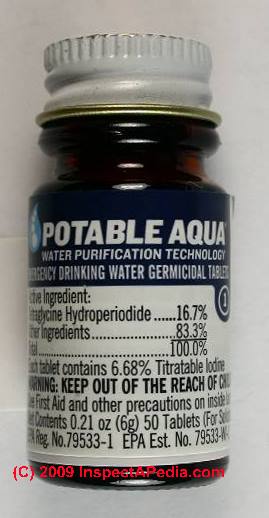
Potable Aqua® iodine water purification tablets (shown at left) are available from camping suppliers and other sources and are an inexpensive means of treating small volumes of emergency drinking water. Potable Aqua® tablets contain the active ingredient Tetraglycine Hydroperiodide 16.7% - equivalent to 8.68% titratable iodine. You can also purchase these tablets online.
How to use water purification tablets:
Paraphrasing the Potable Aqua® instructions: Two tablets are added to a quart of water (or to 1 liter of water) to be treated. The water plus tablets is left in a loosely-capped bottle or similar container, loose enough to allow some leakage. Allow this combination to stand for five minutes, then shake the container to moisten the threads on the container and its cap. Then tighten the cap and allow the water plus tablets to sit for 30 minutes before drinking.
Effectiveness of iodine-based water purification tablets:
According to the manufacturer, these germicidal tablets used for "water purification" make questionable water bacteriologically suitable to drink, and the treatment is effective against Giardia Lamblia when used as directed. The product is intended for use when hiking or traveling. Potable Aqua® germicidal tablets have not been shown to inactivate Cryptosporidium cysts.
Watch out: Cryptosporidium cysts might survive a typical chlorine disinfection process (such as at a municipal water treatment plant).
For this reason some municipalities where Cryptosporidium cysts are a concern add a water treatment step using chlorine dioxide. Others may use a combination of UV light and chlorine in the water treatment procedure. This treatment is also available to hikers, travelers, and for emergency water supply use.
Aquamira™ and Katadyn™ (Micropur) provide portable or field-use water treatment kits using chlorine dioxide.
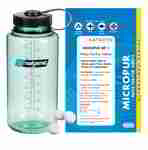
Katadyn® water purification tablets are sold as Micropur MP1. Quoting from Katadyn's product literature:
The Only EPA Registered Purification Tablets on the Market! And the only disinfection system effective against viruses, bacteria, cryptosporidium, and Giardia. No unpleasant taste. - Article number: 8014996
See FILTERS for DRINKING WATER PURIFICATION for some alternative approaches to water purification that can handle cryptosporidium cysts.
Guide to Using Tinctures of Iodine to Disinfect Drinking Water
- Tincture of iodine: If you have no iodine tablets but have liquid iodine such as would be used to treat a wound, (typically this is a 2% tincture of iodine) try a teaspoon of iodine in a gallon of water.
- Do not use iodine to purify water for certain people:
- people who are allergic to iodine - possibly including people allergic to shellfish
- people who have a thyroid disorder
- people who are taking lithium (a medication)
- women over fifty and women who are pregnant (without a doctor's advice)
Also see Wait Time & Water Temperature When Adding a Disinfectant - Before Drinking the Water where we provide more details about how to use iodine as a disinfectant.
[OPINION] In an emergency if you have nothing else, no way to boil water, no ceramic filter, but you have iodine, use it. But beware that iodine is not fully effective as a water sterilization method and be sure to see the allergic reaction warnings just above.
Using Lugol's Solution for Water Disinfection?
Reader question: I looked at the article about water sterilization from the link that you sent me and I saw no mention of Lugol's iodine as a sterilizing agent. Am I missing an article? I did see the post about using chlorine to kill Giardia cysts (GIARDIA in DRINKING WATER) where you cite:
"Bacteria in Drinking Water" - "Chlorine," Karen Mancl, water quality specialist, Agricultural Engineering, Ohio State University Extension. Mancl explains factors affecting the effectiveness of chlorine in water as a means to destroy bacteria and other microorganisms. OSU reports as follows:
Chlorine kills bacteria, including disease-causing organisms and the nuisance organism, iron bacteria. However, low levels of chlorine, normally used to disinfect water, are not an effective treatment for giardia cysts. A chlorine level of over 10 mg/1 must be maintained for at least 30 minutes to kill giardia cysts. -- http://ohioline.osu.edu/b795/index.html is the front page of this bulletin.
Is that 10 parts of chlorine to one part of Water? Is that the dilution of chlorine that one woul buy in a container of Chlorox? Thanks - G.B. / S.R. 5/30/2013
Reply:
Watch out: The Manci citation specifies 10 milligrams of chlorine per liter of water: That is nowhere near a 10:1 ratio. Confusion about proper dilutions of disinfectants can lead to dangerous drinking water.
Furthermore, even with proper levels of chlorine disinfectant in water and proper contact time and proper water pH adjustment, disinfecting water does not remove other contaminants. See WATER DISINFECTION LIMITATIONS.
Lugol's Solution or Lugol's Iodine I2KI
Indeed chlorine (bleach), iodine, and permanganate all have been widely used in water treatment and disinfection systems. We have written about iodine as a water disinfectant and I've used various formulations including Lugol's iodine in the lab as a stain, but I've not written not specifically iodine mixed with potassium iodide - Lugol's solution - as a water disinfectant. (Synonymns I2KI (iodine-potassium iodide); Markodine, Strong solution (Systemic); and Aqueous Iodine Solution BCP).
I've read that while there is a historic use as a water disinfectant including following Chernobyl (where it had a second purpose) the mix can also be toxic if drunk or ingested at concentrations of 2% & above. The Wikipedia article adds "The lethal dose of free iodine for an adult human of 2 to 3 grams (2000-3000 mg) free iodine represents 40 to 60 mL (less than 2 fluid ounces) of 5% Lugol's solution.
I'll add these notes to our iodine discussion found at along with some useful citations [27][28][29][30][31][32] about iodine as a disinfectant in articles citing the preparation and use of Lugol's solution.
Because there can be health problems from unsupervised consumpation of iodine, and lacking expert sources that argue otherwise, I am not competent to recommend regular use of Lugol's solution as a general purpose water disinfectant in any of the forms discussed. Here is what Backer & Hollowell say about using iodine (but not specifically Lugol's solution) to disinfect water:
Iodine is an effective, simple, and cost-efficient means of water disinfection for people who vacation, travel, or work in areas where municipal water treatment is not reliable. However, there is considerable controversy about the maximum safe iodine dose and duration of use when iodine is ingested in excess of the recommended daily dietary amount. The major health effect of concern with excess iodine ingestion is thyroid disorders, primarily hypothyroidism with or without iodine-induced goiter.
A review of the human trials on the safety of iodine ingestion indicates that neither the maximum recommended dietary dose (2 mg/day) nor the maximum recommended duration of use (3 weeks) has a firm basis.
Rather than a clear threshold response level or a linear and temporal dose-response relationship between iodine intake and thyroid function, there appears to be marked individual sensitivity, often resulting from unmasking of underlying thyroid disease.
The use of iodine for water disinfection requires a risk-benefit decision based on iodine's benefit as a disinfectant and the changes it induces in thyroid physiology.
By using appropriate disinfection techniques and monitoring thyroid function, most people can use iodine for water treatment over a prolonged period of time. Backer [29]
...
Continue reading at SOLAR WATER DISINFECTION or select a topic from the closely-related articles below, or see the complete ARTICLE INDEX.
Or see these
Recommended Articles
- DRINKING WATER EMERGENCY PURIFICATION - home
- VEGETABLE or PRODUCE DISINFECTION where we include a discussion of use of iodine-based disinfectants for vegetable wash.
Suggested citation for this web page
IODINE for WATER DISINFECTION at InspectApedia.com - online encyclopedia of building & environmental inspection, testing, diagnosis, repair, & problem prevention advice.
Or see this
INDEX to RELATED ARTICLES: ARTICLE INDEX to WATER TREATMENT SYSTEMS
Or use the SEARCH BOX found below to Ask a Question or Search InspectApedia
Ask a Question or Search InspectApedia
Questions & answers or comments about using iodine or iodine tablets to purify drinking water.
Try the search box just below, or if you prefer, post a question or comment in the Comments box below and we will respond promptly.
Search the InspectApedia website
Note: appearance of your Comment below may be delayed: if your comment contains an image, photograph, web link, or text that looks to the software as if it might be a web link, your posting will appear after it has been approved by a moderator. Apologies for the delay.
Only one image can be added per comment but you can post as many comments, and therefore images, as you like.
You will not receive a notification when a response to your question has been posted.
Please bookmark this page to make it easy for you to check back for our response.
Our Comment Box is provided by Countable Web Productions countable.ca
Citations & References
In addition to any citations in the article above, a full list is available on request.
- [1] Mark Cramer Inspection Services Mark Cramer, Tampa Florida, Mr. Cramer is a past president of ASHI, the American Society of Home Inspectors and is a Florida home inspector and home inspection educator. (727) 595-4211 mark@BestTampaInspector.com 11/06
- [2] Hankey and Brown home inspectors, Eden Prairie, MN, technical review by Roger Hankey, prior chairman, Standards Committee, American Society of Home Inspectors - ASHI. 952 829-0044 - hankeyandbrown.com 11/06
- [3] Dr. Omar Amin, of the Tempe AZ Parasitology Center, corresponded with one of our readers asking about peroxide: "You can use hydrogen peroxide if you want to but we do not have a track record of percentage dilution". Dr. Amin has done research for the US military and for the CDC.
- [4] Potable Aqua® emergency drinking water germicidal tablets are produced by the Wisconsin Pharmacal Co., Jackson WI 53037. 800-558-6614 pharmacalway.com
- [5] Aquamira™ chlorine dioxide water purification kits - see www.aquamira.com/
"Aquamira Water Treatment Drops were introduced to the Outdoor market in 1999 and have been a favorite of top outdoor guides and instructors ever since. Whether you are camping, traveling in a foreign country or faced with a disaster, our goal is to provide you with safe, pure and good tasting drinking water. Our complete line of water treatment products include leading edge purification and filtration technologies developed and tested in the lab and proven in the field. We offer systems and products that will provide water for a single individual or a village and almost anything in between." - [6] Katadyn™, a Swiss corporation provides water filters, desalinization equipment, and their Micropur chlorine dioxide water purification - see www.katadyn.com/usen/
"Katadyn offers a wide variety of water filtration and purification products suitable for any need. This allows outdoor enthusiasts and travelers to take along products for making their own drinking water when preparing their trips." - [10] "Bacteria in Drinking Water" - "Chlorine," Karen Mancl, water quality specialist, Agricultural Engineering, Ohio State University Extension. Mancl explains factors affecting the effectiveness of chlorine in water as a means to destroy bacteria and other microorganisms. OSU reports as follows:
Chlorine kills bacteria, including disease-causing organisms and the nuisance organism, iron bacteria. However, low levels of chlorine, normally used to disinfect water, are not an effective treatment for giardia cysts. A chlorine level of over 10 mg/1 must be maintained for at least 30 minutes to kill giardia cysts. -- http://ohioline.osu.edu/b795/index.html is the front page of this bulletin.
- [11] Crystal Clear Supply provides portable ceramic water filter purifiers and portable reverse osmosis water treatment equipment - see http://www.crystalclearsupply.com/category_s/7.htm
- [12] "Do Iodine Water Purification Tablets Provide an Effective Barrier against Cryptosporidium parvum?", Starke, Jeffrey A., Bowman, Dwight D., Labare, Michael, Fogarty, Elizabeth A., and others, Military Medicine, 25 October 2001 [possibly a later version of this article appeared in 2005 -DF] http://www.amsus.org/military medicine/milmed.htm
- [13] "Drinking Water Safety in Emergencies", University of Minnesota extension, extension.umn.edu/info-u/nutrition/BJ646.html
- [14] FDA Warning about drinking hydrogen peroxide: www.truthorfiction.com/rumors/h/hydrogen-peroxide.htm This article cites a 2003 entry in Journal of Food and Science on using Hy.Perox to sterilize vegetables, referring to E.coli - NOT to Giardia.
- [15] www.epa.gov/ogwdw/mdbp/pdf/alter/chapt_2.pdf provides an article on use of disinfectants for water treatment
- [61] This patent application for UV light sterilization www.patentstorm.us/patents/6565803.html Lists good references on water purification for Giardia et als
- [17] Giardia exposure limits for drinking water: see www.mass.gov/dep/water/drinking/standards/giardia.htm is the current regulatory exposure limit (your minimum target for sterilization)
- [19] Wikipedia on history of use of hydrogen peroxide: Information on Hydrogen peroxide as a sterilant is in Wikipedia at en.wikipedia.org/wiki/Sterilization_(microbiology) HO2 has been used for a long time, including by vaporization for sterilizing freeze dryers.
- [20] Potable Aqua® emergency drinking water germicidal tablets are produced by the Wisconsin Pharmacal Co., Jackson WI 53037. 800-558-6614 pharmacalway.com
- [21] Principles and Practice of Disinfection, Preservation and Sterilization (Hardcover)
by A. D. Russell (Editor), W. B. Hugo (Editor), G. A. J. Ayliffe (Editor), Blackwell Science, 2004. ISBN-10: 1405101997, ISBN-13: 978-1405101998.
"This superb book is the best of its kind available and one that will undoubtedly be useful, if not essential, to workers in a variety of industries. Thirty-one distinguished specialists deal comprehensively with the subject matter indicated by the title ... The book is produced with care, is very readable with useful selected references at the end of each chapter and an excellent index. It is an essential source book for everyone interested in this field. For pharmacy undergraduates, it will complement the excellent text on pharmaceutical microbiology by two of the present editors."
The Pharmaceutical Journal: "This is an excellent book. It deals comprehensively and authoritatively with its subject with contributions from 31 distinguished specialists. There is a great deal to interest all those involved in hospital infection ... This book is exceptionally well laid out. There are well chosen references for each chapter and an excellent index. It is highly recommended." The Journal of Hospital Infection.: "The editors and authors must be congratulated for this excellent treatise on nonantibiotic antimicrobial measures in hospitals and industry ... The publication is highly recommended to hospital and research personnel, especially to clinical microbiologists, infection-control and environmental-safety specialists, pharmacists, and dieticians."
New England Journal of Medicine: City Hospital, Birmingham, UK. Covers the many methods of the elimination or prevention of microbial growth. Provides an historical overview, descriptions of the types of antimicrobial agents, factors affecting efficacy, evaluation methods, and types of resistance. Features sterilization methods, and more. Previous edition: c1999. DNLM: Sterilization--methods. - [22] Handbook of Disinfectants and Antiseptics, Joseph M. Ascenzi (Editor), CRC, 1995, ISBN-10: 0824795245 ISBN-13: 978-0824795245 "The evaluation of chemical germicides predates the golden age of microbiology..." -
This well-focused, up-to-date reference details the current medical uses of antiseptics and disinfectants -- particularly in the control of hospital-acquired infections -- presenting methods for evaluating products to obtain regulatory approval and examining chemical, physical, and microbiological properties as well as the toxicology of the most widely used commercial chemicals. - [23] When Technology Fails, Matthew Stein, Chelsea Green Publisher, 2008,493 pages. ISBN-10: 1933392452 ISBN-13: 978-1933392455, "... how to find and sterilize water in the face of utility failure, as well as practical information for dealing with water-quality issues even when the public tap water is still flowing". Mr. Stein's website is www.whentechfails.com/
- [24] "Bacteria in Drinking Water" - "Chlorine," Karen Mancl, water quality specialist, Agricultural Engineering, Ohio State University Extension. Mancl explains factors affecting the effectiveness of chlorine in water as a means to destroy bacteria and other microorganisms. OSU reports as follows:
Chlorine kills bacteria, including disease-causing organisms and the nuisance organism, iron bacteria. However, low levels of chlorine, normally used to disinfect water, are not an effective treatment for giardia cysts. A chlorine level of over 10 mg/1 must be maintained for at least 30 minutes to kill giardia cysts. -- http://ohioline.osu.edu/b795/index.html is the front page of this bulletin.
- [25] Ohio State University article on the concentration of chlorine necessary to act as an effective disinfectant, and the effects of the water's pH and temperature: See http://ohioline.osu.edu/b795/b795_7.html for details.
- [26] Extreme Lead Poisoning Symptoms Suggested by Feb 2006 NY Times Article on Kosovo Roma Camps
- [27] Wikipedia Web: https://www.wikipedia.org/ provided background information about some topics discussed at this website provided this citation is also found in the same article along with a " retrieved on" date. NOTE: because Wikipedia entries are fluid and can be amended in real time, we cite the retrieval date of Wikipedia citations and we do not assert that the information found there is necessarily authoritative. Lugol's Iodine, http://en.wikipedia.org/wiki/Lugol%27s_iodine retrieved 5/30/2013
- [28] Chang, Shih L. "The use of active iodine as a water disinfectant." Journal of the American Pharmaceutical Association 47, no. 6 (1958): 417-423.
Abstract:
The chemistry of the formation of various species of titrable iodine in solutions of elemental iodine and iodide are described in a quantitative manner. The relative cysticidal efficiencies of various species of titrable iodine and the effect of temperature on cysticidal efficiency of I2 are described, and equations are given for computing the cysticidal residual I2 with a given contact time, and vice versa, at varying temperatures, as well as that for computing the cysticidal residual iodine in I2-I-3 systems. The relative viricidal (against Coxsackie B2 virus) efficiencies of various species of titrable iodine and the effect of temperature on viricidal efficiency of I2 are described, and the employment of the equations used in computing the cysticidal residual iodine for I2 and I2I-3 combination, with or without modification, are given. Because of the incompleteness of the data other than those on I2 at 25deg;, values obtained in various computations are presented with reservation but are considered as relatively safe for use in practice. The use of preparations of iodine for water disinfection in practice is discussed. - [29] Backer, Howard, and Joe Hollowell. "Use of iodine for water disinfection: iodine toxicity and maximum recommended dose." Environmental Health Perspectives 108, no. 8 (2000): 679.
Abstract:
Iodine is an effective, simple, and cost-efficient means of water disinfection for people who vacation, travel, or work in areas where municipal water treatment is not reliable. However, there is considerable controversy about the maximum safe iodine dose and duration of use when iodine is ingested in excess of the recommended daily dietary amount. The major health effect of concern with excess iodine ingestion is thyroid disorders, primarily hypothyroidism with or without iodine-induced goiter. A review of the human trials on the safety of iodine ingestion indicates that neither the maximum recommended dietary dose (2 mg/day) nor the maximum recommended duration of use (3 weeks) has a firm basis. Rather than a clear threshold response level or a linear and temporal dose-response relationship between iodine intake and thyroid function, there appears to be marked individual sensitivity, often resulting from unmasking of underlying thyroid disease. The use of iodine for water disinfection requires a risk-benefit decision based on iodine's benefit as a disinfectant and the changes it induces in thyroid physiology. By using appropriate disinfection techniques and monitoring thyroid function, most people can use iodine for water treatment over a prolonged period of time. - [30] Gottardi, Waldemar. "Iodine and iodine compounds." Disinfection, sterilization, and preservation. Philadelphia: Lippincott Williams & Wilkins (2001): 159-84.
- [31] Ellis, K. V. "Water disinfection: a review with some consideration of the requirements of the third world." Critical Reviews in Environmental Science and Technology 20, no. 5-6 (1991): 341-407.
- [32] Block, Seymoue S. "Disinfection, sterilization, and preservation." Lea & Febiger, Philadelphia (1999): 818-819.
- Our recommended books about building & mechanical systems design, inspection, problem diagnosis, and repair, and about indoor environment and IAQ testing, diagnosis, and cleanup are at the InspectAPedia Bookstore. Also see our Book Reviews - InspectAPedia.
- In addition to citations & references found in this article, see the research citations given at the end of the related articles found at our suggested
CONTINUE READING or RECOMMENDED ARTICLES.
- Carson, Dunlop & Associates Ltd., 120 Carlton Street Suite 407, Toronto ON M5A 4K2. Tel: (416) 964-9415 1-800-268-7070 Email: info@carsondunlop.com. Alan Carson is a past president of ASHI, the American Society of Home Inspectors.
Thanks to Alan Carson and Bob Dunlop, for permission for InspectAPedia to use text excerpts from The HOME REFERENCE BOOK - the Encyclopedia of Homes and to use illustrations from The ILLUSTRATED HOME .
Carson Dunlop Associates provides extensive home inspection education and report writing material. In gratitude we provide links to tsome Carson Dunlop Associates products and services.
 | HOME | ABOUT | ASK a QUESTION | CONTACT | CONTENT USE POLICY | DESCRIPTION | POLICIES | PRIVACY | |
| © 2024 - 1985 Publisher InspectApedia.com - Daniel Friedman | |||||||||