
InspectAPedia® FREE Encyclopedia of Building & Environmental Construction, Diagnosis, Maintenance & Repair |
Question? Just ask us! InspectAPedia
|
 Septic Tank Cleaning
Who cleans septic tanks? What is Involved?
- POST a QUESTION or COMMENT about septic tank pumping or cleaning
Septic tank cleaning or pumping: homeowner information.
This document explains the process of cleaning a septic tank, including pumping, inspection, and possible repairs.
This information is for homeowners and discusses the septic tank pumping procedure so that the reader knows what to expect from the septic tank pumping contractor, what to watch out for,and what to ask during the septic tank pumping process.
InspectAPedia tolerates no conflicts of interest. We have no relationship with advertisers, products, or services discussed at this website.
An Owner's Guide to Cleaning out Septic Tanks, Who Does It? Why? How often? What is Involved?
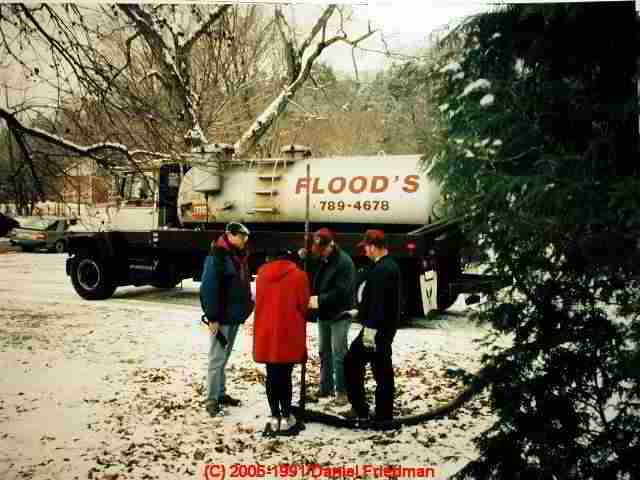 Septic tank pump and haul contractors can clean your tank. It is a good idea to supervise cleaning to assure that it
is done properly. To extract all the material from the tank, the scum layer must be broken up and the sludge layer mixed
with the liquid portion of the tank.
Septic tank pump and haul contractors can clean your tank. It is a good idea to supervise cleaning to assure that it
is done properly. To extract all the material from the tank, the scum layer must be broken up and the sludge layer mixed
with the liquid portion of the tank.
This is usually done by alternately pumping liquid from the tank and re-injecting it into the bottom of the tank. The septic tank should be pumped through the large central manhole, not the baffle inspection ports. Pumping a tank through the baffle inspection ports can damage the baffles, resulting in a destroyed leach field.
To facilitate future cleaning and inspection, if you don't already have inspection and cleaning access ports, install risers from the manhole and inspection ports to the surface.
Be sure that the septic tank cover(s) and access port covers are in good condition and completely safe. A bad septic tank, drywell, or cesspool cover can cause a collapse and can be fatal to someone walking in that area. Before burying the tank also measure from a fixed landmark and mark the location of the tank, so it can be easily identified.
The thickness of the floating scum layer and settled sludge layer in a septic tank are the keys to determining if a tank actually needs to be pumped.
How to measure the floating scum layer and
sludge layer in a septic tank are discussed in SEPTIC TANK PUMPING PROCEDURE See MEASURE SEPTIC TANK SCUM & SLUDGE
First we need to discuss the importance of septic inspection and pumping safety and also effluent retention time of effluent in septic tanks and the concept of septic tank net free area left in the tank after accounting for the thickness of the sludge and scum layers.
Readers should also see WHEN to CLEAN THE SEPTIC TANK. Homeowners should also reviewSEPTIC TANK SAFETY.
If you can't find your septic tank see SEPTIC TANK, HOW TO FIND - tips on locating septic tanks for inspection and septic tank pumping. Use of this information at other websites, in books or pamphlets for sale is reserved to the author. Technical review by industry experts has been performed and is ongoing - reviewers are listed at "References."
Comment:
(July 14, 2014) (mod) said:
Septic tank pumpers: we do not accept advertisements posted as comments on these web articles.
Website content contributors whether it is just a small correction or an in-depth article series (which of course invites more search engine attention), are, if they choose, cited, quoted, and linked-to from the appropriate additional web pages and articles - which benefits us both. Those who wish to remain anonymous can also do so.
Comments:
(July 17, 2014) Pumping Septic Tank said:
Thank you for this service, I feel a little better knowing about this Septic Tank Cleaning services can be prevented for the most part if I just take better care of my Septic Tank.
I’ll be sure to check it out soon.
(Nov 6, 2014) Tammy said:
I don't know if I could clean out my septic tank. I think it's good to know just in case though. I don't know if mine needs cleaning. Ours was leaking once and the smell nearly had me moving out! I'm so glad people do this for a job so I don't have to!
(Mar 24, 2015) Megan said:
Thanks for this information about cleaning out septic tanks. I really appreciate all of the helpful links included in this article! I like your tip about being sure that the septic tank cover and access port covers are in good condition. If they're in poor condition, they can cause a collapse and can be fatal to someone walking in that area.
Megan - from Australia
Reply:
PST
Thanks for the generous comment. I did not mean to suggest that septic tank cleaning is not necessary nor that it is something to be prevented. Rather I mean to say that the tank needs to be cleaned on a regular schedule (given At the ARTICLE INDEX at the end of this article at SEPTIC TANK PUMPING SCHEDULE) and that doing that is the one of the best ways to maximize septic system life.
Additives, chemicals, treatments are generally unnecessary and sometimes harmful or even illegal.
When your septic tank is pumped, there is additional information to be gleaned that can tell us the condition of the drainfield, tank, and also that can be used to let us adjust the pumping frequency schedule as needed.
Question:
Tara Tompson said:
I moved into a home with a septic tank that I have to take care of last year. I don't know how often I'm supposed to get it pumped. I don't even know what size it is. I should talk to my landlord about it.
Reply:
Tara
A septic contractor can open the tank, inspect its condition, pump it if appropriate, and determine its capacity or size. That size combined with information about the number of building occupants can give a reasonable guess at how often the tank needs to be pumped. See
Question: My septic tank was pumped without my knowledge and says it's important to leave "good bugs" sewage in the tank
(May 12, 2015) Linda said:
My septic tank was pumped without my knowledge as the driver went to the wrong house. We came home to find that the tank cover had been disturbed and we removed the cover to see if it had actually been pumped. There was about a foot of liquid and a chunk of crust in the bottom. We have had our tanke pumped every three years without fail ever since it was new and each time it was totally emptied.
The driver sheepishly returned the next day to tell us of his error and to ask for payment or it would be taken out of his pay. I asked why it wasn't totally empty. He said he always leaves some of "the good bugs" so as to not disturb the bacteria "action" and he said he even put a chemicals in!! WHAT??!!! We have never had chemicals put in our tank! Now I'm worried that it will become damaged!!! Should I be worried?
Reply:
Thanks Linda, that's one we've not head before. It does sound as if the pumper was inexperienced or took a bit of a short cut. During pump-down good practice is to break up and remove the sludge, not just leave it in the tank.
The claim that we need to leave "good bugs" in the tank is balderdash and an excuse. Even a new septic tank is rapidly inoculated with bacteria naturally. No additives nor pre-charge with sewage are necessary and no additives are needed. In fact some additives are harmful to the tank, drainfield, and / or environment and are completely prohibited in many jurisdictions.
Ask this junior septictankpumper guy the brand and product that he used. It may be harmless enough to leave in place.
If he want sot be paid for pumping out the tank then he needs to finish the job. At this point that may require adding some water to permit breaking up and removing the sludge he left as an inappropriate and lazy gift.
...
Continue reading at EFFLUENT RETENTION TIME or select a topic from the closely-related articles below, or see the complete ARTICLE INDEX.
Or see these
Septic Tank Cleaning Articles
- CLEANING SEPTIC TANKS
- EFFLUENT RETENTION TIME
- SEPTIC SYSTEM INSPECTION LEVELS
- SEPTIC TANK INSPECTION PROCEDURE
- SEPTIC PUMPING CONCLUSIONS
- SEPTIC TANK PUMPING PROCEDURE - home
- WASH SEPTIC TANK SIDES/BOTTOM Details of the final wash-down of a septic tank interior after the tank has been pumped
- SEPTIC TANK PUMPING SCHEDULE
- WHEN NOT TO PUMP A SEPTIC TANK
Suggested citation for this web page
CLEANING SEPTIC TANKS at InspectApedia.com - online encyclopedia of building & environmental inspection, testing, diagnosis, repair, & problem prevention advice.
Or see this
INDEX to RELATED ARTICLES: ARTICLE INDEX to SEPTIC SYSTEMS
Or use the SEARCH BOX found below to Ask a Question or Search InspectApedia
Ask a Question or Search InspectApedia
Try the search box just below, or if you prefer, post a question or comment in the Comments box below and we will respond promptly.
Search the InspectApedia website
Note: appearance of your Comment below may be delayed: if your comment contains an image, photograph, web link, or text that looks to the software as if it might be a web link, your posting will appear after it has been approved by a moderator. Apologies for the delay.
Only one image can be added per comment but you can post as many comments, and therefore images, as you like.
You will not receive a notification when a response to your question has been posted.
Please bookmark this page to make it easy for you to check back for our response.
Our Comment Box is provided by Countable Web Productions countable.ca
Citations & References
In addition to any citations in the article above, a full list is available on request.
- New York State Department of Health, APPENDIX 75-A WASTEWATER TREATMENT STANDARDS - INDIVIDUAL HOUSEHOLD SYSTEMS , [PDF] New York State Department of Health, 3 February 2010, retrieved 3/1/2010, original source: https://www.health.ny.gov/regulations/nycrr/title_10/part_75/appendix_75-a.htm
- For a table explaining how often to clean your septic tank see: SEPTIC TANK PUMPING SCHEDULE
- For a detailed procedure on how a septic tank is cleaned and inspected see SEPTIC TANK PUMPING PROCEDURE
- "Manual of Policy, Procedures, and Guidelines for Onsite Sewage Systems," Ontario Reg. 374/81, Part VII of the Environmental Protection Act (Canada), ISBN 0-7743-7303-2, Ministry of the Environment,135 St. Clair Ave. West, Toronto Ontario M4V 1P5 Canada $24. CDN.
- Manual of Septic Tank Practice, US Public Health Service's 1959.
- "International Private Sewage Disposal Code," 1995, BOCA-708-799-2300, ICBO-310-699-0541, SBCCI 205-591-1853, available from those code associations.
- SEPTIC TANK/SOIL-ABSORPTION SYSTEMS: HOW TO OPERATE & MAINTAIN [PDF] - , Equipment Tips, U.S. Department of Agriculture, 8271 1302, 7100 Engineering, 2300 Recreation, September 1982, web search 08/28/2010, original source: http://www.fs.fed.us/t-d/pubs/pdfimage/82711302.pdf.
- Pennsylvania State Wastewater Treatment Fact Sheet SW-161, Septic System Failure: Diagnosis and Treatment
- Pennsylvania State Wastewater Treatment Fact Sheet SW-162, The Soil Media and the Percolation Test
- Pennsylvania State Wastewater Treatment Fact Sheet SW-l64, Mound Systems for Wastewater Treatment
- Pennsylvania State Wastewater Treatment Fact Sheet SW-165, Septic Tank-Soil Absorption Systems
- Document Sources used for this web page include but are not limited to: Agricultural Fact Sheet #SW-161 "Septic Tank Pumping," by Paul D. Robillard and Kelli S. Martin. Penn State College of Agriculture - Cooperative Extension, edited and annotated by Dan Friedman (Thanks: to Bob Mackey for proofreading the original source material.)
- Advanced Onsite Wastewater Systems Technologies, Anish R. Jantrania, Mark A. Gross. Anish Jantrania, Ph.D., P.E., M.B.A., is a Consulting Engineer, in Mechanicsville VA, 804-550-0389 (2006). Outstanding technical reference especially on alternative septic system design alternatives. Written for designers and engineers, this book is not at all easy going for homeowners but is a text I recommend for professionals--DF.
- Onsite Wastewater Treatment Systems, Bennette D. Burks, Mary Margaret Minnis, Hogarth House 1994 - one of the best septic system books around, suffering a bit from small fonts and a weak index. While it contains some material more technical than needed by homeowners, Burks/Minnis book on onsite wastewater treatment systems a very useful reference for both property owners and septic system designers.
- Septic Tank/Soil-Absorption Systems: How to Operate & Maintain, Equipment Tips, U.S. Department of Agriculture, 8271 1302, 7100 Engineering, 2300 Recreation, September 1982, web search 08/28/2010, original source: http://www.fs.fed.us/t-d/pubs/pdfimage/82711302.pdf
- Wells and Septic System, Alth, Max and Charlet, Rev. by S. Blackwell Duncan, $ 18.95; Tab Books 1992. We have found this text very useful for conventional well and septic systems design and maintenance --DF.
- The NSFC Products List has an excellent list of design manuals/modules National Small Flows Clearinghouse (NSFC) now (2019/12/13) hosted at http://www.nesc.wvu.edu/ Tel: 304-293-4191 e-mail info@mail.nesc.wvu.edu.
he National Small Flows Clearinghouse (NSFC) was funded by the U.S. Environmental Protection Agency (EPA) to help America's small communities and individuals solve their wastewater problems through objective information about onsite wastewater collection and treatment systems. NSFC products and information are the only national resource of its type, dealing with small community wastewater infrastructure. or by telephone 800-624-8301 - In addition to citations & references found in this article, see the research citations given at the end of the related articles found at our suggested
CONTINUE READING or RECOMMENDED ARTICLES.
- Carson, Dunlop & Associates Ltd., 120 Carlton Street Suite 407, Toronto ON M5A 4K2. Tel: (416) 964-9415 1-800-268-7070 Email: info@carsondunlop.com. Alan Carson is a past president of ASHI, the American Society of Home Inspectors.
Thanks to Alan Carson and Bob Dunlop, for permission for InspectAPedia to use text excerpts from The HOME REFERENCE BOOK - the Encyclopedia of Homes and to use illustrations from The ILLUSTRATED HOME .
Carson Dunlop Associates provides extensive home inspection education and report writing material. In gratitude we provide links to tsome Carson Dunlop Associates products and services.
 | HOME | ABOUT | ASK a QUESTION | CONTACT | CONTENT USE POLICY | DESCRIPTION | POLICIES | PRIVACY | |
| © 2024 - 1985 Publisher InspectApedia.com - Daniel Friedman | |||||||||