
InspectAPedia® FREE Encyclopedia of Building & Environmental Construction, Diagnosis, Maintenance & Repair |
Question? Just ask us! InspectAPedia
|
 Inspection & Repair Guide for Sump Pumps
- POST a QUESTION or COMMENT about inspecting, diagnosing, and repairing sump pumps for basements and crawl spaces
Sump pump inspection, care & maintenance:
This article explains how sump pumps inspected, and maintained.
To help in diagnosing or preventing problems with your sump pump we include a sump pump inspection and diagnostic checklist.
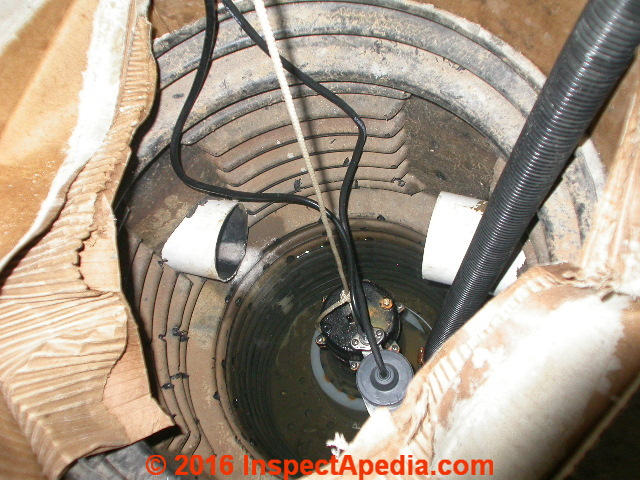
The sump pump installation shown above used cardboard box material as its pit cover - an unsafe installation.
InspectAPedia tolerates no conflicts of interest. We have no relationship with advertisers, products, or services discussed at this website.
- Daniel Friedman, Publisher/Editor/Author - See WHO ARE WE?
Guide to Inspecting Sump Pumps
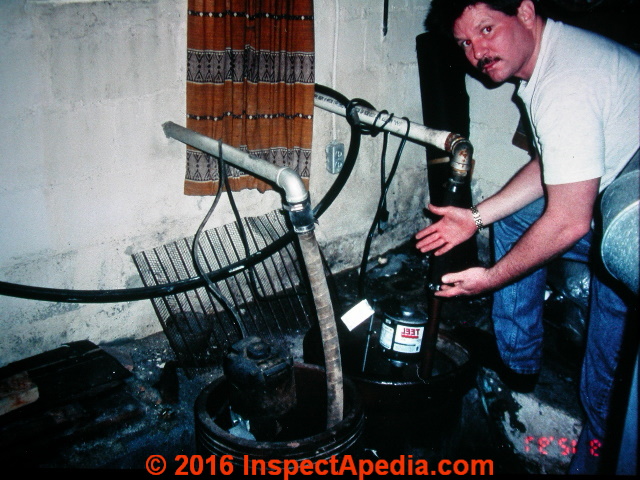 Sump pumps remove unwanted water, such as surface or ground water that leak ino a building.
A sump pump is normally installed in a pit at the low end of a basement or crawl space floor or in another location where water needs to be removed such as in a boiler pit or an outdoor well pit.
Sump pumps on newly constructed buildings are often connected to the building foundation drain. We consider this a bad practice. It is a rare home more than 20 years old whose footing drains are intact.
If a footing drain discharge itself becomes clogged or damaged, sending the sump pump discharge into that system will not work: you'll simply flood another section of the building foundation, basement, or crawl space, or you may overload the existing foundation drain causing building water entry.
Connecting a sump pump to a municipal sewer drain is bad practice and illegal in some communities. You're adding to the municipal sewer plant's water overload during wet weather and you may thus be contributing to the discharge of raw sewage from the overloaded municipal treatment facility right into the environment.
Where permitted, we prefer to route a sump pump to a storm drain, or where soil conditions permit it might be discharged to a drywell.
Sump Pump Inspection System Checklist
- Sump pump normal operation: if the sump pump does not run when water lifts the float switch, or if the water level is high in the sump pit and the sump pump is not running, the system needs repair. The problem could be a clogged sump discharge line, stuck check valve, a failing or damaged sump pump impeller assembly, low voltage to the pump motor, or something else.
Sump pump noises: whining, grinding, screeching, or crunching or clunking sounds mean something is wrong with your sump pump and it needs repair or replacement. Don't wait or your sump pump won't' be on the job when it's most needed.

- Sump pump adequacy: while your sump pump may be able to handle modest groundwater or building leakage in-flow, if the sump installation was not properly located or if the pump system is under-sized, it may be unable to keep ahead of water in-flow rates during very wet weather, times of heavy snow-melt when the ground is still frozen, or during times of local area flooding.
You may need a duplex pump system, multiple sump pumps, sump pumps at more than one pumping location, or staged sump pumps that bring additional pumping capacity online when water inflow is rapid. If you don't address the worst plausible water inflow rate your sump pump is not going not prevent building flooding and related damage.
Our photo above illustrates a commercial-grade duplexed sump pump installation with an alarm system and control panel.
Also see SUMP PUMP SINGLE vs DUPLEX to decide if you need more than one sump pump,
and see SEPTIC PUMP DUPLEX DESIGNS for duplex sump system alternatives.
If you hear your sump pump running for long intervals (more than about a minute of on-time) then it is operating at or near its pumping capacity (or its impeller is damaged or there's a similar problem). When water entry conditions are worse the sump system is not going to do the job
If you hear your sump pump cycling on and off frequently (sump pump turns on at intervals of less than a few minutes) then the check valve may have failed (or been omitted) or your system may have a combination of a too-small pumping pit and an inadequately-sized sump pump.
The result is short pump life and a system unable to keep up with heavier water inflow rates: your building is going to flood.
Sump pump lift height: you may need a more powerful sump pump if the lift height for your sump pump water discharge line is above five feet. For example a 1/4 hp sump pump with a five-foot lift can handle a water inflow-rate of about 30 gallons a minute with a 5-foto lift.
But if the sump pump has to lift the water fifteen feet its pumping capacity drops to just 10 gpm.
At SUMP PUMPS - topic home, we include an explanation of how to Calculate the Necessary Sump Pump Capacity, and we also include a Table of Example Sump Pump Performance Capacities and Typical Ratings for Residential Use
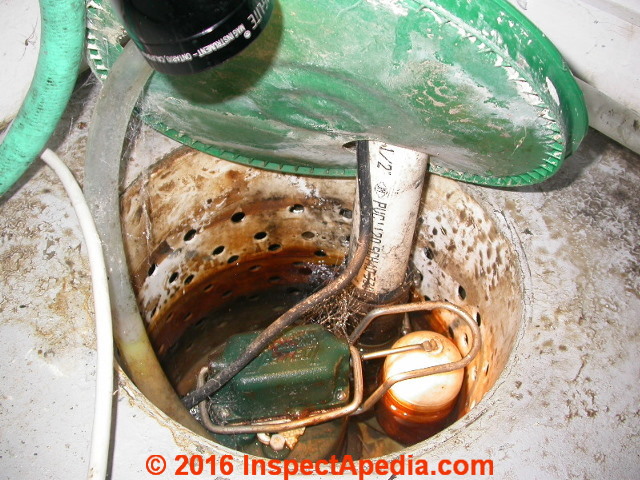
Above: this sump pump pit appears to have been made out of a 5-gallon drywall joint compound bucket, neatly drilled with holes to allow water to enter the sump pit.
The green cover is certainly from a drywall joint compound container. If this sump pump is cycling on and off too frequently (and has a check valve installed) we might improve the sump pump's duty cycle by lowering the pumping chamber in the ground, allowing the pump to handle larger doses of water during wet weather.
Below: a sump pit with no cover.
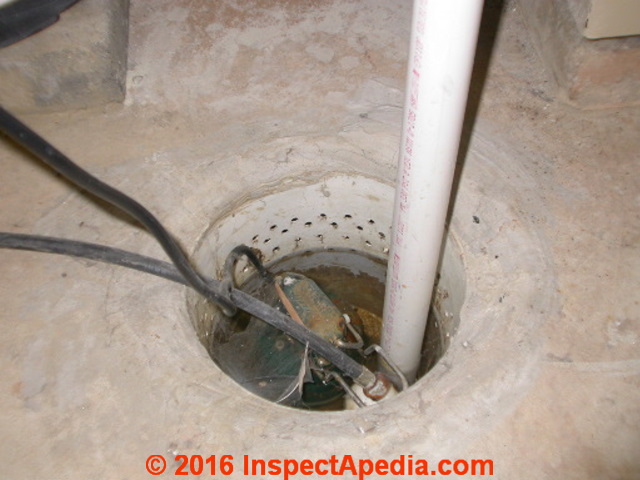
- Sump pump cover: sump pump pits should have a cover strong enough and secure enough that no one can accidentally step into or fall into the sump pit and to assure that children cannot enter or fall into the sump pit - a possible cause of fatal injury.
If water on the floor surface also has to enter the sump pit, the cover must also be designed to prevent water passage - a conflict with radon gas entry prevention in some locations.
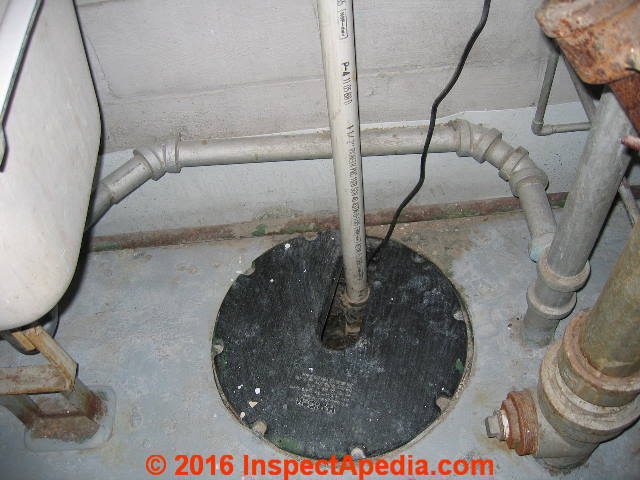
Above: our photo above illustrates a secure sump pit cover.
- GFCI protection: Is the sump pump connected to a GFCI-protected electrical circuit or outlet? According to some writers a sump pump should be connected to a GFCI circuit.
But we find that wet locations sometimes keep tripping off the GFCI - a safe condition, but it means the building is likely to become flooded because the circuit powering it has shut down. Some writers and electrical inspectors make an exception to the more general GFCI-requirement rules for sump pumps.
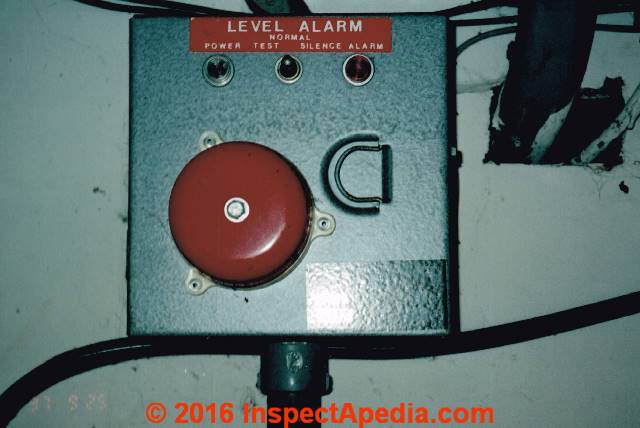
- Water or Sump Pump Alarm protection: where a sump pump is relied-upon to keep water out of a building, good practice includes an alarm to inform someone when the pump is not operating. Various systems use a detector which senses water on a building floor near the sump pump. Sump pump alarm systems like the level alarm shown above are used on both septic pumping systems and on sump pump systems.
High water level alarms and battery backup or low-battery alarms on sump pumps can sound an alarm to building occupants, turn on a light in a window for a neighbor to see, notify a security service, or even place a telephone call to report this condition.
We recommend this protection for any building which is left unattended for long periods. Activate the sump pump alarm and be sure that it works and that you'll recognize it if it is sounding in the future.
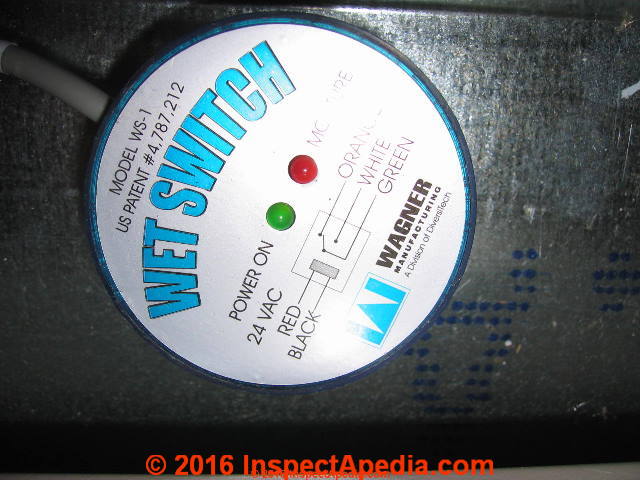
Above: the Wet Switch, produced by Wagner Manufacturing or Diversitech (under $40. U.S.) is not a sump pump control but rather an alarm system that can detect water on a surface such as your basement or crawl space floor. Wet floor alarms can serve as a backup notification system to let you know that a sump system is not keeping water out of your building.
Below: components in a Sears battery-operated sump pump system.
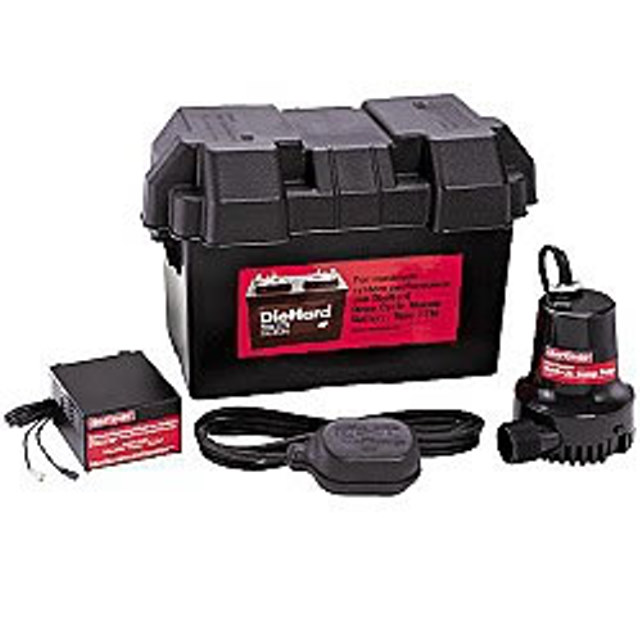
- Battery backup sump pump systems: in areas prone to power failures the sump pump may be a battery-backup installation. The batteries are connected to a charging system and are available to operate the pump when area electrical power has been lost.
Also see BATTERY BACKUP SUMP PUMPS
Turn off the electrical power to the charger and confirm that the pump is running on battery power. Review the specifications for the system to determine whether or not the pump may be able to continue to operate on battery power for the typical length of time that electrical power is lost.
Also see WATER POWERED SUMP PUMPS (though in my opinion these are not going to work for most people)
How long will your sump pump battery backup keep the pump in operation? If power outages in your area are likely to last for days it is likely that you'll need an auxiliary electrical power source to keep the sump pump (and other critical building electrical components) working.
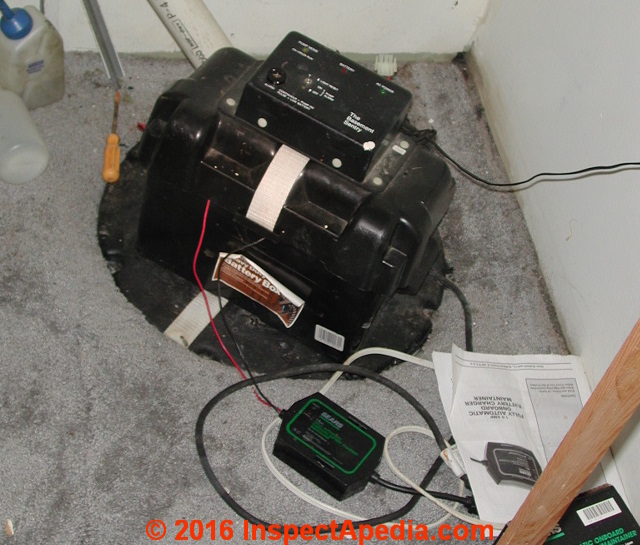
Above: a battery-operated sump pump over the sump pit, with battery charger on the floor. I'm not too confident about putting the battery charger and wiring right on what may be a wet basement floor.
This installation could be unsafe as well as unreliable.
- Sump Pump Backup System Battery Alarms: If your sump pump uses a backup battery the system will normally be connected to a charger.
Check the sump pump battery charging system, first to make sure it's working and second, if a low battery alarm is installed, check that alarm sound so that if in the future your sump's battery charger is unable to charge the battery (could be a bad battery or bad charger or loss of electrical power) you will recognize and respond to the sump pump alarm.

- Sump Pump Mounting / Installation Mechanical security: If a pedestal sump pump is installed, is it secured against tipping over?
A tipped pump will jam its float and stop working. If the sump pump twists, turns, jumps, leans when it runs, your system is headed for failure and it may also be unsafe as it may abrade or tear an electrical wire.
If the sump pump piping moves each time the sump pump cycles on/off the piping may become abraded, cracked, and then leaky. A leak in sump pump piping will spray water like mad when the pump runs and of course it'll be unable to keep water out of your building.
The thin-walled flexible corrugated black sump pump piping shown in our photo above is inexpensive and easy to install. But if it is moving and rubbing on an abrasive surface such as a foundation wall top each time the pump cycles, this sump discharge line is going to leak soon. Also we note there's no check valve installed.
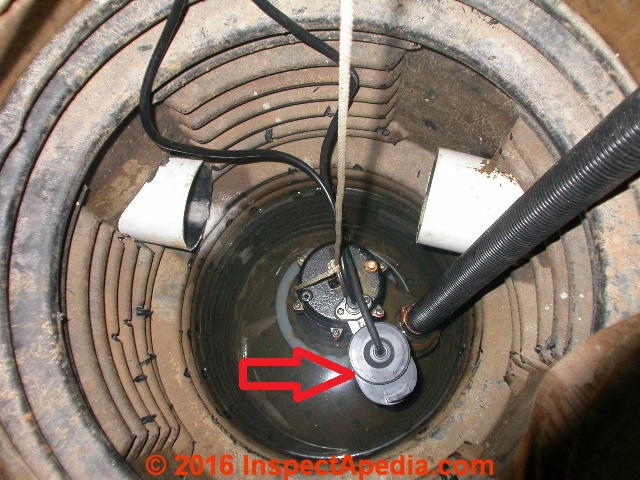
- Sump pump motor float Switch & Electric Motor: Does the pump's electric motor turn on in response to the float?
Check that the float switch (red arrow in our sum pump photograph above) operates: you may need to pour water into the sump pit or it may be possible to lift the float to activate the pump. Be sure nothing will obstruct and jam the float switch assembly. - Pump impeller assembly: does the pump actually move water when the motor runs? Impellers can and should be cleaned of dirt, pebbles, and mineral deposits to keep the pump operating efficiently.
Noisy sump pump pump impellers mean the sump needs repair or replacement and that it may be unable to pump water in event of flood conditions.
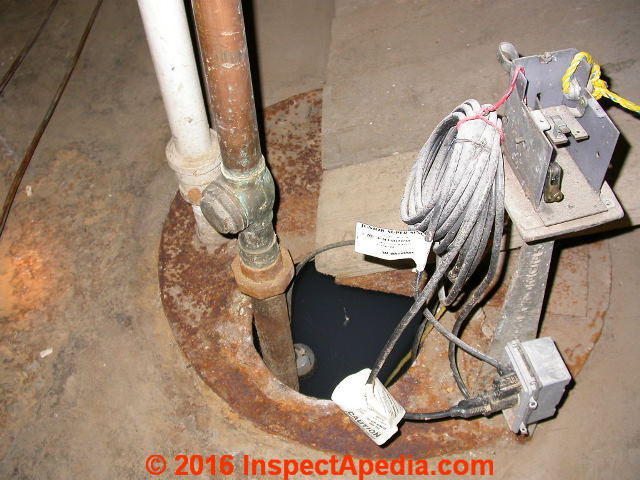
- Check valve at the sump pump: is a check valve (yellow arrow in our sump piping photograph above) installed on the sump pump discharge line? If not water will run back into the sump pit each time the pump shuts off.
The result is frequent, and unnecessary cycling of the sump pump motor and controls, shorter sump pump life, and reduced pumping capacity as the pump has to pump some of the same water over and over again.
Watch the sump pit during a pumping cycle. If you see water running back into the sump pit from the discharge line then the check valve is not working (or not installed).
This defect causes extra cycles of pump operation and may reduce pump or switch life; in odd circumstances such as a sump pump discharge line into a stream, it can even back-siphon outdoor water into the sump pit and into the building.
Reader comment: leave off the check valve at sump pump in freezing climage?
2021/0606 sgbotsford@gmail.com
I chose NOT to install a check valve. My line exits the house above the foundation between two joists. It gets cold there. My concern is that in winter, when the pump runs rarely that water will freeze at the top of the pipe at the corner, blocking the discharge. 11 feet of 1.25" line only puts a gallon or two back in the sump.In hindsight, the hole in the wall should descend to the out side, and the elbow located well inside so that there is warm section of empty discharge line.
mak.church (mod) reply: watch for too much drain-back & too frequent sump cycling if no check valve
@sgbotsford@gmail.com,
Thank you for sharing your ideas about avoiding sump pump trouble in freezing weather, SG; that's indeed a problem in cold climates, as we discuss in this article series.Some sump outlets will work fine without a check-valve but in many installations, depending on the length and rise of outlet piping involved vs. the volume of the sump pit, omitting the check valve can cause too-rapid sump cycling on and off, wearing out the pump.
It's worth noting that in the manufacturer's the sump pump installation guides we include in this article series all of those sources call for including a check valve on the sump outlet.
See SUMP PUMP MANUALS
But it's also the case that those guides don't discuss problems of freezing sump discharge lines. So your suggestions are helpful too.We welcome your questions, criticism, or content suggestions. Working together makes us smarter.
- Discharge line security for sump pump systems: sump pumps cause a sudden surge in water through the discharge pipe when the pump comes on.
Many sump pump installations use a flexible discharge pipe which is not adequately secured. As a result, each time the pump cycles on and off the flexible discharge pipe jerks and moves across various contact surfaces. We've seen this result in holes worn into the discharge pipe so that each time the sump pump cycled on it sprayed water across the basement.
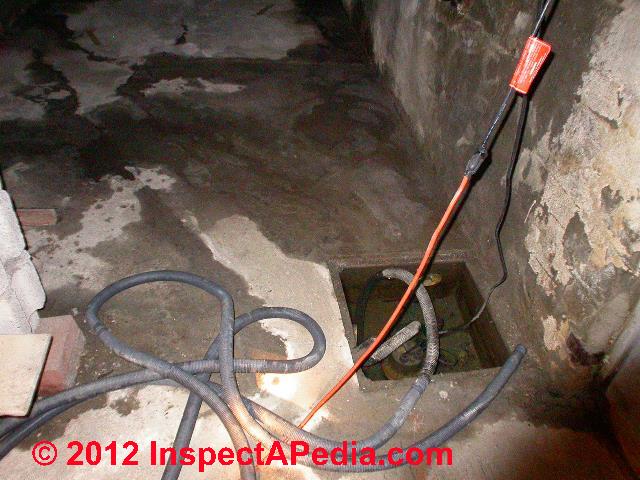
- Trip hazards at sump pumps: Is the sump pit protected against someone tripping or falling into it? The sump pump shown above has no cover, unsupported electrical wiring, no check valve, and trip hazards all around. This sorry sump pump system design lets water run into the basement through basement walls and up through the floor before water is pumped away: the building will suffer from high moisture and perhaps mold contamination.
- If radon is a problem in the area, is a radon-cover installed over the sump pit? When there is plenty of ground water, radon intrusion into a building through the sump pit or basement slab is much less likely. But in dry seasons the sump pit could be a point of radon gas entry.
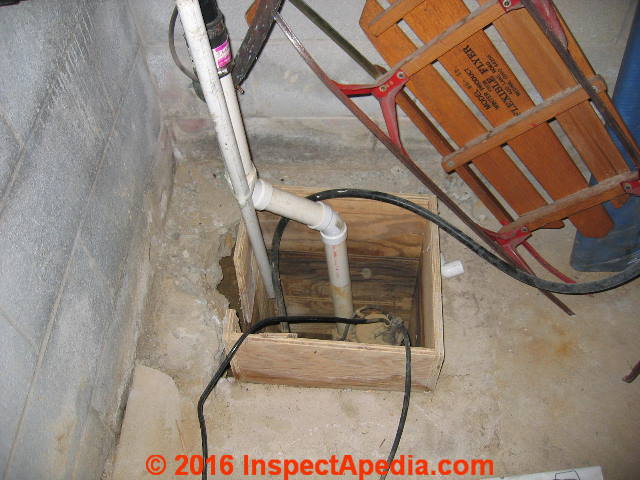
- Sump pit liner materials: The sump pump pit should be made of water-resistant materials, usually plastic, occasionally corrugated galvanized steel or concrete. Making the sump pit liner out of plywood (photo above) is not a durable installation.
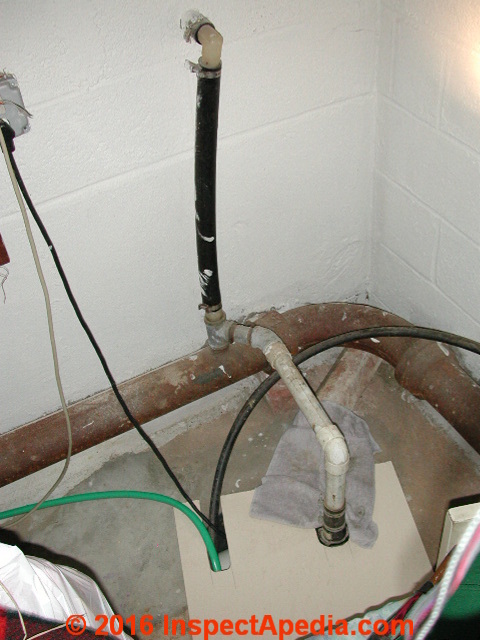
- Sump Pump pit openings: Is the sump well or bucket properly opened to permit ground water to enter the pit directly? Our first home had a basement sump pump installed in a water tight steel bucket the builder had pushed through the basement floor.
Water had to rise under the basement floor, leak into the basement, run across the floor, and then be pumped away.
Making holes in that bucket allowed the pump to draw water from below the basement slab. It lowered the water table and stopped water from entering the basement through the foundation walls.
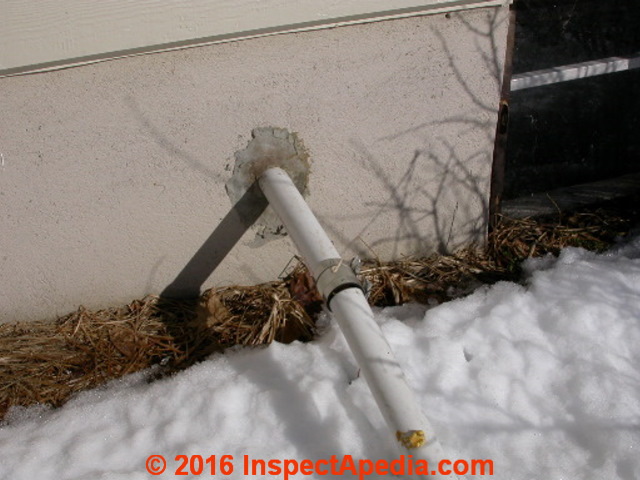
- Sump pump water destination: is the pump delivering water to a legal destination and one which will not send water flowing back towards the building?
Water should be discharged no less than 20 ft. from the building and to a spot which drains away from the building. We discuss sump pump discharge routing and freeze protection further
at SUMP PUMP DISCHARGE
- In a bad building water entry situation water runs across the basement/crawl space floor into the sump pit where it is pumped away (after already wetting the building and inviting a mold contamination problem).
This condition pertains when water is entering a building through foundation walls, often because the roof drainage or surface runoff are directed right against the building foundation itself. Keeping gutters and leaders working and correcting outside drainage errors are critical in keeping water out of a building.
Doesn't it make more sense to prevent water from coming into a building than to let it in and then pump it out? - In a good situation, openings in the sides and bottom of the sump pit, or an under-floor drainage system direct subsurface water into the sump pit before the ground water level rises enough to send water into the building.
Over several years of operation, and partly by pumping a little soil silt as it operates, a sump pump may actually improve the flow of under-floor water into the sump pit, thus reducing building water entry.
- In a bad building water entry situation water runs across the basement/crawl space floor into the sump pit where it is pumped away (after already wetting the building and inviting a mold contamination problem).
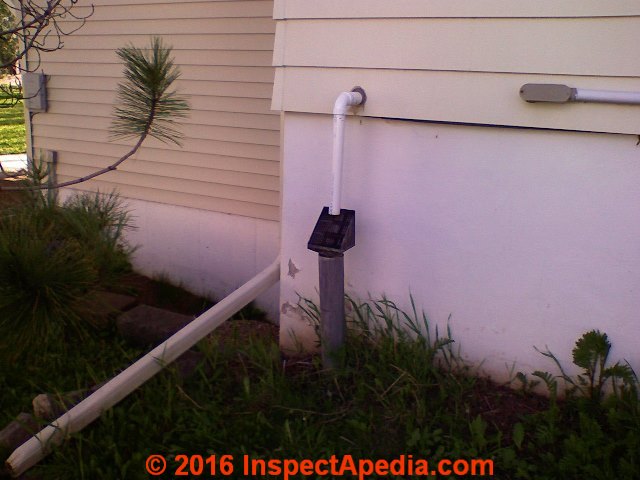
Above, installed in a Duluth Minnesota home, this is the outside discharge line for the sump pump serving an interior basement de-watering system.
The sump discharge destination has to be able to accept the incoming water at any time of the year, or the basement will flood.
...
Reader Comments, Questions & Answers About The Article Above
Below you will find questions and answers previously posted on this page at its page bottom reader comment box.
Reader Q&A - also see RECOMMENDED ARTICLES & FAQs
More causes of sump cycling or backups: sources of flooding in seepage pit used to contain sump pump output
We installed leader drain pipes and connected 2 sump pumps to the leader drains from the basement to two seepage pits about 3 weeks ago.
Since that time, the rear right side corner seepage pit has been backing up and overflowing, creating a pool of water around the rear right corner of the foundation and property. A geothermal well is located several feet away from the right side seepage pit.
Our site contractor sent his crew out to the house yesterday to diagnose the problem with the back right corner leader drain/seepage pit.
They opened the lid on the seepage pit and it is was completely full of water, which indicates that the water is indeed reaching the pit and it is not an issue with the piping that was installed leading to the pit.
The other seepage pits had either no water or a minimal amount of water inside of them and are draining properly.
We came up with 2 potential issues that could be causing the seepage pit to fill up and not drain appropriately.
The first could be the that amount of water that is coming out of the gutter/leader at that section plus the water being pumped out of the rear Sump pump is substantial and causing the 500 gallon seepage pit to fill up and overfllow.
A potential solution to this would be to connect the 2 seepage pits in the rear yard with a pipe which would allow for the water from the pit that is filling up to overflow into the other pit which is not filling up, relieving the excess flow.
Although if both pits then start to overflow after we connect a pipe between them, then that could mean we need larger pits to manage the total amount of water coming off the roof and from the foundation in that area.
The 2nd potential issue would be a more substantial concern if it were to be true.
And that is if one or both of the well pipes from the Geothermal system are leaking into the seepage pit (which is pretty close to one of the Geothermal wells) and causing the pit to overflow.
When the well was dug, a steady flow of water came up from the borehole until it was packed with sealant.
Could this leak have resprung under ground pressure? Is "artesian" water leakage from a geothermal well bore common? On 2017-05-24 by David -
Reply by (mod) - more causes of sump cycling or backups
David
What clever detective work - new ideas to add to our inventory of sump cycling or backups.
I'm guessing that your geo-thermal heat pump water source is sending water where it shouldn't.
Indeed if your geothermal tapped into an artesian well water source then there needs to be a well spool or seal in the casing that keeps well water below the well casing top and perhaps below a pitless adapter.If the spool has failed or is missing then the well could, if there's a leak anywhere in that system, pushing water out to a handy nearby destinatino.
About the roof drain system, I don't know your home - we don't usually run roof drainage into a seepage pit near the building, unless we needed a sump system because the building is at a flat or low spot where there is no chance to drain by gravity to get water away from the home. In any event, if you've gone for a week with no rain and the water problem continues I suspect it's not roof drainage.
It may be possible to look into the flooding seepage pit to see where water is entering it: from the incoming roof drain versus from the pit sides from ground flooding from a leaky artesian well.
Watch out: never work alone and don't lean over any seepage nor septic or drywell pit without appropriate safety gear: falling in can be fatal.
Keep me posted.
Radon level increased after covering the sump pit
During the home inspection, a short term radon test showed 3.8.
After moving in I bought a radon monitor and over the course of a month, the reading was 3.6 - 3.8.
The house is 20 years old with a finished basement that is about 10 years old. The sump pit only had a standard slotted cover so I installed a sealed Dome and siliconed any gaps.
Now the reading is 4.6! I have waited 8 days since the cover was installed and the radon keeps staying above 4. I don't get it! Any advice? On 2016-07-11 by John -
Reply by (mod) - unlikely that covering the sump pit raised the radon level: look elsewhere
I would be surprised if covering a sump would increase the radon level in a home; more likely weather, temperature, air movement in the building or other factors explain the difference you are seeing.
For practical purposes and given the range of error in testing, all of your numbers are roughly identical.
A more accurate guess at the radon level in your home would come from doing a year long test.
Details are at RADON HAZARD TESTS & MITIGATION
and at
RADON MEASUREMENT GUIDE
...
Continue reading at SUMP PUMP TYPES or select a topic from the closely-related articles below, or see the complete ARTICLE INDEX.
Or see these
Recommended Articles
- CROSS CONNECTIONS, PLUMBING - avoid connecting potable water to drain line
- SEPTIC SYSTEM PUMPS - if you are looking for septic system pumps not sump pump information
- SUMP PUMPS - home
- APPLIANCE DIAGNOSIS & REPAIR
- BATTERY BACKUP SUMP PUMPS
- CRAWL SPACE DRYOUT
- CROSS CONNECTIONS, PLUMBING
- MERCURY HAZARDS in SUMP PUMP CONTROLS
- PEDESTAL SUMP PUMP GUIDE
- SUMP PUMP DISCHARGE
- SUMP PUMP INSPECTION
- SUMP PUMP MANUALS
- SUMP PUMP RELIABILITY
- SUMP PUMP TYPES
- SUBMERSIBLE SUMP PUMP GUIDE
- SUMP PUMP SINGLE vs DUPLEX
- SEPTIC PUMP DUPLEX DESIGNS
- WATER ENTRY in BUILDINGS
- WATER POWERED SUMP PUMPS
Suggested citation for this web page
SUMP PUMP INSPECTION at InspectApedia.com - online encyclopedia of building & environmental inspection, testing, diagnosis, repair, & problem prevention advice.
Or see this
INDEX to RELATED ARTICLES: ARTICLE INDEX to BUILDING LEAKS & WATER ENTRY
Or use the SEARCH BOX found below to Ask a Question or Search InspectApedia
Ask a Question or Search InspectApedia
Questions & answers or comments about inspecting, diagnosing, and repairing sump pumps for basements and crawl spaces
Try the search box just below, or if you prefer, post a question or comment in the Comments box below and we will respond promptly.
Search the InspectApedia website
Note: appearance of your Comment below may be delayed: if your comment contains an image, photograph, web link, or text that looks to the software as if it might be a web link, your posting will appear after it has been approved by a moderator. Apologies for the delay.
Only one image can be added per comment but you can post as many comments, and therefore images, as you like.
You will not receive a notification when a response to your question has been posted.
Please bookmark this page to make it easy for you to check back for our response.
IF above you see "Comment Form is loading comments..." then COMMENT BOX - countable.ca / bawkbox.com IS NOT WORKING.
In any case you are welcome to send an email directly to us at InspectApedia.com at editor@inspectApedia.com
We'll reply to you directly. Please help us help you by noting, in your email, the URL of the InspectApedia page where you wanted to comment.
Citations & References
In addition to any citations in the article above, a full list is available on request.
- New York State Department of Health, APPENDIX 75-A WASTEWATER TREATMENT STANDARDS - INDIVIDUAL HOUSEHOLD SYSTEMS , [PDF] New York State Department of Health, 3 February 2010, retrieved 3/1/2010, original source: https://www.health.ny.gov/regulations/nycrr/title_10/part_75/appendix_75-a.htm
- Our recommended books about building & mechanical systems design, inspection, problem diagnosis, and repair, and about indoor environment and IAQ testing, diagnosis, and cleanup are at the InspectAPedia Bookstore. Also see our Book Reviews - InspectAPedia.
- In addition to citations & references found in this article, see the research citations given at the end of the related articles found at our suggested
CONTINUE READING or RECOMMENDED ARTICLES.
- Carson, Dunlop & Associates Ltd., 120 Carlton Street Suite 407, Toronto ON M5A 4K2. Tel: (416) 964-9415 1-800-268-7070 Email: info@carsondunlop.com. Alan Carson is a past president of ASHI, the American Society of Home Inspectors.
Thanks to Alan Carson and Bob Dunlop, for permission for InspectAPedia to use text excerpts from The HOME REFERENCE BOOK - the Encyclopedia of Homes and to use illustrations from The ILLUSTRATED HOME .
Carson Dunlop Associates provides extensive home inspection education and report writing material. In gratitude we provide links to tsome Carson Dunlop Associates products and services.
 | HOME | ABOUT | ASK a QUESTION | CONTACT | CONTENT USE POLICY | DESCRIPTION | POLICIES | PRIVACY | |
| © 2025 - 1985 Publisher InspectApedia.com - Daniel Friedman | |||||||||