
InspectAPedia® FREE Encyclopedia of Building & Environmental Construction, Diagnosis, Maintenance & Repair |
Question? Just ask us! InspectAPedia
|
 Septic Drainfield Installations on Steep Slopes
- POST a QUESTION or COMMENT about how to build a septic system on steeply-sloped land
Steep slope septic drainfield systems.
This article describes the installation of septic drainfields or leach lines on difficult terrain such as on steep slopes where a property disposes of wastewater using a septic tank and drainfield.
InspectAPedia tolerates no conflicts of interest. We have no relationship with advertisers, products, or services discussed at this website.
- Daniel Friedman, Publisher/Editor/Author - See WHO ARE WE?
Guide to Septic Installations on Steep Slopes or Stepped Slopes
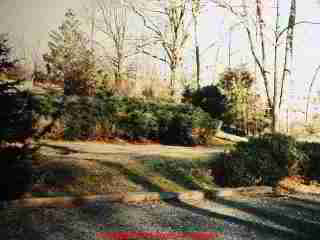
Our photo above illustrates terracing used by the excavator during a septic drainfield installation.
[Click to enlarge any image]
In addition to the text of this article (below), readers concerned with septic installation advice for steeply sloped or rolling sites should see these articles:
- SEWER or SEPTIC LINE INSTALLATION at STEEP SITES which describes sewer piping between a building and septic tank or sewer main at steep sloped sites which slope down significantly between the building and the septic tank. Includes guidance for people conducting a septic system inspection or test,
- DOSING SYSTEMS PRESSURE which describes pressure dosing systems that may be useful for disposing of septic effluent at steep sites where the drainfield must be located either uphill or downhill from a septic tank or building.
- GRAVELLESS SEPTIC SYSTEMS- some gravelless systems can handle gentle curves necessary to follow rolling slope lines
- SEPTIC PUMPS Septic pumps, sewage ejector pumps, grinder pumps, effluent pumps, sump pumps, & septic pumping stations, septic pump alarms - systems that will be needed if a building or septic tank are lower than the drainfield or sewer main.
- STEEP SLOPE DESIGNS (text located just below) which describes installation of septic drainfields on steep or rolling sites.
also see DIFFICULT SEPTIC SITE DESIGNS. Technical reviewers are welcome and are listed at "References." Citation of this article by reference to this website and brief quotation for the sole purpose of review are permitted. Use of this information at other websites, in books or pamphlets for sale is reserved to the author.
Guide to Installing Steep Slope Septic Drainfield Systems
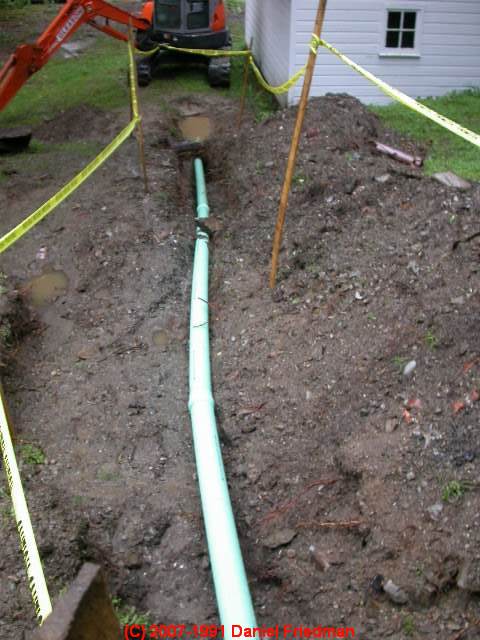
Installing Septic Drainfield Piping on Steep Slopes Located Downhill from the Septic Tank - Uniformly Sloped Land
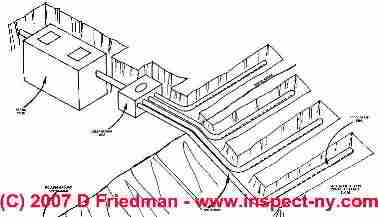
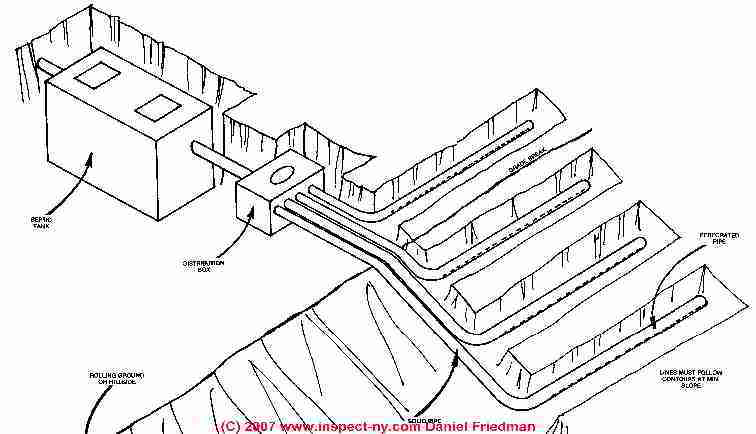
The sketch at page top shows an installation approach for septic drainfields across a steep or rolling slope. The photo just above illustrates sewer line piping down a steep slope to a septic tank and seepage pit system located in a flat area below the hillside. But what do we do if the septic effluent absorption system or soakbed itself has to be installed along a steep hillside? Here are some specifications.
- D-box for septics on steep slopes: Clarified septic effluent leaves the septic tank (or an effluent pumping station) and flows into a large distribution box. This D-box will need to be larger and have more connecting ports than those used for a conventional flat-area drainfield: each effluent line to be located across the hillside needs to connect directly to the D-box.
- Individual effluent lines for steep slope septics: Connected to the distribution box are individual septic effluent drain lines, each of which is routed to an individual gravel trench and perforated drainfield
- Effluent line feeder pipes for steep slope septic systems: Piping between the distribution box and the drainfield trench is solid, not perforated.
- Effluent lines for hillside or rolling land drainfields: Each of the drainfield lines is installed along the slope, not uphill or downhill, sloping gently (1/8" to 1/4" per linear foot) from the inlet end of each drainfield trench to its lowest point.
Installing Septic Drainfield Piping on Steep Slopes Located Downhill from the Septic Tank - Rolling Land
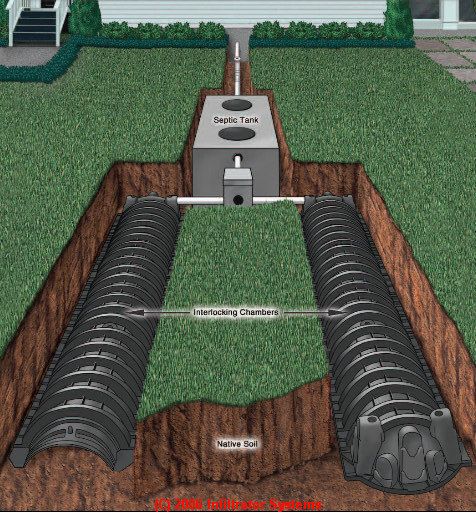
- Flexible distribution piping or gravelless systems for steep slope septics: Where land is rolling or contoured, flexible piping may be easier to install than rigid pipe systems since flexible effluent lines can be routed in a trench which needs to curve in order to remain parallel to the fall line of the slope of rounded hilltops or rolling land.
- Pressure dosing for steep slope septic systems: Other septic effluent handling systems such as pressure distribution systems may be more tolerant of installation on steep or uneven sloped land and can employ either rigid or flexible perforated piping.
See PRESSURE DOSING SEPTIC SYSTEMS
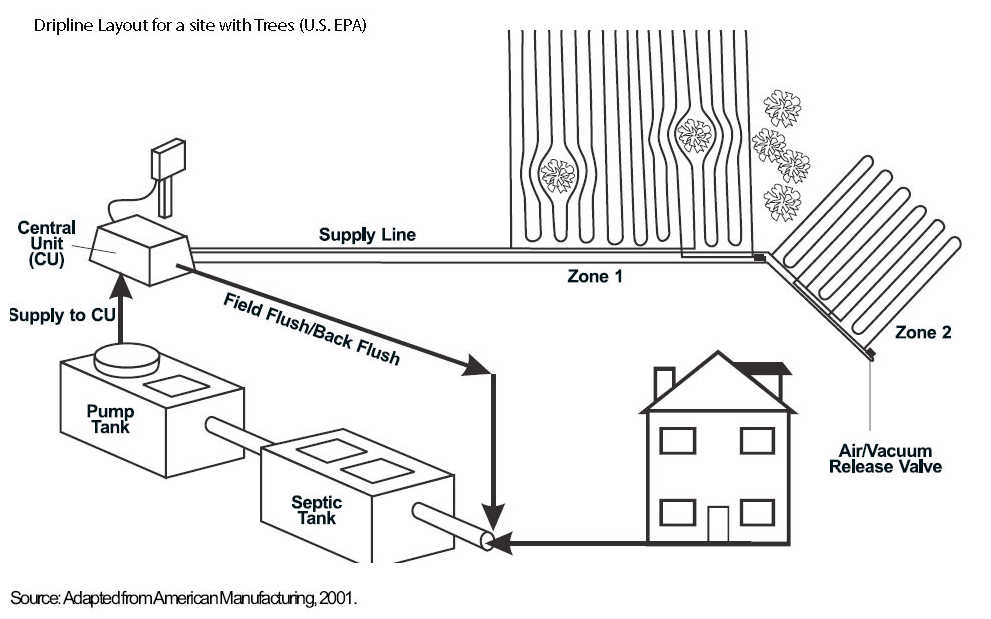
- Drip lines which also use flexible distribution piping for septic system effluent dispersal may also work on some hilly sites. Some aerobic systems that dispose of effluent using drip systems or spray systems or that feed drip irrigation systetms can solve the steep slope septic effluent disposal problem.
See AEROBIC SEPTIC SYSTEMS, ATUs - home
Or
See HOOT AEROBIC SYSTEMS DRIP DISPOSAL DESIGN & INSTALLATION GUIDE [PDF]
Or
See "Guidance For Design, Installation And Operation Of Subsurface DRIP DISTRIBUTION SEPTIC SYSTEMS As A Replacement For Conventional Title 5 Soil Absorption Systems For Disposal Of Septic Tank Effluent", [PDF] Massachusetts Department of Environmental Protection (2006) refrencing MA regulations 310 CMR 15.240, 15.242, 15.247, and 15.280-15.289 - Graywater disposal systems also include designs that can assist with effluent of graywater disposal on steep slopes.
See GREYWATER SYSTEMS - Gustafson, David M., James L. Anderson, Sara F. Heger, and Barbara W. Liukkonen. CHOOSING AN ALTERNATIVE SEPTIC SYSTEM FOR A HOMESITE WITH A STEEP SLOPE [PDF] (2000). University of Minnesota Extension, retrieved 2021/03/30 original source: https://conservancy.umn.edu/bitstream/handle/11299/94143/1/7570.pdf
Why Drainfield Effluent lines need to be properly sloped
Septic drainfields that treat and dispose of clarified wastewater effluent using gravity need to be properly pitched and never sloped too steeply. Otherwise effluent will run too quickly to the low end of the drainfield line and gravel trench where it is likely to simply break out to the property surface.
If you have to install a conventional perforated pipe and gravel trench drainfield on a steep slope you'll need to run the trenches along the slope or parallel to the fall line, stepping down the slope from trench to trench.
...
Reader Comments, Questions & Answers About The Article Above
Below you will find questions and answers previously posted on this page at its page bottom reader comment box.
Reader Q&A - also see RECOMMENDED ARTICLES & FAQs
 On 2020-05-25 - by (mod) -
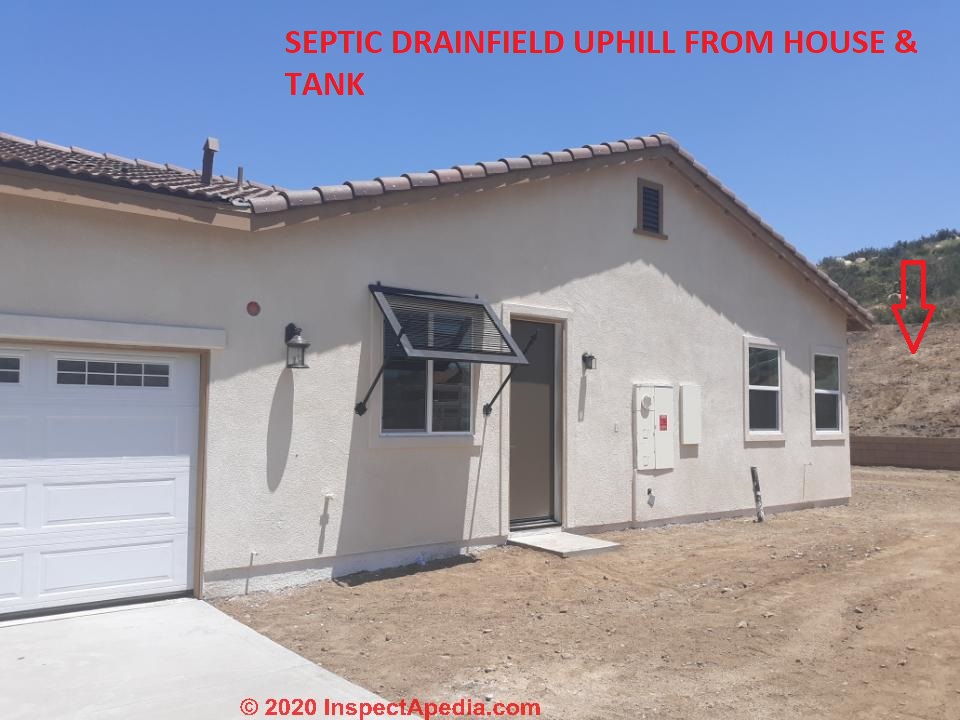
Sure you can have the drainfield above the septic tank, but you'll need an effluent pumping system.
On 2020-05-25 by Edward Cline
This is from last comment. This where leach line will be installed compared to where the septic is buried in the lower level. You see the house and it will be on top of this embankment on the right side of the home.
Can a septic be installed at ground level but the leach area is install on embankment behind the home.
The embankment height is to roof top of the single story home being built. Will there be problems for this set up and how long do a pump last for this system because it is not built at level like the average septic system? How are will pump need to be replaced and how expensive is this process in long run of owning your home because leach area is at a steep slope from septic?
On 2020-05-25 by Edward Cline
Can a septic be installed at ground level but the leach area is install on embankment behind the home. The embankment height is to roof top of the single story home being built. Will there be problems for this set up and how long do a pump last for this system because it is not built at level like the average septic system?
How are will pump need to be replaced and how expensive is this process in long run of owning your home because leach area is at a steep slope from septic?
On 2020-01-10 - by (mod) -
Yes, that's the subject of the article above on this page. Basically you need to keep the slope to the proper 1/8 to 1/4 inch per foot of horizontal run otherwise all the effluent immediately dashes to the end and overloads the system there
On 2020-01-10 by Anonymous
Are there any potential problems with a leachfield that has some slope to it?
On 2019-12-16 by Anonymous
Steve
So in winter we are sending sewage into the environment;
I agree that directing surface runoff away from the drainfield might work. You may need both a swale to intercept actual surface runoff and a trench of depth greater than 24" below the bottom of the drainfield trenches to intercept groundwater and carry it away from the field. C
arry groundwater and surface water to daylight away from the field area.
If none of that works we (ok really you) could have to go to a raised bed or mound septic.
On 2019-12-16 by Steve
During the winter months, it appears that runoff from a steep hill, including seep springs overload the drain field.
The drain field is in a flat area of a hill about 60 feet in width. In the summer, there is no issue. Would it be advised to put a french just starting in the flat uphill from the drain field to sort of isolate the drain field and make it more or less acting as a mound at that point?
The drain field to the down hill side has easy runoff away from the field. Thanks
On 2019-12-10 - by (mod) -
Kelly
You will need sufficient space to be certain that your septic system meets the setback requirements from the water's edge, and most likely you will need to bring in soil in order to construct a sufficiently elevated Mound system such that the bottom of your drain field or effluent Disposal system has enough soil beneath it that it's not simply going to hit rock and then send the affluent Down The Rock and into the lake.
Imagine that wherever you live there will be an authority who needs to approve the specific septic design so you need a septic design engineer who's familiar with both local regulations and the soil conditions on your Island.
On 2019-12-10 by Kelly
I am contemplating the construction of a septic system on an Island that is primarily solid rock (Canadian Shield) and slopes into the lake (5% to 25% gradient in places).
Due to the size of the Lot the setbacks from the Lake would be 30m to 40m. What are the issues that I need to be aware of and how reliable would a septic system be in this scenario. Is it a mistake to try to do this?
How long can I expect this system to function before it might fail?
Thanks.
On 2017-12-13 by William H. Doggett
In Frederick County, MD, what is the maximum topographic slope permitted in a septic field serving a single family residence?
On 2016-09-10 by Anonymous
How far apart do you do agg line?
On 2015-09-25 by Anonymous
Thanks for your prompt reply,
Just a question: Why would I install D Boxes when I can just install a second cleanout midway through the total run more cheaply and less obtrusively? Your method has me installing 6 drop boxes over 100'! To me, that seems excessive, expensive and high maintenance.
On 2015-09-25 - by (mod) - installing a bathroom and kitchenette in my rural 2400 sq. ft. wood-working shop
A too steep sewer pipe may see water running too fast, leaving solids behind.
Yet I've seen straight shot steep lines from house to tank that worked ok for decades. A stepped line approach will work better if each turn is made through a D box to give access for cleaning.
On 2015-09-25 by Brent Herman
What a wonderful website!
My problem: I'm installing a bathroom and kitchenette in my rural 2400 sq. ft. wood-working shop that I am in the process of building (myself - for myself). I am a carpenter/mason/builder.
Though it is not my trade, I have reasonable plumbing skills. I have about 20' of fall for about 100' of run to the pre-existing septic tank. The tank was installed to accommodate a house. The house is on hold (waiting for more money).
The tank and field have been approved for use by the shop. I don't live on site and now it seems it may be some years before I can build the house on site.
Can I run a 4" sewage line in step-wise fashion down to the septic tank? IE: horizontal runs 1"/4' for about 15' to vertical drops of about 3 feet and continue with that pattern till I reach the tank?
The the shop foundation is sitting on granite bedrock, and the septic tank with effluent pump to a drain field are placed on the land to meet both, perc test requirements and maintaining a minimum 100' from a river.
For the most part, the soil is 3' of clay over granite. Frost footings must have a minimum depth of 5' when not tied directly to bedrock. It is common practise by good builders to run 2" of polystyrene over their water pipes.
Black water is another issue. Will I need to vent part way between shop and tank? A cleanout will be placed at the point where the pipe breaches the foundation wall.
I will be most thankful for the help of anyone who can give me good practical assistance.
On 2013-03-13 - by (mod) -
Steve,
It's remarkable to hear about 50-year old drainfields that are really still working correctly, though I have inspected a few as well, including a complex system built on an estate around 1920.
But I'd watch out. Sometimes "working" means the system seems to successfully dispose of effluent - that is, you're not seeing wet spots. A septic system can fail in more clandestine ways, such as sending effluent onto a neighboring property, stream, or aquifer.
Nevertheless, virtually nobody would dig up and mess with a drainfield in the absence of any failure data.
Can you elaborate what special considerations you have learned for steep-slope septics? It'd be helpful to add detail here.
On 2013-03-13 by Steve Hartsell
In this area there several septic leach fields in slopes of up to 80% and numerous leach fields in slopes of up to 50% that utilize standard leach trenches. Many fo these were installed up to 50 years ago and still work fine today.
The suitability of a steep slope for the dispersal of septic effluent is site specific. Proper consideration must be given to various factors including the presence of impervious strata, seasonal ground water, and slope stability.
On 2012-02-13 by B Page
Thank you! This was very helpful.
On 2011-07-18 - by (mod) -
B Page
On a steep slope in Virginia many years ago we satisfied the code officials by combining the type of across-slope trenching system you see at page top with sculpting the slope into a terraced hill; the wider flat areas of the terraced surfaces gave plenty of room for the drainline trenches.
It was, of course expensive. The excavator had to bulldoze what amounted to a roadway zigzagging down the steep hill, then the excavator worked backwards from bottom-up so that there was no worry about equipment driving over finished drainfield trenches.
On 2011-07-14 by BPage
Thought I'd better add: The drainfield site will be well down-slope of the building site and tank...so gravity fed or syphon could be used.
On 2011-07-14 by BPage
Anyone have any further recommendations of septic design for steep slopes greater than 25%? My county code precludes standard drain fields on slopes >25%.... References on designs successful for these types of slopes?
On 2011-07-14 by BPage
Great information. I have a site that is on a 24%-30% slope.
...
Continue reading at SEWER or SEPTIC LINE INSTALLATION at STEEP SITE or select a topic from the closely-related articles below, or see the complete ARTICLE INDEX.
Or see these
Steep Slope Septic System Articles
- DIFFICULT SEPTIC SITE DESIGNS
- SEPTIC CONSULTANTS, DESIGNERS, ENGINEERS
- SEPTIC SYSTEM DESIGN ALTERNATIVES - home
- SEPTIC SYSTEM DESIGN BASICS - home
- SEWER / SEPTIC LINES at STEEP SITES
- STEEP SLOPE SEPTIC DESIGNS
Suggested citation for this web page
STEEP SLOPE SEPTIC DESIGNS at InspectApedia.com - online encyclopedia of building & environmental inspection, testing, diagnosis, repair, & problem prevention advice.
Or see this
INDEX to RELATED ARTICLES: ARTICLE INDEX to SEPTIC SYSTEMS
Or use the SEARCH BOX found below to Ask a Question or Search InspectApedia
Ask a Question or Search InspectApedia
Try the search box just below, or if you prefer, post a question or comment in the Comments box below and we will respond promptly.
Search the InspectApedia website
Note: appearance of your Comment below may be delayed: if your comment contains an image, photograph, web link, or text that looks to the software as if it might be a web link, your posting will appear after it has been approved by a moderator. Apologies for the delay.
Only one image can be added per comment but you can post as many comments, and therefore images, as you like.
You will not receive a notification when a response to your question has been posted.
Please bookmark this page to make it easy for you to check back for our response.
IF above you see "Comment Form is loading comments..." then COMMENT BOX - countable.ca / bawkbox.com IS NOT WORKING.
In any case you are welcome to send an email directly to us at InspectApedia.com at editor@inspectApedia.com
We'll reply to you directly. Please help us help you by noting, in your email, the URL of the InspectApedia page where you wanted to comment.
Citations & References
In addition to any citations in the article above, a full list is available on request.
- New York State Department of Health, APPENDIX 75-A WASTEWATER TREATMENT STANDARDS - INDIVIDUAL HOUSEHOLD SYSTEMS , [PDF] New York State Department of Health, 3 February 2010, retrieved 3/1/2010, original source: https://www.health.ny.gov/regulations/nycrr/title_10/part_75/appendix_75-a.htm
- Our recommended books about building & mechanical systems design, inspection, problem diagnosis, and repair, and about indoor environment and IAQ testing, diagnosis, and cleanup are at the InspectAPedia Bookstore. Also see our Book Reviews - InspectAPedia.
- In addition to citations & references found in this article, see the research citations given at the end of the related articles found at our suggested
CONTINUE READING or RECOMMENDED ARTICLES.
- Carson, Dunlop & Associates Ltd., 120 Carlton Street Suite 407, Toronto ON M5A 4K2. Tel: (416) 964-9415 1-800-268-7070 Email: info@carsondunlop.com. Alan Carson is a past president of ASHI, the American Society of Home Inspectors.
Thanks to Alan Carson and Bob Dunlop, for permission for InspectAPedia to use text excerpts from The HOME REFERENCE BOOK - the Encyclopedia of Homes and to use illustrations from The ILLUSTRATED HOME .
Carson Dunlop Associates provides extensive home inspection education and report writing material. In gratitude we provide links to tsome Carson Dunlop Associates products and services.
 | HOME | ABOUT | ASK a QUESTION | CONTACT | CONTENT USE POLICY | DESCRIPTION | POLICIES | PRIVACY | |
| © 2025 - 1985 Publisher InspectApedia.com - Daniel Friedman | |||||||||