
InspectAPedia® FREE Encyclopedia of Building & Environmental Construction, Diagnosis, Maintenance & Repair |
Question? Just ask us! InspectAPedia
|
 Required Septic Tank Depth
Septic tank design depth - how deep do we put the septic tank below ground?
- POST a QUESTION or COMMENT about how deep the septic tank should be placed when installing a septic tank?
Septic tank design depth: To what depths are septic tanks or cesspools or seepage pits or drywells commonly buried?
Do we need to put the septic tank below the frost line to avoid freezing?
Here we describe the depth at which septic tanks are installed and we describe several factors that influence the actual depth to which a septic tank (or cesspool or drywell or soak-pit) will be buried.
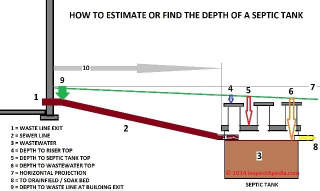
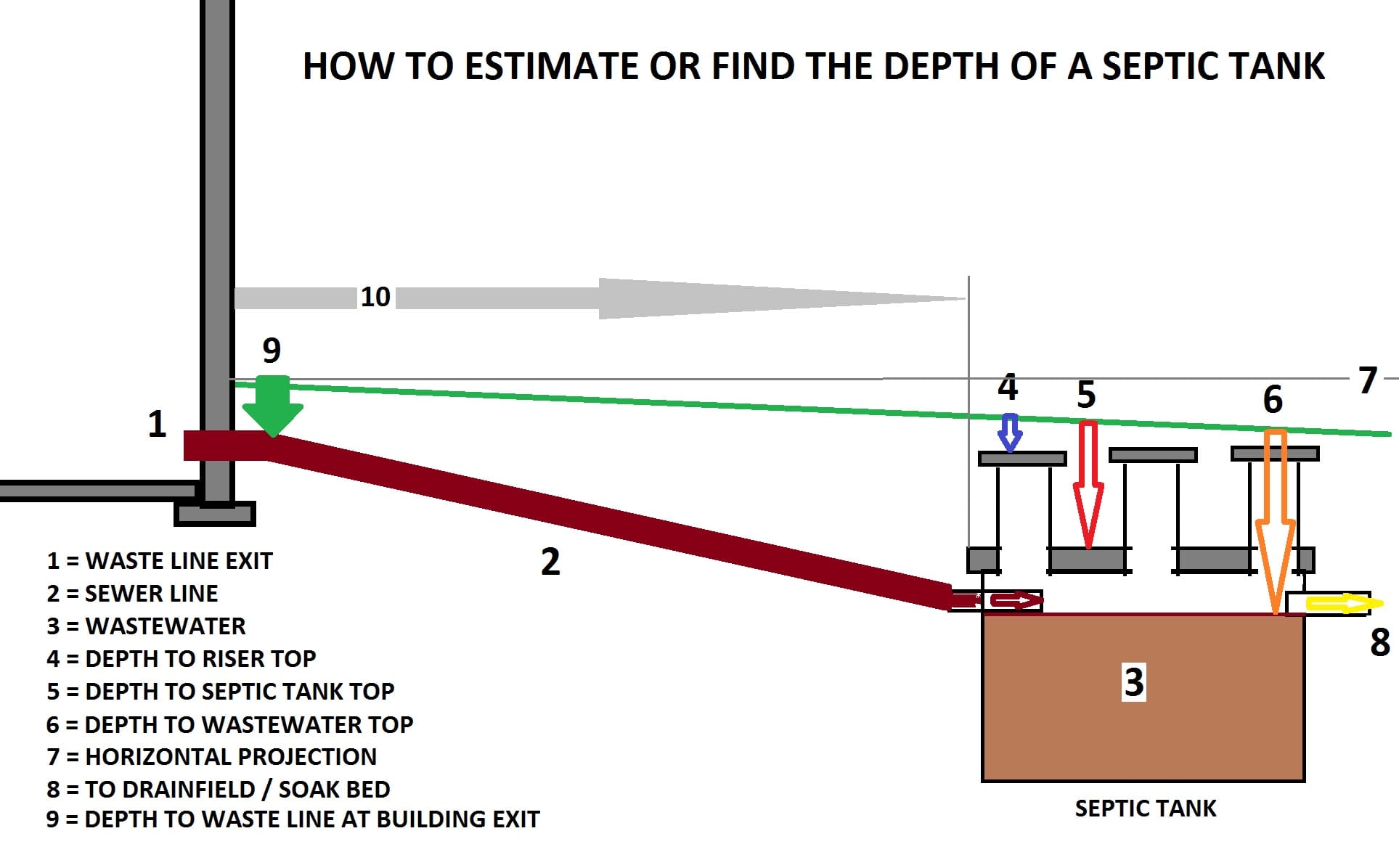
A companion article linked-to at the end of this one explains the septic tank depth sketch shown at the top of this page and describes in detail how to find the actual depth of an existing installed septic tank.
InspectAPedia tolerates no conflicts of interest. We have no relationship with advertisers, products, or services discussed at this website.
Septic Tank Installation Depth
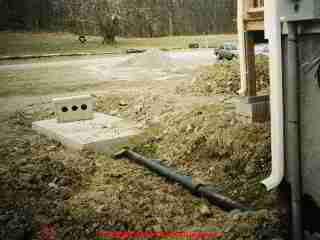 How Deep Should We Put the Septic Tank at Original Installation?
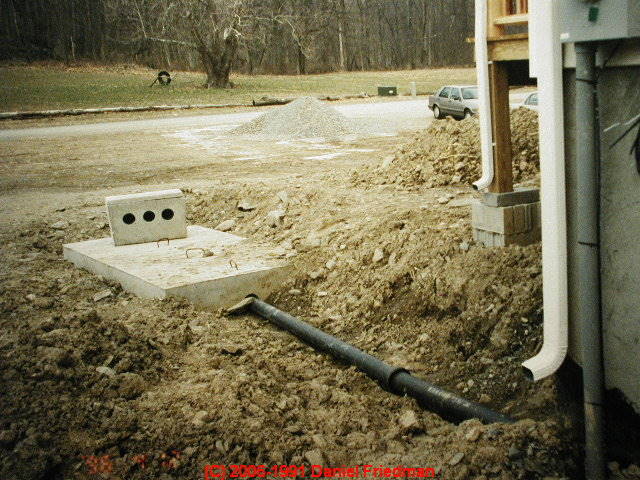
Septic tanks can be installed pretty much at any depth in the soil.
Even in freezing climates, the septic tank serving an occupied home or even an unoccupied one is unlikely to freeze, partly because of latent heat the bottom of the septic tank receives from the earth and partly because of the heat generated by the bacterial action going on in the septic tank, and mostly from warm wastewater entering from the building served by the septic system.
Watch out: If your concern with septic tank depth is to avoid freezing, DO NOT add antifreeze to a septic system.
You'll kill the bacteria and destroy the drainfield as well as contaminate the local environment.
Factors Determining Septic Tank Depth
The principal factors that determine the actual depth at which a septic tank is likely to be buried (and thus how deep you may have to dig to find the septic tank) at a particular site include:
- Sewer line depth:
The depth at which the lowest sewer line leaves the building which the septic tank serves.
Since usually we rely on gravity to move sewage from the building to the septic tank, the tank will be lower than the exiting waste line of the building it serves - Site conditions
of shape, rocks, obstructions: the location at which the contractor found site conditions suitable to bury the septic tank.
If a site has bedrock or large boulders close to the surface, the tank may be located elsewhere;
the further the tank is located from the building, if the system uses gravity to move sewage, the deeper the tank will be. - Keep septic tanks high:
we don't put the septic tank any deeper than necessary, since we are usually moving effluent from the septic tank to the drainfield also by gravity.
Plumbers usually install sewer lines to slope down from inlet to outlet, at 1/8" per foot to 1/4" per foot of linear run of the waste pipe.
We don't want the septic drainfield to be buried at unnecessary depth since the absence of oxygen deep in the soil will prevent some wanted bacterial action (the aerobic bacteria) that we need to break down and process septic effluent.
but
- Be sure that the septic tank is deep enough for proper drain slope
Watch out: be sure that the septic tank is deep enough that the sewer drain line between building and septic tank can slope continuously at 1/8" to 1/4" per foot. We have found some septic tanks that were just a bit too shallow, resulting in inadequate slope between building and septic tank.
The result is that solids remain in the sewer pipe and lead to a sewer line clog and risk a building sewage backup. - If a sewage ejector pump or grinder pump system is used
to move sewage from the building to the septic tank, of course we can place the septic tank anywhere, including uphill from the building. - If a sewage effluent pump is used
to move septic effluent from the septic tank to the drainfield, then of course we can place the tank "downhill" from the drainfield as well. - Growing grass:
if the septic tank is just 2 or 3 inches below ground surface you may as well have left the top of the tank exposed, since you won't get grass to grow in such thin soil.
Adding backfill to 6" to 12" may be enough to get grass to grow over the septic system - this is only a cosmetic issue, not a functional one.
See SEPTIC SYSTEMS, PLANTS OVER - Manufacturer's recommendations:
some advanced septic treatment system designs require very specific inspection & maintenance intervals by a trained system operator. For example, as we discuss
at BAT MEDIA SEPTIC PLANTS, BAT septics (biologically accelerated treatment) are serviced or inspected at 6-month intervals.
The manufacturer of that system (Jet Inc.) notes that:
It is very important that the finished grade slope away from the plant.
Also, grade must be at least 1” below the bottom of the access covers. (Jet ret. 2016).
Deep septic tanks should have a service riser installed.
Septic risers are large-diameter "wells" that are placed over a septic tank inlet baffle access port (and possibly outlet) to permit easy access for septic tank pumping, inspection, and baffle repair.
If the septic tank happens to be buried more than just a few inches below ground surface, good practice includes installing a septic riser, a large diameter pipe that gives good access to the septic tank for inspection and cleaning.
Details are at SEPTIC TANK RISERS.
Reader Comments, Questions & Answers About The Article Above
Below you will find questions and answers previously posted on this page at its page bottom reader comment box.
Reader Q&A - also see RECOMMENDED ARTICLES & FAQs
On 2021-06-12 1 by inspectapedia.com.moderator (mod) - septic tank should be level, not sloped
@Mark,
the septic tank needs to be level; if it's out slightly that's probably not an issue but inches out of level invites uneven solids settlement and increases the risk of pushing solids out into the drainfield, damaging it and leading to need for early and costly drainfield replacement.
Here is just one example of a manufacturer specifying that the tank needs to be level:
NORWESCO SEPTIC TANK INSTALLATION INSTRUCTIONS [PDF]
see step #1 "The tank should be installed level."
On 2021-06-11 by Mark
Does a septic tank have to be set level or could it be set at a downward pitch ? The house is built on the upside of a sloping lot
On 2021-04-05 by danjoefriedman (mod) - do I need to buy a new septic tank and install it less deep in the soil?
@Michael,
Not necessarily.
You will need to ask your installer to look at the slope of the drain between the house and the tank. It may be that your tank needed to be that deep in order to drain from the house.
On the other hand if it's a significant advantage to raise the tank and raise the drainfield then you might find it worthwhile to do so even if that means you need to have a grinder pump to move sewage from the house to the tank.
On 2021-04-05 by Michael
My septic tank is 3 ft to the lid, and 4 ft to the tip of the outlet pipe. My drain field is broken, and I am gonna replace it. Should I buy a new tank and not bury so deep so I don't have to bury the drain lines 5 or 6 ft deep?
On 2020-08-10 by (mod) - what is the depth for a septic tank?
See the septic tank depth notes above on this page and let me know if you have any further questions and we'll be glad to research or discuss your needs.
On 2020-08-10 by OMENTY SIAMPAZANGA - what is the depth for a septic tank?
what is the depth for the septic tank
On 2020-05-27 by danjoefriedman (mod) - code for maximum or minimum depth of cover fill over a septic tank & requirement for septic tank risers
Billy
I don't think you will find that 18" specific septic tank cover depth in any building code.
But there are requirements specifying the maximum or recommended depth of soil cover over septic tanks in Arizona.
Clearly and permanently marked with the manufacturer’s name or registered trademark, or both, the month and year of manufacture, the maximum recommended depth of earth cover in feet, and the design liquid capacity of the tank.
The tank is manufactured to protect the markings from corrosion so that they remain permanent and readable for the operational life of the tank. - R18-9-A314. Septic Tank Design, Manufacturing, and Installation for Onsite Wastewater Treatment Facilities
Here are two examples from Pima County in Arizona. However Arizona's septic code for septic tanks or septic design includes, for septic tanks,
PIMA COUNTY PDEQ SEPTIC INSPECTION for PIPE & GRAVEL SYSTEMS [PDF] Pima County Arizona Government, original source: https://webcms.pima.gov/cms/one.aspx?pageId=63828
The word "depth" appears fifteen times in this specification including:
- Document the depth of the septic tank cover
- Septic drainfield gravel trench depth set to 11ft MAX and trench width typically is 12"
- Form C sets the minimum and maximum depths for septic drainfield trenches
- Septic tank riser shall be installed if there is more than 6" of cover over the septic tank.
Nowhere is an 18" depth to septic tank cover mentioned.
PIMA COUNTY PDEQ SEPTIC INSPECTION for CHAMBER SEPTIC SYSTEMS [PDF]
Similar to the gravel system regarding depths of septic components, though trench depths are different.
- Septic drainfield chamber system trench depth maximum is 6' 5" and trench width is 3'
- Form C often sets minimum and maximum depths – stay within limits or contact the designer and Development Services for a revision
- Maximum depth of septic tank cover must be documented
- Septic tank riser shall be installed if there is more than 6" of cover over the septic tank.
Typical septic codes may require that a septic riser shall be installed if there is more than 6" of cover over the septic tank.
Watch out: Note that the septic tank manufacturer may indeed specify a maximum depth of fill over the septic tank cover.
See Arizona's septic regulations under the AZ link found
at SEPTIC & DESIGN CODES & SPECIFICATIONS U.S.A
On 2020-05-27 by Billy
In Tucson. Is a fiberglass tank.supposed to be buried no more than 18 inches.deep.
On 2019-06-16 by danjoefriedman (mod) - what to do if the septic or sewer line is higher than the building's main drain pipe?
Anon
You will need a sewage ejector pump - read about those in the ARTICLE INDEX found above.
On 2019-06-16 by Anonymous
what do i need to do if septic waste connection is higher than the waste line running from the house?
...
Continue reading at SEPTIC TANK DEPTH to find the depth to the cover of an existing septic tank or select a topic from the closely-related articles below, or see the complete ARTICLE INDEX.
Or see SEPTIC TANK DESIGN DEPTH FAQs - questions and answers posted originally on this page
Or see these
Recommended Articles
- SEPTIC CLEARANCE DISTANCES
- SEPTIC DRAINFIELD LOCATION
- SEPTIC DRAINFIELD SIZE
- SEPTIC TANK COVERS
- SEPTIC TANK DESIGN STRENGTH SPECS
- SEPTIC TANK & DRAINFIELD FREEZE PROTECTION
- SEPTIC TANK, HOW TO FIND
- SEPTIC TANK RISERS
- U.S. SEPTIC AUTHORITIES & DESIGN SPECIFICATIONS
Suggested citation for this web page
SEPTIC TANK DESIGN DEPTH at InspectApedia.com - online encyclopedia of building & environmental inspection, testing, diagnosis, repair, & problem prevention advice.
Or see this
INDEX to RELATED ARTICLES: ARTICLE INDEX to SEPTIC SYSTEMS
Or use the SEARCH BOX found below to Ask a Question or Search InspectApedia
Ask a Question or Search InspectApedia
Try the search box just below, or if you prefer, post a question or comment in the Comments box below and we will respond promptly.
Search the InspectApedia website
Note: appearance of your Comment below may be delayed: if your comment contains an image, photograph, web link, or text that looks to the software as if it might be a web link, your posting will appear after it has been approved by a moderator. Apologies for the delay.
Only one image can be added per comment but you can post as many comments, and therefore images, as you like.
You will not receive a notification when a response to your question has been posted.
Please bookmark this page to make it easy for you to check back for our response.
Our Comment Box is provided by Countable Web Productions countable.ca
Citations & References
In addition to any citations in the article above, a full list is available on request.
- Pennsylvania State Fact Sheets relating to domestic wastewater treatment systems include
- "International Private Sewage Disposal Code," 1995, BOCA-708-799-2300, ICBO-310-699-0541, SBCCI 205-591-1853, available from those code associations.
- "Manual of Policy, Procedures, and Guidelines for Onsite Sewage Systems," Ontario Reg. 374/81, Part VII of the Environmental Protection Act (Canada), ISBN 0-7743-7303-2, Ministry of the Environment,135 St. Clair Ave. West, Toronto Ontario M4V 1P5 Canada $24. CDN.
- Manual of Septic Tank Practice, US Public Health Service's 1959.
- In addition to citations & references found in this article, see the research citations given at the end of the related articles found at our suggested
CONTINUE READING or RECOMMENDED ARTICLES.
- Carson, Dunlop & Associates Ltd., 120 Carlton Street Suite 407, Toronto ON M5A 4K2. Tel: (416) 964-9415 1-800-268-7070 Email: info@carsondunlop.com. Alan Carson is a past president of ASHI, the American Society of Home Inspectors.
Thanks to Alan Carson and Bob Dunlop, for permission for InspectAPedia to use text excerpts from The HOME REFERENCE BOOK - the Encyclopedia of Homes and to use illustrations from The ILLUSTRATED HOME .
Carson Dunlop Associates provides extensive home inspection education and report writing material. In gratitude we provide links to tsome Carson Dunlop Associates products and services.
 | HOME | ABOUT | ASK a QUESTION | CONTACT | CONTENT USE POLICY | DESCRIPTION | POLICIES | PRIVACY | |
| © 2024 - 1985 Publisher InspectApedia.com - Daniel Friedman | |||||||||