
InspectAPedia® FREE Encyclopedia of Building & Environmental Construction, Diagnosis, Maintenance & Repair |
Question? Just ask us! InspectAPedia
|
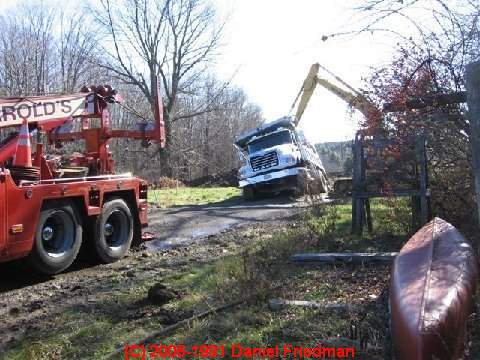
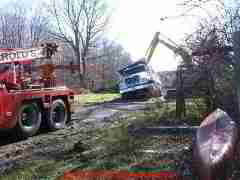 Do not drive, pave nor park over Septic System Components
- POST a QUESTION or COMMENT about drainfield damage due to vehicle or equipment traffic
Is it ever ok to drive-over or pave over a septic system, tank, or absorption bed?
This article explains the problems that occur if septic components are located under a drive or parking area. We explain why you should not drive cars, construction equipment, or other heavy machinery over the septic drainfield and in some cases also not over the septic tank.
Our page to photo shows a big effort underway to pull a dump truck out of a seepage pit. Luckily no one was injured but the cost of extracting the truck and repairing the septic system was significant.
InspectAPedia tolerates no conflicts of interest. We have no relationship with advertisers, products, or services discussed at this website.
Do not drive over the septic tank, septic piping, or septic drainfield.
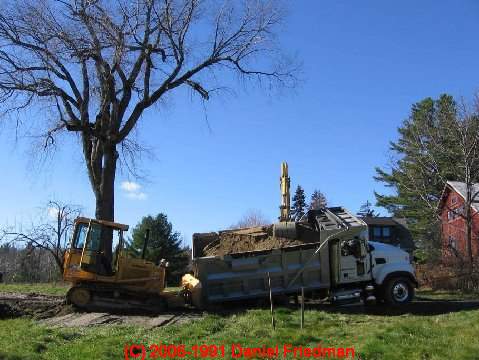 Unless special provisions have been made such as protection of sewer piping and septic tanks from damage, vehicle-rated septic tank covers, or similar steps, do not drive vehicles over septic system piping or septic tanks.
Driving over septic tanks, septic piping, or drainfields risks costly damage to the septic system and may also be dangerous.
The bulldozer in our photo (left) was called to help remove a truck which drove over septic system components leading to a surprise collapse.
A property owner may not immediately recognize a septic system problem when piping has been run below a driveway, as crushing and blockage of the line may not happen until a heavy vehicle enters the driveway (such as the loaded septic pumping truck arriving to pump the septic tank). Or a septic line may be broken, permitting soil or roots to enter to complete the clogging process.
Watch out: as we report at SEPTIC TANK ACCIDENT REPORTS, driving over and damaging a septic tank cover or lid can result in a later cave-in, fall-in, or extremely serious hazards. While it is possible to purchase septic tank covers that are rated for withstanding heavy loads, even vehicles, as-installed residential septic tank covers are not normally capable of withstanding such traffic.
Also see SEPTIC & CESSPOOL SAFETY.
How do we run a sewer line under a driveway to get to the septic tank?
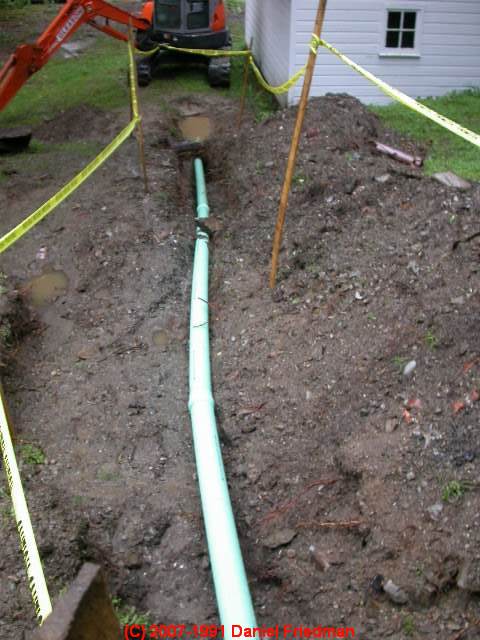
If a septic line must be run under a driveway, for example to pass from a building to the septic tank, the line must be protected by choice of materials (schedule 40), or placed in a covered and protected trench at adequate depth (such as with concrete covers over the trench) to avoid damage to the piping.
Our photo (left) shows a new sewer line being installed down a hillside, connecting a house to its septic tank.
The original terra-cotta sewer line lasted for decades until the building owner (DF) hired a landscaping company to mow the lawn. The fourth time that a heavy lawn mower drove over the original sewer line it was crushed and broken, leading to a costly sewer line replacement job.
The new sewer line was bedded in sand and protected from damage.
If a sewer line is run below a drive or parking area without proper choice of materials, protective measures, etc., it is an improper installation likely to fail.
Also see CLOGGED DRAIN DIAGNOSIS & REPAIR.
Can a septic tank be located safely below a drive or parking area?
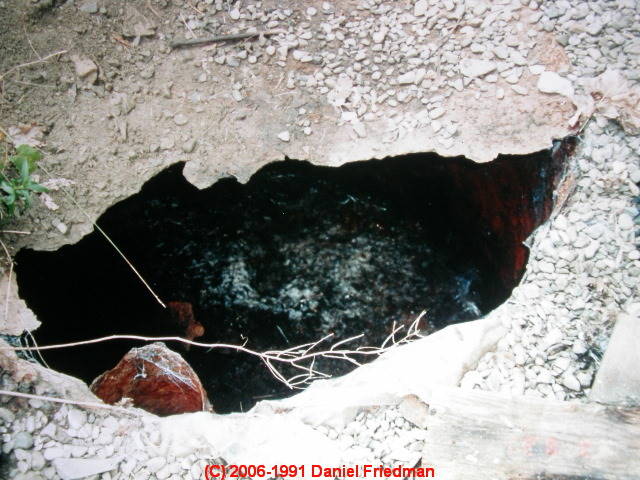 If a septic tank is to be located below a drive or parking area, it too must be properly designed and protected from collapse.
The tank must be constructed of proper materials and provided with a cover rated to withstand the weight of heavy vehicles.
If the septic tank is steel, site-built, home-made, or even pre-cast concrete but lacking a cover rated to withstand vehicle traffic, driving over the tank risks collapse and even a potential fatality.
Our photo (left) shows a rusted-through collapsing steel septic tank cover that nearly led to a fatality to a home inspector.
See SEPTIC TANK DESIGN STRENGTH SPECS for details about the strength requirements for safe septic tanks, cesspools and drywells.
Home made or "site built" septic tanks often have a cover made of wood or other flimsy materials, and depending on the tank construction (dry-laid concrete blocks or stones) the sides may also be likely to collapse if exposed to the weight of even a small vehicle.
The site-built septic tank shown in our photo below was collapsing as well as impacted with solids.
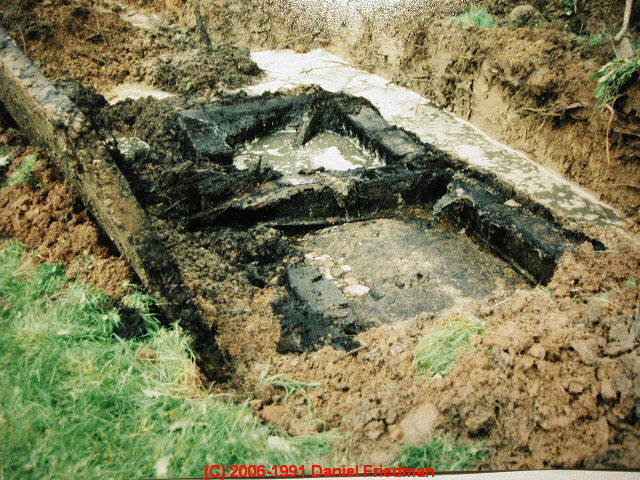
Driving even a lawn mower over this tank was likely to lead to a catastrophe.
Can a septic drainfield be located below a parking area, pavement, driveways, patios, decks, or other structures?
 A septic drainfield should not ever be located below a driveway or parking area.
Driving or parking on a drainfield
will prevent proper drainfield operation due to soil compaction and also due to loss of proper evaporation of moisture through the surface, as well as almost certainly leading to crushed broken piping. In sum, driving over the leach field in any vehicle larger than a child's bicycle is a bad idea.
Heavy vehicles may actually crush buried leach field lines, or they may compress the soils around the leach field, either of which leads to failure. Driving on or parking on leach fields will destroy them.
Paving over a drainfield,
or installing patio stones or astroturf or any other material that blocks proper soil transpiration interrupts the evaporation of moisture from the drainfield, interfering with its ability to dispose of effluent.
Furthermore covering a drainfield may result in inadequate soil oxygen, thus inadequate bacterial action, thus inadequate treatment of septic effluent, thus leading to ground water and possibly local well contamination.
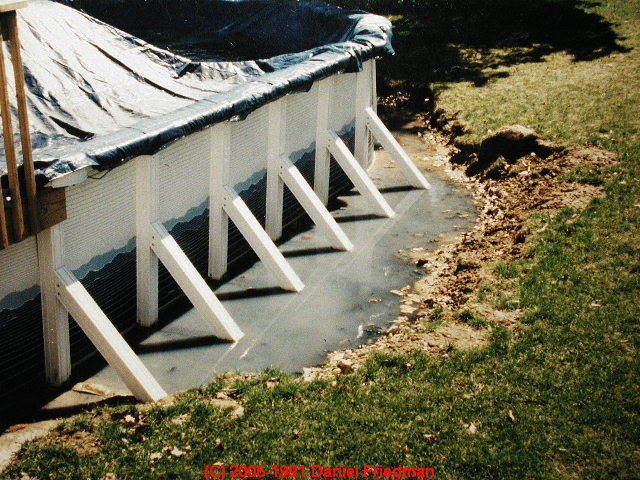 Building any structure over a drainfield risks damage to the drainfield from:
- Vehicle traffic during construction
- Broken drainfield pipes
due to excavation for piers, footings, or other structural supports - Covering the soil, blocking transpiration and oxygen
thus reducing the ability of the septic system to successfully treat pathogens and dispose of a portion of its effluent via transpiration. - Blocks later repairs:
and construction of solid paving over the drainfield may make it impossible to later repair it when needed.
Our photo shows what happened when a swimming pool was constructed over the edge of a septic drainfield in Poughkeepsie, NY. The gray water shown leaked from the drainfield onto the pool perimeter when the homeowners did their laundry.
Citation of this article by reference to this website and brief quotation for the sole purpose of review are permitted. Use of this information at other websites, in books or pamphlets for sale is reserved to the author. Technical reviewers are welcome and are listed at "References."
This is a chapter of SEPTIC SYSTEM INSPECTION & MAINTENANCE COURSE, an online book on septic systems.
Generalizing the Reasons to Keep Equipment, Grazing Animals, Paving, Coverings and What Have-You Off of Septic Drainfields
 Reader Question:
I would like to put a skating rink in my yard over the
septic field (mid-Dec. to mid-March, i.e. northern Illinois)
because it is the flattest part of my yard.
I read everywhere on the internet and your site that one
shouldn't put "anything" on top of a drainage field, at least
the channels where the pipes ("tiles") are buried.
Reader Question:
I would like to put a skating rink in my yard over the
septic field (mid-Dec. to mid-March, i.e. northern Illinois)
because it is the flattest part of my yard.
I read everywhere on the internet and your site that one
shouldn't put "anything" on top of a drainage field, at least
the channels where the pipes ("tiles") are buried.
Photo: a NiceRink™ ice skating rink installed in a level area, photo used with permission. [Click to enlarge any image]
My question is exactly how a skating rink can damage field. Has research been done on this specific situation? Is the problem of a skating rink perceived or real? I haven't read of a failure due to a skating rink, though skating rink are relatively rare. I thought about the various issues: weight and permeability. Are there others?
[... content and detail moved to ICE SKATING OVER SEPTIC]Reply: worries arise if building a skating rink atop a septic drainfield
Regarding your assertion and question
My question is exactly how a skating rink can damage field. Has research been done on this specific situation? Is the problem of a skating rink perceived or real? I haven't read of a failure due to a skating rink,
Of course not. The number of possible SNAFUs humans can come up with is near infinite.
We are not likely to find a study of skating rinks over septic drainfields because of their rarity.
And some reasons for their rarity may be founded in common sense: the various objections to placing anything over a drainfield or soakaway bed can be generalized so that a requirement that experts explicitly address everything imaginable that one could place and should not place in that location is, with respect, well, I'll leave out the adjective.
The reasons to stay off of a drainfield, including keeping equipment from driving over the septic fields in just about all regards are outlined
at SEPTIC FIELD FAILURE CAUSES
Details of the pros, cons, & warnings about building a temporary ice rink over septic fields are found
Cesspool Cover Strength & Safety in the U.K.
I have an extra large cesspit serving 2 properties on my land (19m x 4m) and is a pit only no outlet . Its brick built and was installed early 70’s, it has 2 chambers running back to back, and has a concrete cover on it which spans the whole length and width of the tank having 2 cast iron lids for emptying in the middle.
Question is – I inherited this with house from my Grandfather who used to drive over it with a small vehicle to get to his garage when the pit was still under a lawn area.
Could you please advise if you would consider that this was the type of cess that was constructed for driving over, and would still be ok??? - L.H. 3/25/2014
Reply: warnings about driving over the cesspool
Watch out: driving over a cesspool risks sudden collapse and even a possible death or injury.
- Your system has too many unknowns for anyone with any sense to promise you that it is safe. Here are some of the variables that are apparent just from your message:
My advice is to stay off of the cesspool entirely until it has been excavated and its construction and strength have been evaluated.
We moved the full text of this question and its answer to SEPTIC TANK DESIGN STRENGTH SPECS
Proposal for Paving over Septic Drainfield using Chamber Systems & Pavers or "permeable paving"
 A reader who needed to expand the footprint of his house and had too-little space wrote in a bit of a snit, stating that [paraphrasing] surely there must be a septic design that permits putting the leach field or absorption bed under a driveway.
He proposed installing a paved-over septic absorption bed using a design combining "permeable" materials such as "permeable pavers" or "permeable asphalt" or "permeable concrete" combined with a chamber septic design system itself buried and covered "with permeable surface material".
Indeed there are interlocking, "permeable" concrete pavers that permit stormwaters to soak through or grass to grow up through their openings. The vendors assert that permeable paving mimics the way natural land absorbs water - so I agree that this sounds like a possibility. - (Belgard 2017)
Shown here: an 11.5 x 17.25 x 3.5 inch concrete grass block paver such as sold at Home Depot stores, Lowes, and at your local building supplier. These blocks are intended to assist in absorption of stormwater but are not described as a product intended for use over septic absorption fields or soakaways.
[Click to enlarge any image]
Really? We reviewed several permeable paver products to look for a claim that the paver was approved for use over septic systems without finding nary a one.
While it is certainly possible to build a chamber system whose soil absorption area below the chamber won't be compacted by vehicle traffic, and perhaps where the chambers themselves are engineered to carry the weight of the homeowner's 2000-4000 lb car, I'm doubtful that a poly septic chamber can carry the weight of a 30,000 lb. septic pumper truck loaded and ready to haul away.
Furthermore, an examination of the list of reasons it's smart to avoid driving over or paving over the septic shows that compression or compaction or collapse are not the only worries.
If you solved the construction and engineering problem of weight and compaction your paved-over septic absorption field also needs to permit transpiration (disposal of a portion of its effluent by evaporation up through the soil) at a rate comparable to a conventional soil system or at a rate specified by a design engineer and approved by local septic authorities.
Another worry with a paved-over septic is the same as the worry with a septic system buried quite deep into the soil: the level of oxygen in the soil below the drainage trenches or chambers is so low at depth that it is insufficient to support the aerobic bacterial action needed to break down pathogens in sewage.
In sum we may successfully dispose of the sewage effluent but we're probably not treating it to an adequate level. The result is ground-water and environmental contamination by sewage pathogens.
We have not found a septic authority nor a storm drainage or grass block paver manufacturer who describes their product as intended for use over drainfields. Use the page top or bottom CONTACT link to let us know if you find such a design.
Watch out: We hope that most readers would not willingly construct an out-of-site-out-of-mind septic system that disposes of effluent but doesn't treat it: thus contaminating their own environmental as well as their neighbors. But for those who don't care about that sentiment, we warn in addition that in many jurisdictions paving over the septic fields will also be tagged as a building code violation.
Permeable Pavers for Stormwater Absorption (not for septic absorption field designs)
- Belgard Permeable Pavers, Website: http://www.belgard.com/contact/ retrieved 2017/07/31
- EP Henry Per4meable Pavers, Website: https://www.ephenry.com/products/pavers/permeable-pavers/
- Pervious Pavers, Stormwater Alliance,Website: http://www.stormwater.allianceforthebay.org/take-action/installations/pervious-pavers
- Unilock Permeable Pavers, and Turf Pavers Website: https://unilock.com/product_category/permeable/?region=6
Note: In contrast, it is often possible to construct other portions of a septic system that can be driven-over or parked-over, such as a septic tank and piping between the building and septic tank or between the septic tank and the absorption field.
Using appropriately rated septic tanks, covers, and schedule 80 or stronger piping can work for that situation, as we describe next.
How to Modify a Septic Tank for Vehicle Traffic or Driveway Passage
Question: can I use boards to drive a 14,000 lb RV over the septic tank
2017/06/06 Rhonda said:
Can you lay down boards to distribute the weight of an RV (14,000 lbs) to safely cross over septic tank?
Reply: probably not: here are requirements to make a vehicle traffic-rated septic tank
Rhonda,
You ask an important question for which I don't have an absolutely authoritative answer, in part because I have no idea what boards are to be laid down and thus how much they will flex or will distribute or not distribute the RV weight. I also don't know what sort of septic tank you want to cross over.
A septic tank sporting a cover that is made of concrete reinforced with steel re-bar is a far different case from an old steel septic tank with a sheet-metal lid. In the latter case I'd say that no board-crossover-plan is going to be safe. In the former case ... it's still doubtful from the vehicle weight you cited.
Watch out: driving a heavy vehicle over a septic tank, even one rated for "vehicle traffic" may exceed the tank's rated strength, resulting in a septic tank cave-in and collapse. Falling into a septic tank is most-often quickly fatal. Our photos in this article demonstrate a truck falling into and being pulled out of a septic tank.
If you know that your septic tank is a "traffic-rated" tank and know who constructed it, you would still want to give the manufacturer a call to be sure that their "Traffic rating" included a 14,000 lb. vehicle and you'll need to know the dimensions of the tank and the spacing of the vehicle's axles. Why?
Consider that unless you have installed a septic tank with a "vehicle traffic rated" or Highway Traffic Rated strength cover, a typical concrete residential septic tank, following the University of Minnesota design guide (as a typical standard) is built to carry the weight of the soil covering the septic tank and a vehicle wheel load of 2,500 lbs. That is a far cry from your 14,000 lb RV.
Let's pretend that your RV is so long that only two wheels of it are on the septic tank at a time while you drive across - you're putting a 7,000 load on the lid. Your boards would have to be both long enough to span well more than the septic tank AND to be so thick and rigid as to not deflect to place a significant load on the tank itself.
Septic tanks designed to withstand vehicle traffic ("HS20 vehicle traffic rated septic tanks") have not just a thicker lid but heavier tank sides and bottom too. HS20 loading is defined by the American Association of Highway and Transportation Officials (AASHTO) as follows:
A vehicle with an 8,000-pound (3,630 kg) front axle and one or more rear axles weighing 32,000 pounds (14,500 kg) each and spaced at least 14 feet (4.3 m) apart. This is a key measurement since it means that the vehicle's axle spacing is greater than the tank width, so only one wheel set is on the tank at a time. HS20 and H20 are used interchangeably.
OK so what now: I consulted with an expert source on concrete septic tank design, the National Pre-Cast Concrete Association who, as is no surprise, have looked at the question of how to make it possible to driver over an existing septic tank. Here is an excerpt from the associations article on this that I'll cite below:
Engineering analysis demonstrates the tank design shown in Figure 1, [in Barger's article] initially designed for non-traffic use, can be made into a HS20 traffic-rated tank with careful engineering and many preconditions. Delta Engineers, Architects & Surveyors of Endwell, N.Y., performed the engineering analysis. The eight conditions are as follows:
- 1 to 2 feet (0.3 to 0.6 m) of soil shall be over the top of the tank.
- No more than one axle or two wheels shall be over the tank at any one time.
- The minimum concrete strength will be 5,000 psi (35 MPa) compressive strength.
- The top slab thickness shall be increased to 6.5 inches (165 mm). However, the bottom slab and wall thicknesses cannot be modified.
- The tank contains a monolithic compartment wall.
- The water table shall be at least 3 feet (0.9 m) below grade when the tank is empty.
- The walls are supported at the roof by an interlocking recess that is cast into the top slab.
- Reinforcing bar size, spacing and location shall be installed per Professional Engineer recommendation.
- Barger, Eric, "TRAFFIC RELATED [Septic] TANK DESIGN", [PDF] NPCA, National Precast Concrete Association, 1320 City Center Drive, Suite 200, Carmel, IN 46032 USA, Phone: (800) 366-7731 Website: http://precast.org/ 28 July 2010, retrieved 2017/06/06, original source: precast.org/2010/07/traffic-related-tank-design/
Please also see the articles on septic tank covers and septic tank design strengths listed below at CONTINUE READING below
Reader Comments, Questions & Answers About The Article Above
Below you will find questions and answers previously posted on this page at its page bottom reader comment box.
Reader Q&A - also see RECOMMENDED ARTICLES & FAQs
On 2023-02-02 by InspectApedia Publisher - small toilet+sink lean-to hut against the exterior wall of a slab structure right over the septic tank
@Julian,
Excavating close to an existing building when there's very little clearance space could mean there's a risk of foundation damage.
It's really time to bring in a septic contractor or subject engineer to layout what's actually feasible for your site. Otherwise what we're doing is so speculative here that it's not really very reliable and so not as useful as we might like.
On 2023-02-01 by Julian
@InspectApedia Publisher, Thank you for the considerations. I essentially have a 15 foot wide strip of land between the building and property line. With the current idea, the tank would be under the lean-to roof (but accessible for service near one end)- not exposed to rainfall, essentially forming the floor of the small bathroom.
The septic tank drain pipe would come out away from the building then do a 90 bend and the drain field would run parallel to the building wall and property line, 12 ft from the building.
This would also be the eve line of the lean-to, so would that extra water shed from a 12 ft wide/30ft long roof be a problem for the drain field if planning to use a linear dome chamber system? Sandy soil, good drainage in the area, drainfield probably only 2 feet underground.
Loss of toilet water trap? I thought toilets have a water trap as part of their ceramic mold, you just mean if it goes dry? Maybe I just have the toilet off the edge of the tank on it's own slab against the building wall and the toilet drain pipe will immediately bend into the side of the tank and I have a tall roofline vent pipe there up the wall.
Is there an issue having the septic tank very close to the building wall/slab? This is a rural area. Concerned with safety and function more than code (in theory they should agree).
On 2023-02-01 by InspectApedia Publisher
@Julian,
I can think of a number of concerns that need to be addressed for your toilet plan - not that you can't do it but you want to consider at the very least
1. what is permitted by local health and plumbing codes
2. preventing surface and roof runoff from entering the septic tank, flooding tank and drainfield
3. avoiding blocking access to the septic tank for regular cleaning and inspection - through its access openings at either end
4. safety: lids, covers, nearby over the septic tank must be absolutely safe against removal by a child or from falling in if home made and not secure
5. Loss of water trap in the toilet will vent sewer gases where you may not want
On 2023-02-01 by Julian
In Florida, I am contemplating a small toilet+sink lean-to hut against the exterior wall of a slab structure, and thought the simplest method is mount the toilet directly over the septic tank, onto the concrete lid, which is buried at grade level. Minimal piping needed, and shallow drain field. Any problems with this?
The tank would be buried at grade level for this idea, doesn't exist yet.
I am also wondering if this is bathroom hut is part of a larger open-sided (roof only) lean-to and the eve drip line falls very close to over the drain field- both would run parallel to the building wall at 12ft- would there be any problem with that?
On 2022-12-27 by InspectApedia Publisher
@S. Smith,
Good. We look forward to seeing your installation.
On 2022-12-27 by S. Smith
@InspectApedia Publisher, Exactly my plan. No heavy equipment, space between each paver, less than 36” wide. Will post pictures!
On 2022-12-27 by InspectApedia Publisher - Could we use permeable pavers to create a footpath over drainfield?
@S. Smith,
That sounds fine to me. I interpret your plan for a walking path - house-to-pool (and presumably back again) - as having these attributes where it crosses the septic drainfield:
1. no heavy equipment will be driven over the drainfield (such as a paving stone delivery truck)
2. The total area covered by the pavers will be less than 36" in width. (Using permeable pavers is a smart idea).
3. Ideally the paver are not quite contiguous - leaving some grass and air space between them - inches or more but meeting requirements for comfortable walking.
I'd like to see a photo of the finished installation - posted here - that will help other readers.
On 2022-12-27 by S. Smith
We had a pool built on the other side of our drainfield (no worries there, it is far enough away from the field). We now want to create a walking path from the house to the pool. Could we use permeable pavers to create a footpath (not a sidewalk, just stepping stones here or there across the drainfield)?
On 2022-04-27 by Inspectapedia Com Moderator - stone mason rolled over our septic tank with a F- 550 loaded with flag stone
@coleman,
Until we have objective, factual data, I would be VERY concerned.
IF the top of a septic tank has been damaged such that it might later collapse, if someone walks over the tank or drives a mower over it and falls in, death is likely to be quick and nasty.
My OPINION is that safest would be to rope off the area, keep everyone away, and have a more careful excavation of the septic tank cover/top to inspect its condition. If the top is in perfect shape, when you pump the tank ask that its interior, particularly its sides, be inspected as well.
On 2022-04-27 by coleman
Having a pool built, the stone mason rolled over our existing septic tank with a F- 550 loaded with flag stone. Only one time and won't happen again. Should I be concerned?
On 2021-10-31 by inspectapedia.com.moderator - driving and soil compaction not roof are the concerns
@Dave,
There's no reason you need to drill holes in your roof. The risk of damage to your drain field comes not from having a roof over it but from driving over it or doing anything that might compact the soil.
On 2021-10-30 by Dave
I've build an open double shed ,made of treated wood 4x4 posts ,over my septic field to cover over my 19ft sail boat on trailer and a small boler camper on trailer (later probably not over or only partly). This prevents the yearly damage cause by the snow and potential falling trees.
There was no digging. The posts are held on cement 4x4 blocks. Sides are open except 2x4 crossed beams. The top has no roof, just flat 5/8" treated plywood.
My question is how important is the lack of drain over this area? The field is now maybe 1/2 covered. My plan was to put 3/8" holes all over the plywood to allow the rain to get down to the soil. A structural engineer said the rain/ wet getting to the septic field is not an issue, so I haven't yet drilled the holes in the roof yet.
All the rain or is it ok to keep it dry. There is no flooring, the grass is exposed, no cover. I know ideally no weight on the septic field, but the weight is in isolated small spots- tires, posts 6x6 cement blocks to support the 4x4 posts. Thanks!
On 2021-08-16 by inspectapedia.com.moderator - concerns if septic tank is going to be 1/3 under the driveway
@Ann,
There are at least two concerns that are pretty obvious:
1. If one end of the tank is under a paved driveway it becomes much more difficult and expensive to repair or even service the tank in the future; for example if the outlet end of the tank is under the drive, how would you ever fix an outlet tee, repair a baffle, inspect for damage, or install a filter?
2. If a septic tank is under or even quite close to a driveway, there is risk of collapse or damage by vehicles passing over the drive; it's not just your new lightweight Tesla it's also a heavy oil delivery truck or some other heavier vehicle likely to pass that way over the life of the home.
If the septic tank and its cover are designed for vehicular traffic
AND
If a sufficiently large, removable access cover is provided over the end of tank under the drive, then that design could work. Mostly.
On 2021-08-16 by Ann
We are having our septic system installed - 2 concrete tanks that will be pumped to a septic field. The installer was told to put them in an "L" formation instead of end to end as we were originally expecting. One of them now is going to be 1/3 under the driveway.
The installer says it will be fine... should we be concerned? I read somewhere in my google search that the top of the tank should be thicker - or made from a certain grade concrete so that it's not damaged.
On 2021-04-29 by (mod) - ok to run a lawnmower over the drainfield?
Thank you for a helpful question, Charles.
In my opinion, it is ok to run a lawnmower over the drainfield **IF** the following conditions are all true:
- The soil over the drainfield is dry and hard enough that passage of the mower does not leave visible depressions in the ground - ruts
- The mower itself is light enough that it doesn't compress the ground, leaving tracks and this risking compressing the soil or breaking buried pipes
If you need to mow over the drainfield and are in doubt, then use a light hand-operated mower.
On 2021-04-29 by Charles Carroll
I've seen lots of people saying that you can never drive over septic field lines at all for any reason period. One article on this page in fact states that "driving over the leach field in any vehicle larger than a child's bicycle is a bad idea." What about a riding lawnmower?
If you can't drive a riding mower over these lines, then the design does not seem to be particularly useful.
This all seems very exaggerated. How much weight can an installed leach field support? I want an actual number or a formula to find that number. Not anecdotal accounts.
On 2021-04-28 by danjoefriedman (mod)
@Rob,
If you see ruts where the heavy truck drove over a septic field, you know that there's been some soil compaction.
I will also give you an idea of what percentage of the total area has been affected. Frankly I'm not sure that any testing efforts would produce more useful information.
At this point the critical thing for you to look at us whether or not there were any broken or crushed pipes. If not, you'll probably stop there.
On 2021-04-27 by Rob - Heavy truck on septic
Thank you for the reply. I will have the system inspected. As far as the compaction of dirt I assume no inspection will test that part? Just time will tell? Is there anything I can do to help with the compaction of the dirt to prevent issues?
On 2021-04-27 by (mod) - chances that driving a heavy truck over a septic drain field has already caused damage
@Rob,
Thank you for the question, it's an important one about the chances that driving a heavy truck over a septic drain field has already caused damage.
Unfortunately no one can make an accurate answer to the question when they know nothing at all about the particular septic drainfield in question, nor the path of the heavy vehicle versus exact buried septic component locations..
Some of the septic field damage factors involved besides vehicle weight and path include the depth of the drain field pipes, their construction and material and the preparation of their trenches, and of course the actual soil conditions such as wetness or softness or compactness of the soil material.
In general, it's reasonable to say that even if a pipe is not broken, compaction of the soil over the drain field reduces its ability both to absorb affluent and to dispose of abdomen through transpiration or evaporation up through the soil.
On occasion I've also seen a vehicle cause trenches that actually direct surface water into the drain field area adding to a flooding problem.
There are however some things you can do to replace guessing and theoretical speculation with more useful factual data and observation.
There are details in this article serious giving exact procedures for a thorough septic system inspection and testing.
Besides reading those, immediate thing you can have done is an inspection of the septic tank for signs of abnormal sewage levels that would indicate a backup or possibly that the drainfield was already damaged or clogged.
That inspection can also be made at the distribution box or D box.
Beyond thought you would need to have a septic or plumbing contractor use a sewer line camera to inspect the lines for broken or crushed or damaged piping.
Those checks for more immediate damage do not of course reflect the effect of soil compression or other factors that I mentioned above.
As a very general guide, I would suggest that if you know that a heavy vehicle drove over the drain field and in particular if you can see deep breadths where it passed, that it is worth at least the first steps in that investigation.
On 2021-04-27 by Rob
I recently had work done to my house and company drove a work vehicle over my septic once and then over my drain fields/pipes several times when I was not home.
The weight of work vehicle was about 4500lbs. My question is how likely was it to damage my system and how long after would I mostly like see issues if it caused any? Is there anyway to tell now(test?) if it caused damage?
I just want to make sure If I have issues the company will be liable and discover it sooner than later and them not be able to say they didn’t cause it.
The divers in my yard or few inches deep from equipment if that helps. Thank you
On 2021-04-27 by (mod) - plans for an RV parking shelter over the septic fields
@jeff,
I don't have the full picture here so my answer is a bit speculative but I can see a couple of concerns from your question.
One is that if you're planning to pour a slab to park an RV you're blocking the soil transpiration and therefore injuring your septic field.
Second is it driving to and from a parking space on a field risks damage to buried septic lines.
You point out that your drain field is 7 ft deep.
That may be so in which case the risk of a crushed pipe is considerably reduced
however it's also the case that if you are disposing of septic effluent 7 ft deep in the soil, your septic system does not work and cannot work to treat the pathogens in the sewage effluent because there will not be sufficient oxygen at that depth.
You may be successfully disposing of effluent but not treating it sufficiently, which of course is an environmental contaminant and could contaminate a local well.
On 2021-04-26 by jeff
I want to put an RV port over the leach lines, it'll have a gravel base, the lines are about 7 feet down, I'm told that it should be fine to do this because the depth berried . these have been in the ground sense 2002 at least . will this work ok, as it will be over one line in the middle of RV port the middle one of three is 1 ft. outside port the other is fine .
On 2021-03-27 - by (mod) -
@Ruth,
I would consult with a local civil or structural engineer about what sort of I-beam reinforced cross-over bridge can be placed temporarily at the site.
Watch out: when moving heavy equipment across your property there is more damage risk than just to the septic tank; crossing any buried pipe or wire, depending on soil conditions and burial depth and of course equipment weight, those buried components can be crushed or broken; there may also be a soil compaction damage problem - keep off of the septic drainfield too.
On 2021-03 2 by Ruth
We’re trying to figure out if there’s a way to protect an existing septic tank and/or outflow pipe from a lift weighing up to 45k pounds. There’s no other way we can get to the back side of our house to do repairs, unfortunately. We’d be willing to spend money to add some protection if that’s a possibility.
On 2021-02-02 by (mod) - 25% of the area was not usable for actual drainfield trenches?
Chris:
Perhaps the planner or inspector meant that another 25% of the area was not usable for actual drainfield trenches?
You can put a driveway over piping that leads to a septic drainfield;
Bisecting the drainfield is plausible but probably more costly.
Placing the driveway over the actual drainfield trenches themselves, even if you built it so as to not crush or break a pipe, reduces the available septic area - something to discuss with your septic engineer.
In other words as long as the pipes are not crushed or damaged, your code officials might approve the design (laid out by a qualified septic engineer) provided the total area for absorption is still sufficient.
Yes providing for future repair or switching to a new field area is a great idea. Usually we'd do that at a D-box.
On 2021-02-01 by Chris
I have had a perc test and the drainage field has been marked out. On the permit the field (which is HUGE) is designated as 25% "initial" and 50% "repair" (this doesn't add up to 100 but that is beside the point).
Unfortunately, this area is directly where we had planned the driveway to pass through.
I understand that I can't put a driveway over the field and I understand the rationale for keeping an undisturbed repair are
. My question is, could I separate or bisect the septic field from the repair area with a driveway? I will be required as it is to run the line under the drive so it seems if I had to replace the field, I could just run the line to the "new field" on the other side of the drive.
On 2021-01-11 - by (mod) -
Ann
Rather than risk damage to the buried septic lines, you might put down a double layer of 1/2" or thicker plywood where the truck tires would cross the piping; the plywood is dirt cheap compared with the cost of having to dig up and repair a broken waste line.
Also take care that there is no driving over the drainfield itself
On 2021-01-11 - by (mod) -
Ann
Rather than risk damage to the buried septic lines, you might put down a double layer of 1/2" or thicker plywood where the truck tires would cross the piping; the plywood is dirt cheap compared with the cost of having to dig up and repair a broken waste line.
Also take care that there is no driving over the drainfield itself
On 2021-01-1 by (mod) - drive hot tub delivery truck over septic pipes?
Ann
Rather than risk damage to the buried septic lines, you might put down a double layer of 1/2" or thicker plywood where the truck tires would cross the piping; the plywood is dirt cheap compared with the cost of having to dig up and repair a broken waste line.
Also take care that there is no driving over the drainfield itself
On 2021-01-11 by Ann from CT
We would like to get a hot tub. To get to the side of the house, the delivery truck would have to drive over the underground septic pipe that goes from the house to the tanks. It would not need to go over the tanks themselves. Is that ok? Thank you for your expertise!
 On 2020-07-30 by Anonymous
we have septic lines running from our house to a drain field in the pasture. We would like to build a carport at the side of the house for our small rv and truck.
We are wondering if we could build a ground structure to surround the septic line to allow access as needed, like will a removable grill over the line. We would bring fill dirt and gravel in as a foundation for the carport.
On 2020-06-04 - by (mod) -
Yes, Travis, any effluent pipeline to be driven over needs to be rated for that environment, e.g. schedule 80 PVC
But in any case that's just for packing carrying effluent to the Greenfield. You don't want driving or parking over the septic field itself your should the septic field be buried in backfill or it will be damaged
On 2020-06-03 by Travis
I just recently had a new landfill put in but I wasn't there and the guy took half of my yard up where I turn around at. Is there anything you could do to put over the pipe and dirt to make it stronger for cars
On 2020-04-28 - by (mod) -
Stefanie
Thank you so much for your posting about dad falling into the septic tank.
You and he are incredibly lucky. Very often, more often than not, falling into a septic tank is quickly fatal.
Having participated in investigation of fatalities around falling into septic tanks and cesspools, I've included this warning in multiple spots.
SEPTIC TANK COVERS
SEPTIC & CESSPOOL SAFETY
SEPTIC TANK ACCIDENT REPORTS
I'll include your warning on the accident reports page.
Stay safe and keep away from questionable septic tank covers.
On 2020-04-28 by Stefanie
You should NEVER use a piece of plywood to replace the tank cover. We needed to have the septic tank pumped. Dad started digging to find the lid and suddenly he disappeared. Have you ever tryed to get a totaly furious 260 pound man out of a septic tank?.
On 2020-04-23 - by (mod) -
Tina
Sending more than one sewer line between a building (or trailer) into a septic tank **might** be perfectly fine, provided that the lines all enter the tank at the proper inlet location where there is an inlet baffle. Sending sewage into the tank from some other opening can cause a sewage backup in that sewer line and also unnecessarily stirs the floating scum layer in the tank, increasing the risk of sending solids into the drainfield, ruining it.
But from your description it sounds more as if the septic system, perhaps the drainfield is either blocked or has failed and needs replacement.
On 2020-04-23 by tina douglas
The house I live in has a septic tank. The now former caretaker Liz in a trailer on the side of the house and he is connected directly to the septic tank. What problems may arise if any by connecting like this to the septic. Several times now. There has been a foul odor coming into my house and it seems as though the drains are plugging up more often can this be a result of parking over this now since he's been there for 13
On 2019-10-04 - by (mod) -
Cindy
Provided there is only FOOT TRAFFIC - no heavy machines - driving over the leachfield, the remaining damage risk might be someone driving a pole or tent stake down through a leachfield pipe or line. If you can map out the leach lines and make sure that's avoided you should be fine -
Best wishes to the bride and groom.
Oh and if your septic system is at all marginal in capacity, condition, and performance, before hosting a large group in the home you might pump the septic tank. That'll give a bit of a buffer to avoid an embarrassing septic overload and backup at a bad time.
On 2019-10-04 by CIndy Hall
We are having a 3 pole, 40' x 80', tent installed above the leach field for a wedding. Do you see any problems with having that done?
On 2019-09-16 - by (mod) -
Well I have a little concern, too. I understand that the installer needs to level the soil. However if it was a very large machine it's certainly possible that it could have damaged a pipe or inadvertently compressed the soil. You could investigate the condition of the lines by having them scoped with a sewer line camera.
On 2019-09-16 by Ann
I just had a new septic system including drain field installed. The final phase involved at bulldozer going back and forth over the drain field. Everything I've read said to keep heavy equipment off of the area? Is this normal procedure?
thanks.
On 2019-08-31 - by (mod) -
Dang right. Thanks for the added detail.
We might try writing words to a song sung to the tune of "Don't Sit Under the Apple Tree"
...
Don't build over the septic field
Or anywhere near a tree
anywhere near a tree
Don't build over the septic tank
just keep that dang space free
On 2019-08-31 by Anonymous
Dang, that what I was afraid of. Thanks for your helpful input. I can move it about 10-15 feet to the right or there’s another location we can possibly put the shed that’s far from the field.
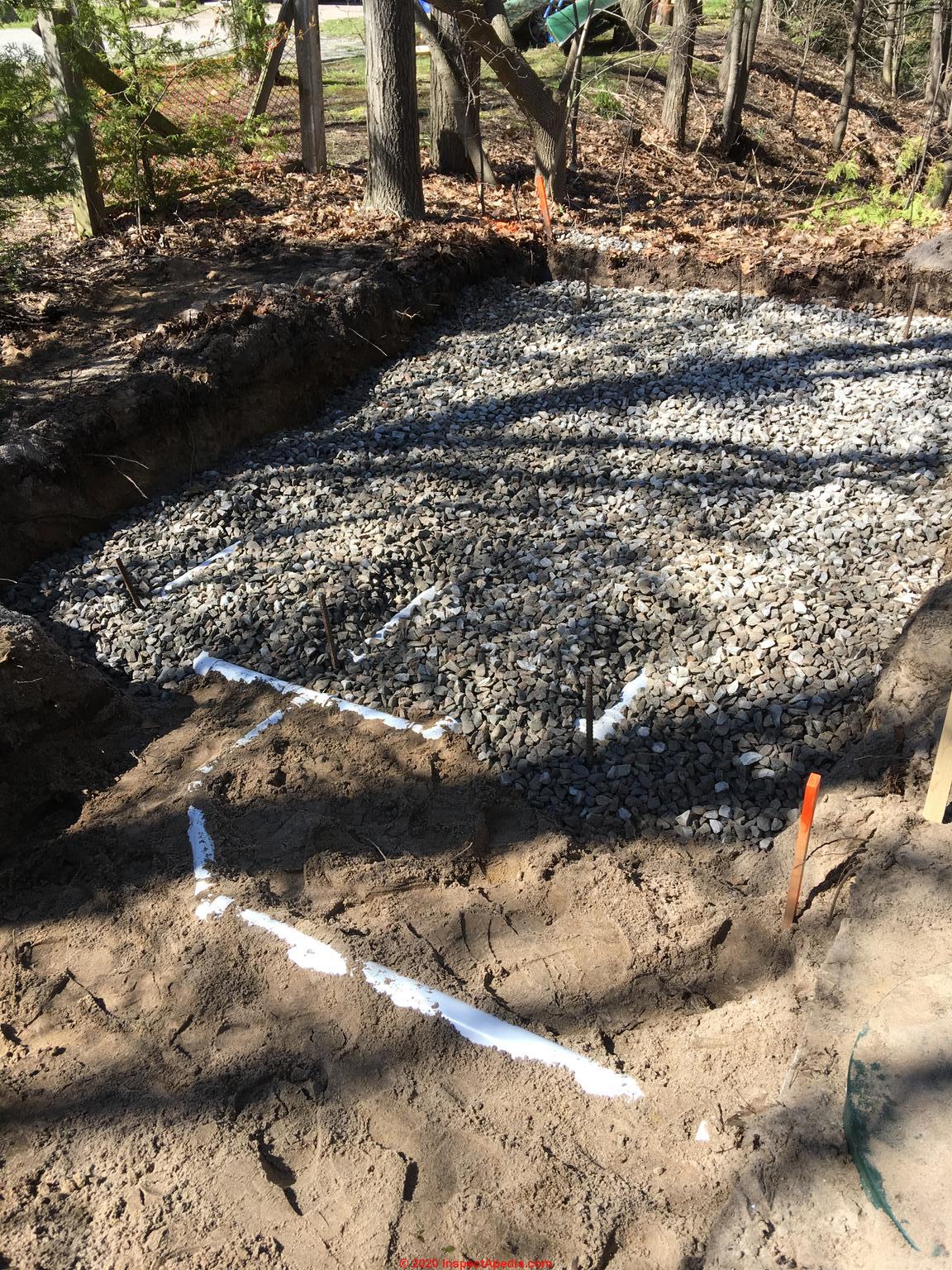
FYI, the image is of my drain bed during installation, before it was buried. It’s certainly not exposed like not the image, lol. It was done by a reputable company.
Thanks again,
Derek
On 2019-08-30 - by (mod) -
Not OK to put a garden shed over a corner of the septic drainfield
Covering any part of the septic drainfield is a bad idea, Derek; the concerns are traffic and weight over the drainfield that compresses soil or even damages pipes, and when covered, reduction of evaporation and transpiration.
If the closest edge of a garden shed to the closest drainfield trench is 10 feet you may still be OK.
Watch out: But in your photo I see all those white PVC pipes right at ground level. What are those? If that's part of your septic system something is seriously wrong; septic leachlines would never be left exposed at ground surface, and your shed is right on top of some of that piping - not something you should attempt.
Watch out: I also see that the edge of your apparent drainfield is just a foot or two from nearby trees. That installation is likely to be rather quickly clogged by tree roots, leading to a septic failure.
On 2019-08-30 by Derek
I want to put a small 7x7 garden shed in my yard. I have laid an 8x8 section of patio stones down for it that is covering a small portion of where my drain field is - the back corner farthest from the septic tanks. It’s covering maybe 1/8 of the entire bed on a corner. In the image attached, it would be the corner nearer to the tree at the back.
My question is whether ANY weight at all can go on any portion of the bed - I’ve read about it affecting respiration or something. Please advise. Thanks!
...
Continue reading at ICE SKATING OVER SEPTIC or select a topic from the closely-related articles below, or see the complete ARTICLE INDEX.
Or see DRIVING OVER SEPTIC, FAQs posted originally at this article
Or see these
Recommended Articles
- COMMERCIAL SEPTIC DESIGN
- ICE SKATING OVER SEPTIC
- SEPTIC TANK DESIGN STRENGTH SPECS
- SEPTIC TANK COVERS
- PLANTS & TREES OVER SEPTIC SYSTEMS
Suggested citation for this web page
DRIVING or PARKING OVER SEPTIC at InspectApedia.com - online encyclopedia of building & environmental inspection, testing, diagnosis, repair, & problem prevention advice.
Or see this
INDEX to RELATED ARTICLES: ARTICLE INDEX to SEPTIC SYSTEMS
Or use the SEARCH BOX found below to Ask a Question or Search InspectApedia
Ask a Question or Search InspectApedia
Try the search box just below, or if you prefer, post a question or comment in the Comments box below and we will respond promptly.
Search the InspectApedia website
Note: appearance of your Comment below may be delayed: if your comment contains an image, photograph, web link, or text that looks to the software as if it might be a web link, your posting will appear after it has been approved by a moderator. Apologies for the delay.
Only one image can be added per comment but you can post as many comments, and therefore images, as you like.
You will not receive a notification when a response to your question has been posted.
Please bookmark this page to make it easy for you to check back for our response.
Our Comment Box is provided by Countable Web Productions countable.ca
Citations & References
In addition to any citations in the article above, a full list is available on request.
- [1] NiceRink 218 South Road P.O. Box 310 Genoa City, WI 53128, Tel. 1-888-NiceRink Tel: 888-642-3746, Fax. 262-279-6744, Jim Stoller, private email communication to DJF 11/27/2013
- Thanks to J. D. Fuller, an ASHI member and professional home inspector in Texas for suggesting clarifications on this information.
- Pennsylvania State Fact Sheets relating to domestic wastewater treatment systems include
- Pennsylvania State Wastewater Treatment Fact Sheet SW-161, Septic System Failure: Diagnosis and Treatment
- Pennsylvania State Wastewater Treatment Fact Sheet SW-162, The Soil Media and the Percolation Test
- Pennsylvania State Wastewater Treatment Fact Sheet SW-l64, Mound Systems for Wastewater Treatment
- Document Sources used for this web page include but are not limited to: Agricultural Fact Sheet #SW-161 "Septic Tank Pumping," by Paul D. Robillard and Kelli S. Martin. Penn State College of Agriculture - Cooperative Extension, edited and annotated by Dan Friedman (Thanks: to Bob Mackey for proofreading the original source material.)
- Our recommended books about building & mechanical systems design, inspection, problem diagnosis, and repair, and about indoor environment and IAQ testing, diagnosis, and cleanup are at the InspectAPedia Bookstore. Also see our Book Reviews - InspectAPedia.
- In addition to citations & references found in this article, see the research citations given at the end of the related articles found at our suggested
CONTINUE READING or RECOMMENDED ARTICLES.
- Carson, Dunlop & Associates Ltd., 120 Carlton Street Suite 407, Toronto ON M5A 4K2. Tel: (416) 964-9415 1-800-268-7070 Email: info@carsondunlop.com. Alan Carson is a past president of ASHI, the American Society of Home Inspectors.
Thanks to Alan Carson and Bob Dunlop, for permission for InspectAPedia to use text excerpts from The HOME REFERENCE BOOK - the Encyclopedia of Homes and to use illustrations from The ILLUSTRATED HOME .
Carson Dunlop Associates provides extensive home inspection education and report writing material. In gratitude we provide links to tsome Carson Dunlop Associates products and services.
 | HOME | ABOUT | ASK a QUESTION | CONTACT | CONTENT USE POLICY | DESCRIPTION | POLICIES | PRIVACY | |
| © 2024 - 1985 Publisher InspectApedia.com - Daniel Friedman | |||||||||