
InspectAPedia® FREE Encyclopedia of Building & Environmental Construction, Diagnosis, Maintenance & Repair |
Question? Just ask us! InspectAPedia
|
 Abandoned, Dis-Used, or New Septic System Test Guide
How to test a septic system that has never been used or has been out of use
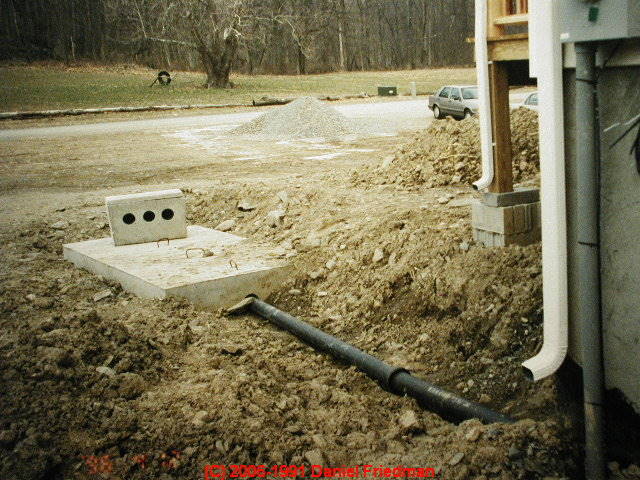
- POST a QUESTION or COMMENT about new, abandoned, or long-term shut-down septic systems and how they may be inspected or tested for usability
How to inspect or test abandoned, disused, or new unused septic systems:
Here we provide suggestions for evaluating the condition of an abandoned, un-used, or new and un-used septic tank and drainfield. Septic systems that have never been used or systems that have been un-used or even abandoned for months or years present special concerns, and the evaluation of the condition of such a system requires different steps than for a working and in-use septic tank and drainfield.
InspectAPedia tolerates no conflicts of interest. We have no relationship with advertisers, products, or services discussed at this website.
- Daniel Friedman, Publisher/Editor/Author - See WHO ARE WE?
How to Evaluate the Condition of an Abandoned or Un-Used Septic System
Determining the Condition of Never-Used Septic Systems
A septic system that has never been used should not be evaluated by a loading and dye test because chances are the septic tank is empty - the loading test volume of water run into the system is unlikely to even fill the septic tank during the test interval.
If the a septic tank is not full to normal operating level, placing a test volume of water into the septic tank will not move any test water out to the drainfield - the drainfield or absorption system will remain un-tested, and its problems will remain undiscovered.
What to Inspect & Test a Septic System is New & Un-Used
In almost any location where building codes and health codes are enforced, a building permit, a septic system design, soil percolation tests, and approval of the septic system design are required by local health or building department officials.
- Contact the building department and health department to ask:
- Was a septic design submitted and approved?
- Are there drawings, inspection, or test result documents available (obtain copies)?
- Was there a final inspection to confirm that the septic system was built as proposed?
- Confirm that a septic construction permit was obtained and the system was inspected and approved as built
- Identify the septic contractor who installed the system;
- Ask for a site tour (offer to pay the contractor for his time) at which the contractor points out (and you mark) the location of septic components (tank, distribution box, drainfield, other site drainage components that may have been installed).
- Ask if the septic contractor had to make changes to the original plan. A septic contractor might encounter a buried surprise - rocks, boulders, changes in lot or building plans, that lead to last-minute changes in the septic system layout or in the location of its components.
- Ask when the work was completed and whether or not all connections (tank to house, tank to D-box, D-box to drainfield) were completed.
- Septic drawing: if an accurate sketch is not already provided, locate and sketch the measurements to and location of all septic system components.
See SEPTIC TANK, HOW TO FIND.
Confirm that the as-built (which may be different than the as approved design) septic system meets all of the setback requirements - distance from well, property lines, streams, etc. - Inspect the septic system site, tank, septic distribution box, septic drainfield:
- A septic tank that has never been used should be empty of sewage and water. It is possible that a small amount of water has run into a septic tank during installation if the tank was set during very wet weather, but that's an abnormal circumstance
. If there is significant water in the septic tank, more than an inch, the concern is that surface runoff or ground water may be leaking into (and flooding) the septic tank: look for stains at the inlet piping, baffles, covers, tank sides, that might indicate places where water is leaking into the septic tank. - Inspect the septic tank further using the criteria that we list below,
- Inspect the site for evidence of settlement, un-wanted surface runoff, or other changes that might have affected the condition of the septic system such as evidence that vehicles have been driven over the drainfield.
See SEPTIC SITE INSPECTION PROCEDURE and
see SEPTIC SYSTEM FAILURE CAUSES - DRAINFIELDS - If the distribution box has tipped, or if there is evidence that surface water is entering the distribution box, these conditions will need to be corrected.
- Make certain that the septic tank has save and secure covers.
See SEPTIC & CESSPOOL SAFETY
- A septic tank that has never been used should be empty of sewage and water. It is possible that a small amount of water has run into a septic tank during installation if the tank was set during very wet weather, but that's an abnormal circumstance
If the septic system is reported to be new and never used, the septic tank should be empty. Inspecting the septic tank by finding and opening its service ports will yield important data such as evidence that surface or groundwater are leaking into the septic tank (and flooding the system).
If the septic system is new and never used, the distribution box should show no evidence of flooding or ground water leaking into that part of the system.
What to Inspect & Test If an Un-used Septic System is Old & of Unknown Age
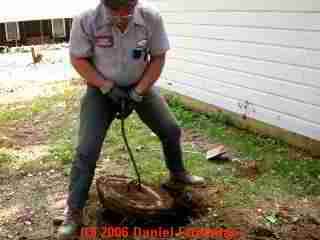 If a septic system is old, perhaps of un-known age, and it is reported that the system has been un-used for a long time, special inspection and test considerations apply.
- Contact the building department and/or health department to ask if there was a septic plan, inspection, approvals for the site, and if drawings are on file. Above we suggest details that might be asked.
- Inspect the septic system site, septic tank, and distribution box: find the septic tank , have the tank opened (be careful not to fall into a tank with an unsafe cover, and never enter a septic tank).
See SEPTIC TANK, HOW TO FIND- If the septic tank is empty and clean inside it has either been pumped or has never been used. There should be no standing water or debris in the septic tank. A steel, plastic, or concrete septic tank that has never been used will have clean sides with no sewage staining.
- While the septic tank is open, look for evidence of places where ground water might be leaking into the tank (DO NOT ENTER THE SEPTIC TANK) - and check the condition of the septic tank inlet and outlet baffles to be sure they are in place.
- If the septic tank is not empty inspect the sewage and effluent levels. A septic tank that was in active use but has been unused for a year or even longer should still be nearly full to the point just below its outlet pipe. A septic tank that has been un-used for many years may have lower sewage and effluent level.
But if the septic tank has no effluent, just a dried crust of sewage sludge on its bottom, it is possible that the tank has been damaged and is leaky. Something is probably wrong.
A steel septic tank is at risk of having rusted through and lost its liquid volume, so unless the test volume of water is more than tank volume you won’t be testing the drainfield.
A concrete septic tank might be cracked and leaky too – but this is less common. - If the septic system's distribution box has tipped, or if there is evidence that surface water is entering the distribution box, these conditions will need to be corrected.
- Watch out: Make certain that the septic tank has safe and secure covers.
See SEPTIC & CESSPOOL SAFETY
- Inspect the septic system site
for evidence conditions that suggest damage to the drainfield, un-wanted surface water, etc:
Site conditions may have changed since the original septic tank or drainfield installation, such as changes in surface runoff, subsidence, nearby construction, vehicle traffic on the drainfield, or even damage to the septic tank, distribution box, or drainfield piping.
See SEPTIC SITE INSPECTION PROCEDURE- Settlement
of the septic tank, tank cover, distribution box, or settlement of areas in the drainfield. Any of these may mean that septic components have become tipped or even disconnected.
For example, a poor-quality installation of septic drainfield piping with uneven trench excavation, inadequate gravel, un-compacted backfill, may have led to drainfield pipes that have become tipped, disconnected, or blocked with soil.
Even a new septic drainfield, just a few months old, might fail under these conditions. - Surface runoff
that directs water onto the septic tank, distribution box, or drainfield can flood the system and may significantly shorten the life of the drainfield. - Other changes
that might have affected the condition of the septic system such as evidence that vehicles have been driven over the drainfield.
Driving over the drainfield compacts soil that needs to breathe, and it risks crushed or broken drainfield piping or distribution boxes. - Soil test:
You might want to do a soil perc test to see if the soil drains as was claimed when the septic drainfield was built.
- Settlement
- Septic drawing: if an accurate sketch is not already provided, locate and sketch the measurements to and location of all septic system components.
See SEPTIC TANK, HOW TO FIND. Confirm that the as-built septic system meets all of the setback requirements - distance from well, property lines, streams, etc. - Septic loading and dye test for an un-used septic system?
If inspection of the septic tank shows that the tank is full or nearly full, then a septic loading and dye test has a chance of disclosing a damaged, blocked, or failed septic drainfield.
We find enough septic failures with this procedure that it's worth performing, but beware: a drainfield that has rested for a few months and that is tested during the dry season might still have a short functional life when it is restored to year round use.
Septic loading and dye tests and septic tank inspections should be accompanied by an expert visual inspection of the site as well as a collection of any available historical data.
See SEPTIC DYE TEST PROCEDURE
and also
see SEPTIC DYE AMOUNT, WATER VOLUME - Septic maintenance history may be available from local septic tank pumping companies
If a few telephone calls can locate a septic pumper who has serviced the property be sure to ask the contractor's opinion of the condition of the septic system.
How to Inspect a Septic System that has been Shut Down for Six Months or Longer
Reader Question: how long should water be turned on before a septic inspection can be performed on a vacant home?
How long should the water be turned on before a septic inspection can be performed on a home that has been vacant for 1 year? - Anonymous, Mortgage Loan Resource Desk Analyst
Reply:
A competent onsite inspection by an expert usually finds additional clues that would permit a more accurate, complete, and authoritative answer than we can give by email alone.
For example, one might learn something about the type of septic system installed, whether or not there are grinder pumps, effluent pumps, a septic tank vs cesspool, separate drywells taking graywater - all of which would be crucial in understanding possibly significant issues about the condition of the system. You will find additional depth and detail in articles at our website.
The short answer is easy but dangerous: run the standard septic test volume
The short answer is: run water long enough to get the minimum standard test volume into the septic system. That's at least 50 gallons per bedroom or 200 gallons, whichever is more.
Longer or more water is a better test as long as the total volume does not exceed a normal family's daily use - which could exceed the septic system's design level. At InspectApedia we give tables of those volumes based on septic tank size and other variables.
See WATER QUANTITY USAGE TABLES
For example, if we know (direct measurement is often easy) the size of the septic tank we know the average daily wastewater flow for which it was designed. I'll repeat that septic tank size and water usage volume data here.
Table of Required Septic Tank Size for Daily Water Usage Volume in Gallons |
|
| Average Sewage Wastewater Flow - Gallons Per Day |
Minimum Septic Tank Size in Gallons of Effective Capacity Needed (1) |
| 0-500 | 900 |
| 601-700 | 1200 |
| 801-900 | 1500 |
| 1001-1240 | 1900 |
| 2001-2500 | 3200 |
| 4501-5000 | 5800 |
The left column in this table gives the average daily wastewater flow for which the tank and septic system were (or should have been) designed. That same figure would be the maximum water that can be run into the septic tank without worry of exceeding the system design volume and thus without being blamed for doing something wrong.
Technical note: in fact since wastewater flow into a septic tank is normally not uniform but instead surges at the start and end of the day, running water into the system more slowly, over the entire day is probably a bit less aggressive and thus safe. I am not recommending using these test volumes as they significantly exceed our minimum test volumes given earlier.
But it is reasonable to conclude that running water in the building at a rate not to exceed 500 gallons over 24 hours is an aggressive but "safe" septic loading test provided other safety checks I describe below are also made.
Reasons why running any septic loading test without knowing more are risky
Watch out: a fundamental and very significant risk, especially for a bank assuming financial responsibility for a property, is that of permitting a "pro-forma" or "going through the motions" test or inspection that is not a true or valid inspection or test. Making such a mistake significantly increases the risk of an expensive surprise.
And there are several critical stumbling blocks that mean to me that simply requesting that a volume of water be run, without checking some other critical parameters first, is a significant mistake.
OK so How Much Water DO We Need to Run to Test a Shut-Down Septic?
Therefore while I completely understand the appeal of a simple answer like
"Turn on the water for one hour" or some variation, such an answer would be, frankly, ridiculous if I were to offer just that.
- We don't know the water flow rate, so we don't know how long to turn it on.
- We don't know what the water is flowing into, so we don't know how much water would constitute a valid test of the septic system.
So we need an approach that makes a credible attempt at addressing these fundamental questions.
When you ask how long water should be "turned on" I imagine you mean left running. But un-stated is at what rate the water is running - the flow rate in gpm, and at how many fixtures simultaneously. We need to either know something more about the house, or make some assumptions.
How long to run water = how much water do we need to run:
It is reasonable to assume that a home water system, whether on well or municipal water supply, delivers between 1 and 3 gallons per minute at a kitchen sink faucet or bath tub faucet. So if we can determine how much water we need, we can calculate the water-on time.
A bare minimum septic test needs to run at least 200 gallons or at least 50 gallons per bedroom into the septic system for an in-use septic system OR for a septic system that has not been in use for some time.
Other Instructions to the Septic Inspector to Reduce Risks & Hazards at the Septic System, Site, & Well Pump
Your instructions to the inspector need to include some effort at determining the following:
- What is the actual water flow rate
( it's trivial to measure it with a container and a stopwatch) - run the water long enough to achieve the necessary volume - What is the water source:
if it is a private well, there is risk that if water is left running unattended, say at a slow rate overnight or longer, if the well runs dry the inspector could be charged with running the well pump dry - which in some systems can destroy the well pump. - What is the condition of the building drain system.
If water is left running unattended and a drain is blocked, a backup and flood in the building could cause costly damage. - What is the type and condition of septic system.
If a visual inspection could have disclosed an unsafe septic tank cover, for example, and your representative was on-site performing a test and failed to detect this potentially fatal hazard, should there be an accident there would be hell to pay.
Also the observation that the system uses septic grinder pumps, effluent distribution pumps or other equipment is important in understanding how the system can be tested.
For example, if a sewage pump is part of the system and the power to the pump is left off the system cannot be safely tested.
See details at SEWAGE EJECTOR / GRINDER PUMPS
and SEPTIC PUMPS
Further, some idea of the type, location, & condition of the septic system informs the test that can or should be performed. For example a dosing system can be flooded by some septic tests and could be damaged, while a conventional septic tank and drainfield would not be unless the system were itself already damaged or defective.
Keep in mind that we are testing the effluent disposal system, the drainfield, not the septic tank, except that if the tank and system include pumps and filters etc. those too are being exercised and thus tested by the septic loading and dye test.
Condition of the septic tank: Impact on Testing a Septic System that Has Been Out of Use
IF the system is a conventional septic tank and drainfield, and if the septic tank is un-damaged, that is, not leaking, after even a year of non-use, the septic tank will be nearly full of sewage. The losses by evaporation or transpiration through a closed septic tank are practically nil.
Therefore pushing a standard minimum test volume, say 50 gallons per bedroom or 200 gallons, whichever is greater, would be a minimum water volume. A safe maximum test volume, as I established above, is 500 gallons of water over 24 hours. In fact, since in most U.S. jurisdictions the minimum permitted tank size for new septic installations is 1000 gallons this is a pretty safe number.
Watch out: if a septic tank has a leak, its in-tank sewage level may have fallen significantly. If so, all of our "test water" or a good part of it, is remaining in the tank - so we never tested the drainfield at all. A "false test".
Watch out: also: if the septic tank was pumped and never re-filled by normal use we are sitting there with 1000 gallons or so of empty volume into which all of our test water runs - the septic "test" would have been false if this condition is not discovered.
Therefore the un-used septic system test needs to include, if possible, an effort to open and inspect the levels in the septic tank before doing anything. This step also allows an effort at assuring that the septic tank cover is safe and secure.
Weather, Season, & Condition & Location of the Septic Drainfield: Impact on Disused-Septic System Testing
The condition absorption bed or drainfield condition is a different question. There are ample visual signs of trouble or likely trouble at the septic drainfield even before a septic test is performed.
See SEPTIC FAILURE SIGN
One would think that a drainfield that has been un-used for a year would have had a rest period that should have improved its performance.
See SEPTIC BIOMATS)
Watch out: that is not necessarily true. There may be critical seasonal variations. For example a drainfield in a low wet area may show failure but only in wet weather, regardless of how long it's been out of use . So a site inspection that notes that the known or apparent or only possible drainfield location is alongside a stream or lake, for example, would be important.
See SOAKBED SOIL CONDITIONS
Watch out for unsafe site conditions like missing or unsafe septic covers, and subsidences:
See SEPTIC SYSTEM SAFETY WARNINGS
For these reasons, a "disused septic system test" that does not include an inspection for these critical pieces of information, is not valid, and exposes all parties to liability, loss, and aggravation.
...
Reader Comments, Questions & Answers About The Article Above
Below you will find questions and answers previously posted on this page at its page bottom reader comment box.
Reader Q&A - also see RECOMMENDED ARTICLES & FAQs
On 2021-07-05 by inspectapedia.com.moderator (mod)
@Terry, It seems unlikely - if sewage from the septic system, even a failed septic system, were causing an odor nearby it ought to have been noticed well before a 12-year or 30-year lapse.
On 2021-07-05 by Terry
If a leech bed has been filled in and abandoned for 30 year could it cause an odor. I have a creek in my back yard? What about after it’s been abandoned for 12 years?
On 2021-06-30 by inspectapedia.com.moderator (mod)
@Denise Beadle,
If your building is connected to a septic tank the tank can be opened and its contents inspected;
But it would perhaps be a more-helpful approach to list first exactly what are your concerns so that those might be addressed more-specifically.
On 2021-06-30 by Denise Beadle
I have a suspicion that some of my contractors have been using my bathroom in my brand new home. Is there a way for me to have it checked to see if there has been usage prior to me getting keys and moving in?
On 2021-06-24 by mak.church (mod)
@Michael J. Yourzek,
My condolences on the loss of your home to fire.
1. First priority: locate the septic tank and be sure (by hiring an excavator or septic company if needed) that the septic tank cover is in place, sound, un-damaged. (E.g. it could be run-over and broken by a fire-truck or demolition vehicle) as an unsafe cover risks someone falling in and thus risks a death. (Search InspectApedia.com for SEPTIC SAFETY for details)
2. Locate all of the septic components, as some investigation of D-box, sewer piping, and drainfield piping is probably in order:
LOCATE SEPTIC SYSTEM COMPONENTS
inspectapedia.com › septic › Septic_Component_Location
and
SEWER LINE CAMERA
inspectapedia.com › plumbing › Sewer-Pipe-Inspection-Cameras
3. If the septic system uses any electrical components (such as effluent pumps),
don't assume those are serviceable after a building fire nearby
4. Review what sorts of traffic were at the site during and after the fire: vehicles over the drainfield may have damaged it: if in doubt, have those lines scoped
5. Then review the above article on this page that you found, specifically the section on:
What to Inspect & Test If an Un-used Septic System is Old & of Unknown Age
On 2021-06-23 by Michael J. Yourzek
How long can a septic system sit unused after last pump out? Our house burned down last March 2020 and system has not been used since. Last pump out approx. 4 years ago
On 2021-04-15 - by (mod) -
@Katt,
I would start by having the tank opened and pumped and inspected for condition.
You won't really be able to test a drain field in any meaningful way when the system has been out of use for so long but if necessary you could have a plumber run a camera through the lines to see their condition
On 2021-04-15 by Katt
Can you test a septic tank before you bill your house back my house got burned down about 10 years ago
On 2020-05-02 - by (mod) -
Zoe Campos said:
Thank you for reminding me that we need to get our septic tank inspected first before doing anything. Our landlord had informed us beforehand that there is an installed septic system in the house, but it's been unused for years before we moved in. It might be a good idea to consult experts in septic design and see what should be done about it.
Zoe's advertisement has been deleted.
On 2020-05-01 - by (mod) - septic tank was tripped off for a few months.
that should be ok
On 2020-05-01 by eric
septic tank was tripped off for a few months. will it hurt to start running
it
On 2020-01-08 - by (mod) - condition of a very old, never-used septic system
Sure, Chuck. If a septic has never been used, then nobody is going to see sewage effluent nor smell septic odors.
Of course if I were the inspector I'd be forced to say that such an inspection is very very incomplete and unreliable.
For example, if a septic tank is empty (which it would be if a septic system has never been used and if there are not improper surface water leaks into the tank) then it is not possible to perform a loading and dye test, so the condition of the drainfield remains unknown.
Even a new system may fail when put into use if it was not installed properly or if, during the ensuing years, the drainfield pipes heaved or settled or were invaded by roots.
On 2020-01-07 by chuck
i own a property with a septic circa 1987. septic has never been used. property is in northern az. any chance it passes inspections?
On 2020-01-04 0 - by (mod) - "drywells" seepage pits in Central Valley California
Is there a typo in your question? I don't know that I've ever come across a 30 foot tall drywell or seepage pit.
The downside of the design is that if we dispose of sewage effluent at a significant depth in the soil there's not enough oxygen for bacteria to break down the pathogens
I don't know what the life would be of your system. I'm sure it depends on how it was used including the amount of grease and also folding solids that were discharged into the pit
On 2019-12-25 by Jeff
I enjoyed reading your topics of drywells, septic pits and cesspools. Here in Calif's Central Valley the primary type is septic tank, D-box, and 'dry wells' as they call them here.
The soils here range from clay to sand, with an alkali "hardpan" on the top 10' of soil.
The 3 Drywells are 5-6' wide, and 30' tall, and completely filled with rough gravel and the tops are about 4' underground. No real risk of caving in. Leach fields DO NOT work here, as the whole neighborhood found out after a neighbor had one installed! Question: what is the average lifespan of 'drywells' such as I've described them? Mine are 45 years old, and haven't been used the last 9 years. Thank you!
Reader Question: upstream "septic drywells" don't work. What's a septic drywell, what's a cesspool, what's the difference & who cares?
2016/09/13 VanCoerte said:
We just discovered that of our two septic drywells, one is at 85% capacity and the other one is empty, because the pipe to it is actually running uphill. (!!) This means that the functioning drywell was the only one in use for - wait for it - 56 years!!
SO: we're going to properly hook up the empty drywell, of course. But I'm wondering: if we cap off the other drywell now, how long do you think it would take for it to become usable again? I heard one estimate of 20 years, but I think the facts that our soil is clearly excellent for drainage and that it hasn't actually failed yet should be taken into consideration. Could it be as soon as 10 years??
DETAILS: The 85% capacity drywell is 8x6 (200 sf) for a 4 bedroom house, in which usually only 2 - 4 people lived.
Reply:
A dope, like me or like Barnum's "Sucker" is born every minute. According to my sister Linda, one was born on my own birthday. But most septic people know that sewage doesn't flow uphill.
A "septic drywell" is properly called a seepage pit oror cesspit - detailed at CESSPOOLS
while a "drywell" strictly speaking, is used to receive graywater. A cesspool that no longer absorbs effluent can be slightly and temporarily pepped up by probing and jamming around the bottom - an approach that is short in benefit and can result in death to site occupants if the fooling around causes the system to collapse - that happened in a case on Long Island in New York.
Also see DRYWELL / SEEPAGE PIT SPECIFICATIONS
So usually we leave the failed cesspool alone and daisy-chain on a new one.
Left alone a cesspool that no longer absorbs won't recover itself in your lifetime nor mine nor the two of them together. There is just too much solid waste, scum, slime in the pit and in the surrounding soil. It's not like resting a drainfield.
I'd plan on either adding a sewage grinder pump to send waste up to the higher cesspool or I'd dig a new one downhill.
Watch out: BE SURE that the covers over these units are safe against collapse or fall-in.
Reader follow-up: why can you rest a drainfield but not a seepage pit?
Anonymous said:
Yes -- it is beyond my comprehension that, even 56 years ago when it was installed, someone would run pipe UPHILL to drain sewage.
Also yes -- I suppose what we have is a seepage pit. But here it's called a drywell by the septic companies and the health department.
Ours is man-made (in 1960) of concrete block and crushed stone and is about 5 feet underground. I believe its size is 8' x 6' - although they say it's 200 square feet, so I don't understand any of that.
If you don't mind taking the time - could you explain WHY you can rest a drainfield and not a man-made drywell (seepage pit)?
Moderator reply: depth, thickness & nature of waste & clogging in the soil
Not to be goo glib but one thing about it: the installer could have given a written guarantee that the uphill cesspool would never clog with sewage.
I understand that sounding like nit-picking over words can be annoying, but misunderstanding about just what is installed, how it works, how it should be designed, how it should be maintained, and what are its failure criteria also causes trouble for owners and occupants anywhere.
So it's nice to be clear about blackwater. If it won't annoy your local officials you are welcome to print out and give free copies of the articles in this series explaining drywell and cesspool to anyone who wants them. We appreciate criticism, gripes, questions, feedback: working together makes us smarter.
So thanks for asking.
The distinction between "drywell" and "seepage pit" and "cesspool" can be confusing but also can be important as designs, maintenance, usage, and failure criteria are not identical.
DRYWELL DESIGN & USES (for graywater disposal and sometimes for stormwater buffering or disposal - What is a drywell or "septic drywell", seepage pit, and how is it different from a cesspool?
How are drywells or seepage pits constructed? What care is needed for a drywell?
Do we need to filter wastewater entering a drywell? What is the failure criteria for a drywell?
CESSPOOLS - used to dispose of sewage wastewater - at inspectapedia.com/septic/Cesspool_Guide.php discusses: Septic cesspool design, construction, installation, inspection, maintenance & repair advice. Definition of a cesspool, why a cesspool is not a drywell, why their function is limited. How is a cesspool cleaned or maintained? Does cleaning the cesspool extend its life? What about hydrojetting cesspools to break up sludge? How do cesspools fail? How old is the cesspool? How long should a cesspool last? Should I put additives or chemical treatments into the cesspool to extend its life?
See also CESSPOOL / DRYWELL PIT COLLAPSE or FAILURE How to detect a drywell or seepage pit failure; What causes seepage pit failure? What causes drywell failure; How to avoid seepage pit or drywell early failure? What care is needed for a drywell? What is the failure criteria for a drywell?
You can rest a drainfield trench because we're talking about a small diameter trench, perhaps a couple of feet across and near the soil surface where there's both anaerobic and aerobic bacteria who eat away at the biomass that has formed, typically an inch or so thick, in the soil around the perimeter of the trench.
That's an inch or so of biomass near the ground surface. In proper use, a drainfield receives ONLY clarified effluent, that is, no solids, no feces, no toilet paper, no grease - or at least very little of those materials and only in ultrafine particulates.
A cesspool is going to be 4 to 20 feet deep and at the end of its life will be filled with nearly solid sewage; that's a mass of solid waste close to say 4-5 feet in diameter by 4 to 20 feet deep.
The cesspool, depending on how it was constructed, was surrounded by gravel and backfill soil. More solids, grease, fecal waste, as well as biomass have formed in the gravel and soil around the cesspool and still more thickly at its bottom.
A cesspool receives all of the solid waste: feces, toilet paper, grease, crud. Therefore the soils around the cesspool will become clogged by much more than the mere biomass produced by soil bacteria.
It's clogged by 6" to 24" (typically) of sewage, grease, solids, as well as by the biomass formed by bacteria. That thickness is not going to be easily removed by soil bacteria for two reasons: 1. It's enormous in thickness compared to a leachfield biomass and 2. it most of the cesspool it's much deeper in the soil where there is no aerobic bacteria.
Think of an outhouse privy pit. When filled the pit is abandoned. That now covered-pit will remain full of nearly-solid sewage for 10 to 20 years or longer. The breakdown is very very slow because of the thickness and mass of the waste.
Some cesspool "restoration" services in some areas pump out cesspools - a dangerous approach if the cesspool is home made as it can lead to a collapse such as one that killed a homeowner on Long Island. Others try toxic caustic chemicals that, even if they de-grease or de-sludge, also kill bacteria and poison groundwater and are illegal in many jurisdictions.
Other cesspool services will hydrojet the bottom of the cesspool to "restore" soil absorption of effluent - a partly-effective but rather short-lived "repair".
Those conditions mean that the usual approach when a cesspool has failed (failure criteria are in the article I cited above) it is abandoned or at most daisy-chained to pass on sewage to a new cesspool just downstream.
Question: what's the normal level of sewage in a septic tank that has not been in use?
(July 22, 2015) irene said:
septic tank has not been used for 3 years and now is dry is this common?
Reply:
"Dry" may be subjective. If the sewage level in the tank were down even a foot I'd not be worried but if sewage levels have fallen to the bottom of the tank I suspect it is leaking.
Question: child safety hazard if old septic tanks remain without proper abandonment
(Sept 1, 2015) cherm32 said:
We moved on a property that has not had a house on it for about 30+ years, we recently found an old PVC pipe sticking out of the ground next to an area of dirt where there is no grass which is directly behind where the old house used to be.
My husband dug up part of the pipe and the rest broke of the dirt was wet a a frog came out of the piece of pipe that was still in the ground that appeared to be filled with dirt.
Questions: is it probable this is the old septic system? if so would it still have water after so many years, and could recent heavy rains fill it up? how do we get rid of this thing. I am really concerned for our and our childs safety.
Reply:
Cherm
While there could certainly be other reasons that you'd find a bit of dirt-filled pipe sticking up out of the ground, an old, failed or possibly abandoned septic is a good guess. The no-grass area may mark a septic tank.
To avoid possibly killing someone, rope off and keep people away from the suspected septic area until you've had a contractor excavate to see what's there. An old steel tank or home made system could have a failing cover that could suddenly collapse - falling into such an opening can be fatal.
When the tank is found you want to know that it was properly abandoned -for safety - as described in the
article ABANDONED or NEW SEPTIC SYSTEM TESTS
Question: realtor says we need a new septic system
(Jan 26, 2016) Geoff said:
I'm looking into purchasing a home that has a septic system. Unfortunately, the septic system was not used for about a year. Because of this, the real estate listing agent has informed us that the home will need an entirely new septic system.
What I was curious about the possible problems (though I would imagine from reading the article and comments that the system is leaking) to ask about if we pursue the property further.
Also, would you ever recommend fixing any of the possible problems without replacing the entire septic system, but instead using a product like aero stream?
Thanks in advance.
Reply:
Please see HOME BUYERS GUIDE to SEPTIC SYSTEMS for suggestions of how to get an idea what's there. It's safe to say you need a "whole new system" but that may not be so. OR the realtor knows something that's not been disclosed.
Also see OTHER PEOPLE's MONEY - why consultants spend your money to reduce their risk.
Question: confusion about old vs. new septic components when buying a home
(Mar 18, 2016) Lenny said:
My wife and I recently purchased a new home with a septic system - we've always lived in homes with "city sewer/water." In Colorado, the existing septic system must pass inspection and re-certified prior to the home being turned over to the new owners; i.e., the seller is on the hook to fix any problems with the septic system.
Well it was found that the leach field needed to be completely rebuilt/replaced. So knowing nothing about these systems the contractor said he is providing a new "tank" behind the existing tank which makes me think, he will use the existing tank as the front tank to the leach field.
I asked him why he just didn't pull the existing tank out and use the new tank (apparently the new is the "latest and greatest" where the existing tank is not) I didn't understand his answer that the new tank will "interface" with the existing tank?
Then I asked him, what if the existing tank goes "south" he said, well I guess you'll have to get another tank. Any info would be appreciated.
Reply: what does "in code shape" mean? Nothing much.
A better approach might be to empty, then abandon the existing septic tank, presuming it's not serviceable. Be sure the work actually addresses the drainfield that has failed - the comments you report don't do so.
(Mar 20, 2016) Lenny said:
Thanks .... The contractor did state he hadn't fully inspected the existing tank, but felt it most likely was in "code" shape.
His work is primarily focused on the leach field which was the failure requiring the rework; apparently it was invaded by existing tree roots and required the removal of two large pine trees to rebuild the drainfield including re-soiling(?). I guess I don't understand the need for the existing tank when a new and improved tank is being installed.
(mod) said:
Lenny,
Not to be too much of a stickler, "code shape" is an undefined term. In fact there is almost no building code written for in-service septic systems.
When the tank is pumped and cleaned it should be inspected for damage such as holes, cracks, missing baffles.
If you want to abandon the existing tank have it emptied and filled-in.
On 2019-07-24 by (mod) - confusing septic inspection & test report, garbled language
What a fascinating mix of improperly-used terms that make little sense.
Baffles in a septic tank are not building structure so the phrase "structural damage" is confusing; I speculate that the inspector mean that baffles are damaged enough as to be not functional. That means a good risk of septic field failure as damaged baffles let solids flow into and clog the drainfield.
"Baffle rotted" is confusing too. Concrete is not organic. It doesn't rot. Wood rots. Vegetables can rot. Concrete may deteriorate, spall, soften, fall apart, but it doesn't rot. I know this sounds picky but when a purported "expert" uses odd terms it makes me nervous about their accuracy.
"System appearing to be structural sound and working" sounds to me like an inspector who was referred by the realtor, doesn't want to upset the person who refers him or her, and who is not telling you that damaged or missing tank baffles mean that solids are clogging the field and that even if the dye test doesn't show a problem now, the field life as doubtless been shortened.
That means in the future you'll face the significant cost of field replacement - something a homeowner ultimately faces anyway - perhaps sooner than ordinary.
"Leach field not under flow" means that the field was not tested. Therefore the septic test is inconclusive - the inspector is ducking.
"Tank depth" notes are not clear enough for me to understand if the tank was at a normal level or not.
Bottom line: the report is confusing, and in my opinion unreliable, except that it suggests that there's trouble ahead.
That's NOT a reason not to buy a home. It's a reason to budget for septic system repairs.
Maximize the drainfield life by having the tank cleaned upon taking ownership and at regular intervals afterwards - search this site for SEPTIC TANK PUMPING SCHEDULE for details.
On 2019-07-24 by Kimber - Buying a house built in 1981 with original septic tank & leach field. Had septic inspection yesterday.
Buying a house built in 1981 with original septic tank & leach field. Had septic inspection yesterday.
Under the "Evidence of structural damage to baffles, tees, or superstructure of tank" inspector says "concrete baffle rotted away and fallen into tank." Yet his overall inspection results state "...septic system ... appears to be structurally sound and working properly at this time."
In addition, under the flow test, it says "passed" but with * "leach field not under flow of load at time of test due to inoccupancy of home. Cannot certify tank as operable as designed at this time." By "inoccupancy" he means the sellers have already moved, but they and others have been in & out making some repairs, etc.
The tank depth is reported as 51" with 10" sludge and 0" scum. Yes, I do have a call into the inspector because this report seems very inconsistent to me.
Would like to hear your thoughts and recommendations.
On 2019-06-18 by (mod) - digging for posts must avoid septic pipes and components
Unless you actually hit a pipe when digging a hole to put in your post you should be fine.
On 2019-06-16 by pj
if a drain field hasn't been used for about 30 years that one would know of, can another pipe be inserted to hold something up? a new drain field has been installed away from the old, so would the old drain be holding anything inside. Can it be filled with dirt or quik crete to hold a pole?
On 2019-05-03 by (mod) - Can a septic tank be used if it hasn’t been used for 20 years
Sure, Gayle if it's un-damaged.
But the more critical question is the condition of the drainfield.
And of course the tank should be emptied, cleaned, inspected.
On 2019-05-03 by Gayle
Can a septic tank be used if it hasn’t been used for 20 years
On 2018-09-14 by (mod) -
On 2018-09-02 by Adam
Thanks so much for your comments. The tank diameter is 4.5'(W) X 12' (L) X 5' (D) which would be more than sufficient for my 1 bath use. It is very thick and solid with out cracks or defects.
I agree with your assessment of the white PVC pipe, I can't quite figure what that would be used for. You're correct, more excavation is needed to solve that mystery.
I've attached a picture of the white box with the metal lid. Any idea is that should be the d-box? It is a box that has a National Sanitastion Foundation sticker on the side.
IMAGE LOST by older version of Comments code - now fixed. Please re-post the image if you can. Sorry. Mod.
On 2018-09-14 by (mod) -
On 2018-09-02 by (mod) - identifying components at an old septic tank
Watch out: for an old septic tank of unknown condition, walking on or near its cover risks falling in and injury or worse, a death.
I do not assume that the septic tank is usable, both by its condition and its size. Further you can't assume that there is a usable absorption field or soakaway.
The molded but un-used side opening is probalbly a knock-out that could have been opened to provide an additional tank inlet or outlet opening.
The small diameter white plastic pipe running alongside the septic tank needs to be understood. You would not run potable water piping right next to a septic tank. The diameter is too small to be a sewer line, though it could have been an amateur drain to the septic tank for graywater, say from a laundry sink. (The diameter looks too small, though).
You need more excavation to understand the dimensions and condition of the tank and further exploration of the site to plan a usable drainfield.
On 2018-09-02 11:06:51.215278 by Adam
I purchased a piece of property that has a septic system on it. I found the tank but I'm not exactly sure what to make of it. First, it does appear to be a cast tank and not a old conder block tank.
However, there's no lid on it, it's just a hole that someone put a piece of cinder block over and covered with dirt.
There was an old house (circa 1960) on the property that was demolished before my ownership, so I'm not sure if maybe the contractor who removed the old house broke the lid in the process.
When I inspect the inside of the tank, there's a wall to the right with a high opening for either the solids or gray water.
Looking at the tank there's an opening molded in to the side that is not in use and I'm not sure what it is used for. I've attached an image.
Also, it looks like a d-box comes out from it on the side but it's just a plastic box (but does have an NSF.sticker) with a thin metal lid. There's ADS green striped pipe coming out of the side. Have you seen this type of setup before?
IMAGE LOST by older version of Comments code - now fixed. Please re-post the image if you can. Sorry. Mod.
On 2016-09-15 by (mod) -
VanCoerte
To have room to blather on in detail I repeat your question and offer detailed replies in the bottom of the article above. Thanks for asking.
On 2016-09-15 by Anonymous
Yes -- it is beyond my comprehension that, even 56 years ago when it was installed, someone would run pipe UPHILL to drain sewage.
Also yes -- I suppose what we have is a seepage pit. But here it's called a drywell by the septic companies and the health department.
Ours is man-made (in 1960) of concrete block and crushed stone and is about 5 feet underground. I believe its size is 8' x 6' - although they say it's 200 square feet, so I don't understand any of that.
If you don't mind taking the time ... could you explain WHY you can rest a drainfield and not a man-made drywell (seepage pit)?
On 2016-09-14 by VanCoerte
We just discovered that of our two septic drywells, one is at 85% capacity and the other one is empty, because the pipe to it is actually running uphill. (!!) This means that the functioning drywell was the only one in use for ... wait for it ... 56 years!!
SO: we're going to properly hook up the empty drywell, of course. But I'm wondering: if we cap off the other drywell now, how long do you think it would take for it to become usable again? I heard one estimate of 20 years, but I think the facts that our soil is clearly excellent for drainage and that it hasn't actually failed yet should be taken into consideration.
Could it be as soon as 10 years??
DETAILS: The 85% capacity drywell is 8x6 (200 sf) for a 4 bedroom house, in which usually only 2 - 4 people lived.
...
Continue reading at DISPOSAL vs TREATMENT or select a topic from the closely-related articles below, or see the complete ARTICLE INDEX.
Or see these
Recommended Articles
- ABANDONED or NEW SEPTIC SYSTEM TESTS
- DISPOSAL vs TREATMENT
- SEPTIC TANK ABANDONMENT GUIDE
- SEPTIC DRAINFIELD RESTORERS?
Suggested citation for this web page
ABANDONED or NEW SEPTIC SYSTEM TESTS at InspectApedia.com - online encyclopedia of building & environmental inspection, testing, diagnosis, repair, & problem prevention advice.
Or see this
INDEX to RELATED ARTICLES: ARTICLE INDEX to SEPTIC SYSTEMS
Or use the SEARCH BOX found below to Ask a Question or Search InspectApedia
Ask a Question or Search InspectApedia
Questions & answers or comments about new, abandoned, or long-term shut-down septic systems and how they may be inspected or tested for usability
Try the search box just below, or if you prefer, post a question or comment in the Comments box below and we will respond promptly.
Search the InspectApedia website
Note: appearance of your Comment below may be delayed: if your comment contains an image, photograph, web link, or text that looks to the software as if it might be a web link, your posting will appear after it has been approved by a moderator. Apologies for the delay.
Only one image can be added per comment but you can post as many comments, and therefore images, as you like.
You will not receive a notification when a response to your question has been posted.
Please bookmark this page to make it easy for you to check back for our response.
IF above you see "Comment Form is loading comments..." then COMMENT BOX - countable.ca / bawkbox.com IS NOT WORKING.
In any case you are welcome to send an email directly to us at InspectApedia.com at editor@inspectApedia.com
We'll reply to you directly. Please help us help you by noting, in your email, the URL of the InspectApedia page where you wanted to comment.
Citations & References
In addition to any citations in the article above, a full list is available on request.
- Thanks to Rick Kie, Email: AccHomeInsp@stny.rr.com a professional home inspector in Endwell, NY, for helpful discussion of septic testing difficulties at abandoned properties. Mr. Kie can also be reached at 607-221-8724. 09/11/2008. Mr. Kie points out that if a septic system design includes a sand bed with chlorinator, septic test dye is likely to be bleached out and will be difficult to spot.
- "International Private Sewage Disposal Code," 1995, BOCA-708-799-2300, ICBO-310-699-0541, SBCCI 205-591-1853, available from those code associations.
- "Manual of Policy, Procedures, and Guidelines for Onsite Sewage Systems," Ontario Reg. 374/81, Part VII of the Environmental Protection Act (Canada), ISBN 0-7743-7303-2, Ministry of the Environment,135 St. Clair Ave. West, Toronto Ontario M4V 1P5 Canada $24. CDN.
- US HEW, MANUAL of SEPTIC TANK PRACTICE [PDF] 1975, U.S. Department of Health, Education and Welfare, Public Health Servicve, original source: https://nepis.epa.gov/
- Manual of Septic Tank Practice, US Public Health Service's 1959 calculating septic tank volume from size measurements
- SEPTIC TANK/SOIL-ABSORPTION SYSTEMS: HOW TO OPERATE & MAINTAIN [PDF] - , Equipment Tips, U.S. Department of Agriculture, 8271 1302, 7100 Engineering, 2300 Recreation, September 1982, web search 08/28/2010, original source: http://www.fs.fed.us/t-d/pubs/pdfimage/82711302.pdf.
- Our recommended books about building & mechanical systems design, inspection, problem diagnosis, and repair, and about indoor environment and IAQ testing, diagnosis, and cleanup are at the InspectAPedia Bookstore. Also see our Book Reviews - InspectAPedia.
- In addition to citations & references found in this article, see the research citations given at the end of the related articles found at our suggested
CONTINUE READING or RECOMMENDED ARTICLES.
- Carson, Dunlop & Associates Ltd., 120 Carlton Street Suite 407, Toronto ON M5A 4K2. Tel: (416) 964-9415 1-800-268-7070 Email: info@carsondunlop.com. Alan Carson is a past president of ASHI, the American Society of Home Inspectors.
Thanks to Alan Carson and Bob Dunlop, for permission for InspectAPedia to use text excerpts from The HOME REFERENCE BOOK - the Encyclopedia of Homes and to use illustrations from The ILLUSTRATED HOME .
Carson Dunlop Associates provides extensive home inspection education and report writing material. In gratitude we provide links to tsome Carson Dunlop Associates products and services.
 | HOME | ABOUT | ASK a QUESTION | CONTACT | CONTENT USE POLICY | DESCRIPTION | POLICIES | PRIVACY | |
| © 2024 - 1985 Publisher InspectApedia.com - Daniel Friedman | |||||||||