
InspectAPedia® FREE Encyclopedia of Building & Environmental Construction, Diagnosis, Maintenance & Repair |
Question? Just ask us! InspectAPedia
|
 How to Remove Water from an Oil Storage Tank
- POST a QUESTION or COMMENT about how to remove water from an oil storage tank
Oil tank water contamination:
This article explains how we remove un-wanted water contamination from oil storage tanks in order to avoid oil tank corrosion, leaks, or loss of heat.
This heating oil storage tank article series provides detailed information about underground (buried) oil storage tanks (USTs), aboveground oil storage tanks (ASTs), above ground fuel storage tanks, reporting and cleaning up oil tank leaks, and choosing among oil tank leak testing methods.
InspectAPedia tolerates no conflicts of interest. We have no relationship with advertisers, products, or services discussed at this website.
- Daniel Friedman, Publisher/Editor/Author - See WHO ARE WE?
How to Remove Unwanted Water from an Oil Tank
- Dispersant / Bactericide Oil Tank Additives
small amounts of water contamination in an oil tank can be absorbed by alcohol products and moved through the heating system by adding "4 in one hot" or similar additives available from HVAC suppliers or through your oil company.
See details about heating oil additives and chemicals at
OIL TANK TREATMENTS, ADDITIVES
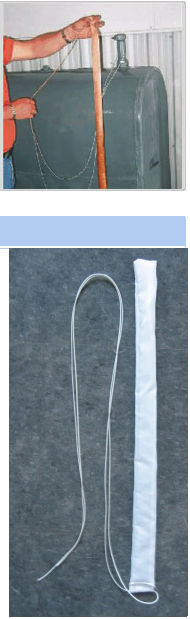
[Click to enlarge any image] - Small amounts of water contamination
in an oil tank can be removed from the oil tank using products like the H2O Water Worm from H2O Control Products, Inc.
Quoting from the company's product literature:
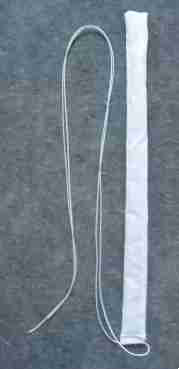
The H2OWater Worm is a 36" x 1.5" cloth tube containing a small amount of our water absorbing desiccant.
You simply drop the Water Worm into the tank via any convenient opening, being sure to hold onto the attached 7' string. Secure the string outside of the tank. After settling to the bottom of the tank, the Water Worm will absorb any water that collects or has collected in the tank.
To check or remove the sock, simply use the attached string to pull the Water Worm out. If it is full and firm, it's spent; if not, put the Water Worm back in to collect more water.
[Photo courtesy of H2O Control Products Inc - Website: h2ocontrol.com/water-worm/ ] - Pump Out Large amounts of water
in an oil tank such as several inches or more in the tank bottom (water will stay at the bottom of the tank as water and oil don't mix), have to be pumped out by your oil company.
They will leave the heating oil behind and intact. Simply call your oil delivery company or heating service company to arrange for them to check and pump water out of the tank. It's a straight-forward procedure that most oil companies know quite well. - Clean oil supply and return piping
that may have become soiled with sludge or water accumulating by using the CO2 cartridge oil line "blow-out" tool that is carried by oil heat service technicians.
Alternatively it may be possible to clean the oil line by disconnecting it at both ends (you'll have to have the proper fitting on hand to plug the oil storage tank to avoid leakage), then blowing out the oil line with compressed air.
Watch out: don't try blowing compressed air through oil piping that is connected to your oil tank. Blowing compressed air directly into your oil storage tank risks that you over pressurize the tank, causing it to leak - a catastrophe. - Clean the oil filter canister
of water, sludge, rust, muck as part of normal heating oil service or when you are removing water from the oil storage tank. - Test the oil burner fuel unit
(fuel pump assembly) to be sure that the fuel unit has not been damaged by water. This is a good time to replace the screen found inside the fuel unit too.
Oil Tank Water Removal References
- OIL TANK WATER WORM INSTRUCTIONS [PDF] 633 Lorne Street, Sudbury, ON, Canada P3C 4R3,
Tel: (705) 522-5300 Fax: (705) 523-0761 Email: sales@h2ocontrolproducts.com Web: h2ocontrolproducts.com - retrieved de-novo 2023/-8/02, original source: h2ocontrol.com/wp-content/uploads/2022/03/H2O-Water-Worm-Moisture-Control-Corrosion-Protection-H2O-Control-Products-Sudbury-Ontario.pdf
Excerpt:
It is recommended to check every 24 hours within a 72 hour period. To remove the sock, simply use the cord to pull the Water Worm out. If it is full and firm, it’s spent; if not, put the Water Worm back in to collect more water. - OIL TANK WATER WORM USE EXAMPLE [PDF] Petroleum Services Limited, Postal Address: PO Box 20 185 Hamilton 3241 New Zealand, Tel:0 243 864 Email: info@petroleumservices.co.nz- retrieved 2023/08/03, original source: petroleumservices.co.nz/Products/Water-Worm#:~:text=The worm is placed into,any water that is present.
- "Preventing Water from Entering the [oil heating] Fuel System", Technical Information Bulletin, 10/15/1990, R.W. Beckett Corporation, 38251 Center Ridge Road, PO Box 1289, Elyria OH 44036, Tel: 440-327-1060, Email: sales@beckettcorp.com Web: beckettcorp.com
...
Reader Comments, Questions & Answers About The Article Above
Below you will find questions and answers previously posted on this page at its page bottom reader comment box.
Reader Q&A - also see RECOMMENDED ARTICLES & FAQs
On 2019-09-29 - by (mod) -
 Re-posting from private email, Anonymous asked:
Could you tell me from where can one buy the H2O Water Worm is a 36" x 1.5" cloth tube?
Moderator reply: where to buy Water Worm oil tank water remover
Sure, Anon. Contact:
H2O Control Products Inc.
2031 Long Lake Road
Sudbury, Ontario P3E 4M8
Canada
Telephone: 705.522.5300
Fax: 705.523.0761
E-mail: sales@h2ocontrol.com
Website: https://www.h2ocontrol.com
Excerpting from the company's website:
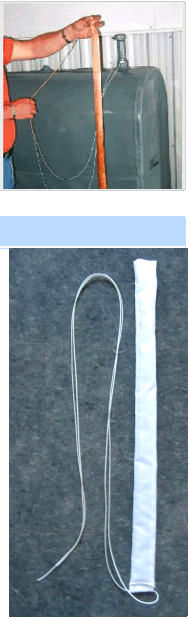
H2O's Water Worm is a 48" x 1.5" cloth tube containing a small amount of our water absorbing desiccant.
You simply drop the Water Worm into the tank via any convenient opening, being sure to hold onto the attached 7' cord.
Secure the cord outside of the tank. After settling to the bottom of the tank, the Water Worm will absorb any water that collects or has collected in the tank.
To check or remove the sock, simply use the attached cord to pull the Water Worm out. If it is full and firm, it's spent; if not, put the Water Worm back in to collect more water.
On 2019-09-29 - by (mod) - where to buy oil tank water remover
Re-posting from private email, Anonymous asked:
Could you tell me from where can one buy the H2O Water Worm is a 36" x 1.5" cloth tube?
On 2019-04-22 - by (mod) -
Dan
Normally the water will be at the bottom of the tank in the oil on top and typically the installer keeps the oil pickup line several inches off the bottom in order to avoid picking up water.
You still may want the water removed. I don't think an additive is going to be very effective at removing as much water as you report. but it also doesn't quite add up in my thinking.
That is, how much rain actually could fall into an oil tank simply through a fill pipe. Only if the pipe or below ground and surface water ran in the hole with that be likely.
So maybe you could give me some more details.
Yes there are oil tank additives that help remove water, such as our old stand-by 4-in-One-Hot oil tank additive that are reasonably effective for small amounts of water.
See details at
See OIL TANK TREATMENTS live link at the end of this page
On 2019-04-21 by Dan Garland
I have a 1000 gal underground oil tank and I measured the oil the other day and it was at 16".
I realized the next day that I didn't put the lid back on and it poured overnight and the next day. When I re-measured I had 16 1/2".
I don't have any hot water and was wondering if I can put an additive into the tank to absorb the water or should I call my oil company to pump it out?
On 2018-12-13 - by (mod) -
Note to Bruce Hewitt
Thanks Bruce but sorry, we don't permit posting of advertisements nor links - to protect reader trust in our independence and to avoid risk of viruses.
However if you contribute technical content, critique, comment, we are able and happy to cite such contibutors.
On 2017-02-06 by SALIN
Hello, please any possibility to talk to someone regarding starting business for water removal, or if anyone can guide me with extra cost.
Thanks
On 2016-09-03 - by (mod) - also buy water tank treatments and water remover from local heating parts supplier or plumbing suppliers
Ric,
You should be able to find a water removing product from your local oil heating supplier or plumbing supplier.
Watch out: About your own fuel idea, I'm way too scared to have much to say about that idea and its' safety other than it's clearly creative.
You might want to check with a petroleum chemist or engineer about both the safety of your custom-made truck fuel and also the environmental impact (and legality) of burning used motor oil - typically a substance filled with highly toxic dioxins, PCBs, heavy metals and other contaminants - in a vehicle.
Certainly other oils, such as vegetable oil having not the same contaminant issue have been under test for some time.
Hewstone, R. K. "Health, safety and environmental aspects of used crankcase lubricating oils." Science of the total environment 156, no. 3 (1994): 255-268.
Delistraty, Damon, and Alex Stone. "Dioxins, metals, and fish toxicity in ash residue from space heaters burning used motor oil." Chemosphere 68, no. 5 (2007): 907-914.
El-Fadel, M., and R. Khoury. "Strategies for vehicle waste-oil management: a case study." Resources, Conservation and Recycling 33, no. 2 (2001): 75-91.
Kajdas, Czeslaw. "Major pathways for used oil disposal and recycling. Part 1." Tribotest 7, no. 1 (2000): 61-74.
Dorado, M. P., E. Ballesteros, J. M. Arnal, J. Gomez, and F. J. Lopez. "Exhaust emissions from a Diesel engine fueled with transesterified waste olive oil☆." Fuel 82, no. 11 (2003): 1311-1315.
We do not sell anything.
InspectAPedia provides building and environmental diagnostic and repair information.
In order to absolutely assure our readers that we write and report without bias we do not sell any products nor do we have any business or financial relationships that could create such conflicts of interest.
InspectAPedia is an independent publisher of building, environmental, and forensic inspection, diagnosis, and repair information for the public - we have no business nor financial connection with any manufacturer or service provider discussed at our website.
We very much welcome critique, questions, or content suggestions for our web articles. Website content contributors, even if it's just a small correction, are cited, quoted, and linked-to from the appropriate additional web pages and articles - which benefits us both. Working together and exchanging information makes us better informed than any individual can be working alone.
On 2016-09-03 by Ric Bennett
I have been using a product called Quic N Dri but, have been unable to find a new source for it. It was imported from Canada and sold to companies that supply materials for the production of bio diesel.
I am using it to remove water from used motor oil before running it through a centrifuge then mixing it with a small percentage of unleaded gasoline to burn in my truck which I have been doing for over five years now.
Problem is I have been unable to find the product since they stopped importing it. Is this the same product? Do you sell the socks and the material. I excitedly look forward to your reply....
Question: my oil company delivered sub-standard heating oil
(Feb 11, 2015) dirty heating oil said:
It's my belief that my oil company delivered sub-standard heating oil.
The tank was installed new about 12 years ago and filters changed at regualr intervals. We've had no problems or reasons for concern until the last fuel delivery. Now we have solids in the fuel as well as water.
The solids appear to be rust like particles and have completely clogged the fuel piping. I spent several hours last evening working on the burner and associated piping to get my heat back on. I had a dirty oil filter, clogged piping and the pump screen needed to be changed as well as the nozzle.
Does my oil company have any obligation to deliver me clean, burnable fuel and how do I approach them about it? How do I go about cleaning out the tank with 250 gallons of oil in it?
Reply:
I can't know what was delivered to you of course - you'd need to have an oil sample properly collected and analyzed. But there have been occasional reports of oil companies delivering mixes of fuels other than what the consumer thought s/.he was buying and paying for.
Question: I don't think the product is anything other than dirty oil.
(Feb 11, 2015) Randy said:
Thanks Dan, I don't think the product is anything other than dirty oil. It almsot appears that the oil was from the bottom of their tank or another tank that they removed oil from.
Reply: factors that can make oil tank sludge suddenly appear in the heating oil lines
Other factors that can make oil tank sludge suddenly appear in the oil lines or at the oil filter and burner include receiving an oil delivery when the tank is nearly empty and while the oil burner is running.
The delivery of oil stirs up sludge at the tank bottom. If the burner is running that dirty oil is then drawn out of the tank. Some oil heating delivery companies have advised that when filling a nearly-empty tank it'd be smart to leave the burner turned off for an hour or few: something folks may not enjoy during freezing weather.
Elsewhere in this article series I suggested getting past this problem by using a large capacity or double pair of oil filters at the burner, possibly combined with an oil tank additive that will with use over time help break up sludge.
See OIL TANK TREATMENTS live link at the end of this page
But if an oil tank is old and has accumulated a lot of sludge the best approach is to have it cleaned or replaced.
See OIL TANK SLUDGE - at inspectapedia.com
Question: Fuel Oil is pink instead of the normal red color
(Mar 26, 2015) Mike said:
What does it mean if your Fuel Oil is pink instead of the normal red color?
Reply:
It sounds as if less dye was used in your oil.
We describe the different colors and dyes used in heating and fuel oil at
OIL FUEL TYPES & CHARACTERISTICS
Question: my guage cap has fallen off and a small amount of water may have got in the tank
(Mar 27, 2015) WAYNE said:
i noticed my guage cap has fallen off and a small amount of water may have got in the tank is there any harm in a small amount and is there any additives that will help like there ids for gas tanks--wstevens198@hotmail.com looking forward to a reply
Reply:
Wayne,
above at the ARTIcLE INDEX see OIL TANK TREATMENTS for an additive that can remove small amounts of water from the tank.
If needed your oil company can actually measure the water level and if there is a significant amount it can be pumped out.
Small amounts of water in the bottom of the oil tank should not be picked up by the heating system except if it is run right after the water is mixed in with the oil by the agitation caused during an oil delivery.
On 2019-09-29 by (mod) - where to buy Water Worm
 Re-posting from private email, Anonymous asked:
Could you tell me from where can one buy the H2O Water Worm is a 36" x 1.5" cloth tube?
Moderator reply:
Sure, Anon. Contact:
H2O Control Products Inc.
2031 Long Lake Road
Sudbury, Ontario P3E 4M8
Canada
Telephone: 705.522.5300
Fax: 705.523.0761
E-mail: sales@h2ocontrol.com
Website: https://www.h2ocontrol.com
Excerpting from the company's website:
H2O's Water Worm is a 48" x 1.5" cloth tube containing a small amount of our water absorbing desiccant. You simply drop the Water Worm into the tank via any convenient opening, being sure to hold onto the attached 7' cord. Secure the cord outside of the tank. After settling to the bottom of the tank, the Water Worm will absorb any water that collects or has collected in the tank.
To check or remove the sock, simply use the attached cord to pull the Water Worm out. If it is full and firm, it's spent; if not, put the Water Worm back in to collect more water.
On 2019-09-29 by (mod) - where can one buy the H2O Water Worm is a 36" x 1.5" cloth tube?
Re-posting from private email, Anonymous asked:
Could you tell me from where can one buy the H2O Water Worm is a 36" x 1.5" cloth tube?
On 2019-04-22 by (mod) - it rained into my oil tank
Dan
Normally the water will be at the bottom of the tank in the oil on top and typically the installer keeps the oil pickup line several inches off the bottom in order to avoid picking up water.
You still may want the water removed. I don't think an additive is going to be very effective at removing as much water as you report. but it also doesn't quite add up in my thinking.
That is, how much rain actually could fall into an oil tank simply through a fill pipe. Only if the pipe or below ground and surface water ran in the hole with that be likely.
So maybe you could give me some more details.
On 2019-04-21 by Dan Garland
I have a 1000 gal underground oil tank and I measured the oil the other day and it was at 16". I realized the next day that I didn't put the lid back on and it poured overnight and the next day.
When I re-measured I had 16 1/2". I don't have any hot water and was wondering if I can put an additive into the tank to absorb the water or should I call my oil company to pump it out?
On 2018-12-13 by (mod) -
Note to Bruce Hewitt
Thanks Bruce but sorry, we don't permit posting of advertisements nor links - to protect reader trust in our independence and to avoid risk of viruses.
However if you contribute technical content, critique, comment, we are able and happy to cite such contibutors.
On 2017-02-06 by SALIN
Hello, please any possibility to talk to someone regarding starting business for water removal, or if anyone can guide me with extra cost.
Thanks
On 2016-09-03 by (mod) - more sources of products to remove water from oil;
Ric,
You should be able to find a water removing product from your local oil heating supplier or plumbing supplier. About your own fuel idea, I'm way too scared to have much to say about that idea and its' safety other than it's clearly creative.
You might want to check with a petroleum chemist or engineer about both the safety of your custom-made truck fuel and also the environmental impact (and legality) of burning used motor oil - typically a substance filled with highly toxic dioxins, PCBs, heavy metals and other contaminants - in a vehicle.
Certainly other oils, such as vegetable oil having not the same contaminant issue have been under test for some time.
- Hewstone, R. K. "Health, safety and environmental aspects of used crankcase lubricating oils." Science of the total environment 156, no. 3 (1994): 255-268.
- Delistraty, Damon, and Alex Stone. "Dioxins, metals, and fish toxicity in ash residue from space heaters burning used motor oil." Chemosphere 68, no. 5 (2007): 907-914.
- El-Fadel, M., and R. Khoury. "Strategies for vehicle waste-oil management: a case study." Resources, Conservation and Recycling 33, no. 2 (2001): 75-91.
- Kajdas, Czeslaw. "Major pathways for used oil disposal and recycling. Part 1." Tribotest 7, no. 1 (2000): 61-74.
- Dorado, M. P., E. Ballesteros, J. M. Arnal, J. Gomez, and F. J. Lopez. "Exhaust emissions from a Diesel engine fueled with transesterified waste olive oil☆." Fuel 82, no. 11 (2003): 1311-1315.
We do not sell anything.
InspectAPedia provides building and environmental diagnostic and repair information.
In order to absolutely assure our readers that we write and report without bias we do not sell any products nor do we have any business or financial relationships that could create such conflicts of interest.
On 2016-09-03 by Ric Bennett - Quic N Dri water removal product
I have been using a product called Quic N Dri but, have been unable to find a new source for it. It was imported from Canada and sold to companies that supply materials for the production of bio diesel.
I am using it to remove water from used motor oil before running it through a centrifuge then mixing it with a small percentage of unleaded gasoline to burn in my truck which I have been doing for over five years now.
Problem is I have been unable to find the product since they stopped importing it. Is this the same product? Do you sell the socks and the material. I excitedly look forward to your reply....
...
Continue reading at OIL TANK TREATMENTS, ADDITIVES or select a topic from the closely-related articles below, or see the complete ARTICLE INDEX.
Or see these
Aboveground Oil Storage Tank Water Contamination Articles
- OIL TANK WATER CONTAMINATION
- ABOVE GROUND OIL TANK WATER ENTRY
- BURIED OIL TANK WATER ENTRY
- OIL TANK TREATMENTS, ADDITIVES - can help remove water as well as sludge
- OIL TANK WATER DETECTION
- OIL TANK WATER PREVENTION
- OIL TANK WATER REMOVAL
Suggested citation for this web page
OIL TANK WATER REMOVAL at InspectApedia.com - online encyclopedia of building & environmental inspection, testing, diagnosis, repair, & problem prevention advice.
Or see this
INDEX to RELATED ARTICLES: ARTICLE INDEX to HEATING OIL, OIL BURNERS, OIL FIRED HEATERS, OIL TANKS
Or use the SEARCH BOX found below to Ask a Question or Search InspectApedia
Ask a Question or Search InspectApedia
Try the search box just below, or if you prefer, post a question or comment in the Comments box below and we will respond promptly.
Search the InspectApedia website
Note: appearance of your Comment below may be delayed: if your comment contains an image, photograph, web link, or text that looks to the software as if it might be a web link, your posting will appear after it has been approved by a moderator. Apologies for the delay.
Only one image can be added per comment but you can post as many comments, and therefore images, as you like.
You will not receive a notification when a response to your question has been posted.
Please bookmark this page to make it easy for you to check back for our response.
IF above you see "Comment Form is loading comments..." then COMMENT BOX - countable.ca / bawkbox.com IS NOT WORKING.
In any case you are welcome to send an email directly to us at InspectApedia.com at editor@inspectApedia.com
We'll reply to you directly. Please help us help you by noting, in your email, the URL of the InspectApedia page where you wanted to comment.
Citations & References
In addition to any citations in the article above, a full list is available on request.
- National Association of Oil Heat Service Managers, PO Box 380, Elmwood Park, NJ 07407
- "Homeowners Guide to Fuel Storage," Agway Energy Products, Verbank, NY, November 1990
- In addition to citations & references found in this article, see the research citations given at the end of the related articles found at our suggested
CONTINUE READING or RECOMMENDED ARTICLES.
- Carson, Dunlop & Associates Ltd., 120 Carlton Street Suite 407, Toronto ON M5A 4K2. Tel: (416) 964-9415 1-800-268-7070 Email: info@carsondunlop.com. Alan Carson is a past president of ASHI, the American Society of Home Inspectors.
Thanks to Alan Carson and Bob Dunlop, for permission for InspectAPedia to use text excerpts from The HOME REFERENCE BOOK - the Encyclopedia of Homes and to use illustrations from The ILLUSTRATED HOME .
Carson Dunlop Associates provides extensive home inspection education and report writing material. In gratitude we provide links to tsome Carson Dunlop Associates products and services.
 | HOME | ABOUT | ASK a QUESTION | CONTACT | CONTENT USE POLICY | DESCRIPTION | POLICIES | PRIVACY | |
| © 2025 - 1985 Publisher InspectApedia.com - Daniel Friedman | |||||||||