
InspectAPedia® FREE Encyclopedia of Building & Environmental Construction, Diagnosis, Maintenance & Repair |
Question? Just ask us! InspectAPedia
|
 Find Underground or Buried Oil Tanks - Outdoor Clues
How to Inspect a Property to Find Evidence of Buried Oil Tanks
- POST a QUESTION or COMMENT about how to find hidden or buried oil storage tanks
How to inspect property grounds for signs of a buried or abandoned oil tank: Spot these signs of a buried oil tank:
This is a photo guide to visual clues spotted first outdoors and second indoors to help detect and locate abandoned or buried oil tanks or the detection of evidence that an underground (or even an above ground) oil tank is or was in use at a property.
The article and photographs used to show the reader ways to find buried oil tanks include examples of clues leading to the discovery of "nearly hidden" buried or underground oil tanks which were found at residential properties and which avoided very costly surprises later for the new owner.
Underground oil storage tanks, or UST's, whether still present or previously removed, involve a risk of costly oil leaks and soil contamination which may need to be addressed. Here are some investigation methods that any home buyer, owner, or home inspector can apply to reduce these risks by looking for evidence that a buried oil tank is or was at a property.
InspectAPedia tolerates no conflicts of interest. We have no relationship with advertisers, products, or services discussed at this website.
Photo Guide to Visual Clues for Finding Buried Oil Storage Tanks - Part 1, Outdoor Clues
 How to find buried oil tanks
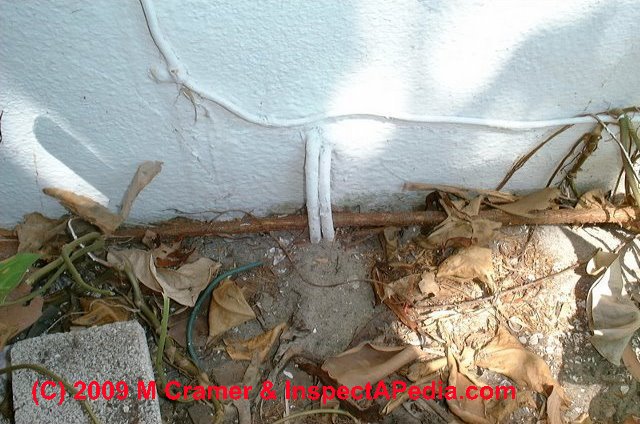
Evidence that a buried fuel storage tank exists at a property may be direct and visually obvious, or the evidence may be subtle. Mark Cramer's photo (left) shows a pair of painted-over copper pipes penetrating a building foundation wall close to ground level - a strong suggestion of a buried oil tank at this property.
Often a series of small observations, individually not apparently very important, can add up to an increased probability that a buried fuel storage tank is or was at a property.
While environmental investigators and oil tank test companies may use magnetic scanners or even ground scanning radar to locate buried steel tanks, an astute visual inspection can often discover the presence or probable presence of a buried fuel storage tank at a property, thus suggesting that further testing is definitely in order.
Beginning with a description of walking a building site for obvious signs of a buried oil tank, we include below photos and other clues that can point to the possible current or past presence of a buried tank at a property.
Inspect the Property where an Oil Tank Might Have Been Installed
How to Inspect the Grounds of Properties Where There are Known or Suspected Abandoned or Removed Oil Storage Tanks
Have all abandoned tank fill pipes been completely removed from the building to prevent mistaken delivery and spill into the building? Have old indoor tanks been removed or marked clearly as "Abandoned, DO NOT FILL" ?
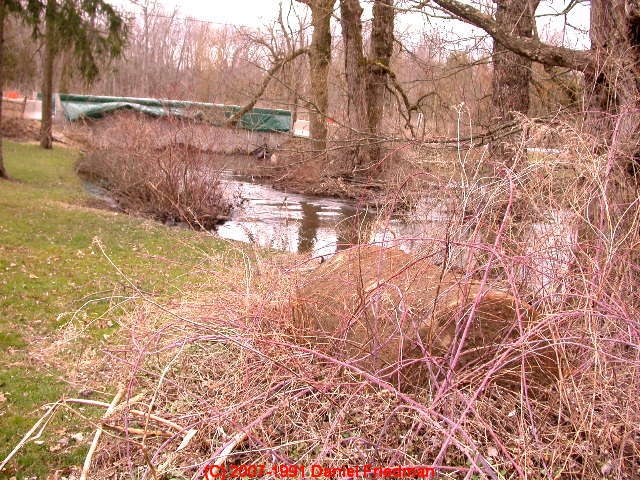
At this property in Rhinebeck, NY we had spotted oil filler and vent pipes inside the dense thicket along the creek.
A decade later during a period of local flooding the tank to which the oil pipes had been connected floated up out of the ground as shown in this photo. The owner no longer had an easy option of "hiding" the abandoned oil tank. Like a spring corpse it had floated to the surface.
If an outdoor buried oil tank has been properly abandoned at a property, the tank should have been excavated at its top, opened, emptied, cleaned, inspected for evidence of leaks, and then filled with an approved material (perhaps sand or a special foam) both to prevent re-use of the tank and to prevent a possibly dangerous future collapse of the old tank.
This procedure should have been performed by a qualified tank abandonment company, and documentation should be provided showing who did the work, when it was done, what inspections or tests were performed to assure that there was no evidence of oil tank leakage into the surrounding soil, and how the tank was filled-in.
If this documentation is not available for a property being purchased then the minimum prudent step would be to order a site inspection and soil testing for evidence of leakage.
Surface soil tests are not as important, in our opinion, as soil borings taken from the approximate depth of the bottom of the tank since that's where more problematic leakage would have occurred.
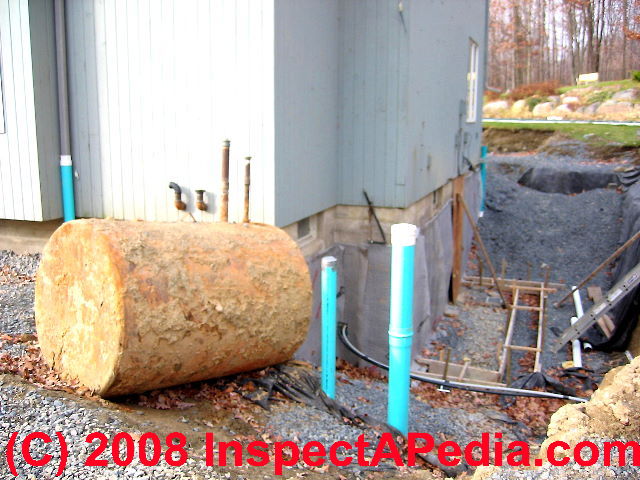
If a property seller will not permit site inspection and testing for oil leakage we would be concerned that the owner knows or suspects that a costly contamination issue is present.
One of our clients was told that she would not be permitted to perform any tests or inspections for oil tank leakage prior to purchase of the property - a sufficiently ominous warning that she did not complete the purchase.
We learned that a significant oil spill had occurred and that the owner had herself had removed the tank fill and vent piping, leaving a costly problem in-ground for the next owner.
Photographs of Outdoor Evidence of Buried Oil Tanks
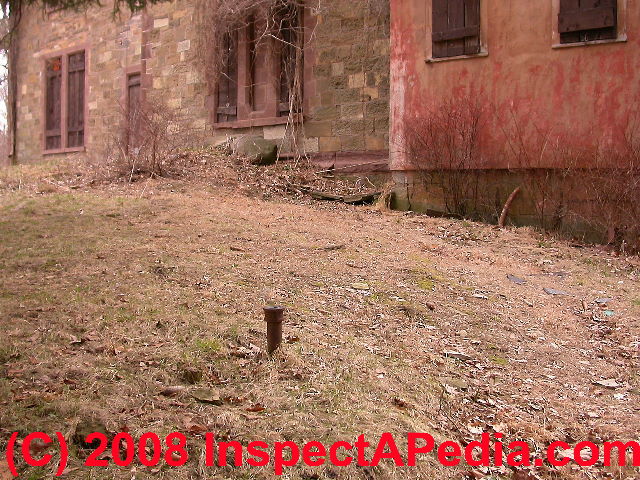
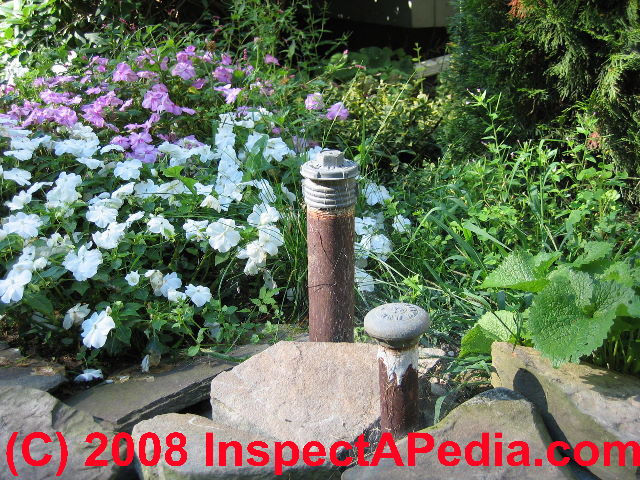
Visible oil tank fill or vent pipes protruding from the ground or flush with the ground anywhere on a property.
Oil fill pipes may be directly over a tank, near a tank, close to a building wall, or located at a considerable distance from the building and from the tank as well. Our photo (above left) shows an oil fill pipe located nearly 25 feet from a building exterior wall.
The combination of distance from the building and the type and size of building (large antique barn at an estate) hint that this may be a large buried oil tank.
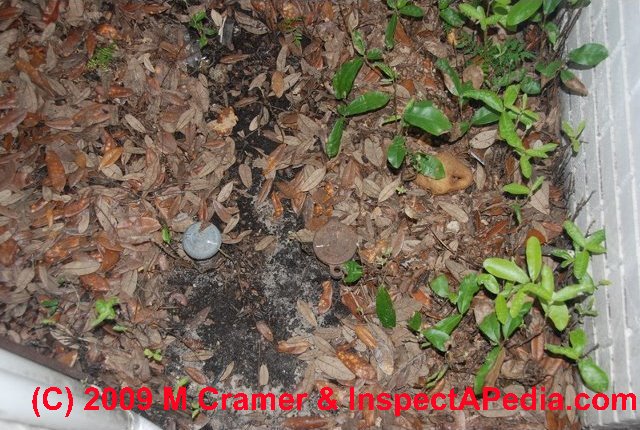
Tampa home inspector Mark Cramer's photo (above right) shows an oil tank fill pipe cap (rust-colored round object closer to the building wall) and an oil tank vent pipe cap (silver colored object) .
Placing the oil tank vent pipe cap at ground level was probably a cosmetic decision by the homeowner, but if that area of missing leaves marks a spill line from roof runoff, we're also asking for a problem with water in the oil tank at this home.

Curbside oil fill pipes: Look for remote & curbside oil filler pipes: In some neighborhoods we've observed oil fill valves located in a curb box at the street for oil tanks which were buried more than 75 feet away.
The vent pipe for an oil tank filled in this manner will probably be nowhere near the curb and may be not even too close to the oil tank. At the property served by this curbside oil tank filler, the tank was buried uphill near the home and the tank vent pipe appeared near the home's foundation wall.
Depressions near a building suggesting recent excavation, particularly if the depression is outside a wall where it would have been logical to install a buried tank, such as at a building foundation near the location of indoor current or previously installed oil-fired heating equipment.
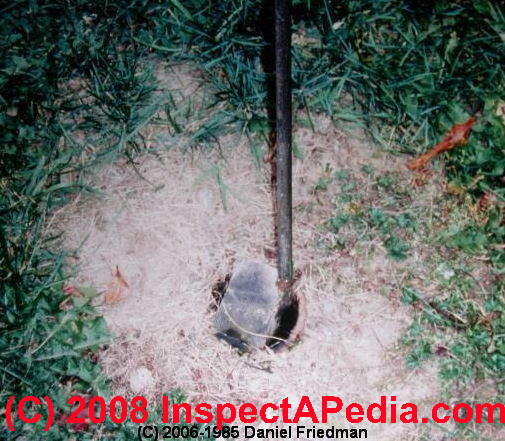
Areas of dead grass or plantings in a small spot where a buried or previous fuel tank fill pipe may have been installed - from spillage of fuel.
At one site this clue led to the discovery that the tank "removal" had consisted of nothing more than the unscrewing and removal of the fill and vent pipes from the leaky oil tank.
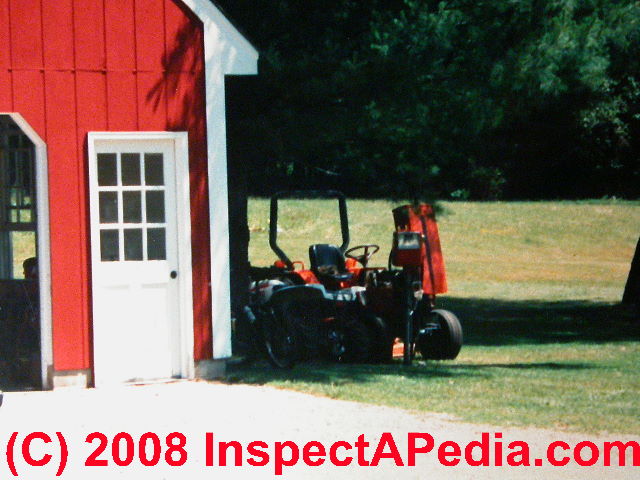
Age and type of property: often older buildings, farms, and commercial buildings will have had a buried
tank installed even if more recently the fuel has been converted from oil to gas. Our photo shows a red pump control in front of the mowing tractor to the right of this barn.
The pump served a buried diesel fuel tank used for farm equipment. At other properties where farm buildings were present buried diesel fuel tanks have been found with no initial evidence other than the age of the property and the probability that such tanks would have often been present close to farm buildings.
Sites distant from a village or town are more likely to have required a larger onsite fuel storage facility. Farms may also have
had fuel oil stored for diesel tractors or other farming equipment, so remember to look for clues of buried oil tanks at a central location near old farm buildings. Even if an old indoor oil tank is in view at an old property, don't assume that a still-older tank is not also buried nearby.

Oil Fill and Vent Piping Location:
In the confusing photo at left, we see an oil fill and vent pipe close to the building wall. We don't know if those pipes serve an indoor tank or a buried outdoor tank until we look further. But my black notepad in the photo lower left corner marks another vertical standpipe which could mark the end of a large underground oil storage tank.
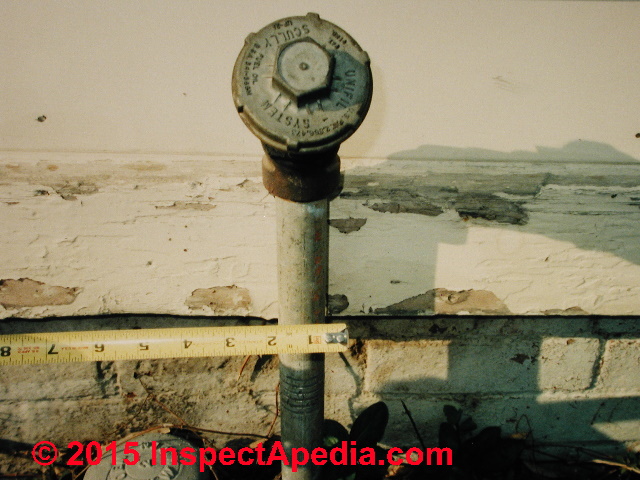
If the oil tank fill pipe is a straight line down from above ground into the tank, and if the tank is buried close to a building wall, measure the distance from the center of the fill pipe to the building wall.
If the distance is small, perhaps 20" or less, we suspect that an indoor-tank, not rated for outdoor use, may be buried there. The typical dimensions of a 250 or 275 gallon oil storage tank, usually oval in shape, are 5' long x 4' high (excluding legs or other support.)
These oil tanks are roughly 27" in width. The threaded tappings used to mount fill and
vent pipes are located in the center of the width of the fuel or heating oil storage tank.
A storage tank buried close to a building wall and with a fill pipe going straight down into the tank, would display a filler pipe which is as little as 14" from the building wall
(measured from the outside of the wall to the center of the filler pipe).
So if a filler pipe is located close to the wall and passes straight down into the tank, the distance can indicate the probable tank cross section or width and can indicate an indoor tank which has been improperly installed outside.

Unexplained oil tank vent pipes may be found at building foundation walls nowhere near currently-installed heating equipment or oil tanks.
Be sure to investigate pipes like the one in our photo at left. It may lead to a buried oil tank or to an oil tank which has been abandoned in a building crawl space.
Amateur oil piping installations may be found still in place. Is a buried oil tank still present or not?
This undersized oil filler line indicates either that the installation is quite old or that the plumbing was not done by a professional.
Similarly, you may trace oil piping to an old "lost" oil tank in an inaccessible or hidden crawl space or even a basement closet.
Follow backwards oil fill or vent piping or oil supply piping between to oil tank from he oil fired equipment it supplied.
Reader Comments, Questions & Answers About The Article Above
Below you will find questions and answers previously posted on this page at its page bottom reader comment box.
Reader Q&A - also see RECOMMENDED ARTICLES & FAQs
Reader Comment: Cut-off copper tubing leads to a buried oil tank
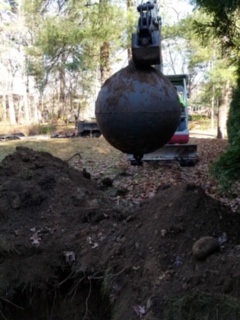 I was inspecting a home on the edge of a lake built in 1972. I saw evidence of copper fuel lines cut off penetrating the foundation of the home behind the oil boiler. ...
I searched around for some time with a ground probe, and eventually hit an object 18 inches below ground, but the size and shape was not consistent with a standard size and shape tank that would have been buried.
The tank is a 275 gallon Ball shaped tank. 'Ive never seen one before, and it resembled a wrecking ball.
Details are at SPHERICAL OIL STORAGE TANKS - the HORTON SPHERE
- David Grudzinski, Advantage Home Inspections,
ASHI cert # 249089, HUD cert# H-145, is a professional home inspector who contributes on various topics including structural matters.
David Grudzinski, Cranston RI serving both Rhode Island and Eastern Connecticut can be reached at 401-935-6547 fax- 401-490-0607 or by email to Davidgrudzinski@aol.com
Mr. Grudzinski is a regular contributor to InspectAPedia.com
BTW: a fellow inspector told me his parent were in the HVAC wholesale biz in the 50s and these ball shaped tanks were remnants of WW11 bomb casings that they decided to use as oil tanks. I thought that was awesome. Some old buoys were also made from them.
This article assists property buyers, owners, and inspectors in the location of buried oil tanks or the detection of evidence that an underground (or even an above ground) oil tank is or was in use at a property. This is a photo guide to finding buried oil storage tanks by visual inspection of the grounds around a home.
The article and photographs used to show the reader ways to find buried oil tanks include examples of clues leading to the discovery of "nearly hidden" buried or underground oil tanks which were found at residential properties and which avoided very costly surprises later for the new owner.
Underground oil storage tanks, or UST's, whether still present or previously removed, involve a risk of costly oil leaks and soil contamination which may need to be addressed. Here are investigation methods that any home buyer, owner, or home inspector can apply to reduce these risks by looking for evidence that a buried oil tank is or was at a property.
Question: we have a pipe sticking up out of the ground: now what?
(Nov 11, 2011) HELP! WE HAVE A PIPE JUST LIKE said:
Please help me. We have a pipe just like the one in the pictures in our cellar / basement of our century home - 110 years old.
A cap on the pipe sticking out of the later-poured concrete with exactly the same nut on top to open whatever it is...NOW WHAT?
Reply: hire an expert to perform an "oil tank sweep" to scan your property and locate this and any other buried oil tanks
Help:
Take a look at the buried oil tank location articles in the series given at the Recommended Articles section of this page. If your home has a buried tank that is no longer in use but that has not been properly abandoned, then you will want to do so.
Depending on where you live, experts who perform inspections or use equipment to scan a building site for evidence of buried oil tanks may refer to performing an oil tank sweep - described in more detail
at BURIED / UNDERGROUND OIL TANK (UST), LOCATION METHODS
...
Continue reading at BURIED / UNDERGROUND OIL TANK (UST), LOCATION METHODS or select a topic from the closely-related articles below, or see the complete ARTICLE INDEX.
Or see these
Recommended Articles
- ABOVE GROUND OUTDOOR OIL TANKS - outdoor above ground oil tank clearances, water contamination, additives
- BURIED OIL STORAGE TANKS (UST) GUIDE - home
- BURIED OIL TANK HISTORY REVIEW
- BURIED OIL TANKS, INDOOR CLUES
- BURIED OIL TANKS, OUTDOOR CLUES
- BURIED / UNDERGROUND OIL TANK (UST), LOCATION METHODS
- BURIED OIL TANK REPORTS
- BURIED OIL TANK WATER ENTRY
- OIL TANK HISTORY REVIEW
- SPHERICAL OIL STORAGE TANKS - the HORTON SPHERE
- OIL TANK LEAK / FAILURE RATES
Suggested citation for this web page
BURIED OIL TANKS, OUTDOOR CLUES at InspectApedia.com - online encyclopedia of building & environmental inspection, testing, diagnosis, repair, & problem prevention advice.
Or see this
INDEX to RELATED ARTICLES: ARTICLE INDEX to HEATING OIL, OIL BURNERS, OIL FIRED HEATERS, OIL TANKS
Or use the SEARCH BOX found below to Ask a Question or Search InspectApedia
Ask a Question or Search InspectApedia
Try the search box just below, or if you prefer, post a question or comment in the Comments box below and we will respond promptly.
Search the InspectApedia website
Note: appearance of your Comment below may be delayed: if your comment contains an image, photograph, web link, or text that looks to the software as if it might be a web link, your posting will appear after it has been approved by a moderator. Apologies for the delay.
Only one image can be added per comment but you can post as many comments, and therefore images, as you like.
You will not receive a notification when a response to your question has been posted.
Please bookmark this page to make it easy for you to check back for our response.
Our Comment Box is provided by Countable Web Productions countable.ca
Citations & References
In addition to any citations in the article above, a full list is available on request.
- [1] Fuel Storage] Tank Corrosion Study, U.S. EPA report on gasoline and oil tank corrosion, James H. Pim, P.E., John M. Searing, Suffolk County DOHS, 15 Horseblock Place, Farmingville Long Island, NY 11728, November 1988, for the Office of Underground Storage Tanks, U.S. EPA. ATTN: David O'Brien. The report presents a study of 500 underground storage tanks spanning 24 February 1987 and September 1 1988 and summarizes earlier reports on this same study. Tank sizes ranged from 175 gallons to 50,000 gallons, and oil tank ages ranged from two years to 70 years old. All 500 oil storage tanks were constructed of welded steel, and 12 other tanks that were other than plain steel were also examined. Summary [with minor edits for clarity by DJF]
- [3] "A Case Study of a Large Scale Precision [oil or fuel] Tank Testing Program", Diane H. Heck, Tetra Tech Richardson, Newark, Delaware, web search 4/27/12, original source: http://info.ngwa.org/GWOL/pdf/870143411.PDF, copy on file as /heating/OIl Tanks UST/Tank_Test_Heck_870143411.pdf
- [4] Fuel Oil and Oil Heat Magazine, August 1985 p.18. Fuel Oil & Oil Heating Magazine, 3621 Hill Rd., Parsippany, NJ 07054, 973-331-9545
- [5] Standards of the National Board of Fire Underwriters, as referenced by "Domestic and Commercial Oil Burners,", Charles H. Burkhardt, 1961, 3rd Ed., McGraw Hill Book Company, p. 172
- [6] NFPA - the National Fire Protection Association can be found online at www.nfpa.org
- [7] "The Interim Prohibition Guidance for Design and Installation of Underground Oil Storage Tanks", U.S. EPA, EPA/530-SW-85203, Office of Underground Storage Tanks, Washington D.C.
- In addition to citations & references found in this article, see the research citations given at the end of the related articles found at our suggested
CONTINUE READING or RECOMMENDED ARTICLES.
- Carson, Dunlop & Associates Ltd., 120 Carlton Street Suite 407, Toronto ON M5A 4K2. Tel: (416) 964-9415 1-800-268-7070 Email: info@carsondunlop.com. Alan Carson is a past president of ASHI, the American Society of Home Inspectors.
Thanks to Alan Carson and Bob Dunlop, for permission for InspectAPedia to use text excerpts from The HOME REFERENCE BOOK - the Encyclopedia of Homes and to use illustrations from The ILLUSTRATED HOME .
Carson Dunlop Associates provides extensive home inspection education and report writing material. In gratitude we provide links to tsome Carson Dunlop Associates products and services.
 | HOME | ABOUT | ASK a QUESTION | CONTACT | CONTENT USE POLICY | DESCRIPTION | POLICIES | PRIVACY | |
| © 2024 - 1985 Publisher InspectApedia.com - Daniel Friedman | |||||||||