InspectAPedia.com InspectAPedia®
Google
InspectAPedia
 

Free Encyclopedia of Building & Environmental Inspection, Testing, Diagnosis, Repair

Ask a Question or Search InspectAPedia

  • HOME
  • AIR CONDITIONING
  • DAMAGE ASSESSMENT
  • ELECTRICAL
  • EXTERIORS
  • HEATING
  • HOME INSPECTION
  • INTERIORS
  • PLUMBING
  • ROOFING
  • SEPTIC SYSTEMS
  • STRUCTURE
  • WATER SUPPLY
  • ENERGY SAVINGS
  • ENVIRONMENT
  • INDOOR AIR IAQ
  • INSULATION
  • MOLD INSPECT TEST REMOVE
  • NOISE
  • ODORS
  • SOLAR ENERGY
  • VENTILATION
  • EXPERTS DIRECTORY
  • CONTACT US


InspectAPedia ® Home

HEATING SYSTEMS

AFUE DEFINITION, RATINGS
AGE of AIR CONDITIONERS & HEAT PUMPS
AGE of HEATERS, BOILERS, FURNACES
AIR CONDITIONING & HEAT PUMP SYSTEMS
AIR FILTERS for HVAC SYSTEMS
AIR FLOW MEASUREMENT CFM
AIR HANDLER / BLOWER UNITS
AIRBOUND HEAT SYSTEM REPAIRS
ANODES & DIP TUBES on WATER HEATERS
ANTIFREEZE for BOILERS
ANTI SCALD VALVES
APPLIANCE EFFICIENCY RATINGS
ASBESTOS IDENTIFICATION IN buildings

BACKDRAFTING HEATING EQUIPMENT
BACKFLOW PREVENTER VALVE, HEATING SYS
BACKFLOW PREVENTER, HEATER WATER FEEDER
BACKUP HEAT for HEAT PUMPS
BAROMETRIC DAMPERS
BASEBOARD HEAT
BIOGAS PRODUCTION & USE
BLEVE EXPLOSIONS
BLOWER DOORS & AIR INFILTRATION
BLOWER FAN CONTINUOUS OPERATION
BLOWER FAN OPERATION & TESTING
BLUE vs YELLOW COMBUSTION FLAMES
BLUERAY Recall
BOILERS, HEATING
BOILER CHEMICAL TREATMENTS
BOILER COMPONENTS & PARTS
BOILER CONTROLS & SWITCHES
BOILER LEAKS CORROSION STAINS
BOILER LEAKS, HOW TO LOCATE
BOILER NOISE SMOKE ODORS
BOILER OPERATING PROBLEMS
BOILER OPERATION DETAILS
BOILER PRESSURE & TEMPERATURE SETTINGS
BOOKSTORE - InspectAPedia
BTU USAGE MONITORS
BUILDING SAFETY HAZARDS GUIDE

CAPACITORS for HARD STARTING MOTORS
CARBON DIOXIDE - CO2
CARBON MONOXIDE - CO
CHEMICAL TREATMENTS for BOILERS
CHIMNEY INSPECTION DIAGNOSIS REPAIR
CHIMNEYS & Flues - Asbestos Transite Pipe
CHINESE DRYWALL HAZARDS
CIRCULATOR PUMPS & RELAYS
COOL OFF HEAT, Thermostat Switch
COMBUSTION AIR
COMBUSTION PRODUCTS & IAQ
COMPLETE COMBUSTION, Stoichiometric
CREOSOTE FIRE HAZARDS
Curved Brick Chimneys - Sulphation
CONDENSING BOILERS/FURNACES
CONDENSING BOILERS/FURNACES DAMAGE
CONVECTOR HEATERS - HYDRONIC COILS

DEFINITION of Heating & Cooling Terms
DIAGNOSE & FIX AIR CONDITIONER / HEAT PUMP
DIAGNOSE & FIX HEATING PROBLEMS-BOILER
DIAGNOSE & FIX HEATING PROBLEMS-FURNACE
DIRECT VENTS / SIDE WALL VENTS
DIRECTORY of OIL TANK EXPERTS
DRAFT HOODS - gas fired
DRAFT MEASUREMENT, CHIMNEYS & FLUES
DRAFT REGULATORS, DAMPERS, BOOSTERS
DUCT INSULATION, Asbestos Paper
DUCT SYSTEM & DUCT DEFECTS
DUCTS, Asbestos Transite Pipe
DUST, HVAC CONTAMINATION STUDY
DUST SAMPLING PROCEDURE

ELECTRIC HEAT, DIAGNOSIS, REPAIR
ELECTRIC MOTOR DIAGNOSTIC GUIDE
ELECTRIC MOTOR OVERLOAD RESET SWITCH
ELECTRICAL POWER SWITCH FOR HEAT
EVAPORATIVE COOLING SYSTEMS

FAN, AIR HANDLER BLOWER UNIT
FAN AUTO ON Thermostat Switch
FAN, COMPRESSOR/CONDENSER UNIT
FAN CONVECTOR HEATERS - HYDRONIC COILS
FAN LIMIT SWITCH
FAN NOISES
FILTERS, AIR for HVAC SYSTEMS
FILTERS, OIL on HEATING EQUIPMENT
FIRE SAFETY CONTROLS
FIREPLACES & HEARTHS
FLAME COLOR, BLUE vs YELLOW COMBUSTION
FLOODED HEATING EQUIPMENT REPAIR
FLOODED WATER HEATER REPAIR
FLUE VENT CONNECTORS
FREEZE-PROOF A BUILDING
FUEL OIL TYPES & CHARACTERISTICS
FUEL UNIT, HEATING OIL PUMPS
FURNACES, HEATING
FURNACE CONTROLS & SWITCHES
FURNACE EFFICIENCY, HIGH vs MID
FURNACE HEAT EXCHANGER LEAKS
FURNACE OPERATION DETAILS
FURNACE OPERATING TEMPERATURES

GALVANIC SCALE & METAL CORROSION
GAS BURNER Flame & Noise Defects
GAS FIRED WATER HEATERS
GAS PIPING, VALVES, CONTROLS
GAUGES ON HEATING EQUIPMENT

HEAT LOSS in BUILDINGS
HEAT LOSS DETECTION TOOLS
HEAT LOSS INDICATORS
HEAT LOSS PREVENTION PRIORITIES
HEAT LOSS R U & K VALUE CALCULATION
HEAT PUMPS, DIAGNOSIS, REPAIR
HEAT TAPES & CABLES on Roofs for Ice Dams
HEATING COST FUEL & BTU Cost Table
HEATING COST SAVINGS METHODS
HEATING LOSS DIAGNOSIS-BOILERS
HEATING LOSS DIAGNOSIS-FURNACES
HEATING OIL CLOUD WAX GEL POINT
HEATING OIL EXPOSURE HAZARDS, LIMITS
HEATING OIL - OLD, USEABLE?
HEATING OIL PIPING TROUBLES
HEATING OIL SHELF LIFE
HEATING OIL SLUDGE
HEATING OIL USAGE RATE
HEATING SMALL LOADS
HEATING SYSTEM NOISES
HEATING SYSTEM INSPECT DIAGNOSE REPAIR
HOT WATER HEATERS
HOT WATER IMPROVEMENT

INSULATION INSPECTION & IMPROVEMENT

LOW VOLTAGE BUILDING WIRING
LOW VOLTAGE TRANSFORMER TEST
LP & Natural Gas Safety Hazards

MANUALS & PARTS GUIDES - HVAC
MIXING / ANTI-SCALD VALVES
MOTOR OVERLOAD RESET SWITCH

Natural Gas Combustion Products
NO HEAT - BOILER
NO HEAT - FURNACE
NOISE / SOUND DIAGNOSIS & CURE
NOISE AIR CONDITIONER / HEAT PUMP
NOISE, DUCT VIBRATION DAMPENERS
NOISE, HEATING SYSTEMS
NOISE, PLUMBING
NOISE, WATER HEATER

ODORS GASES SMELLS, DIAGNOSIS & CURE
ODORS FROM HEATING SYSTEMS
OIL BURNERS
OIL BURNER FUEL UNIT
OIL BURNER INSPECTION & REPAIR
OIL BURNER NOISE SMOKE ODORS
OIL BURNER NOZZLE & ELECTRODES
OIL BURNERS, RETENTION HEAD
OIL BURNER SOOT & PUFFBACKS
OIL FILTERS on HEATING EQUIPMENT
OIL FILTER MISSING
OIL FUEL TYPES & CHARACTERISTICS
OIL HEAT FIRE SAFETY CONTROLS
OIL LINE CLOGGING FIX
OIL LINE QUICK STOP VALVES
OIL LINE SAFETY VALVES
OIL ODORS, LEAKY OIL TANK PIPING
OIL PUMP FUEL UNIT
OIL SPILL CLEANUP / PREVENTION
OIL TANKS

PLASTIC HEATER VENT
PULSE COMBUSTION HEATERS
PASCAL CALCULATIONS
PRESSURE REDUCING VALVES
PRESSURE REGULATOR, WATER
PUFFBACKS, OIL BURNER
PUMPS, PONY PUMPS

RADIANT BARRIERS
RADIANT HEAT
RADIANT HEAT Floor Mistakes to Avoid
RADIANT HEAT TEMPERATURES
RADIANT SLAB FLOORING CHOICES
RADIANT SLAB TUBING & FLUID CHOICES
RADIATORS

RELIEF VALVE LEAKS
RELIEF VALVES - TP Valves on Boilers
RELIEF VALVES - STEAM TP VALVES
RELIEF VALVES - Water Heaters
RELIEF VALVES - Water Tanks

Reset Switch - Heater Primary Control
Reset Switch Broken - Quick Repair
RESET SWITCH - ELECTRIC MOTOR
Reset Switch - Stack Relays

SAFETY HAZARDS & INSPECTIONS
SAFETY HAZARDS GUIDE
SAFETY, HEATING INSPECTION
SAFETY RECALLS, Chimneys, Vents, Heaters
SOLAR HEATING SYSTEM DESIGNS
SOOT on OIL FIRED HEATING EQUIPMENT
SPILL SWITCHES - Flue Gas Detection
SPLIT SYSTEM AIR CONDITIONERS & HEAT PUMPS
STACK RELAY SWITCHES
STAIN DIAGNOSIS on BUILDING INTERIORS
STEAM HEATING SYSTEMS

TANKLESS COILS
Thermal Expansion Cracking of Brick
THERMAL EXPANSION of HOT WATER
THERMAL EXPANSION of MATERIALS
THERMAL IMAGING, THERMOGRAPHY
THERMAL IMAGING MOLD SCANS
THERMAL MASS in BUILDINGS
THERMAL TRACKING & HEAT LOSS
THERMOSTATS, HEATING / COOLING
Transite Pipe Chimneys & FlueS

VIDEO GUIDES: Heating System Videos
VIDEO GUIDES - InspectAPedia.com

WATER HEATERS
WATER HEATER SAFETY
WATER HEATERS for HOME HEATING USE?
WATER HEATER NOISES
WATER HEATER SCALE - De-Liming Procedure
WATER HEATER SCALE PREVENTION
WINTERIZE A BUILDING
WOOD, COAL STOVES & FIREPLACES
WOOD STOVE SAFETY

ZONE DAMPERS
ZONE VALVES

More Information

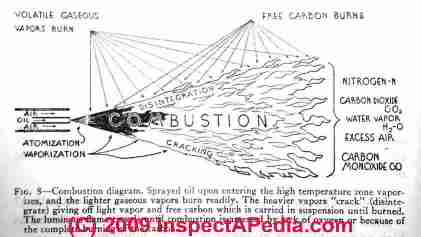
Oil burner gun operation (C) D Friedman - AudelStoichiometric Combustion: Perfect Fuel Combustion for Gas or Oil Burners
     

  • COMPLETE COMBUSTION, Stoichiometric - What is the definition of Stoichiometric Combustion
    • Theoretical Fuel to Air Ratios for Complete Combustion (Stoichiometric Combustion)
    • Oil Burners: characteristics of perfect combustion of fuel
      Gas Burners: characteristics of perfect combustion of fuel
      Oil Burners: Guide to Oil Burners for heating systems, boilers & Furnaces: basic parts, operation, maintenance, performance & money-saving tips
    • Optimal fuel combustion process, boiler or furnace efficiency
  • BLUE vs YELLOW COMBUSTION FLAMES - separate article
  • BLUERAY Recall - separate article
  • COMBUSTION AIR - separate article
  • COMBUSTION PRODUCTS & IAQ - separate article
  • FURNACES & IAQ - separate article
  • Questions & Answers about heating oil or gas fuel combustion - perfect or stoichiometric combustion.
  • References

Click to Show or Hide Related Topics

  • GAS DETECTION INSTRUMENTS - home
    • COLORIMETRIC GAS DETECTION TUBES
    • Drager GAS DETECTORS
    • GAUGE, REFRIGERATION PRESSURE TEST
    • GAS DETECTOR WARNINGS
    • GAS DETECTOR TUBE WARNINGS
    • TIF 5000 GAS DETECTOR
    • TIF 8800 GAS DETECTOR
  • BACKDRAFTING HEATING EQUIPMENT
  • BLUE vs YELLOW COMBUSTION FLAMES
  • CARBON DIOXIDE - CO2
  • CARBON MONOXIDE - CO
  • CARBON MONOXIDE WARNING
  • COALSTOVE SAFETY
  • COMBUSTION PRODUCTS & IAQ
  • COMBUSTION GASES & PARTICLE HAZARDS
  • DEFECTS LIST - HEAT SPACE & FIREPLACE, GAS
  • DRAFT HOODS - gas fired
  • DRAFT MEASUREMENT, CHIMNEYS & FLUES
  • DRAFT REGULATORS, DAMPERS, BOOSTERS
  • EMERGENCY RESPONSE, IAQ, GAS, MOLD
  • FLAME COLOR, BLUE vs YELLOW COMBUSTION
  • FORMALDEHYDE HAZARDS
  • FORMALDEHYDE GAS HAZARD REDUCTION
  • GAS EXPOSURE EFFECTS, TOXIC
  • GAS EXPOSURE LIMITS & STANDARDS
  • GAS EXPOSURE SCREENING TEST
  • GAS LP & Natural Gas Safety Hazards
  • GAS LP & Natural Gas Pressures
  • GAS PIPING, VALVES, CONTROLS
  • HEAT EXCHANGER LEAK TEST
  • INDOOR AIR QUALITY & HOUSE TIGHTNESS
  • METHANE GAS SOURCES
  • MVOCs & MOLDY MUSTY ODORS
  • ODORS GASES SMELLS, DIAGNOSIS & CURE
  • ODORS IN WATER
  • OXYGEN - O2
  • OZONE as a "CURE" for MOLD or ODORS
  • OZONE AIR PURIFIER WARNINGS
  • OZONE EXPOSURE STANDARDS
  • OZONE HAZARDS
  • OZONE MSDS
  • OZONE ODORS, MOLD, REFS
  • OZONE TESTS
  • OZONE TOXICITY
  • SAFETY RECALLS, Chimneys, Vents, Heaters
  • SEPTIC METHANE GAS
  • SEWER GAS ODORS
  • SULPHUR & SEWER GAS SMELL SOURCES
InspectAPedia tolerates no conflicts of interest. We have no relationship with advertisers, products, or services discussed at this website.

Here, courtesy of aerospace engineer Herman Vogel, we provide a definition of Stoichiometric Combustion and we explain and give formulas for Theoretical Fuel to Air Ratios for Complete Combustion (Stoichiometric Combustion). Stoichiometric Combustion discusses theoretical fuel to air ratios for hydrocarbon fuels (kerosene, jet fuel, heating oil, LP gas, etc) in which a fuel is burned completely, producing only carbon dioxide and water, with no other byproducts. Our sketch (page top) shows how an oil burner gun atomizes and sprays heating oil into the combustion chamber - Audel Oil Burner Guide

Green links show where you are. © Copyright 2013 InspectAPedia.com, All Rights Reserved. Author Daniel Friedman.

Theoretical Fuel to Air Ratios for Complete Combustion (Stoichiometric Combustion)

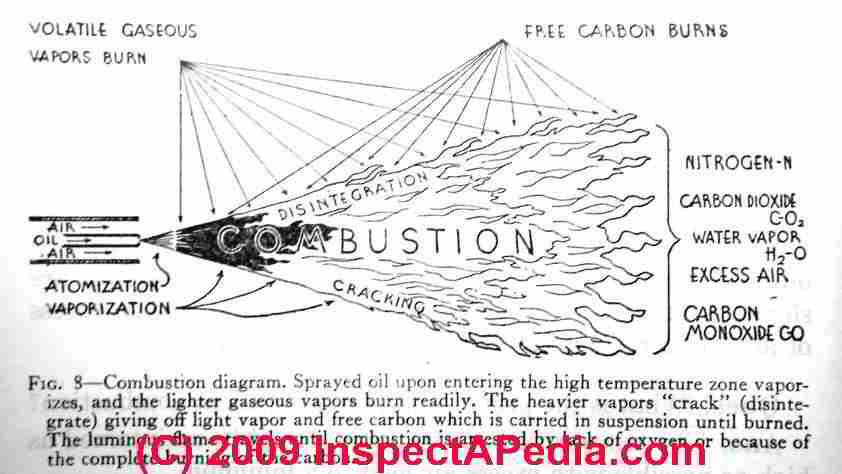
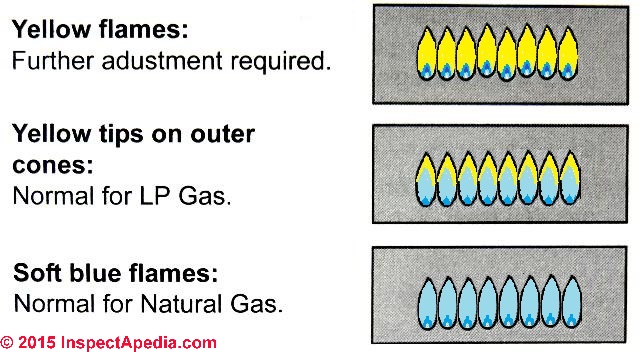
Photograph of  this gas flame which gives a clue that there may be an operating problem and an unsafe gas furnace in this buildingThis website answers most questions about central heating and water heating systems to aid in troubleshooting, inspection, diagnosis, and repairs. Contact us to suggest text changes and additions and, if you wish, to receive online listing and credit for that contribution.

Herman Vogel, Aerospace Engineer

In brief: Stoichiometric combustion is by thermodynamic definition the theoretical combustion of every drop of fuel when mixed with the correct amount of air (oxygen) to yield exhaust products of only CO2 and H2O.

Stoichiometric combustion is by thermodynamic definition the theoretical combustion of every drop of fuel when mixed with the correct amount of air (a basic mixture of oxygen and nitrogen gases) to yield exhaust products of only CO2 and H2O. However, such combustion is ideal and in reality doesn't occur since the burning in furnaces, automobiles and jet-engines is always incomplete and less than 100% due to engineering design limitations.

Therefore while our two ideal exhaust products are relatively benign, non-stoichiometric combustion rules in the real world. This results in burning rich, as no matter how much extra air we cleverly add, it is never able to chemically react with all the fuel. Hence the resultant unburned fuel gets exposed to the high combustion temperatures and chemically reacts to form additional exhaust products of CO (Carbon Monoxide) and NO (Nitric Oxide), which can be dangerous exhaust products to both people and the environment.
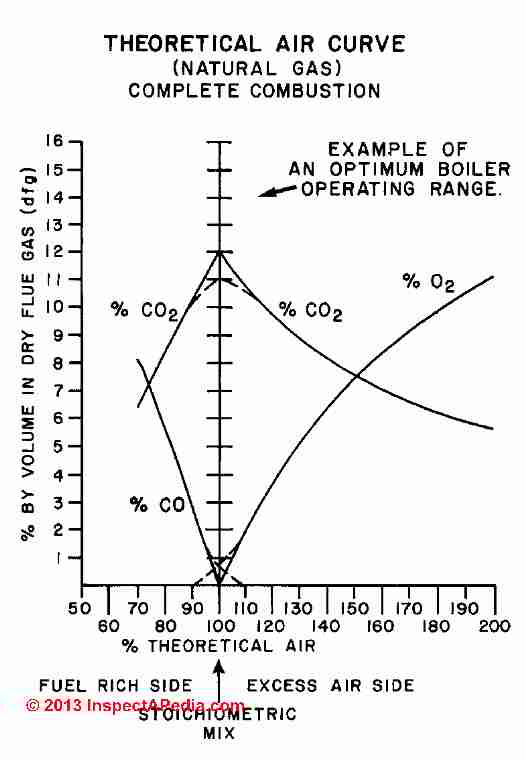
Theoretical air curve fdor complete combustion of natural gas (C) InspectApediaStoichiometric combustion has a chemical reaction equation attached to it:

C12H26(l) + 37/2 O2(g) + 2(37) N2(g) → 12 CO2(g) + 13 H2(g) + 2(37) N2(g)

For the above chemical reaction to be complete, both sides of the equation (about the arrow) must have its chemical elements matched. So, if the left-side has 12 Carbon molecules, then the right-side must also have 12.

Note that we are using air which contains a weighted ratio of N2/O2 = 2x37 / (37/2) = 4 (100% air = 80% N2 + 20% O2), or four times as much Nitrogen exists in a given volume of air as does Oxygen.

Also, the above chemical reaction equation represents kerosene fuel which is considered a Dodecanese (liquid) hydrocarbon having the chemical formula C12H26.

That means it contains a molecular composition of 12-carbon atoms and 26-hydrogen atoms and is a liquid at room temperature.

Kerosene is the main constituent of Jet Propulsion (JP) fuels, where other additives include various blends of differently distilled crude oils.

The fuel to air ratio by chemical weight of the above relationship is:

Theoretical air curve fdor complete combustion of fuel oil (C) InspectApediaFAR = [mf_C12H26 / ma_O2+N2] = (12*12.011+26*1.008)/(37/2*32+2*37*28.014) = 0.064 or 6.4%

This says that for complete combustion of typical hydrocarbon fuels, and in particular kerosene, we need 6.4 lbs. of fuel for every 100 lbs. of air that we burn. Clearly, on a relative basis, we need a lot of air to completely burn our small amount of fuel.

The beauty of the above chemical equation is that not only does it define the required fuel-to-air ratio, but it also provides us with:

  1. The expectant adiabatic (pure, no losses in heat) flame temperature released by this chemical reaction as based on chemical heats of formation (4,310 R), and
  2. The heating value released per pound of kerosene (18,950 BTU/lbs.) as based on its chemical formulation plus heat of formation.

Technical Note: The temperature above is in units of R (Rankin) not (F). If it were F (farenheit) we have 4,310R - 460R = 3,850F.

What Does Complete Combustion (Stoichiometric Combustion) Mean to the Heating System Designer?

The above three pieces of information helps the furnace designer to properly size combustion chambers and their air-fans, and to burn the correct amount of fuel to keep a home comfortable. It also helps the designer to choose the appropriate materials to avoid furnace melt-down. Note that the theoretical adiabatic flame temperature is very high.

While some of this temperature is reduced due to furnace heat losses, flame temperatures are generally controlled by intentionally burning lean. This dramatically reduces the theoretical flame temperature based on the lean chemistry of combustion, plus additional temperature reductions are realized by diluting high temperatures using the extra cold air entering the combustion chamber.

So, the furnace designer has a whole arsenal of possibilities to work with in designing today's reliable fuel oil furnaces.


Frequently Asked Questions (FAQs) about complete combustion of natural gas, LP gas, or home heating oil: the definition & explanation of stoichiometric combustion

...

Ask a Question or Search InspectApedia

Questions & answers or comments about heating oil or gas fuel combustion - perfect or stoichiometric combustion. .

Ask a Question or Enter Search Terms in the InspectApedia search box just below.

Technical Reviewers & References

Related Topics, found near the top of this page suggest articles closely related to this one.

  • Thanks to aerospace engineer Herman Vogel, July 2010, for providing this explanation of complete combustion of fossil fuels and the details as well as the significance (to non-engineers) of Stoichiometric Combustion
  • Audels Oil Burner Guide, Installation, Servicing, Repairing, Frank D. Graham, 1940's edition (obsolete). Updated versions of this guide are available in various editions, 1947, 1950, 1955, 1958, 1959, 1962, 1965, 1967, and at prices from around $3.00 to nearly $70.00 - useful for simple, clear, but not current, explanation of how heating equipment works. The original retail price was $1.00. Used copies are available at Amazon.com
  • Mark Cramer Inspection Services Mark Cramer, Tampa Florida, Mr. Cramer is a past president of ASHI, the American Society of Home Inspectors and is a Florida home inspector and home inspection educator. Mr. Cramer serves on the ASHI Home Inspection Standards. Contact Mark Cramer at: 727-595-4211 mark@BestTampaInspector.com
  • John Cranor is an ASHI member and a home inspector (The House Whisperer) is located in Glen Allen, VA 23060. He is also a contributor to InspectApedia.com in several technical areas such as plumbing and appliances (dryer vents). Contact Mr. Cranor at 804-747-7747 or by Email: johncranor@verizon.net
  • Carson, Dunlop &
Associates Ltd., TorontoCarson, Dunlop & Associates Ltd., 120 Carlton Street Suite 407, Toronto ON M5A 4K2. (416) 964-9415 1-800-268-7070 info@carsondunlop.com. The firm provides professional home inspection services & home inspection education & publications. Alan Carson is a past president of ASHI, the American Society of Home Inspectors. Thanks to Alan Carson and Bob Dunlop, for permission for InspectAPedia to use text excerpts from The Home Reference Book & illustrations from The Illustrated Home. Carson Dunlop Associates' provides:
    • Commercial Building Inspection Courses - protocol ASTM Standard E 2018-08 for Property Condition Assessments
    • Home Inspection Education Courses including home study & live classes at eleven colleges & universities.
    • Home Inspection Education Home Study Courses - ASHI@Home Training 10-course program.
      Special Offer: Carson Dunlop Associates offers InspectAPedia readers in the U.S.A. a 5% discount on these courses: Enter INSPECTAHITP in the order payment page "Promo/Redemption" space. InspectAPedia.com editor Daniel Friedman is a contributing author.
    • The Home Reference Book, a reference & inspection report product for building owners & inspectors.
      Special Offer: For a 10% discount on any number of copies of the Home Reference Book purchased as a single order. Enter INSPECTAHRB in the order payment page "Promo/Redemption" space. InspectAPedia.com editor Daniel Friedman is a contributing author.
    • The Home Reference eBook, an electronic version for PCs, the iPad, iPhone, & Android smart phones.
      Special Offer: For a 5% discount on any number of copies of the Home Reference eBook purchased as a single order. Enter inspectaehrb in the order payment page "Promo/Redemption" space.
    • The Illustrated Home illustrates construction details and building components, a reference for owners & inspectors.
      Special Offer: For a 5% discount on any number of copies of the Illustrated Home purchased as a single order Enter INSPECTAILL in the order payment page "Promo/Redemption" space.
    • The Horizon Software System manages business operations,scheduling, & inspection report writing using Carson Dunlop's knowledge base & color images. The Horizon system runs on always-available cloud-based software for office computers, laptops, tablets, iPad, Android, & other smartphones.

Books & Articles on Building & Environmental Inspection, Testing, Diagnosis, & Repair

  • Our recommended books about building & mechanical systems design, inspection, problem diagnosis, and repair, and about indoor environment and IAQ testing, diagnosis, and cleanup are at the InspectAPedia Bookstore. Also see our Book Reviews - InspectAPedia.
  • Home Reference Book - Carson DunlopThe Home Reference Book - the Encyclopedia of Homes, Carson Dunlop & Associates, Toronto, Ontario, 25th Ed., 2012, is a bound volume of more than 450 illustrated pages that assist home inspectors and home owners in the inspection and detection of problems on buildings. The text is intended as a reference guide to help building owners operate and maintain their home effectively. Field inspection worksheets are included at the back of the volume. Special Offer: For a 10% discount on any number of copies of the Home Reference Book purchased as a single order. Enter INSPECTAHRB in the order payment page "Promo/Redemption" space. InspectAPedia.com editor Daniel Friedman is a contributing author.

    Or choose the The Home Reference eBook for PCs, Macs, Kindle, iPad, iPhone, or Android Smart Phones. Special Offer: For a 5% discount on any number of copies of the Home Reference eBook purchased as a single order. Enter INSPECTAEHRB in the order payment page "Promo/Redemption" space.

  • GO TO Carson Dunlop's Home Study Course Information - How to Become a Home Inspector: Carson Dunlop's nationally recognized Home Study Course, selected by ASHI the American Society of Home Inspectors and other professionals and associations. This website author is a contributor to this course.
  • GO TO Carson Dunlop's Home Study Course Information - How to Become a Home Inspector: Carson Dunlop's nationally recognized Home Study Course, selected by ASHI the American Society of Home Inspectors and other professionals and associations. This website author is a contributor to this course.
  • GO TO Carson Dunlop's Home Study Course Information - How to Become a Home Inspector: Carson Dunlop's nationally recognized Home Study Course, selected by ASHI the American Society of Home Inspectors and other professionals and associations. This website author is a contributor to this course.
    Building inspection education & report writing systems from Carson, Dunlop & Associates Ltd
  • Carson Dunlop, Associates, Toronto, have provided us with (and we recommend) Carson Dunlop Weldon & Associates' Technical Reference Guide to manufacturer's model and serial number information for heating and cooling equipment
    Special Offer
    : Carson Dunlop Associates offers InspectAPedia readers in the U.S.A. a 5% discount on any number of copies of the Technical Reference Guide purchased as a single order. Just enter INSPECTATRG in the order payment page "Promo/Redemption" space.

  • Carbon Monoxide Gas Toxicity, exposure limits, poisoning symptoms, and inspecting buildings for CO hazards
  • DUST, HVAC CONTAMINATION STUDY An Investigation of Indoor Dust Debris Blamed on a Heating/Cooling System Reveals Carpet Dust
  • Fuel Oil & Oil Heating Magazine, 3621 Hill Rd., Parsippany, NJ 07054, 973-331-9545
  • Goodman Furnace High Temperature Plastic Vent HTPV safety recall US CPSC notice
  • Home Heating System Should Be Checked [for proper venting and for CO Carbon Monoxide Hazards - DJF]
  • Inspection Procedures for Oil-Fired Heating Systems Detailed step by step approaches for inspecting complex systems]
  • Lennox Pulse Furnace Safety Inspection/Warranty Program: Carbon Monoxide Warning
  • Oil Tanks - The Oil Storage Tank Information Website: Buried or Above Ground Oil Tank Inspection, Testing, Cleanup, Abandonment of Oil Tanks
  • Oil Tanks Above Ground, UL Standards, guidance for home owners, buyers, and inspectors
  • Plastic Heating Vent Pipe & Other Heating Safety Recall Notices
  • Weil McLain Model GV Gas Boiler/gas valve CPSC recall/repair
  • Domestic and Commercial Oil Burners, Charles H. Burkhardt, McGraw Hill Book Company, New York 3rd Ed 1969.
  • National Fuel Gas Code (Z223.1) $16.00 and National Fuel Gas Code Handbook (Z223.2) $47.00 American Gas Association (A.G.A.), 1515 Wilson Boulevard, Arlington, VA 22209 also available from National Fire Protection Association, Batterymarch Park, Quincy, MA 02269. Fundamentals of Gas Appliance Venting and Ventilation, 1985, American Gas Association Laboratories, Engineering Services Department. American Gas Association, 1515 Wilson Boulevard, Arlington, VA 22209. Catalog #XHO585. Reprinted 1989.
  • The Steam Book, 1984, Training and Education Department, Fluid Handling Division, ITT [probably out of print, possibly available from several home inspection supply companies] Fuel Oil and Oil Heat Magazine, October 1990, offers an update,
  • Principles of Steam Heating, $13.25 includes postage. Fuel oil & Oil Heat Magazine, 389 Passaic Ave., Fairfield, NJ 07004.
  • The Lost Art of Steam Heating, Dan Holohan, 516-579-3046 FAX
  • Principles of Steam Heating, Dan Holohan, technical editor of Fuel Oil and Oil Heat magazine, 389 Passaic Ave., Fairfield, NJ 07004 ($12.+1.25 postage/handling).
  • "Residential Steam Heating Systems", Instructional Technologies Institute, Inc., 145 "D" Grassy Plain St., Bethel, CT 06801 800/227-1663 [home inspection training material] 1987
  • "Residential Hydronic (circulating hot water) Heating Systems", Instructional Technologies Institute, Inc., 145 "D" Grassy Plain St., Bethel, CT 06801 800/227-1663 [home inspection training material] 1987
  • "Warm Air Heating Systems". Instructional Technologies Institute, Inc., 145 "D" Grassy Plain St., Bethel, CT 06801 800/227-1663 [home inspection training material] 1987
  • Heating, Ventilating, and Air Conditioning Volume I, Heating Fundamentals,
  • Boilers, Boiler Conversions, James E. Brumbaugh, ISBN 0-672-23389-4 (v. 1) Volume II, Oil, Gas, and Coal Burners, Controls, Ducts, Piping, Valves, James E. Brumbaugh, ISBN 0-672-23390-7 (v. 2) Volume III, Radiant Heating, Water Heaters, Ventilation, Air Conditioning, Heat Pumps, Air Cleaners, James E. Brumbaugh, ISBN 0-672-23383-5 (v. 3) or ISBN 0-672-23380-0 (set) Special Sales Director, Macmillan Publishing Co., 866 Third Ave., New York, NY 10022. Macmillan Publishing Co., NY
  • Installation Guide for Residential Hydronic Heating Systems
  • Installation Guide #200, The Hydronics Institute, 35 Russo Place, Berkeley Heights, NJ 07922
  • The ABC's of Retention Head Oil Burners, National Association of Oil Heat Service Managers, TM 115, National Old Timers' Association of the Energy Industry, PO Box 168, Mineola, NY 11501. (Excellent tips on spotting problems on oil-fired heating equipment. Booklet.)
  • Links to our list of additional information on heating system inspection, repair, maintenance
  • ...

HOME ABOUT CONTACT COPYING DESCRIPTION POLICIES PRINTING PRIVACY © 2013 Copyright InspectAPedia.com