
InspectAPedia® FREE Encyclopedia of Building & Environmental Construction, Diagnosis, Maintenance & Repair |
Question? Just ask us! InspectAPedia
|
 Client Safety Procedures
for Electrical Inspectors & Home Inspectors
- POST a QUESTION or COMMENT about how to protect bystanders during an electrical system inspection in a building
This article discusses suggests safety procedures to reduce the chances of injury to or from a client during an electrical inspection.
Example: How to handle immediate life-safety threats during a building or home inspection. How to improve the safety of bystanders during an electrical inspection. Client and Building Owner Follow-up on electrical safety issues
These electrical inspection suggestions are not a complete inventory of all electrical safety procedures nor of all electrical components that should be inspected; these notes focus on identification of conditions that may present special electrical hazards for the electrical inspector.
InspectAPedia tolerates no conflicts of interest. We have no relationship with advertisers, products, or services discussed at this website.
How to Protect People From Injury During Inspection of an Electrical Panel
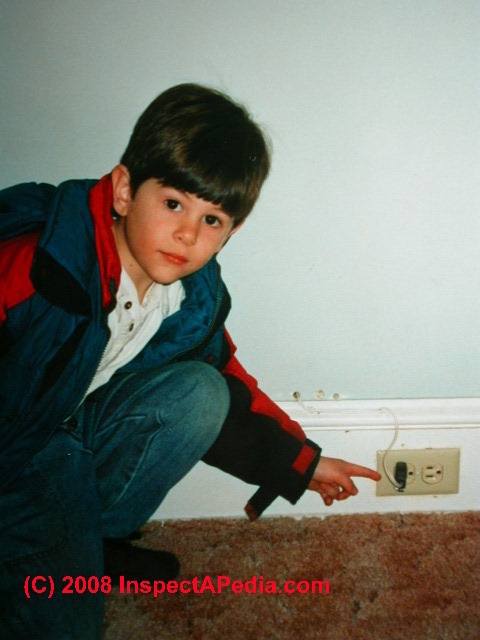
In our photograph at page top a young client shows unsafe electrical wiring - lamp cord that has been run through the building wall cavity. Would we permit him to handle this wiring? Did we let him get too close to make this photograph?
ASHI Home Inspector Educational Seminar Proceedings: ASHI-NE Chapter Annual conference
September 22-23, 2008, Randolph, MA. -- Daniel Friedman.
This is the full text version. A powerpoint presentation version of this class is also available.
Earlier we discussed this topic in detail and offered some strategies in positioning the inspector and client, making sure only one person handles the electrical panel, and other measures. See A HREF="/electric/Electric_Panel_Inspection_Safety.php">ELECTRICAL PANEL INSPECTION SAFETY for these details.
Electrical Inspection Follow up and Client Safety
Since the Standards of Practice for home inspectors (such as those published by ASHI, NAHI, CREIA, and CAHI) require home inspectors to open electric panels, a task not performed in many states during some other types of inspections, we and our clients face additional risks.
In a much less serious incident, the author had the personal experience of having a client ask "What's that?" as he reached over our shoulder to stick his finger right into an open fuse socket.
Among many reports of fires and accidents whose origin was suspected to be electrical, are reported deaths of a number of electricians and electrical workers - people working in some of the same high-risk areas examined by inspectors.
A home inspector or electrical inspector who has reported a very unsafe condition, recommended immediate action, and yet may later learn that occupants of the building were nearly killed by work by an incompetent repairman. [NOTE: Port Jervis, NY, AHS Ctl#4658911, 7/10/90.] What can be done to reduce the chance of this terrible consequence?
Recommending action on an unsafe condition can convert a pre-existing problem into an immediate catastrophe
if the client or owner calls an untrained person to the property or if he attempts a do-it-yourself repair.
Often a referral to local fire inspector, electrical inspector, or utility company can help assure that repairs are prompt, proper, and safe. If you recommend immediate action for an unsafe condition, where possible you should provide some means for the client or building owner to assure that the action which is taken is proper and safe.
Inspectors are properly nervous and reluctant to prescribe the actual repair that is needed at a property - they may not know the detailed repair procedure, or there may be alternative repairs, or their description may prompt an un-trained person to try to do the work.
The Building Owner or Building Manager Needs to Know About Unsafe Conditions that Need Immediate Action
- What kind of trades person, utility worker, or other technician is proper to perform the necessary repair?
- What steps should be taken by the building owner or manager to assure that the repair is proper and safe?
- Is there an independent follow-up authority such as a fire inspector, utility company representative, or building code compliance inspector who should examine the repair?
- Are there well-known and common foul-ups in repair, or local inept repair companies against whom the owner should be warned?
The inspector should inform the appropriate parties both orally and in writing any suspected unsafe conditions.
If an area or component could not be fully inspected, the inspector should explain in writing why she or he did not enter or examine an area or component, and what additional inspections or steps should be taken, as well as the general risks that may be present.
Handling Immediate Threats to Life and Safety at a Building Inspection
If in the inspector's judgment equipment is an immediate threat to life and property, such as a boiler whose flue connection has fallen off, we recommend that dangerous equipment be shut down and the appropriate people notified. See Shutting Down Unsafe Equipment. In some cases "appropriate people" includes not only the client and building owner, but also building occupants.
In some instances such as sparking electrical panels, gas leaks, or evidence of a fire, the inspector and everyone else should leave the building immediately and from outside, call the fire department and as appropriate, the gas company, police, or rescue personnel.
Original text - Daniel Friedman, as ASHI Technical Journal Staff, January 1992,updates February 2006, September 2008. This is the full text version.
A powerpoint presentation version of this class is also available. Readers of this article should also see these other building inspection safety articles: Safety for Building Inspectors.
...
Continue reading at ELECTRICAL INSPECTOR SAFETY PROCEDURES for important basic safety procedures, clothing, and equipment for home inspectors and electrical inspectors, or select a topic from the closely-related articles below, or see the complete ARTICLE INDEX.
Or see these
Recommended Articles
Suggested citation for this web page
ELECTRICAL INSPECTION CLIENT SAFETY at InspectApedia.com - online encyclopedia of building & environmental inspection, testing, diagnosis, repair, & problem prevention advice.
Or see this
INDEX to RELATED ARTICLES: ARTICLE INDEX to ELECTRICAL INSPECTION & TESTING
Or use the SEARCH BOX found below to Ask a Question or Search InspectApedia
Ask a Question or Search InspectApedia
Try the search box just below, or if you prefer, post a question or comment in the Comments box below and we will respond promptly.
Search the InspectApedia website
Note: appearance of your Comment below may be delayed: if your comment contains an image, photograph, web link, or text that looks to the software as if it might be a web link, your posting will appear after it has been approved by a moderator. Apologies for the delay.
Only one image can be added per comment but you can post as many comments, and therefore images, as you like.
You will not receive a notification when a response to your question has been posted.
Please bookmark this page to make it easy for you to check back for our response.
Our Comment Box is provided by Countable Web Productions countable.ca
Citations & References
In addition to any citations in the article above, a full list is available on request.
- Electrical shock injury statistics: www.healthatoz.com - September 2008;
- Mark Cramer Inspection Services Mark Cramer, Tampa Florida, Mr. Cramer is a past president of ASHI, the American Society of Home Inspectors and is a Florida home inspector and home inspection educator. Mr. Cramer serves on the ASHI Home Inspection Standards. Contact Mark Cramer at: 727-595-4211 mark@BestTampaInspector.com
- John Cranor [Website: /www.house-whisperer.com ] is an ASHI member and a home inspector (The House Whisperer) is located in Glen Allen, VA 23060. He is also a contributor to InspectApedia.com in several technical areas such as plumbing and appliances (dryer vents). Contact Mr. Cranor at 804-873-8534 or by Email: johncranor@verizon.net
- "Frequency of Occurrence and Sources of Rust and Corrosion in Electrical Panels," Daniel Friedman, IEEE HOLM Conference, Philadelphia PA, 1992 - see ELECTRIC PANEL RUST for an online version of this article.
- Jim Simmons: Personal communication, J. Simmons to Daniel Friedman, 9/19/2008. Photographs contributed to this website by Jim P. Simmons, Licensed Electrician, 360-705-4225 Mr. Electric, Licensed Master Electrician, Olympia, Washington Contact Jim P. Simmons, Licensed Master Electrician, Mr. Electric, 1320 Dayton Street SE
Olympia, WA 98501, Ph 360-705-4225, Fx 360-705-0130 mrelectricwa@gmail.com - Kenneth Kruger: Original author of the sidebar on testing VOM DMM condition: Kenneth Kruger, R.A., P.E. AIA ASCE, is an ASHI Member and ASHI Director in Cambridge, MA. He provided basis for this article penned by DJ Friedman.
- "How to Use DMM's Safely," Leonard Ogden, CEE News, 888 Seventh Ave., New York, NY 10106, Dec 1990 p.10.
- Dr. Jess Aronstein, consulting engineer, Poughkeepsie NY, 1991 protune@aol.com
- Rex Cauldwell, master electrician and contributor to the Journal of Light ConstructionOn electrical topics
- New York State Central Hudson Gas and Electric Company, G&E/1-2/85 consumer safety pamphlet
- American Society of Home Inspectors, ASHI Training Manual, Al Alk -[obsolete, and includes unsafe practices-DF]
- "Electrical System Inspection Basics," Richard C. Wolcott, ASHI 8th Annual Education Conference, Boston 1985.
- "Simplified Electrical Wiring," Sears, Roebuck and Co., 15705 (F5428) Rev. 4-77 1977 [Lots of sketches of older-type service panels.]
- "How to plan and install electric wiring for homes, farms, garages, shops," Montgomery Ward Co., 83-850.
- "Simplified Electrical Wiring," Sears, Roebuck and Co., 15705 (F5428) Rev. 4-77 1977 [Lots of sketches of older-type service panels.]
- "Home Wiring Inspection," Roswell W. Ard, Rodale's New Shelter, July/August, 1985 p. 35-40.
- "Evaluating Wiring in Older Minnesota Homes," Agricultural Extension Service, University of Minnesota, St. Paul, Minnesota 55108.
- In addition to citations & references found in this article, see the research citations given at the end of the related articles found at our suggested
CONTINUE READING or RECOMMENDED ARTICLES.
- Carson, Dunlop & Associates Ltd., 120 Carlton Street Suite 407, Toronto ON M5A 4K2. Tel: (416) 964-9415 1-800-268-7070 Email: info@carsondunlop.com. Alan Carson is a past president of ASHI, the American Society of Home Inspectors.
Thanks to Alan Carson and Bob Dunlop, for permission for InspectAPedia to use text excerpts from The HOME REFERENCE BOOK - the Encyclopedia of Homes and to use illustrations from The ILLUSTRATED HOME .
Carson Dunlop Associates provides extensive home inspection education and report writing material. In gratitude we provide links to tsome Carson Dunlop Associates products and services.
 | HOME | ABOUT | ASK a QUESTION | CONTACT | CONTENT USE POLICY | DESCRIPTION | POLICIES | PRIVACY | |
| © 2024 - 1985 Publisher InspectApedia.com - Daniel Friedman | |||||||||