InspectAPedia.com InspectAPedia®
Google
InspectAPedia
 

Free Encyclopedia of Building & Environmental Inspection, Testing, Diagnosis, Repair

Ask a Question or Search InspectAPedia

  • HOME
  • AIR CONDITIONING
  • DAMAGE ASSESSMENT
  • ELECTRICAL
  • EXTERIORS
  • HEATING
  • HOME INSPECTION
  • INTERIORS
  • PLUMBING
  • ROOFING
  • SEPTIC SYSTEMS
  • STRUCTURE
  • WATER SUPPLY
  • ENERGY SAVINGS
  • ENVIRONMENT
  • INDOOR AIR IAQ
  • INSULATION
  • MOLD INSPECT TEST REMOVE
  • NOISE
  • ODORS
  • SOLAR ENERGY
  • VENTILATION
  • EXPERTS DIRECTORY
  • CONTACT US


InspectAPedia ® Home

AIR CONDITIONING & HEAT PUMP SYSTEMS

A/C - HEAT PUMP CONTROLS & SWITCHES
AIR CONDITIONER COMPONENT PARTS
AIR CONDITIONER TYPES, ENERGY SOURCES
AIR FILTER EFFICIENCY
AIR FILTERS, FIBERGLASS PARTICLES
AIR FLOW MEASUREMENT CFM
APPLIANCE EFFICIENCY RATINGS

BLOWER DOORS & AIR INFILTRATION
BLOWER FAN CONTINUOUS OPERATION
BLOWER FAN OPERATION & TESTING
BOOKSTORE - Air Conditioning "How To" Books

CAPACITORS for HARD STARTING MOTORS
CAPILLARY TUBES
CLEANING & Legionella BACTERIA
CHINESE DRYWALL HAZARDS
CONDENSATION or SWEATING PIPES, TANKS

DEFINITION of Heating & Cooling Terms
DEW POINT CALCULATION for WALLS
DEW POINT TABLE - CONDENSATION POINT GUIDE
DIAGNOSE & FIX AIR CONDITIONER / HEAT PUMP
DIAGNOSE & FIX HEATING PROBLEMS-BOILER
DIAGNOSE & FIX HEATING PROBLEMS-FURNACE
DUCTS - Asbestos
DUCT INSULATION, Asbestos Paper
DUCT INSULATION for SOUNDPROOFING
DUCT SYSTEM NOISES
DUCTS, Asbestos Transite Pipe
DUST, HVAC CONTAMINATION STUDY

ELECTRIC MOTOR OVERLOAD RESET SWITCH
EVAPORATIVE COOLING SYSTEMS

FAN LIMIT SWITCH
FAN NOISES

GAS EXPOSURE EFFECTS, TOXIC
GAS DETECTION INSTRUMENTS

HEAT LOSS (or GAIN) in buildings
HEAT LOSS (or GAIN) INDICATORS
HEAT LOSS R U & K VALUE CALCULATION
HEAT PUMPS
HEATING SMALL LOADS

INSPECTION CHECKLIST - OUTDOOR UNIT
INSPECTION LIMITATIONS, A/C SYSTEMS

LEED GREEN BUILDING CERTIFICATION
LOST COOLING CAPACITY
LOW VOLTAGE TRANSFORMER TEST

MOTOR OVERLOAD RESET SWITCH
MOLD in AIR HANDLERS & DUCT WORK

OPERATING COST, AIR CONDITIONER
OPERATING DEFECTS, AIR CONDITIONING

REPAIR GUIDE, AIR CONDITIONERS / HEAT PUMPS
REPAIR & DIAGNOSTIC FAQs for A/C

SWAMP COOLERS

THERMOSTATS, HEATING / COOLING
THERMOSTATIC EXPANSION VALVES

WATER COOLED AIR CONDITIONERS
WINDOW / WALL AIR CONDITIONERS
WINDOW / WALL A/C SUPPORTS

More Information

Photograph of attic air conditioning air handler, condensate drips on floor Cooling Coil or Evaporator Coil Ice-up or Frost Over
in Air Conditioners or Heat Pumps
     

  • FROST BUILD-UP on AIR CONDITIONER COILS - CONTENTS:
    • Frost or ice build-up on evaporator coils and its effect on cool air flow and mold: freezing AC coils; Frost or ice formation at air conditioning compressor/condenser units;
    • Ice and condensate problems in air conditioning duct work, why it forms, how bad it can get, how to prevention
  • COOLING COIL or EVAPORATOR COIL - separate article
  • DIRTY COOLING COIL - separate article
  • Questions & Answers about the causes, effects, and cures of icing or frost formation on the air conditioner or heat pump cooling coil
  • References

Click to Show or Hide Related Topics

  • AIR CONDITIONING & HEAT PUMP SYSTEMS - home
  • A/C COMPONENTS
  • AIR FILTERS for HVAC SYSTEMS
  • AIR HANDLER / BLOWER UNITS
  • BACKUP HEAT for HEAT PUMPS
  • BTU CHART for AIR CONDITIONERS / HEAT PUMPS
  • CLEARANCE DISTANCE, HVAC
  • COMPRESSOR & CONDENSING COIL, A/C
  • CONDENSATE HANDLING, A/C
  • CONTROLS & SWITCHES, A/C - HEAT PUMP
  • CONDENSING COIL REPAIR REPLACE
  • COOL OFF HEAT THERMOSTAT SWITCH
  • COOLING CAPACITY, RATED
  • COOLING COIL or EVAPORATOR COIL
  • COOLING COIL CLEANING
  • DATA TAGS on AIR CONDITIONERS
  • DEHUMIDIFICATION PROBLEMS
  • DUCT SYSTEM & DUCT DEFECTS
  • DUCTLESS AIR CONDITIONERS & HEAT PUMPS
  • EDUCATION & CLASSES, HVAC SCHOOLS
  • ELECTRIC MOTOR DIAGNOSTIC GUIDE
  • EXPANSION VALVES, REFRIGERANT
  • FAN, AIR HANDLER BLOWER UNIT
  • FAN AUTO ON Thermostat Switch
  • FAN, COMPRESSOR/CONDENSER UNIT
  • FAN CONVECTOR HEATERS - HYDRONIC COILS
  • FROST BUILD-UP on AIR CONDITIONER COILS
  • GAUGE, REFRIGERATION PRESSURE TEST
  • HEAT PUMPS
  • HUMIDITY LEVEL TARGET
  • MANUALS & PARTS GUIDES - HVAC
  • MINI SPLIT AIR CONDITIONERS & HEAT PUMPS
  • NOISE AIR CONDITIONER / HEAT PUMP
  • ODORS in AIR HANDLERS & DUCT WORK
  • OPERATING TEMPERATURES
  • PORTABLE ROOM AIR CONDITIONERS
  • PRESSURE READINGS, REFRIGERANT
  • REFRIGERANTS & PIPING
  • REPAIR GUIDE - A/C or Heat Pumps
  • REPAIR TOPICS A/C & HEAT PUMPS
  • ROOFTOP A/C / HEAT PUMP
  • SEER RATINGS & OTHER DEFINITIONS
  • SPLIT SYSTEM Ductless Air Conditioners
  • SWAMP COOLERS
  • THERMOSTATS, HEATING / COOLING
  • THERMOSTATIC EXPANSION VALVES
  • WALL CONVECTORS Heating / Cooling
  • WINDOW / WALL AIR CONDITIONERS
InspectAPedia tolerates no conflicts of interest. We have no relationship with advertisers, products, or services discussed at this website.

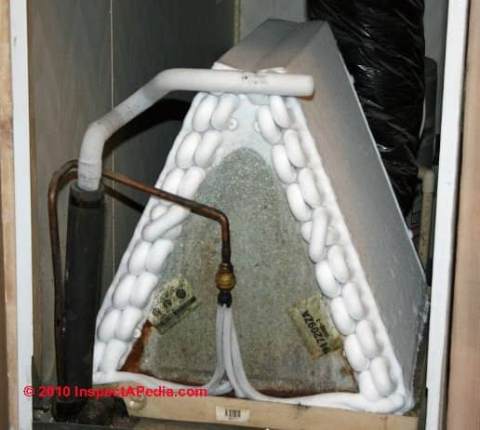
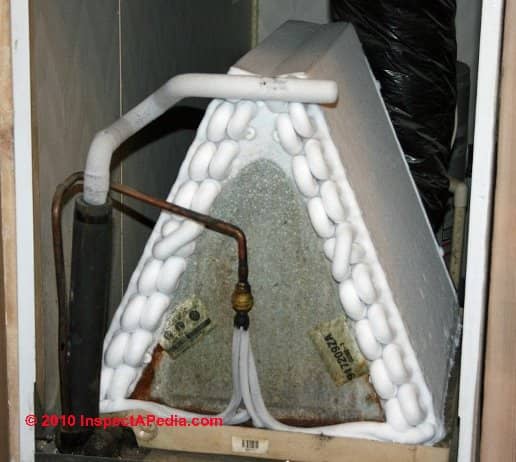
This air conditioning repair article discusses evaporator coil icing: the problems of ice and frost formation in air conditioning system air handler units, blower units, or AHU's, duct work, or other air conditioning system components. A freezing or frosted A/C coil blocks air flow and leads to loss of cooling. If you don't see information you want, ask us for it using the comments box on this page. The air conditioning system evaporator coil and problems of frost build-up on the air conditioning coil are explained and diagnosed here. Readers concerned with ice or water leaks into or out of HVAC ductwork should also see WET CORRODED DUCT WORK and see WATER & ICE IN DUCT WORK. Our page top photograph of a thoroughly ice-blocked air conditioner evaporator coil was contributed by a reader who described: "I cleaned the coils & installed a new filter - obviously I have a low refrigerant problem. This is an 11 year old furnace/air handler with no history of other problems, but low on Freon."

Green links show where you are. © Copyright 2013 InspectAPedia.com, All Rights Reserved. Author Daniel Friedman.

FROST BUILD-UP -Ice or Frost Build-up on the Evaporator Coil or Refrigerant Suction Line on an Air Conditioner

Ice on the A/C refrigerant piping and thermal expansion valve (C) Bill Cauthen D Friedman

If your air conditioning or heat pump system has lost its cooling capacity or won't start see REPAIR GUIDE for AIR CONDITIONERS. See How to determine the cooling capacity of air conditioning equipment if the system seems to be working but is inadequate to cool your building. Contact us to suggest text changes and additions and, if you wish, to receive online listing and credit for that contribution. Page top photo of an iced-up air conditioning evaporator coil are courtesy Guy Benfante.

An air conditioning system will not operate properly and will lose cooling capacity if the evaporator coil becomes blocked with frost or ice. Even though there is all that ice on the evaporator coil the cool air flow out of the system will be reduced as air flow across the coil becomes less and less as the ice area grows.

Our photo (left) of ice formation on refrigerant piping and on the thermal expansion valve in an air conditioner air handler unit was contributed by reader Bill Cauthen.

Why Frost or Ice Forms on an Evaporator Coil

AC Coil ice up (C) Daniel Friedman Bill McNeillFrost line on the cooling coil: When liquid refrigerant enters the evaporator coil temperatures may be as low as 10 degF at that point - that is at the top of the coil at the point of refrigerant entry. In normal operation of a refrigeration system, air movement across the evaporator coil provides enough warmth that frost or ice do not form on the coil.

In fact, as one sees in a refrigeration class, releasing liquid refrigerant into a coil over which air is not being blown will quickly result in frost formation on the coil surfaces, beginning at the point of entry of refrigerant into the coil.

At the point on the cooling coil (with no air blowing across it) where no more frost forms on the coil, we know that there is no more liquid refrigerant in the coil. That is, at this point in its travel through the cooling coil all of the liquid refrigerant that has been introduced has boiled (evaporated) to a gas. Now as all vapor, the refrigerant begins to absorb sensible heat and its temperature will increase. There are pressure increases at this point in the coil too, but they are insignificant.

In a refrigeration class demonstration, we learn that one could, given no other data, determine the proper refrigerant charge or better, the proper adjustment of an adjustable refrigerant metering device (Thermostatic expansion valve) by adjusting the refrigerant flow rate into the coil so that the frost line stops just before the end of the coil.

Normal cooling of building air at the cooling coil: In normal operation an air conditioning system is cooling air by moving it across a refrigerant-cooled "evaporator coil" or "cooling coil" in the air handler.

Dehumidification at the cooling coil: Cooling air passing over the coil also removes moisture from that air - a key factor in making indoor air comfortable in hot weather. (Photo at left of an iced-up cooling coil courtesy of Bill McNeill.)

Normally the moisture that's removed from building air forms condensate on the surfaces of the cooling coil, runs down that surface to a collector pan, and is drained away. [CONDENSATE HANDLING discusses disposing of air conditioning condensate.]


Why frost or ice forms on a cooling coil in an active or in-use air handler

  • The air flow is too slow or has completely halted across the cooling coil. The cause of this problem could be as simple as a dirty air filter or it could be crimped, disconnected ductwork or even improperly-sized ductwork.
  • The refrigerant is not being metered properly into the cooling coil, (too little is being released). A clogged capillary tube or a frozen, dirty, stuck thermostatic expansion valve can cause this trouble.

    Watch out: adding refrigerant to "fix" this problem by raising the compressor head pressure will indeed force more refrigerant through the system. But if/when that piece of crud blows out of the metering device too much refrigerant will flow back to the compressor, slugging it, perhaps destroying it when liquid refrigerant reaches the compressor internal parts. See REFRIGERANT METERING DEVICES TEVs and REFRIGERANT METERING CAPILLARY TUBES

Below in this article you will see What Are the Common Causes & Repairs for Ice or Frost Build-up on an Air Conditioning Cooling Coil (the Evaporator Coil)? for our complete diagnostic list of causes and effects of cooling coil ice and frost blockage.

Any or all of those conditions cause the level of refrigerant in the cooling coil to be too low; if there is some refrigerant but not enough the coil may become abnormally cold, freezing the condensate that forms on the cooling coil surface as moisture condenses out of air moving across the coil. This freezing condensate liquid can form frost and may build up into a coil icing problem or frost may appear on the cooling coil's refrigerant suction line.

When the surface of a cooling coil or suction line drops below 32 degF (say from too little refrigerant in the system or too little flow of warmer air across the cooling coil) frost formation is likely on that surface. Conversely, when the air conditioning system is working properly the surface temperatures on the cooling coil and on the refrigerant lines stay above 32 degF.

In some installations the evaporator coil tend want to drop below 32 F even in normal operation, but air movement across the coil keeps its temperature higher, and thus avoids freezing. On some commercial refrigeration or air conditioning systems where lower temperatures are common, a defrost cycle is designed into the equipment. If an icing problem is occurring on commercial cooling systems, in addition to checking the refrigerant charge and air flow, the service technician will also check out the defrost cycle timer.

What Happens to the Ability of the Cooling System to Cool the Air When an Evaporator Coil Ices Up?
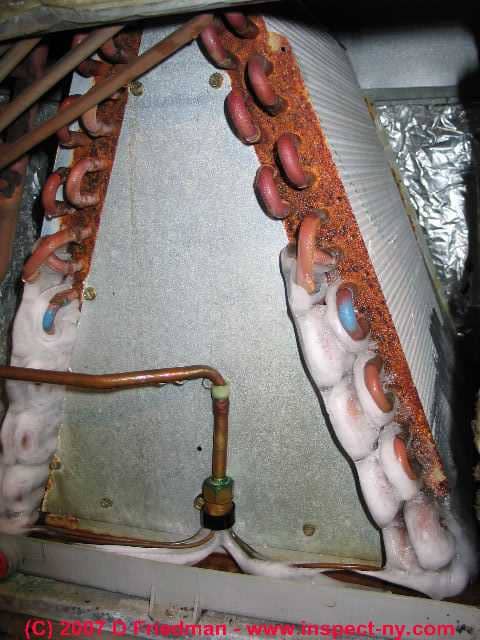
Photograph of attic air conditioning air handler, condensate drips on floorWhen the cooling coil has a nice thick ice build-up on its surface there will be no cool air produced by the air conditioning system at all. The fan runs, outside compressor/condenser run, but little or no air moves through the duct system. The page top photograph shows icing on the cooling coil and refrigerant lines exiting the coil inside air handler close to the evaporator coil even.

You might see ice formation on the suction line just outside of your air handler even though you cannot see the evaporator coil itself - on most residential air conditioning systems, the surfaces of the cooling coil are not readily accessible by the homeowner. But if you don't see ice on the suction line, ice could still be present on and blocking air flow through the cooling coil.

The cooling coil, or evaporator coil is visible if the air handler is opened on some air conditioner units. At other installations the cooling coil is completely covered and can't be seen at its location (say on a retrofit installation atop an existing hot air furnace) unless an inspection opening has been made (by cutting the steel and installing an access panel cover), or unless there is an opening that was made previously to install a humidifier in the same plenum chamber.

When an air conditioning system with a frost-blocked coil is turned off and allowed to warm up the ice on the coil melts and spills into the internal condensate collector tray in the air handler. Then when the air conditioner is re-started it may for a while produce cool air before becoming ice blocked again. If an air conditioning system behaves in this way coil icing is a possible explanation.

Frost build-up indicates an air flow or refrigerant problem. A blocked coil (by dirt) or a blower fan which has lost its ability to move air (such as a dirty squirrel cage fan) will reduce air movement across the coil and lead to frost build up there. We suspect this is the more common cause of this defect. We discuss the problem of dirt on the cooling coil slowing air flow and leading to ice-build-up at DIRTY COOLING COIL.

[Photograph of ice formation at the suction line of an air conditioning compressor/condenser unit (and some odd insulation there) courtesy of Mark Cramer a past president of ASHI and a Florida home inspector.]

What Are the Common Causes & Repairs for Ice or Frost Build-up on an Air Conditioning Cooling Coil (the Evaporator Coil)?

As we introduced in the previous article, when the surface temperature of an air conditioning or refrigeration evaporator coil (cooling coil) drops below 32 degF or 0 degC, condensate forming on the coil surface begins to freeze, leading to sometimes some pretty weird behavior of the cooling system, none of it good.

The following causes of cooling coil icing or refrigerant line icing are arranged roughly alphabetically, not in order of most-likely. In our experience the most common causes of A/C coil icing are blocked/stopped air flow or lost refrigerant charge.

  1. Control board failure: if the the HVAC/R system control board is defective it may not be sending the signal to the compressor to shut down when the thermostat has been satisfied. In that case at the indoor air handler / blower unit the blower fan has stopped (and on commercial equipment louvers in the duct system have closed) but the compressor keeps sending refrigerant to the cooling coil. The problem could be in the thermostat, thermostat wiring, or the control board itself may need replacement. Thanks to reader R. Hansen for this tip.

  2. Cooling coil fan (the blower in the air handler unit) has stopped working. A bad fan motor relay, a bad fan motor itself in the air handler unit (some call this the "evaporator fan"), lost (or someone turned off) electrical power to the air handler blower, or even a blocked fan blade or loose fan blade on motor shaft or a fan blade blocked by ice (rare in most residential air conditioning system designs), or a lost, or broken fan belt (if your motor is not a direct drive unit) can cause coil frost formation.

    The blower fan (air handler fan or evaporator coil fan) should run when your thermostat is calling for cooling. The motor could also be off on thermal overload or reset - see ELECTRIC MOTOR OVERLOAD RESET SWITCH. With electrical power to the blower unit off, see if the fan blade moves freely. If not the fan motor assembly needs repair or replacement.

  3. Damaged cooling coil fins can also lead to evaporator (cooling) coil freezing: when the coil cooling fins are bent and crushed sufficiently to block a significant portion of air flow across the coil, icing is likely. See DAMAGED COOLING COIL for details on how to recognize and fix this problem.

  4. Debris-blocked evaporator coils might lead to evaporator coil icing: When an air conditioning or refrigeration unit evaporator coil becomes sufficiently blocked with debris as to slow down the air flow enough, the coil may actually become so cold that the condensate forming on its surface freezes, completely blocking the coil. That's because the rate of release of refrigerant into the evaporator coil was designed with an assumption of a sufficient volume of air moving across the coil to keep it from becoming too cold. We discuss dirty evaporator coils in more detail at DIRTY COOLING COIL. Dirty or debris-blocked evaporator coils are caused by running the air conditioning system without an air filter in place. The coil will need to be cleaned to get the system working again. See DIRTY COIL CLEANING PROCEDURES.

  5. Defrost control: A malfunctioning auto-defrost control or bad defrost timer control (less common on residential air conditioning systems)

  6. Dirty air conditioning filter can block or reduce air flow across the cooling coil, leading to coil frost. This is the first component a homeowner should check since the fix: replace the air filter, is so easy. See AIR FILTERS for HVAC SYSTEMS

  7. Dirty blower fan blades or non-functioning blower fan assembly: an air handler blower unit that is not moving as much air as it should will be blowing too little air across the evaporator coil. This is a less likely but possible cause of frost build-up on the cooling coil. See DIRTY A/C BLOWERS for details. Don't forget to check for a dirty blower fan itself - dirt can significantly cut airflow produced by the fan. See BLOWER FAN OPERATION & TESTING

  8. The refrigerant charge is too low. If there is a refrigerant leak, the first symptom may be coil icing; but later as refrigerant continues to be lost, all cooling may be lost and the coil will no longer be frosted or iced over. In our opinion it's better to find and fix the refrigerant leak. See articles beginning at REFRIGERANTS & PIPING.

  9. Refrigerant loss or expansion valve problems might lead to cooling coil ice-ups: an improper charge or amount of refrigerant in the system can cause frost build-up on the evaporator or cooling coil. Too-little refrigerant can cause temperature in the coil to be abnormally low, leading to icing. Really. We discuss the detection of air conditioning refrigerant leaks in detail at A/C REFRIGERANT LEAK DETECTION.

    Watch out: air conditioning refrigerant leaks are not normal and should be found and fixed. it's better to find and fix a leak than to turn your leaky air conditioning system into a stop on your repairman's regular refrigerant delivery route.

  10. Thermostatic Expansion Valve malfunction: a bad TEV or capillary tube that is not metering refrigerant into the evaporator coil at the proper rate can cause frost build-up or icing on the evaporator coil or cooling coil. We discuss thermostatic expansion valves (some call them thermal expansion valves or TEVs) in more detail at THERMOSTATIC EXPANSION VALVES.

  11. Wall thermostat not working properly: a thermostat that fails to stop calling for cooling can lead to coil icing. When the set-temperature on the thermostat has been reached in the room where the thermostat is mounted, the thermostat should stop calling for cooling (or its switch should "open". But wall thermostats are so simple that unless someone has damaged the thermostat or operated it in a very dirty environment we don't find that the thermostat problem is a defect in the unit itself. More often it's operator error: the thermostat is not set properly, or it is set to a low temperature that the cooling system simply can not reach.

    Watch out:Don't just try quickly and repeatedly turning the thermostat up and down. Some air conditioner compressors may have trouble re-starting against the head pressure of refrigerant in the condenser unit. So if you keep switching the A/C system on and off the system may stop on a thermal reset. If you suspect you've caused this just leave the air conditioner off for 15 to 30 minutes and then turn it back on. See HARD STARTING COMPRESSOR MOTORS.

Just let the cooling coil ice melt? Watch out: advice you may find in some air conditioner repair articles such as "turn off the system and let the ice melt" are only partly correct. Turning off the air conditioning system for a sufficient length of time will indeed let the ice melt. But icing will simply return when the system is turned back on if you have not also found and fixed the cause of ice and frost formation in the system.

CONTACT us to suggest additions or corrections to this diagnostic list.

Why Frost or Ice May Appear on an Air Conditioning Refrigerant Suction Line

Photograph of ice formation on the suction line of an
air conditioner compressor/condenser unit in Florida -- Mark Cramer The ice formed here is at the low pressure inlet to an air conditioning compressor condenser unit. Similar ice may form at the evaporator coil (also called the cooling coil) or at the refrigerant suction line on the cooling coil at other end of the air conditioning system, as you can see in our iced-up air conditioning cooling coil photograph at the top of this page. [More photographs wanted].

Frost and ice can even form inside air conditioning duct work, leading to troublesome leaks into the building. This article explains locations and causes of condensate, frost or ice formation in air conditioning systems, air handlers, compressor/condensers, refrigerant lines, and in air ducts.

Several reasons can cause frost or ice formation not only on the cooling coil, but on the refrigerant suction lines at the equipment as well:

  • Blocked air flow across the cooling coil, for example from a dirty air filter, collapsed duct insulation, crimped flex-duct, or similar problem.
  • Refrigerant charge level: Improper refrigerant charge (too low a charge of refrigerant in the A/C system can, for a while, lead to too-low temperatures in the coil which will then cause frost or ice build-up on the suction line.

    Ultimately however, when there is simply little or no refrigerant left in the cooling system, temperature at the cooling coil will climb back up, the frost will disappear, and you'll no longer have any cooling at all. In air conditioning service schools the instructor may demonstrate this effect by dynamically adjusting the amount of refrigerant in the cooling system as students watch the frost line extend down the suction line, then crawl back up to near the end of the cooling coil as the proper refrigerant charge amount is reached.

    Alternatively, on some cooling systems too much refrigerant can cause liquid refrigerant to flow past the cooling coil into the suction line,also causing icing.
  • TEV/Cap Tube: a malfunctioning refrigerant metering device like a bad thermal expansion valve (TEV). Conversely, a bad capillary tube (a more rudimentary refrigerant metering device found on refrigerators, dehumidifiers, and window air conditioners) won't fail by passing too much refrigerant but it might fail to pass any refrigerant at all if it becomes blocked by debris or by a slug of oil in the system.
  • Defrost control: A malfunctioning auto-defrost control or bad defrost timer control (less common on residential air conditioning systems)

Technical Note on Refrigerant Piping, HVAC Design and Heat Exchange Between the Low Pressure & High Pressure Refrigerant Lines: an HVAC economizer detail using refrigerant line brazing or soldering together

In some air conditioners or heat pumps at the point where the low-side suction line enters the compressor condenser unit the low-temperature (heat laden) vapor line (suction line) is soldered or brazed right next to and touching the high-temperature, high-pressure liquid refrigerant line. The purpose of this refrigerant piping detail is to act as a heat exchanger, to reduce the temperature of the liquid refrigerant that is going to enter the metering device (TEV or cap tube), gaining some benefit to system operation. Details about soldering or brazing the two refrigerant lines in direct contact are discussed at REFRIGERANT PIPING & DISTANCES - at Technical Note on Refrigerant Piping: HVAC economizer detail

Other Causes of Ice Formation in Duct Work, What Happens, How to Stop and Prevent Air Conditioner System Ice Formation

Details about water and ice in ductwork are found at WATER & ICE IN DUCT WORK.

In freezing climates such as New York where some homes route their top floor HVAC ducts along the attic floor, sometimes that ductwork is not well insulated and just as it gets too hot in summer (increasing the cost of air conditioning), in winter the same ducts become too cold, increasing heating costs. But something else funny can happen in homes with attic ducts that are used only for air conditioning.

One of our clients called us to investigate a claim that had resulted in litigation against the company who had installed a new roof on their home. The owner claimed that the roof was leaking. The roofer claimed that the roof was perfect. What was curious was that the roof "leaked" only at the end of winter, and at times when there had been no rain and when there was no melting snow on the rooftop.

What we observed was the following causes of ice in the air ducts:

  • There were leak stains at most of the top floor air conditioning ceiling-mounted supply registers.
  • There were leak stains at the top floor ceiling mounted return air register
  • The home had hot water baseboard heating and used its ductwork only for air conditioning during the summer
  • The home had a problem of chronic basement water entry and was in general pretty damp, even in winter
  • Inspecting the home's attic and the duct work in the attic I was astonished to find that in the dead of winter the ducts had about 2" of solid ice in the bottom of the ductwork! Ice was thickest closest to the supply or return registers and was thinnest in the middle of the duct runs
  • [Have you guessed yet?]
  • Inspecting back out of the attic and at the supply registers on the second floor, all of them were open - which is pretty common - few people think to close off un-used air conditioning supply registers in winter.

The duct ice problem was occurring because warm moist air was circulating by convection during winter, rising up into both the supply and return registers, flowing through the duct work, and leaking out of an open air handler. As the warm moist air entered the attic, the ducts were absolutely freezing cold. Moisture first condensed, then formed ice inside the duct system.

Ice accumulated in the duct system throughout the winter a little at a time, until it was several inches thick.

When the weather warmed all that ice in the ducts melted and leaked back out into the upper floor in a stunning flood. The owners, who were not thinking particularly clearly about whether or not it was raining or whether or not there was melting snow on the roof, saw that it was "raining inside" out of their air conditioning ducts and through other ceiling locations (since the ducts were not water tight there was leakage out of the ducts at other areas besides just at the supply and return air registers.

The solution to this problem had two components:

  1. Close off all of the ceiling mounted supply and return air ducts (at the registers) at the end of the air conditioning season since they were not needed for heating. This stopped the flow by convection movement of warm house air into the un-used A/C duct system. (Warm air rises up into a cool space.)
  2. Identify the sources of high indoor moisture (such as basement water entry) and fix them so that the house is not abnormally damp. (Stop providing high levels of moisture un-wanted in house air.)

The roofing contractor was happy with this solution and the building owner was relieved as well. Perhaps because their roof had previously been leaking, before it was replaced, when they saw water coming through their top floor ceilings they thought that it was still leaking. Of course the ice in ducts problem won't occur in homes which use the same duct system for winter heating, nor will it occur in climates where freezing weather is uncommon, though we still might see some surprising in-duct condensation in some cases.


Frequently Asked Questions (FAQs) about ice & frost formation on air conditioner or heat pump coils, refrigerant lines, expansion valves & other components

Click to Show or Hide FAQs

...

Question: What causes ice to form on the cooling coil in an air conditioner or heat pump?

the unit get frozen,cleaned, freon ok,could it be the compressor/ - Anon 6/6/11

how often is the compressor the problem with icing - Anon 6/6/11 -

My friends condensor coil is iced up and his house is warm. The outside temp is 89. What can be the cause and if we run a hose on the coil will it help the problem by melting the ice ? - Jack Christian 7/8/11

I have a small haier air conditioner window until, you can open it right up in the front and see all the exposed ice. What would most likely be the problem and how could I find it to fix it? - Brianna Shollenberger 7/8/11

The article has cleared some doubts which I had since a long time. As I understand now, likely causes of ice formation are unclean filter/coil, incorrect amount of refrigerant, or thermostat not working properly. Hope this helps to solve problem I have been having with our bedroom AC. Ice starts forming if I set the temperature to 24 degrees centigrade, or less. Without cooling, the room temperature is around 30 degrees. - Ramesh Chopra 7/17/2011

Reply: the most common causes of ice formation in the air conditioner are:

Ice formation inside the equipment on the coils or refrigerant metering devices is not a normal operating condition, but it's a common defect often traced to

  • Any problem that has stopped or reduced air flow through the system, such as a dirty air filter or crimped or disconnected air ducts. Collapsed or crimped air ducts, collapsed duct interior insulation, a closed duct damper, closed supply registers, or a dirty blower fan in the air handler unit, even a mis-wired thermostat or bad system control board can also cause reduced or halted air flow. Find and fix the air blockage.
  • Low or lost refrigerant - can cause evaporator coil icing because of abnormally low pressures on the low side of the cooling system. Often this condition deteriorates to no more coil icing and no cooling whatsoever as the refrigerant leak continues and eventually there is just little or no refrigerant gas left in the system. Find and fix the leak and recharge the system.
  • A refrigerant metering device problem such as a dirty or mi s-adjusted thermal expansion valve or a partly-blocked capillary tube. Dirt in the system, compressor oil circulating into a capillary tube, and ice on the TEV can cause these problems as well.
  • Please review the more extensive description of causes & cures for ice formation in the article above

If a cooling coil or other components inside the air handler or air conditioner is freezing up the cause needs to be found and fixed; Iced coil means less or no air flow across the coil - it stops working. That's why the indoor temperature creeps up and why air flow is further reduced in the system.

A small amount of frost found on the refrigerant lines right at the uninsulated line at the entry to the cooling coil and sometimes at the compressor is common and may not be serious.

Brianna in your small A/C unit icing is most likely one of two things:
a dirty air filter is slowing airflow across the evaporator coil OR the level of refrigerant in the unit has dropped a bit too low.

Ramseh: yes; I'd add that a bad thermostatic expansion valve could also cause coil icing. The first cause I suspect is a dirty air filter, the second cause I suspect is low refrigerant.

Question: poor cooling traced to iced coil traced to dirty air filter

Our problem began with a poorly performing unit. The Ice only formed after the visit by a licensed hvac tech
recommended by our ins. co. who wanted to install a completely new system. I discovered the ice this A.M. and on climbing into the attic to check the coil I found the thermostat control cable had been intentionally crimped in an attempt to break the wire inside. It's an old unit but now I'm on my own trying to eke out the truth. BTW the tech never mentioned the possibility of a dirty filter. It was covered completely with dust. Hopefully the coil is dirt free since there is no access. - Jim 5/29/11

Reply:

Jim:
too bad your service tech missed the clogged filter - you might want to mention to him or her that that's what you found - it might help another customer.

I wouldn't assume the tech tried to sabotage your system, more likely it was someone without experience. Unfortunately it's too easy to recommend replacement of equipment when some careful diagnosis might be what should be done first.

Question: ice build up on one side of the cooling coil

I have a lot of ice build up on one side should I just turn it all off and let it melt? I think it's a dirty filter and will try first after ice is gone Just concerned about where all the water will go. When ice drains. And a little concerned about why all the build up is all on one side. Love to hear ideas or suggestions. - Brandon Tully 5/25/12

Reply:

Brandon, you can turn off the A/C to let the iced coil melt and clear, but it will ice up again if you don't find and fix the problem. Typical causes are dirty filter, dirty coil fins, or improper refrigerant charge. Icing may be asymmetric depending on the level of refrigerant in the system, OR on some systems that inject refrigerant via cap tubes into more than one place in the cooling coil, if one tube section is blocked and the other is not, you can get one sided icing on the evaporator coil.

Question: replaced fan blower, but now little or no air flow, frost seen on refrigerant lines

I had the fan blower replaced yesterday. Worked fine for about 12 hours, but now there is very little/no air flow from vents, though whatever is coming out feels cool. Outside fan and new motor are running fine, but there is a bit of frost on both an outside pipe and on the inside unit(a pipe going into it), as well as a little bit of condensation on the inside unit. Any ideas? - Sam 5/28/12

Reply:

Sam, several things can cause reduced airflow such as a dirty filter, disconnected duct, or iced coil. If the coil is not frosted over inside the cooling unit but the air that blows across it is made chilled, I suspect a blower or duct problem. A little condensation in the unit is normal. A low refrigerant charge can result in first icing of the coil and later, when there is still less refrigerant in the system, loss of cooling.

Check the cooling coil in the air handler for ice blockage or dirt blockage. If the coil is clean and not iced, and as you previously had good air flow, we don't think it's a dirty air filter. I'd look for a collapsed or blocked flex-duct line, or a similar blockage. If the coil is ice-blocked then the diagnosis and repair suggestions in the article above are the right approach.

Question: had the AC coil replaced with a used one - would this cause ice up on the compressor/condenser

had a coil changed out, on side of box stated that this coil was filled with new 410 refridgerant. the unit outside was replaced with a used one and the installer said he used r22 , would this caused a coil to ice up and back up to outside unit? - Cathi 6/7/11

Reply:

Cathi: certainly mixing two different refrigerants will not permit proper air conditioner operation.

Question: can I use a blow drier to get ice off of my cooling coils?

Can I blow dry the ice that is on my ac coils ? Paris 6/10/11

Reply:

Yes Paris, or you can just leave the system turned off to allow the ice to melt; however this is more of a diagnostic step than a repair since unless the problem that caused ice to form is fixed it will just recur.

Question: I've been told closing off some rooms in the house can cause coil icing

My wife insists on closing two of the five rooms upstairs off, and sealing the vents. I've been told this can cause the coils to freeze. Is that correct, and if so, will opening the doors and removing the vent covers thaw it out or will I need to do more? - BDM

Reply:

BDM:

I don't think that closing off two of five rooms would be enough A/C air blockage to cause coil freeze-up, though indeed if most of the air flow were blocked that coil icing problem would be likely.

Try closing off the rooms as you wish - just shut the registers using the adjustable lever. You shouldn't need to "seal" the vents. A little leakage out of them won't make much difference in system operation.

Then if you notice a reduced air flow at your other room supply registers you'll want to check inside the air handler (turn off power first for safety) to see if the coil is icing. If it is icing up and never did before, and assuming that nothing else (like a dirty air filter) is blocking air flow, leave the system off for an hour or so to let the ice melt and go back to opening the vents in question.

Question: HVAC fan on continuously to help defrost an iced-up cooling coil?

Will leaving the HVAC fan on continuously help defrost an iced-up cooling coil?

Reply:

Tony:
Yep, leaving the fan on all the time is using the fan to help "defrost" the icing coil. But you still don't want coil icing - it's wasting energy and interfering with the cooling system. Your A/C guy is right that a faulty TEV (thermostatic expansion valve) COULD be the problem but also there could be other causes (dirty filter, blocked air flow, or low refrigerant level).

Question: frozen coils, no air flow, found low refrigerant, added refrigerant, coils frozen again

(I have a very old Rheem) Frozen Coils with no air flow Saturday and Tech found little over a 1 lb low on R-22. Sunday better air flow not cooling, tech found he overcharged and removed R-22. System ran normal for 3 days. Thursday coils froze and tech (new tech, same company) found low and added.. ran normal. Friday morning awoke to find no air flow and coils frozen again. Turing off AC and the fan on has melted the ice and air flow is restored.

Both techs were hesitant to look for leak with dye- and suggested putting that money into a new unit. I know the unit is old- but am I crazy to try to find the leak? Compressor is a little noisy- but it has been that way the 6 years we've lived here.. and doesn't seem like it would cause loss of refrigerant. To get this fixed over the Holiday weekend- and quickly- I went with a company I have never used- so I'd love a second opinion. - Scott 7/8/11

Reply:

Scott:

Quite so: too much OR too little refrigerant can cause icing in the system. If it were me I'd ask the techs to find and fix the refrigerant leak. A leak in refrigerant lines in a system that is otherwise working fine is no reason to replace the equipment itself. And surely finding and fixing a leak in tubing is cheaper than replacing the whole system.

An exception to that view is if inspection discovers that the evaporator coil is so badly corroded or so much of other systems are so badly corroded that leaks are likely to be everywhere and recurrent - in that case it's time for a more extensive replacement.

Question: evaporator coil and suction line keep freezing up

I have a 2005 Duroguard A/C hooked up to an old GE gas furnace. The evaporator and suction line freeze up constantly. Tech checked high side pressure only, it was good. Furnace blower motor, capacitor and filter were replaced and the unit still freezes. The thermostat works normally. I am beginning to suspect a bad TEV or cap tube. Does that sound like the problem? - Chuck 7/8/11

Reply:

Chuck: indeed if the refrigerant charge is correct and airflow across the coil is good but icing is still occurring, I'd suspect a bad TEV. (Thermostatic expansion valve). Some TEVs are adjustable. And a TEV can be clogged or blocked by dirt, debris, or ice.

Question: ice formation at the point of entry to the cooling coil

I have a 20 yr-old amana ac unit, that is freezing at the point of entry, the hose into the furnace, a small coil of ice. It had been serviced last year with an addition of freon and a good hose down to improve air flow. This year another good hose down after it slowed down and couldn't keep up. Now it won't keep up again, set at 74 and seems stuck at 77, checked and that's when I saw the ice. Have a dehumidifier in the furnace room going.. any thoughts? - Martha 7/19/11

Reply:

Martha, ask your service tech to check for a refrigerant leak or loss and also for proper functioning of the thermostatic expansion valve.

Question: persistent ice formation on the cooling coil, letting it melt off doesn't fix anything

My small apartment AC does not sufficiently cool my place. The thermostat is set on 75 and the temp is around 83 (I live in a very hot, dry climate). There is ice/frost on my coil and so I called a repairman who told me it's because I have set the temp too low and "it will never be 75 degrees in here" and told me to turn off the unit until the ice melts, and to change my filter, then he left. I changed the filter and the day after it's iced over again and still not cooling down. Should I call him back and have him check for something more specific this time? - Daisy 7/25/11

Reply:

Daisy, if the coil is frost-covered that means that either the air flow across the coil is blocked or reduced (say a dirty air filter) or the refrigerant charge is low (leak) or the refrigerant metering device is not working properly.

The advice from the repairman was a gift to you in that it's good starting advice and was probably free. But now that we don't think the airflow is blocked and you've changed the filter, you need a service call to diagnose and fix the icing problem. If the unit's fan is working properly and moving plenty of air then I suspect a refrigerant problem.

Question: owner does her own diagnostics on poor air conditioner performance

Been waiting all day for the HVAC repairman and it is 100* out, so thought I'd do some research of my own & be knowledgeable when he gets here. First noticed this morning, house was warmer so I checked the air vents on both 1st & 2nd floors of my house & there was GREATLY reduced airflow, almost nothing coming out. But I heard the A/C unit running on the outside of the house ...sounded a little louder than normal. I went and checked it & the metal piping leaving the A/C had a lot of ice build-up very near where the piping leaves the AC unit (this piping is covered w/a foam insulter(I am guessing)) & it is the piping that runs from the AC to the entry on the side wall of my house. The only thing we have done differently in the past few days is adjust the lever on the furnace unit inside the basement so more airflow goes upstairs to our bedrooms & less airflow downstairs & we shut the main floor vents to help force more air to the warmer area upstairs. I did have the thermostat on 65* for several hours but that was on almost 2 days ago, but when we got the upstairs cooled down, I turned it back to 70-72*. Any help would be great. Oh, also, the outside unit/fan was running fine, but had to turn it off to thaw it out, and haven't turned it back on because I don't want it to freeze again before AC guy comes to take a look. THANK YOU! - Kristen 7/26/11

Reply:

You're doing some good diagnostics on coil frost or icing on your air conditioner, Kristen. The basics to check before calling the HVAC repair technician is to assure that both air handler indoors and compressor/condenser outside are running, that the air filter is clean and in place, and that no one has adjusted a supply or return air duct damper nor damaged ductwork so as to block air that should be flowing across the evaporator coil.

Provided the air routing adjustments you made didn't simply cut off air flow inside the air handler I wouldn't expect that to have caused coil icing. Let us know what your tech says - it may help other readers.

Reader follow-up:

Thanks for your comments Dan. The AC repairman came and ran a test on our AC and it needed Freon, so far so good & it's been running for 6 hours trying to get back to a decent temperature in the house. It was up to 82* & now back down to 75*. Hoping to get it back to 70*. I went outside (now after dark) & checked the pipe with a flashlight. No ice, but pipe is VERY cold since it has been running so long. Is it okay for the the AC to run this long continuously since we are trying to get the house to cool down?? Or do I need to adjust the thermostat to 75* and give the AC a break from running. I'm not sure if these things are built for this/or meant to run this long continuously. We have about 2200 sq ft (I think) above ground 2-story, & another 800 square feet of finished basement, but mainly trying to get the upstairs sleeping quarters cooled down. I would hate for the AC man to have to make another trip out since he is actually about an hour from our house. Any thoughts ..I'm afraid the pipe could freeze again since it was so cold to the touch (even though the Freon level is back to normal). Thanks again.

Adding comments to my earlier problem w/freezing pipe on outdoor home AC unit. The pipe did freeze again, & we figured out why on our own. Since it is okay now, we believe it was a combination of the low freon in the beginning, and our furnace fan was pulling so much air to cool the house that the filter was actually almost stuck in the slot (like it was pulling a lot of suction), not to mention when needed to change our filter. So our diagnose for the freezing pipe as of now is this: a combination of low Freon, dirty furnace filter that was making it work overtime & running to long w/out lowering the indoor temperature enough, & we also had closed all the main floor vents, so we opened a few back up to make sure air was coming in and out properly. Hope this helps someone. - Kristen 7/27/12

Reply:

Good going Kristen on diagnosing those cooling system problem sources. You need a service tech to fix a refrigerant leak and charge a system, but a dirty filter or collapsing air filter are tasks most homeowners can tackle.

When your home has been quite hot for days, it could take the air conditioning system quite a while, (hours not days) to get the temperature back down, as the thermal mass of the home affects the cooling load. For example drywall walls and ceilings that are warm have to be cooled off too. - DF

Question: the hvac tech added refrigerant - what should I do to avoid repeat service calls?

My AC output was low for some time. On opening the cover I noticed heavy icing on cooling ducts. The young technician who came instantly said that gas had leaked and it requires a refill. Should there be other reasons to avoid repeat technician visits? - Kulbir Labana 7/30/11

Reply:

Kulbir: yes, if the refrigerant gas has leaked out of the system then just putting more refrigerant in is only a temporary fix. You will want a service tech to find and fix the gas leak or other causes of icing that are described in the article above. .

Question: frozen pipe outside my air conditioner unit - bad switch not lost freon?

Pipe frozen at outside unit and the inside unit would stop running but the outside unit would continue to run. I made an appointment for service. The tech came out and checked my freon level, he said it was fine and suggested that my problem may be the compressor. I told him that I was out of town all week and did not notice any problem before I left. He then told me that severe weather came through the area a few days prior and I should call my insurance agent to file a claim. The insurance agent sent someone out to check it. This turned out to be another heating and air company.

This guy said that the freon levels were good but s switch needed to be replaced. He replaced it but three weeks later I have the same problem and have no idea what to look at myself to see what the problem could be. My air filter is new. Both units come on and off together. No registers are closed. I checked for dirty coils outside then went into the attic, up there the coils had frost on them hours after I shut everything down. - Jason 7/30/11

I have the same problem as Jason, only it is intermittent (once every two weeks or so). Ha,ve had two contactors(?) replaced since last year. What can I tell repairman to test next? - Jackie 8/2/11

Reply:

Jason if your inside unit (air handler, cooling coil, blower fan) stops running, I'm not clear how a bad outdoor compressor would make the inside air handler unit stop. A bad switch can be the culprit and sometimes even a replacement part can be bad, or the conditions that burned up the first switch could burn up the second one, indicating that more careful testing and diagnosis to find a root cause are needed.

Jackie, I would be careful not to be too directive to the repairman; but I would press for an explanation of why the same part keeps being replaced; it's natural to suspect that a different problem is damaging the part that's being swapped out.

Question: if I close off the upstairs will that solve my air conditioner compressor and evaporator coil problems?

I've read through a ton of comments here, and I appreciate all of the answers you gave. It seems that there's only three causes for the evaporator coils icing issue. We moved into our house here in south Texas from Alaska about 9 months ago. It was a foreclosure, but things were in good shape, except for the compressor. The sellers agent replaced it free of charge and worked great up until 3 months ago. That's when the problems started.

First they could a leak in a joint right on the outside of the in-house unit, he refilled it with 5 out of the 12lbs that are supposed to go into the unit. 2 weeks later, another call to the tech cause of an icing issue. This time, with dye and an electronic sniffer, he said it was the coil itself, and it was COVERED in rust. $1000 later, labor only, thank you carrier warranty, i have a new evaporator coil. This last week has been HOT here in south Texas. I've shut a lot of the rooms to save on cooling bills as I have since we moved in. Could me closing off the entire upstairs cause the system to keep dying like this? Thanks for the help to all of us! - Jeff Collins 8/7/11

Reply:

Jeff:

- leaks of refrigerant resulting in low refrigerant levels can indeed cause coil icing;
- improperly operating thermostatic expansion valve that does not meter refrigerant at proper rate can cause icing
- low air flow can cause icing - and of course several things can cause low air flow such as dirty filter or a blower fan problem

For sure, closing off part of a home is well within the normal things that a homeowner might do and in no way should it be capable of damaging the HVAC system. I suppose if someone could close enough supply registers as to greatly reduce airflow across the coil it could, however, contribute to an icing problem there.

Question: sweating on the A/C suction line

My suction line is sweating just before it enters the furnace and drips into the pan causing water buildup, therefore, shutting off my pump, and then shutting off the furnace unit. There is about 5" of pipe not insulated just before it enters the indoor unit. Will wrapping this prevent the dripping? - Sean 8/12/11

Reply:

Sean, most likely, insulating the suction line will stop condensation on its surface. You can use foam insulation tubes designed for that purpose.

A/C manufacturers recommend that the insulation be secured with plastic ties or a protective tape, and they emphasize that you should not crimp the insulation by the ties or tape since doing so will compromise its insulating value.

Question: central air coils keep forming ice, cleaning and filter changes didn't help; our system never reaches the set temperature on the thermostat

Our central air conditioning coils inside the house keep forming ice. We have had a repairman come out clean all the coils, inside and out. We have also changed filters. Could the possibility that my husband turns down the thermostat to 50 degrees when we turn it back on to cool the house, that it never gets to that temp, runs all the time, and refreezes? - Angi 8/28/11

Reply:

Angi even at a thermostat setting that keeps the air conditioner running constantly the cooling coil should not ice up - after all lots of people might use that setting - it's within the bounds of what people might do and the system design has to handle that setting.

More likely your system is low on refrigerant, or perhaps a refrigerant metering device is not working properly or you have low air flow across the coil due to a dirty blower fan, dirty filter, leaky ductwork, blocked airflow - the sorts of problems we discuss in the article above.

Since you've cleaned the coils and changed air filters, I'd look at
- refrigerant charge (if it's low there is a leak to find and fix as well as need to re-charge)
- blocked or leaky ductwork and reduced air flow across the coil, maybe also from a dirty blower fan

Question: AC Heat Pump Keeps Freezing Up Outside

AC heat pump unit is freezing up inside, I guess the coils, and the outside unit had ice on one pipe. the unit is about 10 years old and i think it has only been serviced once during that time. I am recently divorced and broke. Will the heater work this winter, I can do without ac till spring, or do I need to repair or replace it to have heat? - Lee 9/7/11

Reply:

Lee you need a service tech to diagnose and correct the problem or just as you'll have no cooling now, you may have no heat in winter - which will, unfortunately, be costly itself.

You don't have to use the A/C in hot weather if you can tolerate the temperatures, though depending on where you live there could be mold risks if the indoor humidity is too high.

In winter, without your heat pump you'll be running on backup heat that is likely to cost more over the whole winter than the cost of repairing and using the heat pump.

Question: how do I close off return air ducts when not used in winter

We have an air-handler installed in our attic, laying on its side, for air-conditioning. There are the circle vents of supply and return air, in each room. The article says to close them both in the winter, but only the supply ones have a little handle where I can close them off. I hear this is the common way to do this, so how is it possible to close the return air ones?
2nd question: When we bought this house, there were several places where the ceiling had leaks, and we thought it was from a bad roof, but now find that it is where the drain tube from the condensation, froze and cracked in the winter. How can we stop this, it is pretty much on the floor in the attic, and no way to get it higher as it goes to the outside wall. - Anon 10/23/11

Reply:

Anon, at WATER & ICE IN DUCT WORK we describe the causes of ice formation in HVAC ducts routed through a cold attic or ceiling. Indeed by natural convection warm moist air can rise up into ceiling or high-wall HVAC supply or return air ducts when the HVAC system is not operating.

And yes it's easy to close off a supply duct as most have operable louvers or register closures. To close off high or ceiling mounted return ducts we recommend a magnetic cover sold for that purpose; some homeowners just cover their ceiling return openings with clear plastic wrap or aluminum foil - more ugly but functional. Just remember to remove it before turning the system back on.

Question: ice on an ammonia based chiller

why ice on ammonia chiller or evaporator in an arena? - Ali Khan 1/30/12

Reply:

Ali ice can form on any HVACR equipment when conditions produce temperatures below freezing. The root causes are the same as those listed in the article above, regardless of the refrigerant gas or chemical used.

Question: no air flow at some of the HVAC ducts, good air flow at others?

I understand that low refrigerant and low air flow can cause freezing I get that. But I have Carrier split heat system where the air handler is in the attic standing upright. On top of the air handler are three air supply "taps". Two on front and one in the back. The two taps on the front go to the back of the house. The one tap in the back goes to the front with spiders taps of off that to registers. The back tap off the air handler has no air flow what so ever. None at the register it feed.

I went to the first spider leg of this tap and took the duct work off and turned on the unit. No air flow and no blockage. Why would my unit have two taps with air flow and one with none and ice up every time I turn it on? Also I had the unit charged last night, which didn't take much. By 6 am this morning the coil was frozen. Any thoughts would be appreciated. - Anon 5/16/12

Reply:

If the same air handler is feeding all of the duct systems and two have good air flow while the third does not, you want to look for a closed duct damper, missing or leaky duct connections, a crimped, constricted air duct, or an air duct where internal insulation has collapsed. There is a blockage or a closed duct damper or something to find.

Question: can I use water to get ice off of the refrigeration equipment?

Can I pour water on iced pipes - Terrence 5/26/12

Reply:

yes, it wont hurt the piping, but it won't fix anything, and indoors could be quite a mess. And of course don't wet any electrical components.

Question: frost on the evaporator coil, slugged compressor motor

had frost on evaporator coil and suction line. cleaned dirty coil and melted ice by turning furnace on. Turned A/C back on but only got 75F at nearest register. Did I ruin the compressor? Is there a protection device for compressor? - Greg Nelms 4/17/12

Reply:

Greg, you could be running out of refrigerant. Running the compressor briefly = may be ok, but don't keep running it since compressor motors rely on the presence of refrigerant for cooling and lubrication.

Reader follow-up:

Dan,The day the coil iced up was an unusually warm day in NJ. Wife turned A/C on in the afternoon, I did not get home till 9 PM and found the iced condition. The evaporator coil was excessively dirty {even though I change the 90 day filter every 45 days}. Temperatures here are back to normal and have not tried the A/C since that day. Afraid I slugged the compressor. - Greg Nelms 5/1/12

Reply:

Greg,

Unfortunately if the compressor was slugged, you can't un-do it. You can have the system cleaned and inspected. If the compressor is damaged it'll be noisy, or won't work at all.

Question: is frosting caused by an AC compressor with poor pumping?

evaporator fan ok and evaporator coil clean , I suspect the cause of the frosting of the suction pipe is because the AC compressor has poor pumping. - Simon Yengi Wani 5/6/12

Reply:

I don't think so, Simon. If the air conditioner compressor were not pumping or could not develop a vacuum the result would be no frost and no cooling.

Question: diagnosing more reasons for ice build up on an air conditioner

I read this article and helped me to understand about what is happening on our air conditioning unit. This is the situation, a month ago i and my mom have purchased Hitachi Ras-25rc, at first i didn't know that the model we bought is i think included in a list of models that is for phase out. Recently i have noticed that water has starting to drip off our indoor unit. When i opened the suction grill to expose the evaporation coil and air filler i found out that there was an ice build up all over the evaporation coil. Do you think the reason of the build up is one among those written/stated above? but although there are reasons yet i cannot specify the problem that causing the building of ice on our evaporation coil.

I have been searching the internet about the model Ras-25rc yet i still cannot find any information about it. Can someone who is knowledgeable about Hitachi products help me in understanding Ras-25rc? all i have here is manual and i don't know if it is inverter or if it can cause us high bill or anything that is necessary for me to know. Thank you.. - Prince Jose Miguel 4/19/12

Reply:

PJM: I'm not sure we can reliably diagnose your system from just the information you've provided. Above we list several causes of ice formation on a cooling coil, of which the two most basic are a low refrigerant charge (or defective refrigerant metering device) or blocked airflow due to dirt or a dirty filter.

You have identified the symptom- ice, but not the cause.

You can yourself make sure that the system is clean and has good airflow. A tech is needed to check or correct a refrigerant problem.

Before giving up on the unit it is certainly worth an inspection by a trained HVAC service technician. Keep us posted -what you learn will help other readers.

Question: if the outdoor coil has ice on it is this low refrigerant?

Outside coil has ice on it and Thermostat is set at 73 but shows 75 in house is this low refrigirant - Anon 5/1/12

Reply: is this a heat pump stuck in heat mode?

Anon, outside coil? That's the compressor/condenser unit. Indeed there is a problem but it may not be low refrigerant, it could be that or other problems. I would shut off the system to stop the risk of further damage and call a service tech.

If your system is a heat pump, then possibly the heat pump stuck in heating mode could also show this problem if the refrigerant level were low or if any of the other causes of coil icing were present. That's because in heating mode at a heat pump, the roles of the outdoor coil and indoor coil are reversed: in heat mode the indoor coil is used to put heat into indoor air and the outdoor coil is used to obtain heat from outdoor air by chilling itself.

Question: air leaks out of the drip line and cables at my air conditioner, freezing coils half way up

I was in my crawlspace under the house and noticed a lot of air coming from where the drip line and other cables were coming from. My coils have been freezing but only about halfway up. Could this be a leak from the blower to the duct? Could this be causing my coils to freeze? - Alan 6/23/12

Reply:

Alan, I'm unclear what that air leak is - perhaps a leak out of the blower compartment? Out of a supply duct? If so it ought to be sealed, but I don't think that'd be a cause of frost formation; Refrigerant lines should be insulated. Coil frosting is discussed in the article above.

Question: added refrigerant, but four days later ice was back - back to the original issue

Two weeks a go, we placed a service call for additional freon as we thought that was why air wasn't reaching thermostat setting. Service guy suspected a possible freon leak, but added 3 gallons of freon. Four days later, we were back to original issue. I checked lines running into outside unit (where fan is located) to see that there was significant ice build up. We've turned off A/C for now. I looked for filter, but couldn't find where one would be. Based on above sounds like dirty filter, faulty TEV or refrigerant leak are all potential causes. Anything else I should think of before calling a different service guy? - Brian 7/8/12

Reply:

Brian, at AIR FILTERS for HVAC SYSTEMS (article links listed at Related Topics ) you will find a description of various places to look for the air filter on an air conditioning system - or search InspectApedia for "find the air conditioner filter"

"back to the original issue" sure suggests the problem was not cured, or your refrigerant leak is a big one; I don't like adding refrigerant to a system without finding and fixing the leak - HVAC equipment does not normally consume refrigerant. Sometimes a tech will just add refrigerant because it's cheap and quick rather than tracking down a hard to find leak. But 3 gallons is a huge addition - a big leak - that ought to be found and repaired.

Question: AC blows cold air but won't reach set temperature - could it be the thermostat?

our a/c is blowing cold air but temperature will not reach to what i set on thermostat. thermostat reads 79, and even when i set it at 74 or 75, it never gets cooler than 78. this was also on a day it was 105+ outside. a/c was just serviced 2 weeks ago and reported in perfect working order, but thermostat was recently replaced. i don't THINK something is wrong with the a/c system, but is it possible the thermostat could be malfunctioning and causing these problems? any thoughts? - Alex 7/11/12

Reply:

Alex,

The thermostat is basically an "on-off" switch. If it's calling for cooling and the room temp never reaches the set temp on the thermostat, the problem is not likely anything to do with the thermostat. Only if the thermostat fails to respond to room temp would I think otherwise.

Depending on the size and condition of your cooling system, its installation details, duct work, capacity, and similar factors, in a home with high heat gain in very hot weather, the system may be unable to reach the set temperature. Your hvac service tech would probably check to see if the system is producing cool air at a normal temperature and that the air flow is not blocked or reduced by a defect such as a dirty air filter or cooling coil or duct defect.

Question: old refrigerator, chopped ice off the freezer, punched a hole in the tube

Probably not the place for me - I'm sure to get a couple laughs here but what the hell. I have a really nice old refrigerator (1945 G.E.) that was in the basement of our cafe for years. One of the staffers thought she'd be helpful chipping the ice off the freezer coils and put a hole in the tube. Enough said. I love this old fridge. Before getting rid of it completely, I was thinking of converting it to a keg fridge and using an old dehumidifier refrigeration system. It is possible to relocate the evaporator. into the cooling space and the condenser/compressor outside without opening the lines as the fridge's top is removable.

My question is this: If I use a fan to circulate air over the evaporator coil inside the fridge and a fan on the condenser located outside the fridge, what happens to the pressures? Would this system cool the fridge and be reliable? Note that as a keg fridge, the space once cooled would not be frequently opened - hopefully preventing frost buildup etc. - Jason 7/14/12

Reply:

Jason first the refrigerant leak has to be repaired and the system properly charged. You might be able to salvage the system by soldering or expoxying the hole and having it recharged. It is difficult to solder aluminum but possible using the proper temperature and aluminum solder; epoxy is easier to try; because the freezer compartment is on the low pressure side of the system such a repair may work.

You are right that a dehumidifier is basically a chiller, but you'll probably find that the dehumidifier's operating temperature range is not designed to drop temperatures down into the range you'd use for refrigeration purposes.

Question: Gurgling heard in the cooling coils; I see a fill valve on my compressor - can I use it to top up the system?

Actually I also just looked closer at the compressor and it has a fill valve on it. I removed the bolt valve-cap and under it is a torx screw. Can this just be used to top up the system? I suspect it's just low based on the fact the freezer coil gets marginally cool but not enough.

You can hear gurgling in the aluminum coils. The condenser gets only slightly warmer than room temperature. The compressor gets very hot after a 24 hour period, while the inside of the fridge reaches about 3 degrees Celsius with ambient of 23 Celsius. The other day it was 35 degrees C and the temp inside the fridge got to plus 10. Not cold enough for beer. Could the capillary tube be clogged from the idiots who had the fridge before me tipping it on its side? Can it be vacuumed out and fully recharged again? The compressor is so quiet you have to almost touch it to feel it vibrating. So now, use the dehumidifier parts as explained below or have this fridge serviced by someone with a vacuum pump? - Anon 7/15/12

Reply: take a look at the sight glass on the refrigerant liquid line - do you see bubbles?

Anon: indeed you've reminded me of a diagnostic clue that I have forgotten to include in our HVAC notes: looking at a sight glass on the refrigerant line, or listening as you did, bubbles can indeed be an indicator of low refrigerant charge.

We describe watching the sight glass while charging a refrigeration system at REFRIGERANT CHARGING PROCEDURE.

I'm a bit uncomfortable with the idea of just "topping off" low refrigerant in that the equipment should never be leaking; it's best to find and fix the leak, though I realize that under time and cost pressure some techs just deliver refrigerant and move on.

Charging a home air conditioner is not a step I recommend to homeowners or a handyman; special equipment, training, even knowing how to purge and then hook up the gauge and charging equipment, matching the right refrigerant, knowing the right charge amount are all stuff learned in HVAC school.

Question: can exposure of the outdoor compressor/condenser unit to sunlight cause indoor air handler coil frosting?

Our AC units sit on the west side of the house in the sun every day, all day in the Vegas heat. We've had the units replaced twice. We are now again having problems with the one unit's fans not spinning around. Could it be because something in the attic is icing up? - Rhonda 5/11/12

Reply:

Rhonda hot conditions increase the load on the outdoor compressor/condenser unit, as the fan and condensing coil have to work harder to condense hot high pressure refrigerant gas back to a liquid. But I'm not sure how I can translate that into an indoor coil frosting problem. Some homeowners try cooling down a super hot outdoor compressor/condenser with spray from a garden hose (don't soak electrical components, simulate rain fall straight down) to see if that improves system performance. If it does, and if other measures check out on the system, providing shade without blocking airflow can help.

Question: Water Chilled air conditioner for a marine vessel

I have repaired a water chilled air cond for a marine vessel, our men renew the entire piping for HP and LP circulation, after install all, the refrigerant only able to inserted up to 30psi, when running the system, it wont let any refrigerant to be inserted, and the piping and cooling coil start frozen and ice build up. I don't know what is the cause of defects, anyone can give some advises? thank you. - Dave 5/18/12

Reply:

Dave it's possible that a capillary tube or thermal expansion valve (TEV) is clogged or frozen. Keep in mind that the procedures for charging on the high side of the system expect liquid refrigerant while charging on the low side of the system can only be safely done with refrigerant in a gas form. Details are at REFRIGERANT CHARGING PROCEDURE.

...

Ask a Question or Search InspectApedia

Questions & answers or comments about the causes, effects, and cures of icing or frost formation on the air conditioner or heat pump cooling coil

Ask a Question or Enter Search Terms in the InspectApedia search box just below.

Technical Reviewers & References

Related Topics, found near the top of this page suggest articles closely related to this one.

Click to Show or Hide Citations & References

  • Carson, Dunlop &
Associates Ltd., TorontoCarson, Dunlop & Associates Ltd., 120 Carlton Street Suite 407, Toronto ON M5A 4K2. (416) 964-9415 1-800-268-7070 info@carsondunlop.com. The firm provides professional home inspection services & home inspection education & publications. Alan Carson is a past president of ASHI, the American Society of Home Inspectors. Thanks to Alan Carson and Bob Dunlop, for permission for InspectAPedia to use text excerpts from The Home Reference Book & illustrations from The Illustrated Home. Carson Dunlop Associates' provides:
    • Commercial Building Inspection Courses - protocol ASTM Standard E 2018-08 for Property Condition Assessments
    • Home Inspection Education Courses including home study & live classes at eleven colleges & universities.
    • Home Inspection Education Home Study Courses - ASHI@Home Training 10-course program.
      Special Offer: Carson Dunlop Associates offers InspectAPedia readers in the U.S.A. a 5% discount on these courses: Enter INSPECTAHITP in the order payment page "Promo/Redemption" space. InspectAPedia.com editor Daniel Friedman is a contributing author.
    • The Home Reference Book, a reference & inspection report product for building owners & inspectors.
      Special Offer: For a 10% discount on any number of copies of the Home Reference Book purchased as a single order. Enter INSPECTAHRB in the order payment page "Promo/Redemption" space. InspectAPedia.com editor Daniel Friedman is a contributing author.
    • The Home Reference eBook, an electronic version for PCs, the iPad, iPhone, & Android smart phones.
      Special Offer: For a 5% discount on any number of copies of the Home Reference eBook purchased as a single order. Enter inspectaehrb in the order payment page "Promo/Redemption" space.
    • The Illustrated Home illustrates construction details and building components, a reference for owners & inspectors.
      Special Offer: For a 5% discount on any number of copies of the Illustrated Home purchased as a single order Enter INSPECTAILL in the order payment page "Promo/Redemption" space.
    • The Horizon Software System manages business operations,scheduling, & inspection report writing using Carson Dunlop's knowledge base & color images. The Horizon system runs on always-available cloud-based software for office computers, laptops, tablets, iPad, Android, & other smartphones.
  • Carson Dunlop, Associates, Toronto, have provided us with (and we recommend) Carson Dunlop Weldon & Associates' Technical Reference Guide to manufacturer's model and serial number information for heating and cooling equipment
    Special Offer
    : Carson Dunlop Associates offers InspectAPedia readers in the U.S.A. a 5% discount on any number of copies of the Technical Reference Guide purchased as a single order. Just enter INSPECTATRG in the order payment page "Promo/Redemption" space.

  • Modern Refrigeration and Air Conditioning, A. D. Althouse, C.H. Turnquist, A. Bracciano, Goodheart-Willcox Co., 1982
  • Principles of Refrigeration, R. Warren Marsh, C. Thomas Olivo, Delmar Publishers, 1979
  • "Air Conditioning & Refrigeration I & II", BOCES Education, Warren Hilliard (instructor), Poughkeepsie, New York, May - July 1982, [classroom notes from air conditioning and refrigeration maintenance and repair course attended by the website author]
  • Refrigeration and Air Conditioning Technology, 5th Ed., William C. Whitman, William M. Johnson, John Tomczyk, Cengage Learning, 2005, ISBN 1401837654, 9781401837655 1324 pages
  • Thanks to inspector Bill McNeill for providing a photograph of an ice-blocked evaporator coil or cooling coil in an air conditioning air handler unit. Mr. McNeill can be reached at wem007@hotmail.com
  • Thanks to reader [Anonymous] for providing a photo of a totally blocked cooling coil on an 11-year-old system that was low on refrigerant. August 2010.
  • Thanks to reader Tom Balla for suggesting clarification on ice formation on the air conditioning system suction line.
  • Thanks to reader R. Hansen for adding air conditioning / heat pump control board failure tip that explains another cause of cooling coil or system icing. Email: rhansen79@yahoo.com July 2012

Books & Articles on Building & Environmental Inspection, Testing, Diagnosis, & Repair

  • Our recommended books about building & mechanical systems design, inspection, problem diagnosis, and repair, and about indoor environment and IAQ testing, diagnosis, and cleanup are at the InspectAPedia Bookstore. Also see our Book Reviews - InspectAPedia.
  • Home Reference Book - Carson DunlopThe Home Reference Book - the Encyclopedia of Homes, Carson Dunlop & Associates, Toronto, Ontario, 25th Ed., 2012, is a bound volume of more than 450 illustrated pages that assist home inspectors and home owners in the inspection and detection of problems on buildings. The text is intended as a reference guide to help building owners operate and maintain their home effectively. Field inspection worksheets are included at the back of the volume. Special Offer: For a 10% discount on any number of copies of the Home Reference Book purchased as a single order. Enter INSPECTAHRB in the order payment page "Promo/Redemption" space. InspectAPedia.com editor Daniel Friedman is a contributing author.

    Or choose the The Home Reference eBook for PCs, Macs, Kindle, iPad, iPhone, or Android Smart Phones. Special Offer: For a 5% discount on any number of copies of the Home Reference eBook purchased as a single order. Enter INSPECTAEHRB in the order payment page "Promo/Redemption" space.

  • GO TO Carson Dunlop's Home Study Course Information - How to Become a Home Inspector: Carson Dunlop's nationally recognized Home Study Course, selected by ASHI the American Society of Home Inspectors and other professionals and associations. This website author is a contributor to this course.
  • GO TO Carson Dunlop's Home Study Course Information - How to Become a Home Inspector: Carson Dunlop's nationally recognized Home Study Course, selected by ASHI the American Society of Home Inspectors and other professionals and associations. This website author is a contributor to this course.
  • GO TO Carson Dunlop's Home Study Course Information - How to Become a Home Inspector: Carson Dunlop's nationally recognized Home Study Course, selected by ASHI the American Society of Home Inspectors and other professionals and associations. This website author is a contributor to this course.
    Building inspection education & report writing systems from Carson, Dunlop & Associates Ltd
  • Carson Dunlop, Associates, Toronto, have provided us with (and we recommend) Carson Dunlop Weldon & Associates' Technical Reference Guide to manufacturer's model and serial number information for heating and cooling equipment
    Special Offer
    : Carson Dunlop Associates offers InspectAPedia readers in the U.S.A. a 5% discount on any number of copies of the Technical Reference Guide purchased as a single order. Just enter INSPECTATRG in the order payment page "Promo/Redemption" space.

  • Complete List of Air Conditioning & Heat Pump Design, Inspection, Repair Books at the InspectAPedia Bookstore.
  • Air Conditioning SEER - New DOE Air Conditioner and Heat Pump Efficiency Standard
  • ...
HOME ABOUT CONTACT COPYING DESCRIPTION POLICIES PRINTING PRIVACY © 2013 Copyright InspectAPedia.com